
Home Care Agency Recruiting: You Need Less Budget Than You Think
Home care recruiting does not need a big budget. In Boostpoint's 2026 Social Job Advertising Benchmark, the median caregiver and home care applicant cost $3.76, and 31% of people who clicked finished the application. Across 263 Boostpoint-managed home care campaigns in 2025 and 2026, more than a third ran on under $150 in total spend — and those campaigns produced applicants at $6.87 each, below the home care average of $8.40. The barrier to running caregiver ads has never been budget. It's been knowing what to spend it on.
Source: 263 Boostpoint-managed home care campaigns run between January 2025 and mid-2026, drawn from a wider set of 478 healthcare campaigns across 30 employers representing 24,712 applications. Boostpoint's canonical 2026 Social Job Advertising Benchmark (891 campaigns, single methodology) reports median cost per applicant of $3.76 for caregivers, $7.72 for CNAs, $12.77 for LPNs and $19.08 for RNs; where this earlier analysis and the benchmark differ, the benchmark figure is canonical.
The assumption that keeps agencies out
Most independent home care agency owners we talk to assume paid social advertising is something the national franchises do. It sounds like a channel with a minimum — a few thousand dollars a month, a marketing person to run it, a content library you don't have. It's the most common misconception we run into across healthcare recruiting.
The data says otherwise, and the pattern is consistent enough to be worth showing.
| Campaign budget | Campaigns | Applications | Cost per applicant |
|---|---|---|---|
| Under $75 | 7 | 24 | $10.89 |
| $75–$150 | 88 | 1,503 | $6.81 |
| $150–$400 | 28 | 1,541 | $5.52 |
| $400–$1,000 | 135 | 9,035 | $9.13 |
| Over $1,000 | 5 | 838 | $7.87 |
Source: 263 Boostpoint-managed home care campaigns run between January 2025 and mid-2026, drawn from a wider set of 478 healthcare campaigns across 30 employers representing 24,712 applications. Boostpoint's canonical 2026 Social Job Advertising Benchmark (891 campaigns, single methodology) reports median cost per applicant of $3.76 for caregivers, $7.72 for CNAs, $12.77 for LPNs and $19.08 for RNs; where this earlier analysis and the benchmark differ, the benchmark figure is canonical.
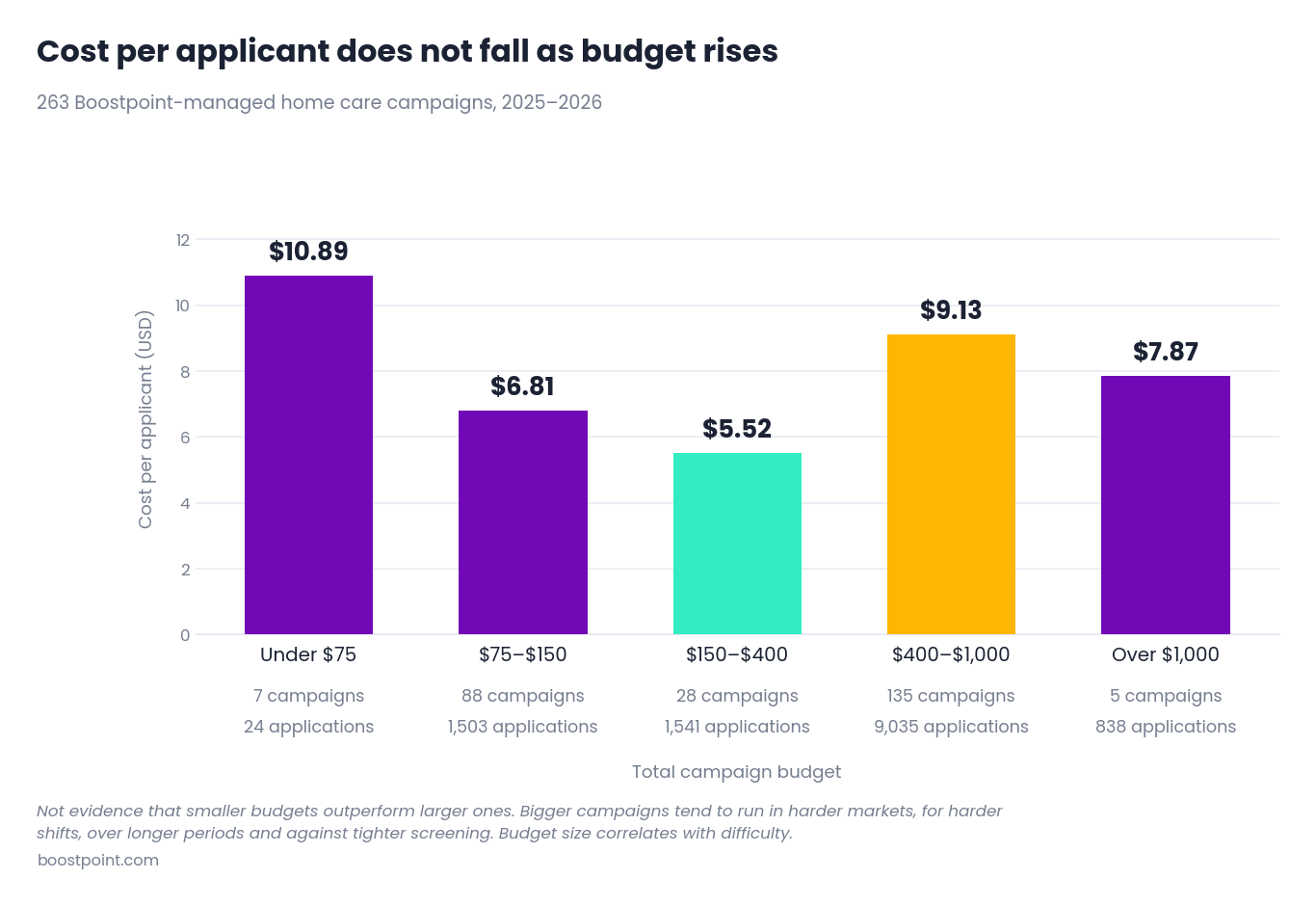
Cost per applicant does not fall as budget rises. The $150–$400 band was the most efficient in our data. The $400–$1,000 band — where most campaigns sit — was among the least.
Read that carefully, because it's easy to over-conclude. This isn't proof that small budgets outperform large ones. Bigger campaigns tend to run in harder markets, for harder shifts, over longer periods, and against tighter screening criteria. Budget size correlates with difficulty.
But it does establish the thing that matters for a small agency: there is no threshold you have to clear before this works. Campaigns under $150 in our data produced 1,527 applications at $6.87 each — a working channel at a budget an independent agency can approve without a board meeting.
What $150 actually buys
Concretely, from the campaigns in that band: roughly 16 applications per campaign.
For an agency filling two or three caregiver positions, sixteen applications is not a trickle. It's more than most job board postings produce in a month, and it's enough to be selective rather than hiring whoever answers the phone.
The median home care campaign in our full dataset ran $541 and produced 24 applications. So the relationship isn't linear — quadrupling spend didn't quadruple applications. Which is precisely why starting small is a reasonable way to find out whether this works in your market before committing more.
The multi-market pattern
One agency in our data illustrates a different approach worth understanding, particularly for anyone operating across several territories.
One national provider ran 90 separate campaigns at a median budget of $117 each, each one scoped to its own market — Augusta, Warner Robins, Murfreesboro, Lufkin, Meadville, Pittsburgh, Minneapolis, Beverly, Portland. Total: 1,358 applications at $7.45 per applicant.
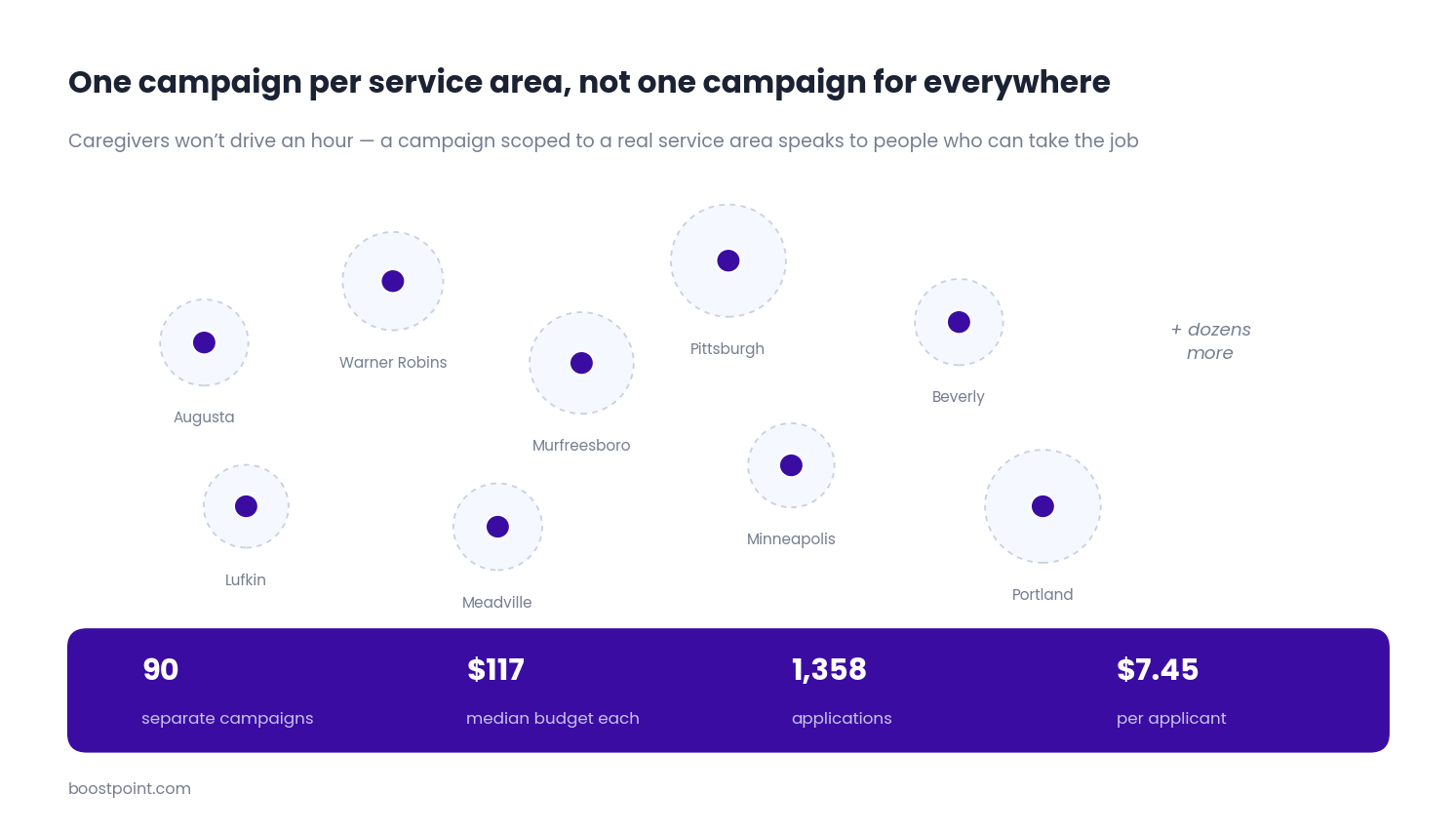
That's a structurally different model from one large campaign covering a wide area, and it's better suited to how home care actually works. Caregivers won't drive an hour. A campaign scoped to a single service area speaks to people who can realistically take the job, and it lets you turn markets up or down independently as your census shifts.
A job board posting can't do this economically — each market needs its own posting and each one competes for whatever small group of local people happen to be searching. Because social reach doesn't depend on local search volume, adding a market is a campaign setting rather than a supply problem.
For a multi-territory franchise or an agency expanding into an adjacent county, that's the mechanic that makes expansion staffable.
What agencies actually paid
The full range across our home care and senior living clients runs from a little over a dollar per applicant to the mid teens — a twelve-fold spread, and almost none of it is execution quality.
The agencies at the low end are filling caregiver roles in defined suburban service areas. The organizations at the high end are hiring clinical staff across large multi-state footprints. For the blended figure, caregiver applicants cost $3.47 on average.
Home care and senior living organizations recruiting with Boostpoint
Which band you land in is determined mostly by three things: how dense your service area is, how tightly you screen, and which roles you're filling. A caregiver in a dense suburb and an RN across four states are different products, and the number reflects that.
Where the money is actually lost
For most agencies, budget isn't the constraint. Three other things cost far more.
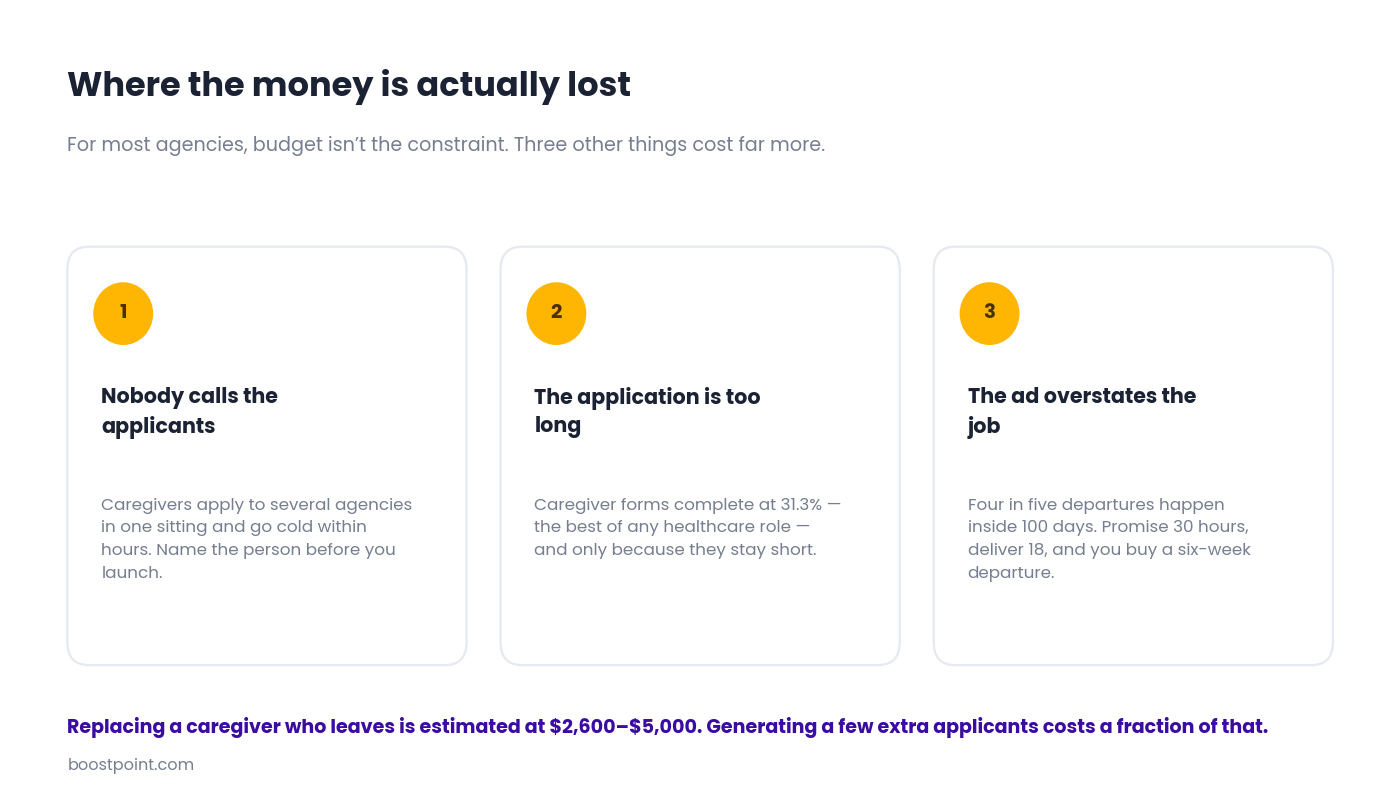
1. Nobody calls the applicants
Caregivers apply to several agencies in one sitting, usually from a phone on a break. The agency that responds within minutes is talking to someone still thinking about working. The agency that calls back Thursday about a Tuesday application is calling someone who already started somewhere else.
If you don't have someone who can work applications the same day, don't turn the ads on yet. You'll pay for candidates you never speak to, and then conclude the channel doesn't work. Name the person before you launch.
2. The application is too long
Caregiver applications in our data complete at 31.3% — the best rate of any healthcare role, and that only holds because the forms are short enough to finish on a phone.
Every question you add costs completions. Ask the four things that genuinely disqualify someone — shift availability, reliable transportation, travel radius, any experience minimum — and save references and paperwork for after you've spoken.
3. The ad overstates the job
Nearly four in five caregivers who leave do so within their first 100 days, and shift mismatch and unpaid travel time are leading causes. An ad that promises 30 hours and delivers 18, or omits that the client is thirty-five minutes away, buys you a hire and a six-week departure.
An honest ad produces fewer applicants and better ones. At $3.47 per caregiver applicant, generating a few extra is cheap. Replacing a caregiver who leaves is estimated at $2,600 to $5,000.
How to hire caregivers fast
To hire caregivers fast, put a short mobile application in front of people near your clients and call every applicant the same day: in Boostpoint's 2026 Social Job Advertising Benchmark, caregiver and home care campaigns converted 31% of clickers into applicants, the highest apply rate of the 15 role families, at a $3.76 median cost per applicant. Speed comes from what happens around the ad, not from spending more on it. The steps that decide it:
- Name the caller before launch. Caregivers apply to several agencies in one sitting. Whoever calls first is talking to someone still deciding; a callback two days later reaches someone who has already said yes elsewhere.
- Ask only what disqualifies. Shift availability, reliable transportation, travel radius and any experience minimum. Save references, documents and background check consent for after the first conversation. Every added question costs completions.
- Scope each campaign to a service area. Employment ads on Meta run under a Special Ad Category with a 15-mile minimum radius and no targeting by age, gender or ZIP code, so one campaign per territory is the practical unit. The rules are on our Meta Special Ad Category page.
- Start at an ordinary budget. Across all 891 campaigns in the benchmark, half of campaign-months ran on less than $334, with a median of 20 applicants per campaign-month. That is an all-role figure, not a caregiver one, but it shows speed does not require a large commitment.
- Check frequency weekly. Once the same people have seen your ad more than 3.0 times in a month, median cost per applicant rises to $18.76. When a campaign passes 2.5, widen the radius or change the creative rather than adding budget.
- Do not wait for a season. Federal hires data for health care and social assistance show a 1.46x swing between the busiest and quietest months, which is not a season. Frontline roles in our data take a median of about four weeks from campaign launch to a filled shift once the posting is right.
The ad itself has to be accurate about hours and drive time, because a fast hire who leaves in six weeks puts you back at the start. What goes into the ad copy is on caregiver recruitment strategies, and where else to look is on where to find caregivers. Cost per applicant is not cost per hire.
What you need before you start
Five things, none of which are budget:
- A competitive rate for your service area. Advertising surfaces a weak offer faster, not slower. Check what other agencies within twenty minutes are posting.
- Someone who can call applicants the same day. Name them before launch.
- Your actual knockout criteria written down. Shift, transportation, travel radius, experience minimum. That list becomes the application.
- Somewhere for applicants to land. An ATS, or at minimum a list one person owns.
- Three weeks of patience. The first two are a learning period while the platform calibrates. Judging on ten days of data leads to the wrong call.
Notably absent from that list: photos, videos, a marketing person, or a content library. Ad creative gets built from your job description, video included. If you have real footage of your caregivers it helps and we'll use it — but nothing about it is a prerequisite. The wider set of caregiver recruitment strategies covers what goes into the ads themselves.
When this isn't the right approach
- One opening, once. For a single shift, your referral program is usually cheaper and faster.
- When your rate is below market. No channel outruns a bad offer.
- If nobody can follow up. See above — this is the most common way agencies waste money on this channel.
- Specialized clinical roles. Nurse practitioners and specialized therapists are search-firm work.
How to recruit home care and personal care aides
Home care agencies usually hire two kinds of aide, and they are not recruited the same way. A home health aide works for a home health agency and helps with health-related tasks; a personal care aide helps with bathing, dressing, meals, errands and companionship. BLS counts them as one group: in BLS Employment Projections 2025-35, home health and personal care aides held 4,677,100 jobs in 2025, are projected to grow 18.1% by 2035, and produce about 760,500 openings a year, at a BLS, May 2025 median annual wage of $35,800. That is a very large pool with a great deal of movement in it, which is why speed and the accuracy of the ad matter more than reach.
Recruiting home health aides
If your agency is Medicare-certified, the aide's training is set by federal rule. Under 42 CFR 484.80, classroom and supervised practical training must total at least 75 hours, including at least 16 hours of supervised practical training, and an aide may furnish services only after completing a competency evaluation. So the first knockout question is whether the applicant has already completed that training, or holds a qualifying nurse aide credential; our home health aide job description covers the rest. Because CNAs qualify for many of these roles, your ad is also competing with facilities for the same people.
Recruiting personal care aides
Training rules for personal care aides vary by state, so check your state's requirements before you write the knockout questions. The bigger recruiting question is who is in the pool: people who have cared for a relative, people leaving retail or food service for steadier hours, and people who want part-time work around school or family. They read the ad for hours per week, how far the clients are, whether drive time and mileage are paid, and how soon they can start. Our personal care aide job description has the wording.
What both ads need
- The hourly rate, the actual weekly hours and the service area in the first lines.
- A short mobile form asking shift availability, reliable transportation, travel radius and any training or credential the role requires.
- One campaign per service area, since Meta's special ad category sets a 15-mile minimum radius and removes age, gender and ZIP code targeting.
- A named person who calls every applicant the same day.
On cost, the Caregiver / home care family in Boostpoint's 2026 Social Job Advertising Benchmark had a median of $3.76 per applicant, a middle half of $2.99 to $5.83 and a 31% apply rate. For more sourcing channels, see where to find caregivers.
Recruiting caregivers for a home care franchise location
A home care franchise location recruits like an independent agency, with one difference: the brand is national, but the caregivers are local and will only take clients within a short drive. The pattern in our data that fits a franchise system is the multi-market one above. One national provider ran 90 separate campaigns at a median budget of $117, each scoped to a single market, and produced 1,358 applications at $7.45 per applicant. Whether you own one territory or several, the unit of recruiting is the territory.
What a franchise location should settle first
- Whose name is on the ad. Run it from the location’s own Facebook page, or a brand page your franchisor lets you advertise from, and use the location name caregivers will see on their paycheck. If your franchise agreement requires brand approval for job ads, get one ad template approved once rather than every ad.
- One campaign per territory. Employment ads on Meta run under a Special Ad Category with a 15-mile minimum radius and no targeting by age, gender or ZIP code, so a campaign per territory is how you keep applicants near your clients.
- Who calls back. The brand earns the click; the location has to make the call. Name the person who works applications the same day before the ads go live.
- Pay against the agency down the road. Caregivers compare your rate with what other agencies within about twenty minutes are posting, including other franchise brands, not with a national figure.
The rest is the same as for any agency: a short application, an honest ad about hours and drive time, and a caregiver applicant that cost a median $3.76 in Boostpoint’s 2026 benchmark. Boostpoint’s minimum ad budget is $750 a month, and the subscription is billed separately. For multi-unit hiring beyond home care, see franchise recruitment marketing.
Frequently asked questions
What's the minimum budget for home care recruitment advertising?
There isn't a hard minimum. In our data, campaigns under $150 in total spend produced 1,527 applications at $6.87 each — roughly 16 applications per campaign. That's enough to fill two or three positions and be selective about it.
Does a bigger budget get a lower cost per applicant?
Not in our data. The $150–$400 band was the most efficient at $5.52 per applicant, while the $400–$1,000 band ran $9.13. Larger budgets tend to correlate with harder markets, harder shifts and tighter screening rather than with worse execution — but the practical takeaway is that there's no threshold you need to clear.
How much does a caregiver applicant cost?
$3.47 on average across our 2025–2026 campaigns. Individual agencies ranged from about a dollar to the mid teens depending on service area density, screening strictness and which roles they were filling.
Can we run campaigns for multiple service areas?
Yes, and it's often the better structure. One agency in our data ran 90 separate campaigns at a median budget of $117 each, scoped to individual markets, producing 1,358 applications. Caregivers won't drive an hour, so a campaign scoped to a real service area speaks to people who can actually take the job.
Do we need photos or videos of our caregivers?
No. Ad creative including video is produced from your job description and refreshed before it fatigues. Your own footage helps if you have it, but it isn't required to launch.
What's the most common way agencies waste money on this?
Not calling applicants quickly. Caregivers apply to several agencies in one sitting and go cold within hours. If nobody can work applications the same day, the campaign generates candidates you never speak to.
How long before we see applicants?
Usually within days, though the first two weeks are a learning period while the platform calibrates. Judging performance on fewer than three weeks of data typically leads to the wrong conclusion.
Should we stop using job boards?
Most of our home care clients run both. Job boards capture people already searching; social reaches the larger group who aren't. Where social tends to displace spend is staffing agency coverage, which costs multiples of either.
How can a home care agency hire caregivers fast?
Use a short mobile application, scope ads to each service area, and call applicants the same day. In Boostpoint's 2026 benchmark, caregiver and home care campaigns converted 31% of clickers into applicants at a $3.76 median cost per applicant. Ask only disqualifying questions, check ad frequency weekly, and expect about four weeks from launch to a filled shift once the posting is right.
How do I recruit caregivers for my home care agency?
Run one campaign per service area so the ad reaches people who can realistically drive to your clients, and lead with pay, hours and travel distance. Keep the application to the questions that disqualify someone, such as shift availability, transportation and travel radius, and call every applicant the same day. In Boostpoint's 2026 Social Job Advertising Benchmark, caregiver and home care campaigns ran a median of $3.76 per applicant with a 31% apply rate.
What does home care agency recruiting cost per applicant?
In Boostpoint's 2026 Social Job Advertising Benchmark, the median caregiver and home care campaign cost $3.76 per applicant, with the middle half of campaigns between $2.99 and $5.83. Across every healthcare and senior living role the median was $15.42, because licensed roles cost more. Cost per applicant is not cost per hire: multiply by the number of applicants your agency needs to make one hire.
How do you recruit home care aides?
Advertise to people near your clients, not only to job board searchers: a local Facebook and Instagram ad per service area with the hourly rate, actual weekly hours and paid mileage in the first lines, a short mobile application, and a same-day call. If you hire home health aides for a Medicare-certified agency, ask up front whether the applicant has completed the training and competency evaluation required under 42 CFR 484.80.
How do you recruit personal care aides?
Recruit from outside healthcare as well as inside it: people with family caregiving experience, workers leaving retail or food service, and people who want part-time hours. State the hours, the travel between clients and whether drive time is paid, since those are the reasons aides leave early. Training requirements for personal care aides vary by state, so confirm yours before writing the application's knockout questions.
How do you hire home care workers quickly?
Keep the application to the four disqualifiers (shift, transportation, travel radius, any required training), name the person who will call before the campaign launches, and call every applicant the same day. Hold references, documents and background check consent until after the first conversation, then move straight to orientation. The how to hire caregivers fast section above lists each step.
How do you recruit home care workers when every agency is hiring?
Compete on the things applicants compare: the hourly rate, guaranteed or typical weekly hours, paid drive time and mileage, how close the clients are, and how fast you respond. An ad that is honest about hours and travel produces fewer but longer-staying hires, and a same-day call beats a higher rate offered two days later. Run the campaign steadily rather than in bursts, because home care openings never stop.
How do you hire home care nurses?
Recruit them as a different hire from caregivers: they are licensed, fewer in number and usually employed already, so the ad has to reach nurses who are not searching and give them a reason to leave a facility. Lead with what home care offers that a hospital shift does not, such as a set caseload, daytime visits or paid mileage, where those are true for you, and state the pay per visit or per hour. Ask about the state license in the application, and if you are a Medicare-certified home health agency, say whether the role includes supervising aides: under 42 CFR 484.80, a registered nurse or other appropriate skilled professional must assess an aide's care at least every 14 days for patients also receiving skilled services. Expect higher costs than for caregivers: in Boostpoint's 2026 Social Job Advertising Benchmark, the Registered nurse family ran a median $19.08 per applicant and the LPN / LVN family $12.77, against $3.76 for the Caregiver / home care family.
How does home care franchise recruiting differ from independent agency recruiting?
Mostly in setup, not in what works. A franchise location still needs a local ad, a short mobile application and a same-day call, but it also has to settle which Facebook page the ad runs from, any brand approval its franchise agreement requires, and one campaign per territory. In our data, one national provider ran 90 single-market campaigns at a median $117 budget and produced 1,358 applications at $7.45 per applicant.
See what caregiver hiring costs in your service area
Book a 30-minute call and we'll walk through cost per applicant for your markets, shifts and screening requirements — before you commit to anything.
Book a Free DemoFigures come from 263 Boostpoint-managed home care campaigns run between January 2025 and mid-2026, drawn from a wider set of 478 healthcare campaigns across 30 employers representing 24,712 applications. Budget bands reflect client-facing spend, and cover advertising only. Cost differences between budget bands reflect market difficulty, role mix and screening criteria as well as budget size, and should not be read as evidence that smaller budgets outperform larger ones. This is a sample of Boostpoint campaigns, not an industry-wide study.
Related: Healthcare Recruiting · How Much Does It Cost to Recruit a Caregiver? · Caregiver Recruitment Strategies · Caregiver Turnover