
Employer guideRead at source, 3 September 2026
Home Health Aide Job Description: Duties, Training Rules, Pay and Template (2026)
Home health aide is not a title an agency gets to define. For any agency billing Medicare, 42 CFR 484.80 sets who is qualified, and the number everyone quotes — 75 hours of classroom and supervised practical training — is the least interesting part. The same rule requires 16 classroom hours before 16 practical hours, five of the fourteen subject areas evaluated by watching the aide work, 12 hours of in-service training a year, and a fresh program after 24 consecutive months without paid service. A CNA in good standing on the state registry is already qualified federally. Six states and DC require more than 75 hours; one publishes a rule at 40, which does not get an aide onto a Medicare-certified roster. Read at the eCFR and in state codes on 3 September 2026.
What the job is, and how it differs from caregiver and PCA
The duty list is regulatory, not editorial. 484.80(g)(3) defines the work as hands-on personal care, simple procedures performed as an extension of therapy or nursing services, assistance with ambulation or exercises, and assistance administering medications ordinarily self-administered. Section (g)(2) adds four conditions on every task: ordered by the physician, in the plan of care, permitted under state law, and consistent with the aide training. That last one is why a description listing a task the program did not cover is a compliance problem, not a stretch assignment.
A caregiver or personal care aide generally works private-duty and non-medical, is uncertified in most states, and is not working under a physician-signed plan of care. A home health aide at a certified agency is. One bridge is worth knowing. 484.80(i) lets someone furnish Medicaid personal care aide-only services on behalf of a home health agency after meeting the state standards for that benefit, demonstrating competency only in what they will furnish. Same employer, different footing, different posting.
The federal training rule, and the four ways to satisfy it
Under 484.80(a)(1) there are four routes to being qualified, and only one is the training program everyone talks about: a training and competency evaluation program; a competency evaluation alone; a state-approved nurse aide program while currently in good standing on the state registry; or a state licensure program meeting the same standards. The third changes recruiting. A working certified nursing assistant with a current registry listing is already federally qualified. An agency hiring aides but not recruiting from the local CNA registry is ignoring a pool that needs no training spend at all.
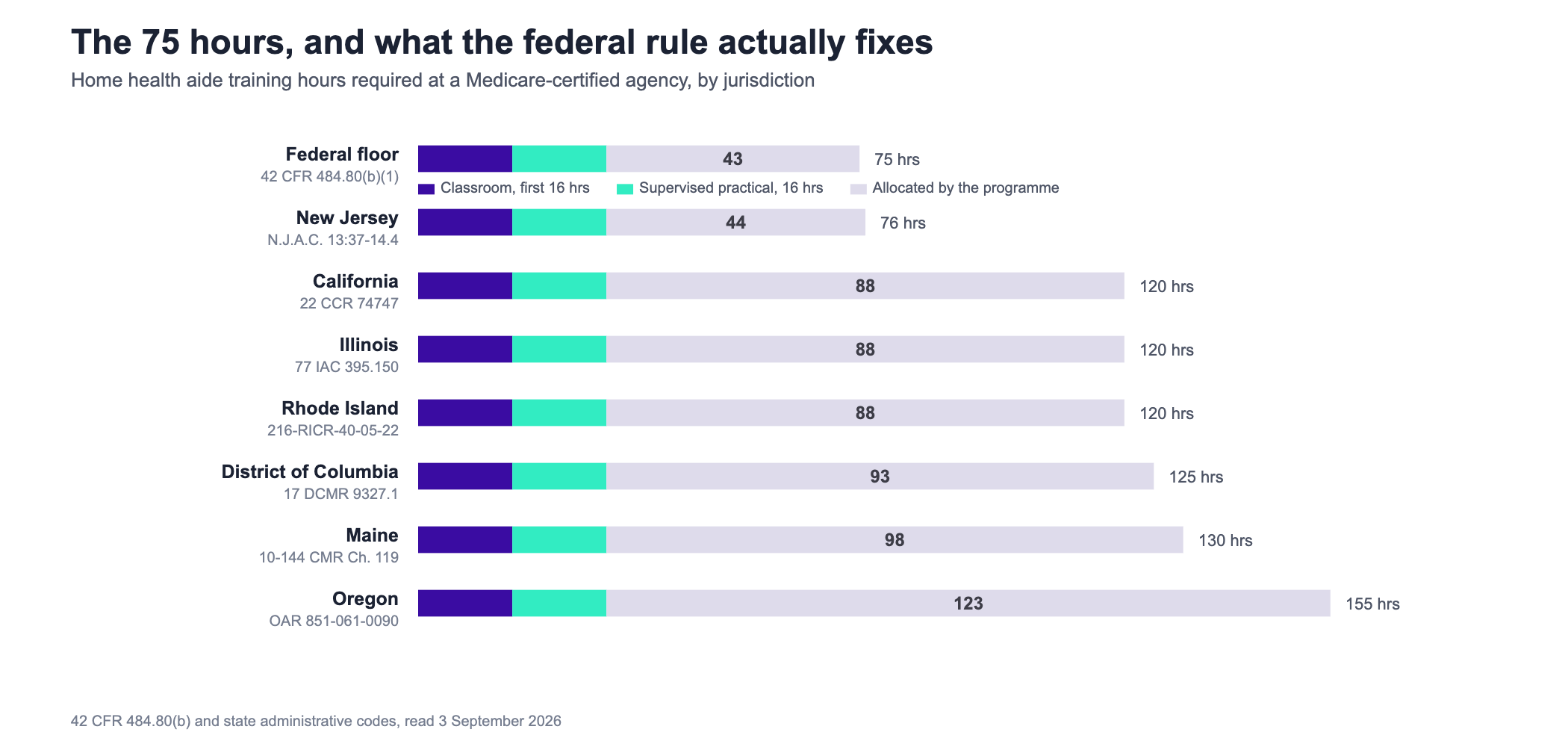
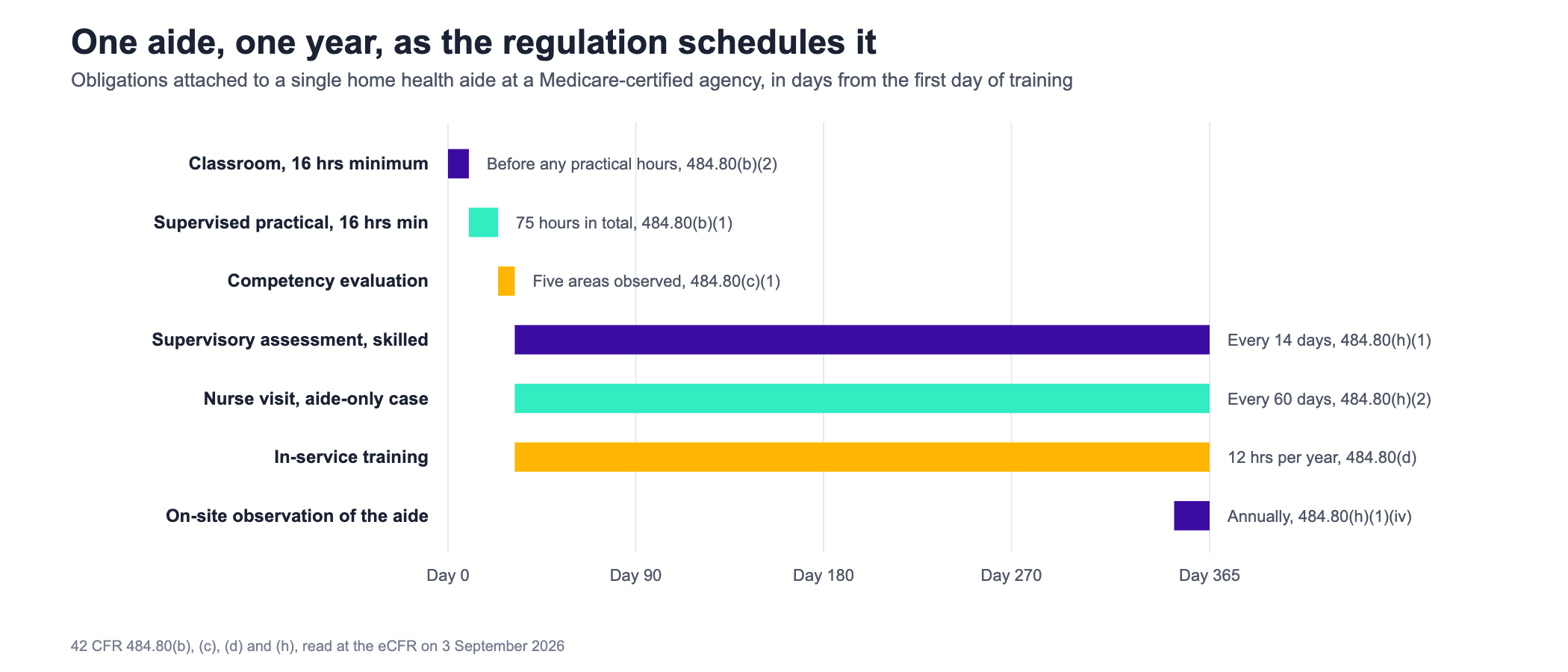
Where a program is required, 484.80(b)(1) sets classroom plus supervised practical training at at least 75 hours, and (b)(2) requires 16 classroom hours to precede 16 practical hours. The practical half must happen where the trainee serves a real person under the direct supervision of a registered nurse, or an RN-supervised LPN. There is no distance-learning route through it.
Then the part no job posting mentions. 484.80(c)(1) lists fourteen subject areas the competency evaluation must cover and requires five — communication, vitals, hygiene and grooming, transfer and ambulation, and positioning — to be evaluated by observing the aide perform the task with a patient or pseudo-patient. Under (c)(4) an aide unsatisfactory in more than one required area has not passed at all.
The 24-month rule that ends rehires
484.80(a)(2) says an aide is not treated as having completed a program if, since the most recent completion, there has been a continuous period of 24 consecutive months in which none of the services they furnished were for compensation. After that lapse they must complete another program first, however good they were before the break. Ask at screening: the answer decides whether the person is a hire or a training placement.
| Obligation | What 42 CFR 484.80 requires | Citation | Cost to the employer |
|---|---|---|---|
| Training total | Classroom plus practical totalling at least 75 hours, 16 classroom before 16 practical | 484.80(b)(1), (b)(2) | One-off per untrained hire; nil for a registry CNA |
| Observed competency | Five of fourteen areas evaluated by watching the task performed, by a registered nurse | 484.80(c)(1), (c)(3) | RN time per aide, not a written test |
| Instructor | An RN with 2 years nursing, 1 in home health, or others under that RN | 484.80(e) | Sharply narrows who can run a small agency program |
| In-service | At least 12 hours in each 12-month period, RN supervised | 484.80(d) | Recurring, every aide, every year |
| Supervision, skilled case | Assessment every 14 days where the patient also gets skilled nursing or therapy; at most one per 60-day episode by audio-video | 484.80(h)(1) | About 26 assessments a year per patient |
| Supervision, aide-only | On-site RN visit every 60 days where no skilled services are provided | 484.80(h)(2) | About 6 visits a year per patient |
| Annual observation | An on-site visit observing each aide at work, at least annually | 484.80(h)(1)(iv) | Once a year, per aide |
Certification by state: where more than 75 hours is required
We read the licensing rule or code section in twenty-nine jurisdictions. Six states and the District of Columbia require more than 75 hours. Everywhere else the federal number binds: some states restate it, some incorporate Part 484 by reference, and several license agencies without setting aide hours at all.
| Jurisdiction | Hours | Citation | What is different |
|---|---|---|---|
| Oregon | 155 | OAR 851-061-0090 | The highest we found |
| Maine | 130 | 10-144 CMR Ch. 119 | Defines the aide as a nursing assistant |
| District of Columbia | 125 | 17 DCMR 9327.1 | Licensed by the Board of Nursing |
| California | 120 | 22 CCR 74747 | A CNA is not automatically an aide: a further 40 hours applies |
| Illinois | 120 | 77 IAC 395.150 | Registry listing is the check |
| Rhode Island | 120 | 216-RICR-40-05-22 | Certified by the Department of Health |
| New Jersey | 76 | N.J.A.C. 13:37-14.4 | One hour above the floor |
| New York | 75 | 10 NYCRR 700.2 and the DOH program guide | 59 classroom, 16 practical; a PCA upgrades on 35 more |
| Delaware, New Mexico | 75 | 16 Del. Admin. Code 3350 s.5.7.4; 8.370.22.30(C) NMAC | Restate the federal figure in state law |
| Colorado | 75 | 6 CCR 1011-1 Ch. 26 s.6.13 | No hours in the rule; nurse aide certification within four months |
| Connecticut, Washington, Wisconsin | 75 | State licensing rules | Exactly the federal figure; the 120-hour Wisconsin figure circulating is obsolete |
| Florida | 40 state | Rule 59A-8.0095(5)(c) F.A.C. | Below the floor; defers upward to Part 484 for certified agencies |
| AK, AZ, MA, MD, MI, MN, MT, NC, NV, OH, PA, UT, VA, VT | Not above 75 | State licensing rules | No aide hours in the rule, or none above the federal floor |
Two deserve a sentence. Florida is the trap: rule 59A-8.0095(5)(c), amended 31 May 2026, requires 40 hours or the state competency test, and an aide who has done exactly that is not qualified at a Medicare-certified agency — the rule says so itself. New York is the opposite: a personal care aide trains 40 hours and upgrades on a further 35, so an agency running both service lines can promote from within for under half the cost of an outside hire.
Check the training requirement for one state
Skills: what belongs in the posting
484.80(b)(3) hands you a defensible skills list for free: the fourteen-area syllabus every qualified aide has already been taught, from clinical communication and documentation through infection control, vitals, hygiene, safe transfer and positioning. Copying it into an ad is a mistake, though. It describes every qualified aide equally, so it filters nobody and reads as boilerplate. What actually varies between candidates is unglamorous. Can they reliably reach a house that is not on a bus route. Will they work a split schedule. Do they document at the point of care or at midnight. Those belong in the posting; the syllabus belongs in the training file.
Pay: what the federal data says, and what it does not
The Bureau of Labor Statistics does not publish home health aides separately. Its occupation is home health and personal care aides combined, and the two have different credentials and, in most markets, different wages. Read at source on 3 September 2026: a 2025 median of $17.21 an hour, $35,800 a year, on 4,677,100 jobs, projected 2025 to 2035 change plus 847,300, or 18 percent, against about 760,500 openings a year.
Put the last two together. Growth accounts for roughly 84,700 of those annual openings; the other 675,800, about 89 percent, are replacements — people leaving the occupation. A workforce that grows while continuously draining, the pattern we also found on the CNA shortage page. An agency treating aide hiring as a project rather than a permanent function will be short-staffed within a year of solving it.
About 89 percent of the 760,500 annual openings in this occupation are replacements, not growth. You are not filling a gap. You are refilling a bucket.
Home health aide job description template
Copy this, replace the bracketed fields, delete what does not apply. It is ordered the way applicants read: pay and territory before duties.
- Title. Home Health Aide (HHA) — [Day / Evening / Weekend], [Full-time / Part-time / Per Diem], [City, State]
- Summary. [Agency] is hiring certified home health aides in [city and surrounding towns]. $[XX.XX] to $[XX.XX] an hour plus [mileage at the IRS rate]. You carry [4 to 6] patients on a consistent assignment under a plan of care written by a registered nurse. [Medicare-certified / private duty only.]
- Responsibilities. Hands-on personal care: bathing, dressing, grooming, toileting, oral hygiene. Safe transfers, ambulation and positioning. Assistance with medications the patient ordinarily takes unaided. Simple procedures as an extension of nursing or therapy. Vitals and meal preparation. Documenting in [EHR] at the point of care and reporting any change the same day.
- Requirements. Current qualification under [state] rules, or good standing on the [state] nurse aide registry. Background check and health screening. Valid license, reliable vehicle, insurance. Able to lift [50] lbs.
- Preferred. Six months in home care, assisted living or long-term care. CPR, which we provide. Dementia or hospice experience.
- Schedule and benefits. [Paid drive time]; [4 to 6] visits a day within [20 miles]; guaranteed [30] hours. Health, dental and vision from day [30]; PTO from day one; [401(k) match]; paid in-service training.
Two lines to delete from the template you use now
The first is must be able to work any shift. Aides take this work partly because the schedule fits something else in their life, and the candidate who closes the tab at that line was often available for exactly the shift you needed. The second is a certificate upload at application: verify the registry number after the interview instead. An upload on a phone, before anyone has spoken to the candidate, is the surest way to lose completions.
Build the description
The ad version, and what an applicant costs
The description is the document. The ad is three lines answering how much, what schedule, how far. Aides are not refreshing job boards; they are on Facebook and Instagram between visits, and an ad leading with the rate, the territory and paid drive time beats one leading with the mission.
On cost we give the range, not a single number, because we do not publish a separate home health aide row and inventing one would be worse than saying so. Across our 2026 Social Job Advertising Benchmark, cost per applicant runs from $2.91 at the 10th percentile to $66.45 at the 90th, median $13.88, volume-weighted $8.02. The nearest published comparator is the CNA row: median $7.72 across 32 campaign-months, 18 percent apply rate. Expect aide campaigns in similar territory — an expectation, not a measurement.
The lever is not the bid. Across the benchmark, apply rate explains about 70 percent of the variation in cost per applicant, so the cheapest thing to change is the application: fewer fields, no upload before a conversation, knockout questions limited to what genuinely disqualifies someone. Method is on the caregiver recruitment cost page; the job description generator drafts the posting.
Related: Home Care Aide Job Description.
Frequently asked questions
Staffing hospice rather than home health? The hospice aide job description covers the same personal care under a comfort-focused plan of care — and the things a hospice posting has to say that a home care posting does not.
What does a home health aide do?
Under 42 CFR 484.80(g)(3) the duties are hands on personal care, simple procedures as an extension of therapy or nursing services, assistance with ambulation or exercises, and assistance with medications that are ordinarily self administered. Every task must also be ordered by the physician, in the plan of care, permitted under state law, and consistent with the aide training.
How many hours of training does a home health aide need?
At a Medicare certified agency the federal minimum is 75 hours of classroom and supervised practical training under 42 CFR 484.80(b)(1), and 16 classroom hours must precede 16 practical hours. Six states and the District of Columbia require more, from 76 hours in New Jersey to 155 in Oregon. Every aide also needs 12 hours of in service training each year.
Can a certified nursing assistant work as a home health aide?
Federally, yes. Section 484.80(a)(1)(iii) treats someone who has completed a state approved nurse aide training and competency evaluation program, and is currently in good standing on the state registry, as a qualified home health aide with no second program. Some states add a step anyway: in California a certified nursing assistant still completes a further program.
What is the difference between a home health aide and a caregiver?
A home health aide at a Medicare certified agency works under a plan of care signed by a physician and must meet the federal qualification standard. A caregiver or personal care aide usually works in private duty, non medical home care, is uncertified in most states, and works under no physician ordered plan. The work can look similar in the house. The regulatory footing is not.
Which states require more than 75 hours of training?
Of the twenty nine jurisdictions where we read the rule, seven exceed the federal floor: Oregon at 155 hours, Maine at 130, the District of Columbia at 125, California, Illinois and Rhode Island at 120 each, and New Jersey at 76. Everywhere else the state restates 75 hours, incorporates the federal rule by reference, or sets no figure.
How much do home health aides get paid?
The Bureau of Labor Statistics reports home health and personal care aides as one combined occupation, with a 2025 median of 17.21 dollars an hour, or 35,800 dollars a year, across 4,677,100 jobs. Because the roles are combined, the figure blends a certified role with an uncertified one, so a local wage survey usually beats the national median.
What happens if a home health aide has not worked in two years?
Section 484.80(a)(2) says that if there has been a continuous period of 24 consecutive months since the most recent program completion in which none of the services the individual furnished were for compensation, the person is no longer treated as having completed a program and must complete another before providing services, however experienced they are.
How often must a nurse supervise a home health aide?
It depends what else the patient receives. Where the patient also gets skilled nursing or therapy, section 484.80(h)(1) requires a supervisory assessment at least every 14 days, no more than one per 60 day episode by audio video. Where no skilled services are provided, an on site nurse visit is required every 60 days. Each aide must also be observed on site once a year.
Hiring home health aides?
The ad is the thing that gets read, on a phone, between visits. We write it, run it where working aides are scrolling, and report what each applicant cost.
Book a Demo