Employer guideUpdated October 5, 2026
The CNA Shortage Is a Replacement Problem: 98% of the Openings Are People Leaving
The Bureau of Labor Statistics projects 203,300 openings a year for nursing assistants and orderlies over 2025 to 2035. Employment over the whole decade grows by 41,100, which is about 4,110 a year. Do the subtraction and 98% of those annual openings are replacement — people leaving the occupation, not new positions being created. Refilling a CNA shortage like that is the cheap part: in Boostpoint’s 2026 Social Job Advertising Benchmark, the median CNA applicant cost $7.72. Against an occupation of 1,558,700 people, 203,300 openings a year means roughly one posting for every eight people employed, every year. Median pay is $20.13 an hour, or $41,870 a year. The shortage is real, and it is a churn problem wearing a demand costume.
Where the 203,300 openings come from
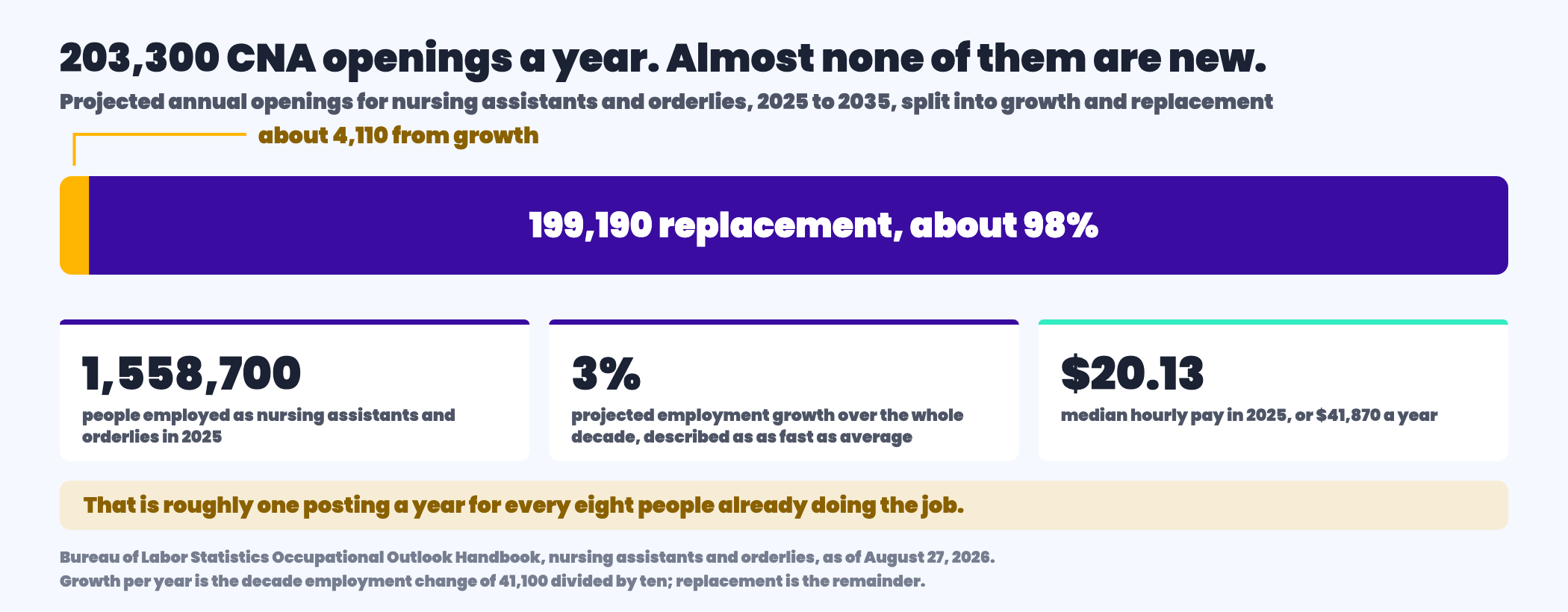
Two figures on the same government page tell the whole story and they are almost never printed together. The first is the one everybody quotes: 203,300 openings each year, on average, over the decade. The second is the one that gets left out: employment is projected to grow 3% over the same decade, from 1,558,700 to about 1,599,800 — a change of 41,100 people in ten years.
So the annual openings figure is not describing an industry adding staff. It is describing an occupation refilling itself. Roughly four thousand of those two hundred thousand openings represent a job that did not exist last year. The rest represent a person who used to do the job and does not anymore, whether they moved to another employer, moved up into licensed nursing, or left healthcare entirely.
Why the framing matters to a hiring budget
If the problem is growth, the answer is a bigger pipeline and you should spend more on advertising. If the problem is replacement, a bigger pipeline refills a bucket with a hole in it, and the return on the same money is decided by how long the people you hire stay. The national numbers say it is replacement by a factor of about fifty to one. That does not mean stop advertising — you still have to fill the posts. It means the advertising budget is a running cost, and the thing to work on is the rate that sets it.
What the occupation actually looks like
| Measure | Figure | What it means for hiring |
|---|---|---|
| People employed, 2025 | 1,558,700 | The base the churn runs against. |
| Projected openings a year | 203,300 | About one posting a year for every eight people employed. |
| Employment change, 2025 to 2035 | 41,100 | Around 4,110 a year, or 2% of annual openings. |
| Projected growth, 2025 to 2035 | 3% | Described by BLS as as fast as average, not faster. |
| Median pay, 2025 | $20.13 an hour, $41,870 a year | The number every competing employer within driving distance is also looking at. |
| Job openings rate, healthcare and social assistance | 5.7% in July 2026 | Against a national hires rate of 3.2% and a separations rate of 3.2% in the same month. |
| Quits rate, healthcare and social assistance | 1.9% in July 2026 | Identical to the national quits rate that month, which is worth noticing. |
The last two rows are the ones worth sitting with. Healthcare and social assistance is carrying a job openings rate of 5.7% while its quits rate, at 1.9%, is exactly the national figure. People are not quitting healthcare at some extraordinary rate relative to the rest of the economy. There are simply a great many posts open at once, in an occupation of a million and a half people, whose projected openings over a decade add up to about 1.3 times its entire workforce.
The healthcare staffing shortage, in three numbers
The CNA figures above are one slice of a pattern that repeats across frontline healthcare, and the pattern is more useful than any single occupation's number. Three occupations carry most of the volume, and all three are read from the Bureau of Labor Statistics Occupational Outlook Handbook.
Home health and personal care aides employed 4,677,100 people in 2025 at a median of $35,800, are projected to grow 18% to 2035 — much faster than average — adding 847,300 jobs, with about 760,500 openings a year. Registered nurses employed 3,465,400 at a median of $97,550, growing 6% and adding 194,700, with about 180,800 openings a year. And nursing assistants contribute the 203,300 a year set out above.
Together that is roughly 1.14 million openings a year across three occupations. But the number that should change how you spend is the ratio inside it. Home health aides are among the fastest-growing large occupations in the economy, and even there, ten years of openings comes to around 7.6 million against 847,300 of net growth — about 89% replacement. Registered nursing lands on almost exactly the same figure, 1.8 million openings against 194,700 of growth.
So the healthcare staffing shortage is not primarily a story about demand outrunning supply, even in the occupation where demand is genuinely exploding. It is a story about people leaving. Nine in ten of the roles you will advertise this year exist because somebody walked out of one, and in the aide occupations that is happening at a median wage under $36,000.
Two things follow for an employer. Retention is not the soft alternative to recruiting; at an 89% replacement rate it is the larger of the two levers by an order of magnitude. And when you do advertise, you are almost always trying to reach somebody who currently holds one of these jobs at another employer, not somebody entering the field — which is a targeting decision, and the reason a job board reaches the wrong half of the market.
Sources: U.S. Bureau of Labor Statistics, Occupational Outlook Handbook, Home Health and Personal Care Aides and Registered Nurses, both read at source September 9, 2026; the nursing assistant figures are those cited earlier on this page. Decade totals and replacement shares are our own arithmetic on the published annual-openings averages, not BLS-published totals.
What it costs to reach a CNA, and what that does not buy
This is the part we measure. Across the 891 campaigns in our 2026 social job advertising benchmark, CNA and nursing assistant campaigns delivered an applicant at a median of $7.72, with the middle half of campaigns running $6.18 to $12.06 and an apply rate of 18%. That is cheap. It is about two-fifths of what a registered nurse applicant costs and a tenth of a therapy applicant.
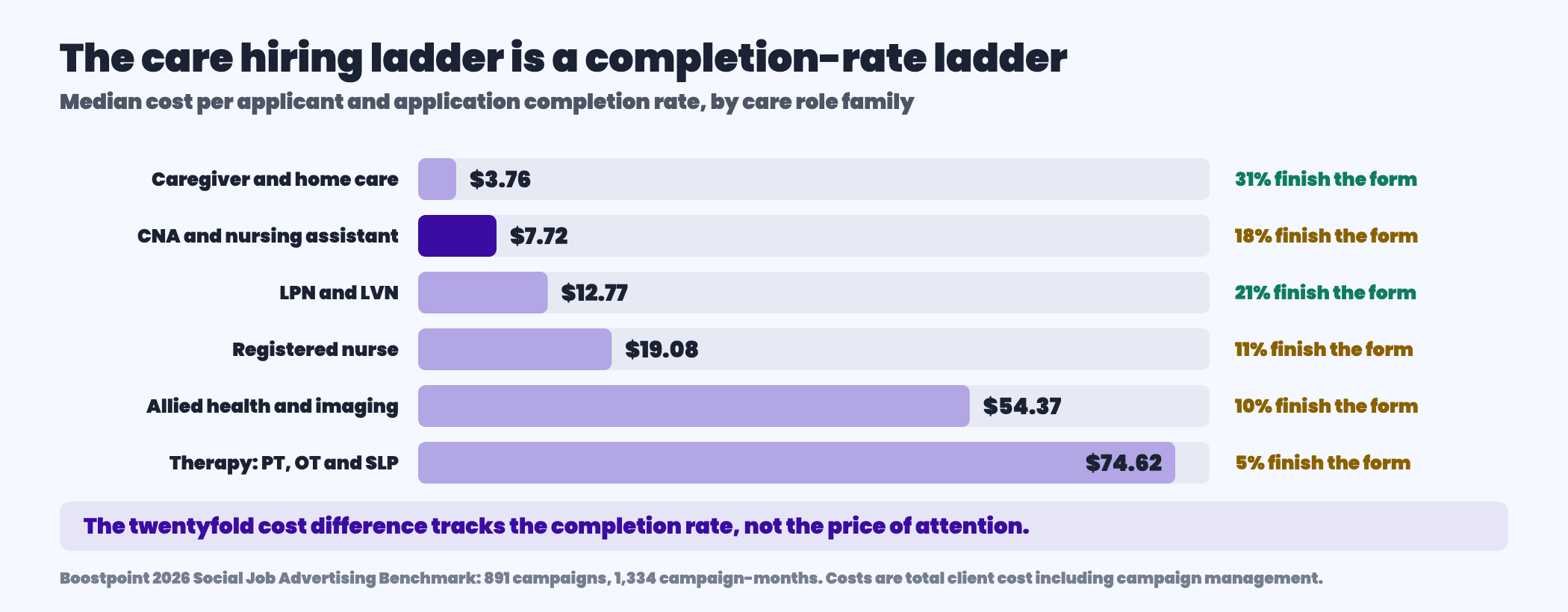
The ladder in that chart is not about how hard the roles are. It is about friction. Caregiver campaigns convert at 31% of clickers and therapy campaigns at 5%, and that gap explains most of the twentyfold cost difference between them. CNA sits near the cheap end, which is the good news and also the trap: when applicants are cheap, an employer can refill a post repeatedly without the cost ever becoming visible enough to force a different conversation.
The number we do not have
We can tell you what a CNA applicant costs. We cannot tell you what share of them are certified, what share show up to interview, what share are still there in week ten, or whether a dollar spent on pay or scheduling returns more than a dollar spent on advertising. Nobody who sells advertising can tell you that, and the ones who claim to are extrapolating from platform data that stops at the form submission. That number lives in your own records, and on this particular occupation it is the number that decides everything.
Split your own openings into growth and replacement
What the refill costs, and what a five-point change is worth
Turnover arguments usually die because nobody puts a number on either side. The advertising side has a number, and it is ours, so here it is with the arithmetic exposed rather than asserted.
Price the refill
Three things this changes about the job ad
Advertise the shift, not the sector. An occupation refilling itself two hundred thousand times a year is not short of people who have heard of it. The applicant deciding between two facilities eight miles apart is deciding on the specifics: the shift pattern, the ratio, whether the schedule changes after they accept. A generic care ad competes on wage alone, and the median wage is public. The rest of the ad and the application are covered in our guide to CNA recruitment.
Put the pay in the ad, because in fifteen jurisdictions you have to. Fourteen states and the District of Columbia now require a pay range inside the posting, Connecticut most recently, from October 1, 2026, and healthcare employers are rarely single-state. We set that out on pay transparency laws by state.
Keep the application on the platform. CNA campaigns convert at 18% against 31% for caregiver roles, and in our data the difference between conversion bands is worth more than anything the ad auction charges — application completion rate explains 70% of the variation in cost per applicant. If your CNA applications route to a career site with a resume upload, that is where the money is going.
And the part we keep coming back to: the arithmetic on this page says the advertising is not the expensive thing. What people leaving costs is set out in the turnover cost calculator, and where those departures actually happen is on first 90 days turnover. If you only have budget to change one thing this year, the national numbers say change the one that keeps people.
Nursing assistants are the tightest of the five largest non-physician healthcare occupations on this measure, and the comparison across all of them is on the healthcare workforce shortage by role.
State staffing minimums turn a CNA shortage into a compliance problem; see nursing home staffing ratios.
Frequently asked questions
How bad is the healthcare staffing shortage?
Across the three largest frontline occupations it is roughly 1.14 million openings a year: about 760,500 for home health and personal care aides, about 180,800 for registered nurses, and about 203,300 for nursing assistants, on Bureau of Labor Statistics projections for 2025 to 2035. The more useful figure is what sits inside that. For both aides and registered nurses, around 89% of a decade's openings are replacements rather than net growth. The shortage is mostly people leaving these jobs, not demand outpacing a pipeline - which is why retention moves the number further than recruiting does.
How bad is the CNA shortage?
The Bureau of Labor Statistics projects about 203,300 openings a year for nursing assistants and orderlies from 2025 to 2035, against an occupation of 1,558,700 people. That is roughly one posting a year for every eight people employed. But employment itself grows only 3% over the decade, or 41,100 people in total, so almost all of that volume is refilling posts rather than adding them.
Is the CNA shortage caused by demand or turnover?
Overwhelmingly turnover, on the federal numbers. A decade employment change of 41,100 works out to about 4,110 a year, which is roughly 2% of the 203,300 projected annual openings. The other 98% are replacements. That does not mean demand is irrelevant, particularly in a given region, but the national figure describes an occupation losing people at scale rather than one expanding.
What does a CNA earn?
The median was $20.13 an hour, or $41,870 a year, in 2025. Half of nursing assistants and orderlies earned more than that and half earned less. It is a published national figure, which means every employer competing for the same applicants can see it, and so can the applicants. Regional pay varies substantially and the national median is a reference point rather than a target.
How much does it cost to recruit a CNA?
In our own data, a median of $7.72 per applicant across CNA and nursing assistant campaigns, with the middle half of campaigns between $6.18 and $12.06 and an apply rate of 18%. That is per applicant, not per hire; multiply by however many applicants your process needs to produce one hire. It covers advertising only and excludes recruiter time, agency fees and everything downstream of the application.
Why are CNA applicants cheaper than nurse applicants?
Because more of them finish the form. In our data the whole ladder from caregiver at $3.76 to therapy roles at $74.62 tracks application completion rate rather than the price of attention: caregiver campaigns convert 31% of clickers, CNA 18%, registered nurse 11% and therapy 5%. Credentialed candidates abandon longer forms more often, and the cost difference is created after the click rather than in the auction.
Are healthcare workers quitting more than everyone else?
Not by the headline measure. In July 2026 the quits rate for health care and social assistance was 1.9%, identical to the national quits rate that month. What is different is the job openings rate, at 5.7% for the sector. So the sector is not distinguished by an unusual exit rate so much as by the sheer number of posts open at any moment in a very large workforce.
Will more advertising fix a CNA shortage?
It will fill the posts you have open, which is not nothing, and it is cheap relative to most alternatives. It will not change the rate at which the posts reopen. We sell advertising and we would still say that if the replacement share of your own openings looks like the national one, the higher-return work is on the reasons people leave, and the advertising budget is best treated as a running cost you size accurately rather than a lever you pull harder.
What should a CNA job ad actually say?
The things that differ between you and the facility eight miles away: the shift pattern, the resident ratio, whether the schedule changes after acceptance, and the pay range, which fourteen states and the District of Columbia now require inside the posting anyway. Keep the application on the platform rather than routing to a career site, because completion rate is the largest single driver of what the campaign costs.
What can a nursing home do about the CNA shortage?
Work on both sides of the replacement problem. On retention, look at shift patterns, resident ratios and schedule changes after hire, because most openings exist because someone left. On hiring, state the pay range and shift in the ad, keep the application on the platform and call the same day. In Boostpoint’s 2026 Social Job Advertising Benchmark, the median CNA applicant cost $7.72 and 18% of people who clicked finished the application.
Is there a nursing assistant shortage?
Yes, but mostly as turnover rather than growth. The Bureau of Labor Statistics projects about 203,300 openings a year for nursing assistants and orderlies from 2025 to 2035, while employment grows only 3% over the decade, by 41,100 people. About 98% of those annual openings replace people leaving the occupation. For an employer the shortage shows up as constant refilling: the median CNA applicant cost $7.72 in Boostpoint's 2026 Social Job Advertising Benchmark, so the expensive part is keeping people, not finding them.
Is the nurse aide shortage the same as the CNA shortage?
Yes. Nurse aide is the term federal nursing home rules use for the role most employers post as CNA. Under 42 CFR 483.35(d), a facility may not use someone who has worked less than four months as a nurse aide there unless they are in a state-approved training and competency evaluation program or have demonstrated competence, and it must receive registry verification before they serve. So a nurse aide shortage is a shortage of registry-verified aides, and trainees in an approved program count toward filling it.
You will refill these roles either way. Let us show you what that costs.
Bring your CNA headcount, your turnover rate and the markets you staff. We will show you what applicant flow actually costs there, and what the refill is costing you now.
Book a Demo