Employer guideUpdated September 2026
Pay Transparency Laws by State: The Range Goes in the Ad, Not in the Offer
Thirteen states and the District of Columbia require a pay range inside the job posting today. Connecticut makes it fifteen on October 1, 2026 and Delaware makes it sixteen on September 26, 2027. Thresholds run from four employees in New York to fifty in Hawaii, and four jurisdictions have no threshold at all. Three of the newest laws give you a window to fix a bad posting before a penalty — two business days in Massachusetts, five in Washington, fifteen in Virginia — and two of those three expire in 2027. This is an advertising requirement before it is an HR one, because the disclosure has to be in the ad at the moment it goes live.
Three of these are new this year
If you built a compliance list in 2024 it is now wrong in at least three places. Virginia took effect on July 1, 2026 and covers every employer with no size threshold at all. Maine followed on July 29, 2026 at ten or more employees. Connecticut arrives on October 1, 2026, also with no size threshold, and adds a general description of benefits to the posting. California did not add a law but narrowed the one it has: from January 1, 2026 the posted pay scale must be a good faith estimate of what the employer expects to pay upon hire, which is a different and much tighter thing than a range wide enough to be safe.
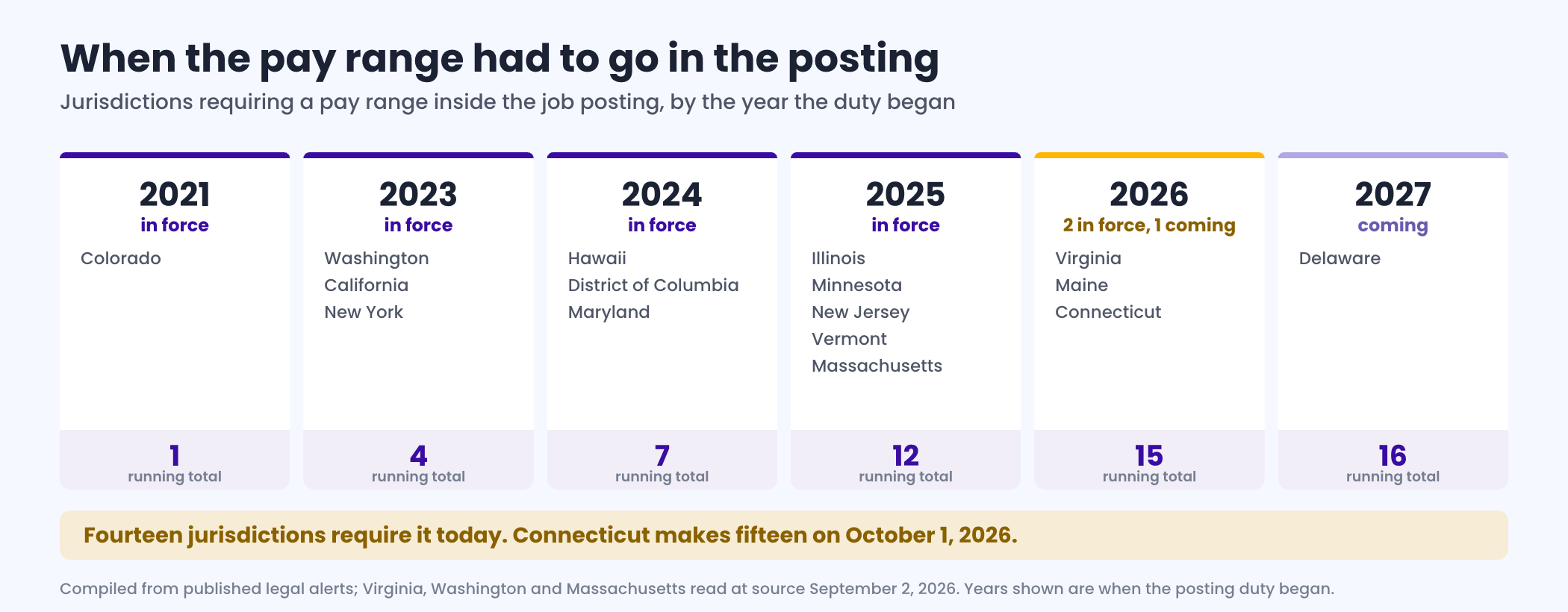
The deadline in front of you is Connecticut
Public Act 26-12 takes effect October 1, 2026. It applies to employers in the state with no size threshold, requires the wage or wage range and a general description of the benefits offered, and reaches internal postings as well as external ones. It also reaches roles performed outside the state that report to a Connecticut supervisor or worksite. Employers with 100 or more employees additionally owe a pay code guide. Claims run for two years; punitive damages are no longer available.
Every jurisdiction with a rule, and what it actually asks for
Read the second column first. “Yes” means the range belongs in the posting itself, which makes it an advertising problem. “On request” means the duty is triggered by the candidate rather than by the ad, which is a process problem instead. Those are different jobs and they land on different teams.
| Jurisdiction | In the posting? | Threshold | What has to be disclosed | Since |
|---|---|---|---|---|
| California | Yes | 15 or more | Pay scale, defined from January 1, 2026 as a good faith estimate of what you expect to pay upon hire | In force; amended by SB 642 effective January 1, 2026 |
| Colorado | Yes | All employers | Pay range, a general description of other compensation and benefits, and the application deadline | In force |
| Connecticut | From October 1, 2026 | All employers | Wage or wage range plus a general description of the benefits offered, in internal and external postings | Posting requirement effective October 1, 2026 under Public Act 26-12 |
| Delaware | From September 26, 2027 | 26 or more | Hourly or salary range plus a general description of benefits and other compensation | September 26, 2027 under HB 105 |
| District of Columbia | Yes | All employers | Minimum and maximum projected salary or hourly pay, and disclosure of healthcare benefits | In force since June 30, 2024 |
| Hawaii | Yes | 50 or more | Hourly rate or salary range | In force |
| Illinois | Yes | 15 or more | Pay scale and benefits | In force since January 1, 2025 |
| Maine | Yes | 10 or more | The expected pay range for the role; commission-based positions must be identified as such | July 29, 2026 under LD 54 |
| Maryland | Yes | All employers | Wage range, a general description of benefits and any other compensation | In force since October 1, 2024 |
| Massachusetts | Yes | 25 or more | Pay range, meaning the annual salary range or hourly wage range reasonably and in good faith expected for the position | Posting requirement effective one year after the act, on October 29, 2025 |
| Minnesota | Yes | 30 or more | Starting salary range or a fixed pay rate, plus a general description of benefits | In force since January 1, 2025 |
| Nevada | To any applicant who completes an interview (on request only for promotions and transfers) | All employers | Wage or salary range | In force |
| New Jersey | Yes | 10 or more | Pay or pay range and a general description of benefits and other compensation | In force since June 1, 2025 |
| New York | Yes | 4 or more | Compensation or compensation range, and the job description if one exists | In force since September 17, 2023 |
| Rhode Island | On request, and before discussing compensation | All employers | Wage range | In force since January 1, 2023 (the January 1, 2026 written notice is a separate new-hire pay notice under 28-14-12) |
| Vermont | Yes | 5 or more | Compensation or compensation range | In force since July 1, 2025 |
| Virginia | Yes | All employers | Wage, salary, or wage or salary range, in each public and internal posting for a job, promotion, transfer or other opportunity | July 1, 2026 under HB 636 and SB 215 |
| Washington | Yes | 15 or more | Wage scale or salary range, or the fixed wage, plus a general description of all benefits and other compensation | In force since January 1, 2023 |
Three states, read at source
Virginia: every employer, every posting, from July 1, 2026
Section 40.1-28.7:12 of the Virginia Code requires the wage, salary, or wage or salary range in each public and internal posting for each job, promotion, transfer, or other employment opportunity. There is no size threshold. The same section bars seeking or relying on a prospective employee’s wage history. The Attorney General may seek up to $1,000 for a first violation and up to $5,000 for any subsequent one, and an aggrieved person may sue within a year — but an employer gets fifteen business days to correct a posting after written notice before that private action can proceed. That cure window is the most generous of the three, and it is the reason a monitored posting inventory is worth more in Virginia than a legal opinion.
Washington: five business days, and the clock on that runs out in 2027
RCW 49.58.110 applies to employers with fifteen or more employees and requires the wage scale or salary range, or the fixed wage, plus a general description of all of the benefits and other compensation offered. Statutory damages run from $100 to $5,000 per violation, with departmental civil penalties of up to $500 for a first violation and $1,000 for a repeat. The part with a date on it: an employer has five business days from receiving written notice to correct a posting, and that opportunity exists only from July 27, 2025 through July 27, 2027. After that the first mistake is the penalty.
Massachusetts: the 48-hour rule almost nobody publishes
Chapter 141 of the Acts of 2024 covers employers with 25 or more employees in the commonwealth and defines pay range as the annual salary range or hourly wage range the employer reasonably and in good faith expects to pay for such position at that time. The Attorney General has exclusive jurisdiction: a warning for the first offense, up to $500 for the second and up to $1,000 for the third. The detail that matters operationally is the definition of an offense: one or more job postings by the same employer during a 48-hour period counts as a single offense. A bulk posting run of fifty requisitions with the same defect is one offense, not fifty. Separately, for the first two years the law is in force an employer has two business days after notice to cure before a fine.
What the three have in common, and when it ends
All three of the newest regimes assume you will get a posting wrong and give you a window to fix it. All three windows are different lengths, two of them expire — Washington on July 27, 2027, Massachusetts on October 29, 2027 — and none of them helps if nobody is watching the postings. The practical asset here is not legal advice. It is knowing, on any given Tuesday, every live ad you have and what range is on it.
Look up one state
How many of these reach you depends on one number
Thresholds are the quiet part of this subject. A four-person employer hiring in New York is covered; a forty-person employer hiring in Hawaii is not. Because the thresholds are staggered, the number of posting jurisdictions that reach you rises in steps as you grow, and the biggest single step is at fifteen employees, where California, Illinois and Washington all switch on at once.
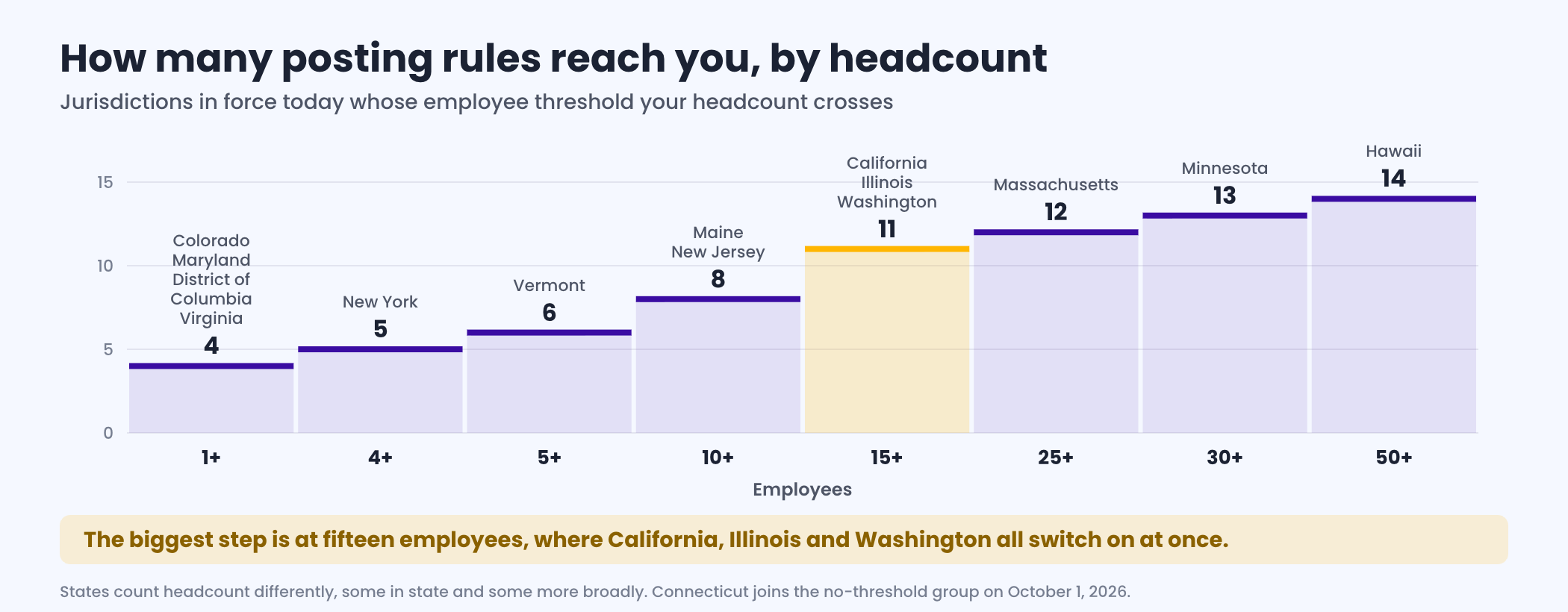
Count the ones that reach you
What this changes about writing the ad
Four things, and none of them is a legal question. The range has to be in the creative, not in the applicant tracking system. A social job ad that routes to a career site still needs the disclosure where the posting is, and several of these laws reach postings placed indirectly through a third party, which means your agency and your job distribution partner are inside the rule with you.
Internal postings count in more places than people expect. Virginia and Connecticut both name internal postings explicitly, and Massachusetts extends the duty to an employee offered a promotion or transfer. The requisition you never advertised is still a posting.
The wide range is being closed off. California’s 2026 amendment defines the pay scale as what you expect to pay upon hire, and Massachusetts and Connecticut both write good faith into the definition. A range of $18 to $52 an hour was always a bad ad; from 2026 it is a bad ad with a statute attached.
And the range is a conversion lever, not just a compliance field. We cannot tell you what publishing pay does to your apply rate — we have not run that test and we are not going to guess at it. What we can tell you is what the surrounding numbers cost. Across the 891 campaigns in our 2026 social job advertising benchmark the median campaign delivered an applicant for $13.88, and application completion rate explains 70% of the difference between a cheap campaign and an expensive one. Anything that changes how many people finish the form is worth more than anything that changes what the auction charges. On a public works job the range is not a choice at all, because a wage determination has already set it, and prevailing wage by state covers which contracts that reaches.
State-by-state employer guides: every state’s breaks, overtime, final pay and hiring rules in one place: Alabama, Alaska, Arizona, Arkansas, California, Colorado, Connecticut, Delaware, D.C., Florida, Georgia, Hawaii, Idaho, Illinois, Indiana, Iowa, Kansas, Kentucky, Louisiana, Maine, Maryland, Massachusetts, Michigan, Minnesota, Mississippi, Missouri, Montana, Nebraska, Nevada, New Hampshire, New Jersey, New Mexico, New York, North Carolina, North Dakota, Ohio, Oklahoma, Oregon, Pennsylvania, Rhode Island, South Carolina, South Dakota, Tennessee, Texas, Utah, Vermont, Virginia, Washington, West Virginia, Wisconsin, Wyoming.
Should you include pay in a job posting? What it does to applicant volume
Yes, include it, and judge the result by apply rate: in Boostpoint’s 2026 benchmark of 891 campaigns, application completion rate explains 70% of the difference in cost per applicant between campaigns, against 18% for what the ad auction charges. That benchmark does not split campaigns by whether the ad showed pay, so we will not give you a figure for how many more applicants a pay line brings. Anyone who quotes you one for your roles should be able to show the test behind it.
What the data does show is how much rides on the step where a candidate decides. Grouped by the share of clickers who finished the application:
| Apply rate | Cost per applicant | Share of budget | Share of applicants |
|---|---|---|---|
| Under 5% | $53.77 | 18% | 3% |
| 5–10% | $23.13 | 24% | 8% |
| 10–20% | $11.11 | 32% | 23% |
| 20–35% | $4.41 | 21% | 38% |
| Over 35% | $1.61 | 6% | 28% |
Source: Boostpoint 2026 Social Job Advertising Benchmark, 891 Boostpoint-managed campaigns on Meta (1,334 campaign-months). Costs include campaign management. Cost per applicant is not cost per hire.
Our reading, not a measured result: a candidate who can see the rate decides whether the job is worth it before clicking, and one who cannot often decides after, in the form or on the phone screen, which is the stage those bands price.
In many states the question is already answered
Where a posting law applies, and the table above lists thirteen states and the District of Columbia today, leaving pay out is not an option, and a range so wide it says nothing runs into California’s good-faith definition and the similar wording in Massachusetts and Connecticut. For roles outside those states, the practical version is the same: the hourly rate or a narrow range in the first line, shift differentials stated separately, and no “competitive pay” in place of a number.
How to test it on your own roles
- Run two ads that are identical except for the pay line, to the same audience, with the same budget, over the same weeks.
- Compare apply rate (completed applications divided by link clicks), not click-through rate alone. A pay line can lower clicks from people who would never have taken the job and still raise completions.
- Then follow the applicants into your ATS. A cheaper applicant who never answers the phone is not a win. That is the number no ad platform can give you.
Many of these states also bar asking what a candidate earns now; see salary history ban states.
Frequently asked questions
Which states require salary ranges in job postings?
Thirteen states and the District of Columbia today, fourteen jurisdictions in all: California, Colorado, Hawaii, Illinois, Maine, Maryland, Massachusetts, Minnesota, New Jersey, New York, Vermont, Virginia and Washington, plus the District of Columbia. Connecticut joins them on October 1, 2026 and Delaware on September 26, 2027. Nevada and Rhode Island require the range on request or at a point in the process rather than in the posting itself.
Does Virginia require pay ranges in job postings?
Yes, from July 1, 2026, and with no size threshold at all. Section 40.1-28.7:12 of the Virginia Code requires the wage, salary, or wage or salary range in each public and internal posting for each job, promotion, transfer or other employment opportunity. The Attorney General may seek up to $1,000 for a first violation and up to $5,000 for a subsequent one, and an employer has fifteen business days after written notice to correct a posting before a private action can proceed.
What changes in Connecticut on October 1, 2026?
The duty moves from the candidate to the posting. Until then a Connecticut employer owes the wage range on request or before an offer; from October 1, 2026 the wage or wage range and a general description of the benefits must appear in internal and external job postings, with no size threshold. The rule also reaches roles performed outside the state that report to a Connecticut supervisor or worksite, and employers with 100 or more employees owe a pay code guide.
How many employees before pay transparency applies?
It depends entirely on where you are hiring. Colorado, Maryland, the District of Columbia and Virginia have no threshold; New York starts at four, Vermont at five, Maine and New Jersey at ten, California, Illinois and Washington at fifteen, Massachusetts at twenty-five, Minnesota at thirty and Hawaii at fifty. The states also count differently, some in state and some more broadly, so a borderline headcount is worth confirming rather than assuming.
Can I fix a job posting before being penalized?
In three states, for now. Virginia gives fifteen business days after written notice before a private action can proceed. Washington gives five business days, but only until July 27, 2027. Massachusetts gives two business days for the first two years the law is in force, and its first offense is a warning rather than a fine anyway. Everywhere else the assumption is that the posting was correct when it went live.
How wide can a posted pay range be?
Narrower than it used to be. From January 1, 2026 California defines the pay scale as a good faith estimate of the salary or hourly wage range the employer reasonably expects to pay for the position upon hire, which is aimed squarely at ranges posted wide enough to be safe. Massachusetts and Connecticut both write good faith into their definitions as well. There is no numeric cap, but a range you would not actually pay across is not a good faith range.
Do internal postings and promotions count?
In several states, yes, and this is the most commonly missed part. Virginia names public and internal postings for jobs, promotions, transfers and other employment opportunities. Connecticut covers internal and external postings from October 1, 2026. Massachusetts requires the pay range to be given to an employee offered a promotion or transfer to a role with different responsibilities, and to any employee or applicant who asks for it.
Is my job advertising agency covered too?
Usually the duty stays with the employer while the reach of the rule extends to the posting however it was placed. Massachusetts defines a posting to include recruitment done directly or indirectly through a third party, and several other states use similar wording, with the duty falling on the employer or its agent. Practically, that means the range needs to be in the ad copy your partner publishes, not only in your own system.
This is one rule among about a dozen that attach at different points in a hire. Our hiring compliance hub sets out which obligation bites at which stage, and the four federal deadlines every US employer is on.
The range belongs in the ad. Let us show you what that ad costs.
Bring the states you hire in and the roles you refill most. We will show you what applicant flow costs in those markets, with the disclosure in the creative from the first campaign rather than added after somebody complains.
Book a Demo