
Employer guideRead at source, September 3, 2026
Prevailing Wage by State: Davis-Bacon Thresholds, State Rules and What Contractors Must Pay (2026)
Federal Davis-Bacon prevailing wage attaches to federally funded construction contracts over $2,000, a threshold indexed to nothing. On top of that, 28 states and the District of Columbia run their own law, and the trigger points are nothing like each other: $1,000 in California and Rhode Island, $500,000 in Colorado, $1,000,000 in Connecticut, and no dollar threshold at all in seven states. Twenty-two states have none, and three forbid their own cities from adopting one. The table below carries every jurisdiction with its threshold, its certified payroll cadence and its statute. It was rebuilt from the statutes, because the published summaries — including the federal government’s own state-by-state page — are wrong in both directions.
The federal floor: a threshold indexed to nothing, a definition rewritten in 2023
40 U.S.C. 3142 requires laborers and mechanics on federally funded or assisted construction contracts in excess of $2,000 to be paid the locally prevailing wage and fringe benefits the Secretary of Labor determines. Around sixty Related Acts push the same requirement out to federally assisted work, which is how a water plant or a housing rehabilitation is covered without being a federal contract. The Service Contract Act does the same for services over $2,500; the Contract Work Hours and Safety Standards Act adds overtime above forty hours on prime contracts over $100,000.
One detail matters more than it looks. Section 3142(a) puts the obligation in the advertised specifications: the advertisement must state the minimum wages for each class of laborer and mechanic, and 3142(c)(2) requires the scale posted at the site. The rate is published before anyone is hired, which is the number a job ad for that project has to match.
What counts as prevailing was rewritten recently. 29 CFR 1.2, amended at 88 FR 57723 on August 23, 2023, is a three step test: the rate paid to a majority in the classification; failing a majority, the rate paid to the greatest number provided that number is at least 30 percent; failing that, a weighted average. The 30 percent step is the restored part, and it pulls determinations toward collectively bargained rates wherever union density sits between a third and a half. A Federal Register search on September 3, 2026 found no substantive Davis-Bacon rulemaking since. The paperwork rule, 29 CFR 5.5(a)(3), requires records kept three years past completion and certified payrolls filed weekly.
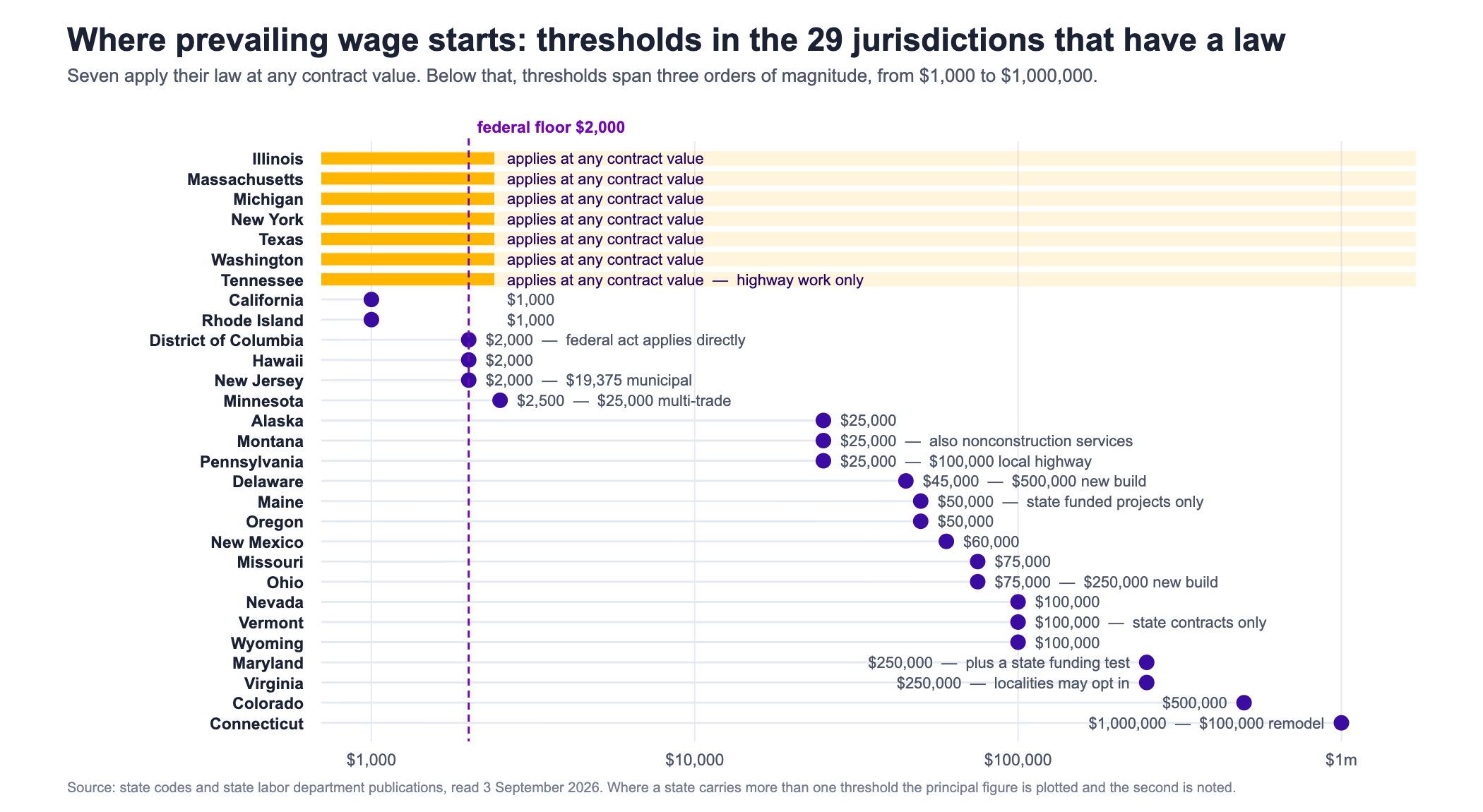
The federal threshold filters nothing
Two thousand dollars, on a 2026 public works job, is about a day and a half of a two person crew. Every federally funded construction contract clears it, so the federal threshold decides nothing. The state thresholds decide, and they span three orders of magnitude.
Federal (Davis-Bacon) prevailing wage rates and where the Department of Labor publishes them
The Department of Labor does not publish one federal prevailing wage rate. Its Wage and Hour Division issues wage determinations: a list of hourly rates and fringe benefits for each trade classification, set for a specific county and a specific type of construction. The four standard types are building, heavy, highway and residential, and the same trade in the same county can carry a different federal prevailing wage rate depending on which type the project is.
Since June 14, 2019 the official source is SAM.gov, which holds both Davis-Bacon determinations for construction and Service Contract Act determinations for services. You search by state, county and construction type, and you can follow a determination to be told when it is revised. The two kinds you will meet:
- General wage determinations cover a geographic area and a construction type, carry no expiration date, and stay in force until revised, superseded or canceled. Most contracts use one of these.
- Project wage determinations are issued on request of a contracting agency for one named project, and expire 180 calendar days from issuance.
Timing decides which revision you pay. Under 29 CFR 1.6, once a determination is incorporated into the contract it generally applies for the life of the contract. A revision issued less than 10 days before bid opening still takes effect unless the agency finds there is no reasonable time left to notify bidders, and on a sealed bid not awarded within 90 days of bid opening a later revision applies unless the agency gets an extension. Rates not set by collective bargaining can be updated from Employment Cost Index data, no more often than once every three years.
One thing trips up searches for Department of Labor prevailing wage. The same phrase is used by a different part of the Department for a different purpose: a prevailing wage determination for foreign labor certification is issued by the National Prevailing Wage Center on Form ETA-9141, and is required before filing an H-2B or permanent labor certification application. That figure is the average wage paid to similarly employed workers in the occupation and area. It has nothing to do with Davis-Bacon, and a determination from one does not satisfy the other.
Prevailing wage by state: who has a law and what triggers it
Tennessee counts only narrowly: since January 1, 2014 its act reaches state highway construction only. Of the twenty-two states with no law, three go further than silence. Arizona bars agencies and political subdivisions from requiring it, Utah bars the state and every subdivision from requiring predetermined rates except where federal law compels it, and Indiana forbids a public agency to set a wage scale for contracts awarded after July 1, 2015. In those three a city cannot opt in; in Virginia a locality expressly can, by ordinance, so the answer there turns on the county as much as the state.
Seven states apply their law at any contract value: Illinois, Massachusetts, Michigan, New York, Texas, Washington, and Tennessee within its highway scope. In between the poles sit figures like Ohio $101,201 for road work and New Jersey $19,375 for municipal contracts, both of which move on a schedule and both of which go stale in published summaries within a year of moving.
| State | Law | Threshold | Statute |
|---|---|---|---|
| Alabama | No | No law | None in force |
| Alaska | Yes | Over $25,000 | AS 36.05 |
| Arizona | No, and prohibited | No law, and prohibited | A.R.S. 34-321 |
| Arkansas | No | No law | Former Ark. Code 22-9-301 et seq. |
| California | Yes | $1,000 | Cal. Lab. Code 1720 to 1861 |
| Colorado | Yes | $500,000 | C.R.S. 24-92-201 et seq. |
| Connecticut | Yes | $1,000,000 new | C.G.S. 31-53 |
| Delaware | Yes | Over $500,000 new | 29 Del. C. 6960 |
| District of Columbia | Yes | Over $2,000 | 40 U.S.C. 3142; D.C. Code 32-1081.01 |
| Florida | No | No law | None in force |
| Georgia | No | No law | None |
| Hawaii | Yes | Over $2,000 | HRS ch. 104 |
| Idaho | No | No law | None in force |
| Illinois | Yes | No threshold | 820 ILCS 130 |
| Indiana | No, and prohibited | No law, and prohibited | Repealed by 2015 HEA 1019 |
| Iowa | No | No law | None |
| Kansas | No | No law | None in force |
| Kentucky | No | No law | Former KRS 337.505 to 337.550 |
| Louisiana | No | No law | Former La. R.S. 38:2301 et seq. |
| Maine | Yes | $50,000 | 26 M.R.S. 1304 to 1313 |
| Maryland | Yes | $250,000 | Md. State Fin. and Proc. 17-201 to 17-226 |
| Massachusetts | Yes | No threshold | M.G.L. c.149 sections 26 to 27H |
| Michigan | Yes | No threshold | Public Act 10 of 2023 |
| Minnesota | Yes | $2,500 single trade | Minn. Stat. 177.41 to 177.44 |
| Mississippi | No | No law | None |
| Missouri | Yes | Over $75,000 | RSMo 290.210 to 290.340 |
| Montana | Yes | Over $25,000 | MCA 18-2-401 to 18-2-432 |
| Nebraska | No | No law | Neb. Rev. Stat. 73-101 to 73-105 |
| Nevada | Yes | $100,000 | NRS 338.010 to 338.090 |
| New Hampshire | No | No law | None in force |
| New Jersey | Yes | $2,000 state | N.J.S.A. 34:11-56.25 et seq. |
| New Mexico | Yes | Over $60,000 | NMSA 13-4-10 to 13-4-17 |
| New York | Yes | No threshold | N.Y. Lab. Law 220 and 224-a |
| North Carolina | No | No law | None |
| North Dakota | No | No law | None |
| Ohio | Yes | Over $250,000 new | Ohio R.C. ch. 4115 |
| Oklahoma | No | No law | Former 40 O.S. 196.1 to 196.14 |
| Oregon | Yes | Over $50,000 | ORS 279C.800 to 279C.870 |
| Pennsylvania | Yes | Over $25,000 | 43 P.S. 165-1 et seq. |
| Rhode Island | Yes | Over $1,000 | R.I. Gen. Laws ch. 37-13 |
| South Carolina | No | No law | None |
| South Dakota | No | No law | None |
| Tennessee | Highway work only | No threshold, highway only | T.C.A. 12-4-401 to 12-4-415 |
| Texas | Yes | No threshold | Tex. Gov't Code ch. 2258 |
| Utah | No, and prohibited | No law, and prohibited | Utah Code 34-30-14 |
| Vermont | Yes | Over $100,000 | 29 V.S.A. 161(b) |
| Virginia | Yes | Over $250,000 | Va. Code 2.2-4321.3 |
| Washington | Yes | No threshold | RCW 39.12 |
| West Virginia | No | No law | Former W. Va. Code 21-5A-1 et seq. |
| Wisconsin | No | No law | Former Wis. Stat. 66.0903, 16.856, 84.062 |
| Wyoming | Yes | $100,000 | W.S. 27-4-401 to 27-4-413 |
The published summaries are wrong, and the federal one is the worst
The obvious place to look this up is the Department of Labor state-by-state prevailing wage page, revision stamped January 1, 2023 and still the leading government result. Read against the statutes on September 3, 2026 it is wrong in at least five places. It lists Michigan as repealed, when Public Act 10 of 2023 took effect February 13, 2024 with no threshold. It puts Texas and Washington under states with no prevailing wage law; both have one, and in both the right entry is not a dollar figure but no threshold at all. It gives Tennessee a $50,000 highway threshold, a figure that was the pre-2014 building threshold. And it gives New Jersey $16,263 for municipal contracts, correct until the five yearly adjustment took it to $19,375 on July 1, 2024.
The mirror image is more instructive. Connecticut labor department guidance in circulation puts the new construction threshold at $400,000. The statute does not: C.G.S. 31-53(h)(1), read in the General Assembly’s own text on September 3, 2026, exempts new construction below $1,000,000 and remodeling, rehabilitation, alteration or repair below $100,000. The $400,000 figure survives from before the 2017 change. So the federal page understates Connecticut coverage and the state guide overstates it. One of those errors costs money and the other costs a bid, and the rule they leave is unglamorous: near a threshold, the governing number is in the statute, not in a table, and that includes this one.
Look up one state
The repeal wave stopped, and then it reversed
For four decades the direction was one way: nine states let their acts go between 1979 and 1988, Oklahoma act fell to a court in 1995, and a second wave took Indiana (2015), West Virginia (2016), Kentucky, Arkansas and Wisconsin (2017) and Michigan (2018). Of the nine early repeals only two trace to a repealing instrument we could read, New Hampshire effective July 13, 1985 and Louisiana effective June 27, 1988; the other seven years come from secondary compilations, though the absence from those codes is verifiable and we verified it.
Since 2019 it has reversed three times. Colorado enacted at $500,000 effective July 1, 2021 and began publishing its own rates in place of federal ones on January 1, 2022. Michigan undid its own repeal in February 2024, with no threshold at all. And Virginia enacted at $250,000 with a local opt in — where one clause shows how contested the federal definition has become, because it requires the method of determination to be consistent with 29 CFR 1.2 as of January 20, 2026. Virginia adopted a snapshot of the federal definition on a named date, which is what a legislature writes when it expects the federal text to move.
Repeal does not remove the federal rule
In all twenty-two states without a law, Davis-Bacon still governs federally funded work over $2,000. A crew on a federally funded highway job in West Virginia is on a determination; the same crew on a county job across town is not.
Certified payroll is where the compliance cost actually lands
The threshold decides whether you are in. Certified payroll decides what being in costs every week for the length of the job, and it is the column published comparisons almost never carry. Federally it is uniform: weekly, records kept three years past completion. At state level, six jurisdictions want it weekly, Alaska wants it every second Friday and filed with the Department itself rather than passed up to the prime, Maryland gives fourteen days and charges $10 a calendar day when you miss, and Oregon withholds 25 percent of payment until the monthly filing lands.
The outliers matter because a process built for one fails everywhere else. Missouri takes records once at the end with a sworn affidavit and pays nothing final until it arrives. Montana asks for nothing until somebody complains, then gives you five days. Texas, Vermont and Wyoming require no filing at all. Michigan now takes it online, direct to the state, not the contracting agent.
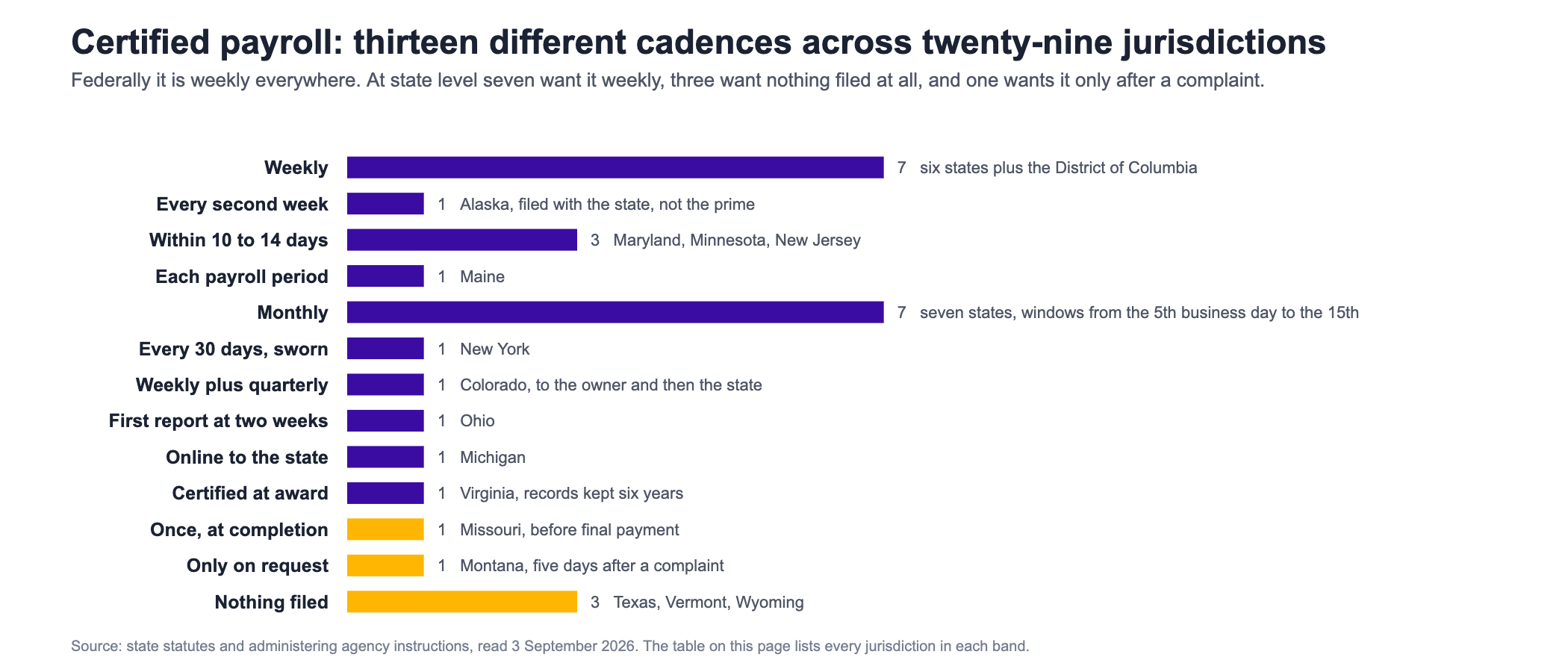
| Certified payroll cadence | Jurisdictions | Count |
|---|---|---|
| Weekly, filed with the awarding body or the state | Delaware, District of Columbia (federal rule), Hawaii, Massachusetts, Pennsylvania, Tennessee, Washington (weekly records, filed at least monthly) | 7 |
| Every second week, filed with the state | Alaska | 1 |
| Within 10 to 14 days of the pay period | Maryland, Minnesota, New Jersey | 3 |
| Monthly | California, Connecticut, Illinois (by the fifteenth), Nevada (within 15 days), New Mexico, Oregon (by the fifth business day), Rhode Island | 7 |
| Every 30 days, sworn | New York | 1 |
| Weekly to the owner, with a quarterly state certification | Colorado | 1 |
| Online to the state, no fixed public cadence | Michigan | 1 |
| Once, at completion, before final payment | Missouri | 1 |
| Only on request, after a complaint | Montana | 1 |
| Certified at award, records kept six years | Virginia | 1 |
| First report within two weeks of the initial pay period | Ohio | 1 |
| Each payroll period | Maine | 1 |
| Nothing filed; records kept open to inspection | Texas, Vermont, Wyoming | 3 |
What a wage determination does to your job ad
Davis-Bacon puts the wage in the advertised specifications and requires the scale posted at the site, and every state law above works the same way: the determination issues before the work is advertised. So when the job reaches a recruiting ad there is a right number and a wrong number. Two failure modes recur: advertising the base rate when the determination is base plus fringe, which understates the package and puts the ad below a competitor who advertised correctly; and advertising the shop rate for a role only sometimes on public work, so the ad is right for four jobs out of five and wrong for the covered one.
Both matter, because the wage line is the highest leverage line in a frontline job ad. In our 2026 social job advertising benchmark, the median cost per applicant is $13.88, and the middle half of campaigns runs from $6.48 to $29.74 (advertising costs only). Much of that spread comes down to whether the offer in the ad is one a qualified person wants to click, and on public work the offer has already been determined for you. So pull the determination for the classification and the county, add the fringe, and advertise that. See also what makes a good job ad, pay transparency laws by state and overtime laws by state.
Does this contract trigger prevailing wage
Frequently asked questions
What is prevailing wage?
The hourly rate plus fringe benefits a government determines to be standard for one trade classification in one locality, and that contractors on public works must pay whatever they pay privately. Federally it comes from the Davis-Bacon Act for construction over $2,000 and the Service Contract Act for services over $2,500; twenty-eight states and the District of Columbia run their own version. The determination issues before the contract is advertised, so the rate is published rather than negotiated.
Is prevailing wage the same as minimum wage?
No. Minimum wage is one floor across nearly all employment in a jurisdiction. Prevailing wage is specific to a trade classification, a locality and a type of construction, applies only to covered public work, and is almost always far higher. A determination also carries a fringe amount payable as benefits or added to cash, which minimum wage does not.
Who sets prevailing wage rates?
Federally, the Secretary of Labor. At state level, usually the labor commissioner or labor department. Connecticut and Rhode Island adopt the federal determination; Colorado used federal rates until the end of 2021 and publishes its own now. Texas is the outlier: the statute hands the job to the awarding public body, which must run a local survey or adopt the federal rate.
Do subcontractors have to pay prevailing wage?
Yes. Coverage follows the work, not the contract tier. Every laborer and mechanic on site, at any tier, must be paid the determined rate for the classification actually performed, and the federal rule says so without regard to any contractual relationship alleged to exist. Michigan makes contractor and subcontractor jointly and severally liable by statute.
What is certified payroll?
A payroll record submitted with a signed statement of compliance verifying the record is correct, that each worker received full wages without rebate, and that classifications and rates match the determination. Federally it is due weekly, on Optional Form WH-347 or any other format, with full Social Security numbers left off. Records are kept three years after the prime contract is complete.
What are the penalties for not paying prevailing wage?
Back wages are the floor everywhere; beyond that it varies. Federal contracting officers may withhold accrued payments, and debarment is available. Connecticut fines $5,000 per offense and keeps a rolling three year violation list, with mandatory debarment referral once settlements pass $50,000. Virginia adds eight percent interest, bars public bidding until restitution is complete, and makes a willful violation a Class 1 misdemeanor.
Does prevailing wage apply to private projects?
Usually not, but the exceptions are real. New York covers privately owned projects where public funds are at least 30 percent of construction cost and the project costs more than $5,000,000. Oregon reaches privately owned projects using $750,000 or more of public agency funds. The test is the money, not who holds title.
How often do prevailing wage rates change?
Federal determinations are revised continuously, so the operative question is which revision went into the contract. State schedules are fixed: Connecticut adjusts on July 1, Missouri issues a wage order by July 1, Nevada on October 1 of odd numbered years for two years, Wyoming on May 1, Oregon twice yearly, Virginia by survey every three years. Ohio adjusts thresholds, not rates, on January 1 of even numbered years.
How much is prevailing wage?
There is no single figure. Prevailing wage is set separately for each trade classification, county and type of construction, as an hourly base rate plus a fringe benefit amount, so an electrician and a laborer on the same job in the same county are on different rates. For federally funded construction over $2,000, look up the Davis-Bacon wage determination on SAM.gov by state, county and construction type. In the 28 states and the District of Columbia with their own law, the state rates apply as described above. Advertise base plus fringe, not the base alone.
The rate is set. Filling the crew is the part that is not.
A determination tells you what the job pays. It does not tell you where the electricians are. Bring the classifications you refill most often and the counties you bid in, and we will show you what a qualified applicant has cost in those markets.
Book a Demo