
Employer guideUpdated September 2026
Overtime Laws by State: The Daily Rule Is the One That Costs You
Federal law pays overtime after 40 hours in a week. A handful of states also pay it after a number of hours in a day, and that is the rule that changes what a shift pattern costs. A four-day, ten-hour schedule generates no federal overtime at all and eight premium hours a week per person in California and Alaska. A four-day, twelve-hour schedule costs eight premium hours federally and sixteen in California. Nothing about the headcount changed; only the state did.
The federal floor, and what changed in May
The Fair Labor Standards Act requires one and a half times the regular rate for hours worked over 40 in a workweek. There is no federal daily overtime rule, no federal rule about consecutive days, and no federal requirement to pay a premium for nights, weekends or holidays. Everything beyond 40 hours a week comes from a state. Nor does the FLSA define full-time or part-time employment at all, which is why the labels on a schedule decide nothing about the premium: full-time vs part-time employees sets out the three federal lines and which obligations actually follow them.
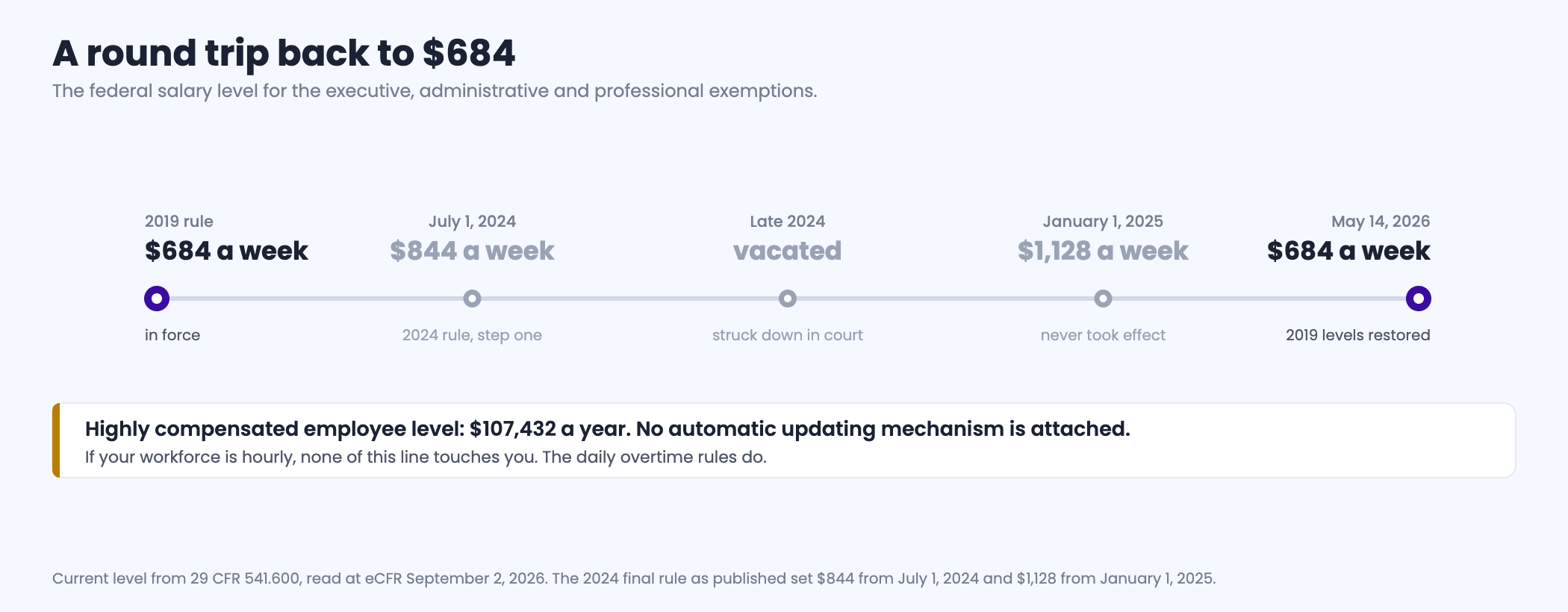
The exempt salary level moved twice and ended up where it started. The 2024 rule that raised it to $844 and then $1,128 a week was vacated, and on May 14, 2026 the Department of Labor published a technical amendment unwinding that rule and restoring the 2019 levels. As the regulation stands today an employee must be paid at least $684 a week, or $35,568 a year, to satisfy the salary test for the executive, administrative and professional exemptions, with the highly compensated employee level at $107,432. There is no automatic updating mechanism attached.
| Test | Amount | Equivalent |
|---|---|---|
| Salary level, executive, administrative and professional | $684 per week | $1,368 biweekly, $1,482 semimonthly, $2,964 monthly, $35,568 a year |
| Highly compensated employee | $107,432 a year | — |
| Overtime multiplier over 40 hours | 1.5x the regular rate | No federal daily or consecutive-day rule |
The salary test is the wrong thing for most frontline employers to be reading
Nearly every “overtime laws” article leads with the exempt salary threshold, because it is a change and changes make news. If your workforce is hourly, that number does not touch you. What touches you is the daily rule in four states and how it interacts with the shift pattern you already run.
The states with a daily rule
| State | Daily rule | Other thresholds | Source |
|---|---|---|---|
| California | Over 8 hours in a workday at 1.5x; over 12 hours at 2x | Over 40 hours a week at 1.5x. On the seventh consecutive day of a workweek, the first 8 hours at 1.5x and anything beyond at 2x. | Labor Code § 510, DLSE guidance |
| Alaska | Over 8 hours in a day at 1.5x | Over 40 hours a week at 1.5x. Does not apply to an employer with fewer than 4 employees in the regular course of business. | AS 23.10.060, Alaska DOLWD |
| Nevada | Over 8 hours in any workday at 1.5x, but only for employees earning less than 1.5x the minimum wage | Over 40 hours a week for everyone. The daily rule does not apply where the employee works a mutually agreed 10 hours a day for 4 days in a scheduled week. | NRS 608.018 |
| Colorado | Over 12 hours in a workday, or over 12 consecutive hours regardless of when the workday starts and ends | Over 40 hours a week. Where more than one threshold is met, the calculation producing the greater payment applies. | COMPS Order #40 |
What that does to a shift pattern
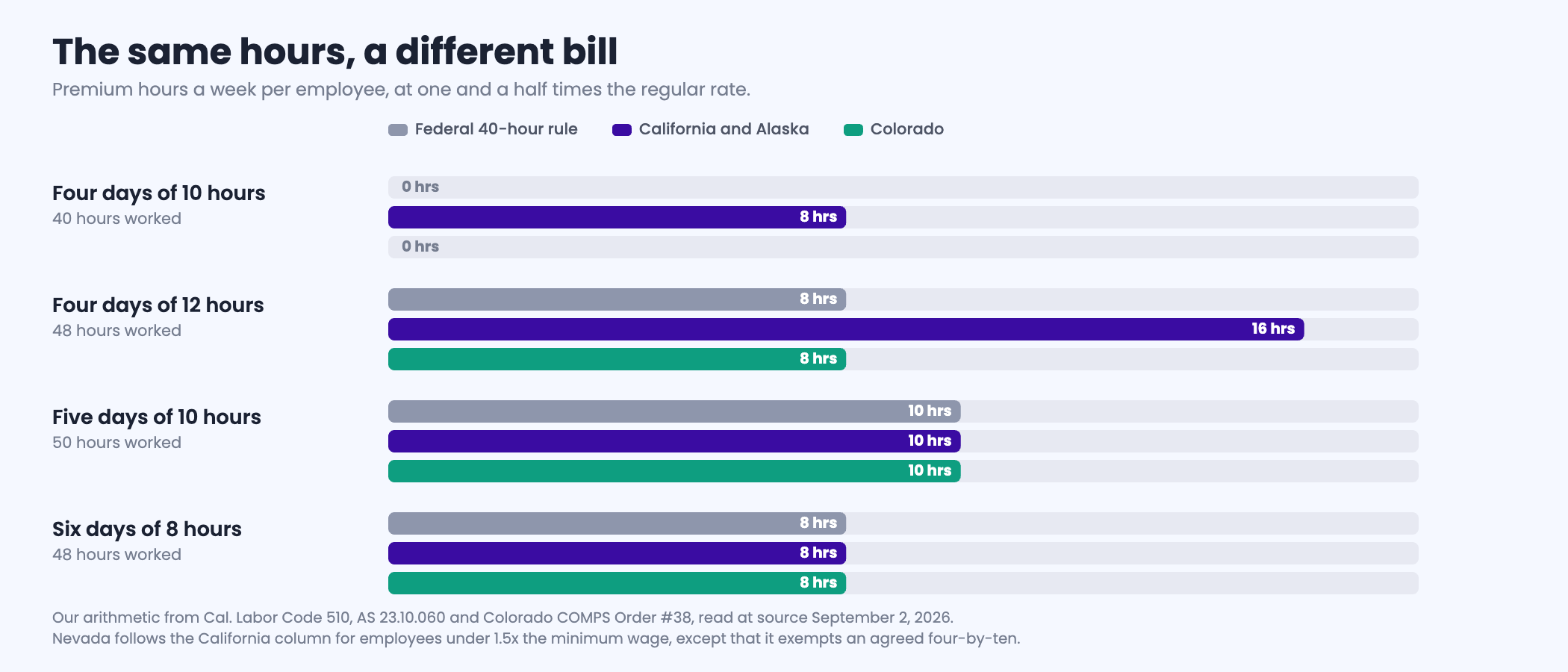
Here is the arithmetic nobody runs before publishing the schedule. Take four common frontline patterns and count the premium hours each generates per person per week.
| Pattern | Hours | Federal | California and Alaska | Colorado |
|---|---|---|---|---|
| Four days of 10 hours | 40 | 0 | 8 | 0 |
| Four days of 12 hours | 48 | 8 | 16 | 8 |
| Five days of 10 hours | 50 | 10 | 10 | 10 |
| Six days of 8 hours | 48 | 8 | 8 | 8 |
Two rows in that table are worth staring at. The four-by-ten is the schedule frontline workers ask for most often and the one operators reach for when they cannot fill a fifth day. Federally it is free: forty hours, no premium. In California and Alaska it costs eight premium hours a week for every person on it, and nobody worked an extra minute. The four-by-twelve, standard in warehousing, manufacturing and senior living, doubles in California against the federal figure.
The other two rows are the point in reverse. A five-by-ten and a six-by-eight cost exactly the same everywhere, because the daily overtime and the weekly overtime land on the same hours. The daily rule is not a surcharge on long weeks. It is a surcharge on long days, and it is invisible until you compare the two.
Price a shift pattern in one state
What it costs across a crew
Premium hours per person are easy to wave away. Multiply them by a crew and a year and they stop being a rounding error, which is the argument for settling the schedule question before the requisition rather than after.
The annual difference between two schedules
Two things that catch people out
Colorado counts consecutive hours, not just workday hours. The COMPS Order sets the twelve-hour trigger “without regard to the starting and ending time of the workday.” A shift that crosses midnight, or a double that spans two workdays with a short gap, can pass twelve consecutive hours without passing twelve hours in either workday. Where more than one threshold is met, the calculation that produces the greater payment applies.
Nevada’s daily rule depends on the wage, not the job. The eight-hour rule reaches only employees earning less than one and a half times the minimum wage. Two people working the identical twelve-hour shift on the same crew can be owed different premiums because one of them is paid more. That is unusual, and it is the sort of thing that shows up in a payroll audit rather than in a policy review.
A second set of rules reaches the same schedules from a different direction. A third reaches only part of the crew: child labor laws by state caps the evening on anyone under 18, and above 16 thirty states set no limit at all. Oregon and several cities require fourteen days notice and charge a premium for changing it; our page on predictive scheduling laws by state covers who is caught and what each change costs.
Mandatory overtime: can an employer require it?
Under federal law, yes. The Department of Labor’s Fact Sheet 23 says: “There is no limit in the Act on the number of hours employees aged 16 and older may work in any workweek.” What the Fair Labor Standards Act regulates is pay, not the requirement: “An employer who requires or permits an employee to work overtime is generally required to pay the employee premium pay for such overtime work.” So mandatory overtime is legal for most adult employees, as long as the overtime is paid, and in at-will employment an employee who refuses it can generally be disciplined unless a state law or a contract says otherwise.
Mandatory overtime laws by state: mostly about nurses
The state limits that exist mostly protect nurses and other health care employees. These are the ones we verified in the statute:
| State | Who is protected | Source |
|---|---|---|
| New York | Nurses: a health care employer may not require work beyond regularly scheduled hours, with emergency exceptions | Labor Law §167 |
| Washington | Health care facility employees covered by the statute: “No employee of a health care facility may be required to work overtime,” with exceptions | RCW 49.28.140 |
| Massachusetts | Hospital nurses, except in an emergency situation | M.G.L. c.111 §226 |
| New Jersey | Covered health care employees: overtime beyond the scheduled shift is voluntary | P.L. 2001, c.300 |
| Minnesota | Nurses who decline extra hours because it may jeopardize patient safety | Minn. Stat. §181.275 |
| Maine | Nurses may not be disciplined for refusing more than 12 consecutive hours; other employees generally may not be required to work more than 80 hours of overtime in any consecutive two-week period, with exceptions | 26 M.R.S. §603 |
Other states have similar health care provisions; check yours before relying on this list. Outside health care, the limits that matter most for frontline employers are the child labor hours rules for minors and any collective bargaining agreement. The cost side is what makes mandatory overtime a hiring problem: a crew that works it every week is a crew that is one resignation away from working more of it.
Two related questions sit next to this page. Whether a salaried role is owed overtime at all is a classification question, covered on exempt vs non-exempt. And holiday premiums, which federal law does not require but which can be credited toward overtime when paid at time and a half or more, are on holiday pay laws.
Why an advertising company has a view on this
Because the schedule is the offer. In the frontline categories we advertise, the shift pattern is stated in the ad and is one of the few things a candidate decides on before clicking. Four tens and three twelves are used as recruiting features precisely because people want them, and they work: they are among the most common differentiators in the ads that fill hardest-to-fill roles.
What we can tell you is what the top of that funnel costs. Across the 891 campaigns in our 2026 social job advertising benchmark the median campaign delivered an applicant for $13.88, with warehouse and production roles at $9.83 and registered nurses at $19.08. What we cannot tell you is whether a compressed schedule fills faster than a standard one, because we do not hold the schedule as a field and will not infer it from ad copy. If you are weighing a four-by-ten against a five-by-eight, the recruiting benefit is a real thing to put on the scale, and the premium hours above are the other side of it.
The related question we do have data on is what turnover costs when a schedule does not work, which our turnover cost calculator takes apart, and how the first ninety days behave, which is on first 90 days turnover.
State-by-state employer guides: every state’s breaks, overtime, final pay and hiring rules in one place: Alabama, Alaska, Arizona, Arkansas, California, Colorado, Connecticut, Delaware, D.C., Florida, Georgia, Hawaii, Idaho, Illinois, Indiana, Iowa, Kansas, Kentucky, Louisiana, Maine, Maryland, Massachusetts, Michigan, Minnesota, Mississippi, Missouri, Montana, Nebraska, Nevada, New Hampshire, New Jersey, New Mexico, New York, North Carolina, North Dakota, Ohio, Oklahoma, Oregon, Pennsylvania, Rhode Island, South Carolina, South Dakota, Tennessee, Texas, Utah, Vermont, Virginia, Washington, West Virginia, Wisconsin, Wyoming.
Frequently asked questions
Which states have daily overtime laws?
California, Alaska, Nevada and Colorado are the ones we verified at source. California and Alaska pay overtime after 8 hours in a day, Colorado after 12 hours in a workday or 12 consecutive hours, and Nevada after 8 hours in a workday but only for employees earning less than one and a half times the minimum wage. Federal law has no daily rule at all, so everywhere else the 40-hour week is the only trigger.
What is the federal overtime salary threshold in 2026?
$684 a week, or $35,568 a year, for the executive, administrative and professional exemptions, with the highly compensated employee level at $107,432. The 2024 rule that would have raised those figures to $844 and then $1,128 a week was vacated, and the Department of Labor published a technical amendment on May 14, 2026 restoring the 2019 levels. No automatic updating mechanism is attached to them.
Does a four-day, ten-hour schedule create overtime?
Not under federal law, because it is forty hours. In California and Alaska it creates eight premium hours a week for every person on it, since both states pay overtime after eight hours in a day. Nevada writes an express exception for a mutually agreed ten-hour, four-day schedule, so the daily rule does not bite there. Colorado, whose daily threshold is twelve hours, treats it as an ordinary forty-hour week.
How much overtime does a four-day, twelve-hour schedule create?
Forty-eight hours worked produces eight premium hours under the federal weekly rule. In California and Alaska the daily rule produces sixteen, because each shift generates four hours over the eight-hour threshold. In Colorado the twelve-hour daily threshold is met but not exceeded, so the weekly rule governs and the answer is eight, the same as federal.
When does California pay double time?
For hours worked beyond twelve in a single workday, and for hours beyond eight on the seventh consecutive day of work in a workweek. On that seventh day the first eight hours are paid at one and a half times the regular rate and everything after that at double. Hours between eight and twelve on an ordinary day are paid at one and a half times.
What is Colorado’s consecutive hours rule?
Colorado pays overtime for work beyond twelve consecutive hours, measured without regard to when the workday starts and ends, as well as for work beyond twelve hours in a workday or forty in a week. A shift crossing midnight, or a double with a short break in the middle, can pass the consecutive-hours threshold without passing the workday one. Where more than one threshold is met, the calculation producing the greater payment applies.
Are small employers exempt from state overtime rules?
Sometimes, and Alaska is the clearest example: its overtime provisions do not apply to an employer with fewer than four employees in the regular course of business. That is a state exemption from the state rule, not from the federal one, so a covered employer still owes overtime after forty hours a week under the Fair Labor Standards Act. Check both layers rather than assuming the smaller headcount settles it.
Is there a federal rule for weekends, nights or holidays?
No. The Fair Labor Standards Act requires a premium only for hours over forty in a workweek. There is no federal requirement to pay extra for night shifts, weekend work, holidays, or for a set number of consecutive days. Any premium of that kind comes from a state law, a collective bargaining agreement, or the employer’s own policy, and once promised it may have to be included in the regular rate on which overtime is calculated.
Is mandatory overtime legal?
For most adult employees, yes. The Fair Labor Standards Act places no limit on hours for employees 16 and older and requires only that overtime over 40 hours in a workweek be paid at time and a half. Some states limit mandatory overtime for nurses and other health care employees, including New York, Washington, Massachusetts, New Jersey, Minnesota and Maine.
Can an employee refuse mandatory overtime?
Under federal law an employer can generally require overtime and, in at-will employment, discipline an employee who refuses, unless a state law or a contract says otherwise. State laws protecting nurses who refuse mandatory overtime are the main exception.
Can private employers give comp time instead of overtime?
No. Under the Fair Labor Standards Act, comp time in place of overtime pay is allowed only for public agencies, under Section 7(o). A private employer must pay non-exempt employees time and a half for hours over 40 in the workweek they are worked. You can cut hours later in the same workweek to stay under 40. The Working Families Flexibility Act of 2025 (H.R. 2870) would change this, but it is not law.
Decide the schedule and the campaign in the same meeting
Bring the pattern you are considering and the markets you are hiring into. We will show you what applicant flow costs for those roles, so the recruiting benefit of a compressed week and its premium-hour cost land on the same page.
Book a Demo