
Employer guideRead at source, 3 September 2026
Full-Time vs Part-Time Employees: Hours, Benefits Thresholds and What to Put in the Job Ad
There is no single federal definition of full-time work. The Fair Labor Standards Act does not define it at all, and the Department of Labor says so in one sentence: it is a matter generally to be determined by the employer. The Affordable Care Act sets its own line at 30 hours a week or 130 hours a month, purely for the employer mandate. The Bureau of Labor Statistics counts full-time at 35 usual hours a week, purely for statistics. Three federal lines, none of them the answer to the question employers actually ask. What matters is that the ACA threshold is a headcount test built out of everyone hours, part-timers included, which is why employers with thirty-five full-time staff discover they are covered anyway.
Three federal definitions, and one of them is the absence of a definition
Ask five employers what full-time means and you will get 40 hours, 35 hours, 32 hours, whatever the handbook says, and whatever payroll is set to. All five can be right, because federal law does not settle it. The Department of Labor page on the subject is two sentences long: the FLSA does not define full-time employment or part-time employment, and this is a matter generally to be determined by the employer. Overtime attaches at 40 hours in a workweek whatever you call the job, and nothing in the FLSA turns on the label.
The ACA is where a real number lives, and only for one purpose. For the employer shared responsibility provisions, a full-time employee is one employed on average at least 30 hours of service per week, or 130 hours of service in a calendar month. That is it. It does not decide who gets your PTO policy, your holiday pay or your shift differential; it decides who counts for the mandate and who you have to offer coverage to. The BLS line of 35 usual hours a week is different again, and is a survey classification based on a person usual schedule rather than the hours worked in any given week.
| Source | Full-time line | What it governs | What it does not |
|---|---|---|---|
| Fair Labor Standards Act | No definition | Nothing. Overtime attaches at 40 hours in a workweek regardless of the label | Benefits eligibility, scheduling, classification |
| Affordable Care Act, IRC 4980H | 30 hours a week, or 130 hours a month | Who must be offered coverage, and who counts toward applicable large employer status | Anything outside the employer mandate |
| BLS Current Population Survey | 35 usual hours a week | How national statistics classify workers | Any legal obligation whatsoever |
| Your handbook | Whatever you write | PTO, holiday pay, differentials, internal transfer eligibility, most benefits | Overtime, and the ACA test |
The threshold that costs money is a headcount, not an hours line
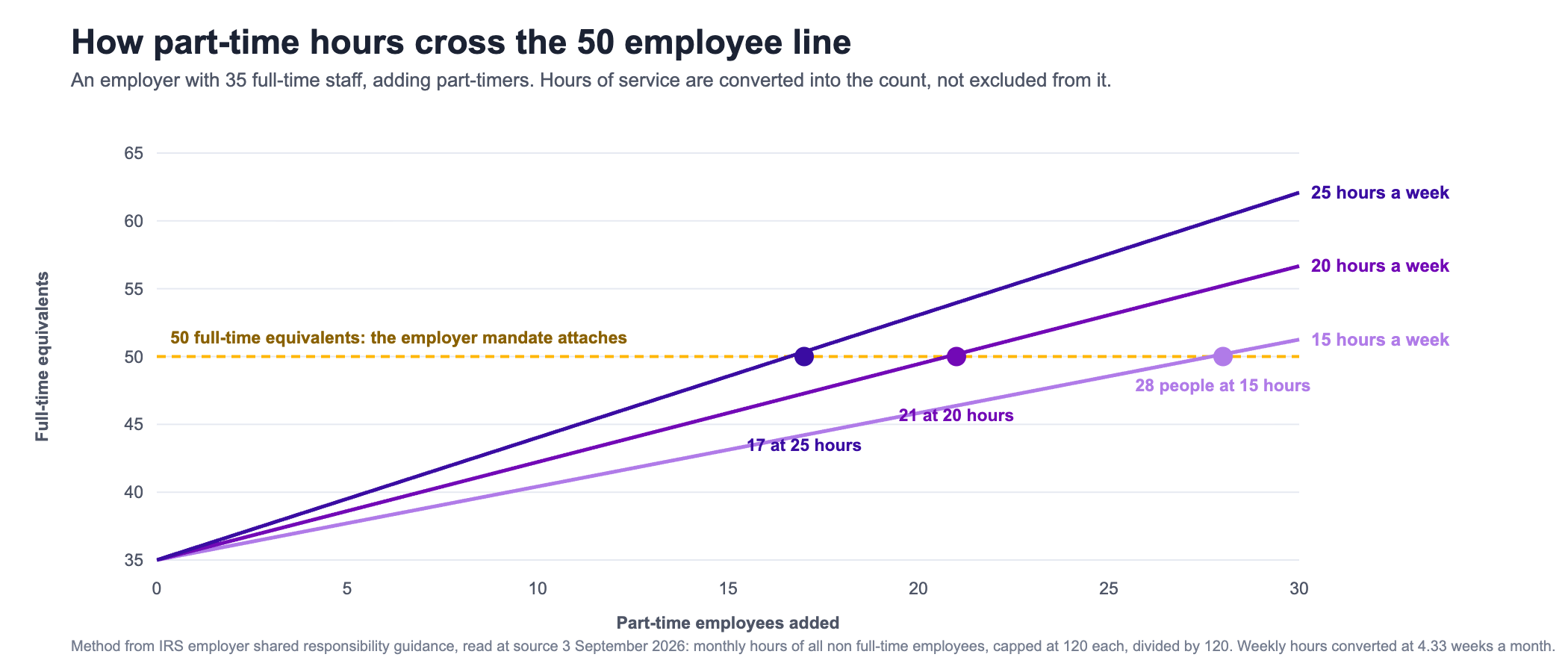
The expensive mistake is not misclassifying an individual. It is misreading the applicable large employer test, because it looks like a headcount and is actually an hours calculation. An employer is an ALE for a calendar year if it averaged 50 or more full-time employees, including full-time equivalents, during the prior calendar year. Part-time hours are not excluded from that count. They are converted into it.
The IRS gives the arithmetic plainly. For each month, take the hours of service of all non full-time employees, count no more than 120 hours for any one of them, and divide the total by 120. The IRS own worked example: an employer with 40 full-time employees and 20 employees at 60 hours of service each has 50 full-time equivalents for that month, because 20 times 60 is 1,200 and 1,200 divided by 120 is 10. Then you add each month full-time count to each month FTE count across the prior year and divide by twelve.
Read that twice if you run a shift operation. Twenty part-timers at fifteen hours a week put you within ten of the mandate on their own. A restaurant group with 38 salaried and managerial staff and a floor of part-time servers is not comfortably under fifty; it is one busy quarter away from being over. And the test looks backwards, at the year already finished, so by the time you notice, the year that decided your status is closed.
Count your own workforce
What the mandate costs if it attaches
Where an ALE offers coverage to fewer than 95 percent of full-time employees and at least one of them takes a premium tax credit, the payment is the full-time headcount minus up to 30, times an indexed $2,000 base. Where coverage is offered but is unaffordable or lacks minimum value, it is an indexed $3,000 for each full-time employee who takes a credit, capped at the first amount. The IRS question and answer page, last reviewed 20 July 2026, publishes adjusted figures only through 2023, where the two amounts stood at $2,880 and $4,320. Later years are set in annual revenue procedures we did not read at source, so we are not quoting them.
Which obligations actually follow the hours
Most of what employers believe is tied to full-time status is tied to nothing but their own handbook. A short list of what the law attaches to hours, and what it leaves to you.
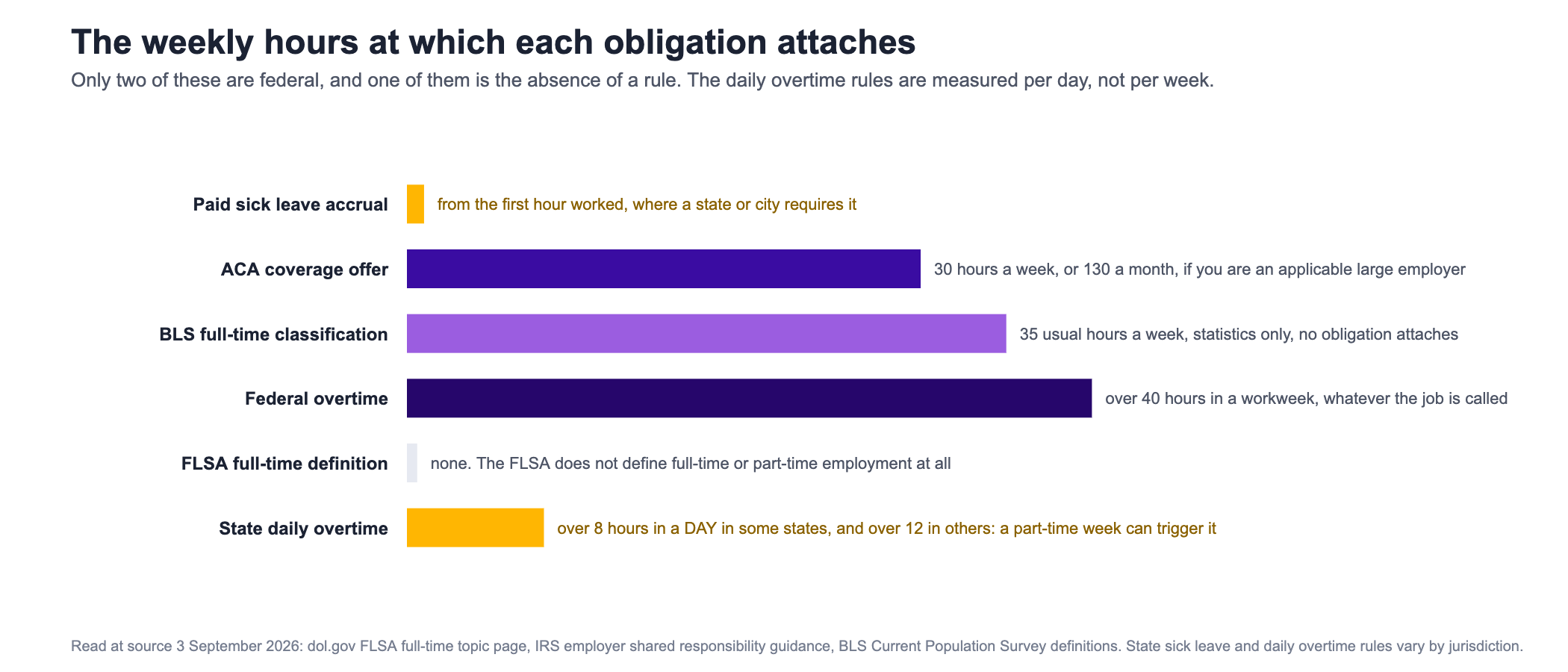
| Obligation | Tied to hours by law? | The line |
|---|---|---|
| Overtime | Yes, federally | Over 40 hours in a workweek. Several states add a daily rule that a part-time schedule can trigger |
| Health coverage offer | Yes, if you are an ALE | 30 hours a week or 130 a month |
| Paid sick leave | Yes, where a state or city requires it | Usually accrual per hour worked from hour one, with no full-time gate |
| Predictive scheduling | Yes, where it applies | Advance notice and predictability pay, and in some cities an offer of hours to existing staff before hiring |
| Retirement plan eligibility | Yes, for long-term part-time staff | Governed by plan rules and federal law, not by a full-time label |
| Paid time off and holiday pay | No | Employer policy, unless a state treats accrued vacation as earned wages |
| Shift differentials and bonuses | No | Employer policy, though they enter the regular rate for overtime |
| The words full-time in your ad | No | Employer policy, and see below on what it does to applications |
Two of those rows are pages of their own here, and the detail lives there. Overtime laws by state covers the daily rules, which are what turn an innocuous part-time schedule expensive. Predictive scheduling laws by state covers advance notice and predictability pay, and the requirement in Seattle and San Francisco to offer additional hours to existing part-time staff before hiring anyone new. That last one changes the order of operations in a hiring plan, not just its cost.
What to put in the job ad, and what we cannot tell you
Here is the honest part. We run recruitment advertising for frontline employers and we have a large campaign dataset, so the obvious thing to publish here would be how much better full-time ads perform than part-time ads. We are not going to, because our benchmark does not segment by hours offered. The 2026 social job advertising benchmark cuts cost per applicant by sector, by role and by age band, and it does not carry a full-time versus part-time split. Publishing one would mean inventing it, and a number invented for a blog post is worse than no number.
What the benchmark does establish is where the leverage sits. Apply rate explains roughly 70 percent of the variation in cost per applicant across campaigns, more than click-through rate or CPM. Cost per applicant runs from $2.91 at the tenth percentile to $66.45 at the ninetieth, median $13.88. Whatever moves apply rate moves the whole cost, and the hours line is one of about four things a frontline applicant reads before deciding whether to start the form.
So the practical guidance is about precision rather than about which word wins. Say the hours, not the category. Full-time means nothing federally and is not the same in your handbook as in the one across the street; twenty-five to thirty hours, Tuesday to Saturday, is a fact somebody can act on. If the schedule genuinely varies, say the range and say it varies, because a candidate who finds out at week two leaves at week three and you pay the acquisition cost twice. If the role can be either, run it as either and let the applicant pick, rather than splitting a small budget across two ads competing in the same auction.
And do not use full-time as a proxy for benefits eligibility in the ad unless it is true. An ad that says full-time with benefits, where benefits begin at a threshold the schedule does not reliably reach, is the kind of thing that turns into a bad first month. More on the wage and hours lines generally in what makes a good job ad, and on covering short shifts without adding headcount in how to fill open shifts.
Check the hours you are advertising against the hours that trigger obligations
Frequently asked questions
How many hours is full-time?
There is no single answer, because federal law does not set one. The Fair Labor Standards Act does not define full-time or part-time employment, and the Department of Labor says it is a matter generally to be determined by the employer. The Affordable Care Act uses 30 hours a week or 130 hours a month, but only for the employer mandate. The Bureau of Labor Statistics uses 35 usual hours a week, but only to classify workers in its surveys. Your handbook decides the rest.
Can part-time employees get benefits?
Yes, and in several cases they must. State and city paid sick leave laws generally accrue per hour worked with no full-time gate. Retirement plan rules reach long term part-time staff. Beyond that it is your choice: nothing in federal law stops you offering health coverage, paid time off or a differential to someone working twenty hours, and many frontline employers do it deliberately because it is cheaper than replacing them.
What is the ACA 30 hour rule?
For the employer shared responsibility provisions, a full-time employee is one employed on average at least 30 hours of service per week, or at least 130 hours of service in a calendar month. Employers may determine that month by month under the monthly measurement method, or over a longer period under the look back measurement method. It matters only if you are an applicable large employer, and it decides who has to be offered coverage.
Do part-time employees count toward the 50 employee threshold?
Yes, converted into full-time equivalents. For each month, add up the hours of service of everyone who is not full-time, counting no more than 120 hours for any one person, and divide by 120. The IRS example: 40 full-time employees plus 20 people at 60 hours each equals 50 full-time equivalents, because 1,200 divided by 120 is 10. You then average the monthly totals across the prior calendar year. This is the step most employers skip.
Can someone hold two part-time jobs with the same employer?
They can, but treat it as one job for wage and hour purposes. Hours across both roles are added together for overtime in the same workweek, and where the two roles pay different rates the overtime premium is calculated on a weighted regular rate. Splitting one person across two positions does not avoid overtime and is a common source of back pay claims.
Do part-time employees get overtime?
Federally, only if they work more than 40 hours in a workweek, which is unusual but not rare when someone picks up shifts. The real exposure is at state level. Several states apply a daily overtime rule, so a part-timer working three twelve hour shifts a week can earn premium hours without ever passing 40. Check the daily rule in each state you operate in before assuming part-time means no premium.
Can I change someone from full-time to part-time?
Generally yes, prospectively, unless a contract or collective agreement says otherwise. Watch three things. If you are an applicable large employer, a cut below the ACA line can end the coverage offer and create exposure depending on your measurement method. Predictive scheduling rules in some cities require notice and predictability pay for reduced hours. And an employee who accepted the job on advertised hours is likely to leave, which puts you back in the market at full acquisition cost.
What should the job ad say about hours?
Say the hours themselves rather than the category. Full-time carries no federal meaning and differs between employers, so a number and a pattern, such as twenty-five to thirty hours Tuesday to Saturday, is far more useful to an applicant deciding whether to start the form. If the schedule varies, say so and give the range. If the role could be either, advertise it as either rather than splitting a budget between two ads bidding in the same auction.
The hours line is one of four things an applicant reads before deciding.
Apply rate explains most of the variation in what an applicant costs. Bring the roles and the markets you hire in, and we will show you what a qualified applicant has actually cost there.
Book a Demo