
How to Fill Open Shifts: Nights, Weekends and the Shifts Nobody Picks Up
A hard shift is a different job with a different price and a different person who wants it, and most postings hide all three. To fill open shifts on nights, weekends and rotating schedules: put the differential and the exact schedule in the first line, design the shift for the people who want it (fixed nights, a compressed weekend program), run one campaign per shift, and watch frequency in a small radius. Boostpoint publishes no shift-level cost figure; cost per applicant is never cost per hire.
A note on who's writing this
Boostpoint runs social media job ads for employers whose hardest openings are shifts, not titles: the plant's third shift, the distribution center's weekend crew, the hospital's nights, the restaurant's Friday close, the guard post at 2 a.m. This page is cross-industry; the healthcare version, with bench sizing and the PRN model, is on PRN staffing. What we can say from data is limited and we say where the limit is: our benchmark has campaign structure, frequency and role figures, but no shift-level cost comparison, so nothing here claims that nights cost more or less per applicant than days. The differential, the schedule designs, the first lines and the same-day call are our practice with shift-based clients, not measured results. Pay-law facts are the Department of Labor's and OPM's, and the schedule statistics are the BLS's, dated where they appear.
Who actually works nights and weekends
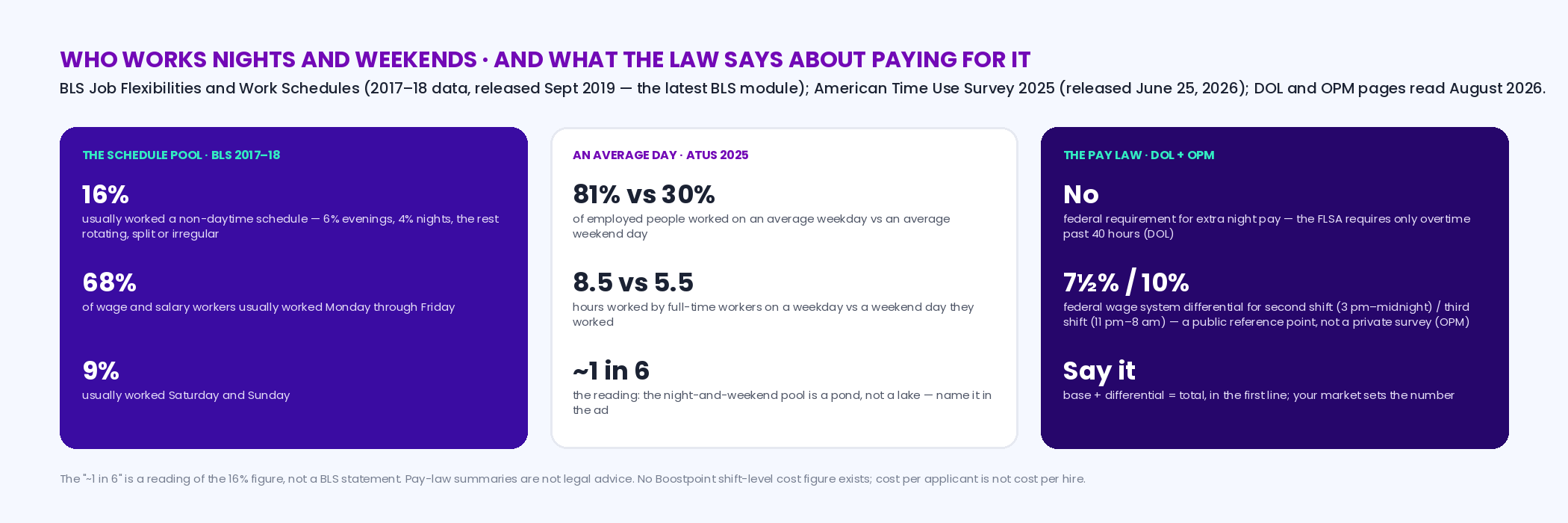
The BLS's most recent module on work schedules found that 16% of workers usually worked a non-daytime schedule — 6% evenings, 4% nights, the rest rotating, split or irregular — that 68% of wage and salary workers usually worked Monday through Friday, and that 9% usually worked Saturday and Sunday (Job Flexibilities and Work Schedules, 2017–18 data, released September 24, 2019, the latest BLS release on the subject). The 2025 American Time Use Survey, released June 25, 2026, puts it another way: 81% of employed people worked on an average weekday and 30% on an average weekend day, and full-time workers who worked on a weekend day averaged 5.5 hours against 8.5 on a weekday. Read those numbers as a recruiter and two things follow. The night and weekend pool is small — roughly one worker in six on a non-daytime schedule, one in eleven on both weekend days — so an ad for a hard shift is fishing in a pond, not a lake, and it has to name the pond. And the people already in it are the recruit: the person who has worked nights for years and wants to keep doing it, not the day worker you hope to talk into a rotation.
Lever one: the differential, said out loud
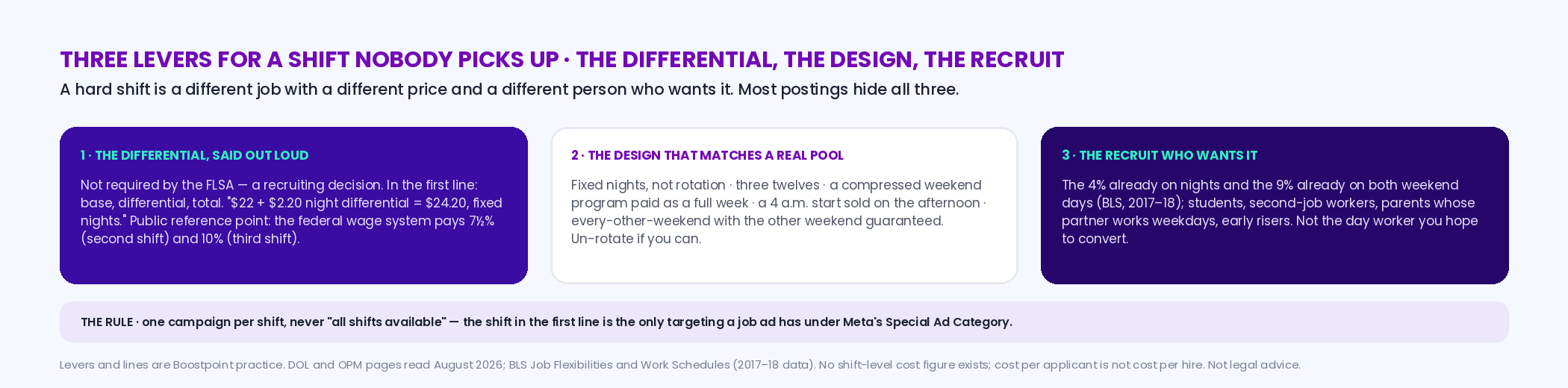
Federal law does not make you pay more for nights: "The Fair Labor Standards Act (FLSA) does not require extra pay for night work," only time and a half past 40 hours in a workweek for covered, nonexempt workers (DOL, Night Work and Shift Work, read August 2026). So a differential is a recruiting decision, and the question is not whether the law requires it but whether the person you want will take the shift without it; for a shift nobody picks up, the answer is already in. For a reference point, the federal government's own blue-collar pay system pays a 7½ percent differential for a second shift (3 p.m. to midnight) and 10 percent for a third shift (11 p.m. to 8 a.m.) when most of an employee's regular hours fall in the window (OPM, Federal Wage System night shift differential, 5 CFR 532.505, read August 2026); that is a public-sector rule, not a private-sector survey, and your market sets your number. What matters more than the size is where it appears: a differential buried in the benefits paragraph recruits nobody, and a differential in the first line — "Nights, 11 to 7, $22 plus $2.20 night differential, fixed schedule" — is the only line a night worker reads. Say the base, say the differential, say the total, and say whether the differential applies to the whole shift or only the hours after a certain time, because the person who has worked nights before will ask. The hours themselves also decide which obligations attach, and the thresholds are not where most employers assume: full-time vs part-time employees has the 30, 35 and 40 hour lines and what each one governs.
Average shift differential: what the number is, and why nobody can actually tell you
This is the most-asked question about differentials and the one with the worst answers online. We went looking for a primary source for an average private-sector shift differential and could not find one. No federal statistic publishes it. The figures that circulate — ten percent, fifteen percent, a dollar to five dollars an hour — trace back to vendor surveys and to calculator pages that cite each other, and a first page of search results for the phrase is almost entirely tools rather than data. We are not going to add another unsourced number to that pile.
What does exist is one night differential with a statute behind it. Under 5 U.S.C. § 5545(a), federal employees working regularly scheduled hours between 6:00 p.m. and 6:00 a.m. are paid their basic rate plus 10 percent. That rule governs the federal government and nobody else, and we are not offering it as a benchmark for your business. We are offering it as the only night premium in the country you can look up and check, which makes it a defensible place to start an argument with a finance director who wants to know where your number came from.
The differential is a price, and you already have the data to set it
Stop looking for the market rate and work out your own. Take one shift you cannot fill. Count how many days it has been open, multiply by the overtime hours you are paying to cover it and the premium on those hours, and you have the weekly cost of not filling it. Divide that by the hours in the shift and you have the hourly amount you are already spending to leave it open. Any differential below that number is cheaper than the status quo, and it is a number you can show someone rather than assert.
The shape you choose matters as much as the size, and the three shapes behave differently.
| Shape | What it does well | What to watch |
|---|---|---|
| Percentage of base | Scales automatically with pay rises and seniority; reads as fair | Your most expensive people get the biggest premium for the same inconvenience |
| Cents per hour | Easy to say in an ad, easy to budget, same for everyone | Erodes in real terms unless somebody revisits it, and usually nobody does |
| Flat sum per shift | Strongest pull for a specific shift nobody takes | A lump sum paid without regard to hours worked is not an overtime premium and still goes into the regular rate — see the next section |
One last thing, and it is the one most employers get backwards: a differential you do not put in the advertisement buys retention, not applicants. If the premium only appears at the offer stage, it is paying people who already work for you to stay on nights. If it is in the first line of the ad, it is doing recruiting work as well. That is a choice, not an accident, and it is worth making deliberately.
Shift differential pay: the overtime rule employers get wrong
Before the next lever, one piece of pay compliance that sits underneath all of them, because getting it wrong is expensive and it is genuinely easy to get wrong.
A shift differential is not a separate pot of money that sits outside the overtime calculation. Under 29 CFR 778.207(b) the Fair Labor Standards Act “requires the inclusion in the regular rate of such extra premiums as nightshift differentials (whether they take the form of a percent of the base rate or an addition of so many cents per hour) and premiums paid for hazardous, arduous or dirty work.”
Read that carefully, because it is the opposite of how most rota software is set up. If you pay $20 an hour plus a $2 night differential, the overtime rate for those hours is not $30. The differential goes into the regular rate first, making it $22, and overtime is then computed on that — $33. The gap looks small per hour and is not small across a year of night shifts, and it is the kind of underpayment that surfaces as a back-pay claim covering every affected employee at once.
The same paragraph catches two things employers rarely think of as differentials. Premiums for “hazardous, arduous or dirty work” go into the regular rate on exactly the same basis. So does “any extra compensation which is paid as an incentive for the rapid performance of work”, and lump sums paid without regard to hours worked are explicitly not overtime premiums and must be included too.
The recruiting consequence is worth stating plainly, because it cuts the other way from what you might expect. A differential is more expensive than the sticker number once overtime is in play, so decide the figure with that in mind — and then, having paid for it, actually put it in the advert. Employers routinely pay a differential and describe the role as “competitive pay”, which spends the money without buying any of the attention it should have bought.
Source: 29 CFR 778.207, read at source 9 September 2026 via the Electronic Code of Federal Regulations. General information on the federal rule, not legal advice; state law and any collective bargaining agreement sit on top of it.
Lever two: design the shift for the person who wants it
The schedule is usually the problem, not the pay. A rotating schedule asks a person to live as two people and recruits from the smallest pool there is; a fixed night shift recruits from the 4% who already live that way and want to keep doing it. A five-night week asks for the whole life; three twelves asks for three nights and gives four back. A weekend shift that pays weekday rates asks people to give up what 70% of employed people have off; a compressed weekend program — two twelve-hour weekend shifts paid as a full week, or at a rate that makes the weekend worth more than the weekdays — recruits the student, the parent whose partner works weekdays, and the second-job worker who can only give you Saturday and Sunday. And a shift that starts at 4 a.m. is a different recruit again: the early riser who wants to be home by one. The table is the designs we use with clients; none of them is new, and all of them are stated in the ad, because a design nobody knows about fills nothing.
| Design | Who it recruits | What the first line says | What it costs you that isn't money |
|---|---|---|---|
| Fixed nights (no rotation) | The 4% who already work nights and want to keep the rhythm; second-job workers; people with daytime care duties | "Nights, 11 to 7, fixed — no rotation, ever" | A separate night crew with its own lead and its own culture; days and nights stop knowing each other |
| Three twelves | People who want four days off more than they want five short days | "Three 12s, Sun–Tue nights, 36 hours paid as full time" | Handoffs at 12 hours; fatigue policies; overtime past 40 only in the fourth shift |
| Compressed weekend program | Students, parents with a weekday-working partner, second-job workers, the 9% already on Saturday–Sunday | "Weekend program: Sat and Sun 7 to 7, paid for 36–40 hours, weekdays are yours" | A premium that the weekday crew will notice; a program that has to be honored when a weekday shift opens |
| Early start | The early riser; the parent who does school pickup at three | "4 a.m. start, home by 12:30, Mon–Fri" | A pre-dawn supervisor; a commute in the dark |
| Split weekend rotation (every other) | The day worker who will take every other weekend for a differential and a guaranteed one off | "Every other weekend, $X differential, the other weekend guaranteed off" | Scheduling discipline: the "guaranteed" has to be real |
Lever three: recruit the person who wants the shift, in their own ad
"All shifts available" is the sentence that fills no shift, because the person who wants nights reads it as a day job with a catch and the person who wants days reads it as a night job with a catch. Every hard shift gets its own ad, with the shift in the first line and the person it is for in the second; where several shifts are open at once that is one campaign with a distinct ad per shift, the multi-role structure, which in our 2026 benchmark ran a median $9.83 per applicant at a 12% apply rate across 46 campaigns, against $14.45 and 18% for single-role campaigns across 1,210 — structure figures across every industry we serve, not shift figures. Under Meta's Special Ad Category a job ad has no age, gender or ZIP targeting (the rules), so the copy does all the selecting: "Weekend program, Sat–Sun 7 to 7, paid for 36 hours" finds the student and repels the person who wanted Monday to Friday, which is the point. The form asks which shifts the person can work, in their words, before anything else; the call comes the same day from the supervisor who runs that shift, at an hour that shift is awake, which is our practice, not a statistic. And the interview happens on the shift — a paid trial hour at 11 p.m. tells both sides more than any daytime conversation about nights. The board below writes the five first lines.
Interactive
Hard-shift ad builder — pick the shift and get who wants it, the three knockouts, the first line and the design tip
Nothing is stored or sent — this runs in your browser. Lines and designs are Boostpoint practice, not measured results; pool shares are the BLS's and dated.
What the open shift costs you now: overtime, and what a hire replaces
Before deciding what to pay to fill a shift, price the empty one. An open shift is usually covered by someone already on the payroll at time and a half, and the premium half of that rate is the cost of not hiring, week after week. Ten open twelve-hour shifts a week is 120 hours; if current staff pick up 30% of them, 84 hours a week go uncovered or go to overtime, and at a $22 base the overtime premium alone — the extra half, not the whole wage — is 84 × $22 × 0.5 = $924 a week, $48,048 a year, before the turnover that mandatory overtime causes. Those 84 hours are 2.33 people at 36 hours, so three hires, which is a recruiting target and a differential budget, not a cost per hire; we don't compute those. The calculator runs it on your numbers.
Interactive
Coverage gap calculator — the hours nobody picks up, the hires that close them, and the overtime premium you pay meanwhile
Nothing is stored or sent — this runs in your browser. Every input is yours; this prices coverage, never a hire.
The campaign: one per shift, and watch frequency in a small radius
A hard-shift ad has a small audience by definition — one shift, one site, one radius — and small audiences saturate. Our benchmark's clearest operating rule is about that: as monthly frequency rises, cost per applicant climbs from a median $7.85 under 1.5 to $26.78 above 4.0, click-through falls from 1.69% to 0.94% across the range, and 33% of all budget ran above a frequency of 3.0; the rule is to check weekly and act when a campaign passes 2.5 — widen the radius, change the creative, or pause and let the audience rest. A night-shift campaign in a town of 40,000 will hit that line faster than a day-shift campaign in a metro, which is the practical reason not to run a hard-shift ad on the same budget and radius as the easy one. The other structural facts hold for shifts as for roles: a normal campaign ran on a median $334 a month, produced 20 applicants a campaign-month and reached 6,061 people, and the dated hiring event — a Saturday open house for the weekend program, with the trial hour on the spot — is the event-driven structure at a median $8.02 and 21% across 78 campaigns. For a plant or distribution center the nearest role row is warehouse and production, a median $9.83 per applicant (middle 50% $3.15–$18.72, 20% apply rate, 82 campaigns), and it is a role figure, not a shift figure; the manufacturing pages are on manufacturing recruiting.
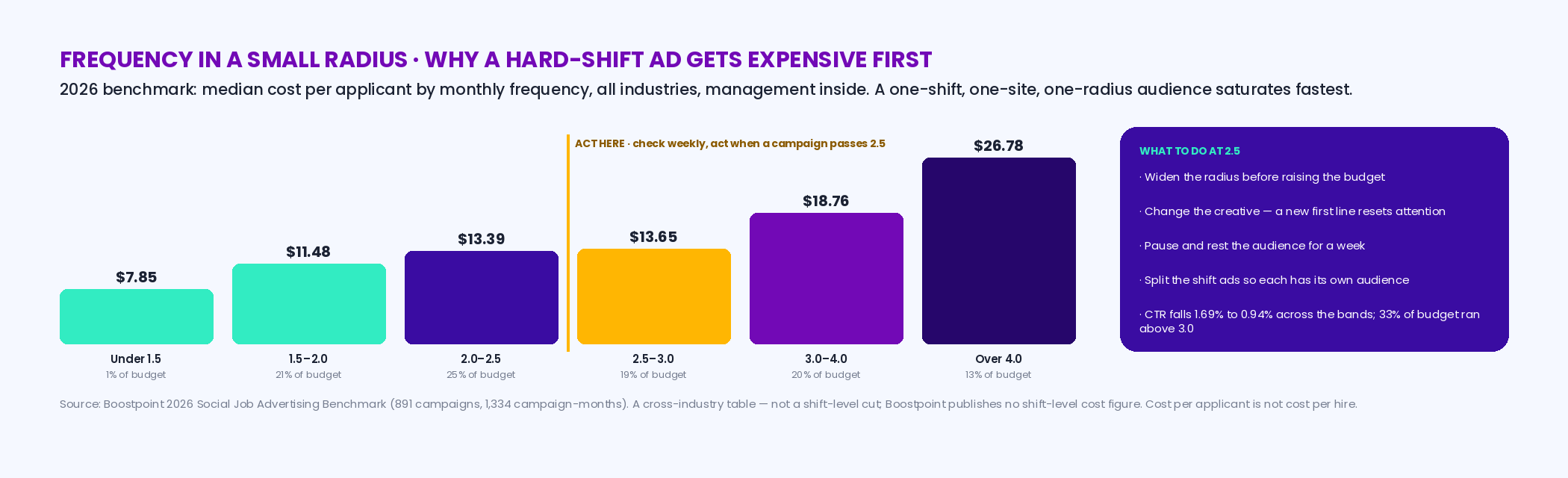
| Monthly frequency | Median cost per applicant | Share of budget | Source |
|---|---|---|---|
| Under 1.5 | $7.85 | 1% | 2026 benchmark |
| 1.5 – 2.0 | $11.48 | 21% | 2026 benchmark |
| 2.0 – 2.5 | $13.39 | 25% | 2026 benchmark |
| 2.5 – 3.0 | $13.65 | 19% | 2026 benchmark |
| 3.0 – 4.0 | $18.76 | 20% | 2026 benchmark |
| Over 4.0 | $26.78 | 13% | 2026 benchmark |
Source: Boostpoint 2026 Social Job Advertising Benchmark — 891 Boostpoint-managed campaigns on Meta (1,334 campaign-months), 2026; costs are what advertisers paid for advertising only.
Night shift hiring is not weekend hiring: what changes when the shift starts at 11 p.m.
Most of this page treats nights and weekends as one problem, because the three levers are the same for both. For night shift hiring specifically, four things change, and they change in ways that decide whether the campaign works at all. The BLS numbers above are the reason: 4% of workers usually work nights against 9% who usually work Saturday and Sunday. The night pool is smaller, and it is a different person — someone who has already built a life around being awake at 3 a.m., rather than someone adding hours to a weekday job.
| What changes | Night shift hiring | Weekend hiring |
|---|---|---|
| Who you are actually recruiting | The 4% who already work nights and want to keep the rhythm. You are rarely converting a day worker; you are hiring someone else's night worker. | The 9% who work Saturday and Sunday — students, second-job workers, parents whose partner works weekdays. Much of that pool also works weekdays. |
| What the pay premium is | A differential paid on every hour of every shift, for as long as the person stays. It is a standing payroll line, not a campaign cost. | A premium on the weekend shifts only, or a compressed week priced as a full one. It is bounded by how many weekend hours exist. |
| When the ad, the call and the interview happen | At hours a night worker is awake. A 9 a.m. callback reaches someone four hours into their sleep. | Ordinary hours. The weekend pool is reachable on a weekday, which is why weekend roles are easier to interview for than to fill. |
| How fast the audience saturates | Faster than almost anything else we run: one shift, one site, one radius, drawn from the smallest of the three pools. | Faster than a day-shift campaign, but from a pool roughly twice the size, so the frequency line arrives later. |
The honest limit on all of it: our benchmark splits campaigns by role and by campaign structure, not by shift, so we cannot tell you what a night shift costs per applicant against a day shift for the same role. Anyone who quotes you that number is estimating. What the data does support is the direction — the smaller and more specific the audience, the faster frequency climbs, and most of the cost is still decided after the click, by whether the schedule in the ad matches the schedule on the form. Cost per applicant is not cost per hire in either column.
Flexible scheduling, and who actually absorbs the variance
Flexible scheduling means two different things, and frontline employers are usually sold the wrong one. In salaried work it means the employee moves their own start and finish. On a shift roster it means the employer moves the hours, and a worker who has been on the receiving end of that reads the word in the ad as a warning rather than a benefit. The distinction that decides whether the word helps you is who absorbs the variance. Self-scheduling, shift swaps and published minimum-hours floors put it on the employer. On-call shifts, clopenings and a roster that lands on Friday for a Monday start put it on the worker, and they cost you applicants even where they are perfectly legal.
Where it is regulated the law has already taken a side, and the rule is not the one people expect. Oregon, Seattle, Chicago and San Francisco require the schedule in writing roughly two weeks ahead and charge a premium for changing it afterwards. Seattle and San Francisco go further and make it a hiring rule: available hours must be offered to existing part-time staff before anyone new is taken on, which puts a step in front of the requisition. The detail is on predictive scheduling laws by state.
Two limits sit underneath any flexible pattern. A shift of a given length owes a break in twenty-one states, set out on meal break laws by state, and anyone under 18 has an evening cutoff and an hours cap that federal law fixes below 16 and leaves entirely to the states above it, on child labor laws by state. The practical version of flexibility in an ad is therefore not the word itself but the pattern: publish the shift a candidate can plan a week around, and say which parts of it move.
Internal shift marketplaces: what they fix and what they don't
An internal shift marketplace fixes distribution, not supply. It is the app or scheduling module where open shifts are posted and qualified employees claim them, instead of a manager texting down a list. If you already have people who want more hours, a marketplace gets the open shift to them faster and makes the pickup fair and visible. If nobody on your roster wants the Saturday night, posting it in an app does not create that person.
| It fixes | It does not fix |
|---|---|
| The phone tree: open shifts reach everyone qualified at once | A roster that is simply too small for the hours you need covered |
| Favoritism complaints about who gets offered extra hours | A shift nobody wants at the current pay and schedule |
| Part-timers who want more hours but never hear about them | Burnout when the same few people pick up everything |
| Cross-site coverage for people qualified at more than one location | The weekend and night pools, which are small to begin with |
The pay rules still apply to every pickup
A picked-up shift is ordinary hours worked, and it lands in the same workweek as everything else. Under 29 CFR 778.103 the employer “must total all the hours worked by the employee for him in that workweek (even though two or more unrelated job assignments may have been performed)” and pay overtime past 40 for nonexempt employees. That includes shifts picked up at a second location. Incentives need care too. Night differentials must be included in the regular rate under 29 CFR 778.207(b), and 29 CFR 778.211(c) says bonuses “announced to employees to induce them to work more steadily” are part of the regular rate, so a posted pickup bonus generally raises the overtime rate for that week. If you operate where a predictive scheduling law applies, check how it treats shifts an employee volunteers for before you build pickup incentives around it. General information, not legal advice.
When the marketplace tells you to recruit
The useful thing a marketplace gives you is data. If the same shifts sit unclaimed week after week, or are always claimed by the same three people already near 40 hours, you have a supply problem that no app will fix. That is the signal to run the shift as its own job ad, with the differential and the schedule in the first line, and to hire for the shift instead of redistributing it. A marketplace plus a steady trickle of new hires for the hard shifts is the combination that holds; a marketplace alone just moves overtime around.
Where this page stops and others start
If the shift is a nurse's or an aide's, the PRN model, the bench and the credential mix are on PRN staffing. If the shifts are a season's worth at once, the backwards calendar is on peak season staffing, and if it is fifty people on one start date, mass hiring. If it is a restaurant's Friday close, hospitality recruiting; if it is a guard post at 2 a.m., how to hire security guards. What this page owns is the shift itself, in any industry: the differential said out loud, the design that matches a real pool, and the ad that names the shift.
If the shortfall is not one specific shift but the whole schedule, that is a different diagnosis. Understaffing sets out the three numbers that tell you whether it is structural, and which of them is binding.
Frequently asked questions
Does shift differential pay count toward overtime?
Yes, and this is the most commonly missed rule in shift pay. Under 29 CFR 778.207(b) the FLSA "requires the inclusion in the regular rate of such extra premiums as nightshift differentials (whether they take the form of a percent of the base rate or an addition of so many cents per hour) and premiums paid for hazardous, arduous or dirty work". So $20 an hour plus a $2 night differential gives a regular rate of $22, and overtime is computed on $22 rather than on $20. Lump sums paid without regard to hours worked, and incentives for rapid performance of work, must be included on the same basis.
How do you fill open shifts nobody wants?
Treat the shift as its own job: put the differential and the exact schedule in the first line of its own ad, design it for a real pool (fixed nights for the 4% who already work nights; a compressed weekend program for students, second-job workers and parents with weekday-working partners), ask which shifts the person can work before anything else, call the same day from the supervisor who runs that shift, and interview on the shift with a paid trial hour. "All shifts available" fills none of them.
Do you have to pay a night shift differential?
Not under federal law: the Department of Labor says the FLSA "does not require extra pay for night work," only overtime past 40 hours for covered, nonexempt workers. Whether you pay one is a recruiting decision. As a public reference point, the federal wage system pays 7½ percent for a second shift and 10 percent for a third shift; your market sets your number, and the ad should state base, differential and total. Check your state and any contract; not legal advice.
How do you staff weekends?
Recruit the people who want weekends rather than rotating the people who don't: the BLS's schedule module found 9% of workers usually worked both Saturday and Sunday, and its 2025 time-use survey found 30% of employed people worked on an average weekend day. A compressed weekend program — two twelve-hour weekend shifts paid as a full week, or at a premium that makes the weekend worth more — draws students, second-job workers and parents whose partner works weekdays, and it needs its own ad with the design in the first line.
What does night shift hiring actually take?
Night shift hiring works when the shift is fixed and advertised in its own ad, with the differential in the first line and "no rotation" said plainly, aimed at the roughly 4% of workers who already work nights and want to keep the rhythm. Ask which shifts they can work, call at an hour a night worker is awake, and run a paid trial hour on the shift as the interview. A rotating schedule recruits from the smallest pool there is; fixing the shift is usually worth more than raising the differential.
What does an unfilled shift cost?
Usually overtime: the premium half of time and a half on every uncovered hour worked by existing staff. Ten open twelve-hour shifts a week at 30% pickup is 84 uncovered hours; at a $22 base the premium alone is $924 a week, $48,048 a year, before the turnover that mandatory overtime causes. Those hours are three hires at 36 hours each. That is the cost of coverage, not a cost per hire, which we don't compute.
Should each shift have its own job ad?
Yes. One campaign with a distinct ad per shift is the multi-role structure, which ran a median $9.83 per applicant at a 12% apply rate across 46 campaigns in our 2026 benchmark, against $14.45 and 18% for single-role campaigns — cross-industry figures, not shift figures. The reason is selection: under Meta's Special Ad Category there is no age, gender or ZIP targeting, so the shift in the first line is the only thing that finds the person who wants it.
Why does a night-shift ad get expensive after a few weeks?
Frequency. A hard-shift ad has a small audience — one shift, one site, one radius — and small audiences see the same ad too often. In our benchmark, cost per applicant climbs from a median $7.85 at a monthly frequency under 1.5 to $26.78 above 4.0, and click-through falls from 1.69% to 0.94%. Check weekly and act at 2.5: widen the radius, change the creative, or rest the audience.
Does it cost more to recruit for nights than for days?
We don't know, and we won't guess: our benchmark has no shift-level cost comparison, so this page makes no claim that nights or weekends cost more or less per applicant than days. What we can say is structural — one campaign per shift, the frequency rule, the event-driven option for a weekend program — and the rest is your differential and your design. Cost per applicant is not cost per hire.
What is the average shift differential?
There is no published federal average for private-sector shift differentials, and the figures that circulate online trace to vendor surveys and calculator pages rather than to primary data. The one documented night premium in American law is the federal government’s own: under 5 U.S.C. § 5545(a), federal employees working regularly scheduled hours between 6:00 p.m. and 6:00 a.m. receive their basic rate plus 10 percent. That governs federal employment only, but it is the only such figure you can look up and verify.
How much should a night shift differential be?
Work it out from your own cost of leaving the shift open rather than from a market average. Count the overtime hours and premium you currently pay to cover the unfilled shift in a week, divide by the hours in the shift, and you have what the vacancy is already costing you per hour. Any differential below that is cheaper than the status quo, and unlike a borrowed benchmark it is a number you can defend to finance.
What is a shift marketplace?
A shift marketplace is a scheduling tool where an employer posts open shifts and qualified employees claim them, often from a phone app. It replaces calling down a list and makes extra hours visible to everyone eligible. It helps when current staff want more hours; it cannot fill shifts that nobody on the roster is willing to work.
Do picked-up shifts count toward overtime?
Yes. Under 29 CFR 778.103 the employer must total all hours a nonexempt employee works in the workweek, even across unrelated job assignments, and pay time and a half past 40. A shift picked up through an app or at another location of the same employer counts the same as a scheduled one. Pickup bonuses announced in advance generally belong in the regular rate too.
Give the hard shift its own ad
We'll write one ad per shift with the differential and the schedule in the first line, run them where the people who want that shift scroll, watch frequency in your radius, and show you the shift-based campaigns closest to yours — costs, and never a shift figure we don't have.
Book a DemoBoostpoint figures come from the 2026 Social Job Advertising Benchmark — 891 campaigns and 1,334 campaign-months: campaign structures event-driven median $8.02 per applicant, 21% apply rate, 78 campaigns; multi-role $9.83, 12%, 46; single-role $14.45, 18%, 1,210; frequency bands under 1.5 $7.85 (1% of budget), 1.5–2.0 $11.48 (21%), 2.0–2.5 $13.39 (25%), 2.5–3.0 $13.65 (19%), 3.0–4.0 $18.76 (20%), over 4.0 $26.78 (13%), 33% of budget above 3.0, CTR 1.69% to 0.94%; warehouse / production $9.83, $3.15–$18.72, 20%, 82; a normal campaign $334 a month, 20 applicants, 6,061 reached. The benchmark contains no shift-level cost cut and none is implied; no seasonality claim is made. Third-party figures are dated where they appear: DOL Night Work and Shift Work and OPM Federal Wage System night shift differential (read August 2026); BLS Job Flexibilities and Work Schedules (2017–18 data, released September 24, 2019); BLS American Time Use Survey 2025 (released June 25, 2026). Shift designs, first lines, the trial hour and same-day contact are Boostpoint practice, not measured results; pay-law summaries are not legal advice. The coverage calculator prices overtime on your inputs, never a hire. Cost per applicant is not cost per hire; we do not track hires and publish no cost-per-hire figure. A sample of Boostpoint campaigns, not an industry-wide study.