
Employer guideRead at source, 4 September 2026
Child Labor Laws by State: Work Permits, Hours and Break Rules for Minors (2026)
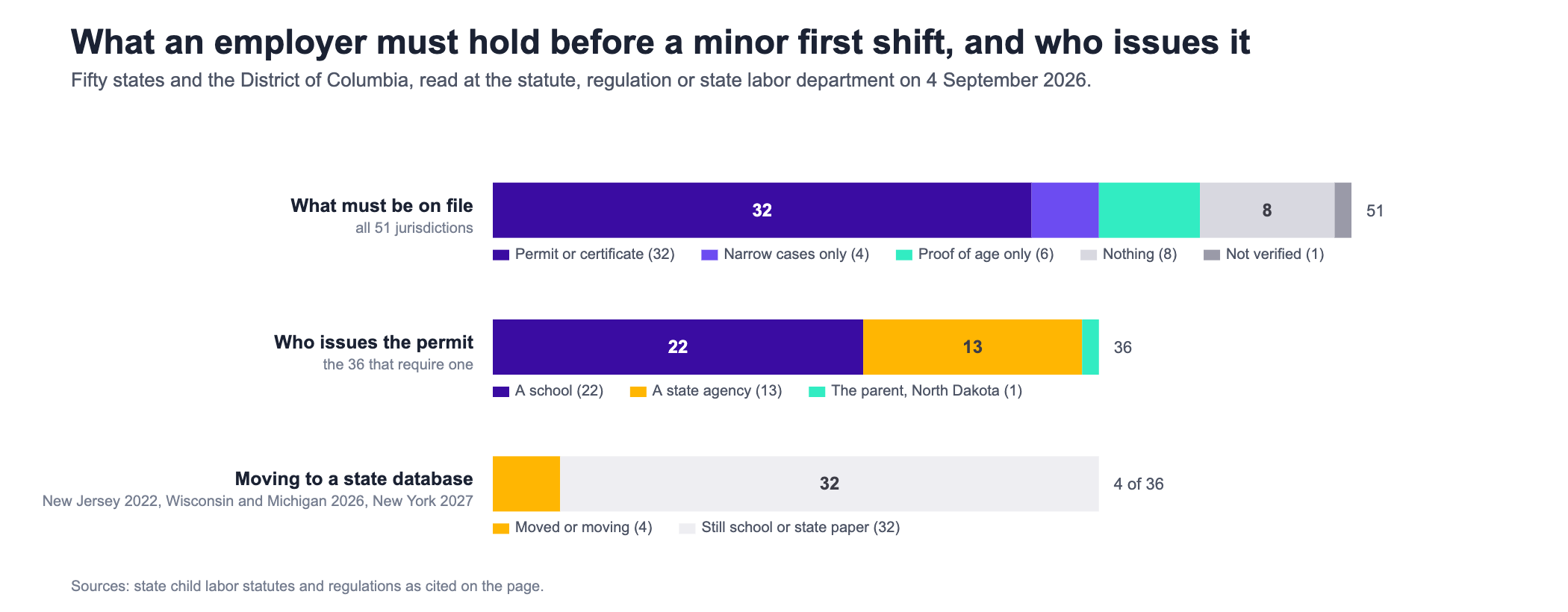
State child labor law is three separate questions, and the published summaries get all three wrong in different places. Thirty-two jurisdictions require a permit or certificate before an ordinary 15-year-old works a first shift; four more require one only narrowly, six want proof of age, and eight require nothing. It comes from a school in twenty-two of them and a state agency in thirteen, and in North Dakota the minor own parent signs it. Twenty-four jurisdictions require a meal or rest break for minors — the federal list of those states names thirty-three, ten of which do not hold up at the code, and it leaves Tennessee off. And the one federal hours table everybody copies was last revised 15 July 2025; since then Nevada has cut its under-16 weekly cap, Ohio has loosened an evening rule past what federal law allows, and four states have moved the permit out of the school office. Every row below was read at the statute, the regulation or the state labor department on 4 September 2026.
The federal floor, and the part of it that surprises people
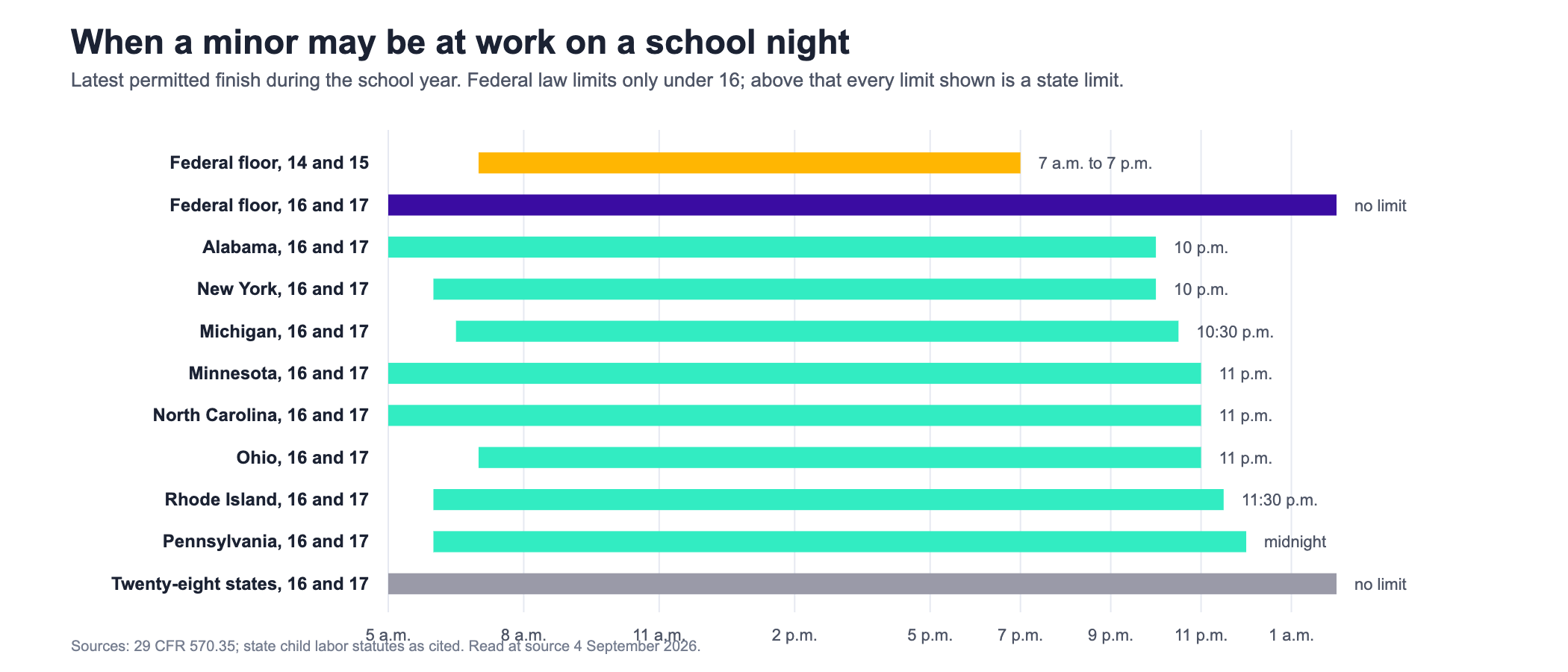
The Fair Labor Standards Act sets a minimum state law can exceed but not undercut. 29 CFR 570.35 confines 14- and 15-year-olds to outside school hours, no more than 3 hours on a school day and 18 in a school week, 8 on a non-school day and 40 in a non-school week, and only between 7 a.m. and 7 p.m., the evening hour moving to 9 p.m. from 1 June through Labor Day. One definition in 570.35(b) does more work than it looks: school is in session or not according to the local public school district where the minor lives, not where the employer sits.
The surprise is at the top of the range. Federal law places no hours limit at all on 16- and 17-year-olds. A 17-year-old may work a double on a Tuesday night in term time and the FLSA has nothing to say about it, and thirty states set no hours limit above 16 either, twenty-eight of them no evening limit. What federal law does at 16 and 17 is ban whole occupations: the seventeen Hazardous Occupations Orders at 29 CFR 570.51 to 570.68 cover driving, power-driven hoists, meat slicers, balers, roofing, excavation and wrecking, and they apply until the eighteenth birthday whatever the state says.
Where a state is looser, the state rule is not the answer
Ohio amends its evening rule on 9 October 2026 to let 14- and 15-year-olds work from 7 p.m. to 9 p.m. before a non-school day with parental approval. For an FLSA-covered employer, 29 CFR 570.35(a)(6) still stops at 7 p.m. outside 1 June to Labor Day. The state table says nine; the exposure sits at seven.
Work permits by state: who needs one, who issues it, and who holds it
The word permit hides three documents. In most states it is issued to the minor by a school, and the employer keeps a copy. In four it is issued to the employer: Oregon runs an annual certificate covering every minor on the payroll, Washington puts an endorsement on the employer business license for each work location, Virginia issues it electronically, and Alabama sells a per-site Class I or Class II certificate. A manager there waiting for a minor to walk in holding working papers is waiting for a document that does not exist. In North Dakota the certificate is signed by the minor own parent.
| Jurisdiction | Permit or certificate required for | Issued by | Authority |
|---|---|---|---|
| Alabama | Employer certificate | State agency | Ala. Code 25-8-45 |
| Alaska | Under 17 | State agency | AS 23.10.332 |
| Arizona | None | - | A.R.S. 23-230 to 23-242 contain no permit provision |
| Arkansas | None | - | Ark. Code 11-6-109, repealed |
| California | 12-17 if not graduated | School | Cal. Lab. Code 1299 |
| Colorado | 14-15, school hours | School | C.R.S. 8-12-113 |
| Connecticut | Under 18 | School | C.G.S. 31-23 |
| Delaware | Under 18 | School plus state | 19 Del. C. 504 |
| District of Columbia | Under 18 | School | D.C. Code 32-207 |
| Florida | Proof of age only | School, optional | Fla. Stat. 450.045 |
| Georgia | Under 16 | School | Ga. Comp. R. & Regs. 300-7-2 |
| Hawaii | Through 17 | State agency | HRS ch. 390 |
| Idaho | None | - | Idaho Code 44-1303 |
| Illinois | 14-15 | School | 820 ILCS 206/55 |
| Indiana | None | - | IC 22-2-18.1 |
| Iowa | None, repealed 2023 | - | Iowa Code 92.10 to 92.16, repealed |
| Kansas | Under 16, if not in school | School or judge | K.S.A. 38-604 |
| Kentucky | Proof of age from every employee; age certificate on request | School | KRS 339.360 |
| Louisiana | Under 18 | School | La. R.S. 23:182 |
| Maine | Under 16 | School plus state | 26 M.R.S. 775 |
| Maryland | Under 18 | State agency, online | Md. Lab. & Empl. 3-205 |
| Massachusetts | 14-17 | School | M.G.L. c.149 s.86 |
| Michigan | Under 18 | School, state from Oct 2026 | MCL 409.104 |
| Minnesota | 14-15, school hours | School | Minn. Stat. 181A.05 |
| Mississippi | Not verified | Not verified | Miss. Code 71-1-17 to 71-1-33, text not reachable |
| Missouri | Under 16, school term | School | RSMo 294.024 |
| Montana | None | - | MCA 41-2-102 to 41-2-121 contain no permit provision |
| Nebraska | Under 16 | School | Neb. Rev. Stat. 48-302 |
| Nevada | Under 14 only | District judge | NRS 609.245 |
| New Hampshire | Under 16, consent 16-17 | School or parent | RSA 276-A:4 |
| New Jersey | Under 18 | State database | N.J.S.A. 34:2-21.1a |
| New Mexico | Under 16 | School or state | 11.1.4.9 NMAC |
| New York | 14-17 | School, state from May 2027 | N.Y. Lab. Law 135 |
| North Carolina | Under 18 | State agency | N.C.G.S. 95-25.5(a) |
| North Dakota | 14-15 | The minor's own parent | N.D.C.C. 34-07-05 |
| Ohio | 14-17 | School, filed with state | O.R.C. 4109.02 |
| Oklahoma | Under 16 | School | 40 O.S. 77 |
| Oregon | Under 18, to the employer | State agency | ORS 653.307 |
| Pennsylvania | Under 18 | School | 43 P.S. 40.8 |
| Rhode Island | 14-15, training first | School | R.I. Gen. Laws 28-3-3 |
| South Carolina | None | - | S.C. Code ch. 41-13 contains no permit provision |
| South Dakota | None, hardship only | State agency | SDCL 60-12-5 |
| Tennessee | None, file record only | - | T.C.A. 50-5-111 |
| Texas | None, optional only | State agency, optional | Tex. Lab. Code 51.022 |
| Utah | Age certificate on ask | School | Utah Code 34-23-209 |
| Vermont | Under 16, term time | State agency | 21 V.S.A. 431 |
| Virginia | Under 16, to the employer | State agency | Va. Code 40.1-84 |
| Washington | Under 18, license endorsement | State agency | WAC 296-125-041 |
| West Virginia | Age certificate since Jul 2025 | State agency | W. Va. Code 21-6-5 |
| Wisconsin | Under 16 | State portal or school | Wis. Stat. 103.70(1) |
| Wyoming | Proof of age only | - | W.S. 27-6-107 |
Two rows deserve a sentence. West Virginia repealed its work permit with SB 427, effective 11 July 2025, replacing it with a parental consent form plus an age certificate the Commissioner of Labor issues to the employer. That landed four days before the federal table was last revised, so a summary built on it describes a regime West Virginia no longer runs. Kansas requires a permit under 16 but exempts any child attending a secondary school in the state, which is nearly all of them.
The permit is migrating from the school office to a state database
Four states have moved the same way, and the dates matter to anyone building onboarding. New Jersey went first: since 2022 the minor and the employer both register in a state database, the caregiver authorizes within two weeks, and silence counts as approval. Wisconsin added a state online portal by clearinghouse rule CR 26-015, effective 1 June 2026. Michigan moves issuance from schools to the state labor department under 2024 PA 196 on 1 October 2026, grandfathering minors already employed until they change employer or work location or turn 16. New York follows on 9 May 2027, when Labor Law 135 is replaced with a state database issuing certificates electronically.
So a multi-state onboarding checklist that says obtain working papers from the school will be wrong in Michigan in October and wrong in New York in 2027. The failure mode is quiet: nobody bounces the hire, the file simply has the wrong document in it.
Meal breaks for minors, where the federal list goes wrong
There is no federal meal break, for a minor or anyone else. Short breaks of five to twenty minutes, if given, count as hours worked; a bona fide meal period of thirty minutes or more, taken free of duty, does not. Everything else is state law, and more states protect minors than protect adults. The federal meal-break table lists twenty-three jurisdictions with an adult requirement. A footnote to it names thirty-five with a provision specifically for minors.
That footnote does not survive contact with the state codes. It was last revised on 1 January 2023, and of the thirty-three states it names, ten do not hold up. Colorado, Indiana, Massachusetts, Minnesota, Nebraska, Nevada, New Hampshire, New York and North Dakota have no minor-specific provision in the chapter that would carry one; Rhode Island has a break statute inside its Employment of Children chapter, but written for every employee. Four of the ten, Nebraska, New Hampshire, New York and North Dakota, have only a duty to post a notice stating the time allowed for meals, which looks like where the error began. And it leaves out Tennessee, whose 30-minute rule is real, unpaid, and expressly not waivable under 18 even though adults may waive theirs.
What remains is twenty-four jurisdictions and one pattern: the common rule is thirty minutes after five continuous hours, stricter than most adult rules and shorter than a closing shift. Washington goes further, tiering by age at four consecutive hours under 16 and five at 16 and 17. Kentucky, Oregon, Utah and Washington add a paid rest period on top, which is a payroll consequence and not just a scheduling one.
| Jurisdiction | Break due after | Length | Paid? | Authority |
|---|---|---|---|---|
| Alabama | 5 continuous hours | 30 min | Not stated | Ala. Code 25-8-38(e) |
| Alaska | Scheduled for 6 consecutive hours, or 5 consecutive hours worked without a break | 30 min | Unpaid | AS 23.10.350(c) |
| California | Entertainment only | 30 min | Unpaid | 8 CCR 11761 |
| Delaware | 5 continuous hours | 30 min | Not stated | 19 Del. C. 507(e) |
| Florida | 4 continuous hours | 30 min | Not stated | Fla. Stat. 450.081(4) |
| Hawaii | 5 consecutive hours | 30 min | Not stated | HRS ch. 390 (section not confirmed) |
| Illinois | 5 continuous hours | 30 min | Not stated | 820 ILCS 206/35(d) |
| Iowa | 5 hours in a day | 30 min | Not stated | Iowa Code 92.7 |
| Kentucky | 5 continuous hours | 30 min plus 10 per 4 hrs | Rest paid | KRS 339.270 |
| Louisiana | Any 5-hour period (under 16 only) | 30 min | Unpaid | La. R.S. 23:213 |
| Maryland | 5 consecutive hours | 30 min | Not stated | Md. Lab. & Empl. 3-210(a)(1) |
| Michigan | 5 continuous hours | 30 min | Not stated | MCL 409.112 |
| New Jersey | 6 continuous hours | 30 min | Not stated | N.J.S.A. 34:2-21.4 |
| North Carolina | 5 consecutive hours | 30 min | Not stated | N.C.G.S. 95-25.5(e) |
| Ohio | 5 consecutive hours | 30 min | Unpaid | O.R.C. 4109.07(C) |
| Oklahoma | 5 consecutive hours | 30 min, 1 hr per 8 | Not stated | 40 O.S. 75(C) |
| Oregon | 6 to 8 hour shift | 30 min plus 15 per 4 hrs | Rest paid | ORS 653.315(3) |
| Pennsylvania | 5 continuous hours | 30 min | Not stated | 43 P.S. 40.3(a) |
| Tennessee | 6 consecutive hours | 30 min | Unpaid | T.C.A. 50-5-115 |
| Utah | 5 hours from shift start | 30 min plus 10 per 4 hrs | Rest paid | Utah Admin. Code R610-2-3 |
| Virginia | 5 continuous hours | 30 min | Not stated | Va. Code 40.1-80.1(B) |
| Washington | 4 hours under 16, 5 at 16-17 | 30 min | Rest paid | WAC 296-125-111 and 296-125-121 |
| West Virginia | 5 continuous hours | 30 min | Not stated | W. Va. Code 21-6-7(a)(7) |
| Wisconsin | 6 consecutive hours | 30 min | Paid if on duty | Wis. Stat. 103.68(3) |
Most of these statutes are silent on pay. Only Ohio says so directly, and it says the rest period need not be counted as hours worked. Louisiana excludes the interval from the working hours of the day and requires it documented in the normal timekeeping system, with edits signed by both the minor and a manager. Wisconsin is the one to watch: a meal period there must be paid unless the minor is genuinely free from duty for the full thirty minutes and free to leave the premises.
What has changed since the federal table was last revised
The federal state-standards table is dated 15 July 2025, and almost every summary copies it. Ten jurisdictions have moved since.
Nevada is the clearest miss. AB 215, chapter 238 of the 2025 statutes, took effect 1 October 2025. It cut the under-16 weekly cap from 48 hours to 40, and added a rule Nevada did not have: non-emancipated high school students aged 16 to under 19 may not work between 11 p.m. and 6 a.m. before a school day, with carve-outs for lifeguards, arcade staff, performers and farm work. Both Nevada rows in the federal table are now wrong, and the second reaches 18-year-olds, which no other state nightwork rule does.
The rest are administrative but consequential. Washington replaced its entire youth employment rule chapter on 1 July 2026, renumbering every citation. Colorado adopted new Youth Employment Standards rules from 1 February 2026. Indiana has abolished its registration portal and, on its own labor department statement, no longer requires a break for a minor at all. Maryland added civil penalties up to $16,035 per violation from 1 June 2026 without touching a substantive rule.
State bans that catch frontline employers out
Beyond the federal orders, some state rules land on ordinary shift work. Massachusetts bars anyone under 18 from operating a motor vehicle of any description, bar a golf cart and an auto repair shop, stricter than the federal allowance for 17-year-olds. Michigan bars a minor from a cash transaction at a fixed location after sunset or 8 p.m., whichever is earlier, unless someone 18 or over is present. North Dakota bars 14- and 15-year-olds from all cooking, grilling and frying, and Connecticut bars under-16s from restaurants.
Check a state and an age
Pick a jurisdiction and an age band for what must be on file before the first shift, the hours and evening limits, and whether a break is owed.
Will this shift clear on a school night?
Enter a shift; the checker applies the state rule and the federal floor together and says which binds.
What this means when you write the job ad
Two things follow for anyone advertising shifts a minor might fill. The closing shift is usually the illegal one: a 5 p.m. to 10 p.m. school night is fine for a 17-year-old in thirty states and unlawful for a 15-year-old everywhere, and saying so in the ad saves the interview. And the document, not the hire, is the compliance event. The checklist items are on our new hire forms checklist; the adult break rules that sit alongside these are on meal break laws by state, and the hours rules on overtime laws by state and predictive scheduling laws by state; sector context is in hospitality recruiting and retail recruitment strategies.
Working papers: the same document under a different name
"Working papers" is what the permit is called in New York and New Jersey. Everywhere else in the table above it is a work permit, an employment certificate, or an age certificate. The name changes; the function does not. It is the document that says a named minor may work, and in most states the employer holds a copy for as long as the minor is on the payroll.
The two states that use the term have moved in opposite directions, and the difference matters to whoever is doing the hiring.
New York still runs it through the schools. The State Education Department is explicit that school districts issue the certificates, and the Department of Labor's guidance is that youth aged 14 to 17 need working papers to hold a job in the state. Which certificate depends on age and whether the minor is in school: the Student Non-Factory Employment Certificate for 14- and 15-year-olds, the Student General Employment Certificate for 16- and 17-year-olds attending school, and the Full-Time Employment Certificate for 16- and 17-year-olds who have left. The minor brings a doctor's exam from within the last twelve months and official proof of age — a birth certificate, state photo ID, driver's license or passport — to the school's guidance office. New York has said digital working papers are coming in 2027; until then it is paper, and the school office's hours are the constraint.
New Jersey has taken the school out of it entirely. Applications run through the state's online system, and the sequence is the part employers get wrong: the minor must have a job offer before applying. The employer registers first and receives an eight-digit Employer Unique Code, the minor enters that code on the application, email prompts go to the employer and the caregiver to complete their sections, the caregiver uploads a birth certificate or passport, and the minor can start once the application is approved.
That last sequence is worth reading twice if you hire teenagers in New Jersey. You are not a bystander to the paperwork — the application cannot be completed without your code and your section, so an unregistered employer is the thing holding up its own start date. Register once, keep the code where whoever makes the offer can find it, and hand it over in the same conversation as the offer.
How old do you have to be to work? The federal age ladder
Federal law answers the question in four steps, and every state rule sits on top of them. The minimum ages are in 29 CFR 570.2: 16 is the general minimum for non-farm work, the Department of Labor may allow 14- and 15-year-olds into listed non-manufacturing, non-mining jobs, and 18 is the minimum for occupations declared hazardous. The Department’s Fact Sheet #43 puts it plainly: “Children under 14 years of age may not be employed in non-agricultural occupations covered by the FLSA.”
| Age | What federal law allows | Source |
|---|---|---|
| Under 14 | No non-farm employment, apart from work outside the child labor rules such as delivering newspapers to the consumer, acting and performing, and most work in a business entirely owned by the child’s parents | Fact Sheet #43 |
| 14 and 15 | Listed jobs only, such as retail, food service and office work; outside school hours; 3 hours on a school day, 18 in a school week, 8 on a non-school day, 40 in a non-school week; 7 a.m. to 7 p.m. (9 p.m. from 1 June through Labor Day) | 29 CFR 570.33 to 570.35 |
| 16 and 17 | Any job not declared hazardous, with no federal limit on hours or time of day | Fact Sheet #43 |
| 18 and over | No longer covered by the federal youth employment rules, including the seventeen hazardous occupations orders | 29 CFR 570.51 to 570.68 |
Farm work runs on its own ladder under 570.2(b): 16 during school hours, generally 14 outside them, 12 and 13 with a parent’s written consent or on a farm where the parent also works, and younger children on the parents’ own farm. Fifteen-year-olds may also work as lifeguards at traditional pools and water parks once trained and certified by the American Red Cross or a similar certifying organization (29 CFR 570.34(l)).
How states change the answer
States move the answer in three ways, and all three are in the tables on this page. They add paperwork: 32 jurisdictions require a permit or certificate before an ordinary 15-year-old starts, and 17 still require one at 16. They add hours: the federal rules stop at 16, and 30 states set no hours limit above that age either, which means the others do. And they close jobs to teenagers that federal law leaves open, as the state bans section above shows. What a state cannot do is lower the federal floor for an employer the Fair Labor Standards Act covers; where the two differ, the stricter rule applies (29 U.S.C. 218(a)). The Department of Labor keeps a state-by-state summary, but it has fallen behind in the places listed in the section on what has changed.
For a job ad, that makes the minimum age a line worth writing. “Must be 16 or older” on a closing shift, or “18+ to operate the baler”, screens out applicants you could not schedule before they reach your new hire paperwork.
Youth employment laws: the minimum age to work by state
Youth employment laws start from the federal floor. The Department of Labor puts it in one sentence: “As a general rule, the FLSA sets 14 years old as the minimum age for employment, and limits the number of hours worked by minors under the age of 16.” At 14 and 15 the permitted jobs and hours are limited; 16 is the basic minimum age for most other non-hazardous work; and the hazardous occupations orders apply until 18.
States can set a higher minimum or add conditions, and many do, most often through the work permit rules in the table above and through lists of jobs closed to younger teens. A state cannot lower the federal floor for an employer the FLSA covers: where a state allows something federal law does not, the stricter rule applies. A few kinds of work sit outside the general rule, including delivering newspapers, performing, working for a parent’s business outside the hazardous occupations, and agricultural work, which has its own age rules. So the practical answer to “what is the minimum age to work in my state” is: 14 for most jobs, under the federal hours limits, plus whatever permit, hours or job restrictions your state adds.
Related: Interview Questions for Teenagers.
State-by-state employer guides: every state’s breaks, overtime, final pay and hiring rules in one place: Alabama, Alaska, Arizona, Arkansas, California, Colorado, Connecticut, Delaware, D.C., Florida, Georgia, Hawaii, Idaho, Illinois, Indiana, Iowa, Kansas, Kentucky, Louisiana, Maine, Maryland, Massachusetts, Michigan, Minnesota, Mississippi, Missouri, Montana, Nebraska, Nevada, New Hampshire, New Jersey, New Mexico, New York, North Carolina, North Dakota, Ohio, Oklahoma, Oregon, Pennsylvania, Rhode Island, South Carolina, South Dakota, Tennessee, Texas, Utah, Vermont, Virginia, Washington, West Virginia, Wisconsin, Wyoming.
Frequently asked questions
Does a 16 year old need a work permit?
In seventeen jurisdictions: Alaska, California, Connecticut, Delaware, the District of Columbia, Hawaii, Louisiana, Maryland, Massachusetts, Michigan, New Jersey, New York, North Carolina, Ohio, Oregon, Pennsylvania and Washington. The rest stop at 16.
Which states do not require a work permit for minors?
Arizona, Arkansas, Idaho, Indiana, Iowa, Montana, South Carolina and South Dakota require nothing before a minor starts. Florida, Kentucky, Tennessee, Texas, Utah and Wyoming want proof of age but no permit. Mississippi could not be verified at a primary source.
How many hours can a 15 year old work on a school day?
Three, under 29 CFR 570.35, and no more than 18 in a school week, worked outside school hours and between 7 a.m. and 7 p.m. The evening hour moves to 9 p.m. from 1 June through Labor Day. A state may be stricter, but none may go below this.
Does federal law limit hours for 16 and 17 year olds?
No. The Fair Labor Standards Act sets no daily, weekly or evening limit above age 16. It bans occupations rather than hours, through the seventeen hazardous occupations orders at 29 CFR 570.51 to 570.68. Thirty states set none of their own above 16 either.
Do minors have to be given a meal break?
In 24 jurisdictions, yes. The common rule is 30 minutes after five continuous hours. Washington requires it after four consecutive hours under 16, and Kentucky, Oregon, Utah and Washington add a paid rest period on top. There is no federal meal break for minors or adults.
Who issues a work permit for a minor?
A school in 22 of the 36 jurisdictions that require one, a state agency in 13, and in North Dakota the parent. Michigan moves issuance to its labor department on 1 October 2026 and New York to a state database on 9 May 2027.
What happens when a state rule is looser than the federal rule?
The stricter standard governs, under 29 U.S.C. 218(a). A state that lets a 15 year old work until 9 p.m. outside the federal summer window does not make that shift lawful for an employer covered by the Fair Labor Standards Act.
How long must an employer keep a minor work permit on file?
It varies and the outliers are long. Illinois requires the copy kept at the worksite three years after the employment ends, and Virginia 36 months. Massachusetts instead wants it returned to the superintendent within two days of termination, with a fine for keeping it.
What are working papers for minors?
Working papers are the employment certificate a minor needs before starting a job. The term is used in New York and New Jersey; other states call the same document a work permit, employment certificate or age certificate. In New York, school districts issue them to 14- to 17-year-olds, and the minor brings a doctor's exam from the last twelve months plus official proof of age to the guidance office. New Jersey no longer uses paper: the minor applies online after receiving a job offer, using an eight-digit Employer Unique Code the employer gets by registering with the state system, and the caregiver uploads age verification before approval.
What is the minimum age to work in each state?
The federal minimum age for most non-agricultural jobs is 14: the Fair Labor Standards Act sets 14 as the general minimum age and limits the jobs and hours of 14- and 15-year-olds. States can add work permit requirements, tighter hours and job restrictions, but cannot lower the federal floor for covered employers. Some work, such as newspaper delivery, performing and some family-business and agricultural jobs, follows different rules.
How old do you have to be to work?
Under federal law, 14 for listed non-farm jobs, with limits: 14- and 15-year-olds may work only in listed jobs such as retail, food service and office work, outside school hours and for no more than 3 hours on a school day (29 CFR 570.33 to 570.35). At 16 any non-hazardous job is open with no federal hours limit, and at 18 the hazardous occupations are too (29 CFR 570.2). Your state may add a work permit, hours limits or job bans, but cannot lower these ages for a covered employer.
Advertising shifts a teenager could fill?
Knowing the rules does not fill the shift. Bring the roles you refill most and the states you hire in, and we will show what an applicant has actually cost there.
Book a Demo