
Retail Recruitment Strategies: What the Cost Data Says Actually Works
In Boostpoint's 2026 Social Job Advertising Benchmark, retail applicants cost $8.58 at the median, and the range is tighter than any other sector we measure — the middle 50% of campaigns landed between $3.72 and $17.76. That predictability is the most useful thing about retail hiring, and almost nobody plans around it.
Source: Boostpoint 2026 Social Job Advertising Benchmark — 891 Boostpoint-managed campaigns on Meta (1,334 campaign-months), 2026; costs are what advertisers paid for advertising only.
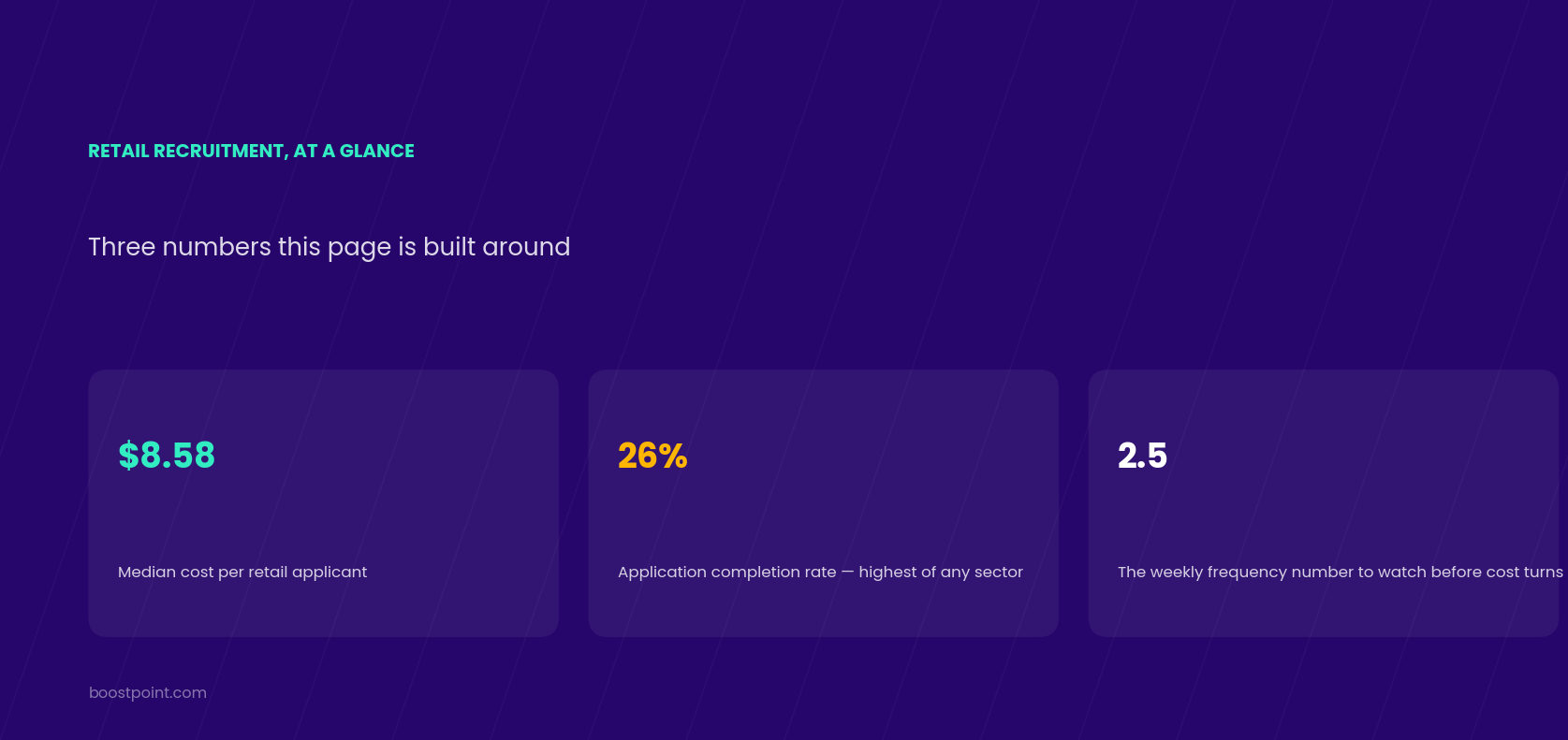
The number that makes retail different
Most sector benchmarks focus on which industry is cheapest. For retail, the more useful finding is how consistent it is.
| Sector | Median cost per applicant | Middle 50% range | Spread |
|---|---|---|---|
| Retail / corporate | $8.58 | $3.72 – $17.76 | 4.8x |
| Skilled trades & field service | $11.89 | $6.50 – $24.89 | 3.8x |
| Transportation & logistics | $13.34 | $5.26 – $25.17 | 4.8x |
| Healthcare & senior living | $15.42 | $7.89 – $39.61 | 5.0x |
| Behavioral & education | $27.50 | $15.35 – $76.67 | 5.0x |
Source: Boostpoint 2026 Social Job Advertising Benchmark — 891 Boostpoint-managed campaigns on Meta (1,334 campaign-months), 2026; costs are what advertisers paid for advertising only.
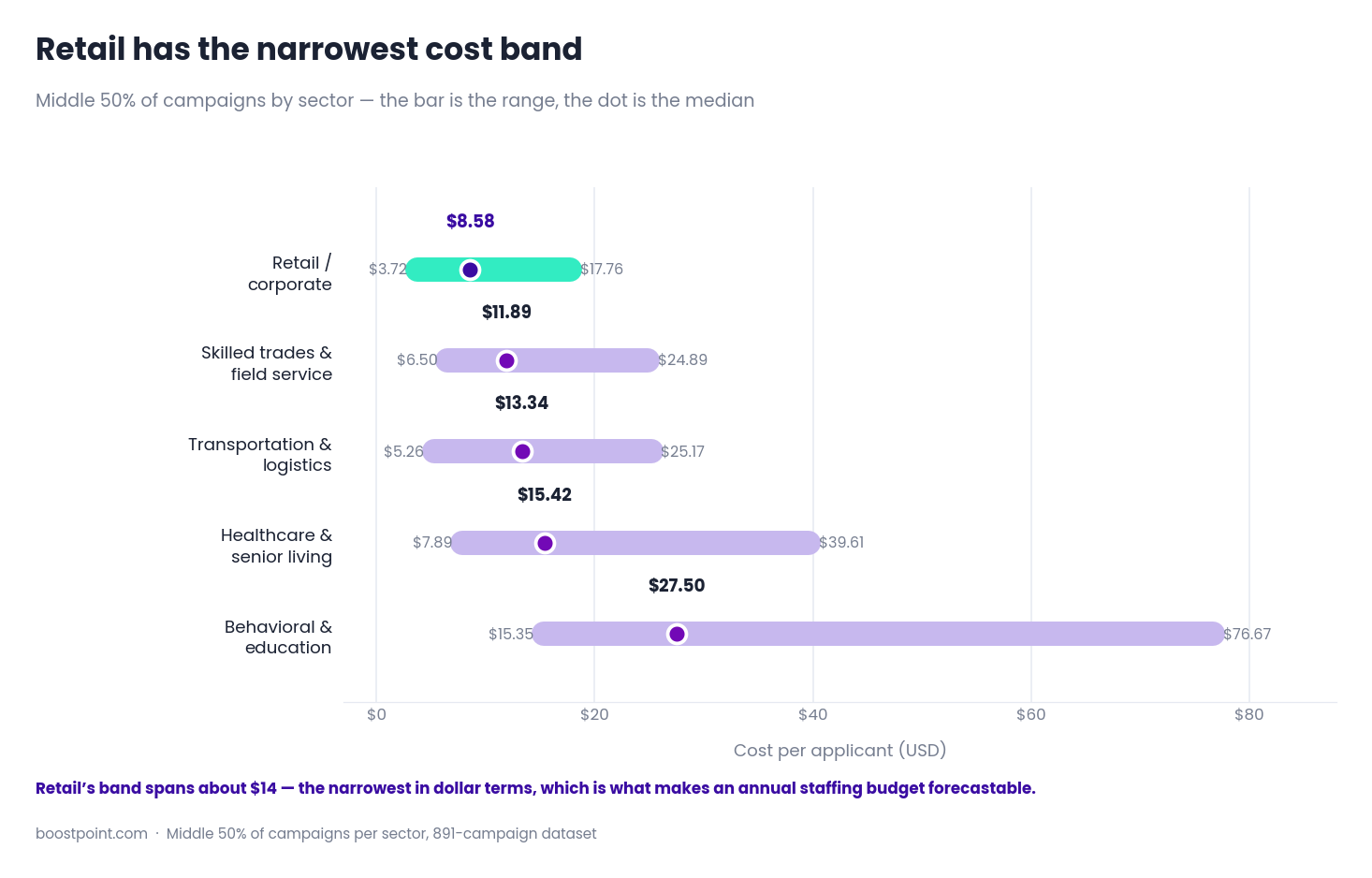
Retail also posts the highest application completion rate of any sector at 26%, and among the lowest media costs at a $14.74 CPM.
Costs are what advertisers paid. An applicant is a completed application, not a click. The full cross-sector picture is in our published benchmark data.
Why predictability matters more than the headline number. A channel you can forecast can be budgeted. A volatile one has to be managed month to month with contingency built in from the start. If you're building an annual staffing plan across dozens of locations, knowing your cost per applicant will sit in a narrow band is worth more than shaving a dollar off the average.
It also sets a realistic expectation. Where the middle 50% sits inside a tight range, the market has effectively priced the role. Gains come from volume and speed rather than efficiency — and anyone promising you a 40% cost reduction on retail hiring is promising something this data says doesn't happen.
Choosing the system that handles those applicants is a separate decision; retail recruitment software covers what store hiring needs from it.
Where retail hiring actually goes wrong
If applicant cost is predictable and completion rates are the best in the frontline, the problems live elsewhere. Four of them, in rough order of how much they cost.
1. Hiring one store at a time
Most retail operations run recruiting store by store, which means every location competes for attention, budget and the district manager's time separately.
Campaigns scoped to individual trade areas and run in parallel work better — and because reach doesn't depend on local search volume, adding a location is a setting rather than a supply problem. One of our multi-market clients runs 110 separate campaigns at a median budget of $117 each, with per-market cost staying stable across very different geographies.
2. Treating peak like a surprise
Retail hiring is more seasonal than almost any category, and the seasonal premium is real. In our agricultural campaigns — a comparable seasonal category — a campaign launched at peak cost 2.8 times what the same campaign cost in the trough.
Holiday staffing that starts in October is competing with every other retailer in the market at the same moment. Starting six to eight weeks earlier is the largest single cost lever in seasonal hiring, and it costs nothing but planning.
3. Optimizing the average instead of the tail
Across all campaigns in our dataset, the top 10% produced 57% of all applicants on 22% of the budget. The top 30% produced 83% on 53%.
For a multi-location retailer that concentration is usually geographic — a handful of stores in dense markets carry the program while a long tail of locations underperform. The highest-return move isn't making the middle better by ten percent. It's looking hard at the bottom third and deciding, deliberately, whether each is a strategic necessity or an unexamined habit.
4. Turnover, which advertising doesn't fix
Retail turnover runs high enough that recruiting is continuous by design. Advertising gives you flow and lets you be selective; it doesn't address scheduling practices, supervisor quality or pay position. Being clear about that boundary is what makes the rest of the advice usable.
The frequency trap, and why it matters more in retail
This is the operational finding most retail teams have never looked at, and it's expensive.
Frequency is the average number of times each person in your audience saw your ad in a month. Across our data:
| Monthly frequency | Median cost per applicant |
|---|---|
| Under 1.5 | $7.85 |
| 1.5 – 2.0 | $11.48 |
| 2.0 – 2.5 | $13.39 |
| 2.5 – 3.0 | $13.65 |
| 3.0 – 4.0 | $18.76 |
| Over 4.0 | $26.78 |
Source: Boostpoint 2026 Social Job Advertising Benchmark — 891 Boostpoint-managed campaigns on Meta (1,334 campaign-months), 2026; costs are what advertisers paid for advertising only.
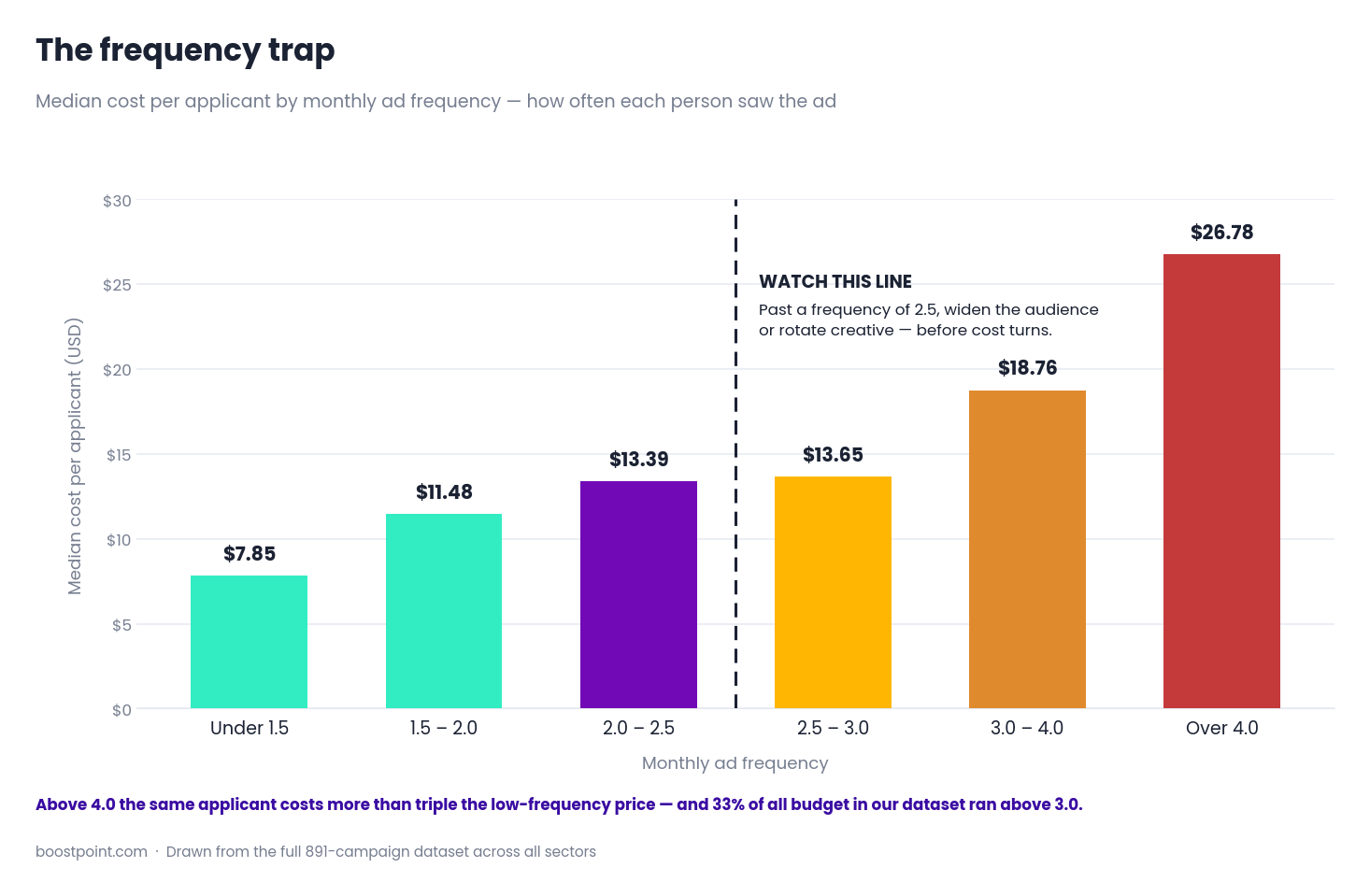
Above a frequency of 3.0, median cost per applicant rises to $18.76. Above 4.0 it reaches $26.78 — more than triple the low-frequency figure. Click-through falls in step, from 1.69% to 0.94%. The audience has seen it and stopped responding.
33% of all budget in our dataset ran above a frequency of 3.0.
Retail is unusually exposed to this because store-level campaigns often target small trade areas with budgets sized for a larger population. A daily spend that would be reasonable across a metro will saturate a single suburb within days.
The fix is rarely to cut budget. It's to widen the audience — expand the radius, drop an interest filter that was never a real requirement — so the same money reaches more people fewer times.
The operating rule: check frequency weekly. When a campaign passes 2.5 within a month, widen the audience or rotate the creative before the cost curve turns. Waiting until cost per applicant rises means paying for the lesson first.
What works in the ad
Lead with pay, schedule and store location. In that order, in the first two lines. Retail applicants screen on those three before reading anything about the brand. State a real hourly range, not "competitive pay" — several states now require it, and postings with a stated range consistently draw more applicants. Our cashier job description template is written in that order.
Be specific about the schedule. Evenings, weekends, holiday blackout periods. Retail schedules are the most common source of early attrition, and stating them costs you applicants at $8.58 each rather than a trained associate in week three. Say the hours themselves rather than the category, because full-time carries no federal meaning and differs between employers: full-time vs part-time employees covers what the word does and does not commit you to.
Show the actual store. Phone video of the floor, the team, the back room. It outperforms brand imagery, and it sets an accurate expectation of the environment. For supermarkets, grocery store recruiting covers the deli, meat, stocking and front-end roles one by one.
Refresh before fatigue. See the frequency section. A single ad running unchanged for months in a small trade area is the most common way retail campaigns quietly stop working.
Screen at the application, not the audience. Employment ads run under Meta's Special Ad Category, which removes detailed targeting. Qualification happens through knockout questions — availability by day and shift, age requirements where the role legally has them, reliable transportation, any physical requirements.
Respond the same day. Retail applicants apply broadly and accept the first reasonable offer. Automated text on submission holds attention until someone can call.
Holiday hiring: the seasonal build is real, and it has shrunk every year since 2020
Retail adds people between September and December every year, and everyone in the sector is doing it in the same ninety days. What has changed is the size of it. Taking the federal payroll count for retail trade, not seasonally adjusted, and measuring from September to the December peak gives the actual holiday build for each of the last eleven years — and it has fallen in almost every year since the pandemic.
| Year | Retail employment in September | December peak | Holiday build |
|---|---|---|---|
| 2015 | 15.46m | 16.17m | +708,100 (4.6%) |
| 2019 | 15.39m | 16.04m | +651,900 (4.2%) |
| 2020 | 14.86m | 15.61m | +749,800 (5.0%) |
| 2022 | 15.38m | 15.90m | +519,500 (3.4%) |
| 2024 | 15.35m | 15.86m | +510,600 (3.3%) |
| 2025 | 15.35m | 15.81m | +461,500 (3.0%) |
Two things follow, and they cut in opposite directions. The build in 2025 was the smallest in the series, about a third smaller than 2020’s, so the number of seasonal posts you are competing against is lower than the folklore assumes. But the whole of it still happens inside one quarter, which means the timing pressure has not eased at all even though the volume has. Everybody still starts at once.
The date that decides your holiday hiring
Work backwards rather than forwards. Pick the first day you need people trained and on the floor, subtract your training time, then subtract the number of days it currently takes you to go from application to a signed offer. That is your launch date, and for most retailers it lands in September or very early October — earlier than it feels like it should, and earlier than the competitor who advertises when the pressure arrives rather than when the arithmetic says. The people who take a seasonal job in November are largely the people who did not get one in October.
How to hire retail employees fast
To hire retail employees fast, cut the time between each step rather than trying to find more candidates: a short mobile application, a reply the same day, an interview within two days and an offer in the room. Retail is a good category to move quickly in. In the 2026 Boostpoint benchmark, retail and corporate campaigns had a median cost of $8.58 per applicant and a 26% apply rate, so applicants usually arrive. The delays you control are the ones after they apply. Across frontline roles in our data, the median is about four weeks from campaign launch to a filled shift once the posting is right.
A seven-day hiring plan for one store
- Day 1: post it right. Pay range, the actual shifts and the store address in the first two lines. Keep the application to name, phone and three or four questions: availability by day, weekends and evenings, and any legal age requirement for the role.
- Day 1 onward: reply within the hour. An automated text on submission with a link to book an interview slot. Retail applicants often apply to several stores at once and take the first reasonable offer.
- Days 2 to 4: short interviews on set blocks. Hold fifteen-minute interviews in two or three fixed blocks each week so the store manager isn't scheduling one at a time. Our retail interview questions give you a scored set.
- Same day: decide and offer. Make a conditional offer at the end of the interview when you can. Waiting until Friday to decide loses the people who had other interviews.
- Days 5 to 7: paperwork and a start date. Send onboarding forms the same day, start any background check you run, and set the first shift within days, not weeks. Text the new hire the day before they start.
What makes it slow
- A careers-site application that asks for an account and a resume for a cashier job.
- Applications that go to a district inbox nobody checks daily.
- Waiting to collect “enough” applicants before scheduling anyone.
- A second interview for an entry-level role.
- Starting holiday hiring late. In federal hiring data, retail has a June peak and a second bump in October and November; our hiring curves by industry put the start of holiday advertising in August.
If you need many people for one start date, such as a new store opening, run it as a hiring event with a date and a place instead of an open posting. Cost per applicant is not cost per hire; the speed comes from your follow-up, not the ad alone.
Hiring events work unusually well here
Retail hires in cohorts more than most categories — seasonal classes, new store openings, back-to-school ramps. That structure suits event-driven campaigns.
In our data, event-driven campaigns produced the lowest median cost of any campaign structure at $8.02 per applicant, converting at 21% — against $14.45 median for single-role campaigns.
A date, a place and a reason to act outperforms an open-ended invitation to apply. For a store opening or a seasonal class, that maps directly onto how you already hire. For a sense of how these costs compare against an adjacent frontline sector, see hospitality staffing costs.
When advertising isn't the answer
- A single associate role in a dense market. Referrals and a window sign are often faster and free.
- When pay sits below the market. Advertising surfaces that faster and more expensively. Check what the retailers within twenty minutes are posting before you spend.
- If nobody can follow up same-day. Applicants at this price point go cold within hours. Cheap applicants you never call are still wasted budget.
- Management and buying roles. Store managers, district managers and corporate roles behave like professional hires — smaller qualified pool, different channel.
Before you size any of this, settle the churn number it has to cover. Retail employee turnover sets out what the BLS figure actually is for 2025, why two thirds of it is voluntary, and what that translates to in replacement hires a month.
What to measure
- Cost per applicant by location, not blended. Dense and thin trade areas behave differently, and the blend hides both.
- Frequency, weekly. Anything above 2.5 in a month is heading toward rising prices and falling response.
- Time to first contact, in minutes.
- 90-day retention by store. The number that tells you whether your screening is set correctly, and the one advertising data can't give you.
Retail store crew applicant cost: the latest 12 months
Boostpoint's newest cut looks at store crew roles on their own: across 12 Boostpoint-managed Meta campaigns, October 2025–September 2026, the median retail store crew applicant cost $4.35, with the middle half of campaigns between $3.64 and $6.46.
| Measure | Figure |
|---|---|
| Median cost per applicant (retail / store crew) | $4.35 |
| Middle half of campaigns (25th–75th percentile) | $3.64–$6.46 |
| Click-through rate | 0.9% |
| Clicks that became applicants | 26.9% |
| Campaigns | 12 |
| Sample | Boostpoint-managed Meta campaigns, October 2025–September 2026 |
| Basis | Cost per applicant: what advertisers paid. Not cost per hire. |
Twelve campaigns is a small sample, so treat this as directional. It is also a narrower group than the sector row at the top of this page: Boostpoint's 2026 Social Job Advertising Benchmark reports an $8.58 median for retail and corporate roles combined, from a different sample and window. What the newer cut does show is the pattern this page is built on: a narrow middle half ($3.64 to $6.46) and a high share of clicks turning into completed applications (26.9%).
Frequently asked questions
How much does it cost to recruit retail staff?
Retail and corporate applicants cost a median of $8.58 in our 2026 campaigns, with the middle 50% of campaigns between $3.72 and $17.76. Retail also posted the highest application completion rate of any sector at 26%.
Why is retail hiring cost more predictable than other sectors?
The eligible population is large and the roles require no license or certification, so there's little of the credential scarcity that drives volatility in healthcare and skilled trades. Practically, that means retail hiring can be budgeted with more confidence — but it also means efficiency gains are limited, because the market has effectively priced the role.
When should we start hiring for the holiday season?
Six to eight weeks earlier than feels necessary. In comparable seasonal categories we've measured, campaigns launched at peak cost roughly 2.8 times what the same campaigns cost in the trough — because every employer in the market is competing for the same people in the same window.
Why did our campaign work for three weeks and then stop?
Almost always ad frequency. Above a frequency of 3.0, median cost per applicant rises to $18.76; above 4.0 it reaches $26.78. Store-level campaigns are especially exposed because a budget sized for a metro will saturate a single trade area within days. Widen the audience rather than cutting spend.
Should we run one campaign or one per store?
One per trade area, run in parallel. Because reach doesn't depend on local search volume, adding a location is a campaign setting rather than a supply problem — one multi-market client runs 110 separate campaigns at a median budget of $117 each with stable per-market cost.
Do hiring events work for retail?
Well, and better than most categories. Event-driven campaigns produced the lowest median cost of any structure in our data at $8.02 per applicant with a 21% apply rate. Retail already hires in cohorts for seasonal classes and store openings, which maps naturally onto an event format.
What should a retail job ad say first?
Pay rate, schedule and store location, in the first two lines. State a real hourly range rather than "competitive pay." Be explicit about evenings, weekends and holiday requirements — schedule mismatch is the most common cause of early retail attrition, and losing someone at the ad stage is far cheaper than losing them in week three.
Will advertising fix our turnover?
Partly. More applicant flow lets you hire for fit rather than availability, and screening for schedule at the point of application addresses a leading cause of early departure. It won't address scheduling practices, supervisor quality or pay position — those are operational problems.
When should retailers start holiday hiring?
Work backwards from the first day you need trained people on the floor: subtract training time, then subtract your own current days from application to signed offer. For most retailers that lands in September or very early October. The seasonal build in the federal payroll data runs from September to a December peak, so anyone advertising in November is recruiting from what is left after everyone else has hired.
How many seasonal workers does retail hire?
Measured from September to the December peak in the federal payroll count for retail trade, the build was 461,500 in 2025, 510,600 in 2024 and 519,500 in 2022, against 749,800 in 2020 and 708,100 in 2015. The holiday build has shrunk in almost every year since the pandemic and 2025 was the smallest in the series, so there are fewer competing seasonal posts than the folklore suggests.
Is holiday hiring getting harder?
The volume of competing seasonal jobs has fallen — the 2025 build was about a third smaller than 2020’s — but the timing pressure has not, because the entire build still happens inside one quarter. The competition is less about how many posts are open and more about all of them opening in the same ninety days, which is why the launch date matters more than the budget.
For the levers that hold across every frontline category, ranked by measured effect rather than by popularity, see recruiting strategies.
How do you hire retail employees fast?
Put pay, shifts and the store location in the first two lines of the ad, keep the application to a few mobile questions, text every applicant within the hour with a link to book an interview, hold short interviews in fixed blocks, and make offers at the end of the interview. The delays you control come after the application, so speed up each handoff.
How long does it take to hire a retail employee?
It depends mostly on your process. A store that replies the same day, interviews within two days and offers in the room can hire within a week of a strong applicant applying. Across frontline roles in Boostpoint's data, the median is about four weeks from campaign launch to a filled shift once the posting is right.
See what it costs to staff your stores
Book a 30-minute call and we'll walk through cost per applicant for your markets, store formats and seasonal ramps.
Book a Demo →Figures come from 181 Boostpoint-managed retail and corporate campaigns run in 2026, drawn from a wider dataset of 891 campaigns and 1,334 campaign-months. Costs are what advertisers paid for advertising only. Frequency, campaign structure and budget concentration findings are drawn from the full dataset across all sectors. The seasonal cost multiple cited is drawn from agricultural campaigns as a comparable seasonal category and reflects a single season; treat it as directional rather than as a retail-specific forecast.