
Employer guideUpdated September 2026
Predictive Scheduling Laws by State: The Rule That Sits Before the Job Ad
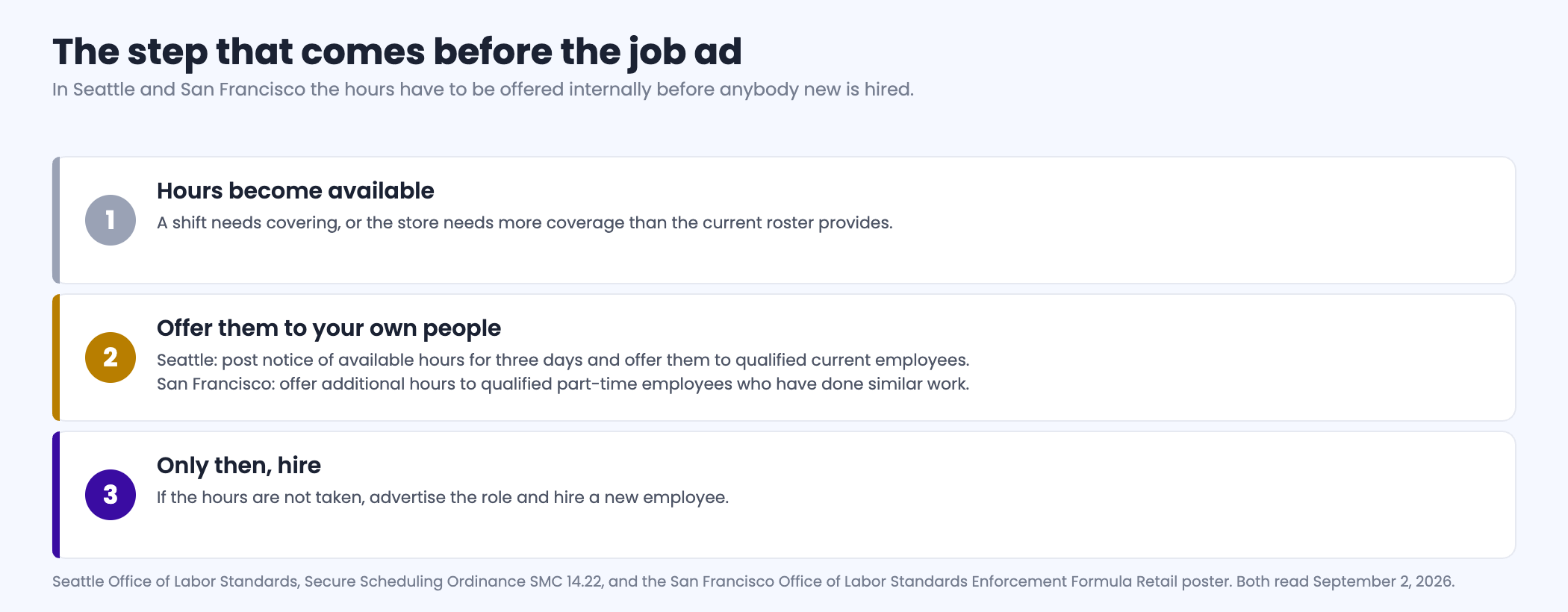
Predictive scheduling laws are usually described as a notice requirement: post the schedule 14 days ahead, pay a premium if you change it. That is the visible half. The half that reaches recruiting is the access to hours rule. In Seattle you must post available hours for three days and offer them to qualified current employees before hiring new employees. In San Francisco you must offer additional hours to qualified part-time employees who have done similar work before you hire. In those places the job ad is not the first step in filling a shift; it is the second.
Where these laws exist
One state and a short list of cities. Every one of them targets the same industries — retail, food service, hospitality, and in Chicago’s case warehouses, manufacturing, healthcare and building services too — and every one sets a size threshold high enough that it reaches chains rather than single sites.
| Jurisdiction | Who it covers | Notice | Source |
|---|---|---|---|
| Oregon | Retail, hospitality and food services employers with 500 or more employees worldwide | 14 calendar days, in writing, posted | Read at source |
| Seattle | Retail and food services with 500 or more employees worldwide; full-service restaurants also need 40 or more locations worldwide | 14 days | Read at source |
| Chicago | Building services, healthcare, hotels, manufacturing, restaurants, retail and warehouse services with 100 or more employees (250 for not-for-profits), at least 50 of them covered; employees earning up to $32.60 an hour or $62,561.90 a year | 14 days | Read at source |
| San Francisco | Formula retail with 40 or more retail establishments worldwide and 20 or more employees in San Francisco | Two weeks | Read at source |
| New York City | Fast food and retail, with separate rules for each | 14 days fast food, 72 hours retail | Reported |
| Philadelphia, Los Angeles, Berkeley, Emeryville, Evanston | Retail, food and hospitality chains above local size thresholds | Generally 14 days | Reported |
The access to hours rule, and why it is a recruiting rule
This is the provision that changes the order of operations, and it is almost never the headline anywhere else. Two of the four jurisdictions we read at source require the employer to go to its own part-time staff first.
| Where | What the rule says |
|---|---|
| Seattle | “Offer additional work hours to current employees by posting notice of available hours for three days and offering the hours to qualified, current employees before hiring new employees (unless an exception applies).” |
| San Francisco | “Before hiring new employees, offer additional hours of work to qualified part-time employees who have performed similar work for the employer.” |
Read that as an operations rule rather than a compliance one and it says something useful. If a store needs twenty more hours a week covered, the law makes you find out whether your existing part-timers want them before you spend anything on advertising. That is not obviously a bad deal: hours filled internally cost nothing to source, the person is already trained, and there is no onboarding. It is only a problem when nobody has asked, because then it arrives as a delay in the middle of a hiring plan rather than as a step in it.
The awkward part, stated plainly
We sell advertising. A rule that makes an employer try to fill hours without advertising first is, on the face of it, against our interest. It is also the cheaper answer when it works, and pretending otherwise would not survive contact with anyone who has run a store. The honest position is that the internal offer should happen because it is quick and free, not because an ordinance forces it, and the advertising should start the moment it is clear the hours are not going to be taken.
The premium is a price list, not a fine
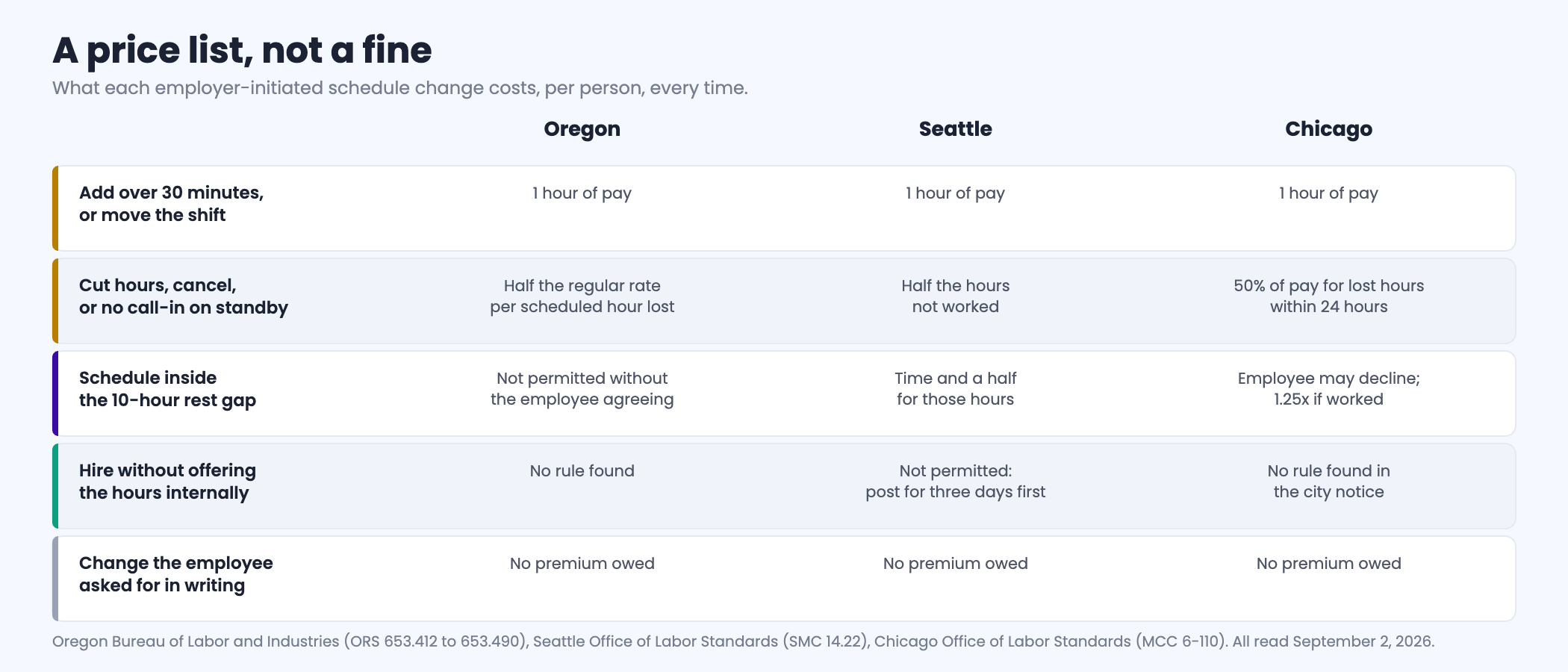
The other half of these laws is what you pay when the schedule changes after it is posted. A separate rule decides what the shift owes once it starts, which is set out on meal break laws by state. It is worth reading as a tariff, because that is how it behaves: a fixed amount per person per change, charged every time, forever.
| What you do | Oregon | Seattle | Chicago |
|---|---|---|---|
| Add more than 30 minutes, or move the date or start or end time with no loss of hours | 1 hour of pay | 1 hour of pay for hours added or a date or time change | 1 hour of pay per affected shift when hours are added |
| Cut hours, cancel the shift, or not call in an on-call shift | Half the regular rate for each scheduled hour not worked | Half the hours not worked | 50% of pay for lost hours where the change comes within 24 hours |
| Schedule a shift too close to the last one | Cannot schedule within 10 hours of the previous day’s shift unless the employee requests or agrees | Time and a half for hours worked where shifts are separated by less than 10 hours | Employee may decline; 1.25x the regular rate if the shift is worked |
| Hire without offering the hours internally | — | Not permitted; post for three days first | — |
Look up a jurisdiction
What schedule churn actually costs
Managers change posted schedules constantly, and in most of the country that costs nothing. Where the shift belongs to a minor the constraint is a different one entirely, and child labor laws by state sets it out with the statute attached. In a covered jurisdiction each edit has a price, and the price does not scale with how small the edit is. Moving somebody’s start time by an hour costs the same as adding two hours to their shift.
Price a month of schedule edits
Three details that catch employers out
The employee can say no. In Oregon an employee may decline any shift not on the written schedule; in Chicago they may decline a shift beginning less than ten hours after the previous day’s ended, and are owed 1.25 times their rate if they work it anyway. Coverage you assumed you had, because somebody was available, is coverage you have to ask for.
Employee-requested changes are free. Every one of these laws exempts changes the employee asked for in writing. Oregon says so explicitly: if a worker requests extra shifts after the schedule is posted, no additional compensation is owed. A shift-swap board that records who asked for what is not an administrative nicety, it is the difference between a change that costs an hour of pay and one that costs nothing.
The threshold counts everywhere, not locally. Oregon and Seattle both count 500 or more employees worldwide. A single Portland restaurant belonging to a national group is covered; an independent with four hundred staff in Oregon is not. Employers routinely get this backwards, and the count that matters is the one on the parent company’s payroll.
What this changes about advertising a shift
Three practical things, none of which requires a lawyer. Post the internal offer first where the rule requires it, and treat the three-day window in Seattle as part of the hiring timeline rather than as a surprise. Advertise for the shape of work you can actually schedule, because a fourteen-day posted schedule is a promise and the premium is what you pay for breaking it. And write the good faith estimate of hours before the ad goes live, since Oregon, Seattle and Chicago all require one at hire and the ad is where the expectation gets set in the first place.
On cost, we can tell you the part we measure. Across the 891 campaigns in our 2026 social job advertising benchmark the median campaign delivered an applicant for $13.88, with customer service and admin roles at $2.71 and warehouse and production at $9.83. Against that, an hour of predictability pay for every person on a schedule you edited is not a rounding error. What we have no data on is how often covered employers actually edit schedules, whether the internal offer fills the hours, or what any of this does to retention, and we will not estimate them. The adjacent question we have written about honestly is what a schedule that does not work costs when people leave, in the turnover cost calculator and on overtime laws by state, where the daily rule creates a second cost on the same long shifts.
Frequently asked questions
Which states have predictive scheduling laws?
Oregon is the only statewide law. It covers retail, hospitality and food services employers with 500 or more employees worldwide and requires a written work schedule at least 14 calendar days in advance. Everywhere else the rules are city ordinances: Seattle, Chicago, San Francisco, New York City, Philadelphia, Los Angeles, Berkeley, Emeryville and Evanston among them, each with its own industries and size thresholds.
Do I have to offer hours to existing staff before hiring?
In Seattle and San Francisco, yes. Seattle requires an employer to post notice of available hours for three days and offer them to qualified current employees before hiring new employees, unless an exception applies. San Francisco requires an employer to offer additional hours of work to qualified part-time employees who have performed similar work before hiring new employees. That makes the internal offer a step in the hiring timeline rather than an alternative to it.
How much notice does a work schedule need?
Fourteen days in Oregon, Seattle and Chicago, and two weeks in San Francisco. Oregon requires the schedule in writing, posted and easily visible, covering all work shifts and on-call shifts, with the notice running to the first day on the schedule. New York City is the exception among the larger jurisdictions: 14 days for fast food and 72 hours for retail.
What is predictability pay?
Extra compensation owed when the employer changes a posted schedule. The common shape is one hour of pay at the regular rate when hours are added or a shift is moved without losing hours, and half the regular rate for each scheduled hour the employee does not work when a shift is cut, canceled, or an on-call shift is not called in. It is owed per person per change, and it is separate from the wages earned for hours actually worked.
What is the ten-hour rest rule?
A restriction on scheduling a shift too soon after the last one, sometimes called the clopening rule. In Oregon an employee cannot be scheduled during the first 10 hours after the previous calendar day’s shift unless they request or agree to it. Seattle requires time and a half for hours worked where shifts are separated by less than 10 hours. Chicago lets the employee decline such a shift and requires 1.25 times the regular rate if it is worked.
Do employee-requested changes cost anything?
No, and this is the cheapest thing an employer can fix. Oregon states that where an employee requests in writing to be added to more shifts after the schedule is posted, the change is not subject to the advance notice requirement and no additional compensation is owed. Keeping a written record of who asked for what turns an expensive change into a free one, which makes a shift-swap log worth more than it looks.
Does the size threshold count employees in that city only?
Usually not. Oregon and Seattle both count 500 or more employees worldwide, which means a single location belonging to a national chain is covered while a large local independent may not be. Seattle adds a second test for full-service restaurants, which also need 40 or more locations worldwide. Chicago counts 100 or more employees, 250 for not-for-profits, with at least 50 of them covered by the ordinance.
Are there exceptions to predictability pay?
Yes, and they are narrower than people assume. Oregon excuses additional compensation where a change results from a natural disaster or a comparable event outside the employer’s control, listing floods, earthquakes, wildfires, snowstorms, extreme temperatures, fires, explosions, war and civil unrest. Ordinary business reasons, including a slow day or somebody calling in sick, are not on that list.
Fill the hours internally first, then advertise properly
Bring the sites you are staffing and the shifts you cannot cover. We will show you what applicant flow costs in those markets, so the advertising starts the day the internal offer runs out rather than a week later.
Book a Demo