
Employer guideRead at source, 4 September 2026
Meal Break Laws by State: Who Must Give One, After How Long, and Whether It Is Paid (2026)
There is no federal meal break. Not for adults, not for anyone. Twenty-one states require one, and only seventeen are a plain rule with a fixed trigger and length a scheduler can plan against. The other four are narrower than their reputation: Maryland reaches only retail employers with 50 or more retail staff, Nebraska only assembly plants, workshops and mechanical establishments, New York turns on what time of day the shift runs rather than how long it is, and Vermont requires reasonable opportunities to eat with no trigger, no length and no pay rule. Twenty-eight jurisdictions require nothing, and Wisconsin merely recommends. Seven states add a paid rest break, and since 1 January 2026 Minnesota has the longest at fifteen minutes per four hours. The federal table almost every summary copies was last revised 1 January 2023, and it is now wrong about Minnesota, Colorado and Illinois. Every row below was read at the statute, the regulation or the state labor department on 4 September 2026.
The federal position is a pay rule, not a break rule
The Fair Labor Standards Act does not require an employer to give a meal or a rest break to an adult. What federal law does is tell you how to treat a break you have already given. 29 CFR 785.18 covers rest: breaks running from 5 minutes to about 20 minutes are common in industry, they promote efficiency, and they must be counted as hours worked. That time cannot be offset against other compensable time such as waiting or on-call time. 29 CFR 785.19 covers meals: a bona fide meal period is not worktime, it does not include coffee breaks or snack time, and the employee must be completely relieved from duty for the purpose of eating a regular meal. Ordinarily 30 minutes or more is long enough; a shorter period may qualify under special conditions.
Two lines in 785.19 decide most real disputes. An employee is not relieved if required to perform any duties, active or inactive, while eating: the rule names the office worker made to eat at a desk and the factory worker kept at a machine. But 785.19(b) says it is not necessary that the employee be permitted to leave the premises, so long as they are otherwise completely freed from duty. Keeping someone in the building is fine. Keeping them answerable is not.
There is exactly one federal break mandate
29 U.S.C. 218d, added by the PUMP for Nursing Mothers Act in December 2022, requires reasonable break time for an employee to express breast milk each time the employee needs to, for one year after the birth, plus a private space that is not a bathroom. The break need not be paid unless the employee is not completely relieved of duty. Employers with fewer than 50 employees are exempt only where compliance would be a genuine undue hardship.
Federal meal and rest break law (FLSA) at a glance
If you only need the federal break and lunch laws in one place, this is all of it. The Department of Labor puts the headline in one sentence: "Federal law does not require lunch or coffee breaks." Everything else in federal law is about how a break you choose to give is paid.
| Break | Required by federal law? | Paid? | Authority |
|---|---|---|---|
| Meal or lunch break (ordinarily 30 minutes or more) | No | Unpaid, if the employee is completely relieved of duty | 29 CFR 785.19 |
| Rest break of 5 to about 20 minutes | No | Paid, counted as hours worked | 29 CFR 785.18 |
| Lactation break, for one year after the birth | Yes | Unpaid unless not completely relieved of duty | 29 U.S.C. 218d |
Because paid short breaks count as hours worked, they also count toward the 40 hours that trigger overtime. And because nothing federal requires the break itself, the question of whether a shift owes one is always a state question, which is what the rest of this page answers.
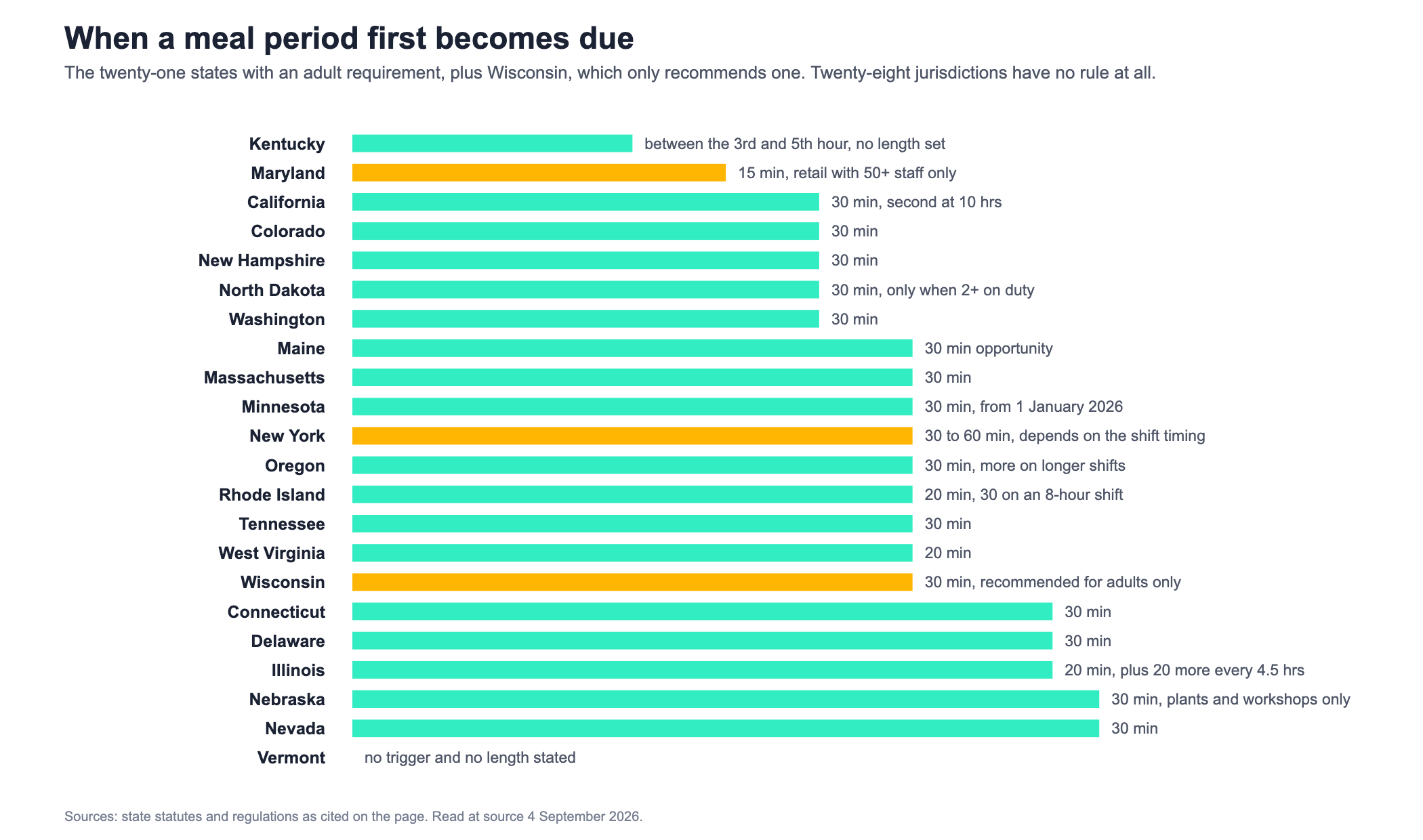
The twenty-three jurisdictions with a rule, and what each one actually says
Twenty-one states require an adult meal period. Wisconsin only recommends one, in a rule that becomes mandatory the moment the employee is under 18. And twenty-eight jurisdictions require nothing at all: Alabama, Alaska, Arizona, Arkansas, the District of Columbia, Florida, Georgia, Hawaii, Idaho, Indiana, Iowa, Kansas, Louisiana, Michigan, Missouri, Montana, New Jersey, New Mexico, North Carolina, Ohio, Oklahoma, Pennsylvania, South Carolina, South Dakota, Texas, Utah, Virginia and Wyoming. Several still have a rule for minors, a trap for anyone who reads the adult row and stops. Arizona goes further: A.R.S. 23-204 makes meal breaks and rest periods a matter of statewide concern not subject to further regulation by a city or town, which forecloses a local ordinance.
| Jurisdiction | Break due after | Length | Paid? | Who it covers | Authority |
|---|---|---|---|---|---|
| California | 5 hours | 30 min | Unpaid if duty free | All IWC-covered employees | Cal. Lab. Code 512(a) |
| Colorado | 5 hours | 30 min | Unpaid if uninterrupted | All employers | COMPS Order 40, 7 CCR 1103-1, Rule 5.1 |
| Connecticut | 7.5 hours | 30 min | Statute silent | All employers | C.G.S. 31-51ii(a) |
| Delaware | 7.5 hours | 30 min | Unpaid | All but school professionals | 19 Del. C. 707(a) |
| Illinois | 7.5 hours | 20 min | Statute silent; IDOL says a break worked through must be paid | All employers | 820 ILCS 140/3 |
| Kentucky | 3rd to 5th hour | No length set | Unpaid if bona fide | All but Railway Labor Act | KRS 337.355 |
| Maine | 6 hours | 30 min | Unpaid if duty free | All, small-site exception | 26 M.R.S. 601 |
| Maryland | 4 hours | 15 min, 30 after 6 | Unpaid unless on duty | Retail with 50+ retail staff | Md. Lab. & Empl. 3-710 |
| Massachusetts | 6 hours | 30 min | Unpaid if duty free | All but named works | M.G.L. c.149 s.100 |
| Minnesota | 6 hours | 30 min | Unpaid | All employers | Minn. Stat. 177.254 subd. 1 |
| Mississippi | Not verified | Not verified | Not verified | Not verified | Miss. Code text not reachable |
| Nebraska | 8-hour shift | 30 min | Statute silent | Plants and workshops only | Neb. Rev. Stat. 48-212 |
| Nevada | 8 continuous hours | 30 min | Statute silent | All but one-person sites | NRS 608.019(1) |
| New Hampshire | 5 consecutive hours | 30 min | Statute silent | All employers | RSA 275:30-a |
| New York | Depends on the shift | 60, 45, 30 or 20 min | Statute silent | Factories and other establishments | N.Y. Lab. Law 162 |
| North Dakota | Shift over 5 hours | 30 min | Unpaid if duty free | Only when 2+ on duty | N.D. Admin. Code 46-02-07-02(5) |
| Oregon | 6 hours | 30 min | Unpaid if duty free | All employers | OAR 839-020-0050(2)(a) |
| Rhode Island | 6 hours | 20 min, 30 on 8 hrs | Unpaid | All but sites with fewer than 3 per shift and licensed healthcare facilities | R.I. Gen. Laws 28-3-14 |
| Tennessee | 6 consecutive hours | 30 min | Unpaid | All but ample-opportunity sites | T.C.A. 50-2-103(h) |
| Vermont | Not stated | Not stated | Not stated | All employers | 21 V.S.A. 304 |
| Washington | 5 consecutive hours | 30 min | Paid if kept on duty | All non-agricultural adults | WAC 296-126-092(1) |
| West Virginia | 6 hours | 20 min | Statute silent | All, if not already given | W. Va. Code 21-3-10a |
| Wisconsin | 6 consecutive hours | 30 min | Paid if on duty | Recommendation only | Wis. Admin. Code DWD 274.02(2) |
Read the trigger column and the pattern is a cluster, not a gradient. Five states start the clock at five hours and eight at six, three at seven and a half, and two at eight. That matters more than it looks, because the standard frontline shift sits on top of that band: a six-and-a-half-hour closing shift crosses the trigger in fourteen of these states, plus New York if it runs at the wrong time of day, and clears it in neither of the eight-hour ones. What a full 12-hour shift owes in each state is on 12-hour shift laws by state.
Three rows are narrower than the name suggests, and one is wider. Maryland is not a meal break law in the ordinary sense: it is the Healthy Retail Employee Act, reaching only retail establishments with 50 or more retail employees, and excluding wholesalers, restaurants, corporate offices and any site with five or fewer people. Nebraska covers assembling plants, workshops and mechanical establishments, so a Nebraska restaurant is not covered. New York is not an hours rule: the entitlement turns on whether the shift spans the noon period, starts before 11 a.m. and runs past 7 p.m., or starts between 1 p.m. and 6 a.m. And Rhode Island is wider than its address: the section sits in a chapter titled Employment of Children but by its terms covers all employees.
On pay, most of these statutes do not say. Only Delaware, Minnesota, Rhode Island and Tennessee state the unpaid answer on the face of the rule. Washington and Wisconsin put it the other way round and say when the break must be paid: Washington when the employee is required to stay on duty on the premises in the employer interest, Wisconsin whenever the employee is not free from work for a full thirty minutes or not free to leave. Everywhere else the answer comes from 29 CFR 785.19, not from the state.
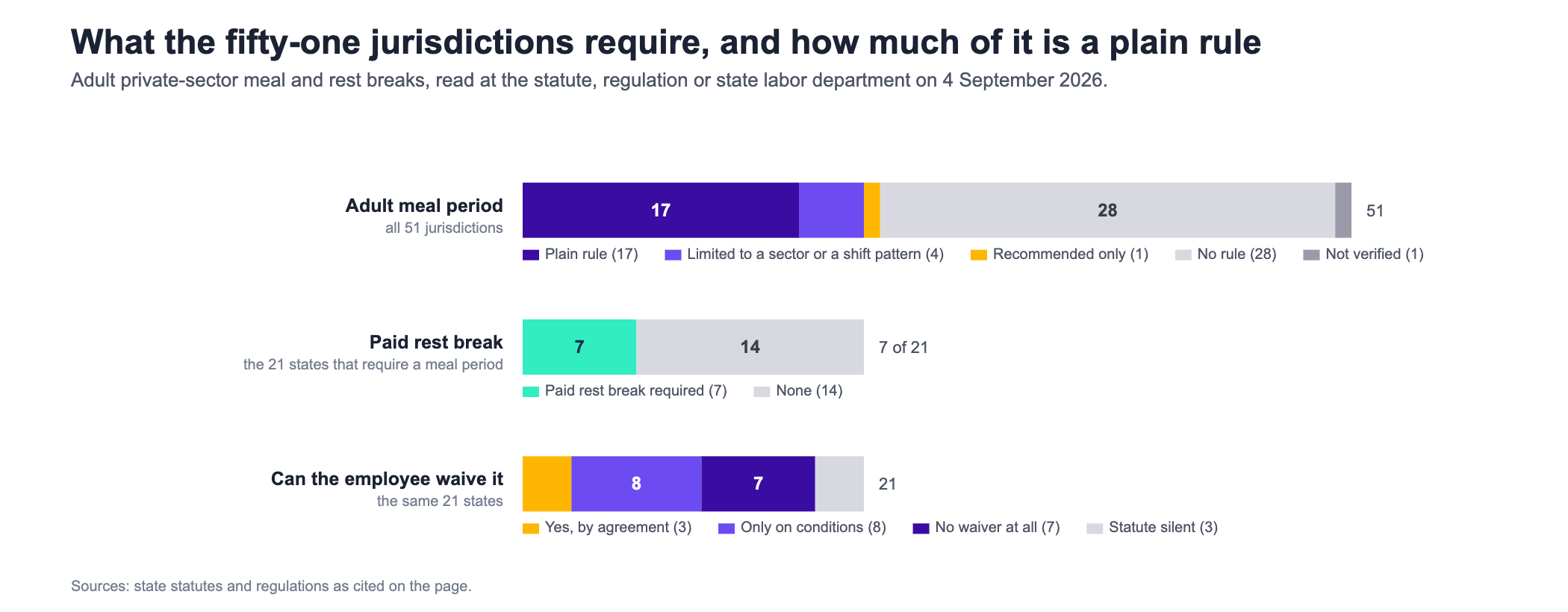
Lunch break laws by state, grouped by when the break is due
Most people searching state law on lunch breaks want one thing: after how many hours does the lunch break become due? Here are the same state rules as the table above, grouped by that trigger.
- At 5 hours: California, Colorado, New Hampshire, North Dakota and Washington.
- At 6 hours: Maine, Massachusetts, Minnesota, Oregon, Rhode Island, Tennessee and West Virginia, plus Wisconsin as a recommendation only.
- At 7.5 hours: Connecticut, Delaware and Illinois.
- At 8 hours: Nebraska (plants and workshops only) and Nevada.
- Earlier, but narrow: Maryland at 4 hours, retail employers with 50 or more retail staff only, and Kentucky somewhere between the third and fifth hour.
- No hours trigger: New York, where it depends on the time of day the shift runs, and Vermont, which requires reasonable opportunities to eat with no trigger or length.
- No adult lunch break law: the other twenty-eight jurisdictions, listed above. Mississippi could not be confirmed at source.
Lunch length is 30 minutes almost everywhere on this list. The exceptions are Illinois, Rhode Island and West Virginia at 20 minutes, and New York, which runs from 20 to 60 depending on the shift.
Where the federal table is wrong, and it is wrong in three places
The Department of Labor publishes the state table almost every summary is built from. It was last revised on 1 January 2023. Three of its rows no longer describe the law.
Minnesota is wrong on both counts. The federal table says sufficient unpaid time for employees who work eight consecutive hours, which was accurate when written and is not now. Minn. Stat. 177.254, as rewritten by the 2025 first special session and effective 1 January 2026, requires a meal break of at least 30 minutes at six or more consecutive hours. The trigger moved down two hours and the indefinite length became a fixed thirty minutes. Minn. Stat. 177.253 at the same time replaced adequate restroom time with a paid 15-minute rest break within each four consecutive hours, the longest mandated paid rest period in the country. Both now carry a remedy the old ones did not: unallowed break time is payable at the regular rate plus an equal amount in liquidated damages.
Colorado is wrong on coverage. The federal table attributes the rule to a wage order covering four industries, retail and service, food and beverage, commercial support service, and health and medical. That has not been the law for years. COMPS Order 40, 7 CCR 1103-1, Rule 2.1, effective 1 February 2026, regulates all employers and employees for work performed in Colorado, subject to the exemptions in Rule 2.2. The federal table also omits Colorado paid rest break entirely.
Illinois was wrong on the day the table was revised. The table gives 20 minutes for employees who work seven and a half continuous hours. The current 820 ILCS 140/3, as amended by Public Act 102-828 effective 1 January 2023, adds a sentence: an employee who works in excess of seven and a half continuous hours is entitled to an additional 20-minute meal period for every additional four and a half continuous hours. A twelve-hour double in Illinois earns two meal periods, not one. A sixteen-and-a-half-hour day earns three.
Three smaller entries also mislead. Maine is described as a 30-minute meal period after six consecutive hours; the section is titled Rest breaks and requires the opportunity for thirty consecutive minutes, and its small-employer exception needs both conditions, fewer than three employees on duty and work that allows frequent paid short breaks, where the federal table gives only the headcount. Nevada is described as applying to employers of two or more employees; the statute is a per-worksite test, excluding a place where only one person works. North Dakota is described as half an hour if desired; the rule is mandatory whenever two or more employees are on duty, subject to an express waiver, which is a different thing. And Kentucky is credited with an ordinary half hour not counted as time worked, but KRS 337.355 sets no length and says nothing about pay. The half hour arrives through 803 KAR 1:067, which adopts the federal criteria, and the regulation the federal wording traces to has expired.
| Jurisdiction | Paid rest break | Rest authority | May the meal be waived? |
|---|---|---|---|
| California | 10 min per 4 hrs, paid | IWC Order 4-2001 sec. 12(A) | Yes, if the day ends in 6 hrs |
| Colorado | 10 min per 4 hrs, paid | COMPS Order 40, Rule 5.2 | No |
| Connecticut | None | — | Schedule only, in writing |
| Delaware | None | — | By written agreement |
| Illinois | Hotel attendants only, paid | 820 ILCS 140/3.1 | No |
| Kentucky | 10 min per 4 hrs, paid | KRS 337.365 | By agreement |
| Maine | None | — | By written agreement |
| Maryland | None | — | The 15 min, in writing |
| Massachusetts | None | — | Paid if kept on site |
| Minnesota | 15 min per 4 hrs, paid | Minn. Stat. 177.253 subd. 1 | No |
| Nebraska | None | — | By written agreement |
| Nevada | 10 min per 4 hrs, paid | NRS 608.019(2) | No |
| New Hampshire | None | — | No |
| New York | None | — | No, permit only |
| North Dakota | None | — | Yes, expressly |
| Oregon | 10 min per 4 hrs, paid | OAR 839-020-0050(6)(a) | Tipped staff only |
| Rhode Island | None | — | No |
| Tennessee | None | — | Tipped staff only |
| Vermont | None | — | Not addressed |
| Washington | 10 min per 4 hrs, paid | WAC 296-126-092(4) | Meal yes, rest no |
| West Virginia | None | — | Not addressed |
| Wisconsin | None | — | Not applicable |
The waiver column is where a compliant schedule most often goes wrong. Only North Dakota lets an employee simply agree to skip the meal, and only California and Washington allow a straightforward mutual waiver, California limited to a workday finishing within six hours. Oregon and Tennessee allow a waiver only for tipped food and beverage staff, and both wrap it in procedure: Oregon requires a prescribed form requested no fewer than seven days after employment begins, and Tennessee requires a posted written policy, an acknowledgement of the right being given up, and a seven-day rescission right on either side. In Colorado, Illinois, Minnesota, Nevada, New Hampshire, New York and Rhode Island there is no employee waiver at all. An employee who says they would rather work through does not make it lawful in any of those seven.
Check a state
Pick a jurisdiction for the meal rule, the rest rule, who it covers, whether it may be waived, and the section it comes from.
What does a shift of this length owe?
Enter a state and a shift length. The planner applies that state schedule, including the states where a long shift earns more than one break.
Rest break laws by state
Rest breaks are a separate question from meal breaks, and the federal position on them is inverted. On meal breaks, federal law says nothing about giving one and only tells you when it has to be paid. On rest breaks, 29 CFR 785.18 is direct: "Rest periods of short duration, running from 5 minutes to about 20 minutes, are common in industry… They must be counted as hours worked." It adds that this compensable time "may not be offset against other working time such as compensable waiting time or on-call time."
So the federal rule does not require you to give a rest break. It requires that if you give one, and it runs under about twenty minutes, you pay for it and you cannot claw it back against downtime elsewhere in the shift. An unpaid fifteen-minute break is the most common version of this mistake, and it is a wage violation in all fifty states regardless of what the state break law says.
Nine jurisdictions go further and require the break itself.
| State | Rest break required | Trigger | Paid? | Who it covers |
|---|---|---|---|---|
| California | 10 min | Each 4 hours or major fraction | Paid | All covered employees; not required under 3½ hours total |
| Colorado | 10 min | Each 4 hours or major fraction | Paid | All covered employees |
| Kentucky | 10 min | Each 4-hour work period | Paid | All covered employees |
| Minnesota | 15 min, or long enough to reach the nearest convenient restroom, whichever is longer | Each 4 consecutive hours | Paid | All employees (Minn. Stat. 177.253) |
| Nevada | 10 min | Each 4 hours or major fraction | Paid | All covered employees; not required under 3½ hours total |
| Oregon | 10 min | Every 4 hours or major portion | Paid | All covered employees |
| Washington | 10 min | Each 4-hour period; no more than 3 hours worked without one | Paid | All covered employees |
| Illinois | Two 15-min breaks per workday | Shifts of 7 hours or more | Paid | Hotel room attendants only |
| Vermont | "Reasonable opportunities" — no fixed length or frequency | During work periods | Paid where short | All covered employees |
Two things to take from the table. First, in seven of the nine the trigger is the same four-hour block, so an eight-hour shift owes two rest breaks in those states, on top of any meal break the shift earns under the table further up this page. Second, Illinois is not a general rest-break state at all — its rest-break rule reaches hotel room attendants and no one else, which is why it sits near the bottom of this list and near the top of the meal-break one.
A note on where this list comes from. The meal-break figures earlier on this page were each read at the statute. This rest-break list starts from the US Department of Labor's summary table of state rest-period requirements, with one correction: DOL still describes Minnesota's requirement as an "adequate" rest period with no stated length. Minnesota Statutes 177.253 now sets it at "a rest break of at least 15 minutes or enough time to utilize the nearest convenient restroom, whichever is longer, within each four consecutive hours of work." If you are scheduling in Minnesota, the fifteen minutes is the number, not the federal table's wording.
Lactation breaks: the federal PUMP Act and state rules
The lactation break is the one break federal law requires, and it applies in every state. 29 U.S.C. 218d, as expanded by the PUMP for Nursing Mothers Act, says an employer shall provide “a reasonable break time for an employee to express breast milk for such employee’s nursing child for 1 year after the child’s birth each time such employee has need to express the milk,” and “a place, other than a bathroom, that is shielded from view and free from intrusion from coworkers and the public.” The Department of Labor’s Fact Sheet 73 says the right covers nearly all FLSA-covered employees, exempt staff included.
- Frequency and length. Set by need, not by a schedule. There is no fixed number of breaks and no fixed length.
- Pay. Federal law does not require the time to be paid, but it counts as hours worked if the employee is not completely relieved from duty for the whole break. If the employee pumps during a paid rest break you already give, that break stays paid.
- Small employers. An employer with fewer than 50 employees is exempt only if compliance “would impose an undue hardship by causing the employer significant difficulty or expense” in relation to its size, finances, nature or structure.
- Transport. Airline crewmembers are exempt. Some rail and motorcoach employees are covered only where compliance would not mean significant expense or unsafe conditions.
- Space complaints. Before suing over the lack of a space, an employee generally must notify the employer and give it 10 days to comply. That step does not apply if the employee was fired for asking or the employer has said it will not provide the space.
The statute leaves room for states to go further: it does not preempt “a State law or municipal ordinance that provides greater protections.” Three examples read at source:
| Jurisdiction | How long after birth | Paid? | Source |
|---|---|---|---|
| Federal (all states) | 1 year | No, unless not fully relieved of duty | 29 U.S.C. 218d |
| New York | Up to 3 years | Yes, 30 minutes of paid break time each time needed, since June 19, 2024 | NYSDOL; N.Y. Lab. Law 206-c |
| Minnesota | No time limit stated | Pay may not be reduced for the time used | Minn. Stat. 181.939 |
| California | No time limit stated | Unpaid beyond break time already provided | California Labor Commissioner; Lab. Code 1030 |
New York also requires employers to give each employee the NYSDOL lactation policy when they start and every year after. California spells out what the space must have, including a surface for the pump, seating, electricity, a nearby sink with running water and access to a refrigerator, and the Labor Commissioner can cite $100 for each day an employee is denied a break or adequate space. Other states have their own rules, so check the state where the employee works.
What this means when you publish the shift
Three consequences. A break rule is a staffing rule: in the seventeen states with a plain requirement, a single-person site cannot run a shift past the trigger without cover, which is why Nevada writes a one-person exception into the statute and Maine a small-site exception. The second is that the paid rest break, not the meal, is what moves payroll: seven states require it, and in Minnesota it is now fifteen minutes in every four hours. The third is that the trigger sits under the most common frontline shift there is. Advertise a close of more than six hours and you have advertised a break in fourteen states. The adjacent rules are on overtime laws by state and predictive scheduling laws by state, and the rules that reach anyone under 18 are on child labor laws by state.
State-by-state employer guides: every state’s breaks, overtime, final pay and hiring rules in one place: Alabama, Alaska, Arizona, Arkansas, California, Colorado, Connecticut, Delaware, D.C., Florida, Georgia, Hawaii, Idaho, Illinois, Indiana, Iowa, Kansas, Kentucky, Louisiana, Maine, Maryland, Massachusetts, Michigan, Minnesota, Mississippi, Missouri, Montana, Nebraska, Nevada, New Hampshire, New Jersey, New Mexico, New York, North Carolina, North Dakota, Ohio, Oklahoma, Oregon, Pennsylvania, Rhode Island, South Carolina, South Dakota, Tennessee, Texas, Utah, Vermont, Virginia, Washington, West Virginia, Wisconsin, Wyoming.
Frequently asked questions
Does federal law require a lunch break?
No. The Fair Labor Standards Act requires no meal or rest break for adults. It only says how a break must be treated if one is given: under 29 CFR 785.18 short breaks of 5 to about 20 minutes count as hours worked, and under 29 CFR 785.19 a bona fide meal period does not.
Which states require a meal break?
Twenty-one: California, Colorado, Connecticut, Delaware, Illinois, Kentucky, Maine, Maryland, Massachusetts, Minnesota, Nebraska, Nevada, New Hampshire, New York, North Dakota, Oregon, Rhode Island, Tennessee, Vermont, Washington and West Virginia. Maryland, Nebraska, New York and Vermont are narrower than the rest.
Can I work 6 hours without a lunch break?
It depends on the state. A shift of more than six hours crosses the trigger in fourteen states, among them California, Colorado, Minnesota, Oregon, Rhode Island, Tennessee and Washington. In the twenty-eight jurisdictions with no rule, and in the seven-and-a-half and eight-hour states, it does not.
Does a meal break have to be paid?
Usually not, provided the employee is completely relieved of duty. Under 29 CFR 785.19 the employee is not relieved if required to perform any duties while eating, and then the time is paid. Washington and Wisconsin say so in their own rules. Keeping someone on the premises is allowed; keeping them answerable is not.
How long does a meal break have to be?
Thirty minutes in most states that require one. Illinois, Rhode Island and West Virginia set 20. Maryland sets 15 for a shorter shift. New York runs to 60 minutes in a factory at the noon meal. Kentucky sets no length at all in the statute.
Which states require a paid rest break?
Seven: California, Colorado, Kentucky, Nevada, Oregon and Washington at ten minutes per four hours, and Minnesota at fifteen minutes per four consecutive hours since 1 January 2026. Illinois requires two paid fifteen-minute breaks for hotel room attendants only.
Can an employee waive a meal break?
In some states. North Dakota allows it by simple agreement, California where the workday finishes within six hours, and Washington by mutual agreement. Oregon and Tennessee allow it only for tipped food and beverage staff, on a written form. Colorado, Illinois, Minnesota, Nevada, New Hampshire, New York and Rhode Island allow no waiver at all.
Do longer shifts earn more than one break?
Yes in several states. Illinois adds 20 minutes for every additional four and a half continuous hours past seven and a half. California adds a second 30 minutes after ten hours. Oregon runs a published schedule up to three meal periods on a 22-hour day. Maryland adds 15 minutes for every four consecutive hours past eight.
Do you have to pay employees for a 15-minute break?
Yes, everywhere. Under 29 CFR 785.18, rest periods running from 5 minutes to about 20 minutes "must be counted as hours worked," and that time "may not be offset against other working time such as compensable waiting time or on-call time." This holds in every state, including the forty-two with no law requiring a rest break at all — the federal rule governs how a short break is paid, not whether you must give one. Deducting a fifteen-minute break from a timesheet is a wage violation regardless of state break law.
How many breaks in a 6 hour shift by law?
Federal law requires none. Under state law, a six-hour shift is past the lunch trigger in the five states that start the clock at five hours: California, Colorado, New Hampshire, North Dakota and Washington. In the six-hour states the wording decides whether exactly six hours counts: Minnesota applies at six or more consecutive hours and Oregon gives a meal period on a six-hour work period, while Maine and Massachusetts say more than six. For rest, a six-hour shift earns one paid 10-minute break in California, Colorado, Kentucky, Nevada, Oregon and Washington, and one paid break of at least 15 minutes in Minnesota. California also lets the meal be waived by mutual consent when the workday ends within six hours.
On a 7 hour shift, how many breaks are required?
None under federal law. Under state law, a seven-hour shift owes a 30-minute meal period (20 minutes in Rhode Island and West Virginia) in the states whose trigger is five or six hours, but not yet in Connecticut, Delaware or Illinois (7.5 hours) or Nebraska and Nevada (8 hours). On rest, California, Colorado and Oregon owe two paid 10-minute breaks on a seven-hour shift, because a shift over six hours earns a second one, and Nevada also requires two once the shift reaches seven continuous hours. Minnesota requires 15 paid minutes within each four consecutive hours.
Is there a 15 minute break law?
Not federally. Federal law never requires a 15-minute break; it only requires that a break of 5 to about 20 minutes, if you give one, is paid. Minnesota is the only state with a general 15-minute rest break, due within each four consecutive hours since 1 January 2026. Illinois requires two paid 15-minute breaks for hotel room attendants only, and Maryland requires a 15-minute break on a four-to-six-hour shift for large retail employers only. The other paid rest-break states set 10 minutes.
What does state law say about work breaks?
It depends on the state, because federal law requires no break for adults. According to the U.S. Department of Labor’s state meal-period table, 21 states require a meal break, mostly after five to eight hours of work. Only nine have a rest-break rule on the DOL rest-period table, and seven of those require a paid break in each four-hour block. Minnesota’s is 15 minutes (Minn. Stat. 177.253). Elsewhere, adult breaks are left to employer policy (minors can differ), but a short break you do give must be paid under 29 CFR 785.18.
Do employers have to give breastfeeding breaks?
Yes. Under the federal PUMP Act, 29 U.S.C. 218d, employers must give reasonable break time to express breast milk each time an employee needs it, for one year after the birth, plus a private space that is not a bathroom. The break can be unpaid if the employee is fully relieved of duty. Employers under 50 employees are exempt only if compliance would cause undue hardship. Some states, including New York, require paid time.
The shift pattern is the offer.
Knowing which break the schedule owes does not fill it. Bring the roles you refill most and the markets you hire in, and we will show what a qualified applicant has actually cost there.
Book a Demo