
Caregiver Recruitment Strategies That Actually Work (2026 Data)
Most caregiver recruitment advice is written without numbers attached. In Boostpoint's 2026 Social Job Advertising Benchmark, the median caregiver applicant cost $3.76 and 31% of people who clicked finished the application. Across an earlier set of 478 Boostpoint-managed healthcare campaigns and 24,712 applications, half of applicants were between 45 and 64 — not the under-35 workforce the industry keeps describing.
Source: Boostpoint campaign data — 478 healthcare recruitment campaigns across 30 employers, January 2025 through mid-2026, representing 18,553,441 impressions and 24,712 applications on Meta platforms. Boostpoint's canonical 2026 Social Job Advertising Benchmark (891 campaigns, single methodology) reports median cost per applicant of $3.76 for caregivers, $7.72 for CNAs, $12.77 for LPNs and $19.08 for RNs; where this earlier analysis and the benchmark differ, the benchmark figure is canonical.
Start with what the data contradicts
Before the strategies, one correction — because a widely repeated claim is steering agencies toward the wrong channels. It runs through most of the healthcare recruiting advice published today.
Industry commentary frequently describes direct care as a young workforce. One frequently cited article states that home care direct care workers are typically under 35, excluding registered nurses. Recruiting advice follows from that premise: chase younger candidates, lean on TikTok, emphasize flexibility and entry-level framing.
Our applicant data says something different.
| Age | Share of applicants | Cost per applicant |
|---|---|---|
| 18–24 | 3.3% | $13.00 |
| 25–34 | 10.5% | $14.25 |
| 35–44 | 17.8% | $12.36 |
| 45–54 | 24.5% | $10.70 |
| 55–64 | 25.8% | $10.42 |
| 65+ | 18.1% | $11.60 |
Source: Boostpoint campaign data — 478 healthcare recruitment campaigns across 30 employers, January 2025 through mid-2026, representing 18,553,441 impressions and 24,712 applications on Meta platforms. Boostpoint's canonical 2026 Social Job Advertising Benchmark (891 campaigns, single methodology) reports median cost per applicant of $3.76 for caregivers, $7.72 for CNAs, $12.77 for LPNs and $19.08 for RNs; where this earlier analysis and the benchmark differ, the benchmark figure is canonical.
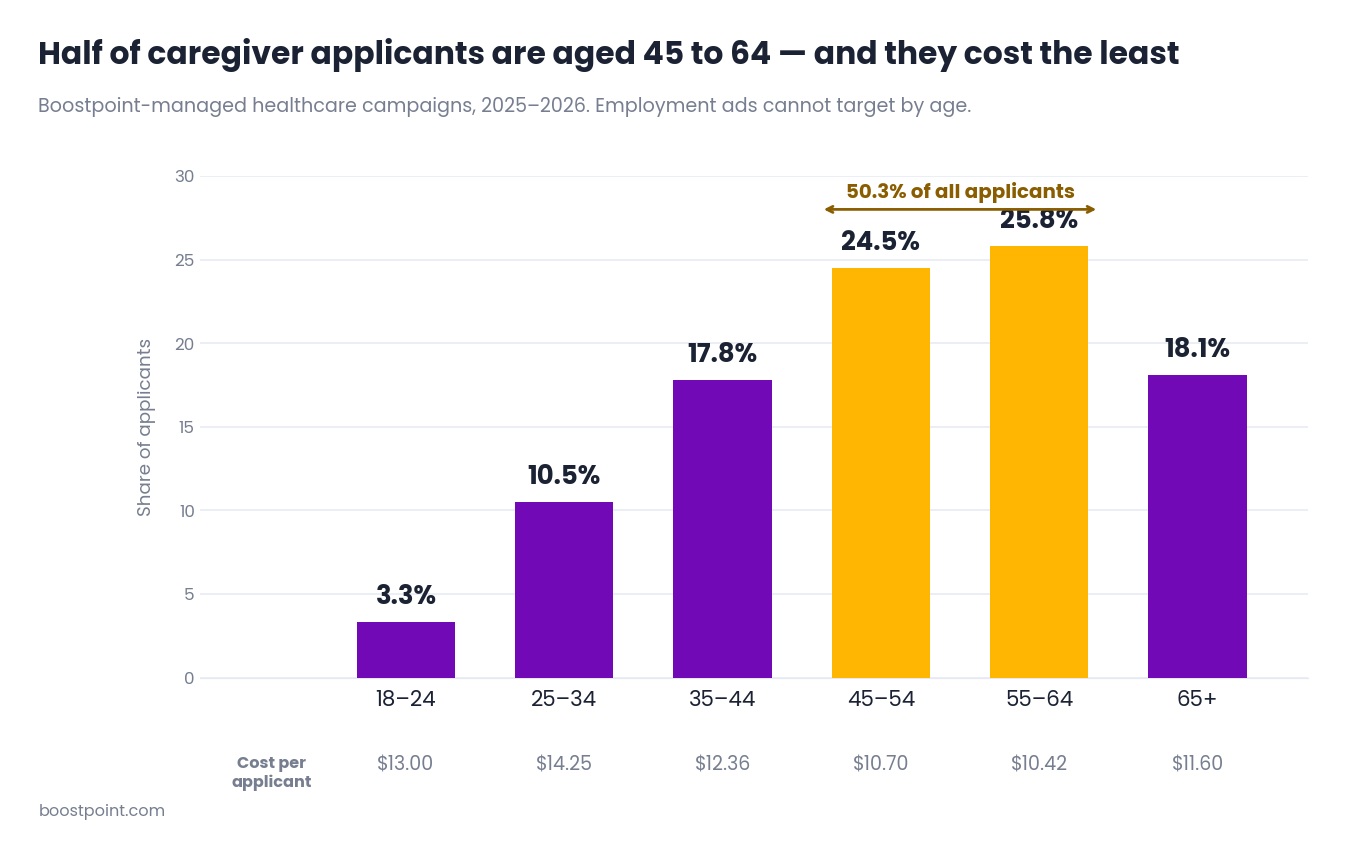
Roughly half of applicants were 45 to 64, and they were the least expensive to acquire. Applicants aged 18 to 24 made up 3.3% of applications at the second-highest cost of any group.
This isn't a targeting choice. Employment ads in the United States run under Meta's Special Ad Category, which removes age targeting entirely — every advertiser operates under the same rules. This is who chose to respond.
The strategic implication is significant. If you've been writing ads for a 24-year-old — emphasizing flexibility, entry-level framing, app-based scheduling — you've been writing for 3% of your applicant pool. A 52-year-old applying for caregiver work in her own community, with her own transportation and a settled life, responds to different things: stable hours, a defined territory, respect for experience, and pay stated plainly.
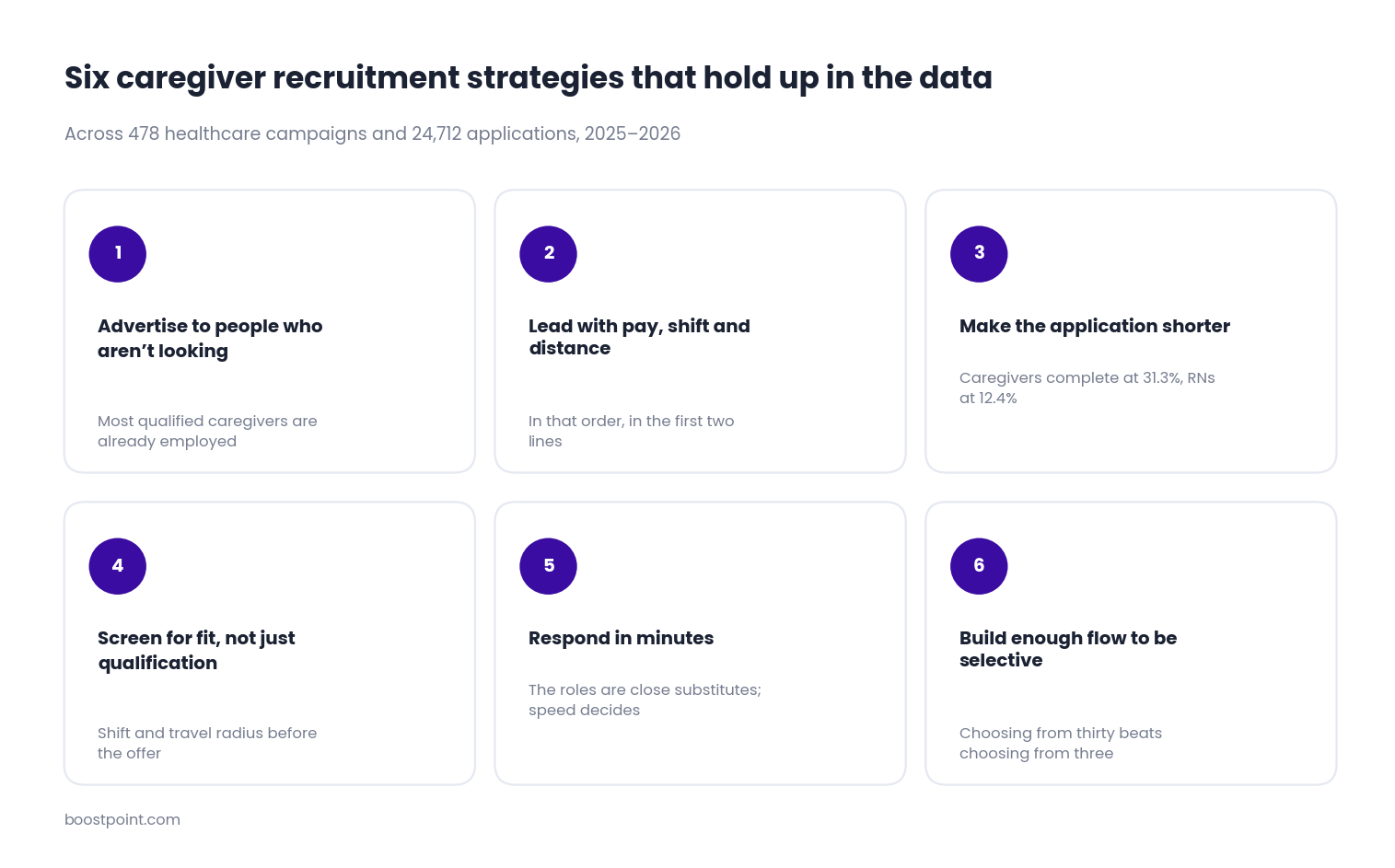
Strategy 1: Advertise to people who aren't looking
The single largest constraint in caregiver recruiting is that job boards only show your role to people actively searching. In any given week in your service area, that's a small and heavily contested group — and every agency within driving distance is bidding on the same people.
The caregiver you actually want is usually employed. She's working days at a facility twenty minutes away, or with another agency whose schedule stopped working. She would move for a shorter drive, a dollar more, or a shift that fits her kid's school day. She will never see your job board posting, because she isn't looking at job boards.
That's the entire case for paid social in this category: it doesn't require search intent. Reach in our healthcare campaigns cost $37.82 per thousand people — the cost of putting a role in front of a thousand people who weren't looking for it. If you want the mechanics, we break down how the Facebook funnel works by role in detail. Social ads are one channel of several; we compare nine of them, from referrals to the CNA class, in where to find caregivers.
This is also why the channel performs best in thin markets. Where a job board produces nothing because nobody in that county searched this week, cost per applicant isn't low — it's undefined. A more expensive applicant who exists beats a cheaper one who doesn't.
Strategy 2: Lead with pay, shift and distance — in that order
Caregivers screen on three things before anything else: what it pays, when it is, and how far it is. Everything else in a job ad — mission, values, benefits, culture — is read only after those three clear.
Most agency job ads bury all three. They open with a paragraph about compassionate care and a commitment to dignity, then list requirements, then mention a pay range near the bottom if at all.
Put them in the first two lines. Specifically:
- A real pay range, not "competitive pay." Several states now require it in postings, and ads with a stated range consistently draw more applicants.
- The actual shift, including whether weekends are involved.
- The service area or general location, so nobody applies for a job forty minutes away and quits in week three.
There's a retention argument here too. Overstating any of the three buys you a hire and a 60-day departure — and nearly four in five caregivers who leave do so within their first 100 days. The honest ad produces fewer applicants and better ones.
Strategy 3: Make the application shorter than you think it should be
This is the highest-leverage change available to most agencies, and it costs nothing.
Across our healthcare campaigns, application completion varies enormously by how long the form is:
| Role | Application completion rate | Cost per applicant |
|---|---|---|
| Caregiver / home health aide | 31.3% | $3.47 |
| LPN / LVN | 18.4% | $12.14 |
| CNA / nurse aide | 17.4% | $6.82 |
| RN / registered nurse | 12.4% | $15.93 |
Source: Boostpoint campaign data — 478 healthcare recruitment campaigns across 30 employers, January 2025 through mid-2026, representing 18,553,441 impressions and 24,712 applications on Meta platforms. Boostpoint's canonical 2026 Social Job Advertising Benchmark (891 campaigns, single methodology) reports median cost per applicant of $3.76 for caregivers, $7.72 for CNAs, $12.77 for LPNs and $19.08 for RNs; where this earlier analysis and the benchmark differ, the benchmark figure is canonical.
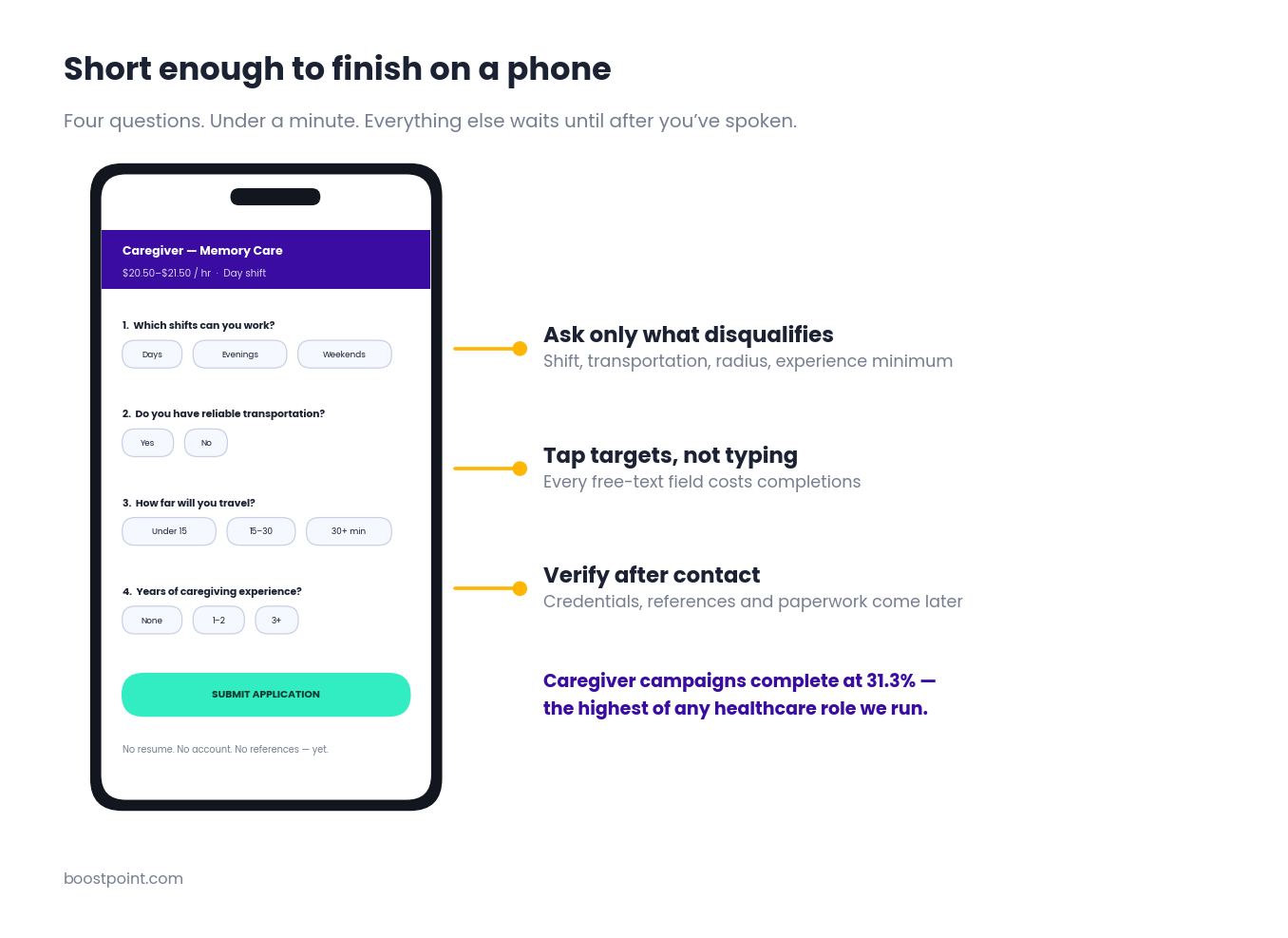
Caregiver applications convert at nearly three times the rate of RN applications. Some of that is genuine candidate behavior — but a large share is form length. Clinical applications ask for license numbers, certification dates, references and resume uploads, at the front of the process, from someone tapping an ad on a phone during a break. If you are hiring for a Medicare-certified agency, the credential to verify is set out on our home health aide job description page.
Ask only what genuinely disqualifies someone. For most caregiver roles that's four questions: shift availability, reliable transportation, willingness to travel a stated distance, and any experience minimum. Everything else — references, certifications, background paperwork — waits until after you've spoken.
Strategy 4: Screen for fit, not just for qualification
The knockout questions in your application aren't only a filter for quality. They're the cheapest retention tool you have.
Nearly four in five caregiver departures happen within the first 100 days, and the common causes are unglamorous: they accepted days and got weekends, the client is thirty-five minutes each way with unpaid travel, they were told 30 hours and got 18. Those aren't retention failures. They're hiring failures that surface later — and each one is knowable before an offer is made.
Asking about shift availability and travel radius at the point of application directly addresses the top two causes of early exit.
The tradeoff is real. Every question you add filters more people out before submission, raising cost per applicant while lowering the screening load on your scheduler. There's no universally correct setting:
- One scheduler and forty open shifts? Screen harder. Pay more per applicant, review fewer, lose fewer in week three.
- Capacity to train and onboard? Screen lighter, cast wider, absorb more of the sorting yourself.
Most agencies have never made this an explicit decision. It's a dial, and you're holding it either way.
Strategy 5: Respond in minutes
Caregivers apply to several agencies in one sitting, from a phone, usually on a break. The agency that responds within minutes is talking to someone still thinking about working. The agency that calls back in two days is calling someone who already started somewhere else.
This matters more in home care than in almost any other frontline sector, because the roles are close substitutes. If three agencies in your market pay within a dollar of each other, response speed is the differentiator — not your benefits page or your Glassdoor rating.
Automated SMS on submission is the practical fix. It doesn't replace a real conversation; it holds attention until you can have one.
A useful diagnostic: measure your median time from application to first human contact, in minutes. Most agencies who measure it for the first time are surprised.
Strategy 6: Build enough flow to be selective
This one sounds obvious and gets ignored.
An agency choosing from three applicants takes who it can get. An agency choosing from thirty hires for fit — the right shift, the right radius, the right temperament for a particular client. The second agency has better retention, and it isn't because they're better at retention.
At caregiver applicants cost $3.47, the cost of generating thirty applicants instead of three is roughly $100. The cost of one caregiver departure is estimated at $2,600 to $5,000.
For most agencies, ad budget has never been the binding constraint. It's whether enough qualified people ever see the role.
What we don't recommend
Being honest about the limits of this advice:
- Chasing younger candidates as a strategy. They're 3.3% of applicants at above-average cost. Serve them well if they apply; don't build your recruiting around them.
- Referral bonuses as your primary channel. They work, and they don't scale — your caregivers know a finite number of caregivers.
- Advertising your way past a pay problem. If the agency across town pays two dollars more, no channel outruns that.
- Long applications to "filter for serious candidates." They filter for people with time and a laptop, which isn't the same thing.
Frequently asked questions
What is the most effective caregiver recruitment strategy?
Reaching caregivers who aren't actively job hunting. The pool of people searching job boards in any service area in a given week is small and contested; most qualified caregivers are currently employed. Paid social advertising reaches them without requiring search intent, at roughly $37.82 per thousand people reached in our campaigns.
Are caregiver applicants mostly young?
No. In our data, roughly half of healthcare applicants were aged 45 to 64 and were the least expensive to acquire; applicants aged 18 to 24 made up 3.3% of applications. Employment ads can't target by age under Meta's Special Ad Category, so this reflects organic response rather than selection.
What should a caregiver job ad say first?
Pay, shift and location — in that order, in the first two lines. Caregivers screen on those three before reading anything about mission or culture. State a real pay range rather than 'competitive pay.'
How long should a caregiver application be?
Short enough to finish on a phone in under a minute. Our caregiver campaigns complete at 31.3% against 12.4% for RN roles, and form length is a major driver. Ask only what genuinely disqualifies someone — typically shift availability, transportation, travel radius and any experience minimum.
Can recruiting reduce caregiver turnover?
Partly. Nearly four in five departures happen in the first 100 days, driven largely by shift mismatch and travel distance. Screening for both at the point of application addresses those directly. It won't fix pay below market, hours volatility or supervision — those are operational problems.
How fast should we respond to applicants?
Minutes, not days. Caregivers apply to several agencies in one sitting and the roles are close substitutes. Automated SMS on submission holds attention until a person can call.
Do referral programs work for caregiver recruiting?
Yes, and they don't scale. Your caregivers know a finite number of caregivers. Referrals should be one channel among several, not the primary one.
How much does caregiver recruitment cost?
Caregiver and home health aide applicants averaged $3.47 in our 2025–2026 campaigns. Individual agencies ranged from about $1.22 to $15 depending on service area density, screening strictness and shift requirements.
The same analysis across all fifteen role families we measure sits on our recruiting strategies page.
How do you recruit caregivers?
Put the job in front of caregivers who are working somewhere else, then make applying and hearing back fast. Lead the ad with pay, shift and location, ask only the questions that disqualify someone, and respond within minutes by text and the same day by phone. In Boostpoint's 2026 Social Job Advertising Benchmark, caregiver campaigns ran a median of $3.76 per applicant and converted 31% of people who clicked into applicants.
Why is nobody applying to our caregiver jobs?
Most often the posting only reaches people searching job boards, the pay or hours are missing from the first lines, or the application asks for too much before anyone has spoken. Caregivers apply from a phone, often on a break. In Boostpoint's 2026 Social Job Advertising Benchmark, caregiver and home care campaigns converted 31% of people who clicked into applicants, so a campaign far below that usually has a form or offer problem rather than an audience problem.
What is the caregiver hiring process?
From opening to first visit: an ad that leads with pay, shift and service area; a short mobile application; a text within minutes and a phone screen the same day; an interview or meeting at the office; a conditional offer; then references, the background check and any training or orientation your state or payer requires before the caregiver works with a client. Those last requirements vary by state and program. If you are a Medicare-certified home health agency, aides must meet the federal home health aide qualification rule, which our home health aide job description explains. Screening for shift and travel radius early, as Strategy 4 describes, keeps the process from producing hires who leave in the first 100 days.
What is the caregiver application process?
It should be the part that takes the least time. The caregiver taps a Facebook or Instagram ad, answers about four questions on an instant form (shift availability, reliable transportation, willingness to travel a stated distance, any experience minimum), enters a name and phone number and submits, usually in under a minute. An automatic text confirms the application and says when someone will call. Everything that verifies rather than disqualifies (references, certifications, background paperwork) waits until after that call. In Boostpoint's 2026 Social Job Advertising Benchmark, caregiver and home care campaigns converted 31% of clickers into applicants, which is what a short application makes possible.
How long does it take to hire a caregiver?
It depends less on the market than on your own steps. The parts you control are how fast you respond (minutes, not days, because caregivers apply to several agencies at once), how quickly you can offer an interview time, and whether the offer comes at the end of that interview. The parts you wait on are the background check, references and any state or payer training required before a first client visit, and those vary by state. Agencies that shorten the wait usually run the background check the day of the offer, hold orientation on fixed weekly dates, and keep applicants warm by text in between. Boostpoint does not publish a time-to-hire figure; measure your own from application to first shift.
See what caregiver hiring costs in your area
Book a 30-minute call and we'll walk through cost per applicant, screening setup and follow-up speed for your service area.
Book a Free DemoBoostpoint figures come from 478 healthcare recruitment campaigns across 30 employers, January 2025 through mid-2026, representing 18,553,441 impressions and 24,712 applications on Meta platforms. Costs are what advertisers paid for advertising only. Turnover rates and departure costs are third-party industry estimates and cited as such. This is a sample of Boostpoint campaigns, not an industry-wide study.
Related: Healthcare Recruiting · How Much Does It Cost to Recruit a Caregiver? · Caregiver Turnover · Recruiting Caregivers and CNAs on Facebook