
Where to Find Caregivers: Nine Sourcing Channels, Ranked by Who's Actually in Them
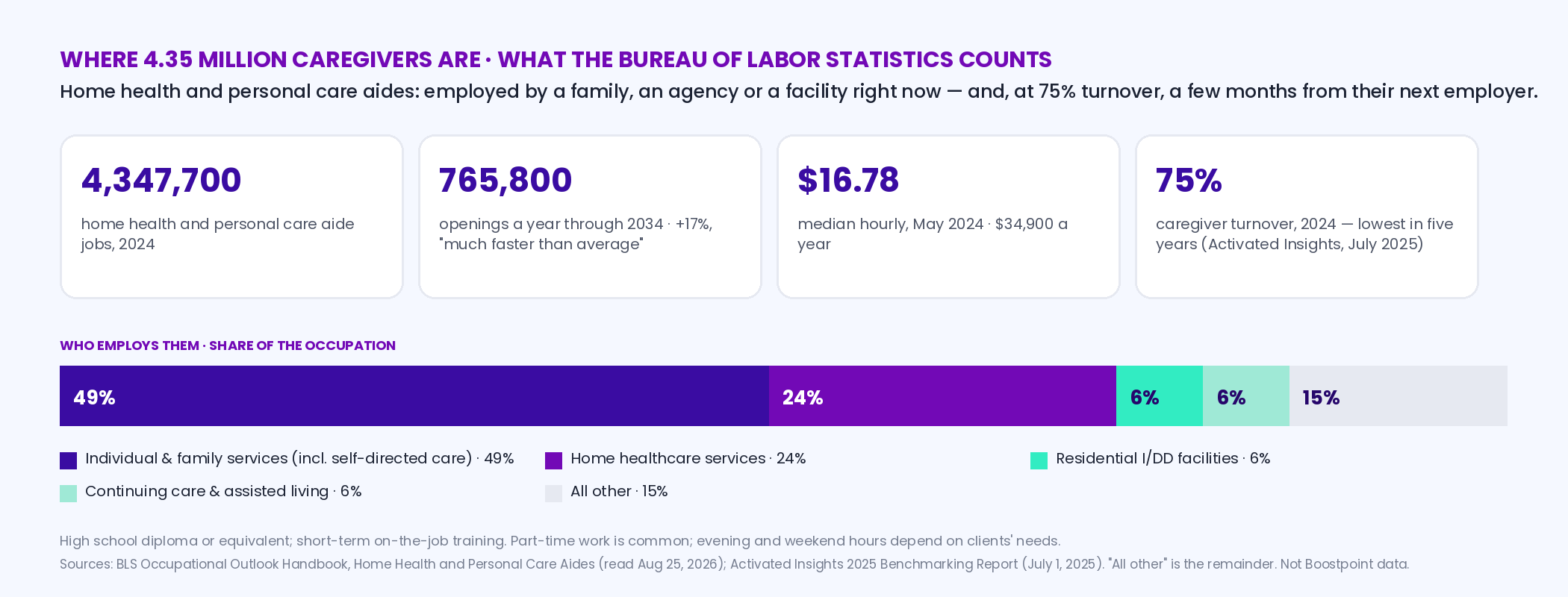
Caregivers are found where working caregivers already are, not where job seekers go. BLS counts 4.35 million home health and personal care aides, 49% of them employed through individual and family services and 24% through home care agencies — and with turnover at 75% (Activated Insights, 2025), most of them are a few months from their next employer. The channels that reach them, in order: your own caregivers' referrals, social feeds on a phone, a hiring day at the office, the CNA class, the church and the community board, and — last — the job boards everyone else is already fishing.
A note on who's writing this
Boostpoint runs social media job ads for home care agencies and senior living communities, including Home Instead, Right at Home, Home Helpers, and Always Best Care franchises, so channel five below is what we sell. This page is only about where caregivers are. What a caregiver campaign costs is on home care agency recruiting; how the click becomes an application is on recruiting caregivers and CNAs on Facebook; what an agency charges instead is on caregiver staffing agency costs; and the posting itself is the caregiver job description. We won't repeat those here.
The map: where 4.35 million caregivers are
In BLS's Occupational Outlook Handbook, home health and personal care aides held 4,347,700 jobs in 2024, with about 765,800 openings a year projected through 2034 on 17% growth. Median pay was $34,900 a year, $16.78 an hour (May 2024). Entry is a high school diploma or equivalent and short-term on-the-job training. Where they work is the sourcing map: 49% in individual and family services (including self-directed and consumer-directed care), 24% in home healthcare services, 6% in residential I/DD facilities, and 6% in continuing care retirement communities and assisted living. Part-time work is common; so are evening and weekend hours. The people you want are employed right now, working odd hours, holding a phone.
Nine channels, ranked by who is actually in them
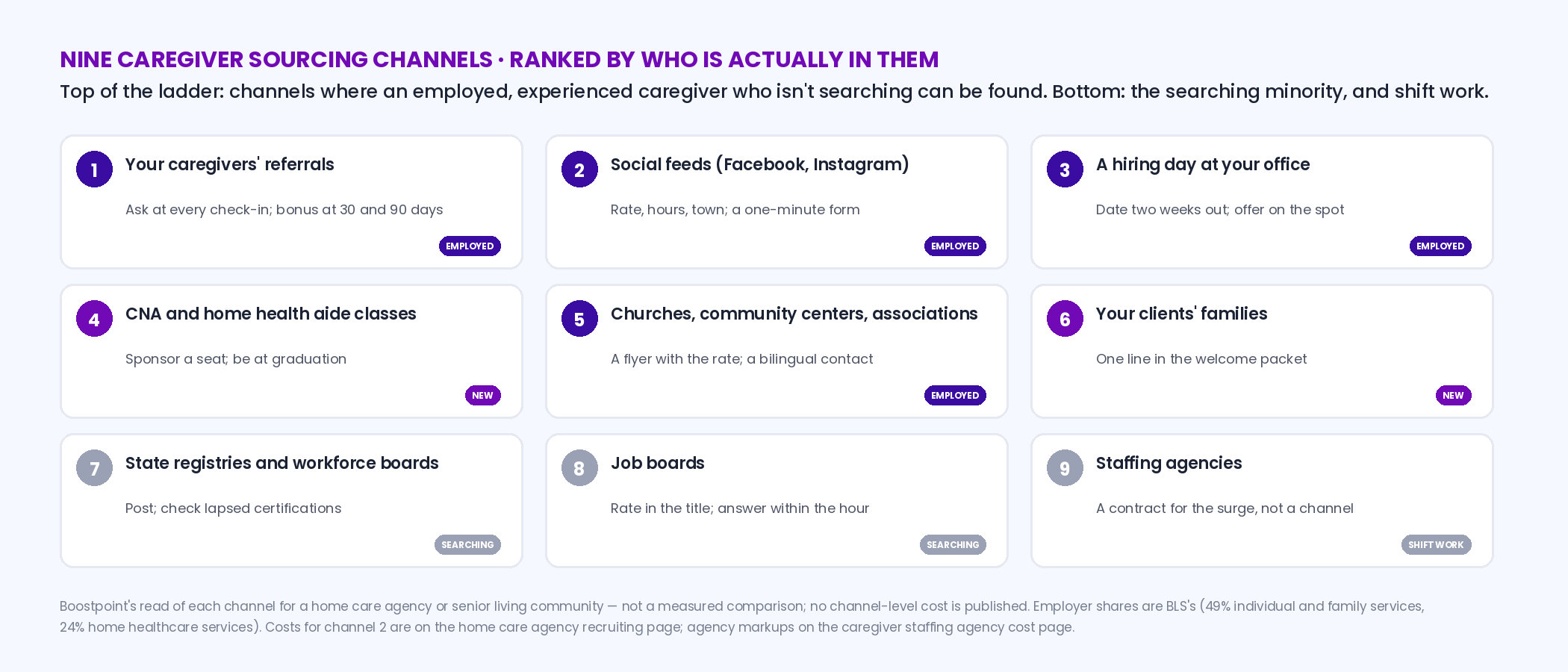
The ranking is Boostpoint's read, on one criterion: is an employed, experienced caregiver who isn't searching actually in this channel? Costs are described, not priced.
| # | Channel | Who is in it | First move | Honest note |
|---|---|---|---|---|
| 1 | Your caregivers' referrals | The caregivers your caregivers worked beside — at the last agency, in the CNA class, at church | Ask every caregiver for one name at every visit check-in; bonus in installments at 30 and 90 days | The hire that stays. Weak only if you ask once a year. |
| 2 | Social feeds (Facebook, Instagram) | Employed caregivers on a break, in the car between clients — the 4.35 million, most of them not searching | An ad with the rate, the hours, the town; a one-minute form | What we sell. Works because the audience is there; fails behind a long form. |
| 3 | A hiring day at your office | People who will walk in on a Tuesday but won't apply online | Pick a date, advertise it for a week, interview and offer on the spot | See open house hiring events. |
| 4 | CNA and home health aide classes | Students finishing a 4–12-week course, and their instructors, who know who's good | Sponsor a seat, teach a session, be at graduation with offers | Slow, steady, and where new caregivers come from. |
| 5 | Churches, community centers, immigrant associations | People already caregiving for family — the 49% in individual and family services includes many of them | A flyer with the rate, a contact who speaks the language, a bulletin line | Real, local, and unmeasured. Ask referrals where they heard of you. |
| 6 | Your own clients' families | The relative who has been the unpaid caregiver and now needs work | A line in the family welcome packet and in the care coordinator's script | Small numbers; strong fit. |
| 7 | State registries and workforce boards | Certified aides who've registered; jobseekers on unemployment | Post with the state; check the nurse aide registry for lapsed certifications you can renew | Free, uneven by state, worth an hour a month. |
| 8 | Job boards | The minority actively searching this week — and every other agency in the county | Post, and answer within the hour or don't bother | Fine for volume; the same twenty people every agency sees. |
| 9 | Staffing agencies | Caregivers who've chosen shift work at a markup | For a census spike, a contract; not a sourcing channel | Priced on the agency cost page. |
Interactive
Channel radar — pick a channel, get the first move
Nothing is stored or sent — this runs in your browser. Tags: employed = reaches caregivers who aren't searching; searching = reaches the active minority.
Boostpoint's practice, not measured results; no channel-level cost comparison is published. What a caregiver campaign costs is on the home care agency recruiting page; nothing here is a cost figure.
What the data says about channel two
One figure, because this page is about where and channel two is the one we can measure. In the 2026 benchmark, caregiver and home care campaigns produced applicants at a median $3.76 (middle 50% $2.99–$5.83; blended $3.87) with a 31% apply rate across 34 campaigns — the highest apply rate of any role we track, which is the sourcing point: when a caregiver sees an ad with the rate and the hours on her phone, she applies, because the form is short and switching is easy. An earlier campaign-level analysis (different methodology) put caregiver application completion at 31.3% and home-care-setting completion at 21.6%. Budget bands and settings are on the home care agency recruiting page. Cost per applicant is not cost per hire.
Week one
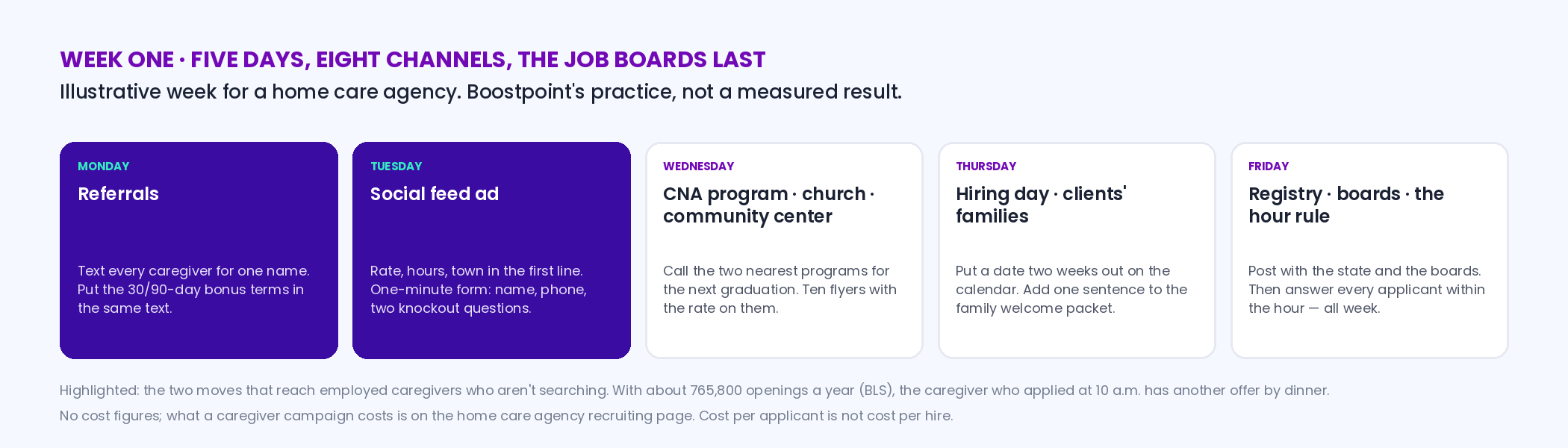
Monday: one name from every caregiver, bonus in writing. Tuesday: the social ad — rate, hours, town — behind a one-minute form, written the way what makes a good job ad describes. Wednesday: the CNA program, the church office, the community center, each with a flyer that has the rate on it. Thursday: a hiring day on the calendar two weeks out, and a line in the family welcome packet. Friday: the state registry and the boards, then answer everything within the hour — with 765,800 openings a year, the 10 a.m. applicant has another offer by dinner. For CNAs specifically, the credential changes the channel mix — see CNA recruitment.
Caregivers aren't on job boards. They're on shift, on a phone, and one referral away — go where they are.
Once the applicants are arriving, the next decision is what to ask them. Our caregiver interview questions page covers eight questions worth the time, what a strong answer contains, and the federal training rules that settle part of it before the interview starts.
Frequently asked questions
Where can I find caregivers to hire?
Where working caregivers already are: your own caregivers' referrals, social feeds on their phones, a hiring day at your office, CNA and home health aide classes, churches and community groups, your clients' families, then state registries and job boards. BLS counts 4.35 million home health and personal care aides, most employed by a family, an agency, or a facility — the job boards reach only the minority searching this week.
What is the best way to recruit caregivers?
Referrals from your current caregivers, asked for at every check-in with a bonus paid in installments, produce the hires that stay; a social feed ad with the rate, hours, and town behind a one-minute form reaches the employed majority. In our 2026 benchmark, caregiver campaigns had a 31% apply rate — the highest of any role — which is why the channel works when the form is short.
Where do home care agencies find caregivers?
Per BLS, 24% of aides work for home healthcare services and 49% through individual and family services, including family caregivers paid through self-directed programs. Agencies that grow recruit from that 49% — through community groups, churches, immigrant associations, and their own clients' families — as much as from other agencies.
How many caregivers are there in the U.S.?
BLS counted 4,347,700 home health and personal care aides in 2024 and projects 17% growth to 2034 with about 765,800 openings a year; median pay was $16.78 an hour in May 2024.
Why is caregiver turnover so high?
Activated Insights' 2025 Benchmarking Report put caregiver turnover at 75%, the lowest in five years but still three in four. Low switching costs (short-term on-the-job training, per BLS), part-time and irregular hours, and a labor market with 765,800 openings a year mean an employed caregiver can change agencies in a week. The sourcing consequence: you are always recruiting from a competitor, and a competitor from you.
Do job boards work for caregivers?
For the minority actively searching, yes, if you answer within the hour. They don't reach the employed caregiver who isn't looking, which is who the first six channels are for.
Should I use a staffing agency to find caregivers?
For a census spike or emergency coverage, an agency is a contract, not a sourcing channel. The markup and the direct alternative are on our caregiver staffing agency cost page; this page keeps to where caregivers are.
What does it cost to find caregivers with advertising?
In the 2026 benchmark, caregiver and home care campaigns ran at a median $3.76 per applicant (middle 50% $2.99–$5.83; 31% apply rate; 34 campaigns). Budget bands and settings are on the home care agency recruiting page. Cost per applicant is not cost per hire.
Reach the caregivers who aren't looking
We'll put the rate, the hours, and your town in front of employed caregivers in your service area, with a one-minute form behind it — and show you the home care campaigns closest to yours.
Book a DemoBoostpoint figures come from the 2026 Social Job Advertising Benchmark — 891 campaigns and 1,334 campaign-months: caregiver / home care median cost per applicant $3.76, middle 50% $2.99–$5.83, blended $3.87, 31% apply rate, 34 campaigns. Earlier campaign-level analysis (different methodology): caregiver application completion 31.3%, home care setting completion 21.6%. Workforce figures are BLS's and Activated Insights', attributed in place. The channel ranking and week-one plan are Boostpoint's practice, not measured results. Cost per applicant is not cost per hire; we do not track hires and publish no cost-per-hire figure. A sample of Boostpoint campaigns, not an industry-wide study.