
Caregiver Staffing Agency Costs: Markups, Bill Rates, and Recruiting Direct
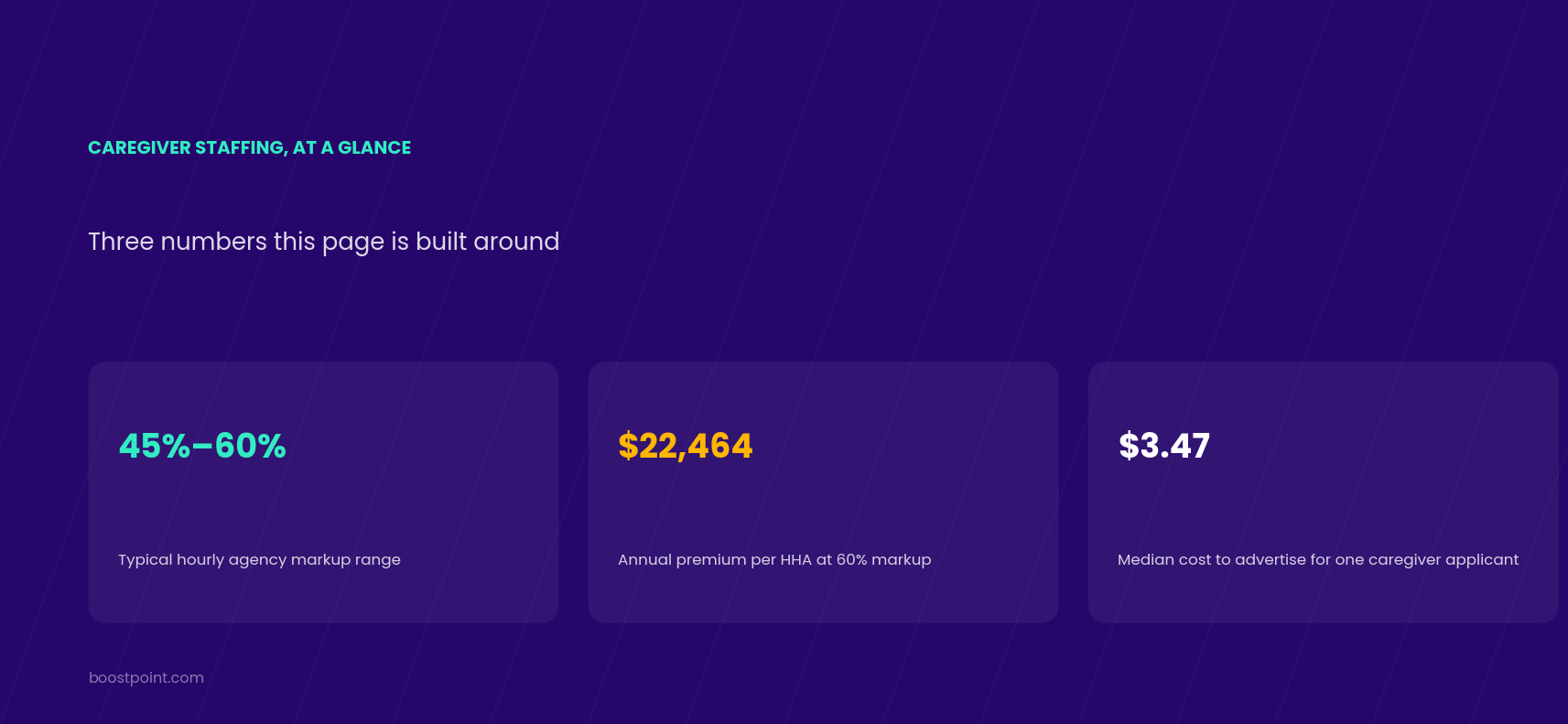
Caregiver staffing agencies typically charge a 45% to 60% markup on hourly worker wages for home care aides, CNAs, and senior living staff. For a caregiver earning $18.00/hour, the agency bill rate sits between $26.10 and $28.80 per hour — adding $16,848 to $22,464 in annual markup costs per worker. By comparison, Boostpoint-managed recruitment advertising yields caregiver applicants at an average cost of $3.47 each, allowing care facilities to hire directly for under $150.
Source: Boostpoint campaign data — managed healthcare, senior living, and home care recruitment campaigns conducted in 2025–2026 across facilities nationwide.
A note on who's writing this
Most guides on caregiver staffing costs and how to recruit caregivers are published by healthcare staffing agencies or gig-work platforms. Because their business model depends on taking a percentage of every hour billed, their content naturally frames these high markups as the unavoidable cost of operating in a tight labor market.
Boostpoint is not a staffing agency. We build recruitment advertising software that helps home care agencies, senior living communities, and healthcare systems generate their own direct applicants through targeted social media campaigns.
We aren't here to claim that caregiver staffing agencies serve no purpose — for immediate emergency shift coverage or rapid census spikes, contingent labor is an essential safety net. But we can provide the financial clarity that agency guides leave out: what it actually costs to build a direct pipeline of caregivers using targeted advertising, backed by 2026 campaign data across the care sector.
What caregiver staffing agencies actually charge
Caregiver staffing agencies supply temporary workers for roles like Home Health Aides (HHAs), Certified Nursing Assistants (CNAs), Direct Support Professionals (DSPs), and general senior living caregivers. The agency acts as the employer of record, carrying payroll, taxes, background checks, and workers' compensation while billing your agency an hourly rate above the caregiver's base wage.
Published markup ranges across care segments:
| Care segment / role | Typical agency markup range |
|---|---|
| Non-Medical Home Care | 45% – 55% |
| Senior Living & Assisted Living | 45% – 60% |
| Certified Nursing Assistants (CNAs) | 50% – 65% |
| Behavioral Health & DSPs | 50% – 70% |
| Emergency / Last-Minute Shift Apps | 55% – 75%+ |
Most standard caregiver contracts cluster between 45% and 60%. Markups are elevated due to strict credentialing, background checks, and liability insurance associated with direct patient and resident care. Caregiver placements are one slice of a bigger pattern — here's what healthcare staffing agencies charge across role types. For how those markups compare across every industry we track, see staffing agency markup and fees.
What that markup means per hour and per worker
Consider standard hourly wage rates across common caregiver roles working full-time (2,080 hours per year):
| Caregiver role | Base wage | 45% markup bill rate | 60% markup bill rate | Annual agency markup premium per worker | Total annual cost per seat |
|---|---|---|---|---|---|
| Companion / Sitter | $16.00/hr | $23.20/hr | $25.60/hr | $14,976 – $19,968 | $48,256 – $53,248 |
| Home Health Aide (HHA) | $18.00/hr | $26.10/hr | $28.80/hr | $16,848 – $22,464 | $54,288 – $59,904 |
| Direct Support Pro (DSP) | $19.00/hr | $27.55/hr | $30.40/hr | $17,784 – $23,712 | $57,304 – $63,232 |
| CNA (Senior Living) | $22.00/hr | $31.90/hr | $35.20/hr | $20,592 – $27,456 | $66,352 – $73,216 |
At a 60% markup on an $18/hour Home Health Aide, your agency pays $59,904 annually for labor where the caregiver receives $37,440 in direct wages.
The fixed-revenue margin crunch
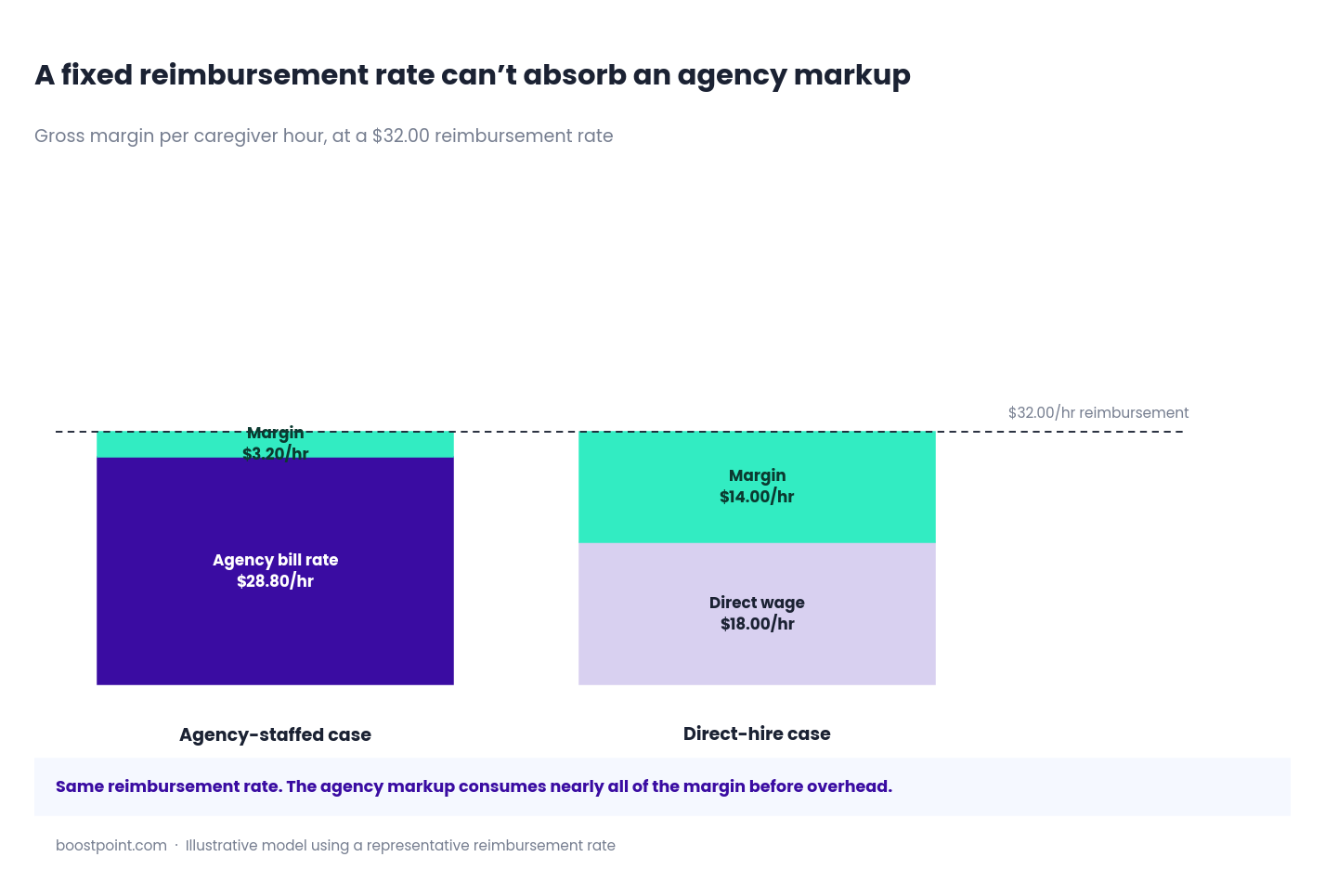
In tech or manufacturing, companies can sometimes pass increased labor costs onto the consumer. In home care and senior living, revenue is often fixed by Medicare/Medicaid reimbursement rates or strict private-pay caps.
If your reimbursement rate for an hour of home care is $32.00, and you are paying an agency bill rate of $28.80 for the caregiver, your gross margin shrinks to just $3.20 per hour. Once you factor in administrative overhead, mileage, and software costs, relying on agency staff on fixed-rate cases actually generates a net loss.
| Headcount on temp labor | Annual markup premium (at 45%–60%) |
|---|---|
| 10 Caregivers | $168,480 – $224,640 |
| 25 Caregivers | $421,200 – $561,600 |
| 50 Caregivers | $842,400 – $1,123,200 |
Figures reflect pure agency markup paid above worker base pay for $18/hr HHA roles.
Net agency margin context: the 45%–60% markup is not pure profit for the staffing agency. It covers employer FICA, FUTA/SUTA, workers' compensation insurance, recruiting, and administrative overhead. Transitioning core caregivers in-house means absorbing standard payroll taxes directly — while completely eliminating the agency's 10% to 15% net profit margin and external recruiting fees.
What it costs to recruit caregivers directly
To break free from agency reliance, care operators need to know exactly how much it costs to generate qualified caregiver applicants in-house.
Traditional job boards are saturated. If a caregiver searches "home care jobs near me," they are met with hundreds of identical listings. However, targeted passive candidate campaigns on social platforms (Facebook, Instagram) reach local caregivers during their off-hours, capturing talent before they ever visit a job board — the full pattern across every industry we track is in our published 2026 campaign data. For the wider picture across permanent and travel hiring too, see our healthcare staffing costs breakdown.
Across Boostpoint-managed healthcare and senior living campaigns in 2026:
| Care setting / role category | Cost per applicant (CPA) | Application completion rate |
|---|---|---|
| Caregiver / Home Health Aide | $3.47 | 21.6% |
| Senior Living (Blended) | $6.11 | 22.1% |
| CNA / Nurse Aide | $6.82 | 20.4% |
| Home Care (Blended) | $8.40 | 21.6% |
Source: Boostpoint campaign data — managed healthcare, senior living, and home care recruitment campaigns conducted in 2025–2026 across facilities nationwide.
Data based on the 2026 Boostpoint Healthcare Benchmark Report covering tens of thousands of care applications.
Calculating direct cost per hire across realistic screening ratios
Advertising budget produces applicants, not finished hires on the schedule. Caregiver recruiting requires strict vetting: background checks, vehicle/insurance verification, and reliable attendance history.
Here is what direct ad cost per hire looks like across three candidate screening scenarios:
| Caregiver role | Cost per applicant (CPA) | 1 in 10 hire rate (10% — high touch) | 1 in 30 hire rate (3.3% — realistic standard) | 1 in 50 hire rate (2% — strict vetting) |
|---|---|---|---|---|
| Caregiver / HHA | $3.47 | $34.70 | $104.10 | $173.50 |
| Senior Living Caregiver | $6.11 | $61.10 | $183.30 | $305.50 |
| CNA / Nurse Aide | $6.82 | $68.20 | $204.60 | $341.00 |
| Home Care (Blended) | $8.40 | $84.00 | $252.00 | $420.00 |
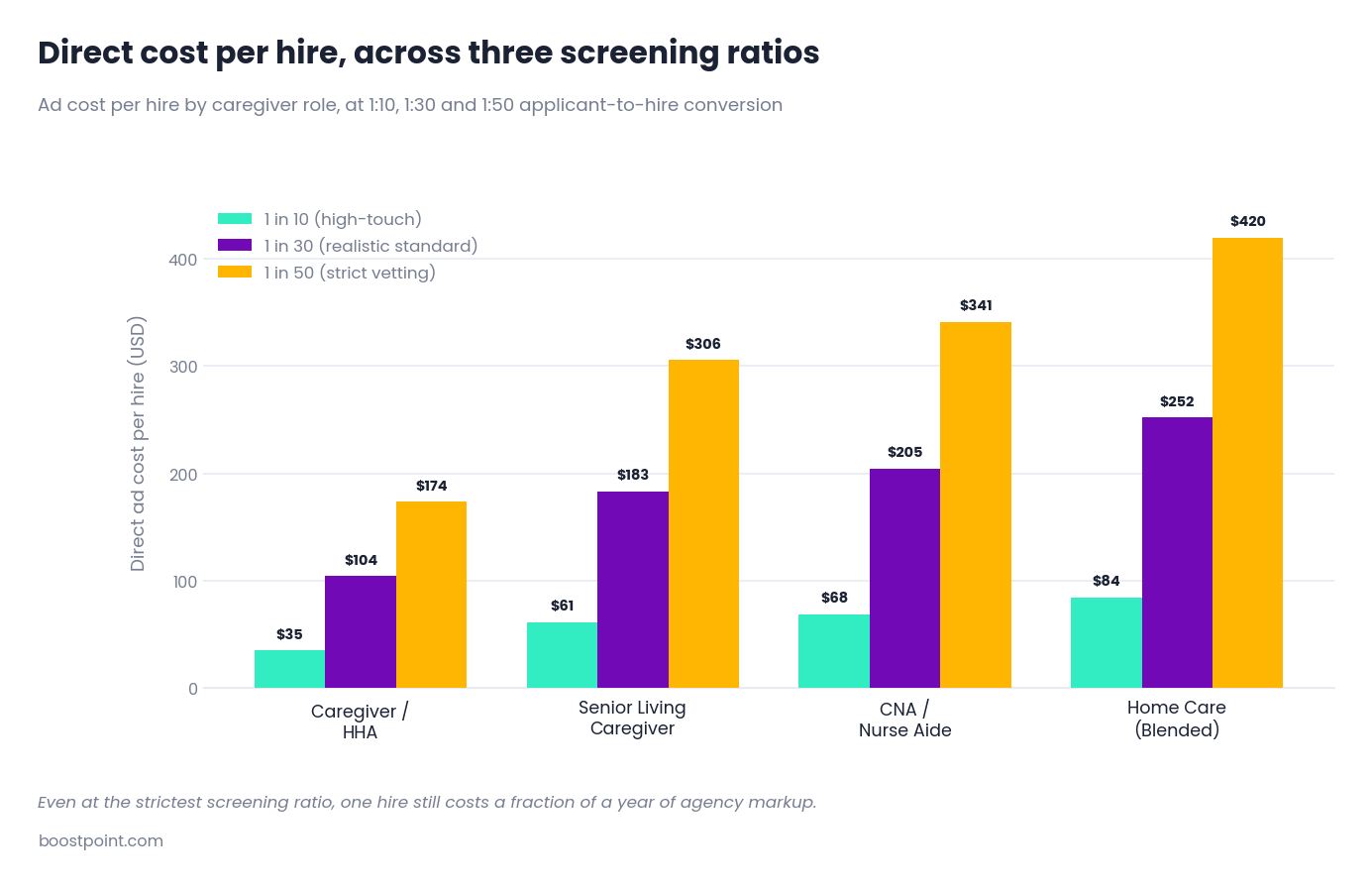
Even under a strict 1 out of 50 hire rate (where you screen 50 applicants to hire 1 reliable HHA), advertising expense runs just $173.50 per hire. Compare that to the $16,800 to $22,400 annual markup paid to a staffing agency for a single full-time schedule.
When a caregiver staffing agency is the right call
Direct advertising is not a total replacement for contingent labor. Agencies serve valuable operational needs during extreme scheduling volatility.
Use a caregiver staffing agency when:
- You take on rapid, unexpected new cases. If a hospital discharges three high-acuity patients to your home care agency on a Friday afternoon and you have no bench strength, an agency ensures safe coverage over the weekend.
- Emergency shift triage. If a night-shift memory care caregiver calls out sick at 6:00 PM, an on-demand agency app is the only way to maintain state-mandated patient ratios.
- Filling hyper-specialized care roles. If you temporarily need a caregiver specialized in severe behavioral de-escalation, an agency network can source that niche talent faster than a local ad campaign.
When direct advertising makes more sense
Recruit directly when:
- Filling permanent, ongoing schedules. If a caregiver is scheduled for 40 hours a week with a long-term home care client, paying a 50% markup indefinitely destroys case profitability.
- Ending "permanent temp" reliance. If 15% of your senior living floor has been staffed by agency temps for over two months, you are paying emergency rates for baseline staffing.
- Improving continuity of care. Patients and residents thrive on routine. Direct hires provide consistent care, whereas rotating agency workers disrupt resident familiarity and increase the likelihood of care errors.
- Building a local employer brand. Direct recruitment campaigns build a database of local caregivers who recognize your agency's brand, allowing you to quickly text them via SMS when a new case opens up.
The honest summary
Agencies provide emergency triage. Direct recruitment advertising protects case profitability.
If your senior living facility experiences an emergency call-out, paying a 55% agency markup is a necessary cost for patient safety. But if you rely on staffing agencies to maintain your core scheduling baseline because Indeed stopped generating applicants, you are paying permanent surge pricing for a fixable candidate generation problem.
Leading home care agencies and senior living communities adopt a strategic hybrid model: using direct recruitment advertising to maintain 90%+ baseline schedule capacity (keeping recruitment costs under $200 per hire), while reserving agency labor strictly for weekend emergencies.
The calculation worth running this quarter
Four metrics every home care operator and Director of Nursing should calculate together:
- Calculate total annual markup premium. Take total agency invoicing over the last 12 months and subtract direct wages paid to workers. That difference is your agency markup tax.
- Audit long-tenure temp staff. Count how many temporary workers have been on your schedule longer than 60 days. These represent baseline core roles.
- Run cost-per-hire math against screening ratios. Compare your annual agency markup against direct advertising costs across realistic 1:30 or 1:50 conversion ratios.
- Evaluate mobile application friction. Caregivers apply on their phones between shifts. Switching from a multi-page ATS application to a 1-minute mobile knockout form drastically increases applicant conversion.
Frequently asked questions
How much does a caregiver staffing agency charge?
Caregiver staffing agencies typically charge a 45% to 60% markup over base hourly wages. For a home health aide earning $18.00/hour, the agency bill rate ranges from $26.10 to $28.80 per hour.
Why are caregiver staffing markups so high?
Caregiver markups cover extensive credentialing requirements, background checks, medical malpractice insurance, and high workers' compensation risks associated with patient handling and home environments.
What is the average cost per applicant for caregivers on social media?
Based on Boostpoint 2026 benchmark data, caregiver and home health aide applicants cost an average of $3.47 each, while CNAs and specialized senior living caregivers average $6.82 per applicant.
How much does direct advertising cost per hire for caregivers?
At a standard 1 out of 30 screening ratio (3.3% conversion), direct ad cost per hire is approximately $104.10 for caregivers, $183.30 for senior living staff, and $204.60 for CNAs.
Is direct hiring cheaper than using a caregiver staffing agency?
For permanent baseline staffing, direct hiring is significantly cheaper. Direct advertising generates candidates for $100 to $350 in ad spend per hire (even at conservative screening rates), compared to $16,000 to $22,000+ per worker in annual agency markup.
How do I recruit caregivers without job boards?
Shift from active sourcing to passive sourcing. Run targeted social media advertising (Facebook, Instagram) focused on local geographic radii. Use 1-minute mobile-friendly applications to capture candidates who are not actively searching resume databases.
See what it costs to fill caregiver roles directly
Book a 30-minute strategy call with our healthcare recruiting team. We'll analyze your local labor market, review cost-per-applicant benchmarks for your specific care settings, and show you how to build a direct hiring pipeline.
Book a Demo →Explore Healthcare Benchmark Data →



Boostpoint figures are derived from managed healthcare, senior living, and home care recruitment campaigns conducted in 2025–2026 across facilities nationwide. Cost-per-applicant metrics reflect what advertisers paid for advertising. Staffing agency markups and margin data are compiled from published healthcare financial audits, Medicare/Medicaid reimbursement benchmarks, and third-party staffing reports.