
Therapy Staffing: What It Costs to Staff PTs, OTs, and SLPs — Including the Number That Argues Against Us
Therapy staffing agencies typically charge 30–45% markups on contract therapists (allied-health rates) and 18–25% of first-year salary for direct placements — $18,496.80–$25,690.00 on the $102,760 median PT salary (BLS, May 2025). And here's the number we publish against our own interest: in Boostpoint's 2026 Social Job Advertising Benchmark, therapy is the most expensive role family we track to advertise for — $74.62 per applicant at a 5% apply rate. This page explains why, and which tool actually fits which therapy hiring problem.
A note on who's writing this — and why we lead with our worst number
Boostpoint runs recruitment advertising, and on most pages of this site our data makes the case for it. This page is different. Therapy is the hardest role family in our 2026 benchmark, and pretending otherwise would be exactly the vendor behavior we criticize elsewhere. So the structure here is honest triage: what agencies charge, why advertising for licensed clinicians is genuinely expensive, and where each tool — including ours — actually earns its cost. The rest of our healthcare pages cover the roles where the math flips.
Once they apply, the follow-up decides the outcome: six free recruiting email templates, from same-day acknowledgement to rejection.
Why therapy staffing is hard: the supply math
Every number on this page follows from one fact: demand for therapists is growing much faster than the pipeline that produces them. Per the Bureau of Labor Statistics' current projections, physical therapist employment is projected to grow 12% and speech-language pathologist employment 17% from 2025 to 2035 — several times the 3.5% all-occupation average — with roughly 13,400 and 12,500 annual openings respectively. BLS's 2024–34 industry projections rank therapy offices among the fifteen fastest-growing industries in the economy at 23.3% growth, driven by the aging population. Meanwhile the supply side moves slowly: a PT license requires a Doctor of Physical Therapy — roughly seven years of higher education — and every state licenses the profession.
Fast-growing demand, slow-growing supply, universal licensure: that's a seller's market for clinicians. Both of the prices below — the agency's and ours — are just that market showing up on an invoice.
The physical therapist shortage
BLS does not publish a shortage count for physical therapists; it publishes a projection, and in the Occupational Outlook Handbook entry updated 27 August 2026 it points one way. Physical therapists held 283,700 jobs in 2025, and employment is projected to grow 12 percent from 2025 to 2035, “much faster than the average for all occupations,” with about 13,400 openings a year. BLS attributes the demand “in large part” to the growing older adult population, along with chronic conditions and a shift toward nonopioid pain management. The median wage was $102,760 in May 2025.
What makes it feel like a shortage is the mix of growth and replacement. Growth accounts for about 3,380 openings a year (33,800 over the decade), so roughly a quarter of PT openings are new posts, a far higher share than for aides or nursing assistants. Those new posts can only be filled by people who have completed a doctoral or professional degree and obtained a state license, so supply cannot respond quickly. The assistant tier is different: BLS projects physical therapist assistants to grow 23 percent and aides 4 percent, with about 24,900 openings a year for the two combined and a PTA median of $68,380. That is the reachable pool, and our physical therapist assistant job description is written for it.
The occupational therapist shortage
Occupational therapists are growing faster than PTs from a smaller base. BLS counts 169,600 occupational therapists in 2025 and projects 15 percent growth to 2035, with about 10,000 openings a year and a median wage of $100,330. The drivers BLS names are population aging and conditions such as Alzheimer’s disease, stroke and cerebral palsy, plus developmental disorders such as autism spectrum disorder in children. The typical entry-level education is a master’s degree.
As with PTs, about a quarter of OT openings are new posts (25,200 added over the decade, or about 2,520 a year). Occupational therapy assistants are projected to grow 21 percent, with about 8,600 openings a year for assistants and aides combined and an assistant median of $72,300.
| Occupation | Jobs, 2025 | Growth, 2025–35 | Openings a year | Median pay, May 2025 |
|---|---|---|---|---|
| Physical therapists | 283,700 | 12% | 13,400 | $102,760 |
| Physical therapist assistants and aides | 163,200 | 17% (assistants 23%, aides 4%) | 24,900 | $68,380 (assistants) |
| Occupational therapists | 169,600 | 15% | 10,000 | $100,330 |
| Occupational therapy assistants and aides | 56,600 | 20% (assistants 21%, aides 4%) | 8,600 | $72,300 (assistants) |
Source: BLS Occupational Outlook Handbook, pages last modified 27 August 2026, read 24 September 2026. For the clinicians, the shortage shows up in our own numbers as a 5 percent apply rate, which is the subject of the rest of this page. The occupation figures in this section and elsewhere on this page are the current 2025–35 projections. The same projections, set beside imaging and surgical roles, are on our healthcare workforce shortage page.
What therapy staffing agencies charge
| Arrangement | Typical cost | Source |
|---|---|---|
| Contract / temp therapy staffing (allied health) | 30–45% markup on hourly pay | AMN Healthcare |
| Direct hire placement | 18–25% of first-year salary | AMN Healthcare |
| Travel contracts (published for nursing; therapy travel priced by the same firms) | 40–70% above staff rates | DirectShifts, SkillGigs |
In dollars, using BLS median salaries: a direct-hire fee on the $102,760 May 2025 median PT salary runs $18,496.80 at 18% and $25,690.00 at 25%. On the $97,870 May 2025 median SLP salary, the same range is $17,616.60 to $24,467.50. Those are large checks — and for a single vacant caseload bleeding referrals, they are often rational ones, which is not something we say lightly on a page that sells the alternative.
Our own data: the most expensive role family we track
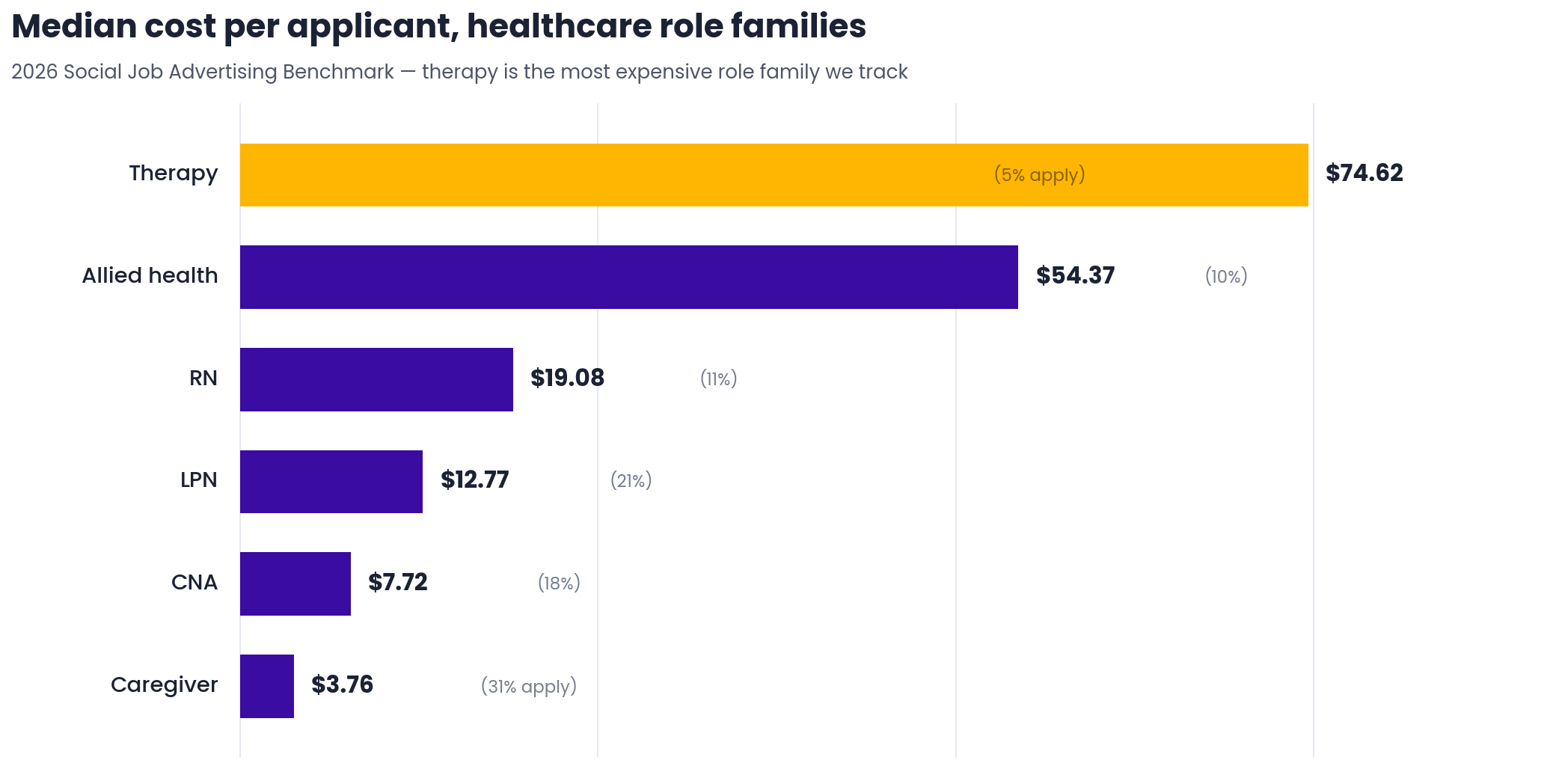
Across the 891 campaigns in our benchmark, here's what applicants cost by healthcare role family — with therapy where it always lands:
Median cost per applicant by role family, 2026 Social Job Advertising Benchmark. Apply rates: caregiver 31%, CNA 18%, LPN 21%, RN 11%, allied 10%, therapy 5%.
Why the number is what it is
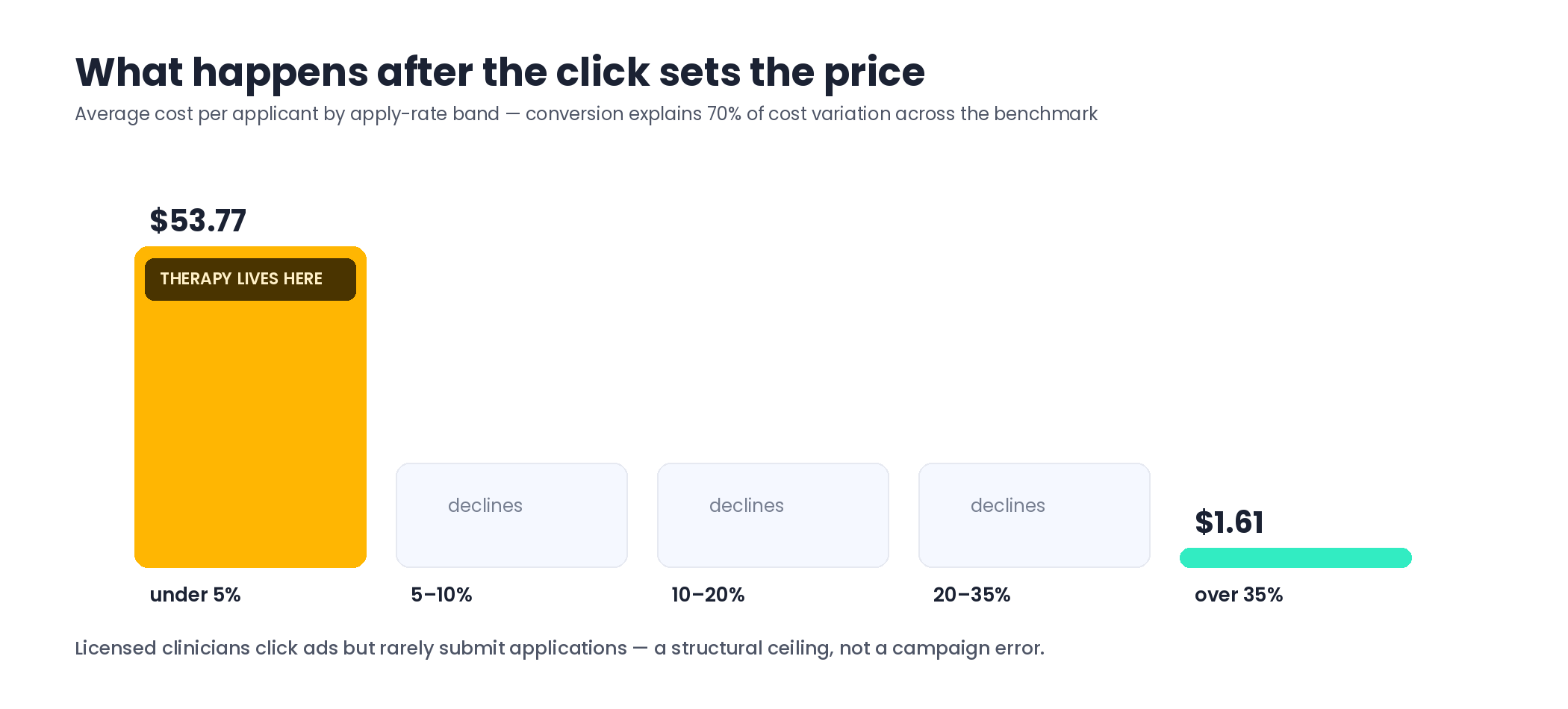
Across our whole dataset, what happens after the click — the apply rate — explains 70% of cost variation, far more than creative or delivery. Campaigns converting under 5% of clickers average $53.77 per applicant; campaigns above 35% average $1.61. Therapy lives in that worst band, and for structural reasons rather than fixable ones: employed clinicians with full caseloads don't fill out application forms from an ad. They're reachable — the ads get clicked — but a licensed professional considering a job change books a conversation; they don't submit. That behavior caps what any advertising campaign can do for a scarce clinician opening, ours included.
When a therapy staffing agency is the right call
- A single vacant clinician caseload, now. An unfilled PT schedule turns away referrals daily. A recruiter with a warm network of licensed clinicians beats a cold campaign into a 5%-apply audience — the fee prices access you can't advertise your way into quickly.
- Coverage with an end date. Maternity leave, a clinician's sabbatical, a census bump: contract therapy staffing at a 30–45% markup exists precisely for gaps that shouldn't become permanent hires.
- New service lines needing credentials on day one. Opening pediatric OT or adding SLP coverage requires a licensed hire before revenue starts; placement fees are part of the launch cost.
Where advertising still earns its keep in therapy staffing
The honest version of our pitch for therapy providers is narrower than for other healthcare roles — and real inside its lane:
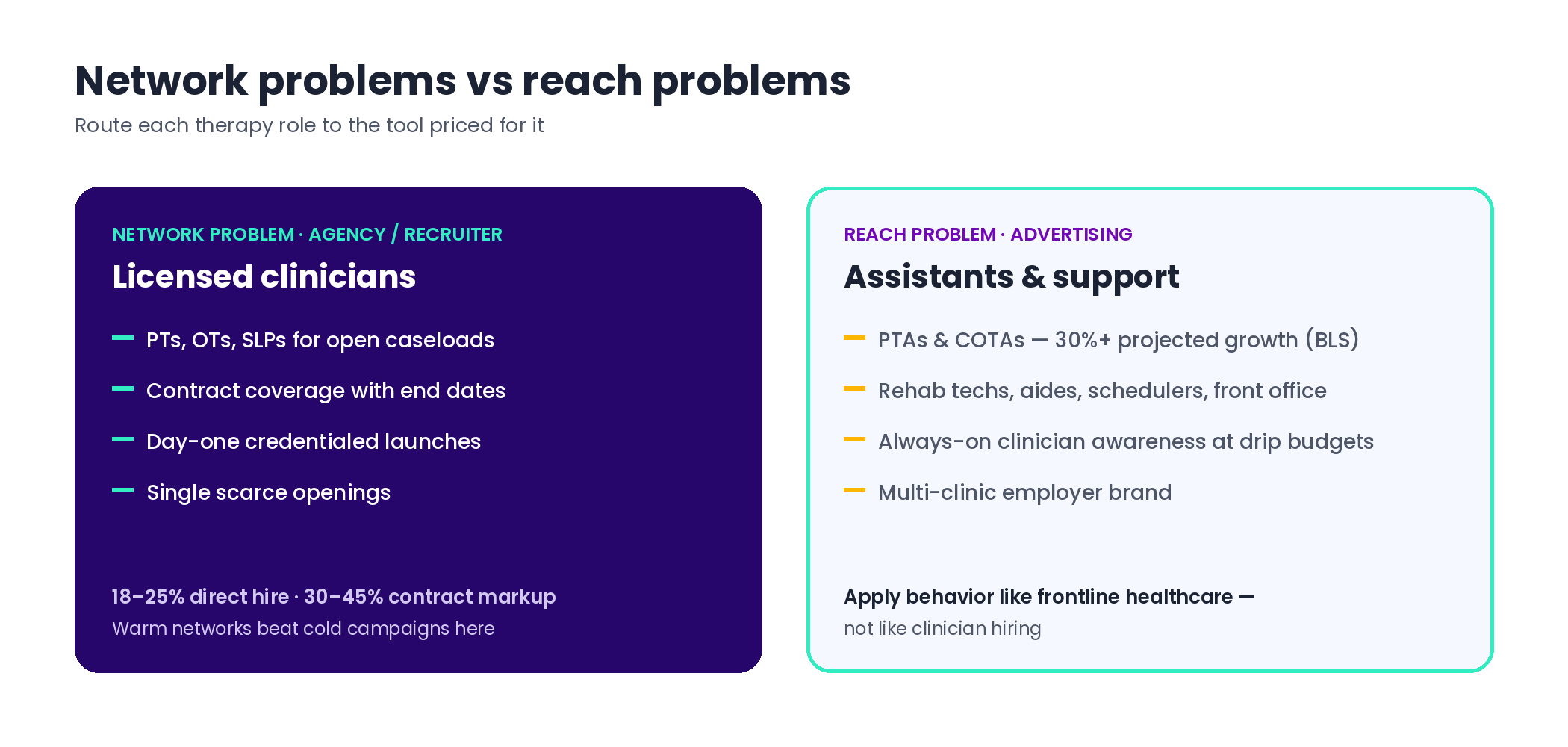
Licensed clinicians
- PTs, OTs, SLPs for open caseloads
- Contract coverage with end dates
- Day-one credentialed launches
- Single scarce openings where time is revenue
Assistants, aides & support
- PTAs and COTAs — BLS projects 17% growth for PT assistants and aides and 20% for OT assistants and aides (2025–35), a genuinely reachable pool
- Rehab techs, aides, front office, schedulers
- Always-on presence that builds clinician awareness for the day they do look
- Multi-clinic employer brand at marginal cost
Two practical notes on the advertising lane. First, budget expectations should match the math: at the $74.62 therapy median, a $334 median-budget campaign yields roughly four clinician applicants a month — a drip that makes sense as an always-on background channel, not as the plan for filling this month's vacancy. Second, the assistants-and-support lane behaves like the rest of frontline healthcare, not like clinician hiring: bigger pool, normal apply rates, and the same in-platform application mechanics that drive our CNA and caregiver numbers. Providers who advertise continuously for the reachable roles and reserve fees for the scarce ones stop paying scarcity prices for non-scarce hires.
The blended playbook for rehab providers
- Advertise always-on for assistants and support — the roles with normal apply rates — and keep those seats off the fee ledger entirely.
- Run a low-budget clinician presence continuously. Clinicians change jobs rarely; being the clinic they already know when they do is cheap insurance at drip budgets.
- Reserve agency fees for the scarce and the urgent, and negotiate them knowing the market: 18–25% direct hire and 30–45% contract markups are ranges, not laws — multi-placement relationships move them. Our markup and fees page covers the negotiating levers.
- Protect retention like a recruiting channel. In a 5%-apply market, every clinician you keep is a placement fee you don't pay. Caseload caps, schedule control, and CEU support are cheaper than the alternative invoice.
- Compare everything against your full healthcare staffing cost picture — therapy decisions made in isolation tend to normalize scarcity pricing for every role in the building.
Therapy staffing runs on one honest rule: pay network prices for network problems — the scarce licensed clinician — and reach prices for reach problems: everyone else in the clinic. The expensive mistake is confusing the two in either direction.
Related: Speech-Language Pathology Assistant Job Description, Occupational Therapy Assistant Job Description, Rehab Technician Job Description, Physical Therapist Interview Questions, Occupational Therapist Interview Questions.
Frequently asked questions
How much does therapy staffing cost?
Through agencies: 30–45% markups on contract therapists (allied-health rates per AMN Healthcare) and 18–25% of first-year salary for direct placements — $18,496.80 to $25,690.00 on the $102,760 BLS median PT salary (May 2025). Through advertising: therapy is the most expensive role family in our benchmark at a $74.62 median per applicant, driven by a 5% apply rate.
How much do therapy staffing agencies charge for a PT placement?
Direct-hire fees for therapy roles typically run 18–25% of first-year salary at major healthcare staffing firms. On the BLS median PT salary of $102,760 (May 2025), that's $18,496.80 to $25,690.00 per placement; on the $97,870 SLP median, $17,616.60 to $24,467.50. Fees are negotiable, particularly across multiple placements.
Does advertising work for recruiting therapists?
Honestly: it's the hardest role family we track — $74.62 per applicant at a 5% apply rate, because employed clinicians click ads but rarely submit applications. It works as a low-budget always-on presence and for building multi-clinic awareness, but a cold campaign is usually the wrong first tool for filling a single vacant clinician caseload quickly. For assistants, aides, and support staff, advertising performs like normal frontline healthcare hiring.
Why is therapist recruiting so hard?
Supply and demand. BLS projects PT employment growing 12% and SLP employment 17% from 2025 to 2035 — several times the all-occupation average — with therapy offices among the fifteen fastest-growing industries (23.3%). Meanwhile a PT license requires a Doctor of Physical Therapy, roughly seven years of higher education, and every state licenses the profession. Demand compounds fast; supply grows at the speed of graduate programs.
Should I use a staffing agency for a PT, OT, or SLP opening?
Often, yes — and this is a recruitment advertising company saying so. For a single vacant caseload, coverage with an end date, or a credentialed day-one launch, a recruiter's warm network of licensed clinicians usually beats advertising into a 5%-apply audience. Reserve the skepticism for paying scarcity fees on roles that aren't scarce: assistants, techs, and support staff.
What's the cheapest way to hire PTAs and COTAs?
Advertising, in most markets. Assistant and aide roles draw from a larger, faster-growing pool — BLS projects 17% growth for physical therapist assistants and aides and 20% for occupational therapy assistants and aides, 2025–35 — with apply behavior resembling frontline healthcare rather than clinician hiring, so in-platform application campaigns perform like our CNA and caregiver numbers rather than the therapy median. Paying clinician-level placement fees for assistant roles is the most common overspend we see in rehab staffing.
What's the difference between therapy staffing and allied health staffing?
Therapy staffing covers PT, OT, SLP, and their assistants; allied health is the broader umbrella — imaging, lab, respiratory, and other credentialed non-nursing clinical roles — which staffing firms typically price together (30–45% contract markups). In our data they're also distinct: allied health runs $54.37 per applicant at a 10% apply rate versus therapy's $74.62 at 5%.
How do I lower therapy staffing costs long-term?
Stop paying scarcity prices for non-scarce roles: advertise always-on for assistants and support, keep a drip-budget clinician presence running so you're known before you're needed, reserve agency fees for genuinely scarce or urgent clinician openings, and invest in retention — in a 5%-apply market, every clinician retained is a placement fee avoided.
Fix the reachable half of your staffing bill
We'll show you what assistants, techs, and support staff cost to recruit across 891 real campaigns — so fees go only where they belong.
Book a DemoAgency figures are third-party ranges from AMN Healthcare (30–45% allied-health contract markups; 18–25% direct-hire fees) and DirectShifts/SkillGigs (40–70% travel-nursing premiums, cited as the published adjacent range — travel therapy is priced by the same firms but we found no equivalently published therapy-specific range). Salary figures are BLS Occupational Outlook Handbook medians for May 2025 ($102,760 PT; $97,870 SLP); fee dollar examples multiply those salaries by the stated percentages (for example, $102,760 × 18% = $18,496.80). Growth projections are BLS Employment Projections, 2025–35 (PT 12% and about 13,400 annual openings; SLP 17% and about 12,500; PT assistants and aides 17%; OT assistants and aides 20%; all occupations 3.5%), plus the 2024–34 industry projection for offices of therapists (23.3%). Advertising figures ($74.62 therapy and $54.37 allied medians, role-family medians and apply rates, apply-rate band costs $53.77 and $1.61, 70% of cost variation explained by conversion, $334 median budget) come from the 2026 Social Job Advertising Benchmark — 891 campaigns, 1,334 campaign-months. Cost per applicant is not cost per hire. This is a sample of Boostpoint campaigns, not an industry-wide study.