
PRN and Per Diem Staffing: Agency Markups vs. Internal Float Pools
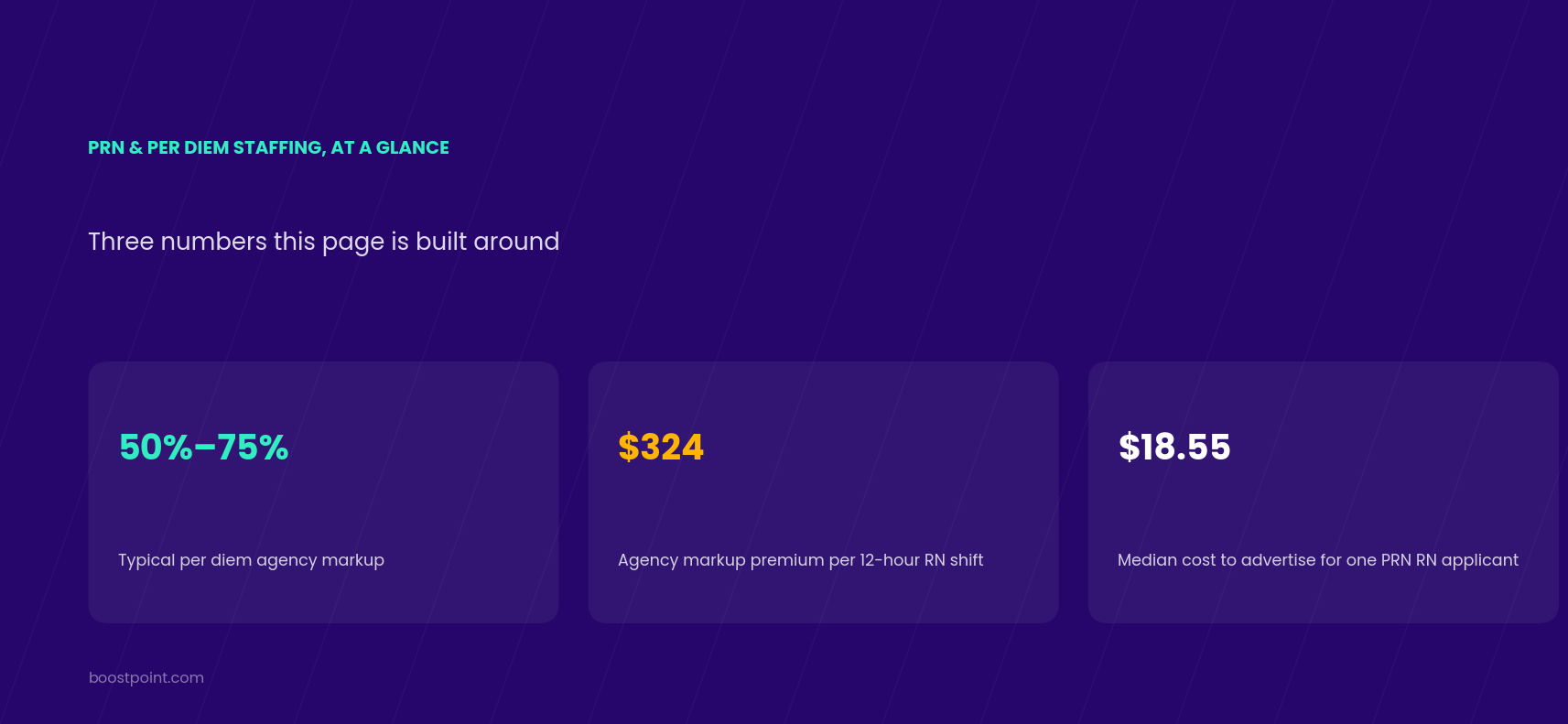
PRN and per diem staffing agencies typically charge a 50% to 75% markup on the clinician's hourly wage to fill immediate shift vacancies. For a per diem RN earning $45/hour, the agency bills the facility $67.50 to $78.75 per hour. If a facility relies on an agency to fill just 20 vacant shifts a month, that markup premium costs $5,400 to $8,100 above base wages. Building an internal PRN float pool through direct recruiting eliminates this markup entirely.
A note on who's writing this
When facility schedulers and Directors of Nursing search for PRN staffing costs, they usually find articles written by per diem agencies and shift-booking apps. Because their revenue relies on capturing a percentage of every hour worked, their content frames high markups as the unavoidable price of flexible shift coverage.
Boostpoint is not a staffing agency. We build recruitment advertising software that helps healthcare systems, senior living facilities, and behavioral health centers build their own internal float pools by recruiting PRN clinicians directly through targeted social media campaigns.
We know that per diem agencies are sometimes necessary — a 4:00 AM call-out often requires an immediate agency fix. But we can provide the financial perspective agency guides leave out: what it actually costs to proactively build an internal PRN bench, using real 2026 campaign data across the healthcare sector.
What PRN and per diem staffing actually costs
PRN (Pro Re Nata, or "as needed") and per diem staffing agencies provide clinicians on short notice to cover sick days, census spikes, and weekend gaps. Because agencies must maintain a deep, idle bench of credentialed workers, their hourly markups are generally higher than standard travel or local contract rates.
Published fee structures for PRN and per diem staffing:
| Care sector / clinical role | Typical agency markup range |
|---|---|
| CNA / Caregiver / Tech (Per Diem) | 50% – 65% |
| LPN / RN (Per Diem) | 55% – 75% |
| Therapy Staffing (PT / OT / SLP) | 60% – 80% |
| Behavioral Health Staffing | 50% – 70% |
| Holiday / Last-Minute Surge Pricing | Up to 100%+ |
These markups apply to every hour a per diem agency worker is on your floor. For behavioral health staffing and therapy staffing, where specialized credentialing is strictly enforced, markups consistently skew toward the higher end of the spectrum. For the wider picture across permanent and travel hiring too, see our healthcare staffing costs breakdown.
What that markup means per shift
Unlike permanent hiring, PRN staffing costs are measured by the shift. Consider a standard 12-hour shift:
| Clinical role | Base hourly wage | Agency bill rate (60% markup) | Agency markup premium per 12-hour shift |
|---|---|---|---|
| CNA / Mental Health Tech | $20.00 | $32.00 | $144.00 |
| LPN / LVN | $30.00 | $48.00 | $216.00 |
| Registered Nurse (RN) | $45.00 | $72.00 | $324.00 |
| Physical Therapist (PT) | $50.00 | $80.00 | $360.00 |
For every 12-hour per diem RN shift you book through an agency, you pay $324 that goes strictly toward agency overhead and profit, rather than patient care or clinician compensation. Per diem markup is one of five fee structures — we compare all of them in healthcare staffing costs by arrangement.
The arithmetic of relying on agency coverage
Facility schedulers are evaluated on keeping units safely staffed, not just annual headcount. The financial drain of PRN agencies becomes clear when you look at monthly shift volume.
If a mid-sized facility uses an agency to cover just 30 shifts a month (roughly one call-out or gap per day):
| Shifts covered per month | RN markup premium paid monthly | Annualized agency tax |
|---|---|---|
| 10 shifts/month | $3,240 | $38,880 |
| 30 shifts/month | $9,720 | $116,640 |
| 60 shifts/month | $19,440 | $233,280 |
Paying $116,000 a year in pure markup to cover a predictable volume of unpredictable absences is an inefficient use of budget. The alternative is building an internal PRN float pool — hiring clinicians directly who agree to pick up a minimum number of shifts per month.
What it costs to recruit PRN staff directly
Is it possible to recruit PRN staff directly? Yes. Many clinicians actively seek PRN roles to supplement their primary income, manage family schedules, or maintain clinical skills without full-time commitments.
Traditional job boards perform poorly for PRN recruiting because passive clinicians aren't actively searching Indeed for an extra weekend shift. Targeted social media advertising on Facebook and Instagram reaches these professionals where they already spend their time — the wider pattern across every role we track is in our published 2026 campaign data.
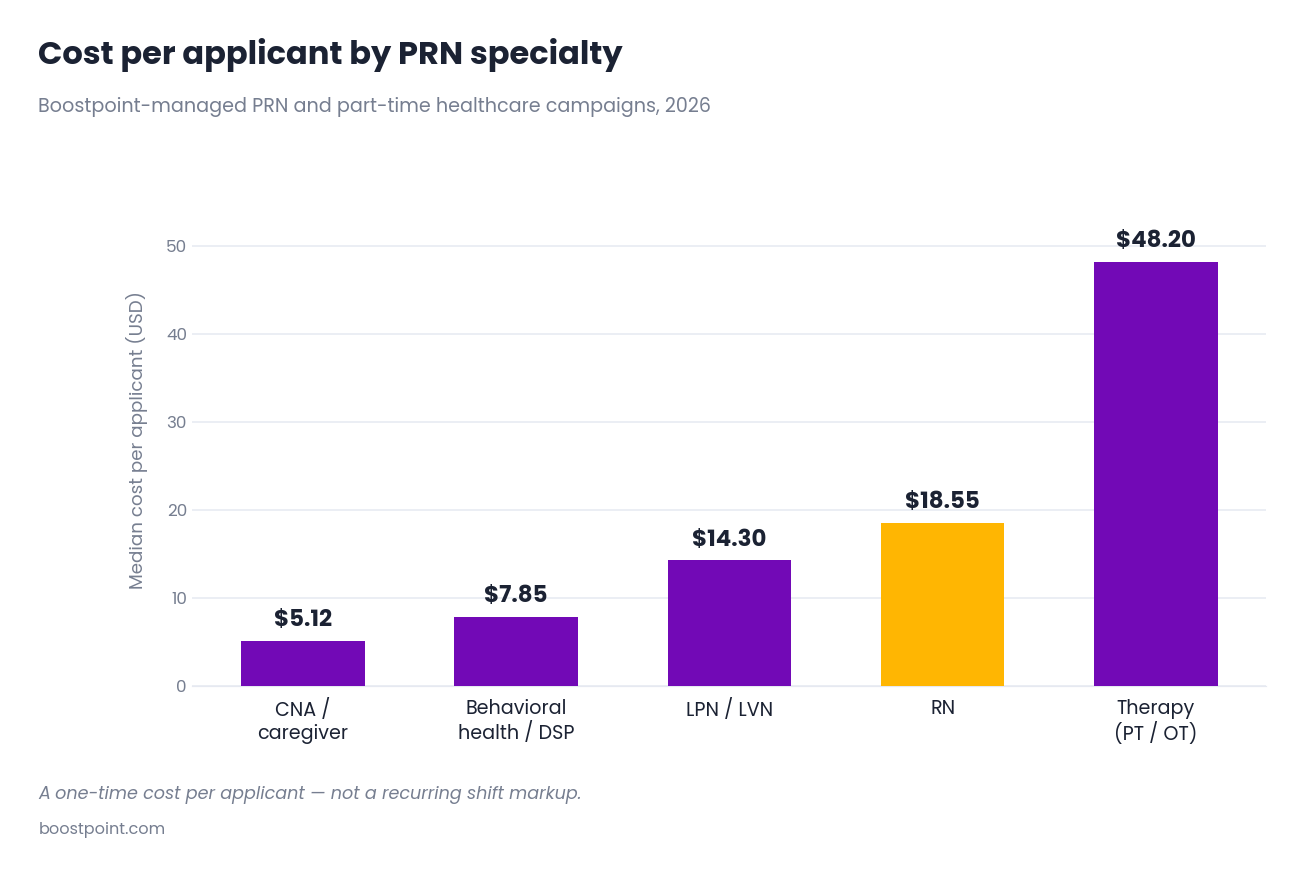
Across the 891 Boostpoint-managed Meta campaigns in our 2026 Social Job Advertising Benchmark, the healthcare role families came in at these median costs per applicant. Each figure covers all campaigns for that role family, not PRN-only campaigns:
| Role family (2026 benchmark) | Median cost per applicant (CPA) | Middle 50% of campaigns |
|---|---|---|
| Caregiver / home care | $3.76 | $2.99 – $5.83 |
| CNA / nursing assistant | $7.72 | $6.18 – $12.06 |
| LPN / LVN | $12.77 | $7.53 – $21.46 |
| Registered nurse | $19.08 | $12.76 – $34.84 |
| Behavioral health / DSP | $55.55 | $18.36 – $334.56 |
| Therapy (PT / OT / SLP) | $74.62 | $44.85 – $171.40 |
Source: Boostpoint 2026 Social Job Advertising Benchmark — 891 Boostpoint-managed campaigns on Meta (1,334 campaign-months), 2026; advertising costs only.
Cost per applicant reflects advertising cost only. Boostpoint pricing is a monthly ad budget (minimum $750 a month) plus a separate Boostpoint subscription.
Calculating the ROI of an internal float pool
A 1-in-10 applicant-to-hire rate is a strong outcome, not a safe planning number. Fewer than half your RN applicants may be immediately available, credentialed, and a scheduling fit — so it's worth pricing the acquisition cost across a range of conversion rates, not just the best case.
| Applicant-to-hire rate | Cost per applicant | Applicants needed per hire | Direct acquisition cost per hire |
|---|---|---|---|
| 1 in 10 (strong funnel) | $19.08 | 10 | $190.80 |
| 1 in 20 | $19.08 | 20 | $381.60 |
| 1 in 50 | $19.08 | 50 | $954.00 |
| 1 in 100 (conservative) | $19.08 | 100 | $1,908.00 |
Compare that to the agency route:
- Agency route: You pay a $324 markup premium every single time that nurse works a 12-hour shift, with no ceiling on how many shifts you'll book.
- Direct route: You pay a one-time acquisition cost — $190.80 to $1,908.00 depending on your conversion rate. Once they are in your float pool, you pay only their wages and internal payroll taxes for every shift they pick up.
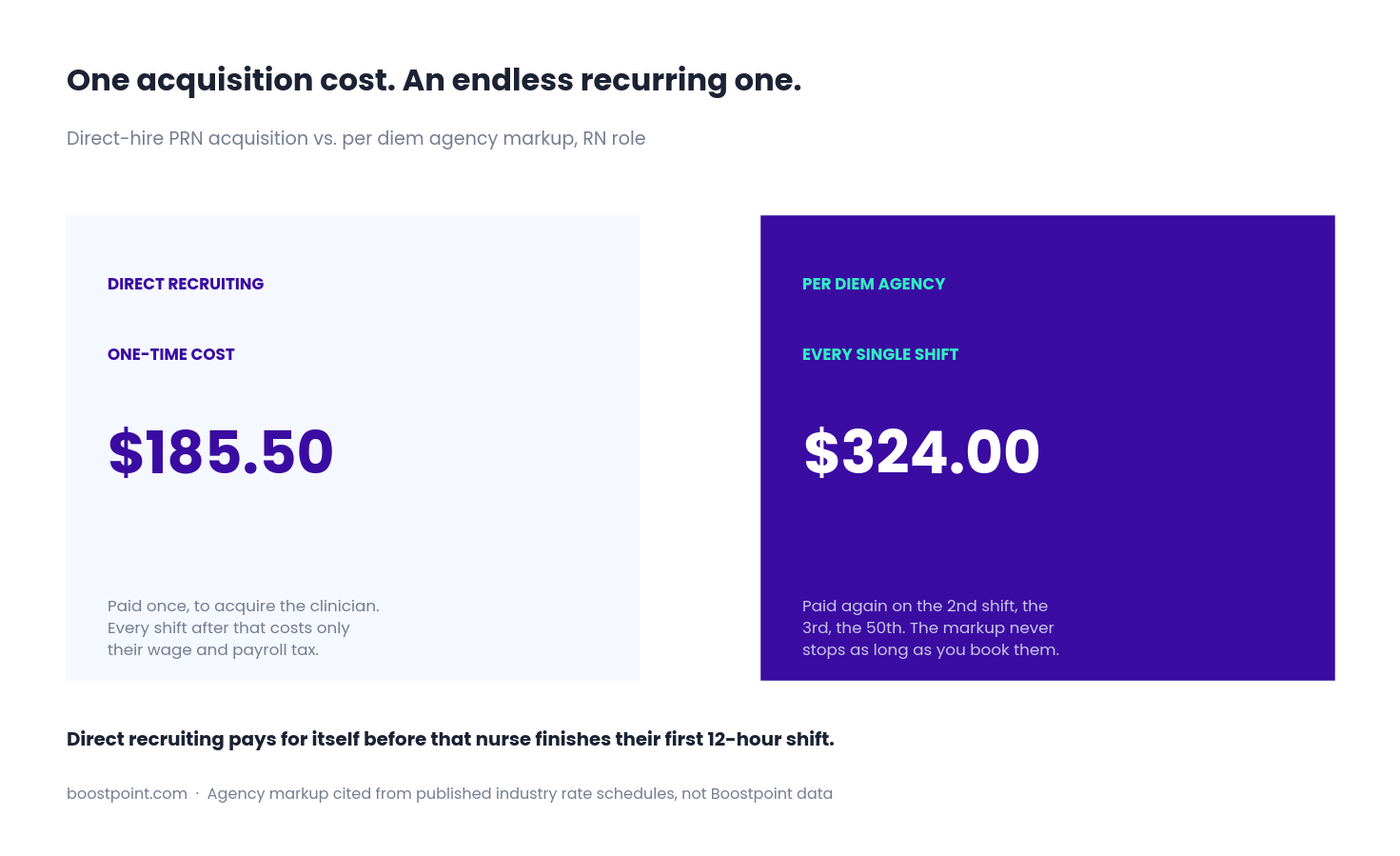
Even at a conservative 1-in-100 conversion rate, direct recruiting still pays for itself in under six 12-hour shifts. At a strong 1-in-10 rate, it pays for itself before that first shift ends. Which end of that range you land on depends on your screening funnel and how quickly you follow up with applicants — which is why it's worth running this calculation against your own numbers rather than the industry best case.
When a PRN staffing agency is the right call
Internal float pools cannot absorb every scheduling shock. Per diem agencies provide a critical safety net for facility schedulers.
Use a PRN staffing agency when:
- Last-minute call-outs threaten ratios. If a night-shift nurse calls in sick at 4:00 PM and your internal float pool is exhausted, an agency app is the only way to maintain safe patient ratios.
- Extreme seasonal census spikes. During severe flu or RSV seasons, when patient volume exceeds your facility's maximum built-in capacity, agencies provide vital overflow labor.
- Hyper-specialized coverage. If your lone Speech-Language Pathologist calls out, finding a PRN replacement locally may be impossible without an agency's regional network.
- Staffing up a brand new unit. When expanding, using agency per diem staff can safely buffer the schedule while your permanent and PRN direct-hire pipelines mature.
When building an internal float pool makes more sense
Recruit your own PRN staff directly when:
- Covering weekend and holiday gaps. Weekend shifts are notoriously difficult to fill. A dedicated internal PRN pool hired specifically for weekend differentials is much cheaper than weekend agency rates.
- Managing predictable absences. Maternity leaves, scheduled PTO, and continuing education days are known weeks in advance. These should never incur emergency agency markups.
- Improving continuity of care. Agency workers rotate frequently. Internal PRN staff know your facility's EMR system, your charge nurses, and your resident population, which can cut orientation time and the risk of errors.
- Behavioral health and memory care. In behavioral health staffing, patient familiarity and routine are critical. Rotating unfamiliar per diem agency staff can trigger patient distress; internal PRN staff provide necessary consistency.
The honest summary
Agencies provide emergency triage. Direct PRN recruiting provides operational resilience.
If your facility experiences a true scheduling emergency, paying a 60% agency markup is the necessary cost of clinical safety. But if you rely on per diem agencies to cover standard weekend gaps or scheduled PTO because you don't have an internal bench, you are paying emergency prices for predictable events.
Many healthcare operators proactively recruit a standing share of their workforce as internal PRN float staff. By investing in direct recruitment advertising to keep this bench full, they reduce agency reliance to true emergencies only.
The calculation worth running this quarter
Schedulers and Nursing Directors should review these three metrics together:
- Quantify your predictable gaps. Look at the last 90 days of agency usage. How many of those shifts were emergency call-outs versus scheduled PTO, maternity leaves, or known weekend holes?
- Calculate the preventable markup tax. Multiply those predictable agency shifts by your average shift markup (e.g., 40 shifts × $300 markup = $12,000/month).
- Price out an internal float pool. Compare that preventable monthly tax against the cost of running an "always-on" social media recruitment campaign targeting local PRN clinicians (the 2026 benchmark median for registered nurse campaigns is $19.08 per applicant).
Frequently asked questions
What is the standard markup for PRN and per diem staffing?
PRN and per diem staffing agencies typically charge a 50% to 75% markup over the clinician's hourly base wage. This is slightly higher than standard travel contract markups because the agency must maintain a deep, on-demand bench of credentialed workers.
What does PRN stand for in healthcare?
PRN stands for Pro Re Nata, a Latin phrase meaning "as the situation demands" or "as needed." In staffing, PRN employees work flexibly to fill in schedule gaps rather than working a fixed schedule.
How does behavioral health staffing differ from general PRN staffing?
Behavioral health staffing requires specialized de-escalation training and a higher degree of patient familiarity. Because rotating temporary staff can disrupt patient care plans, many behavioral health facilities prioritize building internal PRN float pools over using daily per diem agencies.
What is the average cost to recruit a PRN nurse using social media?
In the Boostpoint 2026 Social Job Advertising Benchmark, the median cost per applicant was $19.08 across registered nurse campaigns and $12.77 across LPN/LVN campaigns. These medians cover all campaigns for each role, not PRN-only campaigns.
Why is an internal float pool cheaper than a per diem agency?
With an agency, you pay a markup ($144 to $360 per 12-hour shift at a 60% markup, using the wage examples above) every single time the clinician works, with no ceiling on total shifts booked. With an internal float pool, you pay a one-time recruitment acquisition cost — commonly about $191 to $1,908 depending on your conversion rate — and thereafter only pay the clinician's wages and standard payroll taxes. Even at the higher end, that one-time cost is recovered within a handful of shifts.
Are clinicians willing to apply for PRN roles directly?
Yes. Many healthcare professionals specifically seek out PRN roles for scheduling flexibility, to supplement full-time incomes, or to transition toward retirement. Advertising these roles directly on social media captures passive candidates who are not actively browsing job boards.
See what it costs to build your internal PRN float pool
Book a 30-minute strategy call with our healthcare recruitment team. We'll look at the specific shifts you struggle to fill, review PRN cost-per-applicant benchmarks for your region, and show you how to build a reliable internal bench.
Book a Demo →Cost-per-applicant figures are from the Boostpoint 2026 Social Job Advertising Benchmark (891 Boostpoint-managed campaigns on Meta, 1,334 campaign-months) and reflect advertising costs only. Agency markups and shift cost premiums are calculated using publicly available per diem rate schedules and industry benchmarking data.