
Senior Living Staffing: Why Facility Roles Cost Less to Fill Than Home Care
Across 21 Boostpoint-managed senior living and skilled nursing campaigns in 2025 and 2026, applicants cost $6.11 each — 27% less than home care roles at $8.40, and roughly half the healthcare average. Facility-based hiring has three structural advantages over in-home care, and most operators don't know they have them.
Source: 21 Boostpoint-managed senior living and skilled nursing campaigns representing 6,781 applications, drawn from a wider set of 478 healthcare campaigns across 30 employers, January 2025 through mid-2026. Boostpoint's canonical 2026 Social Job Advertising Benchmark (891 campaigns, single methodology) reports median cost per applicant of $3.76 for caregivers, $7.72 for CNAs, $12.77 for LPNs and $19.08 for RNs; where this earlier analysis and the benchmark differ, the benchmark figure is canonical.
The assumption worth checking
Most senior living and skilled nursing operators we talk to assume they're at a disadvantage against home care agencies in the labor market. Home care sounds more flexible. It sounds like it offers autonomy. Agencies advertise heavily and there are a lot of them.
Our campaign data says the opposite, at least where advertising cost is concerned. It's one of the more counterintuitive findings across our healthcare recruiting work:
| Setting | Cost per applicant | Application completion rate | Applications |
|---|---|---|---|
| Senior living & skilled nursing | $6.11 | 22.1% | 6,781 |
| Home care | $8.40 | 21.6% | 12,941 |
| Hospital & health system | $17.82 | 6.0% | 3,933 |
| Healthcare overall | $11.54 | 10.5% | 24,712 |
Source: 21 Boostpoint-managed senior living and skilled nursing campaigns representing 6,781 applications, drawn from a wider set of 478 healthcare campaigns across 30 employers, January 2025 through mid-2026. Boostpoint's canonical 2026 Social Job Advertising Benchmark (891 campaigns, single methodology) reports median cost per applicant of $3.76 for caregivers, $7.72 for CNAs, $12.77 for LPNs and $19.08 for RNs; where this earlier analysis and the benchmark differ, the benchmark figure is canonical.
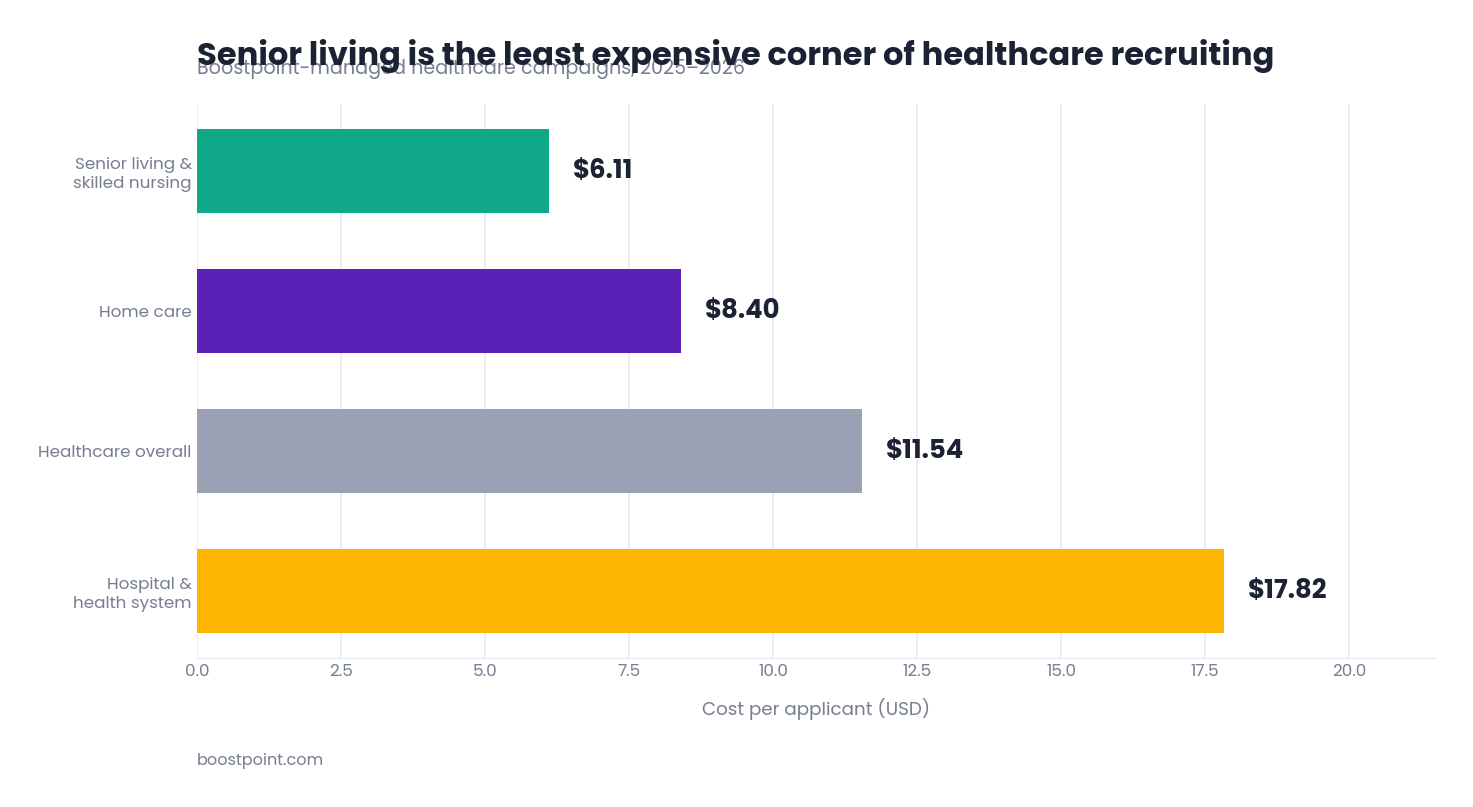
Senior living applicants cost about 27% less than home care applicants, and roughly a third of hospital applicants. That gap holds against home care roles at $8.40. If you run a community or a facility, you are operating in the least expensive corner of healthcare recruiting — which is worth knowing before you set next year's budget or write off social advertising as something for the big systems.
Why facility roles are cheaper to fill
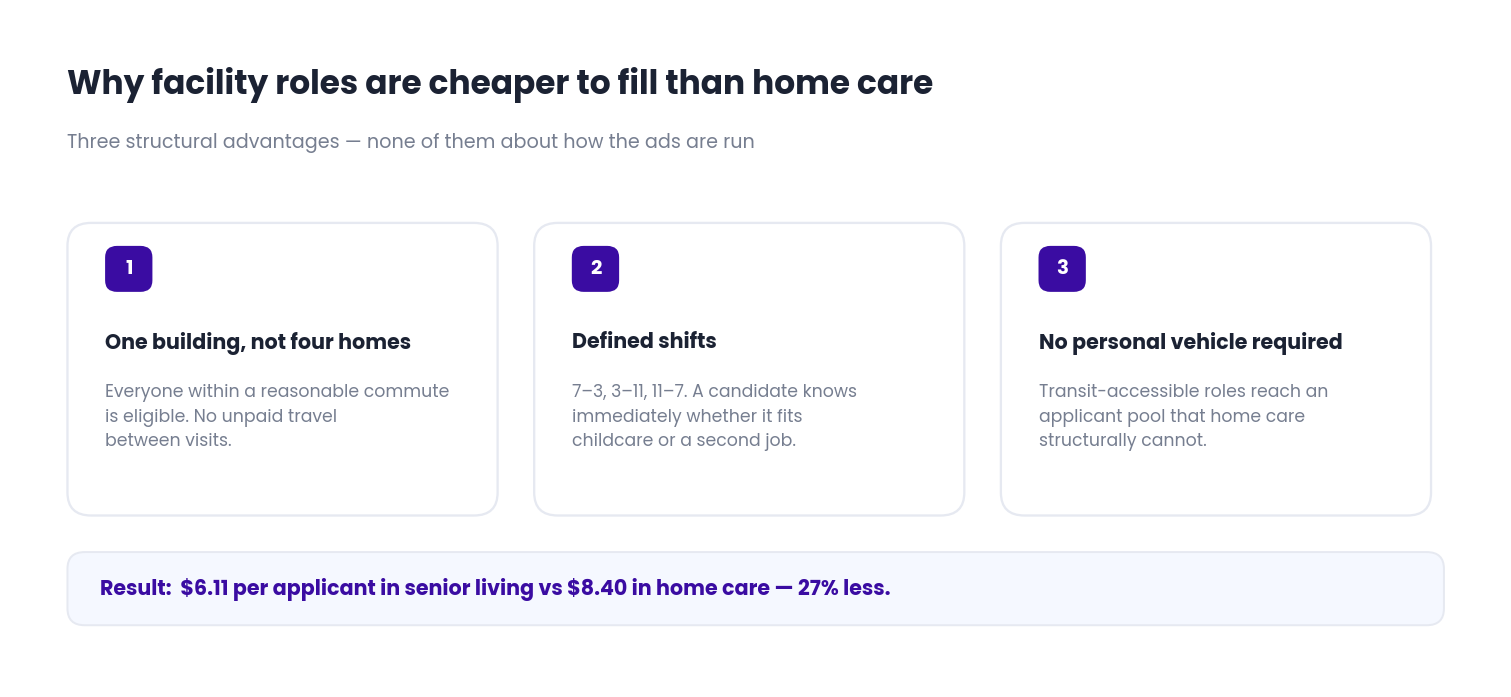
Three structural reasons, none of which have anything to do with how the ads are run. A fourth sits underneath all of them, set out on the CNA shortage: the occupation refills itself roughly two hundred thousand times a year.
1. A fixed location widens the pool
A home care role asks someone to drive between three or four client homes across a service area, often with unpaid travel time between visits, in their own vehicle. That requirement quietly excludes a large share of the potential workforce — anyone without reliable transportation, anyone unwilling to put miles on their car, anyone who can't absorb unpaid gaps in a shift.
A facility role asks someone to drive to one building. Everyone who lives within a reasonable commute is eligible. The addressable pool is simply larger, and larger pools cost less per applicant.
2. Predictable schedules convert better
Facility shifts are defined: 7 to 3, 3 to 11, 11 to 7. A candidate can look at that and know immediately whether it works with childcare, a second job, or a spouse's schedule.
Home care schedules are frequently built around client need, which means hours fluctuate and the schedule changes. That's a genuine feature for some caregivers and a dealbreaker for others — and uncertainty at the ad stage costs you applications.
3. No personal vehicle requirement
This one is underrated. Requiring a reliable personal vehicle and current insurance removes a meaningful portion of the direct care labor pool, particularly in urban markets with transit and in communities where 36% of direct care workers live at or near poverty.
Facility roles that are transit-accessible open up an applicant pool that home care structurally cannot reach.
The advantage is easiest to lose on the roles nobody writes about. Dining, housekeeping and activities staff are hired about as often as the caregivers, and assisted living recruitment covers those specifically. The dining side has its own template too: the dietary aide job description.
Where facilities give the advantage back
Being straight about the other side of this, because the cost advantage isn't the whole story.
Turnover in skilled nursing is severe. CNA turnover was reported at 42.3% in the most recent AHCA data — the highest of any position tracked — and nursing staff turnover across facilities has been measured above 50%. Cheaper applicants don't help if you're refilling the same role three times a year.
Your role mix is more expensive. A home care agency hires mostly caregivers at $3.47. A skilled nursing facility hires CNAs at $6.82, LPNs at $12.14 and RNs at $15.93. Your blended cost is lower per applicant partly because facility caregiver-equivalent roles are cheap — but your clinical roles sit at the expensive end of the ladder.
Overnight and weekend coverage is harder. Facilities run 24/7. The small pool of people actively job hunting self-selects toward convenient shifts, which is exactly why reaching people who weren't looking matters more for NOC coverage than for day shift.
The honest summary: facilities have a reach advantage and a retention disadvantage. The cost data on this page addresses the first. The second is an operational problem that advertising won't solve.
Assisted living and nursing home staffing requirements
The two settings answer to different rulebooks, and it changes what you have to hire for.
Nursing homes: the federal floor
Skilled nursing facilities that take Medicare or Medicaid follow 42 CFR 483.35. It requires “sufficient numbers” of licensed nurses and nurse aides on a 24-hour basis to meet residents’ care plans, a licensed nurse as charge nurse on each shift, a registered nurse “for at least 8 consecutive hours a day, 7 days a week,” and a full-time RN director of nursing, subject to waivers. Nurse aides can work up to four months full time before they must have completed a training and competency evaluation program, and federal rules set that training at no less than 75 clock hours, including at least 16 hours of supervised practical training (42 CFR 483.152).
There is no federal hours-per-resident-day minimum in force. The 2024 rule that would have required 3.48 total nurse staffing hours per resident day and an RN on site around the clock was vacated by a federal court in Texas in 2025, Congress barred its enforcement through 30 September 2034, and CMS formally repealed those provisions in an interim final rule effective 2 February 2026. The facility assessment requirement stayed. Many states set their own nursing home staffing minimums on top of the federal floor, so check your state health department’s rules.
Assisted living: state rules only
Assisted living has no federal staffing standard. It is licensed by the states, and the rules vary widely: some require a set number of awake staff overnight or a staffing ratio, others require only enough trained staff to meet residents’ needs, and training hours for direct care staff differ by state and by license type, such as memory care. Read your state licensing agency’s current regulations rather than a national summary.
For recruiting, the practical effect is the same in both settings: the requirement is a shift count, not a headcount. A building that must cover every night shift needs a pipeline for the night shift specifically, which is why the ad should name the shift and the knockout question should ask about it.
How to staff a nursing home
To staff a nursing home, start from your facility assessment, cover the federal and state floors shift by shift, build a continuous CNA pipeline, and keep agency hours as the exception you can see in your own payroll data. In order:
- Start from the facility assessment. Under 42 CFR 483.71(c), a certified facility must use its assessment to inform staffing decisions, consider staffing needs for each unit and each shift, and "develop and maintain a plan to maximize recruitment and retention of direct care staff." Your hiring plan is part of a document a surveyor can ask for.
- Staff shifts, not a headcount. Cover the 483.35 floor on every shift: a licensed charge nurse, an RN for at least 8 consecutive hours a day, 7 days a week, and a full-time RN director of nursing, plus any state minimum on top. Our nursing home staffing ratios page covers the state rules, and the director of nursing job description covers the role that owns the schedule.
- Build the CNA pipeline first. BLS projects about 203,300 openings a year for nursing assistants and orderlies, most of them replacements. Federal rules let an aide work up to four months full time while completing an approved training and competency evaluation program, so an employer-sponsored training route widens the pool. Registry verification still has to come before an aide works as a nurse aide, apart from narrow exceptions for aides in or just out of an approved program; the steps are on healthcare background checks.
- Recruit continuously, not seasonally. Health care hiring barely moves through the year: federal hires data show a peak of 117 in July against 80 in December on an index where 100 is an average month. A vacancy in March is a posting and process problem, not a season.
- Keep the application short and call the same day. In Boostpoint's 2026 Social Job Advertising Benchmark, median cost per applicant was $7.72 for CNA and nursing assistant campaigns, $12.77 for LPN and LVN, and $19.08 for registered nurses. Cost per applicant is not cost per hire; what happens in the hours after the form is submitted decides the rest.
- Watch agency hours in your own data. 42 CFR 483.70(p) requires facilities to submit direct care staffing information to CMS, including agency and contract staff, based on payroll data, and 483.35(g) requires daily posting of nurse staffing by shift. Track the agency share of hours by shift, and aim recruiting at the shifts where it is highest.
Regulatory text read in the eCFR on September 24, 2026. General information, not legal advice.
What good looks like operationally
Completion rate is where facility operators most often leave value on the table. Our senior living campaigns average 22.1% click-to-application — meaning roughly one in five people who tap an ad finish the form.
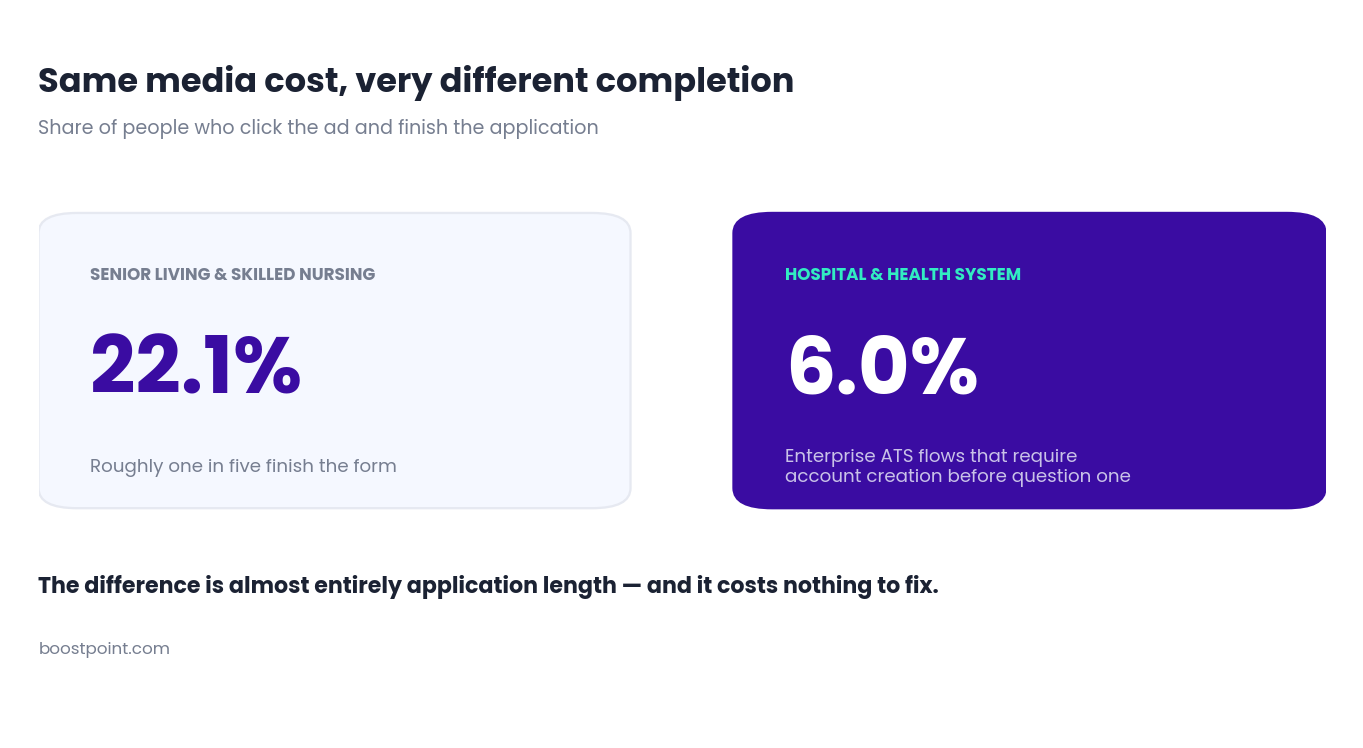
Hospital campaigns, for comparison, run 6.0%. The difference is almost entirely application length: enterprise health systems route applicants through an ATS that requires account creation before the first question.
If you're a facility operator using a hospital-style application flow, you're paying facility-level media costs and getting hospital-level completion. The fix costs nothing:
- Ask three or four knockout questions, not fifteen — certification status, shift availability, transportation, experience minimum
- Capture the application in-platform rather than clicking out to an ATS
- Save credential verification and references for after first contact
- Test the whole flow on a phone, on a slow connection, the way an applicant will actually do it
"We're already on Indeed"
Most senior living operators we talk to are on a job board and not especially happy about it. Applicant quality has slipped, the same names recirculate, and cost has crept up — but the postings are written, the dashboard is familiar, and switching feels like another project in a year that's already full.
That's a fair reason to be cautious. It isn't a reason to skip the arithmetic.
Work out what a qualified applicant costs you today, by role. Total channel spend divided by applicants who actually met your minimums — not total applications.
Most operators have never run it, because job board reporting shows spend and volume but doesn't separate a CNA from an RN, or a qualified applicant from a click.
Do it for one role for one month. If it beats $6.11, your channel is working. If it doesn't, you now know what the gap is worth.
And to be clear: most of our senior living clients still run job boards. The channels do different work — boards capture people already searching, social reaches the larger group who aren't. Where social genuinely displaces spend is agency and travel staffing coverage, which costs multiples of either.
"We don't have the photos or videos for this"
Operators assume social recruiting requires a content library — community footage, staff photos, someone to shoot and edit. Most have a logo, a few images from the website build, and no marketing headcount.
None of it is required. Ad creative is produced for you from the job description — video and static, written, built and refreshed before it fatigues. If you have real footage of your community and your team, it helps and we'll use it. If you don't, the campaign runs anyway.
The implementation concern lands the same way. Nobody has bandwidth to roll out a platform while running short-staffed. What's needed from you is a job description, the pay range and shift, and the market. Campaign build, targeting, optimization and reporting happen on our side.
When this isn't the right approach
- Director-level and specialized clinical roles. DONs, specialized therapists and administrators are search-firm work — the qualified population is too small for broad reach.
- A single opening. The economics favor continuous or multi-site hiring need.
- When your rate is below market. Advertising will surface that faster and more expensively than doing nothing.
- If nobody follows up same-day. Applicants go cold within hours. Without a scheduler working the list, you'll pay for candidates you never reach.
Frequently asked questions
How much does it cost to recruit for senior living?
Across 21 Boostpoint senior living and skilled nursing campaigns in 2025–26, applicants cost $6.11 on average — about 27% less than home care at $8.40 and roughly a third of hospital and health system campaigns at $17.82.
Why is senior living cheaper to recruit for than home care?
Three structural reasons: a fixed work location widens the eligible pool, defined shifts convert better than variable client-driven schedules, and facility roles usually don't require a personal vehicle — which is a meaningful barrier in home care.
What does it cost to hire a CNA for a facility?
CNA applicants averaged $6.82 across our healthcare campaigns. LPNs ran $12.14 and RNs $15.93. Facility blended cost is lower than those clinical figures because caregiver-equivalent and support roles pull the average down.
Does cheaper recruiting solve our turnover problem?
No. CNA turnover in skilled nursing was reported at 42.3% in recent AHCA data, the highest of any tracked position. Lower applicant cost helps you refill faster and be more selective, but retention is an operational problem — scheduling, supervision, pay and workload — that advertising does not address.
Why is our application completion rate so low?
Almost always form length. Our senior living campaigns average 22.1% click-to-application while hospital campaigns run 6.0% — the difference being enterprise ATS flows that require account creation before the first question. Ask three or four knockout questions and capture the application in-platform.
Will this help fill overnight and weekend shifts?
It widens the pool, which is the main constraint. Job boards surface people actively searching, and that group self-selects toward convenient schedules. Reaching people who weren't looking — and screening for shift availability at the application — puts more candidates in front of the hardest shifts to fill.
We already use Indeed. Why change?
Most of our senior living clients run both. The useful step is calculating your current cost per qualified applicant by role. Most operators have never done it, because job board reporting doesn't separate a CNA from an RN or a qualified applicant from a click.
Do we need our own photos or video?
No. Ad creative is produced for you from the job description, including video, and refreshed before it fatigues. Your own community footage helps if you have it, but nothing is required to launch.
Is there a nursing home staffing shortage?
Yes, and it is mostly a refill problem. BLS projects about 203,300 openings a year for nursing assistants and orderlies from 2025 to 2035 while the occupation grows only 3 percent, so about 98 percent of those openings replace people who leave. The CNA turnover figures on this page tell the same story from inside the building. Our CNA shortage and healthcare workforce shortage pages break down the numbers.
How do you staff a nursing home?
Start from the facility assessment, which federal rules require you to use for staffing decisions by unit and shift and for a recruitment and retention plan. Cover the federal floor of a charge nurse every shift, an RN 8 consecutive hours a day and a full-time director of nursing, plus your state minimum. Then recruit CNAs continuously with a short application and same-day follow-up, and keep agency staff for gaps.
How do you recruit for a nursing home?
Recruit each rung from its own pool. CNAs come from certified aides working at other facilities and in home care, from local training programs, and from caregivers, retail and food service workers you pay to certify; nurses come from the regional nursing programs and from other facilities. Run a separate ad per role and shift, with the rate and the shift in the first line, a short application with one or two knockouts (registry status, the shift), and a call the same day. Nursing home recruiting is continuous rather than seasonal: BLS Employment Projections 2025-35 put nursing assistant openings at about 196,200 a year, almost all of them from replacing workers who move to other occupations or leave the labor force rather than from growth. For reference, the CNA / nursing assistant family in Boostpoint's 2026 Social Job Advertising Benchmark ran a median $7.72 per applicant at an 18% apply rate. More on the CNA pipeline is on CNA recruitment.
Can a nursing home train its own CNAs?
Often, through a state-approved nurse aide training and competency evaluation program, but not always. Under 42 CFR 483.151(b)(2), a state may not approve a program offered by or in a facility that, within the previous two years, operated under certain nurse staffing waivers, was subject to an extended or partial extended survey, was assessed a civil money penalty of not less than $5,000 as adjusted annually, or was subject to certain other enforcement remedies. The rule includes a limited waiver for penalties not related to quality of care. Check with your state before building a train-your-own ad around an in-house class.
See what your open roles cost to fill
Book a 30-minute call and we'll walk through cost per applicant for the roles, shifts and markets your communities are hiring for.
Book a Free DemoFigures come from 21 Boostpoint-managed senior living and skilled nursing campaigns representing 6,781 applications, drawn from a wider set of 478 healthcare campaigns across 30 employers, January 2025 through mid-2026. The senior living sample is concentrated among a small number of multi-site operators and should be read as directional. Costs are what advertisers paid for advertising only. Turnover figures are third-party industry estimates and cited as such. This is a sample of Boostpoint campaigns, not an industry-wide study.
Related: Healthcare Recruiting · What It Costs to Recruit an RN vs LPN vs CNA · Caregiver Turnover