
Assisted Living Recruitment: The Dietary, Housekeeping and Activities Hires Nobody Writes About
Assisted living is a state-licensed residence with a kitchen, a laundry and an activities calendar, and the people who run those are hired as often as the caregivers. In Ziegler's 2026 workforce survey, dining staff turned over at 40.0% — the same rate as RNs and above CNAs at 39.0% — and 48.5% of operators named dining among the hardest jobs to fill. These roles compete with restaurants, hotels and schools, not hospitals, so the ad has to say "no license needed" and show the rate against theirs. Boostpoint's closest published figures are the senior living setting at $6.11 per applicant (earlier analysis) and uncredentialed caregivers at $3.76.
Source: Boostpoint 2026 Social Job Advertising Benchmark — 891 Boostpoint-managed campaigns on Meta (1,334 campaign-months), 2026; costs are what advertisers paid for advertising only.
A note on who's writing this
Boostpoint runs social media job ads for senior living communities and home care agencies, so the recruiting sections of this page describe what we sell. None of our senior living customers has agreed to be named here, so none is, and we publish no figure for dietary, housekeeping, activities or maintenance campaigns — the roles this page is about. What we can do is put the third-party numbers in one place with their sources attached, show the arithmetic those numbers imply for a community of your size, and describe what an ad for a server or a housekeeper has to say that a caregiver ad doesn't. The senior living staffing page covers the facility-versus-home-care cost argument; this one doesn't repeat it. Every cost figure here is a cost per applicant, never a cost per hire.
What assisted living is, for recruiting purposes
NCAL counts approximately 41,465 assisted living communities with nearly 1.4 million licensed beds, an average of 33 licensed beds each, 57.3% chain-affiliated and 42.7% independent, housing more than a million residents of whom 4 in 10 are living with Alzheimer's or another dementia. As of June 2026 the profession employed 512,300 people (BLS Quarterly Census of Employment and Wages, as cited by NCAL), and the median community charges $6,200 a month (Genworth, as cited). Two facts matter more than the rest for recruiting. First, there is no federal license: in NCAL's words, "States establish and enforce licensing and certification requirements for assisted living communities," which means the credential your state requires of a caregiver, a med tech or a cook is your state's, not Medicare's — the CNA registry that governs skilled nursing and the 75-hour federal rule that governs home health aides do not apply unless your state borrows them. Second, a 33-bed community is a small hotel with a care staff attached: three meals a day, seven days a week, laundry, housekeeping, a calendar of activities, and a building to maintain. Every one of those departments hires, and the people who work in them come from — and go back to — restaurants, hotels, schools and cleaning companies.
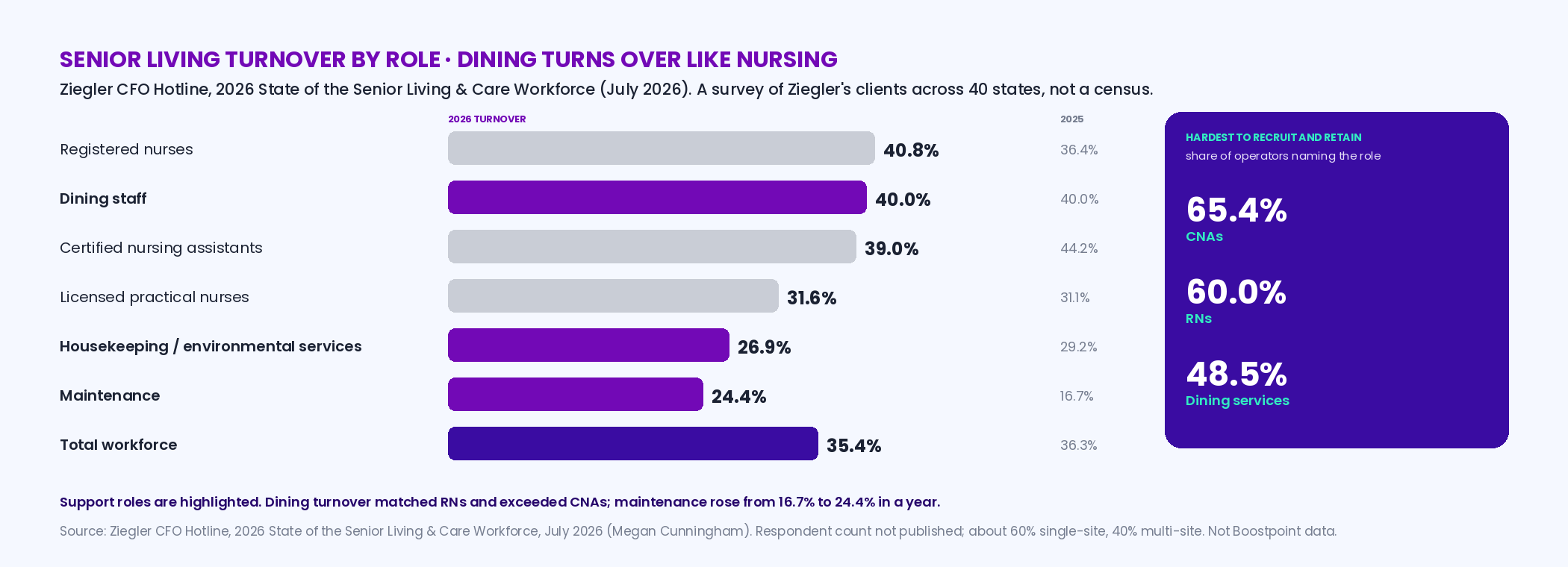
The hires that keep coming: turnover by role
Ziegler's July 2026 CFO Hotline surveyed senior living operators across 40 states — roughly 60% single-site, 40% multi-site; the respondent count isn't published — and put total workforce turnover at 35.4%, down from 36.3% the year before. By role, RNs turned over at 40.8% (up from 36.4%), dining staff at 40.0% (unchanged), CNAs at 39.0% (down from 44.2%), LPNs at 31.6%, housekeeping and environmental services at 26.9% (down from 29.2%), and maintenance at 24.4% (up sharply from 16.7%). Asked which positions are hardest to recruit and retain, 65.4% named CNAs, 60.0% RNs, and 48.5% dining services. Two things follow. A dining department the same size as the care staff produces about as many vacancies a year as the care staff does, with none of the recruiting attention; and the reason people leave is not a mystery — in Argentum and Activated Insights' 2026 survey of senior living workers, 62.3% named non-competitive pay as the primary reason for leaving the industry, and 77.8% of Ziegler's operators named wage increases and base pay the most significant staffing expense. The ad is written against that fact.
Interactive
Hiring load planner — how many hires a year each department produces at Ziegler's 2026 turnover rates
Nothing is stored or sent — this runs in your browser. Enter your headcount by department; the turnover rates are prefilled from Ziegler's July 2026 survey and you can overwrite them with your own.
Arithmetic on your inputs. Prefilled rates are Ziegler CFO Hotline, 2026 State of the Senior Living & Care Workforce (July 2026): dining 40.0%, housekeeping / environmental services 26.9%, CNA 39.0%, maintenance 24.4% — a survey of Ziegler's clients, not a census, and your rate is the one that counts. No cost is computed; cost per applicant is not cost per hire.
The support roles, one at a time
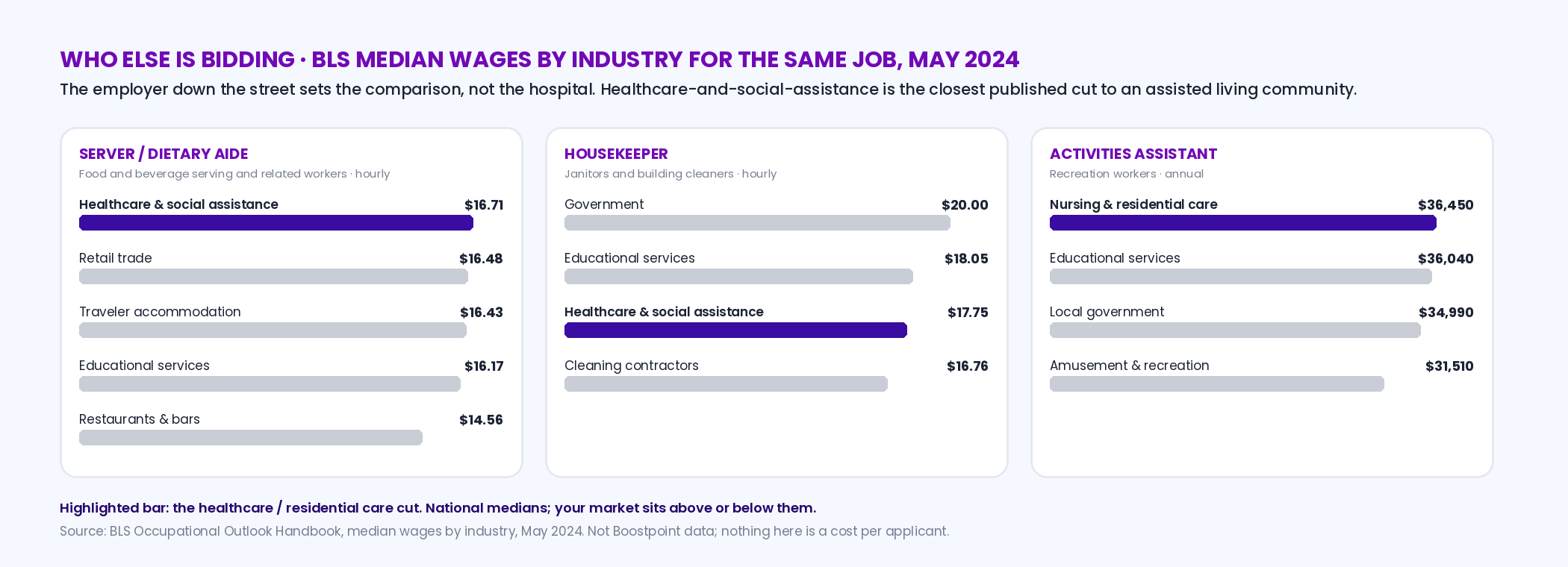
A recruiting page for assisted living usually stops at caregivers and med techs. The table below is the rest of the building. The wage column is BLS's May 2024 median for the occupation in healthcare and social assistance settings, which is the closest published cut to a senior living community; the "who else is bidding" column is BLS's median for the same occupation in the industries that recruit the same person. The credential column is the honest one: for most of these roles the only requirement is your state's, and often it is a food handler card or a background check, not a license.
| Role | What the job is in a 33-bed community | BLS median, healthcare & social assistance | Who else is bidding (BLS median by industry) | Credential | Source |
|---|---|---|---|---|---|
| Dietary aide / server | Three meals a day, seven days; dining-room service, tray line for residents who eat in their rooms, texture-modified diets, the 6 a.m. breakfast shift | $16.71 (food and beverage serving and related workers) | Retail $16.48 · hotels $16.43 · schools $16.17 · restaurants $14.56 | State food-handler rules where they apply (California: a food handler card within 30 days of hire, employer-paid); no license | BLS OOH, May 2024; Cal. Health & Safety Code §113948 |
| Cook | Menu cycle, therapeutic diets, production for 33 to 100 covers a meal, ordering; often the only trained cook on shift | Not published at this cut; food-service occupations overall $14.92 | Restaurants, hotels, school food service, hospitals | State food-safety certification where required; no license | BLS OOH, May 2024 |
| Housekeeper / laundry | Resident apartments, common areas, personal laundry, infection-control cleaning during an outbreak | $17.75 (janitors and building cleaners) | Government $20.00 · schools $18.05 · cleaning contractors $16.76 | Background check; no license | BLS OOH, May 2024 |
| Activities assistant | The calendar: exercise, music, outings, one-to-one visits for residents with dementia; driving the van | $36,450 a year (recreation workers in nursing and residential care facilities); $17.01 an hour across all industries | Schools $36,040 · local government $34,990 · amusement and recreation $31,510 (annual) | High school diploma or equivalent is the typical entry; a driver's license if the job includes the van | BLS OOH, May 2024 |
| Maintenance | The building: HVAC calls, call-light system, apartment turnovers, snow, the generator test | Not published at this cut | Property management, hotels, schools | Trade licenses only where the work requires them | Ziegler 2026: turnover 24.4%, up from 16.7% |
Interactive
Who else is bidding — your rate against BLS medians for the same job in the industries that recruit the same person
Nothing is stored or sent — this runs in your browser. Pick the role, enter what you pay; the bars are BLS May 2024 medians by industry, national, and your local market will sit above or below them.
BLS Occupational Outlook Handbook, May 2024 medians by industry: food and beverage serving and related workers — healthcare and social assistance $16.71, retail $16.48, traveler accommodation $16.43, educational services $16.17, food services and drinking places $14.56; janitors and building cleaners — government $20.00, educational services $18.05, healthcare and social assistance $17.75, services to buildings and dwellings $16.76; recreation workers (annual) — nursing and residential care facilities $36,450, educational services $36,040, local government $34,990, other amusement and recreation $31,510. For the activities role your hourly rate is multiplied by 2,080 hours. National medians, not your market; nothing here is a cost.
What the ad has to say
A server or a housekeeper scrolling past "Now hiring at [Community] Assisted Living" assumes the job needs a certification, because everything else with "assisted living" in it does. So the first line does three things a caregiver ad doesn't need to: it names the job in the words the applicant uses (server, cook, housekeeper — not "dietary aide II"), it says no license or experience is required, and it puts the rate next to the one thing a restaurant can't offer, which is the schedule. "Server · $[rate]/hr · breakfast and lunch shifts, done by 2 p.m. · no nights, no tips to chase · [town]" reaches the person who is tired of closing a restaurant at midnight; "Housekeeper · $[rate]/hr · Monday to Friday days · same building, same residents" reaches the person cleaning three offices a night for a contractor. The form asks one knockout question — food handler card or willing to get one, driver's license for the van, weekend availability — and nothing else before the offer. Then the arithmetic from the earlier campaign-level analysis: application completion in the senior living setting ran 22.1%, the best of the three settings against home care's 21.6% and the hospital's 6.0%, because a community can run a short form where a health system's portal can't. Setting cost in that analysis was $6.11 per applicant, and in the 2026 benchmark uncredentialed caregivers ran a median $3.76 (31% apply rate, 34 campaigns) against the Healthcare & Senior Living sector's $15.42 across 553 campaigns. We have no dietary or housekeeping figure to put beside those, and we won't invent one; the honest inference is that a role with no credential and a wide pool tends to sit at the cheap end of the sector, and the ad has to say "no license" for it to get there.
Where the people are
The pools for these roles are not healthcare pools. Restaurant servers and line cooks move between jobs constantly and read their phones between shifts, which is where a social feed reaches them; a dated open house with the kitchen open and the executive chef present converts them the way a caregiver open house converts caregivers — the event-driven structure ran at a median $8.02 per applicant in the benchmark, mechanics on open house hiring events. Housekeepers come from cleaning contractors, hotels and hospitals, and the sourcing on how to hire housekeepers and janitorial staff applies with one change: the community can offer daytime hours and a single building, which a contractor cannot. Activities assistants come from schools, parks and recreation departments, and the certified nursing assistant who is good with residents and tired of transfers; the van-driver requirement is the filter to state up front. And the best source for every one of these roles is the dining room itself: a referral bonus paid to servers for servers, at a rate you set, costs nothing until it works. For the caregiver side of the building — the roles that do carry a state credential — the channel guide is on where to find caregivers, the facility-versus-home-care cost case on senior living staffing, the CNA squeeze on CNA recruitment, and the departure arithmetic on caregiver turnover.
Half the hires in an assisted living community aren't caregivers. Recruit the kitchen like you recruit the care staff — with its own ad, its own first line, and a rate that reads against the restaurant's, not the hospital's.
Assisted living staffing: ratios, shortages and what an applicant costs
Staffing an assisted living community is a different problem from staffing a skilled nursing facility, and the difference is regulatory. Assisted living is licensed state by state, and most states set staffing by a “sufficient staff to meet resident needs” standard plus specific rules for awake overnight coverage and administrator presence, rather than by a federal hours-per-resident-day figure. The practical consequence for a recruiter is that your staffing floor is set locally and your census can move it in a week, so the requisition pipeline has to be continuous rather than reactive.
Three roles carry most of the churn: the resident aide or caregiver line, dietary, and housekeeping. What it costs to reach each of them differs more than most staffing plans assume. Across our 2026 managed campaigns a caregiver applicant cost $3.76 at the median with a 31% apply rate — the highest apply rate of the fifteen role families we measure — while a CNA applicant cost $7.72 at 18%. Budgeting both at the same rate is the most common error in an assisted living staffing plan.
Source: Boostpoint 2026 Social Job Advertising Benchmark — 891 Boostpoint-managed campaigns on Meta (1,334 campaign-months); costs are what advertisers paid for advertising only. Cost per applicant is not cost per hire.
The staffing lesson in those two rows is that the caregiver line is the cheapest clinical-adjacent hire available to you, and it is cheap because the barrier to entry is low and the ad can say so. Where a community is short on CNAs, the question worth asking before raising the CNA advertising budget is whether some of those shifts can be covered by aides you can hire at about half the acquisition cost, with certification support offered as a retention benefit rather than a hiring requirement.
For the broader category — independent living, memory care and skilled nursing alongside assisted living — see senior living staffing, which covers the same roles across the full continuum of care.
Frequently asked questions
What is assisted living recruitment?
Hiring for a state-licensed assisted living community: caregivers and med techs on the care side, and the dining, housekeeping, laundry, activities and maintenance staff who run the residence. NCAL counts approximately 41,465 communities averaging 33 licensed beds and 512,300 employees as of June 2026. States, not the federal government, set the credentials, so what a role requires depends on your state's rules.
How do you hire dietary aides for assisted living?
Advertise the job as a server or kitchen job, not a healthcare one: name it in the applicant's words, say no license or experience is required, put the rate next to the schedule (breakfast and lunch shifts, no late nights), and ask one knockout question — a food handler card where your state requires one, or willingness to get it. Recruit from restaurants and hotels on social feeds and with a dated open house, and pay servers to refer servers.
What is the turnover rate for senior living dining staff?
Ziegler's July 2026 CFO Hotline put dining staff turnover at 40.0%, unchanged from 2025 — the same rate as RNs (40.8%) and above CNAs (39.0%). Housekeeping and environmental services ran 26.9%, maintenance 24.4%, and the total workforce 35.4%. It is a survey of Ziegler's clients across 40 states, not a census.
What do assisted living support staff earn?
BLS's May 2024 medians in healthcare and social assistance settings: $16.71 an hour for food and beverage serving workers and $17.75 for janitors and building cleaners; recreation workers in nursing and residential care facilities earned a median $36,450 a year. Those are national medians; the comparison that matters is to the restaurant, hotel or school in your town.
Do assisted living dietary aides need a certification?
No license, federally. Requirements are set by your state and are usually food-safety rules: California, for example, requires a food handler card within 30 days of hire, paid for by the employer, with exemptions by facility license category. Check your state's assisted living regulations and food code before advertising the requirement — and say in the ad whether you'll pay for the card.
Why is it hard to hire for assisted living?
Because every department competes with a different industry and most communities write one ad. Care roles compete with hospitals and home care for a state-credentialed pool; dining, housekeeping and activities compete with restaurants, hotels, contractors and schools for people who assume an assisted living job needs a certification. In Argentum and Activated Insights' 2026 survey, 62.3% of senior living workers named non-competitive pay as the primary reason for leaving the industry.
What does it cost to recruit assisted living staff?
We publish no dietary, housekeeping, activities or maintenance figure. Our closest published numbers: the senior living setting ran $6.11 per applicant with 22.1% application completion in an earlier campaign-level analysis, and in the 2026 benchmark uncredentialed caregivers ran a median $3.76 (31% apply rate, 34 campaigns) against $7.72 for CNAs and $15.42 for the Healthcare & Senior Living sector overall. Cost per applicant is not cost per hire.
How many hires a year does an assisted living community make?
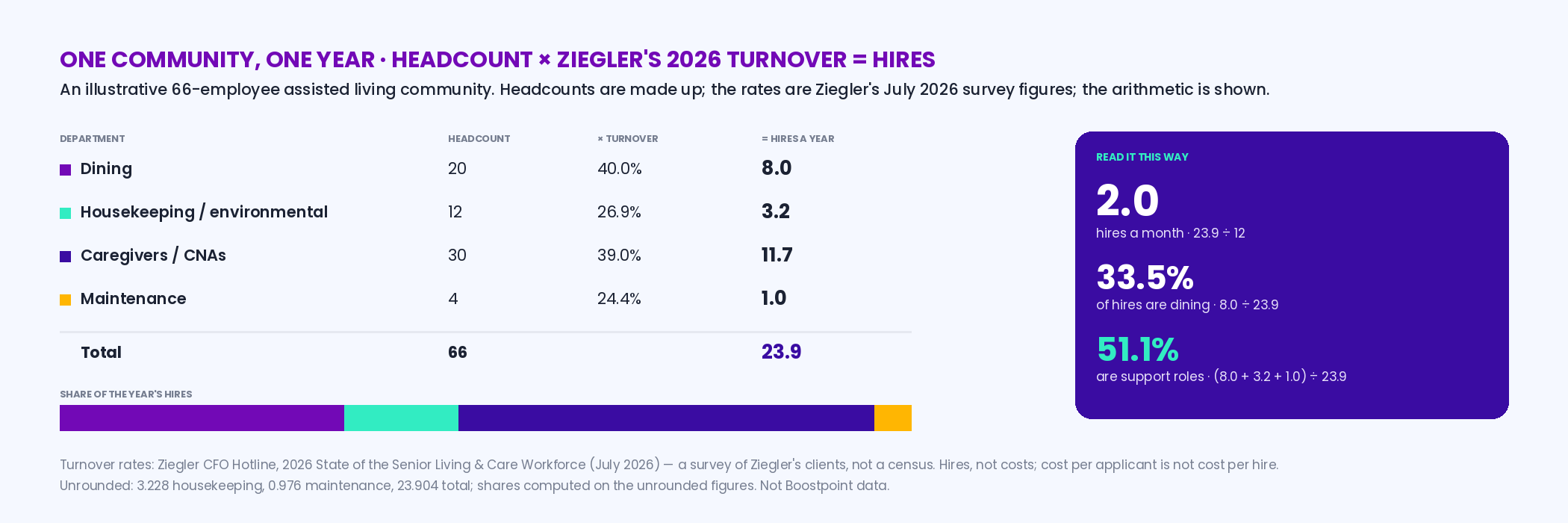
Headcount times turnover, by department. At Ziegler's 2026 rates, a community with 20 dining staff, 12 housekeepers, 30 caregivers and 4 maintenance staff produces about 23.9 hires a year — 8.0 in dining, 3.2 in housekeeping, 11.7 in care, 1.0 in maintenance — or roughly two a month, with dining a third of them. The planner on this page runs the arithmetic on your own numbers.
What are assisted living staffing requirements?
They are set by each state, not by federal rules; federal staffing standards apply to nursing homes, not assisted living. Requirements vary widely. California, for example, requires facilities with 16 to 100 residents to have, overnight, at least one awake employee on duty and another on call within ten minutes, and Florida requires at least one awake staff member at all hours in facilities with 17 or more residents, plus minimum weekly staff hours by size. Check your state licensing regulations.
Run the kitchen's ad next to the caregiver's
We'll write the server, housekeeper and activities campaigns as their own ads with one-question forms, run them where restaurant and hotel workers scroll, and show you the senior living campaigns closest to yours.
Book a DemoBoostpoint figures come from the 2026 Social Job Advertising Benchmark — 891 campaigns and 1,334 campaign-months: caregiver / home care median cost per applicant $3.76, 31% apply rate, 34 campaigns; CNA $7.72, 18%, 32; Healthcare & Senior Living sector $15.42 median, middle 50% $7.89–$39.61, 16%, 553 campaigns; event-driven $8.02, 21%. Earlier campaign-level analysis (different methodology): senior living setting $6.11 per applicant and 22.1% completion; home care $8.40 and 21.6%; hospital $17.82 and 6.0%. No dietary, housekeeping, activities or maintenance figure is published. Third-party figures — NCAL Assisted Living Facts & Figures (citing BLS QCEW and Genworth), NCAL state regulatory resources, Ziegler CFO Hotline 2026 State of the Senior Living & Care Workforce (July 2026), Argentum / Activated Insights 2026 Perceptions of Careers in Senior Living (June 2026), BLS Occupational Outlook Handbook (May 2024 medians), California Health & Safety Code §113948 — are theirs, read August 25, 2026, and attributed in place; regulatory notes are summaries, not legal advice. The planner and wage check are arithmetic on your inputs and BLS medians, not measured results. Cost per applicant is not cost per hire; we do not track hires and publish no cost-per-hire figure. A sample of Boostpoint campaigns, not an industry-wide study.