
Truck Driver Recruiting Agency Costs: Fees, Markups, and Direct Alternatives
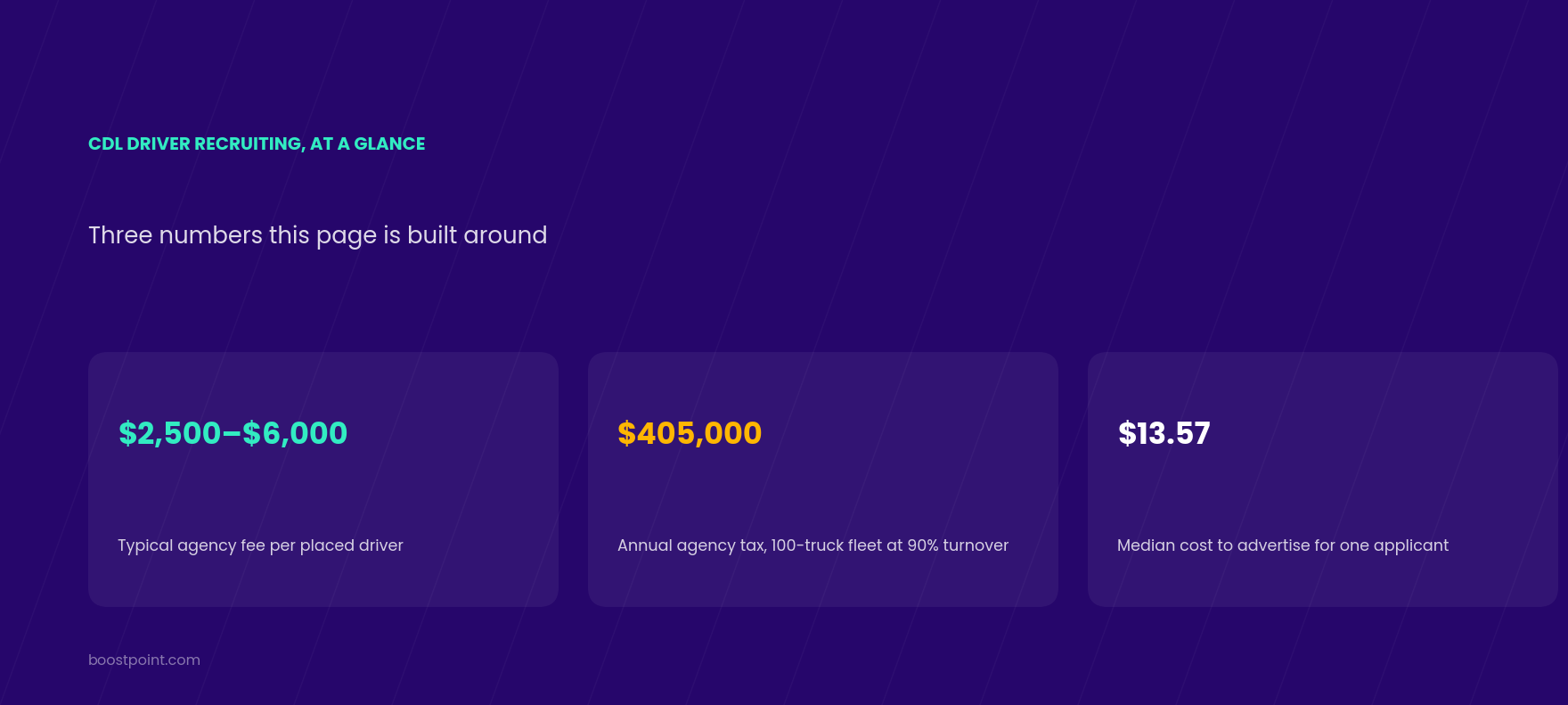
Truck driver recruiting agencies typically charge placement fees between $2,500 and $6,000+ per hired Class A CDL driver, or an hourly markup of 35% to 50% for temporary driver staffing. For a fleet hiring 20 company drivers per year, placement agency fees alone total $50,000 to $120,000 annually. By comparison, Boostpoint-managed social recruitment advertising yields CDL driver applicants at a median cost of $13.57 each — an ad cost per hire of roughly $135 to $1,357 depending on your screening conversion rate, still well under the agency fee at either end.
Source: Boostpoint campaign data — managed transportation and CDL recruitment campaigns conducted in 2025–2026 across motor carriers, private fleets, and agricultural cooperatives nationwide.
A note on who's writing this
Most guides evaluating CDL driver recruitment costs are written by driver recruiting agencies or contingency staffing firms. One cost they rarely price is the screen: since November 2024 a prohibited Clearinghouse status downgrades the license itself, which we cover on drug testing laws by state. Their business model depends on charging per placement or billing ongoing markups on driving hours, so their content treats high placement fees as an unavoidable cost of keeping trucks moving.
Boostpoint is not a recruiting agency. We build recruitment advertising software that helps motor carriers, private fleets, and logistics operations build their own direct pipelines of CDL drivers through targeted social media campaigns.
We aren't here to claim that driver recruiting agencies never serve a purpose — for specialized heavy-haul, urgent lane fill-ins, or small fleets with zero HR staff, agency assistance can be valuable. But we can provide the data agency guides omit: what it actually costs to generate qualified CDL driver applicants directly, backed by real 2026 campaign data across carriers nationwide.
What truck driver recruiting agencies actually charge
Driver recruiting services generally operate under two fee structures: contingency placement agencies (charging flat or percentage-based fees per hire) and driver staffing agencies (billing hourly markups as employer of record).
Published fee structures across CDL recruiting channels:
| Agency service type | Billing model | Typical cost per CDL driver |
|---|---|---|
| Contingency placement agency | Flat fee per hire | $2,500 – $6,000 per Class A driver |
| Executive / specialized search | % of 1st-year compensation | 15% – 25% ($11,250 – $18,750 on $75k driver) |
| Driver staffing agency (temp-to-hire) | Hourly wage markup | 35% – 50% above driver wage ($10–$15/hr markup) |
| Driver lease-purchase / owner-op sourcing | Per-placed-unit fee | $3,500 – $7,500 per placed truck |
Most standard company-driver contingency fees land between $2,500 and $5,000 per driver hire. These fees reflect the intense competition for CDL talent — demonstrated by paid search CPCs for terms like "driver recruiting" topping $60.52 per click. Placement fees, hourly markups and conversion fees across industries are compared side by side in staffing agency markup and fees.
What agency costs mean for fleet operations
Consider a medium-sized fleet hiring 25 Class A CDL company drivers per year to maintain fleet capacity (assuming average driver compensation of $72,000/year):
| Service model | Unit cost per driver | Total annual cost for 25 drivers |
|---|---|---|
| Low-tier contingency fee ($2,500/hire) | $2,500 | $62,500 |
| Standard contingency fee ($4,500/hire) | $4,500 | $112,500 |
| Percentage-based fee (20% of compensation) | $14,400 | $360,000 |
| Driver staffing agency markup (40% on $30/hr wage) | $24,960/yr per seat | $624,000 |
At a $4,500 contingency fee, a fleet replacing 25 drivers spends over $112,000 annually just on external agency fees.
The hidden arithmetic of CDL driver turnover
Here is the underlying economic challenge unique to transportation and trucking:
Industry turnover for long-haul and OTR fleets routinely ranges from 60% to over 90% annually.
When a fleet relies exclusively on contingency recruiting agencies, every driver who quits after 90 days forces the carrier to repurchase that exact same seat at full agency price.
| Annual fleet turnover rate | Drivers hired per year (100-truck fleet) | Annual agency fee at $4,500/hire |
|---|---|---|
| 30% turnover (Local / Dedicated) | 30 hires | $135,000 |
| 60% turnover (Regional) | 60 hires | $270,000 |
| 90% turnover (OTR / Long-Haul) | 90 hires | $405,000 |
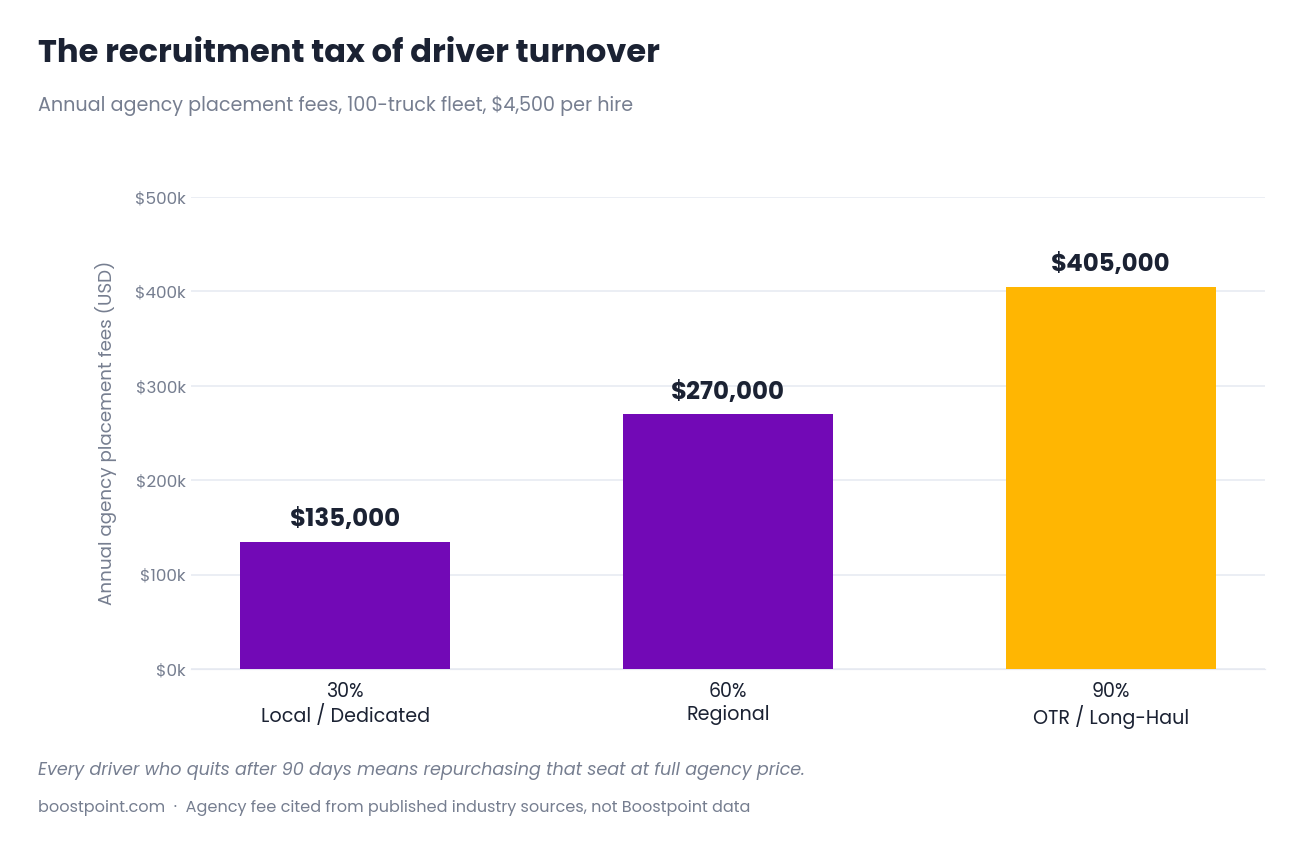
If a 100-truck fleet experiences 90% turnover, paying contingency placement agencies translates to a $405,000 annual recruitment tax. Agency fees solve the immediate vacancy, but they do nothing to reduce your underlying cost per applicant or establish long-term recruiting infrastructure.
What CDL roles cost to recruit directly
To determine if direct recruiting is viable, fleet managers need real benchmarks for direct CDL applicant acquisition costs.
Traditional job boards (Indeed, ZipRecruiter) struggle with driver recruiting because active job seekers are inundated with calls from hundreds of carriers. Conversely, passive candidate sourcing on Meta platforms (Facebook & Instagram) reaches working CDL drivers during off-duty hours at a lower acquisition cost — the full breakdown across every industry we track sits in our 2026 Transportation Benchmark Report.
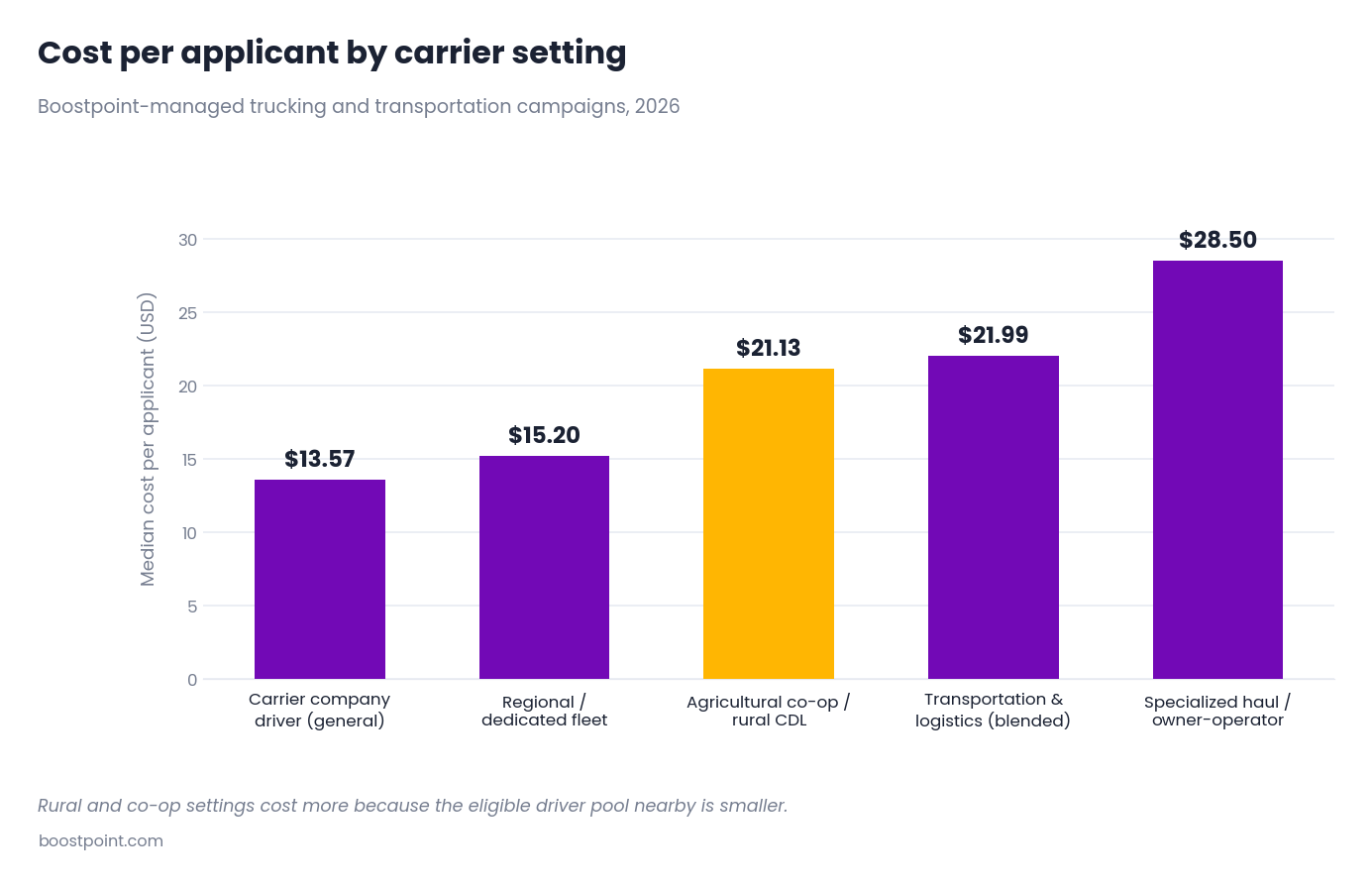
Across Boostpoint-managed trucking and transportation campaigns in 2026:
| Trucking role / employer setting | Cost per applicant (CPA) | Click-through rate |
|---|---|---|
| Carrier company driver (general) | $13.57 | 1.82% |
| Regional / dedicated fleet driver | $15.20 | 1.65% |
| Agricultural co-op / rural CDL driver | $21.13 | 1.08% |
| Transportation & logistics (blended average) | $21.99 | 1.25% |
| Specialized haul / owner-operator | $28.50 | 0.95% |
Source: Boostpoint campaign data — managed transportation and CDL recruitment campaigns conducted in 2025–2026 across motor carriers, private fleets, and agricultural cooperatives nationwide.
Data based on the 2026 Boostpoint Transportation Benchmark Report covering CDL campaigns nationwide. Rural driver recruitment costs follow a related pattern — see our agricultural driver recruiting data.
Calculating direct cost per CDL hire
Advertising budget generates driver applicants, not onboarded hires. To evaluate direct cost per hire, apply your fleet's screening and MVR qualification conversion rate.
Published industry estimates put a strong CDL screening funnel at roughly 1 hire for every 10 to 15 qualified applicants, accounting for MVR, clearinghouse, and experience screening. That's a reasonable target for an established carrier with a tight knockout form and a fast follow-up process — it is not a safe number to budget against on its own. Thinner markets, less selective screening, or a newer employer brand can easily push the real ratio to 1-in-50 or worse. The table below shows the cost at each of those scenarios, not just the best case.
| Applicant-to-hire rate | Cost per applicant | Applicants needed per hire | Ad cost per hire |
|---|---|---|---|
| 1 in 10 (strong funnel) | $13.57 | 10 | $135.70 |
| 1 in 20 | $13.57 | 20 | $271.40 |
| 1 in 50 | $13.57 | 50 | $678.50 |
| 1 in 100 (conservative) | $13.57 | 100 | $1,357.00 |
Rural and agricultural co-op settings run the same math at a higher CPA — $21.13, $422.60, $1,056.50, and $2,113.00 per hire across the same four ratios.
To hire 25 Class A company drivers directly through social recruitment ad campaigns, total direct advertising expense runs from roughly $3,393 at a strong 1-in-10 conversion rate to $33,925 at a conservative 1-in-100 rate — 250 to 2,500 applicants at $13.57 each.
Even at the conservative end, that's meaningfully cheaper than the agency alternative. Against the standard $112,500 contingency fee for 25 drivers, direct advertising runs from about 3% of that cost at a 1-in-10 conversion rate up to roughly 30% at 1-in-100 — before factoring in internal recruiting staff time, orientation pay, and drug testing on the direct side. Which end of that range you land on depends entirely on your screening funnel and follow-up speed, which is why the calculation in the next section is worth running against your own numbers rather than ours.
Before comparing any of these fees, it is worth establishing which kind of agency is quoting you. The phrase covers four different businesses, and the one that decides who holds your driver qualification file is not the one printed on the invoice — the four models behind "driver recruiting agency" sets them side by side.
When a driver recruiting agency is the right call
Direct advertising is not always the complete answer. Truck driver recruiting agencies serve valid operational roles under specific fleet circumstances.
Use a driver recruiting agency when:
- You face sudden, extreme volume spikes. If you land a new dedicated contract requiring 30 drivers in 10 days, agencies can pull from pre-screened talent pools.
- Recruiting highly specialized freight classes. For specialized oversize/heavy-haul, hazmat, or niche equipment roles where the eligible candidate pool in a region is under 50 drivers.
- You have no internal recruiting infrastructure. Small fleets (under 10 trucks) without dedicated HR staff may prefer paying per-hire fees over managing screening workflows.
- Filling temporary seasonal peaks. Short-term seasonal contracts where carrying permanent drivers on payroll would spike unemployment rates.
When direct advertising makes more sense
Recruit directly when:
- Filling permanent, ongoing fleet capacity. If your fleet maintains 20+ trucks year-round, paying $4,500 per seat replacement is an unsustainable operational drag.
- Reducing excessive turnover spend. Direct campaigns showcase your actual equipment, home time, pay packages, and culture — attracting drivers who fit your specific lanes rather than generic agency leads.
- Building a proprietary driver pipeline. Direct advertising builds a database of local CDL drivers who know your brand and can be re-engaged via automated SMS when future seats open.
- Recruiting local or regional drivers. Home-daily and home-weekly drivers respond strongly to localized social media ads highlighting specific routes and home time guarantees.
The honest summary
Agencies rent talent at a premium. Direct recruitment advertising builds fleet equity.
If your carrier needs emergency driver capacity for a short-term contract, paying agency placement fees is an acceptable cost of doing business. But if you rely on agencies to fill standard seat turnover because traditional job boards produce empty leads, you are paying a $4,500 premium for a solvable candidate generation problem.
Top-performing fleets employ a balanced model: direct recruitment advertising to handle 90%+ of ongoing hiring needs, keeping driver acquisition costs under $300 per hire, while reserving agencies strictly for emergency expansion.
The calculation worth running this quarter
Four metrics every fleet manager and fleet recruiting director should analyze together:
- Calculate total annual placement agency spend. Sum all agency placement invoices and temp agency markups paid over the last 12 months.
- Determine cost per agency hire vs. internal hire. Divide total agency spend by agency hires made, and compare against direct recruitment campaign expenses.
- Audit driver retention by source. Track 90-day retention rates for agency-placed drivers versus direct-hire drivers. Agency leads frequently show higher early turnover due to lack of brand affinity.
- Evaluate application friction. CDL drivers apply on mobile devices while parked at truck stops. Switching from a multi-page ATS application to a 1-minute mobile knockout form dramatically increases applicant conversion.
Frequently asked questions
How much do truck driver recruiting agencies charge per hire?
Contingency driver recruiting agencies typically charge $2,500 to $6,000 per placed CDL driver. Executive search or specialized fleet recruitment firms charge 15% to 25% of the driver's first-year salary ($11,000 to $18,000+).
How much do driver staffing agencies charge per hour?
Temporary driver staffing agencies usually bill a 35% to 50% markup over base hourly wages. For a CDL driver earning $30/hour, the agency bill rate ranges from $40.50 to $45.00+ per hour.
What is the average cost per applicant for CDL drivers using direct social ads?
Based on Boostpoint 2026 benchmark data, direct social media recruitment campaigns generate company driver applicants at a median cost of $13.57 per applicant for general carriers, and $21.13 per applicant in rural/agricultural markets.
Why is paid search CPC so high for driver recruiting terms?
Keywords like "driver recruiting" command pay-per-click rates exceeding $60.00 because carriers and agencies compete aggressively for active CDL job seekers on search engines. Social media recruiting avoids this bidding war by engaging passive drivers in their feeds.
How many applicants are needed to make one CDL driver hire?
Due to MVR checks, Clearinghouse records, experience requirements, and drug screening, published estimates put a strong carrier funnel at 10 to 15 qualified applicants per hire. That's the best-case figure, not a guarantee — thinner markets or looser screening can push the real ratio to 50 or more, which is why it's worth modeling your cost per hire at several conversion rates rather than the optimistic one alone.
Is direct social recruitment advertising effective for hiring CDL drivers?
Yes. Over 90% of professional truck drivers actively use social media platforms like Facebook and Instagram during off-duty hours. Mobile-optimized short-form application campaigns deliver immediate applicant flow within 24 to 48 hours of launch.
What is a standard temp-to-hire conversion fee for CDL drivers?
If a carrier converts a temporary staffing agency driver into a direct employee before fulfilling the contract period, agencies typically charge a conversion fee ranging from 10% to 20% of the driver's annualized pay.
See what it costs to recruit CDL drivers directly
Book a 30-minute strategy call with our transportation recruiting team. We'll analyze your hiring lanes, review CDL cost-per-applicant data in your operating regions, and demonstrate how to build a direct driver pipeline.
Book a Demo →Explore Transportation Benchmark Data →





If you are weighing an agency against doing it yourself, the part you keep either way is the interview. See truck driver interview questions and, for passenger work, bus driver interview questions.
Boostpoint figures are derived from managed transportation and CDL recruitment campaigns conducted in 2025–2026 across motor carriers, private fleets, and agricultural cooperatives nationwide. Cost-per-applicant metrics reflect what advertisers paid for advertising. Agency placement fee ranges, staffing markup percentages, and turnover benchmarks are cited from published industry sources and are not Boostpoint data; actual agency rates vary by region, freight class, and contract volume. Cost-per-hire calculations use illustrative conversion assumptions and are not drawn from attributed hire data.