
Manufacturing Staffing Agency Costs: Markups, Bill Rates, and Direct Alternatives
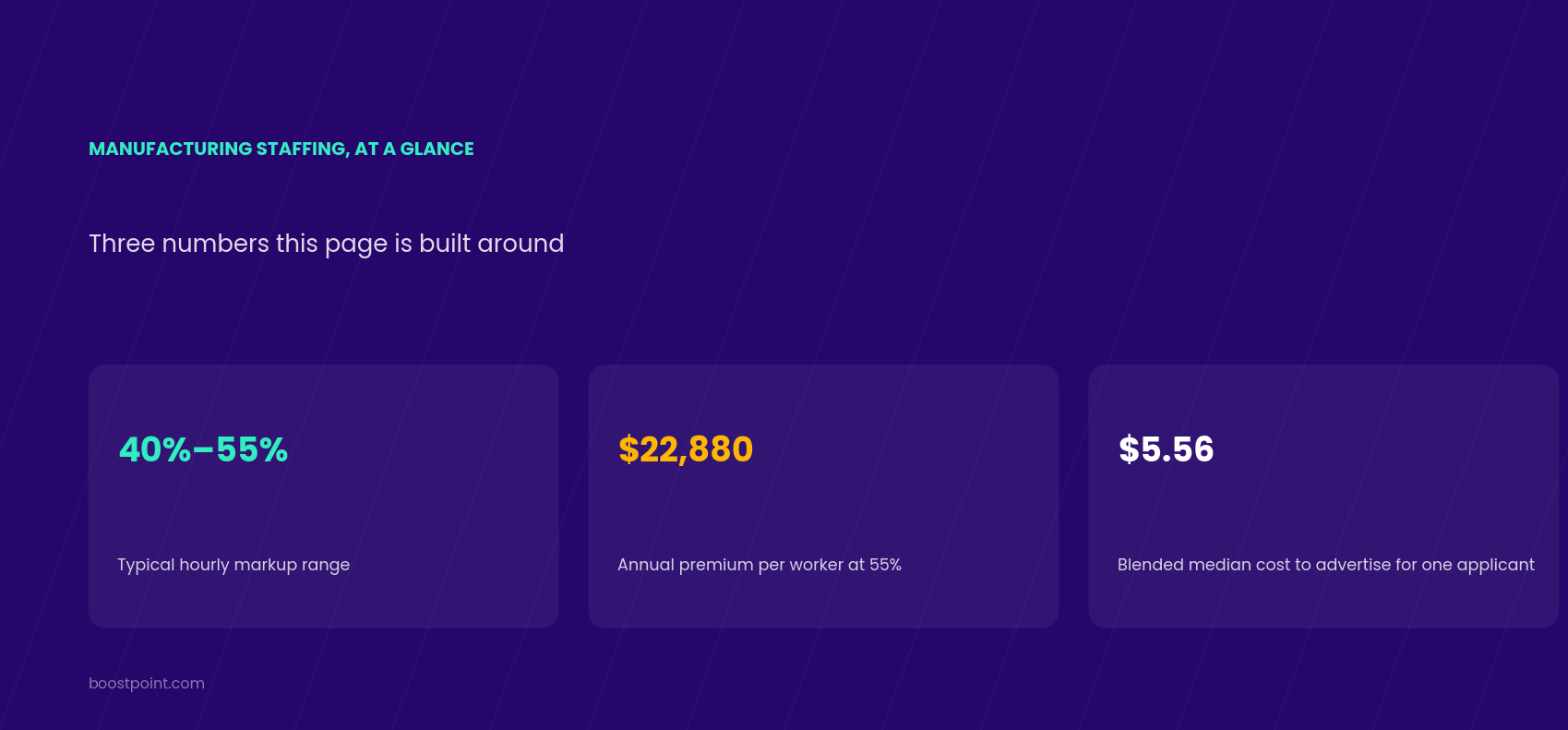
Manufacturing staffing agencies typically charge a 40% to 55% markup on hourly worker wages. For a manufacturing production associate earning $20.00/hour, the agency bill rate sits between $28.00 and $31.00 per hour — adding $16,640 to $22,880 in annual markup costs per worker. Across a 20-worker plant floor, that markup alone costs $332,800 to $457,600 per year.
A note on who's writing this
Most articles reviewing manufacturing staffing agency costs are written by industrial temp agencies. Their business model relies on charging an hourly bill rate for as long as a worker remains on your plant floor, so their content naturally frames agency markups as the normal cost of maintaining production capacity.
Boostpoint is not a staffing agency. We build recruitment advertising software that helps plant managers, HR directors, and industrial operations generate their own direct job applicants through targeted social media campaigns.
We aren't here to claim staffing agencies never make sense — during sudden contract surges or unexpected line expansions, temp labor is indispensable. But we can supply the data agency guides leave out: what it actually costs to build a direct pipeline of manufacturing applicants using targeted advertising, backed by 2026 campaign data across production facilities nationwide.
What manufacturing staffing agencies actually charge
Manufacturing roles — including general assemblers, machine operators, quality control technicians, material handlers, and CNC machinists — are typically billed on an hourly markup basis. The agency acts as the employer of record, carrying payroll, taxes, and workers' compensation while billing your plant an hourly rate above the worker's base wage.
Published markup ranges across manufacturing segments:
| Segment / role family | Typical agency markup range |
|---|---|
| General Assembly & Packaging | 40% – 50% |
| Machine Operation & Production | 40% – 55% |
| Quality Control & Warehouse Logistics | 45% – 55% |
| CNC Machining & Specialized Trades | 45% – 60% |
| High-Hazard Manufacturing & Heavy Industrial | 50% – 65% |
Most light-to-medium manufacturing contracts cluster between 40% and 55%. Markups sit higher than standard clerical roles due to plant floor safety risks and higher workers' compensation classifications — a pattern that shows up in light industrial staffing markups as well. Cross-industry markup ranges, with a calculator, are in staffing agency markup and fees.
What that markup means per hour and per worker
Consider standard hourly wage rates across common manufacturing roles working full-time (2,080 hours per year):
| Plant role | Base wage | 40% markup bill rate | 55% markup bill rate | Annual agency markup premium per worker | Total annual cost per seat |
|---|---|---|---|---|---|
| Assembly Associate | $18.00/hr | $25.20/hr | $27.90/hr | $14,976 – $20,592 | $52,416 – $58,032 |
| Production Operator | $20.00/hr | $28.00/hr | $31.00/hr | $16,640 – $22,880 | $58,240 – $64,480 |
| CNC Machinist | $28.00/hr | $39.20/hr | $43.40/hr | $23,296 – $32,032 | $81,536 – $90,272 |
| Maintenance Tech | $34.00/hr | $47.60/hr | $52.70/hr | $28,288 – $38,896 | $99,008 – $109,616 |
At a 55% markup on a $20/hour production operator, you pay $64,480 annually for labor where the worker receives $41,600 in direct wages.
The headcount markup plant managers rarely add up
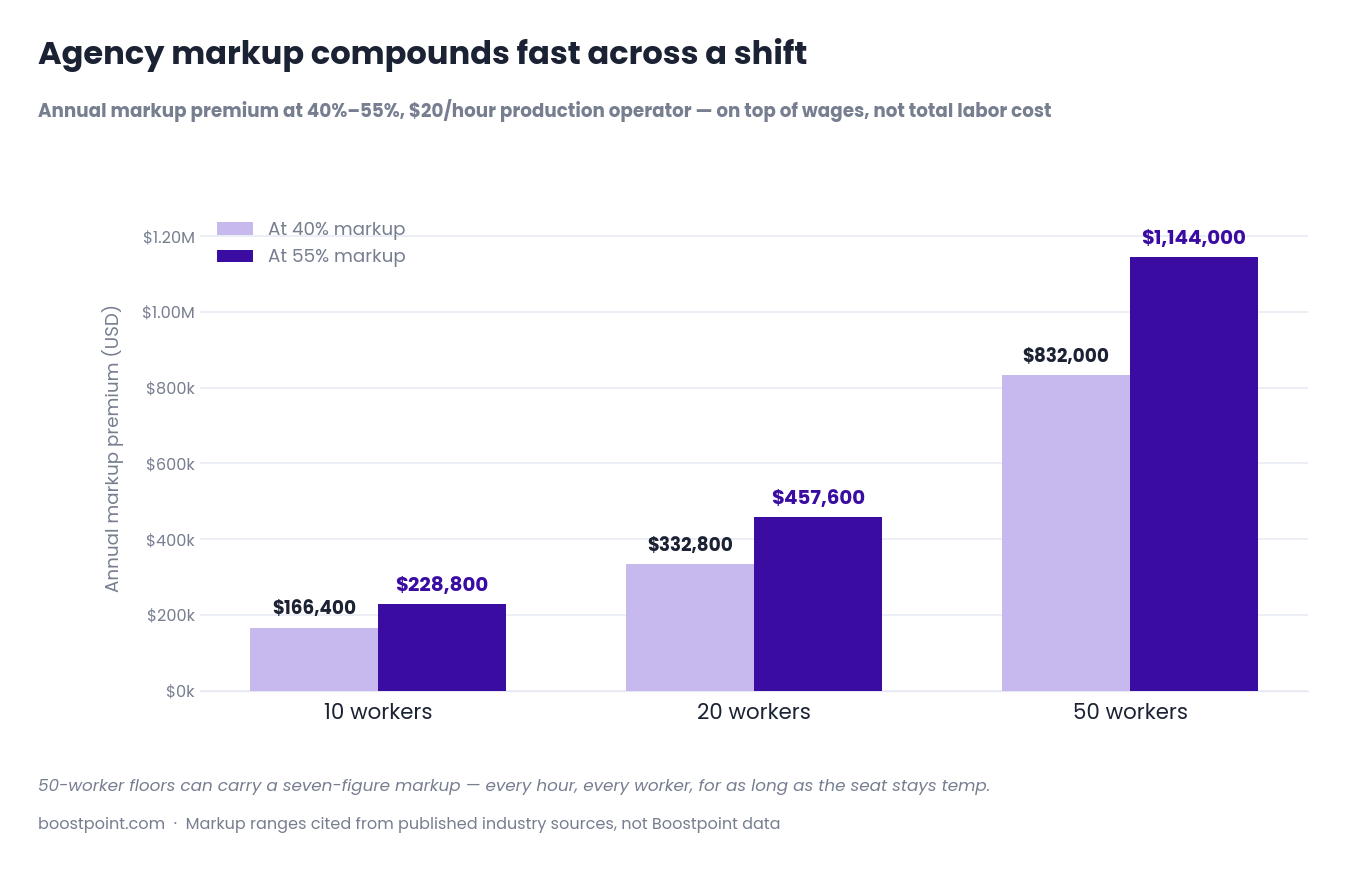
The bill rate for one temp worker rarely triggers concern. The true financial weight hits when markup compounds across total shift headcount and plant turnover.
Manufacturing facilities staff shifts and lines, not isolated individuals.
| Headcount on temp labor | Annual markup premium (at 40%–55%) |
|---|---|
| 10 workers | $166,400 – $228,800 |
| 20 workers | $332,800 – $457,600 |
| 50 workers | $832,000 – $1,144,000 |
Figures reflect pure agency markup paid above worker base pay for $20/hr production roles.
How turnover multiplies your agency bill
Manufacturing turnover averages 30% to 50% annually across production facilities. When a temp worker leaves after two months, you do not stop paying the markup. You pay the exact same 40%–55% markup on their replacement, plus the productivity loss during line re-training.
Net agency margin context: the 40%–55% markup is not pure profit for the agency. It covers employer FICA, FUTA/SUTA, state workers' compensation insurance, recruiting costs, and administrative overhead. Net profit margins for industrial staffing agencies typically run 8% to 15%. Transitioning workers in-house means absorbing payroll taxes and insurance directly — while completely eliminating the agency's net profit margin and external sourcing cut.
What manufacturing roles cost to recruit directly
To evaluate whether direct recruiting makes financial sense, manufacturing leaders need real candidate acquisition benchmarks.
Traditional job boards struggle with frontline production recruiting because active job seekers in these roles are limited. However, targeted passive candidate campaigns on social platforms (Facebook & Instagram) reach working local candidates during off-shift hours — the full pattern across every industry we track is in our published 2026 Social Job Advertising Benchmark data.
Across Boostpoint-managed manufacturing campaigns in 2026:
| Manufacturing role category | Cost per applicant (CPA) | Application completion rate |
|---|---|---|
| Assembly & Material Handling | $3.50 | 21.5% |
| CNC & Machine Operators | $4.15 | 18.2% |
| Blended Manufacturing Average | $5.56 | 17.4% |
| Quality Control & Tooling Techs | $8.20 | 15.1% |
| Maintenance Technicians | $11.83 | 12.0% |
Source: Boostpoint campaign data — 110 managed manufacturing recruitment campaigns conducted in 2025–2026 across industrial facilities nationwide.
Data based on the 2026 Boostpoint Manufacturing Benchmark Report covering 110 distinct plant recruitment campaigns.
Calculating direct cost per hire across realistic screening ratios
Advertising budget produces applicants, not finished hires on the plant floor. Depending on your facility's drug testing, background checks, and attendance vetting, conversion rates vary significantly.
Here is what direct ad cost per hire looks like across three candidate screening scenarios:
| Manufacturing role | Cost per applicant (CPA) | 1 in 10 hire rate (10% — high-touch) | 1 in 50 hire rate (2% — realistic standard) | 1 in 100 hire rate (1% — strict vetting) |
|---|---|---|---|---|
| Assembly & Material Handling | $3.50 | $35.00 | $175.00 | $350.00 |
| CNC & Machine Operators | $4.15 | $41.50 | $207.50 | $415.00 |
| Quality Control Tech | $8.20 | $82.00 | $410.00 | $820.00 |
| Maintenance Technician | $11.83 | $118.30 | $591.50 | $1,183.00 |
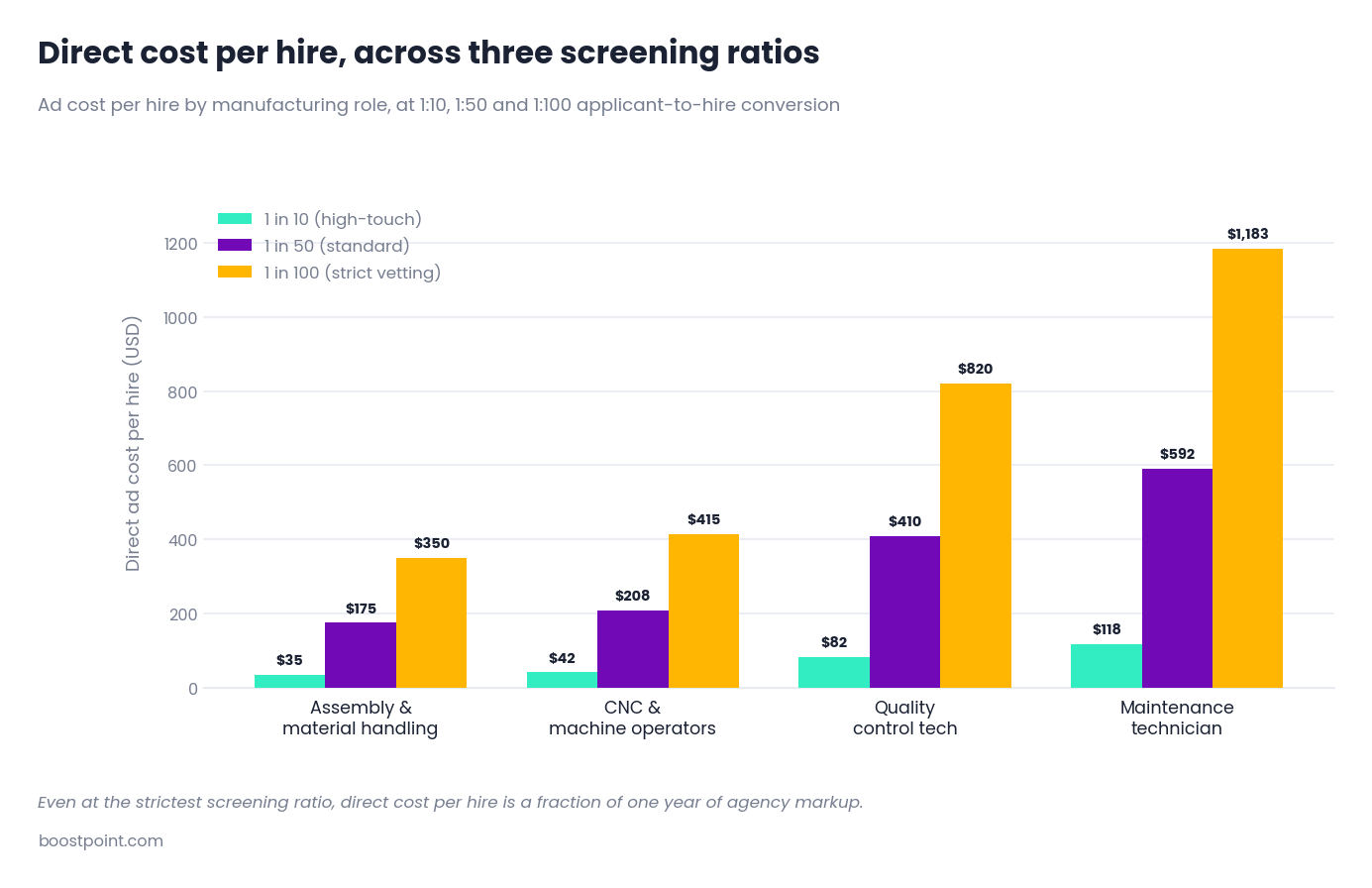
Even under a conservative 1 out of 100 hire rate — where you screen 100 applicants to hire 1 production associate — advertising expense for core roles runs $350 to $415 per hire for Assembly and CNC positions. Compare that to the $16,640 to $22,880 annual markup paid to a staffing agency for a single seat.
When a manufacturing staffing agency is the right call
Direct advertising is not a total replacement for contingent labor. Agencies serve valuable operational needs during extreme production volatility.
Use a manufacturing staffing agency when:
- You face acute, short-term contract surges. If you win a 60-day production run requiring 20 extra assemblers, hiring permanent employees only to lay them off in eight weeks hurts your unemployment tax rating and community reputation.
- Production demand is highly unpredictable. If client orders fluctuate month-to-month, contingent labor lets you treat staffing strictly as a variable expense.
- You need bodies on the floor tomorrow morning. Advertising campaigns build candidate flow over days and weeks. If a shift is short tomorrow, an agency temp roster is your fastest operational patch.
- You have zero internal recruiting bandwidth. If your HR coordinator has no bandwidth to screen 100 incoming applications, agencies supply a pre-screened worker.
When direct advertising makes more sense
Recruit directly when:
- Roles represent core, baseline headcount. If a line position is filled 365 days a year, paying a 45% markup indefinitely is an inefficient drain on plant margins.
- Eliminating "permanent temp floors." If 20% of your production floor has been staffed by agency temps for over six months, you are paying surge pricing for permanent staffing.
- Improving safety, quality, and scrap rates. Direct hires show higher retention, better process adherence, lower scrap rates, and stronger engagement than temporary workers.
- Opening a new facility or adding a permanent shift. Planned expansions afford the 2-to-4 week runway needed to run social ad campaigns and build talent pipelines before launch.
The honest summary
Agencies manage short-term line volatility. Direct recruitment advertising builds permanent workforce capacity.
If your production schedule swings wildly from month to month, agency markups are a reasonable fee for operational flexibility. But if you rely on staffing agencies to maintain your core plant workforce because traditional job boards stopped generating applicants, you are paying permanent surge pricing for a fixable recruiting problem.
Leading manufacturing plants adopt a strategic hybrid model: direct recruitment advertising to maintain 85% to 90% baseline floor capacity, keeping recruitment costs under $400 per hire even at strict screening ratios, while reserving agency labor exclusively for surge peaks.
The calculation worth running this quarter
Four metrics plant managers and HR leaders should calculate together:
- Calculate total annual markup premium. Take total agency invoicing over the last 12 months and subtract direct wages paid to workers. That difference represents your agency markup tax.
- Audit long-tenure temp associates. Count how many temporary workers have been on your plant floor longer than 90 days. These represent baseline core roles.
- Run cost-per-hire math against screening ratios. Compare your annual agency markup against direct advertising costs across realistic 1:50 or 1:100 conversion ratios.
- Evaluate mobile application friction. Production workers apply on mobile devices during breaks. A 1-minute mobile application process drastically increases conversion over long ATS forms.
Frequently asked questions
How much does a manufacturing staffing agency charge?
Manufacturing staffing agencies typically charge a 40% to 55% markup over base hourly wages. For a production associate earning $20.00/hour, the agency bill rate ranges from $28.00 to $31.00 per hour.
Why are manufacturing staffing markups higher than commercial office markups?
Manufacturing roles carry higher workers' compensation classifications due to physical job duties, machinery operation, and plant floor environments. Agencies absorb this added liability, increasing markups to cover insurance overhead.
What is the average cost per applicant for manufacturing roles on social media?
Based on Boostpoint 2026 benchmark data, general assembly applicants cost $3.50 each, CNC machine operators average $4.15, quality control techs average $8.20, and specialized maintenance technicians average $11.83 per applicant.
How much does direct advertising cost per hire for manufacturing roles?
At a standard 1 out of 50 screening ratio (2% conversion), direct ad cost per hire is $175 for general assembly, $207.50 for CNC operators, and $591.50 for maintenance techs.
Is direct hiring cheaper than using a manufacturing staffing agency?
For permanent baseline staffing, direct hiring is significantly cheaper. Direct advertising generates candidates for $175 to $400 in ad spend per hire (even at conservative screening rates), compared to $16,000 to $22,000+ per worker in annual agency markup.
What is a standard temp-to-hire conversion fee in manufacturing?
If a plant converts an agency temp worker into a permanent employee before fulfilling the contract period (usually 90 to 180 days), agencies charge a conversion fee ranging from 10% to 20% of the worker's annualized salary.
See what it costs to fill manufacturing roles directly
Book a 30-minute strategy call with our industrial recruiting team. We'll analyze your local labor market, review cost-per-applicant benchmarks for your specific plant roles, and show you how to build a direct hiring pipeline.
Book a Demo →Boostpoint figures are derived from 110 managed manufacturing recruitment campaigns conducted in 2025–2026 across industrial facilities nationwide. Cost-per-applicant metrics reflect what advertisers paid for advertising. Staffing agency markups and conversion fee figures are compiled from published manufacturing financial audits, SIA reports, and third-party staffing benchmark data.