
Light Industrial Staffing: Costs, Agency Markups, and Direct Alternatives
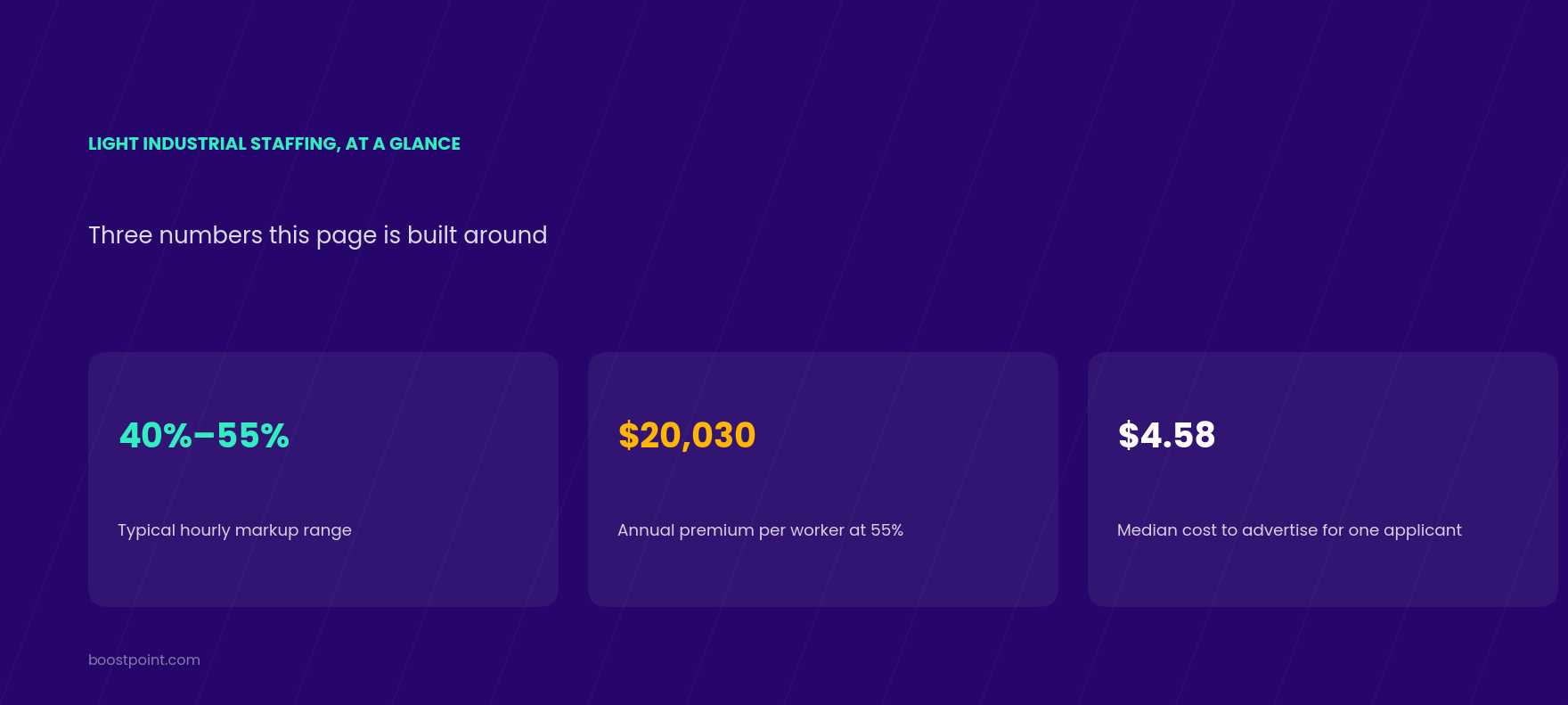
Light industrial staffing agencies typically charge a 40% to 55% markup on hourly worker wages. For a light industrial associate earning $17.50/hour, the agency bill rate sits between $24.50 and $27.13 per hour — adding $14,560 to $20,030 in annual costs per worker. Across a 25-worker plant floor, that markup alone costs $364,000 to $500,750 per year.
A note on who's writing this
Nearly every guide on light industrial staffing is written by a staffing agency. They know the industry inside out, but their framing naturally favors contingent staffing: agency markups are presented as standard administrative overhead, and direct recruitment alternatives rarely get fair arithmetic.
Boostpoint is not a staffing agency. We build recruitment advertising software that helps manufacturers, warehouses, and industrial operations hire frontline workers directly through targeted social media campaigns.
We aren't going to tell you staffing agencies never make sense — in seasonal peaks, they are indispensable. But we can provide the data agencies leave out: what it actually costs to build your own pipeline of light industrial applicants using direct advertising, backed by real campaign data across production floors nationwide.
What light industrial staffing actually costs
Light industrial roles — including assembly line workers, machine operators, material handlers, pickers/packers, and shipping clerks — are usually billed on an hourly markup basis rather than a flat recruitment fee. The agency acts as the employer of record, handles payroll, and bills your plant an hourly rate above the worker's base wage.
Published industry markups for light industrial positions:
| Source | Light industrial markup range |
|---|---|
| LG Resources | 40%–55% |
| The Resource Company | 40%–55% |
| getproductiv | 45%–55% |
| Hunter Recruiting | 35%–60% |
| Freelance Pricing | 35%–55% |
| USA Staffing Services | 25%–40% |
| Instawork | 25%–50% (W2 labor) |
Most sources cluster tightly between 40% and 55%. Light industrial markups sit higher than commercial office or clerical roles because of workers' compensation risk. Industrial environments carry higher injury rates, pushing the agency's underlying insurance costs up — costs passed directly to you in the bill rate.
What that markup means per hour and per worker
Consider a light industrial assembler or operator earning $17.50 per hour, working 2,080 hours per year:
| Agency markup | Hourly bill rate | Hourly agency markup | Annual markup premium per worker | Total annual cost per seat |
|---|---|---|---|---|
| 25% (Low tier) | $21.88 | $4.38 | $9,110 | $45,510 |
| 40% (Standard) | $24.50 | $7.00 | $14,560 | $50,960 |
| 55% (High tier) | $27.13 | $9.63 | $20,030 | $56,430 |
At a 55% markup, you pay $56,430 per year for an employee who receives $36,400 in wages.
The number plant managers rarely add up
The total bill rate rarely causes shock on its own. The real financial weight hits when you calculate markup across total headcount and turnover.
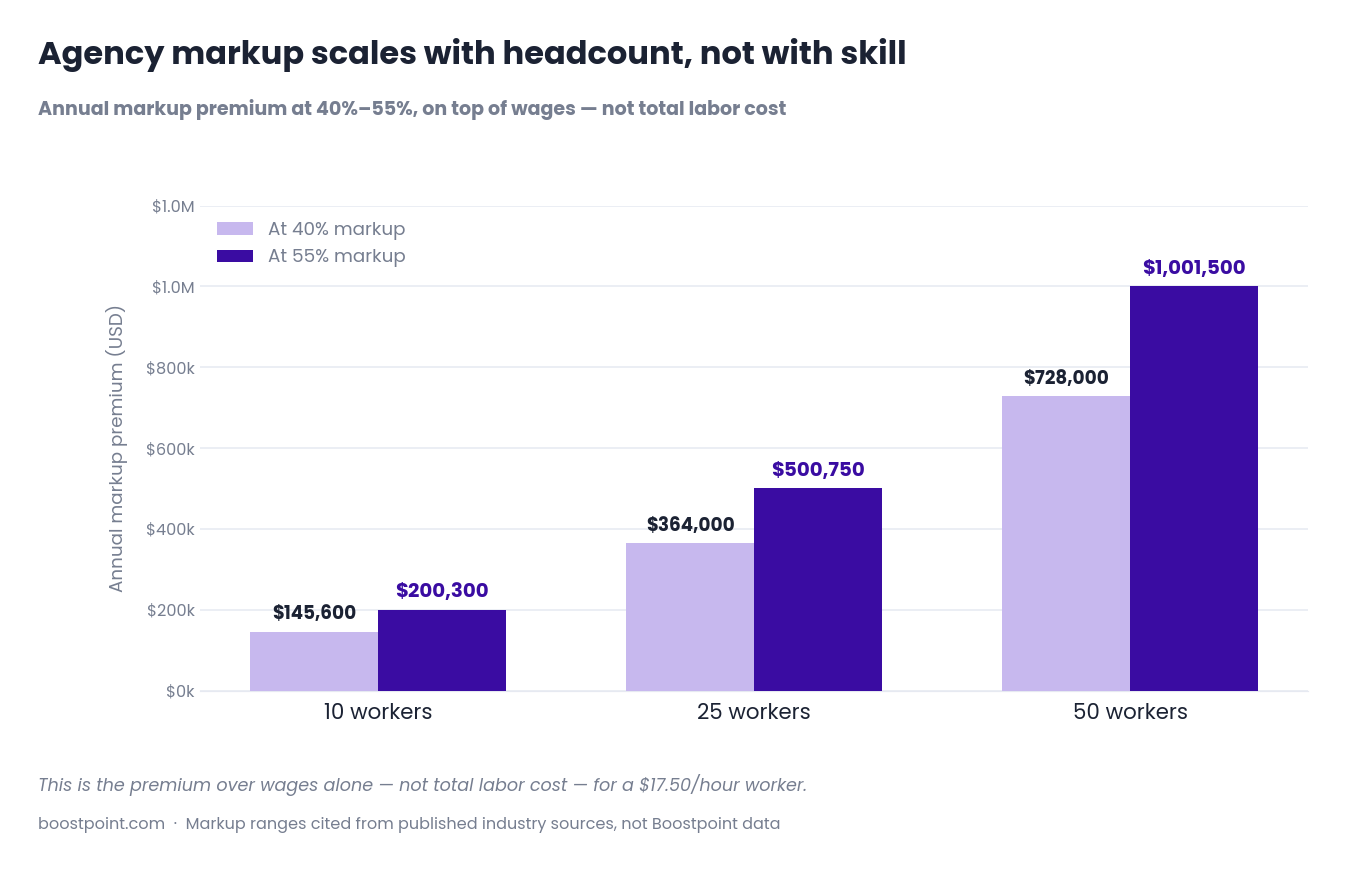
Light industrial operations rarely hire just one worker; they manage shifts and entire floors.
| Headcount on temp labor | Annual markup premium (at 40%–55%) |
|---|---|
| 10 workers | $145,600 – $200,300 |
| 25 workers | $364,000 – $500,750 |
| 50 workers | $728,000 – $1,001,500 |
Figures exclude base worker wages; this represents pure markup paid to the agency.
How turnover multiplies your staffing bill
Light industrial turnover averages 30% to 60% annually across manufacturing and distribution. When a temp worker leaves after three months, you do not stop paying the markup. You pay the same 40%–55% markup on the replacement worker, plus the hidden productivity loss during onboarding and training. How warehouses get ahead of that churn with direct recruiting is in warehouse recruiting: the 2026 playbook.
An important note on agency margins: that 40%–55% markup is not pure profit for the agency. Out of that margin, the staffing firm pays employer FICA, FUTA/SUTA, workers' compensation insurance, recruiting costs, and administrative payroll overhead. Net profit margins for staffing agencies typically sit between 8% and 15%. If you transition positions in-house, you absorb payroll taxes and workers' comp — you simply eliminate the agency's margin and external recruiting fees.
What the same roles cost to recruit directly
To evaluate whether direct hiring makes financial sense, you need to know what it costs to generate qualified light industrial applicants yourself.
Job boards struggle with frontline industrial roles because active job seekers in these categories are limited. However, passive candidate sourcing on platforms like Facebook and Instagram delivers predictable volume at significantly lower costs — the full breakdown across every role we track sits in our published Social Job Advertising Benchmark data.
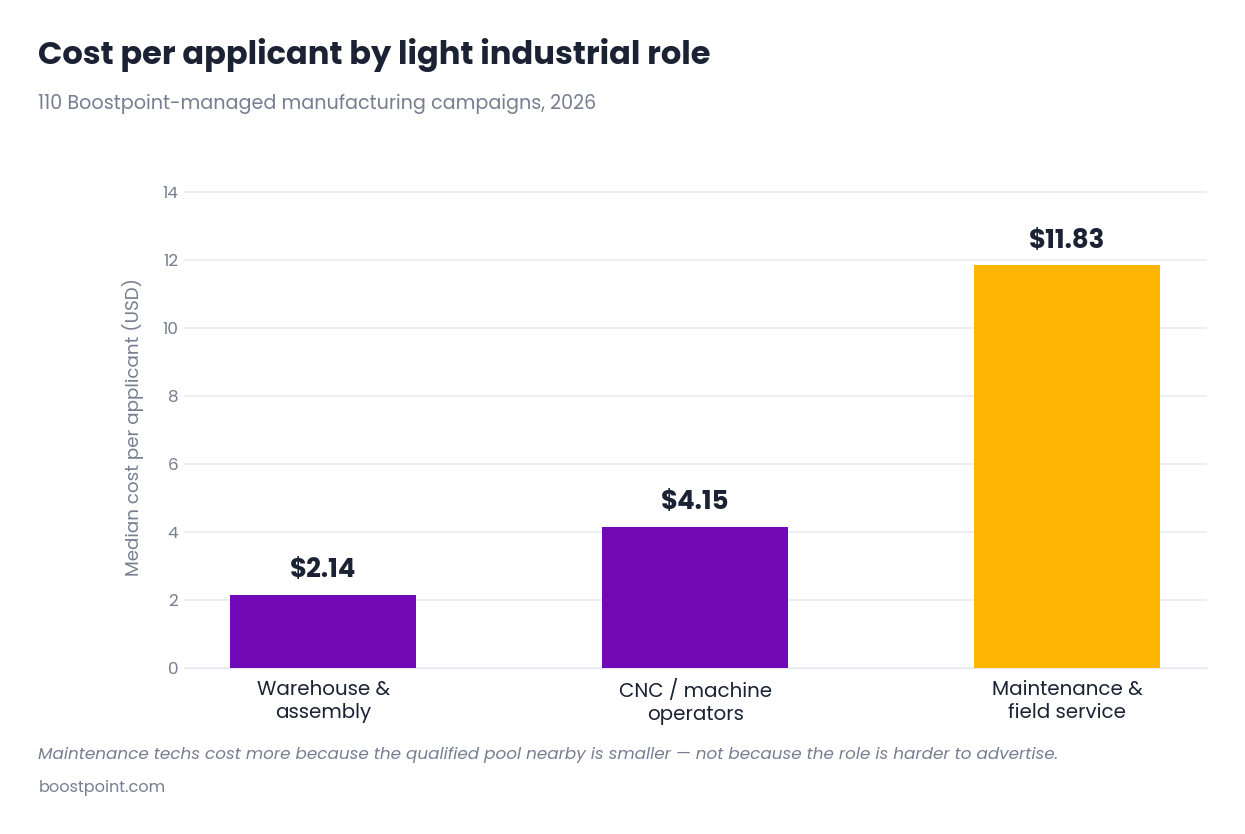
Across Boostpoint-managed manufacturing and light industrial campaigns in 2026:
| Light industrial role category | Cost per applicant (CPA) |
|---|---|
| Warehouse & assembly / material handling | $2.14 |
| CNC / machine operators | $4.15 |
| Maintenance & field service techs | $11.83 |
| Blended average (all manufacturing roles) | $5.56 |
| Median campaign CPA | $4.58 |
Source: Boostpoint campaign data — 110 managed manufacturing and industrial recruitment campaigns conducted in 2026, encompassing thousands of applicant interactions across North America.
Data based on Boostpoint internal benchmark studies covering 110 distinct manufacturing and industrial campaigns. Cost per applicant includes direct ad spend and platform campaign management.
Calculating direct cost per hire
Advertising produces applicants, not finished hires. To calculate your cost per hire, apply your internal screening-to-hire ratio.
Assuming a 10% applicant-to-hire ratio (you hire 1 out of every 10 applicants):
| Role | Cost per applicant | Applicants needed per hire | Ad cost per hire |
|---|---|---|---|
| Assembly / material handler | $2.14 | 10 | $21.40 |
| Machine operator | $4.15 | 10 | $41.50 |
| Maintenance technician | $11.83 | 10 | $118.30 |
To hire 25 general assembly workers directly through social ad campaigns, total advertising cost runs approximately $535 (250 applicants × $2.14). Even adding internal HR screening time, bringing those 25 roles in-house costs a fraction of the $364,000+ paid in annual staffing agency markups.
When a light industrial staffing agency is the right call
Direct hiring is not a universal solution. Staffing agencies exist because contingent labor solves specific operational headaches.
Use an agency when:
- You face acute seasonal surges. If you need 40 extra workers for an 8-week holiday rush, hiring permanent staff only to lay them off two months later destroys your unemployment rating and employer brand.
- Production demand is highly volatile. When contract wins or client volume fluctuates month-to-month, contingent labor lets you treat staffing strictly as a variable cost.
- You need bodies on the floor immediately. Advertising campaigns build applicant flow over days and weeks. If a shift is short tomorrow morning, a staffing agency's temp roster is your only immediate fix.
- You want to offload workers' compensation liability. In high-risk plant environments, carrying contingent workers on the agency's policy protects your internal experience modification rate (EMR).
- You lack internal recruiting bandwidth. If your HR team has no capacity to process 100+ incoming applications, the agency provides an essential screening service.
When direct advertising makes more sense
Recruit directly when:
- Roles represent core, baseline headcount. If a position is filled 365 days a year, paying a 45% markup indefinitely is an inefficient use of budget.
- You operate a "permanent temp floor." If 20% of your plant floor has been staffed by agency temps for over six months, you are paying surge pricing for permanent labor.
- Turnover is driven by low engagement. Direct hires generally show higher retention, better cultural integration, and stronger attendance than temporary workers.
- You are expanding or opening a new facility. Planned facility expansions provide lead time to run targeted social recruitment campaigns, building a deep talent pipeline before doors open.
The honest summary
Agencies manage short-term operational volatility. Direct advertising builds long-term workforce stability.
If your labor demands swing wildly from month to month, agency markups are a reasonable fee for flexibility. But if you rely on staffing agencies to maintain your core plant workforce because job boards stopped generating applicants, you are paying a permanent premium for a fixable recruiting problem.
Most successful industrial operations adopt a hybrid model: direct recruitment advertising to maintain 85–90% baseline staffing, supplemented by agency labor during peak surges. It's the same pattern that shows up in our warehouse staffing markup analysis, where a similar split between baseline and surge labor holds.
The calculation worth running this quarter
Before renewing your next staffing agency contract, evaluate these four metrics:
- Calculate your annual markup premium. Take your total agency spend over the last 12 months and subtract direct worker wages. That remainder is what you paid for access and administration.
- Identify long-tenure temps. Count how many temporary workers have been on your floor longer than 90 days. These are baseline roles disguised as temp needs.
- Determine your true cost per productive hour. Add bill rates, onboarding downtime, and turnover replacement costs together.
- Compare against direct acquisition cost. Multiply your required hiring headcount by your estimated ad cost per hire ($21–$118 based on benchmark data).
Frequently asked questions
How much does a light industrial staffing agency charge?
Light industrial staffing markups typically range between 40% and 55% over base hourly wages. On a $17.50/hour worker, this yields a bill rate between $24.50 and $27.13 per hour.
Why are light industrial staffing markups higher than clerical markup rates?
Light industrial roles carry higher workers' compensation classifications due to physical job requirements, equipment operation, and plant floor environments. Staffing agencies absorb this added liability, raising markups to cover insurance overhead.
What roles are included in light industrial staffing?
Light industrial staffing covers non-office industrial positions, including general assembly workers, machine operators, material handlers, pickers/packers, quality control inspectors, warehouse associates, and shipping/receiving clerks.
What is a typical temp-to-hire conversion fee?
If you convert an agency temp worker into a permanent employee before the contract period ends (usually 90 to 180 days), agencies charge a conversion fee ranging from 10% to 20% of the worker's annualized salary.
How much does it cost to generate light industrial applicants through social media advertising?
Based on Boostpoint benchmark data across manufacturing and industrial campaigns, general assembly and material handler applicants cost a median of $2.14 each. Machine operator applicants average $4.15, while specialized maintenance technicians average $11.83 per applicant.
Is direct hiring cheaper than using a light industrial staffing agency?
For permanent baseline staffing, direct hiring is significantly cheaper. Direct advertising can generate candidates for $21 to $118 per hire, whereas an agency markup costs $14,000 to $20,000+ per worker annually. However, direct hiring requires internal HR bandwidth to process and onboard candidates.
How fast can recruitment advertising generate light industrial applicants?
Targeted social media recruiting campaigns typically begin generating applicant flow within 24 to 48 hours of launch.
See what it costs to fill your light industrial roles directly
Book a 30-minute strategy call with our team. We'll analyze your local labor market, review cost-per-applicant benchmarks for your specific industrial roles, and show you how to build a direct hiring pipeline.
Book a Demo →Boostpoint figures are derived from 110 managed manufacturing and industrial recruitment campaigns conducted in 2026, encompassing thousands of applicant interactions across North America. Cost-per-applicant metrics reflect what advertisers paid for advertising. Staffing agency markup averages and conversion fee standards are compiled from publicly available industry reports and third-party staffing benchmarks; actual agency bill rates vary by geographic region, worker safety classification, and contract volume.