
Warehouse Recruiting: How to Actually Fill Warehouse Jobs
A warehouse applicant costs a median of $5.04 in Boostpoint-managed Meta campaigns, October 2025–September 2026, across 42 warehouse and production campaigns; the middle half of campaigns paid between $2.33 and $10.71. That is what advertisers paid, and it is cost per applicant, not cost per hire. The full data table is further down this page.
Warehouse recruiting is won on speed and friction, not sourcing genius: wage and shift in the ad, an application under a minute, screening in the form, and contact the same day. The gap between doing this and not doing it shows up in Boostpoint's 2026 Social Job Advertising Benchmark — warehouse campaigns there ran a $9.83 median cost per applicant, but a $4.44 blended average, because tuned high-volume campaigns run at less than half the typical cost. This is the playbook for being on the cheap side of that gap.
A note on who's writing this
Boostpoint runs social recruitment advertising for warehouse and light-industrial employers, so this playbook centers the channel we sell — with the numbers shown, including the unflattering ones. The figures come from the warehouse campaigns in our 2026 benchmark, and the adjacent production-floor roles live across our manufacturing pages. If your question is agencies versus recruiting — what temp markups cost against running your own pipeline — that comparison has its own page: warehouse staffing agency costs. This one is about doing the recruiting well.
Why warehouse recruiting is its own sport
Three facts set the rules. Warehouse candidates apply in batches — the person who applied to you applied to four other operations the same evening, so the first employer to make contact usually wins. The decision is practical, not aspirational — pay rate, shift, distance, and start date decide it; employer branding is a tiebreaker at best. And the hiring never ends — turnover in the sector means the funnel refills monthly, which is why the panic-hire cycle (scramble, overpay, stop, scramble again) is the most expensive way to run it. Everything below follows from those three.
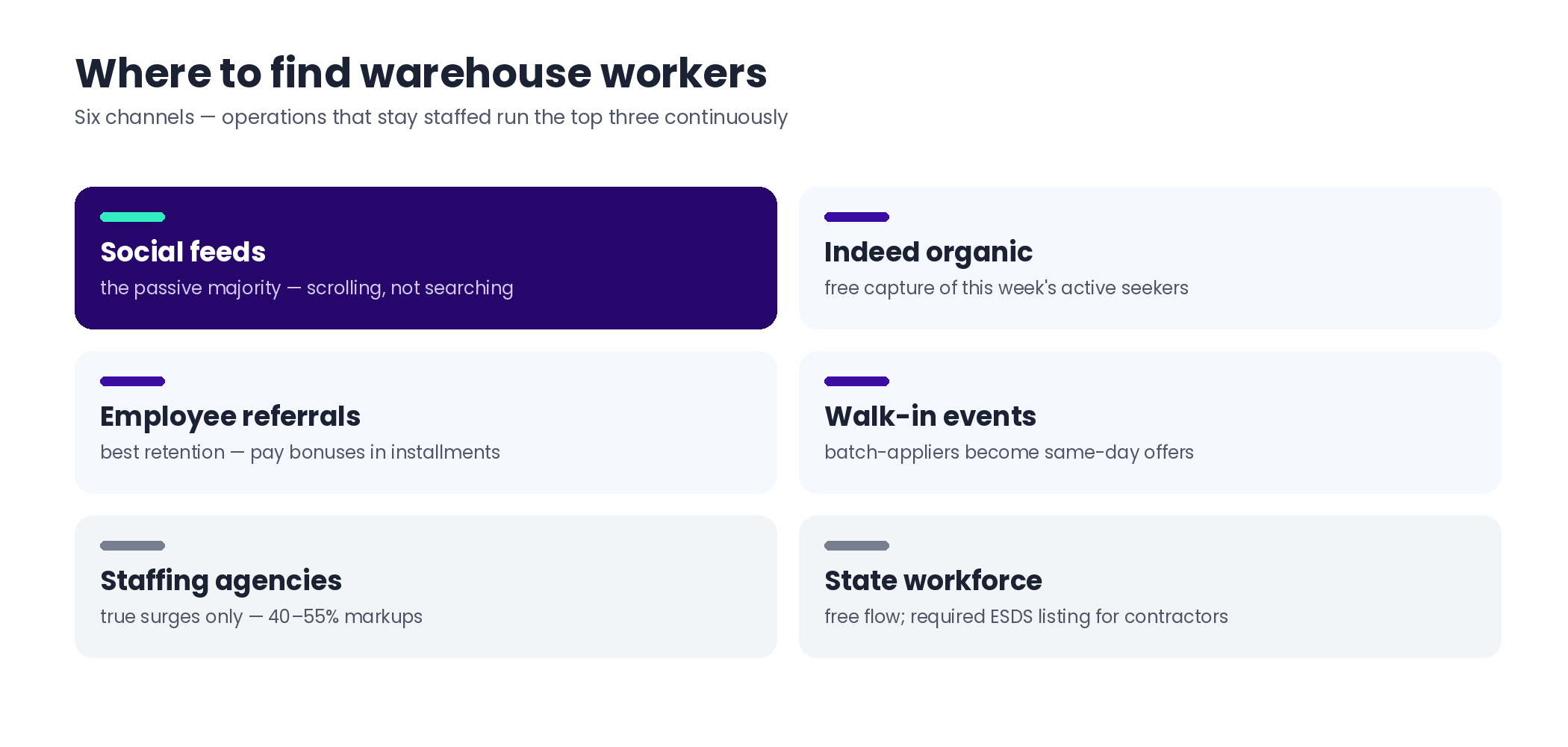
Where to find warehouse workers
Social feeds
Most warehouse workers aren't searching job boards — they're scrolling. Feed ads reach employed workers open to a better rate or shift, at the costs this page is built on.
Indeed organic
Free listings capture whoever's actively searching this week. Worth having always; rarely enough alone at volume, and sponsored warehouse keywords get bid up in every tight market.
Employee referrals
Referred warehouse hires show up and stay at higher rates than any cold channel. Pay the bonus in installments (30/90 days) and promote the program in every crew huddle.
Walk-in events
On-the-spot interviews convert the apply-in-batches behavior into same-day offers. We've written the full mechanics up in our walk-in hiring guide.
Staffing agencies
The right tool for genuine short-term surges — priced accordingly. The 40–55% markups stop making sense when "temporary" runs all year.
State workforce & community
State job banks, workforce boards, and second-chance programs cost nothing but process. Modest flow, loyal hires — and for federal contractors, the ESDS listing is required anyway.
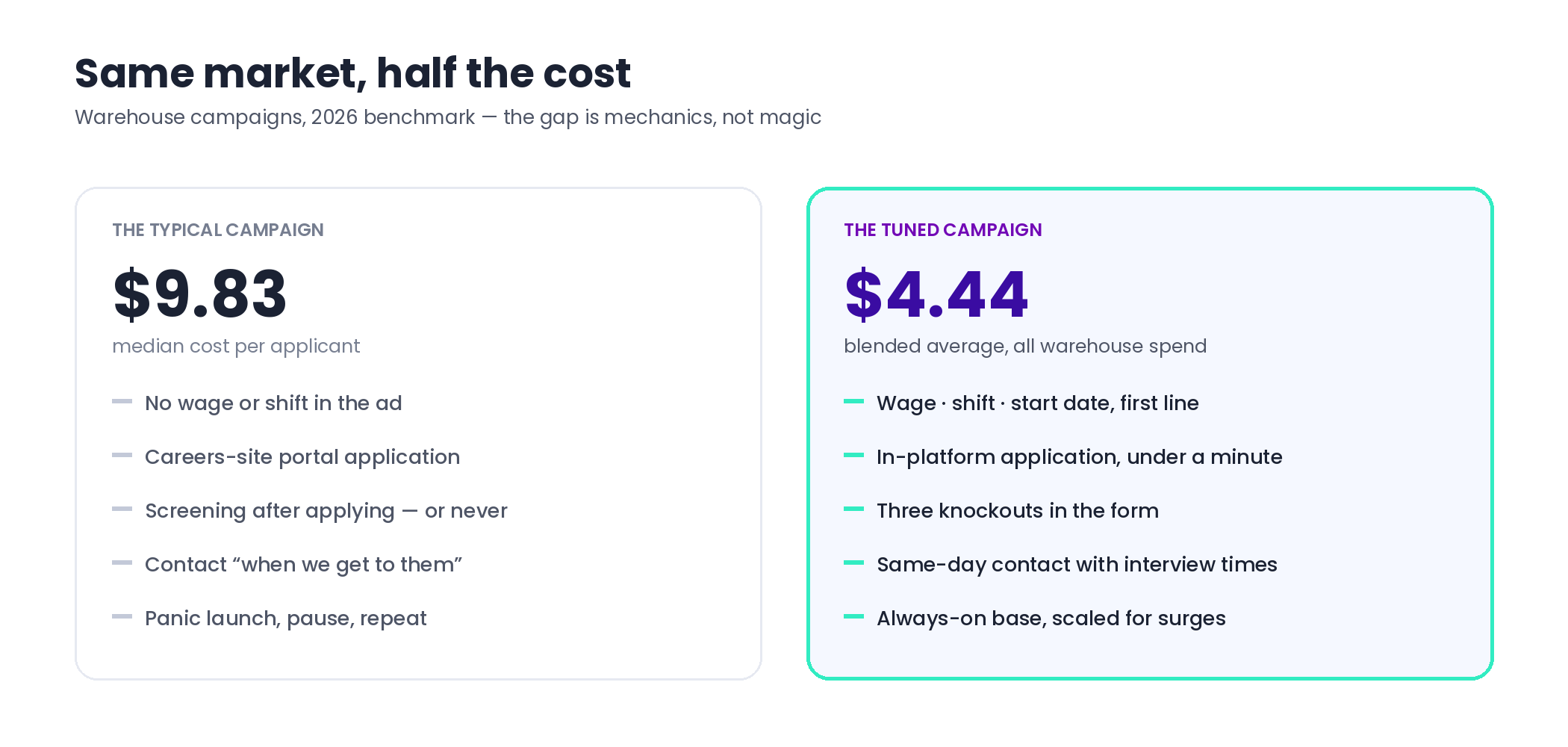
The number that proves tuning matters: $9.83 vs $4.44
Across the warehouse campaigns in our benchmark, the median campaign paid $9.83 per applicant — but the blended average across all warehouse spend was $4.44. Those two numbers describe the same market. The difference is that the blended figure is dominated by large, continuously-optimized campaigns, and they run at less than half the typical campaign's cost. Warehouse applicants also complete applications at 17.2% click-to-apply when the flow is in-platform and short — and across the whole benchmark, that post-click conversion explains 70% of cost variation. The gap isn't targeting magic. It's mechanics:
- Ad copy without a wage or shift
- Click routes to a careers-site portal application
- Screening happens after applying — or never
- Applicants contacted "when we get to them"
- Campaign launched in a panic, paused when the crisis passes
- Wage, shift, and start date in the first line
- In-platform application, under a minute
- Knockouts in the form: shift availability, lifting, transportation
- Same-day contact, interview slots offered in the first message
- Always-on at a base budget; scaled for surges
The playbook below gets people into the building; what happens in the interview is a separate discipline. Our manufacturing interview questions start with the line-stop question and the lockout/tagout status, which is a fact rather than a self-assessment.
The playbook, in order of impact
- 1. Lead with wage, shift, and start date. "$19/hr · 2nd shift · start Monday" is the whole pitch for a practical decision. Hiding the rate doesn't protect it — it just pays for clicks from people who'll drop out when they learn it. (In a growing set of states, posting the range is also the law.)
- 2. Keep the application in-platform and under a minute. This is the single biggest lever — the difference between the columns above lives mostly here. Every field you add sheds applicants you already paid for; the deep dive belongs in the interview, not the form.
- 3. Screen with three knockouts, not a résumé. Shift availability, ability to lift what the job actually requires, reliable transportation. Employment ads run under Meta's Special Ad Category — no age or demographic targeting — so the form is where qualification happens, and three questions do it without scaring off good candidates.
- 4. Contact the same day, with a time on the calendar. Batch-appliers go with whoever responds first. The winning first message isn't "we received your application" — it's "can you interview Tuesday at 10 or 2?"
- 5. Run one campaign per shift, not one for the building. "Weekend overnight — premium rate" out-converts a generic post because it self-selects. Splitting by shift also shows you which shifts genuinely need a pay bump — the ad platform will tell you before your turnover does.
- 6. Stay always-on; scale for surges. A base-budget campaign that never stops beats the panic cycle on both cost and speed — the pipeline exists the day you need it. For genuine peaks, our mass hiring playbook covers the surge structures, including watching ad frequency and refreshing creative when it passes 2.5.
- 7. Fight no-shows between offer and day one. Confirm by text the day before, give a named person to meet, and start people in cohorts on set days. Warehouse no-shows are mostly logistics and cold feet, and both respond to contact.
The posting is the one input none of those mechanics can fix for you. Starting from a blank page, our warehouse associate job description and forklift operator job description templates put the wage and the shift in the first two lines, which is where a warehouse applicant decides whether to keep reading.
The budget math for a real hiring load
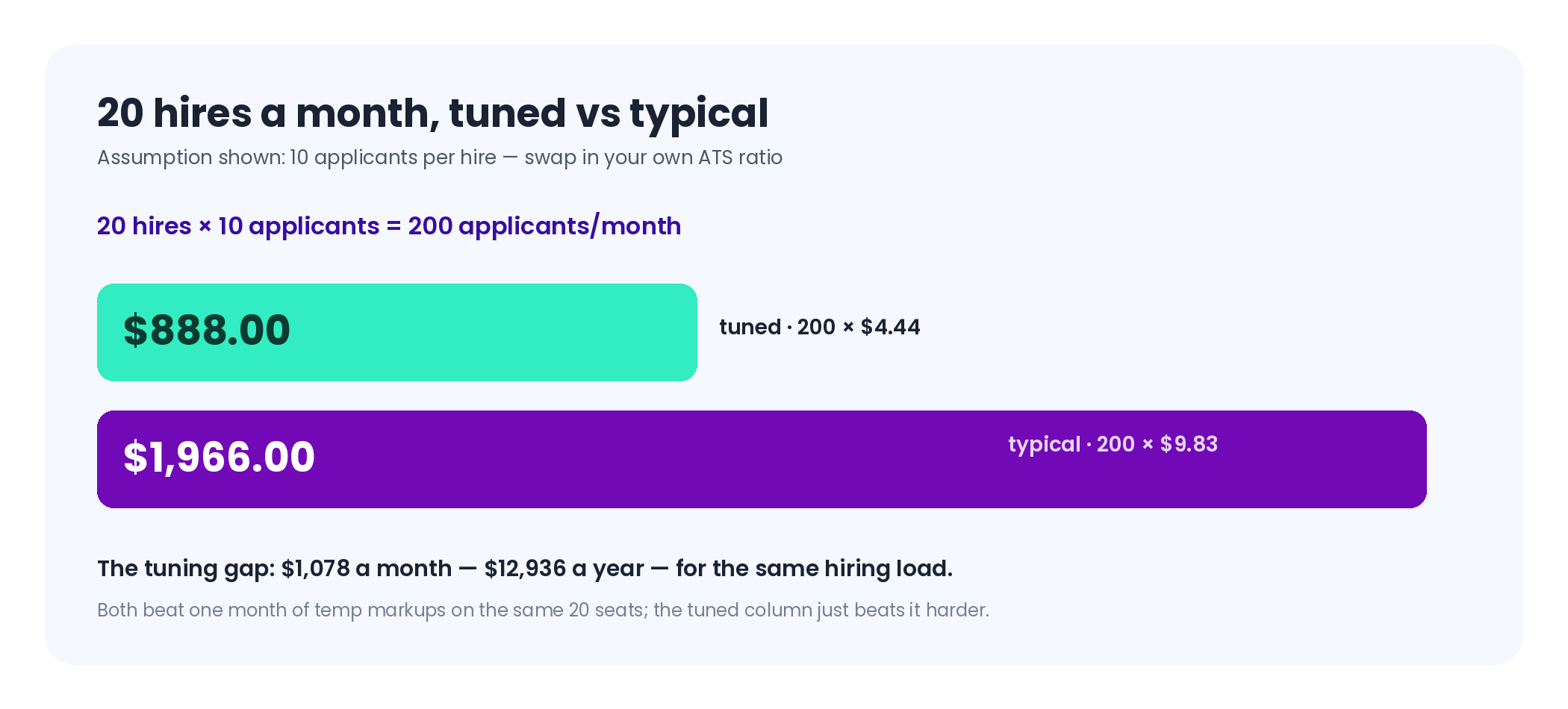
Say you hire 20 warehouse workers a month, and your ATS says it takes about 10 applicants per hire — a common planning ratio, though yours is the one that matters. That's 200 applicants a month. At the tuned blended rate: 200 × $4.44 = $888.00/month. At the median: 200 × $9.83 = $1,966.00/month. That's the practical meaning of the tuning gap — the same hiring load costs $1,078 a month more ($12,936 a year) when the mechanics are sloppy. Either way, compare both figures against what one month of temp markups runs on the same 20 seats, and the case for owning this pipeline makes itself.
Warehouse recruiting rewards boring operational discipline: rate in the ad, a one-minute application, three knockouts, same-day contact, always-on budget. Do those five and you're on the $4.44 side of the gap — no genius required.
Warehouse cost per applicant: the latest 12 months of campaign data
The newest cut of Boostpoint's own campaign data puts the median warehouse and production applicant at $5.04. The sample is 42 Boostpoint-managed Meta campaigns for warehouse and production roles, run October 2025 through September 2026, and the figure is what advertisers paid per completed application.
| Measure | Figure |
|---|---|
| Median cost per applicant (warehouse / production) | $5.04 |
| Middle half of campaigns (25th–75th percentile) | $2.33–$10.71 |
| Click-through rate | 2.43% |
| Clicks that became applicants | 25.1% |
| Campaigns | 42 |
| Sample | Boostpoint-managed Meta campaigns, October 2025–September 2026 |
| Basis | Cost per applicant: what advertisers paid. Not cost per hire. |
Read the range before the median. A quarter of these campaigns came in at $2.33 per applicant or less, and a quarter at $10.71 or more. Where a campaign lands inside that range is mostly the mechanics in the playbook above: wage and shift in the first line, an in-platform application, knockout questions in the form and same-day contact. In this sample, 25.1% of clicks became completed applications.
How this relates to the other figures on this page: the $9.83 median and $4.44 blended average come from Boostpoint's 2026 Social Job Advertising Benchmark; the $5.04 median comes from the latest 12 months of Boostpoint-managed Meta campaigns. They are different samples and windows, so read them side by side rather than as a trend line.
How to cite this: Boostpoint-managed Meta campaigns, October 2025–September 2026 (42 warehouse and production campaigns): median cost per applicant $5.04, middle half $2.33–$10.71. Source: Boostpoint, Warehouse Recruiting: The 2026 Playbook.
Distribution center recruiting: what changes at DC scale
A distribution center runs the same playbook as a single warehouse, but three things change the plan: the volume of hires, the number of distinct roles on the floor, and the shift patterns that keep the building running around the clock. The pool is large. In BLS Employment Projections 2025-35, stockers and order fillers held 2,804,300 jobs in 2025 with about 430,700 openings a year (BLS, May 2025 median annual wage $37,330), and hand laborers and freight, stock and material movers held 2,940,300 jobs with about 340,500 openings a year ($40,240). Most of those openings replace workers who leave rather than new jobs, and the experienced people a DC wants are usually working in another building nearby.
Recruit by role and shift, not by building
A DC hires pickers and packers, loaders and unloaders, forklift and reach truck operators, inventory control clerks, leads and maintenance technicians. Each reads a different first line, so run a distinct ad per role and per shift pattern (4x10 days, weekend nights, overnight) with the rate and any shift differential stated. Equipment roles have an extra step: under OSHA's powered industrial truck standard, 29 CFR 1910.178(l), the employer must ensure each operator is trained and evaluated, with a performance evaluation at least once every three years, so ask about equipment experience in the form and plan the evaluation into onboarding. Our OSHA forklift training requirements page covers it.
Treat hiring as a standing operation
At DC volume, the recruiting load is a monthly number set by headcount and turnover, not a response to a resignation. That argues for an always-on campaign at a base budget, a standing weekly hiring day with interviews and offers on site, orientation cohorts that start on set days, and a no-show routine (a confirmation text the day before, a named person to meet at the door). For peak, start early; the peak season staffing guide works backwards from the date.
Draw from the whole commuting area
DCs often sit on the edge of a metro, near highways rather than housing. Meta's special ad category sets a 15-mile minimum radius and removes ZIP code targeting, which suits a building that draws from several towns. Name the exit or the landmark in the ad, and say whether there is a shuttle or transit stop.
On cost, the Warehouse / production family in Boostpoint's 2026 Social Job Advertising Benchmark had a $9.83 median per applicant, a $4.44 blended average and a 20% apply rate, and the gap between those two numbers is the tuning this page describes.
Frequently asked questions
How do you recruit warehouse workers?
Treat it as an operations problem: state the wage, shift, and start date in the ad; keep the application in-platform and under a minute; screen with three knockout questions (shift availability, lifting, transportation); contact applicants the same day with interview times offered; and run always-on campaigns instead of panic-hiring. In our benchmark, those mechanics are the difference between $9.83 and $4.44 per applicant.
Where can I find warehouse workers?
Six channels, in rough order of scale: social feed advertising (reaches the employed majority who aren't job hunting), free Indeed organic listings (active seekers), employee referrals (best retention), walk-in hiring events (same-week starts), staffing agencies (short-term surges, at markup prices), and state workforce programs (free, modest flow). Most operations that stay staffed run the first three continuously.
What does it cost to recruit a warehouse worker?
In our 2026 benchmark, warehouse campaigns ran a median of $9.83 per applicant, with a blended average of $4.44 across all warehouse spend — tuned high-volume campaigns run at less than half the typical cost. Cost per hire depends on your applicants-per-hire ratio; at a common planning ratio of 10, that's roughly $44–$98 in ad spend per hire. Agency alternatives run 40–55% wage markups — covered on our warehouse staffing agency cost page.
What's the fastest way to hire warehouse workers?
Pair a feed campaign that starts delivering applicants within days with same-day contact and a walk-in interview day — the combination converts batch-appliers before competitors respond. For people needed this week with no pipeline in place, a staffing agency is honestly the only same-week tool; the fix is to keep an always-on campaign running so you're never in that position twice.
What should a warehouse job ad say?
The four facts the decision runs on: hourly rate, shift, location, and start date — first line, no scrolling required. Add the one or two things that differentiate you (weekly pay, climate control, shift differential, real advancement) and skip the mission paragraph. "$19/hr · 2nd shift · Starts Monday · Weekly pay" outperforms prose because it answers the questions candidates are actually asking.
How do I reduce no-shows for warehouse interviews and first days?
Compress the timeline and stay in contact: offer interview slots in the first message, confirm by text the day before, give a named person and exact entrance for arrival, and start new hires in cohorts on fixed days so day one feels organized. No-shows are mostly logistics and cold feet — both respond to a text, neither to silence.
Should I use a staffing agency for warehouse roles?
For genuine short-term spikes and same-week coverage, yes — that's what the 40–55% markup buys. For the recurring hiring a warehouse does all year, an owned pipeline costs a fraction of ongoing markups, and everything you build compounds. The full comparison with worked math is on our warehouse staffing agency cost page.
How many applicants does it take to make one warehouse hire?
It varies enough that the only trustworthy number is your own ATS ratio — but around 10 applicants per hire is a common planning figure for warehouse roles with knockout screening in place. Track it monthly: the ratio is also your quality dial, and a sudden jump usually means the ad, the wage, or the response speed slipped, in that order of likelihood.
How can I hire warehouse workers faster?
Shorten the time between the ad and the first conversation. Put wage, shift and start date in the first line, keep the application in-platform and under a minute, screen with three knockout questions, and call or text applicants the same day with interview times. Applicant flow is rarely the slow part: in Boostpoint-managed Meta campaigns, October 2025–September 2026, warehouse and production applicants cost a median of $5.04 across 42 campaigns. The delay is usually in follow-up.
How do I hire warehouse workers?
Treat it as a steady pipeline rather than a one-off posting. Run an always-on social job ad with the hourly rate, shift, location and start date in the first line, keep the application in-platform with three knockout questions, text applicants the same day with interview times, and start new hires in cohorts on fixed days. In Boostpoint's 2026 Social Job Advertising Benchmark, warehouse and production roles ran a median $9.83 per applicant, with 20% of people who clicked finishing the application.
How do I hire seasonal warehouse workers for peak?
Start before the peak, not at it. Launch the ads several weeks ahead of the volume, say in the ad how long the season runs and whether there is a path to a permanent role, and run a walk-in hiring day so people can be offered a start date on the spot. Confirm every start by text the day before. Keep a staffing agency for overflow only, since its markup applies to every hour worked.
What is distribution center recruiting?
Hiring the hourly workforce of a distribution center, usually at high volume and across several roles and shifts at once: pickers, packers, loaders, equipment operators, inventory clerks, leads and maintenance technicians. It differs from single-site warehouse hiring mainly in scale, which is why it works best as a standing operation with an always-on campaign per role and shift, a weekly hiring day and set start dates.
How do you recruit for a new distribution center opening?
Start eight to twelve weeks before go-live if you can. Build the roster by role and shift, launch one ad per role with the rate and shift in the first line, hold dated hiring days at or near the site with same-day offers, and bring leads and equipment operators in first so they can train the rest. Plan for the forklift training and evaluation that OSHA's powered industrial truck standard requires before anyone operates equipment, and keep the campaign running after opening day, because turnover starts in week one.
How long does it take to hire a warehouse worker?
For general warehouse roles, most of the time is in your own process rather than the market, and Boostpoint does not publish a time-to-hire figure. Applications from an always-on feed campaign arrive within days; the clock then depends on how fast you contact applicants, whether the first message offers interview times, whether you make offers at the interview or at a walk-in hiring day, and how often orientation cohorts start. Any drug screen or background check your policy requires adds its turnaround. Equipment roles take longer: OSHA's powered industrial truck standard requires the employer to ensure each operator has completed training and an evaluation before operating a forklift except for training purposes (29 CFR 1910.178(l)). Track application-to-first-shift in your own ATS.
Get on the $4.44 side of the gap
We'll show you what warehouse campaigns like yours cost across 891 real campaigns — and the mechanics that cut the number in half.
Book a DemoAdvertising figures come from the warehouse campaigns in the 2026 Social Job Advertising Benchmark — 891 campaigns and 1,334 campaign-months overall: $9.83 median cost per applicant, $4.44 blended (volume-weighted) average, 17.2% click-to-apply completion, and post-click conversion explaining 70% of cost variation benchmark-wide. Medians and blended averages differ because large, continuously optimized campaigns dominate volume-weighted figures; both are shown deliberately. The 20-hires-per-month example uses a stated 10-applicants-per-hire planning assumption meant to be replaced with your own ATS ratio ($888.00 and $1,966.00 resolve exactly from the stated inputs; the $1,078 monthly and $12,936 annual gaps are their differences). Cost per applicant is not cost per hire. Agency markup ranges are third-party figures detailed on our warehouse staffing agency cost page. This is a sample of Boostpoint campaigns, not an industry-wide study.