
Manufacturing and Production Worker Interview Questions
The two questions that separate a good operator interview from a generic one are “tell me about a time you stopped the line” and “were you an authorized or an affected employee for lockout/tagout?” The first tells you whether someone will raise a problem or hide it. The second is a real status under federal rule, not a self-assessment, and it tells you exactly how much training you are taking on. Everything else — machines, tolerances, shifts — follows from those two.
Who this is for
Production associates, machine operators, assemblers, packers and material handlers — the roles that make up most of a plant's headcount and almost all of its hiring volume. It is not written for hiring manufacturing engineers, quality managers or maintenance leads, which are different interviews with different failure modes.
The general method — a fixed question set, written anchors, the handoff from your application form — is on our interview questions to ask candidates guide. What it costs to get production candidates in front of you is covered in warehouse and production recruiting. This page is only the interview.
Start with the status that is not a matter of opinion
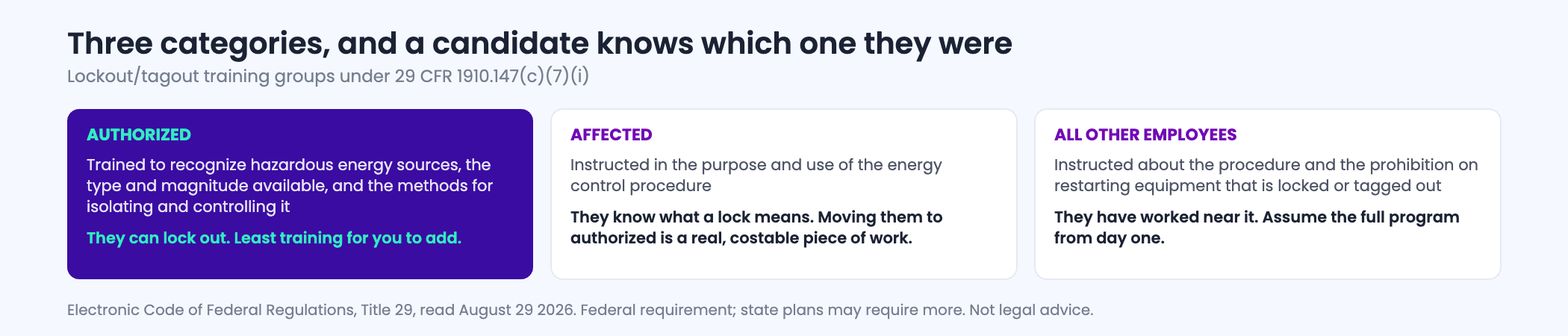
Almost every question in a production interview invites the candidate to rate themselves. One does not. Under the federal lockout/tagout rule, employees fall into three defined groups, and which group a candidate was in at their last plant is a fact rather than a judgment.
| Category | What the rule requires them to have been trained in |
|---|---|
| Authorized | Recognition of applicable hazardous energy sources, the type and magnitude of the energy available in the workplace, and the methods and means necessary for energy isolation and control |
| Affected | Instruction in the purpose and use of the energy control procedure |
| All other employees | Instruction about the procedure and the prohibition on restarting equipment that is locked or tagged out, where their work is or may be in an area where energy control procedures are used |
Source: 29 CFR 1910.147(c)(7)(i), Electronic Code of Federal Regulations, Title 29, read August 29 2026 (eCFR displaying Title 29 up to date as of August 27 2026; Title 29 last amended August 4 2026). Federal requirement; states operating their own plans may require more. Not legal advice.
Asking which category they were in does three things at once. It tells you whether they have been trained to isolate energy or only to recognize when someone else has. It gives you a truthful answer, because the categories are concrete and people know which one applied to them. And it prices the training you are about to provide, since moving someone from affected to authorized is a real piece of work with a real cost that most plants discover after the offer rather than before it.
Eight questions for an operator interview
1. “Tell me about a time you stopped the line, or wanted to and did not.”
The single most useful question in production hiring. The second half is what makes it work: giving permission to describe a time they did not stop turns a test into a conversation, and the answer tells you what the culture at their last plant really was. Listen for whether they told anyone, how long the stop lasted, and what happened to them afterwards. A candidate who says they were told off for stopping and stopped anyway has just told you something you cannot learn any other way.
2. “Were you an authorized or an affected employee for lockout/tagout?”
Ask it in those words. If they answer confidently and can describe what they were allowed to do, you are talking to someone who was trained properly. If they hesitate or use the terms interchangeably, that is not a mark against them — plenty of good operators worked at plants that ran the program loosely — but it is a training line item you should cost before you make the offer.
3. “What machines have you run, and which one did you run longest?”
The list is less useful than the longest. Someone who spent three years on one press knows that machine's behavior in a way a candidate who touched six machines in a year does not, and depth transfers better than breadth for most production work. Follow with what that machine did when it was about to give trouble, because the answer is either specific and physical — a sound, a smell, a drift in the numbers — or it is nothing.
4. “How did you know your parts were good?”
A quality question that does not require the candidate to know the word quality. The good answers name a method: a gauge, a first-article check, a chart on the wall, a check every so many pieces, someone else signing off. The weak answer is that a supervisor or an inspector would have said something. That is not disqualifying, but it tells you what you will need to build.
5. “What did you do when you found a bad part after a run had already gone out?”
The escalation question, in the form that matters most for a plant. What you are listening for is whether the story contains another person and how quickly. Someone who quietly pulled the parts and said nothing is describing a containment failure. Someone who told their lead within the hour is describing the behavior you want, even if the underlying mistake was theirs.
6. “What does your day look like on a rotating shift, and what have you had to change at home to make it work?”
Shift fit is the largest single cause of early production turnover, and asking directly about the schedule is a job-related question rather than an intrusion. Ask about the mechanics — sleep, childcare arrangements they have already made, the commute at that hour — and let the candidate volunteer whatever they choose. Never ask about family status, health or age; ask whether they can work the schedule and what would make it easier.
7. “How do you like to be told you did something wrong?”
An unusual question in production hiring and a revealing one. Plants correct people constantly, and how a person receives that determines whether they get better or get quiet. The answers are practical: in the moment, not in front of the line, show me rather than tell me, tell me why it matters. Whatever they say, you have just learned how to keep them, and it costs nothing.
8. “What would make you leave here in the first six months?”
Asked forward rather than backward, this question gets more honest answers than asking why they left the last plant. Heat, rotating schedules that keep changing, a supervisor who does not answer, being moved between machines every day, and the plant across town paying more are the usual five. Each of them is either fixable, explainable, or a reason not to hire this person into this specific role — and all three of those are useful outcomes.
An operator who has stopped a line and been supported for it will do it again here. One who was punished for it will not — and that is a fact about their last plant, not about them.
Work the scenario
The line-stop question, one stage at a time
Follow the same scenario through three stages of a real answer, and see what each stage tells you.
Answers that sound like problems and are not
- Never having been authorized for lockout/tagout. A training line item, not a character judgment. Plenty of strong operators have only ever been affected employees.
- Having been written up. Ask what for. In production, write-ups cluster around attendance and pace, and the story behind one is usually a commute, a shift change, or a supervisor.
- Coming from a different industry with the same machines. A press is a press. Someone who ran one in a different sector often adapts faster than someone who ran a different machine in yours.
- A short stay at the plant across town. Manufacturing has a small number of employers per town and people circulate between them. Ask what changed, not why they were disloyal.
- Not knowing quality terminology. If they can describe the method, the vocabulary is a week of training.
Spend the interview where the risk is
A thirty-minute operator interview cannot cover everything, and most of them silently spend twenty of those minutes on machine history because that is the comfortable part. Decide the split deliberately instead.
Plan the half hour
Where your interview time actually goes
Move the sliders to split a 30-minute interview. The tool converts the split into minutes and tells you which questions fit.
Thirty minutes is Boostpoint's working assumption for a frontline production interview, not a measured value. The split is yours to choose.
The market you are interviewing in has cooled on both sides
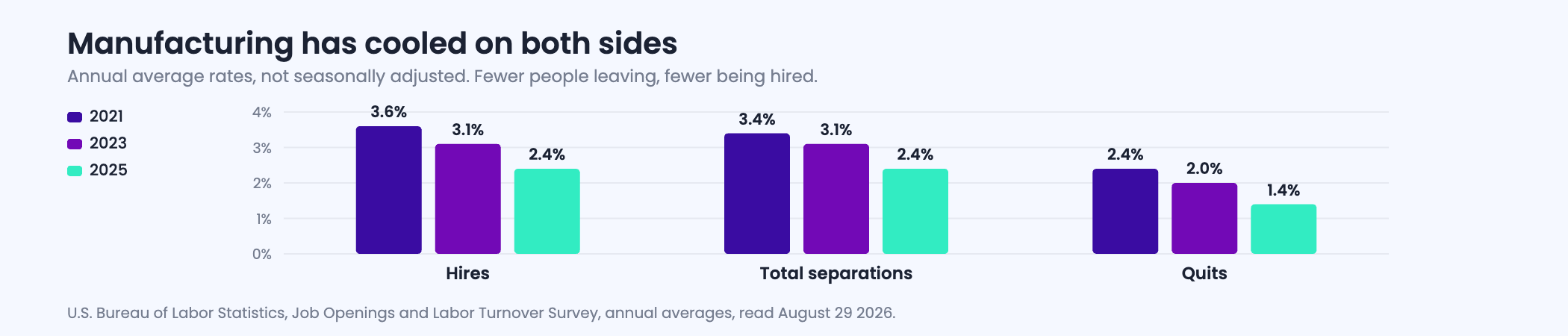
Manufacturing turnover is not what it was, and the change matters for how you interview. Between 2021 and 2025 the manufacturing quits rate fell from 2.4% to 1.4% — the largest fall of any sector in the federal turnover series — while the hires rate fell from 3.6% to 2.4%. Fewer people are leaving, and fewer are being hired.
| Rate | 2021 | 2023 | 2025 |
|---|---|---|---|
| Hires | 3.6% | 3.1% | 2.4% |
| Total separations | 3.4% | 3.1% | 2.4% |
| Quits | 2.4% | 2.0% | 1.4% |
| Layoffs and discharges | 0.8% | 0.9% | 0.9% |
| Durable goods quits | 2.1% | 1.6% | 1.3% |
| Nondurable goods quits | 2.8% | 2.5% | 1.6% |
Source: U.S. Bureau of Labor Statistics, Job Openings and Labor Turnover Survey, annual average rates by industry, not seasonally adjusted, read August 29 2026. The annual rate is built from summed monthly levels over summed employment, not a monthly rate multiplied by twelve.
The practical consequence is that a larger share of the people you interview are currently employed and not desperate. They are comparing your shift, your heat, and your supervisor against a job they already have, and the interview is where that comparison happens. Which is another way of saying that what you tell them in the room now matters as much as what you ask.
Getting production candidates into the room
Our advertising data has one finding that is specific to this family and worth knowing before you blame the interview. The warehouse and production family has the widest gap between its median campaign and its volume-weighted average of any of our fifteen families: a $9.83 median against a $4.44 blended cost per applicant.
| Role family | Median | Middle 50% | Blended | Apply rate | Campaigns |
|---|---|---|---|---|---|
| Warehouse / production | $9.83 | $3.15 – $18.72 | $4.44 | 20% | 82 |
| Technician / mechanic | $13.41 | $7.40 – $23.58 | $8.35 | 16% | 145 |
| Skilled trades | $14.14 | $7.58 – $21.49 | $10.74 | 15% | 35 |
Source: Boostpoint 2026 Social Job Advertising Benchmark — 891 Boostpoint-managed campaigns on Meta (1,334 campaign-months), 2026; advertising costs only. Apply rate is the share of clickers who completed the form. Campaigns counts campaign-months. Cost per applicant is not cost per hire, and nothing on this page derives one from the other.
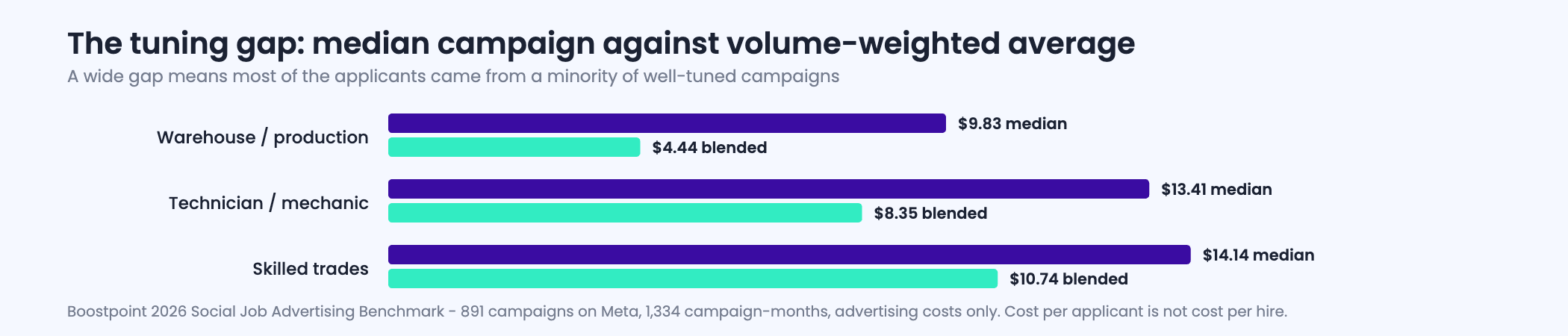
A median more than twice the blended figure means the typical production campaign is expensive while the large ones are cheap. Put plainly: the campaigns that carry most of the volume in this family are the ones that got tuned, and the median campaign is one that did not. If your production pipeline is thin and expensive at the same time, that gap is where to look before you rewrite your interview.
For the written description that goes with these questions on construction and site-work roles, see our free equipment operator job description.
Warehouse and distribution: six questions for a different job in the same building
Warehouse work sits next to production and is often hired by the same people, but the failure modes are not the same. A machine operator fails on attention and procedure; a warehouse associate fails on rate, accuracy and the physical reality of a full shift on foot. These six ask about that job rather than the one down the hall.
- What rate were you held to in your last role, and did you hit it? Picks per hour, cases per hour, stops per day. A candidate who knows their own number has worked somewhere that measured it.
- Walk me through what you do when the scanner and the shelf disagree. The everyday integrity question. You are listening for whether they stop and flag it or make the count fit.
- How many hours a shift were you on your feet, and how did the end of the week feel? Ask it plainly. The candidate who has not done it is the one who leaves in week two.
- Tell me about a time you were short-staffed and the volume did not drop. This is the actual job on a bad day.
- What have you driven, and who signed you off? Pallet jack, reach, sit-down, order picker. The sign-off matters as much as the equipment.
- What would make you leave a warehouse job? Turnover in this occupation runs high, so the reasons are worth hearing before rather than after.
CNC machinist interview questions
Decide first whether you are hiring a machinist or an operator, because the interview is different. O*NET lists CNC Machinist among the reported titles for machinists (SOC 51-4041), who set up machines, read prints and program; their May 2025 median was $28.24 an hour, $58,750 a year. Computer numerically controlled tool operators (SOC 51-9161), who mostly load, run and check, had a median of $50,690 a year. A candidate who is a strong operator and not yet a machinist is still a good hire, for the right job.
- “Here is a print. Which dimension would you check first, and with what?” Listen for the tight tolerance and a named instrument: micrometer, calipers, bore gauge, height gauge. Someone who cannot find it on the print is an operator.
- “Walk me through setting work and tool offsets on the last control you ran.” The sequence is the answer. Vague here means someone else did the setups.
- “Have you edited a program at the machine? What did you change, and how did you prove it out?” Good answers mention single block, a reduced rapid or feed override, and a first piece checked before the run.
- “Your first piece is two thousandths out. What do you check, in order?” Tool wear, offsets, fixturing, warm-up. Anyone who says “adjust the offset” without asking why has a scrap habit.
- “What materials have you cut, and what changed in your feeds and speeds?” Real answers are specific to a material and a tool.
Assembler interview questions
O*NET lists Assembler among the reported titles for team assemblers (SOC 51-2092), with a May 2025 median of $21.47 an hour, $44,650 a year. Its task list starts with quality checks, reviewing work orders and blueprints, and rotating through every task in the process, so the interview should test those three rather than speed alone.
- “How did you know which build you were on, and where did you check the spec?” Work order, traveler, build sheet, a screen at the station. Someone who went by memory is a mixed-model error waiting to happen.
- “Tell me about a part that did not fit. What did you do?” Stop and flag is the answer you want. Forcing it to keep the line moving is the one to worry about.
- “What hand and power tools did you use, and how did you know a fastener was right?” Listen for a torque tool, a click, a mark, a check; not “tight enough.”
- “How do you feel about moving stations mid-shift?” Rotation is part of the job on most lines. Some people like it and some quit over it; ask now.
- “What is the smallest part you have assembled, and how many in a shift?” Dexterity and pace in one answer, with a number in it.
The written roles are on the machinist, CNC operator and assembler job descriptions, and the hiring side for CNC roles is on CNC operator hiring.
Production worker interview questions
"Production worker", "production associate", "assembler" and "machine operator" cover most of the same hiring, and the interview is the same interview with one variable: how much of the job is running a machine and how much is standing on a line. The questions below are the production-worker version of the set above, ordered so that the two that predict retention come first.
1. Walk me through your last shift, start to finish. The highest-signal question in frontline manufacturing interviews and the least used. Someone who has actually worked a line describes a start time, a handover, a cadence, a break structure and a clean-down. Someone who has not describes duties. You are not testing honesty here, you are testing familiarity with the shape of a shift.
2. What shift do you want, and what shift can you actually work? Ask both, in that order, and write down the difference. Most first-90-day production turnover is a shift problem that was visible at the interview — childcare, a second job, a commute that does not work at 5am, a partner on the opposite rotation.
3. Tell me about a time the line went down. What did you do in the first five minutes? Distinguishes people who stop and report from people who improvise. Both answers can be right depending on your plant; the wrong answer is not knowing there is a rule.
4. What is the most repetitive job you have done, and how long did you stay? Repetition tolerance is a real and testable trait and it does not correlate with experience. The answer you want is specific and unembarrassed.
5. How do you know your work is good before it leaves your station? Quality awareness without asking a quality question. Look for a physical check — a gauge, a count, a visual standard, a first-piece inspection — rather than "I just pay attention".
6. When did you last stop a job for safety, or see someone else stop one? Tests whether stopping work is culturally available to them. Someone who has never seen it happen has worked somewhere it did not.
7. What would make you leave a job like this within a month? Candidates answer this more honestly than the positive version, and the answers are actionable: heat, a supervisor, hours that move, no overtime, too much overtime.
8. What do you want to be doing in two years — here or anywhere? The progression answer matters more in production than in most frontline work, because the path from operator to set-up, maintenance or lead is real and is your strongest retention argument if it exists.
Production worker interview questions and answers: what a good answer looks like
A good answer to any of these is specific, has a number or a name in it, and does not flatter you. "I ran the second cell on nights, four to six changeovers a shift, and I stayed two years because the lead let me learn set-up" is a complete answer. "I'm a hard worker and a team player" is not an answer, it is a way of not answering, and it usually means nobody has ever asked the person a concrete question before — which is a reason to ask a follow-up rather than to end the interview.
Two things not to ask. Avoid anything that reaches age, health, disability, national origin, family status or arrest history, all of which are covered on our page on illegal interview questions. And avoid brain-teasers; in production hiring they measure nothing except comfort with being tested by someone who has power over you.
Frequently asked questions
What questions should I ask a machine operator in an interview?
Ask about a time they stopped the line or wanted to, whether they were an authorized or affected employee for lockout/tagout, which machine they ran longest and how it behaved before it gave trouble, how they knew their parts were good, what they did when a bad part got out, how a rotating shift fits their life, how they like to be corrected, and what would make them leave in six months.
What is the difference between an authorized and an affected employee?
Under the federal energy control rule, an authorized employee is trained in recognizing hazardous energy sources, the type and magnitude of energy in the workplace, and the methods for isolating and controlling it. An affected employee is instructed in the purpose and use of the energy control procedure. The distinction is a real status, so asking which one applied is a factual question rather than a self-assessment.
Should I ask technical questions about specific machines?
Ask which machine they ran longest rather than listing every machine. Depth on one machine transfers better than shallow exposure to six, and the useful follow-up is what that machine did when it was about to give trouble. A specific, physical answer about a sound or a drift is worth more than a list of model numbers.
How do I ask about shift work without crossing a line?
Describe the schedule and ask whether they can work it and what would make it easier. That is a job requirement. Do not ask about childcare arrangements, family status, health or age, which are protected characteristics rather than requirements, and let the candidate volunteer whatever detail they choose.
Is a candidate without lockout/tagout training worth hiring?
Often, yes. The status tells you what training you are taking on rather than whether the person is good. Moving someone from affected to authorized is a defined piece of work, and knowing before the offer that you need to do it is far better than discovering it in week two.
Has manufacturing turnover gone down?
Yes, substantially. The manufacturing quits rate fell from 2.4% in 2021 to 1.4% in 2025 in the federal turnover series, the largest fall of any sector, while the hires rate fell from 3.6% to 2.4% over the same period. Fewer people are leaving and fewer are being hired, so more of your candidates are currently employed and comparing you against a job they already have.
What does it cost to get a production applicant?
In our benchmark the warehouse and production family runs a $9.83 median cost per applicant with the middle half between $3.15 and $18.72, a 20% apply rate, and a volume-weighted average of $4.44. The gap between the median and the blended figure is the widest of any family we publish, which says most of the volume comes from a minority of well-tuned campaigns. It is a cost per applicant, not a cost per hire.
What should I say to a production candidate during the interview?
The shift pattern in full, including how often it rotates and how much notice they get. The heat, the noise and the standing, honestly. What the first two weeks look like and who trains them. And when you will decide, followed by deciding sooner than that.
What interview questions should I ask a warehouse candidate?
Ask about the job rather than about manufacturing generally, because warehouse work fails on different things. Six that work: what rate they were held to and whether they hit it, what they do when the scanner and the shelf disagree, how many hours a shift they were on their feet, a time they were short staffed while the volume held, what equipment they have driven and who signed them off, and what would make them leave a warehouse job. The rate question is the most revealing, because a candidate who knows their own number has worked somewhere that measured it.
What are good interview questions for warehouse workers?
Ask about the physical reality first — the heaviest thing they lifted repeatedly in their last job, and how many hours a shift they were on their feet — because that is what people leave over. Then ask what equipment they have actually operated and which class of forklift, whether they have worked to a pick rate and what it was, how they handled a count that did not match the system, and what shift they are actually available for. Avoid asking them to describe their strengths; every candidate has rehearsed that answer and it predicts nothing.
How should a warehouse worker interview be structured?
Keep it under twenty-five minutes and run the same six or seven questions with every candidate in the same order, scoring immediately afterwards rather than during. Warehouse candidates are usually interviewing in two or three places the same week, so a long process loses people who would have been good hires. Where the role turns on a physical or equipment skill, a short practical demonstration tells you more than any question will.
What are good production worker interview questions?
Start with "walk me through your last shift, start to finish" and "what shift do you want, and what shift can you actually work" — the two that predict retention best. Then ask about a line-down situation, repetition tolerance, how they check their own quality, whether they have ever stopped a job for safety, what would make them leave within a month, and where they want to be in two years.
What is a good answer to a production worker interview question?
One that is specific, contains a number or a name, and does not flatter the interviewer: "I ran the second cell on nights, four to six changeovers a shift, and stayed two years because the lead let me learn set-up." A generic "hard worker, team player" answer usually means nobody has asked that person a concrete question before, so follow up rather than ending the interview.
What should you not ask a production worker in an interview?
Anything reaching age, health, disability, national origin, family status or arrest history. Brain-teasers are also a waste in production hiring — they measure comfort with being tested rather than any ability the job needs.
If the interviews are good and the calendar is empty
That is the part we measure, and the production family is where tuning makes the biggest difference.
Lockout/tagout categories and training requirements quoted from 29 CFR 1910.147(c)(7)(i), Electronic Code of Federal Regulations, Title 29, read August 29 2026, displayed as up to date as of August 27 2026 and last amended August 4 2026; states operating their own plans may require more, and nothing here is legal advice. Turnover figures: U.S. Bureau of Labor Statistics, Job Openings and Labor Turnover Survey, annual average rates by industry, not seasonally adjusted, read August 29 2026 — manufacturing hires 3.6% in 2021, 3.1% in 2023 and 2.4% in 2025; total separations 3.4%, 3.1% and 2.4%; quits 2.4%, 2.0% and 1.4%; layoffs and discharges 0.8%, 0.9% and 0.9%; durable goods quits 2.1%, 1.6% and 1.3%; nondurable goods quits 2.8%, 2.5% and 1.6%. The annual rate is built from summed monthly levels over summed employment rather than a monthly rate multiplied by twelve. Advertising figures: Boostpoint 2026 Social Job Advertising Benchmark — 891 Boostpoint-managed campaigns on Meta across 1,334 campaign-months in 2026, advertising costs only; warehouse and production $9.83 median, $3.15 to $18.72 middle half, $4.44 blended, 20% apply rate, 82 campaign-months; technician and mechanic $13.41, $7.40 to $23.58, $8.35, 16%, 145; skilled trades $14.14, $7.58 to $21.49, $10.74, 15%, 35. Cost per applicant is not cost per hire, and no cost per hire is derived from it anywhere on this page. The thirty-minute interview length, the eight-question order and the time split are Boostpoint's working patterns rather than measured values, and are labeled as such. Last updated August 2026.
For the lifting side of the plant, our free crane operator job description template covers duties, pay and which certification rules apply to overhead cranes as against mobile ones.