
Hiring CNC Operators and Machinists: The Scarcity Myth vs the Data
The industry narrative says machinists are nearly impossible to find. Boostpoint's campaign data says machinist applicants cost $4.15 — among the cheapest role families we track, roughly a third of what maintenance technician applicants cost in the same dataset. The people exist; they're employed in other shops and reachable in their feeds. The real CNC operator hiring problem is that most shops only post where machinists aren't looking — and this page is the playbook for the shops that reach them.
A note on who's writing this
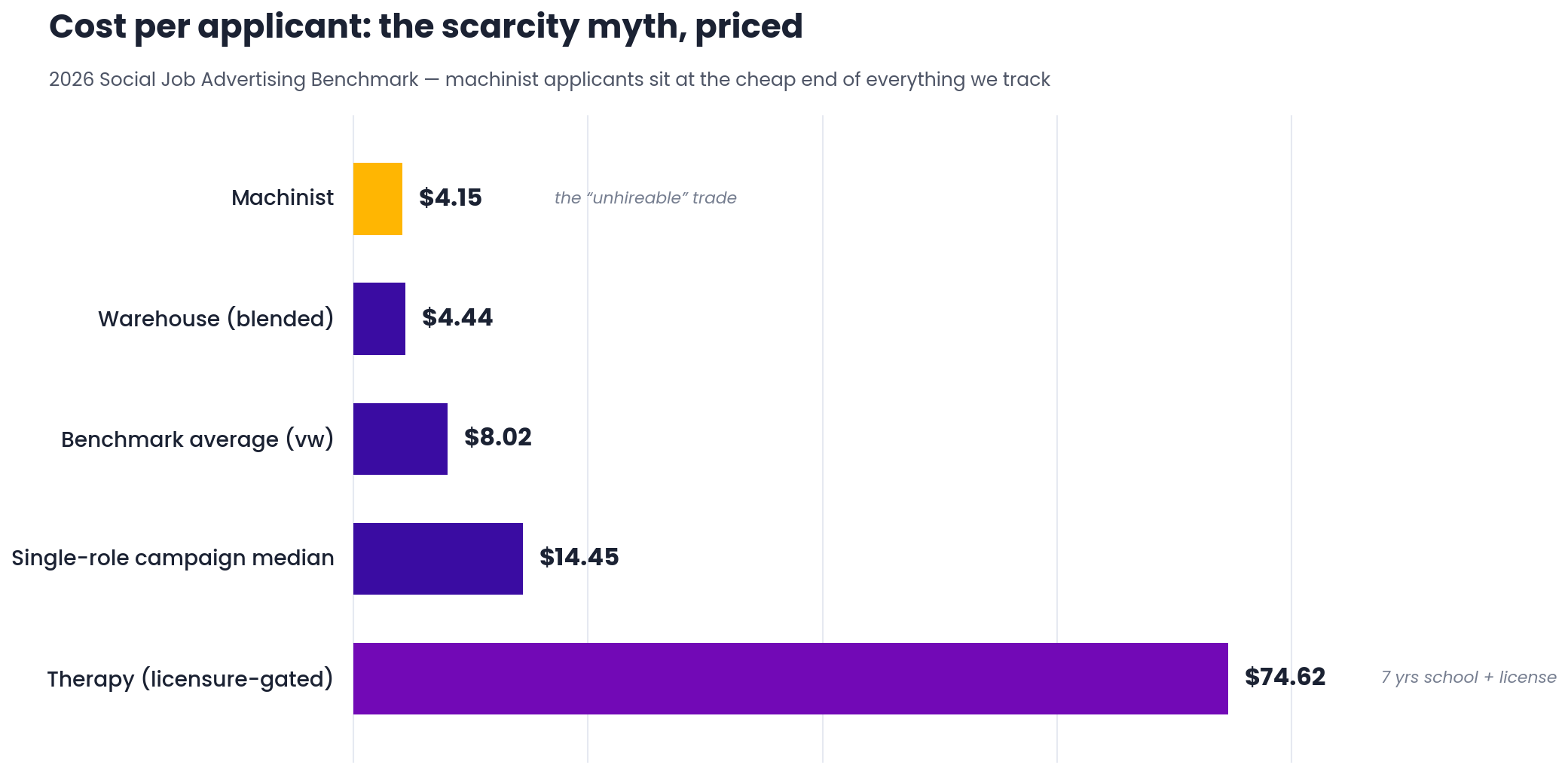
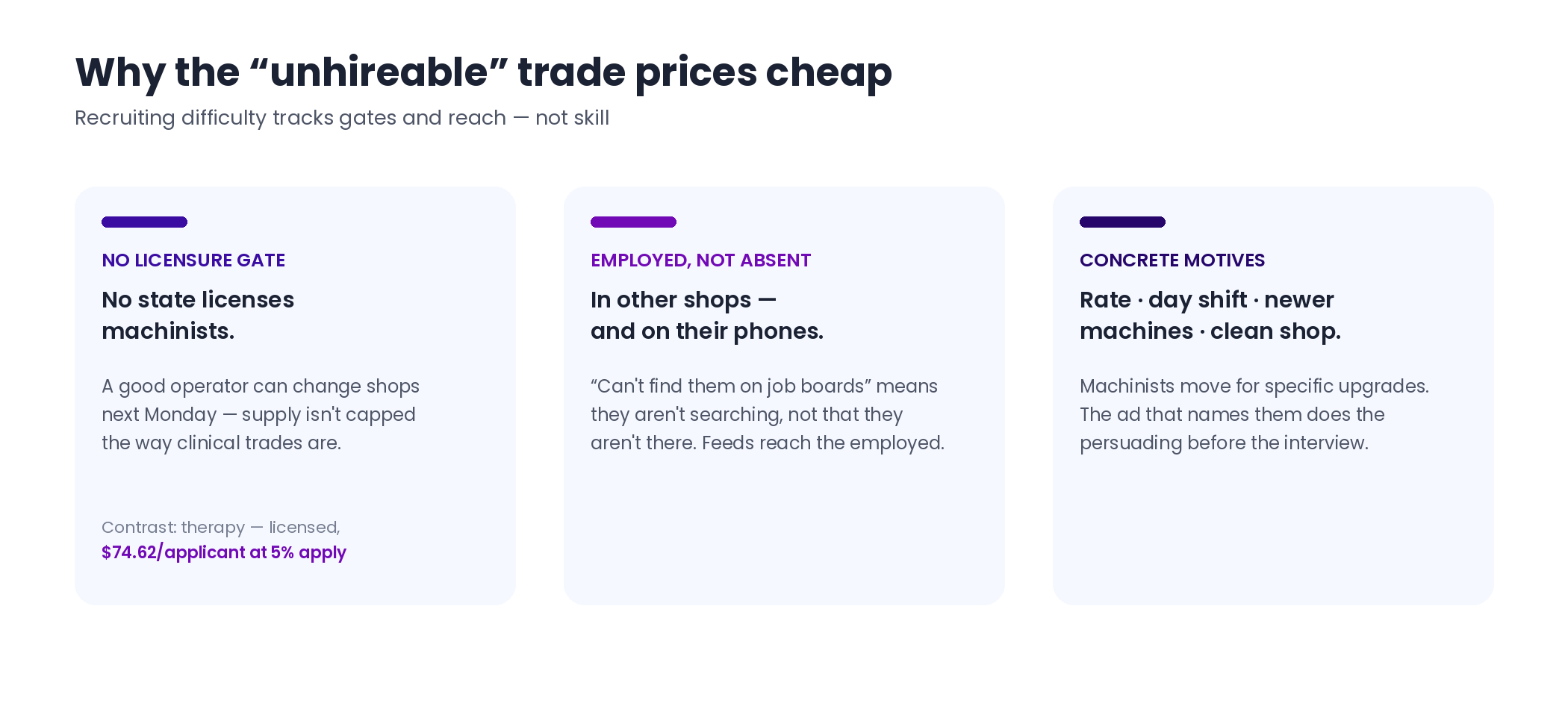
Boostpoint runs social recruitment advertising, including the machinist and CNC campaigns behind the $4.15 figure — so the finding flatters our channel, and you should read it knowing that. What we'd point to in our defense: the same benchmark reports the roles where our channel performs badly just as plainly (therapy runs $74.62 at a 5% apply rate), which is exactly why a cheap machinist number is worth taking seriously rather than dismissing as marketing.
The panic and the price tag
The manufacturing skills-gap alarm is real and well-funded: the 2024 Deloitte and Manufacturing Institute study projects the industry could need as many as 3.8 million workers between 2024 and 2033, with up to 1.9 million jobs unfilled, and 65% of manufacturers in NAM's 2024 outlook named attracting and retaining talent their top business challenge. Worth knowing: a version of that headline number has been re-issued for a decade — 2 million by 2025, 2.4 million by 2028, 2.1 million by 2030, now 1.9 million by 2033. The crisis is perpetual, and the practical question for a shop with two open machines isn't the decade forecast. It's: what does a machinist applicant actually cost to generate this month?
Our answer, from real campaigns: $4.15. For context inside our own data, that's near the cheap end of everything we track — below the $8.02 benchmark-wide volume-weighted average, in the neighborhood of warehouse's $4.44 blended figure, roughly a third of maintenance technicians, and a twentieth of therapy's $74.62. A role family the industry describes as unhireable generates applicants at commodity prices when the ads run where machinists actually are.
Scarcity, not skill: why the myth gets it backwards
Recruiting difficulty doesn't track how skilled a role is. It tracks two other things: whether a licensure gate caps the supply, and whether the employed pool is reachable and movable. Put machinists through that lens and the $4.15 stops being surprising:
The ad that machinists actually answer
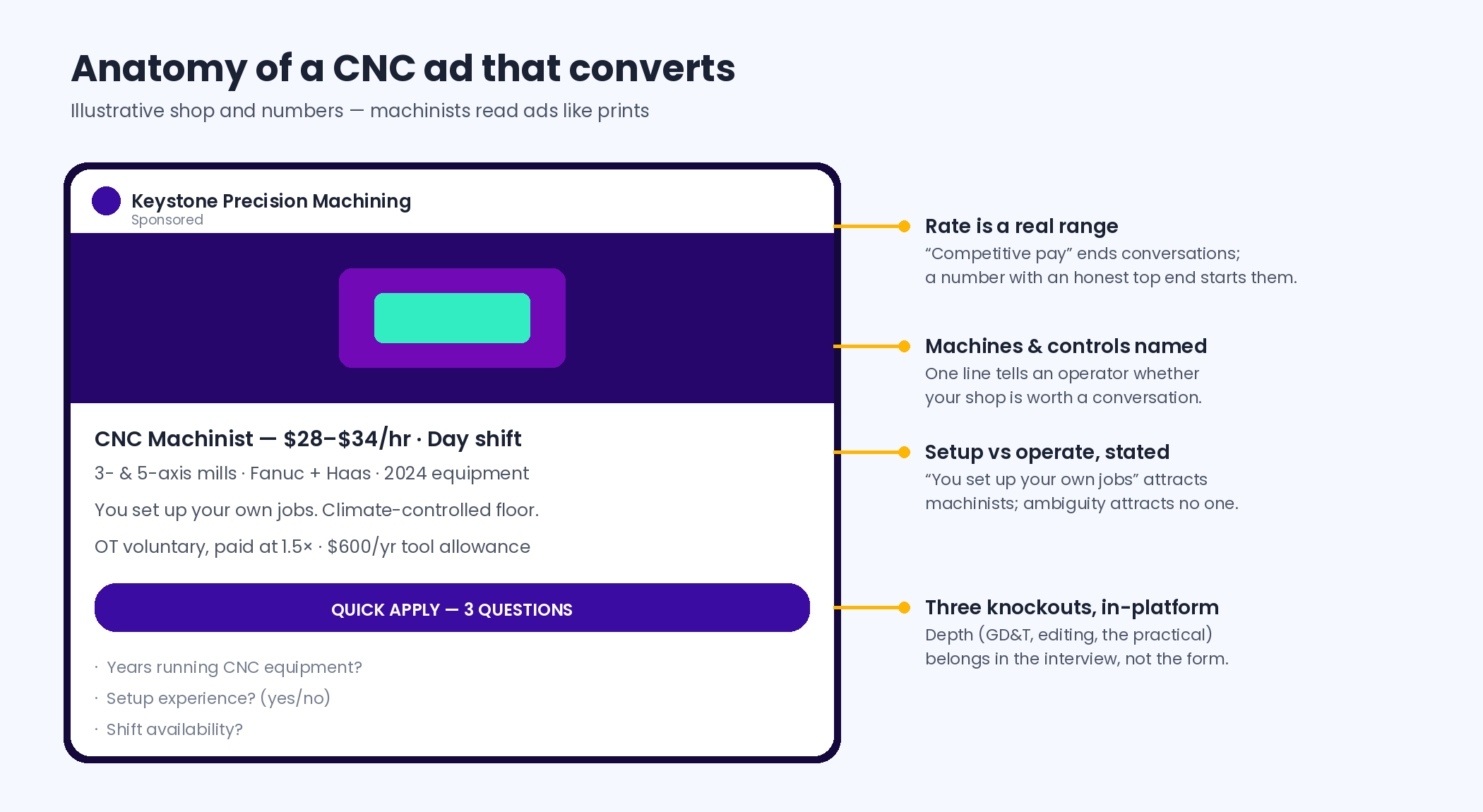
Machinists screen job ads the way they read a print: for specifics. The ad that converts names the real things —
- The machines and controls. "3- and 5-axis mills, Fanuc and Haas controls, 2024 equipment" tells an operator in one line whether your shop is worth a conversation. Vague ads read as old-iron shops hiding something.
- The rate — an actual number. Experienced operators know their market value to the dollar. A range with a real top end starts conversations; "competitive pay" ends them. (In a growing set of states, posting the range is also required.)
- Shift and overtime, plainly. Day shift is a recruiting asset — say so. If it's nights, price it and say that too. Mandatory-overtime ambiguity is the number-one silent disqualifier for experienced tradespeople.
- Setup vs button-pushing. "You'll set up your own jobs and own your offsets" attracts machinists; ambiguity attracts neither machinists nor operators. Say which job this is.
- The shop itself. Climate control, tooling budget, a photo of the actual floor. Machinists have worked in enough bad shops to price the good ones.
The application: one minute, three knockouts
Post-click conversion explains 70% of cost variation across our benchmark, and skilled trades are no exception — an experienced machinist scrolling at 9pm will answer three questions in the feed; he will not create a portal account. Keep the application in-platform and screen with knockouts: years running CNC equipment, setup experience (yes/no), shift availability. Blueprint and GD&T depth, program editing, and the practical test belong in the interview — the form's only job is separating real operators from hopefuls without losing either the machinist or the trainable candidate you might also want.
The two-track pipeline: hire machinists, grow operators
Shops that stay staffed run both tracks at once. Track one recruits experienced machinists from other shops with the ad above — that's the $4.15 lane. Track two builds the future bench: CNC operator roles advertised to production workers and trade-school grads with "we'll train you up — paid" framing, feeding an internal setup-and-programming ladder — the same operations discipline that runs across our manufacturing playbooks. The Deloitte study's own retention finding points the same direction — respondents rated development and flexibility among the most impactful retention levers — and every operator you grow into a machinist is a hire you never make at market rates. Run track two always-on at a small budget; it compounds.
The math for a real shop
A shop hiring 6 machinists a year, at a stated planning ratio of 15 applicants per skilled hire (skilled roles run leaner funnels than warehouse — swap in your own ATS ratio): 90 applicants × $4.15 = $373.50 a year in ad spend. One recruiter placement fee at 20% of a $55,000 machinist salary is $11,000 — roughly 29 times the year of advertising, for one hire. That's not an argument that recruiters are never worth it (a single urgent lead-machinist or tool-and-die search can be), but it prices the habit of defaulting to fees for a role family whose applicants cost $4.15. The full fee breakdown covers when each makes sense.
The skills gap is a decade-scale forecast. Your open machine is a this-month problem — and this month, machinist applicants cost $4.15 when the ad names the machines, the rate, and the shift, and runs where machinists actually are: employed, and scrolling. Our machinist job description template is written to the same specifics.
Frequently asked questions
How do I hire CNC operators?
Reach the employed pool, not just the searching one: run feed ads that name your machines and controls, the real pay range, and the shift; keep the application in-platform with three knockouts (years on CNC equipment, setup experience, shift availability); and contact applicants same-day. In our benchmark, machinist campaigns generate applicants at $4.15 — the problem is rarely supply, it's where shops advertise.
Why is it so hard to find machinists?
Mostly it isn't — it's hard to find them on job boards, because experienced machinists are employed and not actively searching. Recruiting difficulty tracks licensure gates and reachability, not skill: no state licenses machinists, and the employed pool is reachable in social feeds, which is why machinist applicants run $4.15 in our data while genuinely gated roles like therapy run $74.62.
What does it cost to recruit a machinist?
In our 2026 benchmark, machinist applicants cost $4.15 — among the cheapest role families we track, roughly a third of maintenance technicians. At a planning ratio of 15 applicants per skilled hire, that's about $62 in ad spend per hire, against recruiter placement fees that run 15–30% of salary ($8,250–$16,500 on a $55,000 machinist). Your applicants-per-hire ratio is the number that converts one to the other.
What should a CNC machinist job ad say?
The specifics an operator screens for: the machines and controls by name ("5-axis, Fanuc/Haas"), a real pay range with an honest top end, the shift and overtime policy plainly stated, whether the role includes setup or is operation only, and evidence the shop is worth working in (equipment age, climate control, tooling budget). Machinists read ads like prints — vagueness reads as a defect.
How do I attract machinists away from other shops?
With concrete improvements, stated publicly: a better rate, day shift, newer machines, real setup responsibility, a clean climate-controlled floor, honest overtime policy. Experienced machinists switch shops for specific upgrades, not employer branding — the ad that lists what's materially better at your shop does the persuading before the interview.
Should I hire experienced machinists or train CNC operators up?
Both, on separate tracks. Recruit experienced machinists for the seats that need them now — that's the $4.15 lane. Simultaneously run a small always-on campaign hiring trainable operators from production and trade-school pools into a paid train-up ladder. Every operator you develop into a machinist is a future market-rate hire you never make, and development ranks among the strongest retention levers in the industry's own research.
Is the manufacturing skills gap real?
The macro forecast is real: the 2024 Deloitte/Manufacturing Institute study projects up to 3.8 million workers needed by 2033 and as many as 1.9 million unfilled — though versions of that headline have been re-issued for a decade. What the forecast doesn't mean is that your specific machinist opening is unfillable: at the shop level, applicant generation is a reach-and-offer problem, and the data says it's a cheap one when done right.
When should I use a recruiter for a machinist opening?
For a single urgent, senior search — a lead machinist, tool-and-die maker, or programmer where one specific scarce skillset is needed now — a recruiter's network can beat a cold start, at 15–30% of salary. For ongoing operator and machinist hiring, the fee math is hard to justify against $4.15 applicants; our staffing fees page runs the comparison in full.
How do you hire machinists?
Decide first which machinist you need: a setup machinist who reads prints, writes or edits programs and owns the offsets, or an operator who loads, runs and inspects. The BLS counts them separately: 288,300 machinists (2025) at a median $58,750 a year and 170,000 CNC tool operators at a median $50,690 (May 2025), with about 26,100 machinist openings a year through 2035. Then write the ad for that person, naming the machines and controls, the rate range, the shift and whether setup is part of the job; keep the application to three knockouts (years on CNC equipment, setup yes or no, shift); call the same day; and make the interview a walk of the floor and a print-reading or setup check. Our machinist job description is written to the same specifics.
Put your machines in front of machinists
We'll show you what CNC and machinist campaigns cost across 891 real campaigns — and the ads that make experienced operators reach out.
Book a DemoAdvertising figures come from the 2026 Social Job Advertising Benchmark — 891 campaigns and 1,334 campaign-months: machinist applicants $4.15; benchmark-wide volume-weighted average $8.02; warehouse blended $4.44; therapy $74.62 at 5% apply; post-click conversion explaining 70% of cost variation. The maintenance-technician comparison is stated as an approximate ratio ("roughly a third") because we publish role-family figures only where sample thresholds are met. Industry projections are from Deloitte and The Manufacturing Institute's 2024 workforce study (3.8 million workers needed 2024–2033; up to 1.9 million unfilled; retention findings) and NAM's 2024 Q1 outlook (65% naming talent the top challenge); prior editions of that study carried different headline figures, as noted. The 6-hire example uses stated assumptions (15 applicants per skilled hire; $55,000 example salary; 20% fee) and resolves exactly ($373.50; $11,000; $62 rounds from $62.25). Cost per applicant is not cost per hire. This is a sample of Boostpoint campaigns, not an industry-wide study.