
Illegal Interview Questions
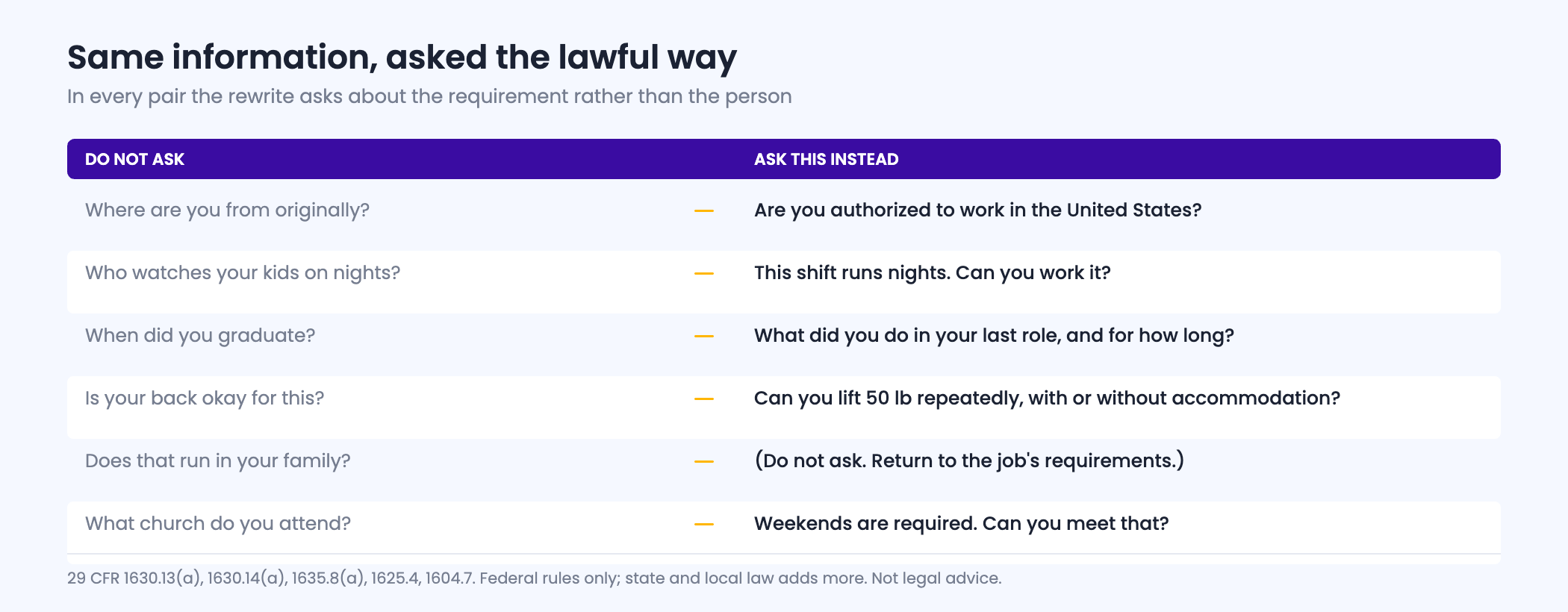
Nearly every question that gets an employer into trouble is friendly small talk, not hostility: where are you from originally, do you have kids at home, when did you graduate, how is your back. The fix is the same shape every time — ask about the job requirement, not the person's circumstances. Federal regulation actually spells out the permitted version: you may ask about the ability to perform job-related functions, and you may ask the candidate to describe or demonstrate how they would do so.
What this page is and is not
This page quotes the federal rules that govern what you can ask a job applicant, with the section numbers attached so you can read them yourself. It is written for the person running the interview rather than for a lawyer, and it covers federal law only. It is not legal advice. State and city rules sit on top of the federal ones, differ from each other, and change; salary history and criminal record timing in particular are governed by a patchwork that no national page can responsibly summarize. Before you finalize an interview script, check your own jurisdiction or ask counsel.
The questions worth asking instead are on our interview questions to ask candidates guide. If you are a federal contractor, the posting side of compliance is on OFCCP job posting requirements. We are a recruitment advertising company, not a law firm, which is exactly why this page quotes the regulation rather than paraphrasing it.
One rule covers most of it
The Americans with Disabilities Act regulations state the prohibition and the permitted alternative in two consecutive sections, and reading them together is the most useful ninety seconds an interviewer can spend.
29 CFR 1630.13(a): “it is unlawful for a covered entity to conduct a medical examination of an applicant or to make inquiries as to whether an applicant is an individual with a disability or as to the nature or severity of such disability.”
29 CFR 1630.14(a): “A covered entity may make pre-employment inquiries into the ability of an applicant to perform job-related functions, and/or may ask an applicant to describe or to demonstrate how, with or without reasonable accommodation, the applicant will be able to perform job-related functions.”
That pattern generalizes far beyond disability. You cannot ask about the person's circumstances; you can always describe the requirement and ask whether they can meet it. Do not ask whether someone has childcare; state the shift and ask whether they can work it. Do not ask about their back; describe the lifting and ask whether they can perform it with or without a reasonable accommodation. Do not ask where they are from; ask whether they are authorized to work in the United States, at the point in your process where that belongs. The same pattern applies in writing, where it is easier to fix because a form is reviewed once: see employment application form for a template built to these rules and a table of what belongs at each stage. For the job ad that comes before the interview, see discriminatory job ad language.
What federal law actually says, by characteristic
| Area | What the rule says | Citation |
|---|---|---|
| Disability and health | Unlawful to conduct a medical examination of an applicant or to ask whether they have a disability, or about its nature or severity, before an offer | 29 CFR 1630.13(a) |
| Ability to do the job | Permitted: inquiries into the ability to perform job-related functions, including asking the applicant to describe or demonstrate how they would perform them | 29 CFR 1630.14(a) |
| Medical exams after an offer | Permitted after an offer and before duties begin, and the offer may be conditioned on the result | 29 CFR 1630.14(b) |
| Genetic information | A covered entity may not request, require or purchase genetic information about an applicant or a family member. Genetic information includes family medical history | 29 CFR 1635.8(a) |
| Age in job ads | Notices may not contain terms that limit or deter older individuals; terms such as age 25 to 35, young, college student, recent college graduate, boy or girl violate the Act unless an exception applies | 29 CFR 1625.4(a) |
| Asking an applicant's age | Does not in itself violate the Act, but such requests will be closely scrutinized | 29 CFR 1625.4(b) |
| Sex | Any pre-employment inquiry expressing directly or indirectly a limitation or discrimination as to sex is unlawful unless based on a bona fide occupational qualification | 29 CFR 1604.7 |
Source: Electronic Code of Federal Regulations, Title 29, read August 29 2026 (eCFR displaying Title 29 up to date as of August 27 2026; Title 29 last amended August 4 2026). Federal rules only. State and local requirements add to these and vary. Not legal advice.
The questions employers actually ask by accident
In practice, the risky questions cluster into a small set, and almost all of them arrive as rapport-building at the start or end of an interview.
“Where are you from originally?”
Asked to be friendly about an accent or a name, and it touches national origin directly. There is no version of this question that is about the job. If work authorization is what you actually need to establish, ask whether the candidate is authorized to work in the United States, and handle the documentation at the point in your process where it belongs rather than in the interview room.
“Do you have kids? Who watches them when you work nights?”
This one is asked constantly in frontline hiring, almost always with genuine concern behind it, and it is the classic sex-discrimination trap because it is disproportionately asked of women. The lawful version carries the same information: state the schedule in full, including how often it changes and how much notice they get, and ask whether they can work it. If the answer is yes, you have what you need. If it is no, you also have what you need.
“When did you graduate?” and “How long have you been doing this?”
Both are proxies for age. The regulation is more nuanced here than most listicles admit — asking an applicant to state their age does not by itself violate the ADEA, but the rule says such requests will be closely scrutinized, and a proxy asked casually is harder to defend than a direct question asked for a documented reason. If the underlying need is experience, ask what they did in their last role and for how long in that role.
“Is your back okay for this?” and “Have you ever been injured on the job?”
The second one is the one that catches people out, because it feels like a safety question. Both are pre-offer medical inquiries. The lawful version is to describe the physical demands specifically — the weight, the frequency, the standing, the climbing — and ask whether the candidate can perform those functions with or without a reasonable accommodation. That wording is not lawyerly caution; it is close to the regulation's own language.
“Does that condition run in your family?”
Family medical history is genetic information under the federal rule, and asking for it is prohibited. This one usually appears as sympathy after a candidate volunteers something about their own health, which makes it easy to walk into. The safe response to a volunteered health disclosure is to acknowledge it, not to ask about it, and to move the conversation back to the job.
“What church do you go to?” and “Any weekends you cannot work?”
The first is religion. The second is legitimate if it is asked of everyone and framed as availability rather than as an inquiry into observance: state the weekend requirement and ask whether they can meet it. If a candidate then raises a religious observance, that is a reasonable accommodation conversation, and it is theirs to open rather than yours.
None of these are hostile questions. They are friendly questions asked without a script, which is why a written question list is a compliance control and not just a hiring one.
Check a question
Type an interview question and see what it touches
This flags language associated with protected characteristics under federal rules and suggests the job-related version. It runs entirely in your browser, sends nothing anywhere, and is not legal advice.
A keyword check, not a legal review. It will miss things, and a question it does not flag can still be unlawful in your state.
Two things that surprise people
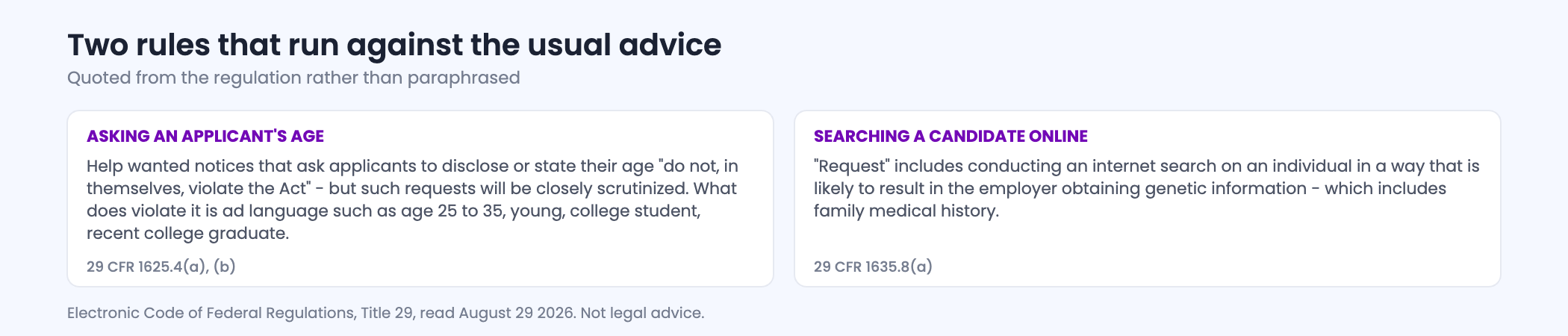
The first is that asking an applicant's age is not automatically unlawful. The ADEA regulation says plainly that help wanted notices asking applicants to disclose their age “do not, in themselves, violate the Act”, while adding that such requests will be closely scrutinized because they may deter older individuals from applying. What is clearly prohibited is the language in the advertisement itself: age 25 to 35, young, college student, recent college graduate. The rule also notes the reverse is permitted — you may advertise a preference for older individuals with terms like over age 60 or retirees.
The second is about searching for candidates online. Under the genetic information rule, “request” explicitly includes conducting an internet search on an individual in a way that is likely to result in the employer obtaining genetic information. A casual look at a candidate's public social media, if it is the kind of search likely to turn up family medical history, is inside the language of the rule. That is worth knowing before pre-interview searches become routine practice at your organization.
Criminal history is the clearest case of a question that is lawful later and unlawful now, and the point it becomes lawful differs by state. Our page on ban the box laws by state sets out the four gates and which states use each.
Before the offer, after the offer, or never
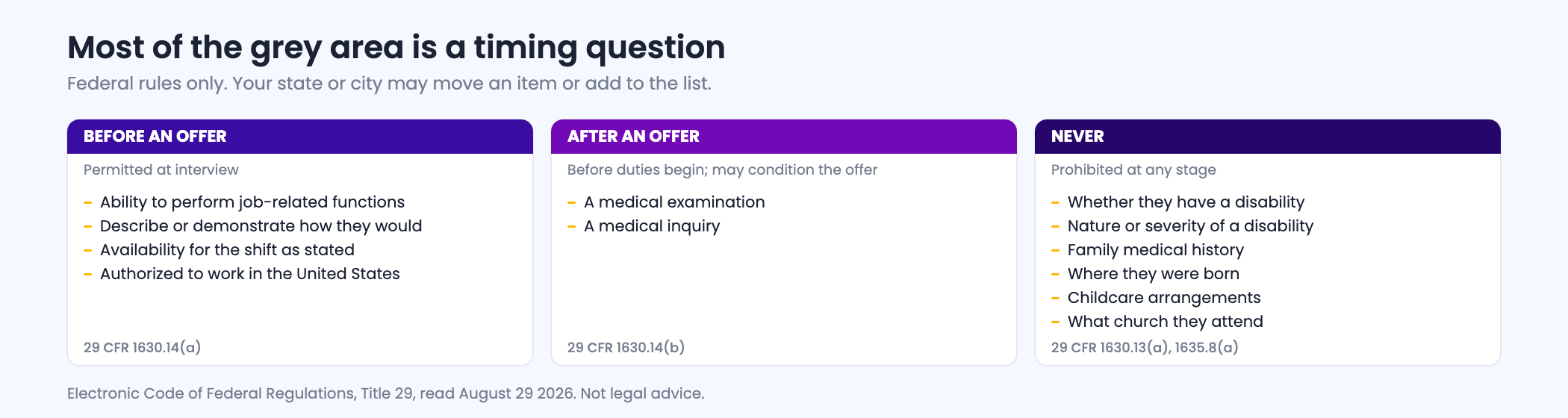
Much of what feels like a gray area is really a timing question. The ADA structure is explicit: medical examinations and inquiries are prohibited before an offer and permitted after one, before duties begin, with the offer able to be conditioned on the result. Sorting your own list into those three buckets removes most of the uncertainty.
Sort the list
Before the offer, after the offer, or never
Click an item to move it. Each one shows the federal rule that puts it where it belongs.
Federal rules only. Your state or city may move an item or add to the list. Not legal advice.
Hiring bias: the part that is legal and still costs you
Everything above is about what you asked. Bias is about who you picked, and the two are measured completely differently. An interview can contain not one prohibited question and still produce a hiring pattern that a federal agency treats as evidence of discrimination, because the law looks at outcomes as well as intent.
The number that defines it
The federal Uniform Guidelines on Employee Selection Procedures set out the four-fifths rule: "A selection rate for any race, sex, or ethnic group which is less than four-fifths (4/5) (or eighty percent) of the rate for the group with the highest rate will generally be regarded by the Federal enforcement agencies as evidence of adverse impact."
In practice: if you hire 50% of the men who apply and 30% of the women, the ratio is 0.6, and that is below the threshold. Nobody has to have said anything. The guidelines add that smaller gaps can still count where they are "significant in both statistical and practical terms", and that larger gaps may not where the numbers are too small to mean anything — so the four-fifths rule is a screening tool, not a safe harbor.
Where the bias usually is, in frontline hiring
- A requirement that is not actually required. The guidelines warn users not to select on knowledge or skills "normally learned in a brief orientation period" — the classic being a certification, a license class or a software system that a new hire is trained on in week one anyway. Every unnecessary requirement filters someone out for a reason unrelated to the work.
- The unstructured interview. When each candidate is asked different things in a different order, the only consistent scale left is how much the interviewer enjoyed the conversation, and that correlates with similarity to the interviewer more than with performance.
- Availability screening done casually. Asking about weekend or evening availability is legitimate and necessary. Asking it only of the candidates you assume have caring responsibilities is where it turns, and it is a pattern that shows up in the data even when no single conversation looks wrong.
- Where the ad ran. Bias enters before anyone applies. A role advertised only through referrals reproduces the composition of the existing workforce, which is why referral-heavy hiring can pass every interview test and still fail the outcome test.
What actually reduces it
The guidelines themselves name the strongest step: where two selection procedures are substantially equally valid, the user should use the one shown to have less adverse impact. Translated into a Tuesday afternoon, that means:
- Write the questions before you meet anyone, ask them in the same order of everyone, and score against an anchored scale rather than an impression. Our interview scorecard template is built for this.
- Audit the requirement list once a year and delete anything a competent new hire learns in the first fortnight.
- Count your selection rates. You cannot see a four-fifths problem without dividing one number by another, and almost nobody does it until a complaint forces the arithmetic.
- Advertise beyond the people you already know. Paid distribution reaches a wider pool than a referral chain by construction, which is a compliance argument as well as a volume one.
None of this is about intent. The employers who get into trouble here are rarely the ones who wanted to discriminate; they are the ones who never wrote the questions down and never checked the ratio.
What varies where you are
Federal law is the floor. Several of the questions employers most want a straight answer on are governed at state or city level, differ substantially between jurisdictions, and change often enough that any list published today will be wrong somewhere within a year. The three that come up most in frontline hiring are salary history, the point in the process at which you may ask about criminal records, and how cannabis is treated where testing is involved.
We are not going to publish a state-by-state table we cannot keep current, because a stale compliance table is worse than none. What we will say is that all three exist, that they are the ones to check before you write your interview script, and that the check is a short conversation with counsel or your state labor department rather than a research project.
If it slips out anyway
It will, eventually, because interviews are conversations. Do not panic and do not draw more attention to it than the moment deserves. Move back to the job requirement immediately — “what matters for this role is whether the schedule works, so let me describe it” — and do not record the answer anywhere. Then make the hiring decision on the criteria you wrote down before the interview, which is the whole reason for writing them down.
The structural fix is the same one that improves hiring quality generally: a fixed question list, asked of every candidate in the same order, with notes taken on the answers rather than on impressions. A script does not make anybody a better interviewer on its own, but it does mean the risky questions never get asked, because they are not on it.
Frequently asked questions
What is hiring bias, and how is it different from an illegal question?
An illegal question is about what you asked. Hiring bias is about who you selected. You can conduct an interview containing no prohibited question and still produce a selection pattern that federal agencies treat as evidence of discrimination, because adverse impact is measured on outcomes rather than intent.
What is the four-fifths rule?
The federal Uniform Guidelines on Employee Selection Procedures state that a selection rate for any race, sex or ethnic group which is less than four-fifths, or eighty percent, of the rate for the highest group will generally be regarded as evidence of adverse impact. Hire 50% of male applicants and 30% of female applicants and the ratio is 0.6, which is below the threshold. Smaller gaps can still count where they are statistically and practically significant, so it is a screening tool rather than a safe harbor.
How do we reduce bias in hiring without changing who we hire for?
Write the interview questions before meeting anyone and ask them in the same order of every candidate; score against an anchored scale instead of an impression; delete any requirement a competent new hire would learn in the first fortnight, which the guidelines specifically warn against selecting on; count your selection rates by group, because you cannot see a four-fifths problem without doing the division; and advertise beyond referrals, since a referral chain reproduces the workforce you already have.
What questions are illegal to ask in an interview?
Under federal rules, questions that seek information about a protected characteristic rather than a job requirement. That includes pre-offer medical inquiries and asking whether someone has a disability, asking for genetic information including family medical history, and any inquiry expressing a limitation as to sex. National origin, religion, race and pregnancy inquiries are prohibited in practice for the same reason. State and city law adds more.
Can I ask an applicant how old they are?
The ADEA regulation says requests that applicants disclose their age do not in themselves violate the Act, but that such requests will be closely scrutinized because they may deter older individuals from applying. What is clearly prohibited is advertising language such as age 25 to 35, young, college student or recent college graduate. If your real question is experience, ask what they did in their last role and for how long.
How do I ask about physical requirements without breaking the rules?
Describe the requirement specifically and ask whether the candidate can perform it, with or without a reasonable accommodation. The federal regulation permits inquiries into the ability to perform job-related functions and permits asking the applicant to describe or demonstrate how they would perform them. What is prohibited before an offer is asking about a disability or about the nature or severity of one.
Can I ask about childcare or family arrangements?
No. Ask about availability instead: state the shift, the rotation and the notice you give, and ask whether the candidate can work it. Childcare questions are asked disproportionately of women, which is what makes them a discrimination risk rather than merely an intrusive one, and the availability question gets you the same information.
When can I require a medical examination?
After making an offer of employment and before the applicant begins duties, and the offer may be conditioned on the results. Before an offer, medical examinations and inquiries about disability are prohibited. This timing structure resolves most of the gray areas people worry about.
Is searching for a candidate online a problem?
It can be. The federal genetic information rule states that a request includes conducting an internet search on an individual in a way that is likely to result in the employer obtaining genetic information, which includes family medical history. That does not make all searching unlawful, but it does mean routine pre-interview searching deserves a policy rather than being left to individual habit.
Can I ask about salary history or criminal records?
It depends entirely on where you are. Both are governed by state and city rules that differ from one another and change regularly, and neither is settled by federal law alone. Check your own jurisdiction before including either in an interview script; a published national list will be out of date somewhere.
What should I do if I have already asked one of these?
Move back to the job requirement in the same breath, do not record the answer, and make the decision on the written criteria you set before the interview. Then fix the process rather than the person: a fixed question list asked of every candidate is the control that stops it happening again, because the risky questions are simply not on the list.
A script fixes the compliance problem and the hiring problem
The same discipline that keeps the risky questions out makes candidates comparable. Getting enough of them to interview is the part we measure.
All federal rules quoted from the Electronic Code of Federal Regulations, Title 29, read August 29 2026, displayed as up to date as of August 27 2026 and last amended August 4 2026: 29 CFR 1630.13(a) on prohibited pre-employment medical examinations and disability inquiries; 29 CFR 1630.14(a) on permitted inquiries into the ability to perform job-related functions; 29 CFR 1630.14(b) on examinations after an offer; 29 CFR 1635.8(a) on the prohibition against requesting, requiring or purchasing genetic information, including family medical history, and on internet searches falling within the meaning of a request; 29 CFR 1625.4(a) and (b) on age-related terms in help wanted notices and on requests that applicants state their age; 29 CFR 1604.7 on pre-employment inquiries as to sex. This page covers federal rules only. State and local requirements add to them, differ between jurisdictions and change; salary history, criminal record timing and cannabis testing in particular are governed at state and city level and are not summarized here. Nothing on this page is legal advice, and no attorney-client relationship is created by reading it. The question rewrites, the checker and the sorting exercise are Boostpoint's working patterns rather than legal determinations, and are labeled as such. Boostpoint is a recruitment advertising company; our own measured data is the 2026 Social Job Advertising Benchmark of 891 Boostpoint-managed campaigns on Meta across 1,334 campaign-months, advertising costs only, and none of it is used on this page. Cost per applicant is not cost per hire. Last updated August 2026.