Employer guideUpdated September 2026
Ban the Box Laws by State: A Rule About When, Not Whether
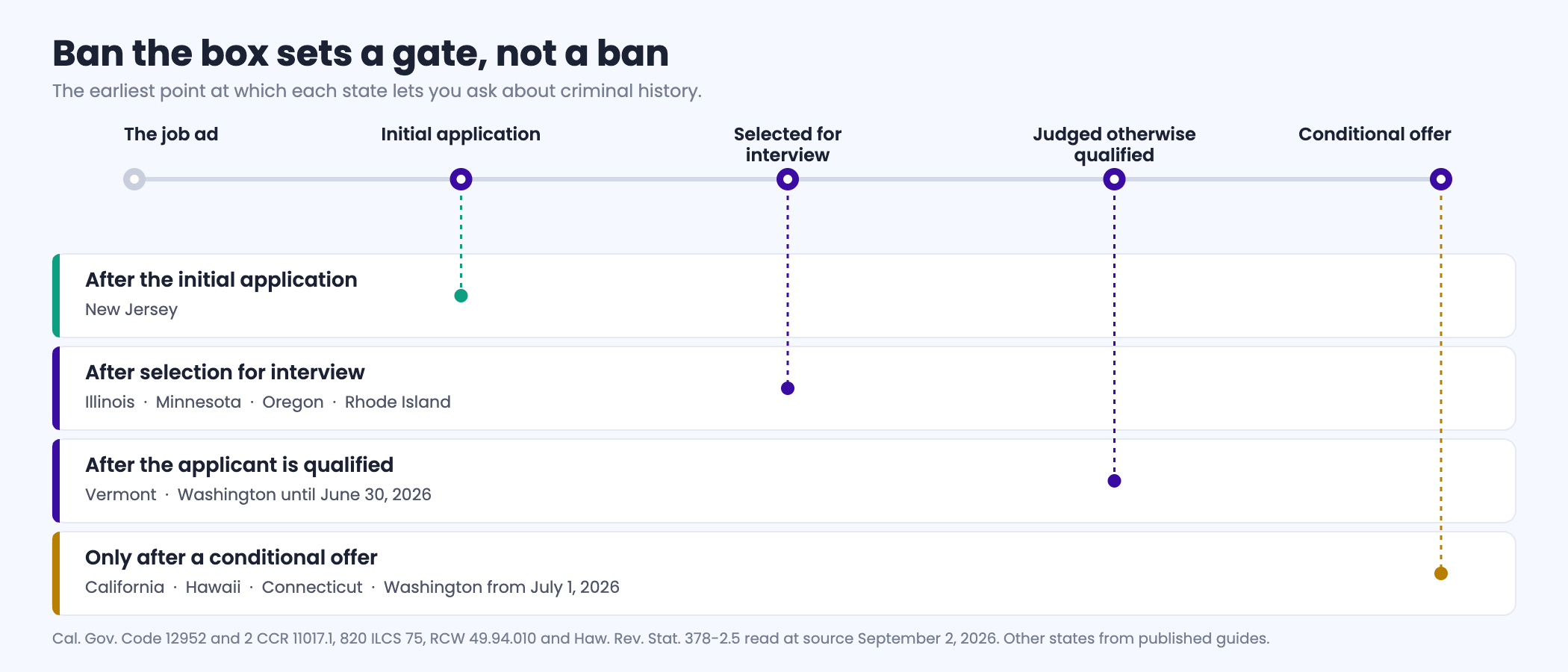
Ban the box does not stop you asking about criminal history. It moves the question later, and states put it in four different places: after the initial application, after the applicant is selected for an interview, after you decide they are otherwise qualified, or only after a conditional offer. Thirty-seven states and more than 150 cities and counties have adopted a policy; fifteen states extend it to private employers. Washington moved its line on July 1, 2026 and moves it again on January 1, 2027. And in California the rule reaches the job advertisement itself.
The question is not banned, it is postponed
Every one of these laws works the same way. It identifies a point in your hiring process and says that before that point you may not ask, and after it you may. Nothing forbids the question outright, nothing requires you to hire anyone, and none of them stops you from deciding that a particular conviction disqualifies a particular job. What they do is take the question off the front of the process, where it screens people out before anyone has looked at them. Keeping the question off the paper form is a simple way to comply across states at once: our employment application form page has a template that omits it, alongside the other fields that have become restricted.
| The gate | What it means in practice | Examples |
|---|---|---|
| After the initial application | The question cannot be on the form. It can be asked once that stage is over. | New Jersey, Connecticut, Maine, New Mexico |
| After selection for interview | You must have judged the applicant qualified and told them they have an interview. | Illinois, Maryland, Minnesota, Oregon, Rhode Island |
| After the applicant is otherwise qualified | A judgment call by you, made before any offer. | Vermont; Washington until June 30, 2026 |
| Only after a conditional offer | The strictest setting. Everything else must be decided first. | California, Hawaii, the District of Columbia; Washington from July 1, 2026 |
Why the gate matters more than the law
An employer running one hiring process across several states does not have fifteen problems, it has four. The same is true of what you may screen for after the offer, which is set out on drug testing laws by state. Build the process to the strictest gate that applies anywhere you hire and the other fourteen states take care of themselves. Build it to the loosest and you are relying on a recruiter to remember which state each applicant is in, at the moment they are looking at a screen full of applications.
Where the gate sits in each state
The fifteen states that reach private employers
The National Employment Law Project counts 37 states and more than 150 cities and counties with a fair chance policy of some kind. Most of those reach only public employment or public contracting. Fifteen reach private employers, and 22 of the local ordinances do.
| State | Threshold | Earliest you may ask | Source |
|---|---|---|---|
| California | 5 or more employees | After a conditional offer | Read at statute and regulation |
| Illinois | 15 or more employees | Once the applicant is judged qualified and told they are selected for an interview, or after a conditional offer | Read at statute |
| Washington | 15 or more from July 1, 2026; all employers from January 1, 2027 | After an offer conditioned on obtaining the record | Read at statute |
| Hawaii | No threshold stated | After a conditional offer, and only for convictions inside the look-back period | Read at statute |
| New Jersey | 15 or more employees | After the initial employment application process has concluded | Statute read in part |
| Connecticut | 1 or more employees | Not on the initial employment application | Read at statute |
| Maine | Private and municipal employers, no threshold stated | Not on the initial application form; at an interview or once the applicant is judged otherwise qualified | Read at statute |
| Maryland | 15 or more full-time employees | At the first in-person interview | Read at statute |
| New Mexico | Private employers, no threshold stated | Not on the employment application; after reviewing the application and discussing the job with the applicant | Read at statute |
| Minnesota, Oregon, Rhode Island, Vermont, Massachusetts, Colorado | Varies | Varies: interview stage in several, application stage in others | Reported from published guides |
| District of Columbia (not counted among the fifteen states) | More than 10 employees in D.C. | After a conditional offer | Read at statute |
Washington moved the line this year, and moves it again next
This is the change older summaries do not yet reflect. Washington’s Fair Chance Act used to let an employer ask once it had determined the applicant was otherwise qualified, which is a judgment the employer makes for itself. From July 1, 2026 that is no longer enough. The statute now bars an employer from asking, from receiving information through a background check, or from otherwise obtaining criminal record information “until after the employer initially determines that the applicant is otherwise qualified for the position and makes an offer of employment conditioned on obtaining the applicant’s criminal record.”
That applies to employers with 15 or more employees now. Employers with fewer than 15 come under the same rule on January 1, 2027. Washington also carves out positions with unsupervised access to children, vulnerable adults or vulnerable persons, employers required by law to run the inquiry, law enforcement and criminal justice agencies, volunteer positions, securities self-regulatory organizations, and federal contract positions that prohibit people with criminal records. For a senior living or home care operator in Washington, that first exemption is the whole workforce; for a warehouse, none of it applies.
The rule reaches the advertisement, not just the form
This is the part that catches recruitment advertising, and it is the reason this page exists on our site rather than on a compliance vendor’s. California’s amended Fair Chance Act regulations, effective October 1, 2023, prohibit an employer from including in a job advertisement, posting, application or other material any statement that a person with a criminal history will not be considered. Phrasing such as “No Felons” or “Must Have Clean Record” is out, in the ad itself, before anybody has applied to anything.
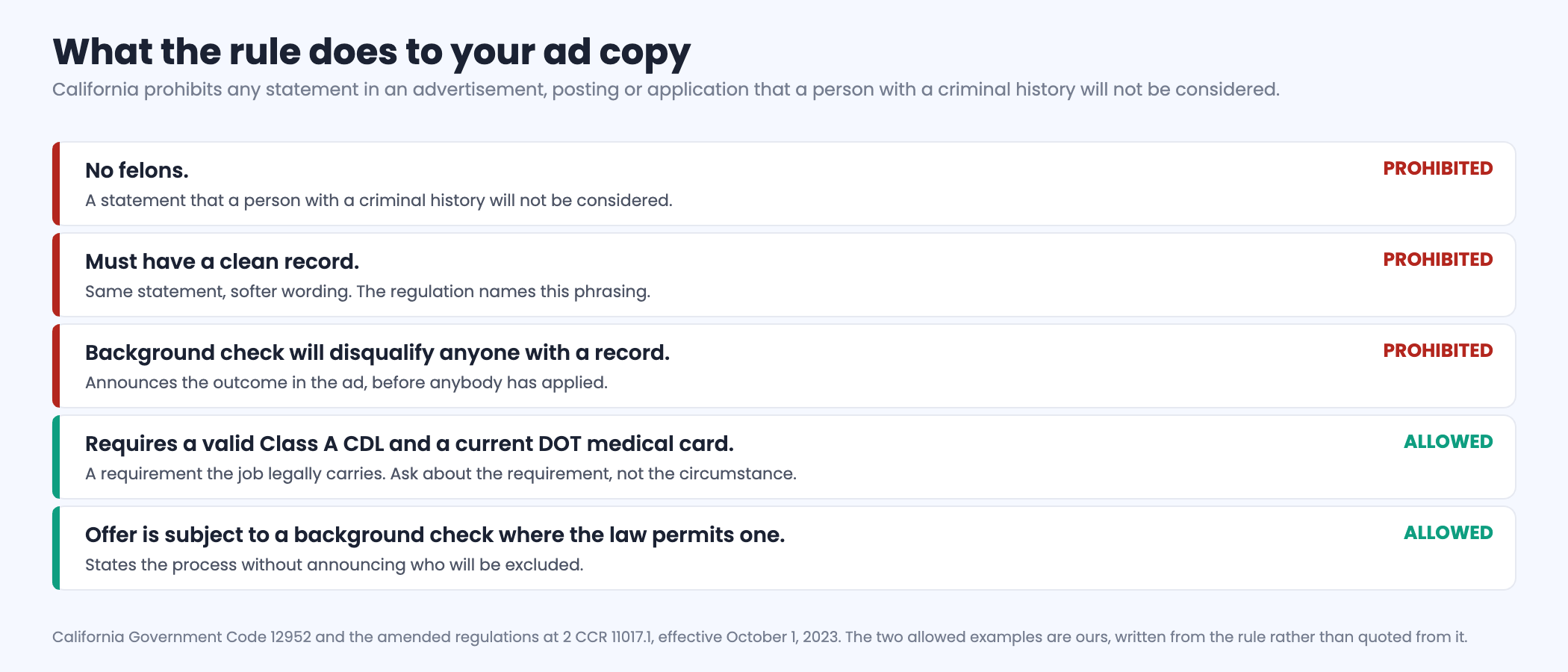
The same logic runs through the screening question. A social job ad with an instant application form collects answers before anything else happens: that form is the initial application. A knockout question asking whether the applicant has been convicted of a felony, set to disqualify anybody who answers yes, is a criminal record inquiry on an initial application. In a conditional-offer state it is the earliest possible moment you could have asked, and the law says it is too early.
The uncomfortable part is that knockout screening is the thing that makes a social job ad worth running. Screening questions are why a completed form is worth more than a click. So the design problem is real rather than rhetorical: you want the fewest, sharpest disqualifiers you can ask, and a criminal-history question is one of the few that is both a genuine disqualifier for some roles and unlawful to ask at that stage in others.
Check a screening question against the gate
What the law asks of you after you do ask
Passing the gate is the beginning rather than the end. The conditional-offer states generally require a reasoned decision rather than a reflex, and give the applicant a chance to answer.
If what remains after that assessment is a worry about money or property rather than about the work, there is a free instrument for it: the Federal Bonding Program issues a $5,000 to $25,000 fidelity bond covering the first six months, at no cost to you or the applicant.
| Requirement | Where | What it says |
|---|---|---|
| Individualized assessment | California | Before any pre-adverse action notice, weigh the nature and gravity of the offense, the time elapsed since the offense or completion of sentence, and the nature of the position sought. |
| Time to respond | California | At least five business days from receipt of the notice for the applicant to dispute the accuracy of the record or show rehabilitation. |
| Look-back limit | Hawaii | Convictions may be considered only within the most recent seven years for felonies and five for misdemeanors, excluding time served, and only where the record bears a rational relationship to the duties of the position. |
| Who counts as an applicant | California | Since October 2023 it includes existing employees who apply for a different position, and existing employees whose criminal history is reviewed because ownership, management or policy changed. |
The penalty ladder is gentler than the reputational one
Illinois is typical of how these are enforced. A first violation gets a written warning and 30 days to fix it. A second is up to $500, a third up to $1,500, and continuing non-compliance is up to $1,500 for every 30 days it persists. The fines are small next to an I-9 penalty. What they are not small next to is the cost of running an advertising campaign whose application form has to be rebuilt mid-flight.
What we can and cannot tell you
We measure the top of the funnel and nothing past it. Across the 891 campaigns in our 2026 social job advertising benchmark we can say what an applicant costs: a median of $13.88, with the middle half of campaigns between $6.48 and $29.74. Every clicker who gives up on a long form is ad spend with no applicant to show for it, which is how screening questions cost volume. We have no data at all on how many applicants a criminal-history question removes, whether removing it changes hire quality, or how any of this interacts with conviction rates, and we will not publish an estimate of any of them. Those are questions your own application data can answer and ours cannot.
The practical advice we would give is the same one the compliance answer points at anyway: ask fewer disqualifying questions, and make the ones you keep about the requirement rather than the circumstance. That is also what our page on Form I-9 requirements concludes about work authorization, and what our job ad copywriting guidance says about ad language generally.
Clean slate laws: automatic sealing, and the four states where it has not started
Ban the box governs when you may ask. Clean slate governs whether the record is still there to find. A clean slate law seals or expunges qualifying records automatically, without the individual petitioning, which means a background check returns nothing rather than returning something the candidate has to explain. The two do different jobs and an employer needs both.
The distinction that matters commercially is between a law being enacted and the automation actually running, because several states have the first without the second. Checked at the state code and the state courts on September 3, 2026:
- Automatic sealing operating now, ten states. Pennsylvania since 2019 (18 Pa.C.S. 9122.2), Utah since 2022 (Utah Code 77-40a-204), Michigan since April 2023 (MCL 780.621g), Connecticut (Conn. Gen. Stat. 54-142a and 54-142t), Delaware since August 2024 (11 Del. C. 4373A), California in its current form since October 2024 (Penal Code 1203.425), Colorado from July 2024 for misdemeanors and July 2025 for eligible felonies (C.R.S. 13-3-117), New York since November 2024 (CPL 160.57), Minnesota since January 2025 (Minn. Stat. 609A.015), and Virginia since July 1, 2026 (Va. Code 19.2-392.6).
- Enacted but not yet automatic, four states. Oklahoma must begin the automatic process by November 1, 2027 (22 O.S. 19d). Missouri, whose law covers drug possession and paraphernalia only, no later than January 1, 2027 (RSMo 610.141). Illinois from January 1, 2029, with a backlog phased to 2034 (20 ILCS 2630/5.2(k)). And New Jersey, which enacted in 2019 but never built the automation: its statute is titled clean slate expungement by petition and that is still how it works.
Two things worth not repeating. Utah turned its automation off between October 2024 and December 2025, requiring a form during that window, and resumed fully on January 1, 2026, so anything written in that period describing Utah as automatic was wrong at the time. And Maryland is not a clean slate state: its 2026 bill passed the Senate and died in a House committee. Maine passed one in 2026 and it was vetoed.
The rest of the application: which questions are gated, and by what
Criminal history is the question this page is about, but it is not the only one on the form with a clock attached. Four other categories are gated by a different law, and the gates do not open at the same moment. It is worth laying them side by side, because a form built to clear the ban-the-box line can still be unlawful on a row nobody checked.
| What you want to ask | When you may ask it | What governs |
|---|---|---|
| Conviction history | After the gate your state sets — application, interview, conditional offer, or not until a specific point in the process | State and local ban-the-box law; the table above |
| Disability, medical conditions, workers' compensation history, past sick leave | Not until after a conditional job offer | ADA; EEOC pre-employment guidance |
| Ability to perform the job's functions, and to meet stated attendance requirements | Any time, including on the application | Permitted expressly by the same EEOC guidance |
| Salary history | Barred outright in a number of states and cities | State pay-transparency and salary-history law |
| Proof of work authorization | After hire, on the I-9 — not as a document request on the application | Form I-9 process |
The medical row is the one that trips up careful employers, because the questions that trip it rarely look medical. The EEOC's position is flat: "An employer may not ask disability-related questions and may not conduct medical examinations until after it makes a conditional job offer." A question does not have to name a condition to break that rule — it only has to be likely to elicit one. Asking how many days someone was out sick in their last job, or whether they have ever filed a workers' compensation claim, is a disability-related question in EEOC's terms, however routine it looks on a warehouse or care facility form.
What you can ask, in the same guidance, is the thing you actually wanted to know: whether the applicant can perform specific job functions, and whether they can meet the attendance requirements the job has. "Can you lift 50 lb repeatedly across an eight-hour shift?" is a lawful pre-offer question. "Do you have a back injury?" is not, and it is also a worse question, because the first one gets you an answer you can act on.
Salary history has its own map, and it is not the same map as this page's. Where your state sits on asking about pay — and on what you must publish in the ad — is set out in pay transparency laws by state.
One thing worth saying about the form as a whole. Every question you cannot yet act on is a field that costs you applicants and buys you nothing: you either cannot use the answer at this stage or cannot lawfully ask for it. The strongest version of the application is the one that asks only what decides the next step — can they do the job, can they work the shift, can they get there — and leaves everything gated until the gate opens. That is the same conclusion the compliance table points at, arrived at from the other direction.
Salary history questions have their own rules; see salary history ban states.
Frequently asked questions
Which states have ban the box laws for private employers?
Fifteen, according to the National Employment Law Project: California, Colorado, Connecticut, Hawaii, Illinois, Maine, Maryland, Massachusetts, Minnesota, New Jersey, New Mexico, Oregon, Rhode Island, Vermont and Washington. Thirty-seven states and more than 150 cities and counties have a fair chance policy of some kind, but most reach only public employment or public contracting. Maine, Maryland and New Mexico do reach private employers: Maine and New Mexico bar the question on the initial application, and Maryland bars it before the first in-person interview for employers with 15 or more full-time employees. The District of Columbia, which is not a state, also covers employers with more than 10 employees and waits until after a conditional offer.
Does ban the box mean I cannot ask about criminal history at all?
No. Every one of these laws sets a point in the hiring process and says the question may not come before it. States use four different points: after the initial application, after the applicant is selected for an interview, after you determine the applicant is otherwise qualified, and after a conditional offer. Nothing requires you to hire anyone, and nothing stops a conviction from disqualifying someone for a job it is genuinely relevant to.
When can a California employer ask about conviction history?
Only after making a conditional job offer, and only if the employer has five or more employees. Before rescinding that offer the employer must make an individualized assessment weighing the nature and gravity of the offense, the time that has passed since the offense or the completion of sentence, and the nature of the job. The applicant then gets at least five business days from receiving the notice to dispute the record or present evidence of rehabilitation.
What changed in Washington on July 1, 2026?
The gate moved from a judgment to an offer. Washington employers used to be able to ask once they had decided an applicant was otherwise qualified. Since July 1, 2026 an employer with 15 or more employees may not ask, run a background check, or otherwise obtain criminal record information until it has both determined the applicant is otherwise qualified and made an offer conditioned on obtaining the record. Employers with fewer than 15 employees come under the same rule on January 1, 2027.
Can a job ad say no felons?
Not in California. The amended Fair Chance Act regulations effective October 1, 2023 prohibit including in a job advertisement, posting, application or other material any statement that a person with a criminal history will not be considered, and name phrasings such as no felons and must have a clean record as examples. That reaches the advertisement itself, before anyone has applied, so it is a copywriting question as much as a compliance one.
Does a screening question on a social ad count as an application?
Treat it as one. An instant form inside a social job ad collects the applicant answers before any other step, which puts it at the initial application stage or earlier. A knockout question about convictions, set to disqualify anyone who answers yes, is a criminal record inquiry made at the earliest possible moment, and in a conditional-offer state that is well before the law allows it. Where a conviction genuinely disqualifies, ask about the requirement at the right stage instead.
How far back can an employer look at convictions?
It depends on the state, and Hawaii is the clearest example of a hard limit. There an employer may consider only convictions within the most recent seven years for felonies and five years for misdemeanors, excluding any period of incarceration, and only where the record bears a rational relationship to the duties of the position. Other states rely on an individualized assessment of how much time has passed rather than a fixed cut-off.
What are the penalties for a ban the box violation?
Modest, and usually graduated. Illinois issues a written warning with 30 days to cure for a first violation, then up to $500 for a second, up to $1,500 for a third, and up to $1,500 for each 30-day period non-compliance continues. The larger cost is operational: an application form or an ad that has to be rebuilt while a campaign is running, and every applicant collected through the old version to account for.
What are clean slate laws?
Laws that seal or expunge qualifying criminal records automatically, without the individual having to petition a court. Ban the box controls when an employer may ask about a record; clean slate controls whether the record is still there to be found. As of September 2026 automatic sealing is operating in ten states: Pennsylvania, Utah, Michigan, Connecticut, Delaware, California, Colorado, New York, Minnesota and Virginia. Four more have enacted a law that has not yet started running automatically: Oklahoma by November 2027, Missouri by January 2027 for drug offenses only, Illinois from January 2029, and New Jersey, which enacted in 2019 but still operates by petition.
What questions can you not ask on a job application?
Before a conditional job offer, you cannot ask disability-related questions or require a medical examination — the EEOC's guidance is that "an employer may not ask disability-related questions and may not conduct medical examinations until after it makes a conditional job offer." That covers indirect versions too, such as past sick days or workers' compensation claims. Conviction history is gated by your state's ban-the-box law rather than banned, and the gate ranges from the application form to a conditional offer. Salary history is barred outright in a number of states and cities. Proof of work authorization belongs on the I-9 after hire, not as a document request on the form. You may always ask whether the applicant can perform the job's specific functions and meet its stated attendance requirements.
This is one rule among about a dozen that attach at different points in a hire. Our hiring compliance hub sets out which obligation bites at which stage, and the four federal deadlines every US employer is on.
Build the form once, to the strictest gate you hire under
Bring the states you advertise into and the questions your form asks today. We will show you what each question costs you in completed applications, so the screening decision is made with a number rather than a hunch.
Book a Demo