
Employment Ad Compliance in 2026: OFCCP Requirements, Pay Transparency, and Platform Rules
OFCCP job posting requirements changed fundamentally in 2025–2026: Executive Order 11246 was revoked, but VEVRAA and Section 503 remain law — including VEVRAA's requirement that covered federal contractors list openings with their state employment service. Separately, a growing set of states now requires salary ranges in job postings, and employment ads on Meta run under the Special Ad Category. Here's the whole stack, current as of August 2026.
Most pages ranking for this topic were written before January 2025 and describe a compliance regime that no longer exists. This one was written the week OFCCP published its final rules — August 21, 2026 — and it's organized the way the obligations actually layer: what applies to every employer, what applies only to federal contractors, and what depends on the state you're hiring in.
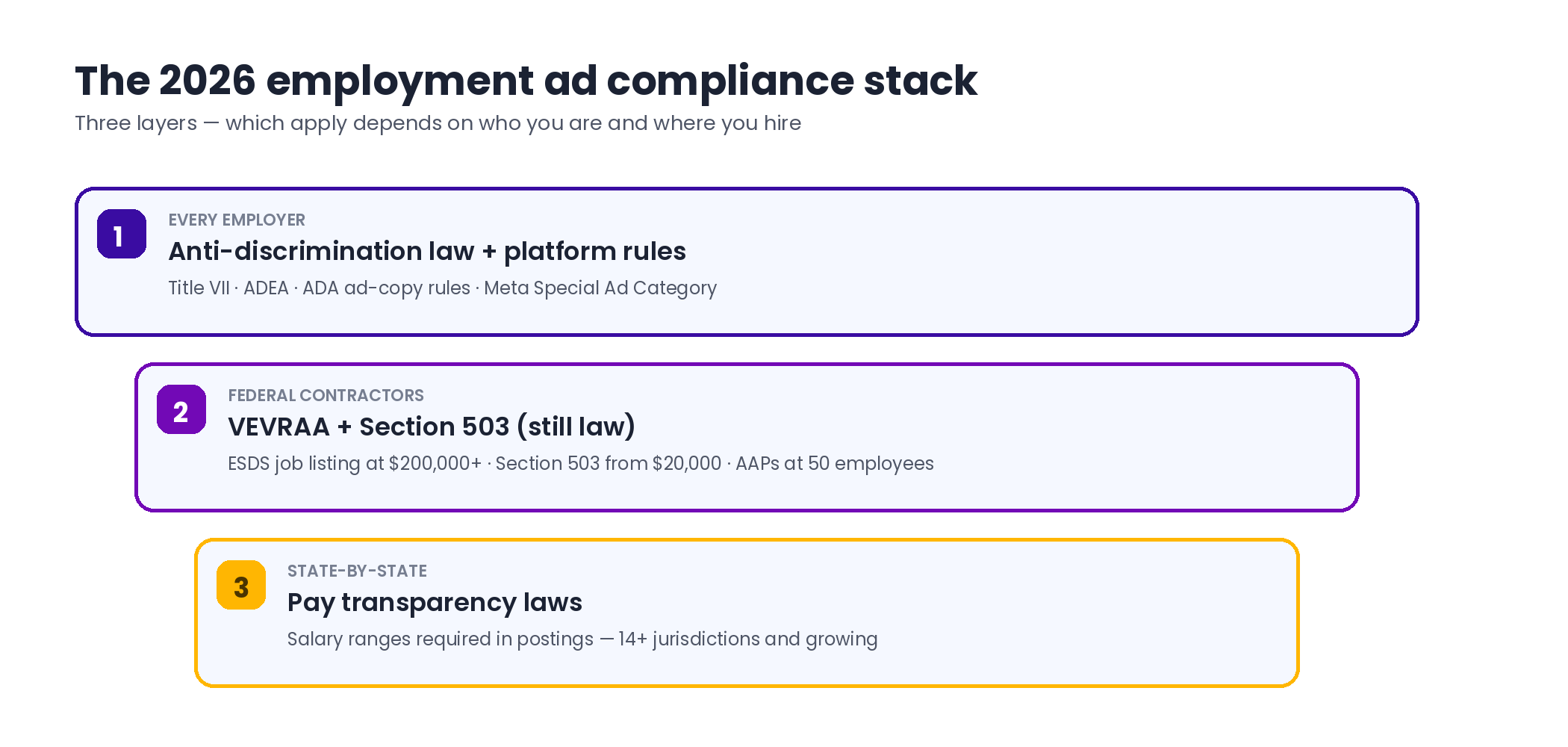
Anti-discrimination law and platform rules
Title VII, the ADEA, and the ADA govern what your ad copy can say. Meta's Special Ad Category governs how employment ads can target. These apply to a five-person shop and a Fortune 500 alike. Once a posting is compliant, our employee cost calculator shows what the hire will cost in wages, taxes and benefits.
VEVRAA and Section 503
The two statutes OFCCP still enforces after EO 11246's revocation — including VEVRAA's mandatory job listing requirement, the one true "OFCCP job posting requirement."
State pay transparency laws
A patchwork of state laws requiring salary ranges in postings, growing every legislative session and reaching remote roles across state lines.
What changed at OFCCP in 2025–2026
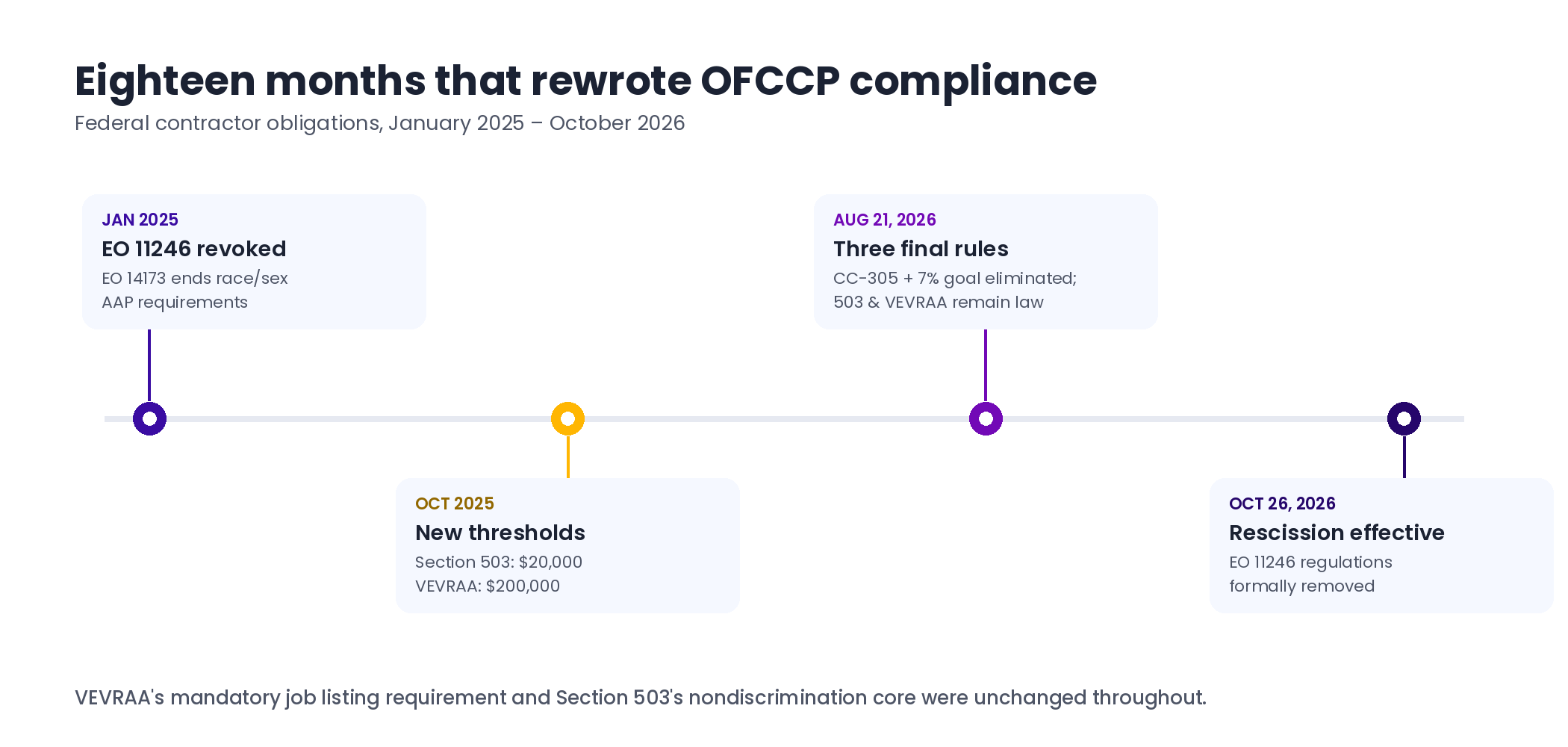
In January 2025, Executive Order 14173 revoked Executive Order 11246 — the 1965 order that had grounded race- and sex-based affirmative action requirements for federal contractors for six decades — and the Department of Labor directed OFCCP to cease enforcing it. On August 21, 2026, OFCCP published three final rules completing the follow-through: the EO 11246 implementing regulations are rescinded effective October 26, 2026, and the Section 503 rules are narrowed — the disability self-identification invitation (the CC-305 form) and the 7% disability utilization goal are eliminated.
What did not change is the part employers keep getting wrong: Section 503 of the Rehabilitation Act and VEVRAA are statutes passed by Congress, not executive orders, and they remain fully enforceable. Congress's FY 2026 budget dismantles OFCCP as an agency and moves its remaining enforcement elsewhere, but the underlying obligations travel with the statutes, not the agency.
What that means for the sentence at the bottom of the ad — which wording is still prescribed, and what a non-contractor should write instead — is set out in our EEO statement guide, with a builder that assembles one from the regulatory language.
| Requirement | Status | Detail |
|---|---|---|
| EO 11246 race/sex affirmative action programs | Rescinded | EO revoked Jan 2025; implementing regulations rescinded effective Oct 26, 2026 |
| Section 503 CC-305 disability self-ID invitation | Eliminated | Removed by the August 2026 final rules |
| Section 503 7% disability utilization goal | Eliminated | Removed by the August 2026 final rules |
| Section 503 nondiscrimination, accommodation & outreach | In force | Core protections retained; coverage from $20,000 in contracts; AAPs at 50 employees + $50,000 |
| VEVRAA nondiscrimination & affirmative action | In force | Coverage from $200,000 in contracts (threshold raised Oct 1, 2025); AAPs at 50 employees + $200,000 |
| VEVRAA mandatory job listing | In force | Covered contractors must list openings with the state employment service delivery system |
The OFCCP job posting requirement that still exists: VEVRAA job listing
If you searched "OFCCP job posting requirements," this is almost certainly the obligation you're looking for. Under VEVRAA, contractors and subcontractors with a covered federal contract of $200,000 or more must:
- List job openings with the appropriate employment service delivery system (ESDS) — in practice, the state or local workforce agency job bank where the position is located. Posting on your careers page or a commercial job board does not satisfy this by itself.
- Identify yourself as a federal contractor when listing, so the ESDS gives protected veterans priority referral to your openings.
- Cover essentially all openings, with three standard exceptions: senior executive positions, positions filled internally, and jobs lasting three days or fewer.
Two practical notes. First, listing with the ESDS is a floor, not a strategy — state job banks satisfy the regulation but rarely fill frontline roles by themselves, which is why covered contractors typically run the ESDS listing and their actual recruiting in parallel. Second, if you use an applicant tracking system or job distribution service, confirm in writing that it actually pushes listings to the ESDS in each state; "we syndicate everywhere" and "we satisfy VEVRAA listing" are not the same claim.
The Internet Applicant rule: who counts as an applicant for OFCCP recordkeeping
For federal contractors, who counts as an applicant has been settled by the Internet Applicant definition at 41 CFR 60-1.3. A person is an Internet Applicant only if all four of these are true:
- 1. They submit an expression of interest in employment through the Internet or related electronic data technologies.
- 2. The contractor considers them for employment in a particular position.
- 3. Their expression of interest indicates they possess the basic qualifications for that position.
- 4. At no point before receiving an offer do they remove themselves from consideration or otherwise indicate they are no longer interested.
Basic qualifications must be noncomparative, objective and relevant to performing the job, and either advertised or recorded before any applications are considered. “Three years' experience in the position” qualifies; “one of the strongest candidates” does not. Once a contractor considers online expressions of interest for a position, paper and walk-in expressions of interest for that position fall under the definition too. The companion retention rule at 41 CFR 60-1.12(a) covers resume database searches — the position searched for, the criteria used and the date — for at least two years, or one year for smaller contractors.
The rule now has an end date. Part 60-1 is one of the parts the EO 11246 rescission rule removes, effective October 26, 2026. The VEVRAA regulations do not define “applicant” themselves, and the VEVRAA final rule effective September 21, 2026 did not add a definition, yet 41 CFR 60-300.44(k) still requires covered contractors to document each year the total number of applicants for all jobs, the number who self-identified as protected veterans, the total hired and the protected veteran applicants hired, and to keep those figures for three years. Something has to decide who goes into that count. Our suggestion: keep applying the four-part test as your own written convention, consistently, rather than drop the discipline along with the regulation.
For social recruiting this is concrete. A Meta instant-form submission is an expression of interest through the Internet, and the form's knockout questions are the natural place to record basic qualifications before anyone applies. The voluntary survey that feeds the veteran count is covered in our EEO statement guide.
Do federal contractors still need an affirmative action plan after October 26, 2026?
Yes, most covered contractors still need a written affirmative action plan after October 26, 2026. What ends that day is the race and sex affirmative action plan under Executive Order 11246. The Department of Labor’s rescission rule, effective October 26, 2026, removes 41 CFR parts 60-1, 60-2, 60-3, 60-4, 60-20, 60-30, 60-40, 60-50 and 60-999. Part 60-2 is where the placement goals and workforce analyses for women and minorities lived. What the rescission means for the annual workforce report is covered in our EEO-1 reporting requirements guide.
The two statute-based plans stay. Both are covered in the VEVRAA and Section 503 section above, and the Section 503 and VEVRAA final rules, both effective September 21, 2026, left the plan requirement itself in place:
| Plan | Who must have one | Status |
|---|---|---|
| EO 11246 plan (women and minorities) | Formerly 50+ employees and a $50,000 contract | Regulations removed effective October 26, 2026 |
| Section 503 plan (individuals with disabilities) | 50 or more employees and a contract of $50,000 or more, under 41 CFR 60-741.40(b) | Still required. Self-identification invitation, data collection and 7 percent utilization goal removed. |
| VEVRAA plan (protected veterans) | 50 or more employees and a contract of $200,000 or more, under 41 CFR 60-300.40(a) | Still required, including the annual hiring benchmark and applicant and hire data |
For both surviving plans, the regulation says the contractor must prepare the plan “within 120 days of the commencement of a contract” at each establishment, have it “reviewed and updated annually,” and submit it within 30 days of an OFCCP request.
What the Section 503 plan looks like now
The Section 503 final rule removed 41 CFR 60-741.42 (asking applicants and employees to self-identify disability), 60-741.44(k) (the related data collection) and 60-741.45 (the 7 percent utilization goal and analysis). The outreach duty remains. Contractors must still review their outreach and recruitment efforts every year, document the criteria used and whether each effort worked, and try alternatives if the efforts as a whole were not effective. A new paragraph, 60-741.44(l), says contractors are not required to use counts of referrals, applicants or hires with disabilities to make that judgment.
What the VEVRAA plan still requires
The VEVRAA final rule removed the cross-references to EO 11246, moved the enforcement procedures into the VEVRAA regulations and updated the coverage threshold to $200,000. It did not change the plan contents. Covered contractors still set a hiring benchmark each year under 41 CFR 60-300.45, still invite applicants to self-identify as protected veterans, and still record applicant and hire counts under 60-300.44(k). That is also where the job listing duty in the section above sits, so for veteran hiring the posting and the plan are one set of records.
What every employer's ad copy has to get right
Independent of contractor status, federal anti-discrimination law reaches the words in the ad itself. So does state law on what the ad must disclose about pay, which we set out on pay transparency laws by state. Title VII, the ADEA, and the ADA prohibit ads that state or signal a preference by race, color, religion, sex, national origin, age, or disability. The violations that actually happen are rarely explicit — they're proxies:
- Age proxies: "recent graduates," "digital natives," "young and energetic," or capping "years of experience" as a screen-out. If the phrase implies an age band, it's a risk.
- Sex-coded titles: "waitress," "foreman as male-only framing," "salesman." Use neutral titles.
- Blanket requirements that screen by disability without job-relatedness — "must be able to lift 50 lbs" is defensible for a warehouse role and a liability for a desk role.
- Citizenship shorthand: "US citizens only" is unlawful in most private-sector postings; "authorized to work in the US" is the compliant phrasing unless a specific legal requirement applies.
Meta's Special Ad Category: compliance built into the platform
Every employment ad on Facebook and Instagram in the US must run under Meta's Special Ad Category, which removes age, gender, and detailed demographic targeting and broadens location targeting — a structural response to discrimination concerns in ad delivery. The practical consequence for recruiters: you cannot target your way to qualified applicants, and you don't need to. Qualification happens in the creative (the ad says plainly who the job is for) and in knockout questions in the application form (license, certification, shift availability). That's not a workaround; it's the compliant design. It's also how our clients run every campaign — the 2026 benchmark data across 891 campaigns was generated entirely under these rules, which is worth remembering when someone tells you the Special Ad Category makes social job advertising unworkable.
State pay transparency: where salary ranges are required in the posting
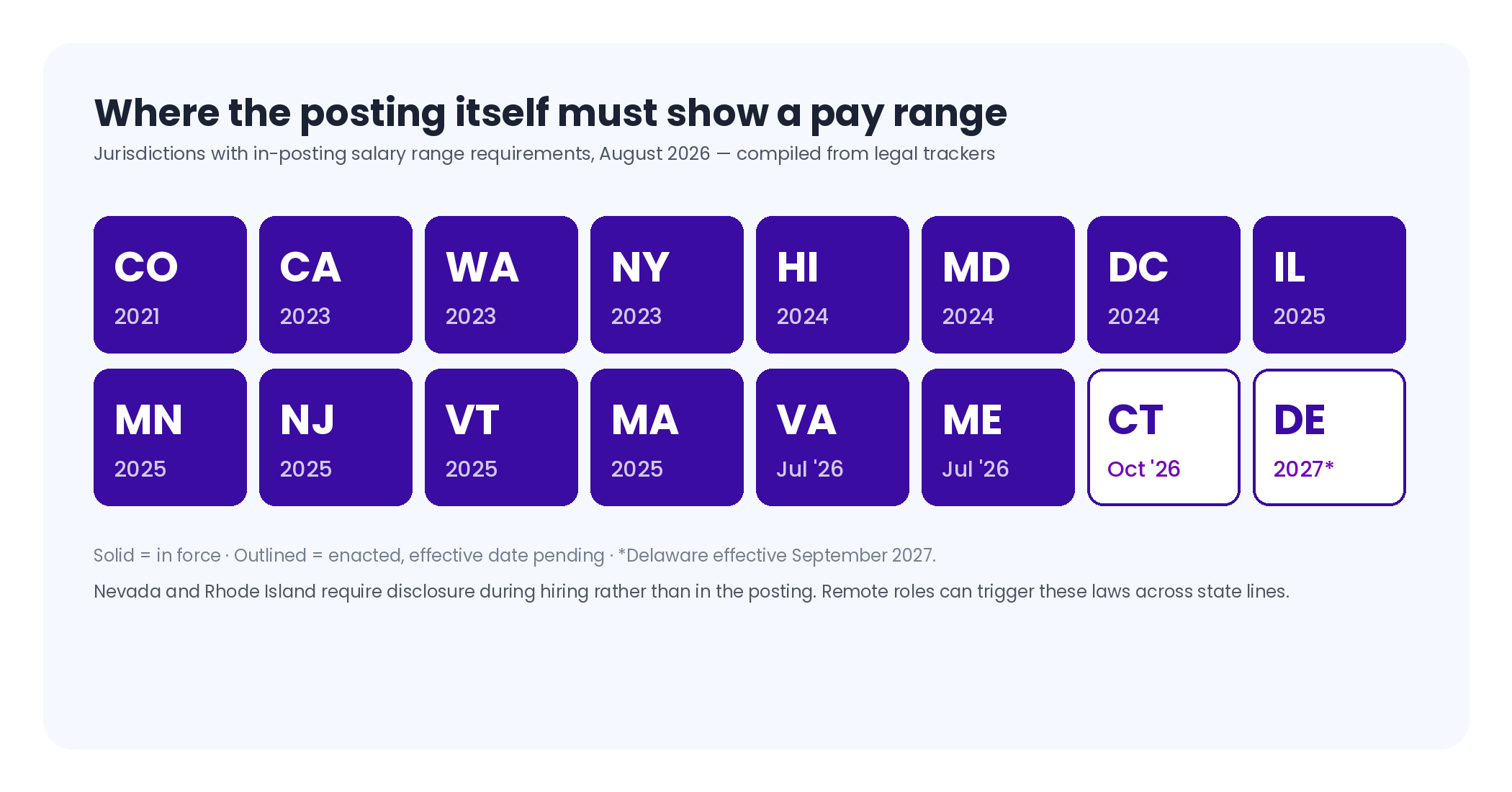
There is no federal pay transparency statute. What exists is a fast-growing patchwork of state laws — three new posting requirements took effect or expanded in 2026 alone. As of August 2026, the states generally requiring a good-faith pay range in the job posting itself:
| Jurisdiction | Posting requirement since | Notes |
|---|---|---|
| Colorado | Jan 2021 | Applies from the first employee working in-state |
| California | Jan 2023 | 15+ employees; 2025 amendment tightened the "pay scale" definition |
| Washington | Jan 2023 | 15+ employees; active private-lawsuit enforcement |
| New York | Sep 2023 | 4+ employees; covers remote roles reporting into NY |
| Hawaii | Jan 2024 | Posting disclosure required |
| Maryland | Oct 2024 | Posting disclosure required |
| Illinois | Jan 2025 | 15+ employees |
| Minnesota | Jan 2025 | Posting disclosure required |
| New Jersey | Jun 2025 | 10+ employees; enforcement active in 2026 |
| Vermont | Jul 2025 | 5+ employees |
| Massachusetts | Oct 2025 | Enforcement active in 2026 |
| Washington, DC | Jun 2024 | Applies from the first employee |
| Virginia | Jul 1, 2026 | New in 2026 |
| Maine | Jul 29, 2026 | New in 2026 |
| Connecticut | Oct 1, 2026 | Converts from disclosure-on-request to in-posting |
| Delaware | Sep 26, 2027 | Enacted 2025; not yet in effect |
Beyond these, Nevada and Rhode Island require disclosure at stages of the hiring process rather than in the posting, and cities including New York City, Cleveland, and Columbus carry their own ordinances. Counts differ between legal trackers depending on how "pay transparency" is defined — treat this table as the posting-requirement snapshot it is, and confirm your specific jurisdictions with counsel before publishing.
The multi-state trap is remote work: most of these laws reach any role that can be performed in the state, not just roles based there. A remote posting with no range can create obligations in states where you've never had an office. Many multi-state employers now put ranges in every posting and treat the strictest state as the standard.
And the recruiting data says that's not just defensive. Across our campaigns, ads that state the wage plainly out-convert ads that hide it — pay clarity does qualification work before the click, which is precisely the mechanic that drives cost per applicant. Compliance and performance point the same direction here.
A compliance walkthrough you can run on your next posting
- 1. Copy check. Read the ad for proxies: age signals, sex-coded titles, non-job-related physical requirements, citizenship shorthand. Fix the phrase, not the lawyer's letter.
- 2. Range check. Is the job performed — or performable — in a posting-requirement state? Add a good-faith range. If you're multi-state or remote, add it everywhere and skip the per-state audit.
- 3. Contractor check. Do you hold a federal contract or subcontract at $200,000+ (VEVRAA) or $20,000+ (Section 503)? Then confirm the ESDS listing happens for this opening, your contractor status is identified, and your AAP obligations (at 50 employees plus the relevant contract level) are current.
- 4. Platform check. On Meta, the campaign runs under the Special Ad Category — and qualification lives in the creative and the form's knockout questions, not in targeting that no longer exists.
- 5. Records check. Keep the posting, the range, the ESDS confirmation, and the application flow. Every obligation above is easier to demonstrate than to reconstruct.
The 2026 rule of thumb: discrimination law governs the words, state law governs the wage, and for federal contractors, VEVRAA governs where the posting must appear. Get those three right and the rest is recordkeeping.
Frequently asked questions
What are the OFCCP job posting requirements in 2026?
The surviving posting requirement comes from VEVRAA: federal contractors and subcontractors with covered contracts of $200,000 or more must list job openings with the state employment service delivery system (ESDS) and identify themselves as federal contractors, so protected veterans receive priority referral. Senior executive roles, internal fills, and jobs of three days or fewer are the standard exceptions. EO 11246's separate requirements were revoked in 2025.
Does Executive Order 11246 still apply?
No. EO 11246 was revoked by Executive Order 14173 in January 2025, and on August 21, 2026 OFCCP published a final rule rescinding its implementing regulations effective October 26, 2026. Race- and sex-based affirmative action program requirements for federal contractors ended with it. Section 503 and VEVRAA — which are statutes, not executive orders — remain in force.
What is the VEVRAA job listing requirement?
Covered federal contractors must list their job openings with the appropriate employment service delivery system — generally the state workforce agency's job bank where the position is located — and indicate federal contractor status to enable priority referral of protected veterans. Posting only on your own careers site or a commercial job board doesn't satisfy it.
What are the current Section 503 and VEVRAA coverage thresholds?
Since October 1, 2025: Section 503 applies from $20,000 in covered federal contracts (up from $15,000), with written affirmative action program requirements at 50 employees plus a $50,000 contract. VEVRAA applies from $200,000 (up from $150,000), with AAP requirements at 50 employees plus a $200,000 contract. The August 2026 final rules eliminated the Section 503 self-identification invitation and 7% utilization goal but retained its nondiscrimination, accommodation, and outreach core.
Which states require salary ranges in job postings?
As of August 2026: Colorado, California, Washington, New York, Hawaii, Maryland, Illinois, Minnesota, New Jersey, Vermont, Massachusetts, Virginia, Maine, and Washington, DC — with Connecticut joining October 1, 2026 and Delaware effective September 2027. Nevada and Rhode Island require disclosure during hiring rather than in the posting, and several cities add their own rules. The list grows most legislative sessions, so verify before posting.
Do pay transparency laws apply to remote jobs?
Generally yes, and this is the multi-state trap: most posting laws reach roles that can be performed in the state, and New York's expressly covers remote roles reporting to a New York supervisor or office. A remote posting without a range can create exposure in states where the employer has no office, which is why many multi-state employers now include ranges in every posting by default.
What is Meta's Special Ad Category for employment ads?
A required classification for all US employment ads on Facebook and Instagram that removes age, gender, and detailed demographic targeting and broadens location targeting. Qualification therefore happens through the ad's creative and knockout questions in the application form — not audience targeting. It's the single most misunderstood mechanic in social recruiting, and campaigns run successfully under it at scale.
Can a job ad say "young and energetic" or "recent grads only"?
Don't. Phrases implying an age preference — "young," "digital native," "recent graduate," experience caps used to screen out older workers — create ADEA risk even without explicit age limits. Describe the work and the requirements ("entry-level," "no experience required," specific skills) rather than the person's age, and apply the same proxy test to sex, disability, and citizenship phrasing.
What is the Internet Applicant rule?
It is the OFCCP definition at 41 CFR 60-1.3 of who counts as an applicant for federal contractor recordkeeping: someone who expresses interest through the Internet or related electronic data technologies, whom the contractor considers for a particular position, whose expression of interest shows the basic qualifications for it, and who has not withdrawn before an offer. Part 60-1 is removed effective October 26, 2026, but VEVRAA still requires covered contractors to count applicants every year under 41 CFR 60-300.44(k), so a consistent definition is still needed.
Run compliant campaigns without the guesswork
Every Boostpoint campaign runs under Meta's Special Ad Category with qualification built into the ad and the form — see how it works for your roles.
Book a Demo




This page summarizes the regulatory landscape as of August 24, 2026 and is not legal advice; consult employment counsel for your specific obligations. Federal contractor sections reflect Executive Order 14173 (January 2025), the Department of Labor's October 1, 2025 threshold updates, and OFCCP's three final rules published August 21, 2026 (EO 11246 regulation rescission effective October 26, 2026; Section 503 and VEVRAA modifications), as reported in the Federal Register and analyses by Ogletree Deakins, Seyfarth Shaw, and Crowell & Moring. Pay transparency entries are compiled from 2026 state-law trackers by Jackson Lewis, ADP, and other legal publishers; counts vary between trackers by definition, and effective dates shown are the in-posting requirement dates. Advertising observations reflect Boostpoint-managed campaigns under Meta's Special Ad Category; see the 2026 benchmark for methodology.
If low-cost boards form part of your outreach, our breakdown of Craigslist job posting cost sets out the published fees and the 30-day posting lifespan.