
Apprenticeship and Trade School Recruiting: Building the Grow Track So the Hire Track Stops Being the Only One
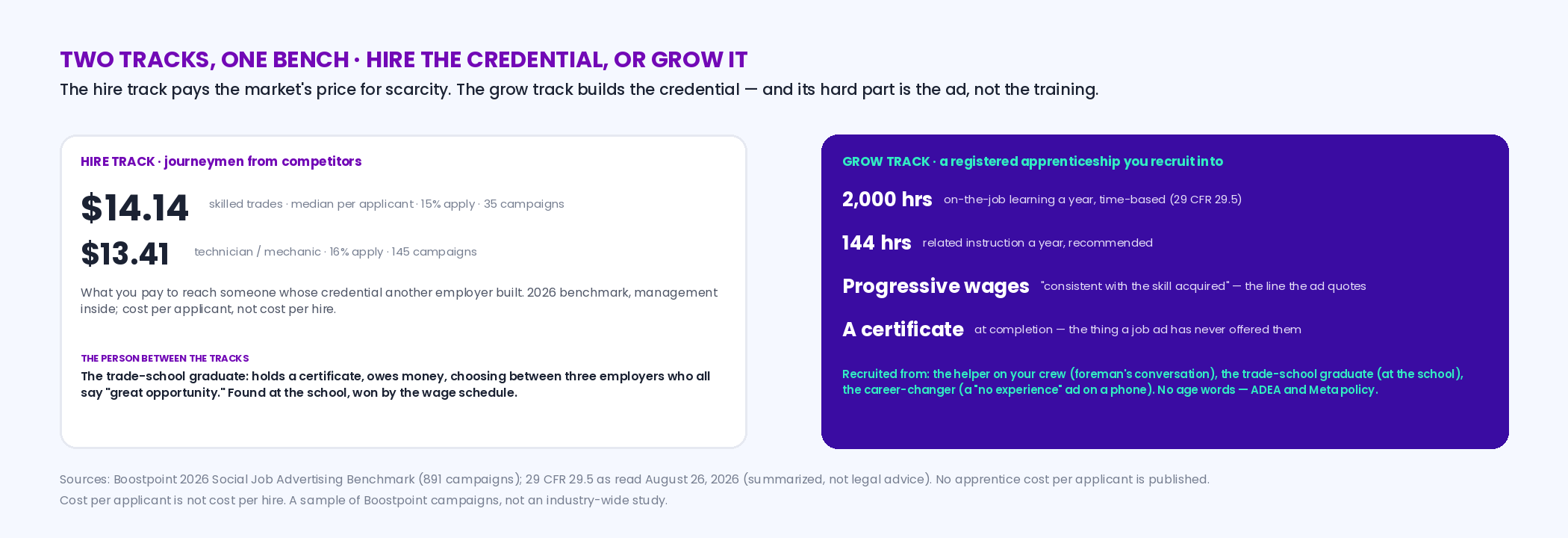
Every trades employer runs two pipelines whether it means to or not: the hire track, which recruits journeymen from competitors and pays the market's price for scarcity, and the grow track, which recruits people who aren't journeymen yet — trade-school graduates, helpers, career-changers — into an apprenticeship and makes them. A registered program has a federal shape: at least 2,000 hours of on-the-job learning over the term on the time-based approach, a recommended 144 hours of related instruction, and a progressively increasing wage schedule, which is the thing the ad can quote. This page is the grow track as a recruiting problem: who to recruit into it, what the ad says, the cohort arithmetic over four years, and the wage ladder that makes "earn while you learn" a number instead of a slogan.
A note on who's writing this
Boostpoint runs social media job ads for contractors and manufacturers, including the "we'll train you — paid" campaigns that feed apprenticeship and train-up programs, so the ad sections of this page describe what we sell. We don't run apprenticeship programs and this page doesn't tell you how to register one; the federal standards are summarized from 29 CFR 29.5 as read today and your state apprenticeship agency or the Office of Apprenticeship governs. On the national numbers, one honesty note: the Department of Labor's static "national results" pages stop at fiscal 2021, and its current figures live in dashboards we could not read programmatically, so the 2024 figure below is attributed to the secondary source that reported it. We publish no apprentice-specific cost per applicant and no trades role ladder. Every figure of ours is a cost per applicant, never a cost per hire.
The two tracks, and why the grow track is a recruiting problem
The hire track is well understood and expensive for a reason our data shows plainly: cost per applicant tracks credential scarcity, not skill. The CNC operator and machinist page makes the case from one side — machinist applicants ran $4.15 in our earlier manufacturing analysis, roughly a third of maintenance technicians in the same dataset, because there is a program in every county that makes machinists — and the maintenance technician page makes it from the other. In the 2026 benchmark, skilled trades campaigns ran a median $14.14 per applicant with a 15% apply rate across 35 campaigns, and technician and mechanic campaigns $13.41 with 16% across 145; both are the price of recruiting a credential that someone else paid to build. The grow track exists to stop paying that price forever, and it fails for a recruiting reason, not a training one, and part of it is fundable: see workforce development grants for the on-the-job training reimbursement that covers the hours: the employer builds a program, posts "apprentice electrician" on a job board, gets the same three applicants, and concludes nobody wants to work. Nobody wants to work for an ad that doesn't say the wage schedule, the hours, the credential at the end and the date the next cohort starts. The market for the grow track is large and mostly ignored: BLS counts 1,649,100 construction laborers and helpers — 66,600 helpers to electricians, 25,200 to carpenters — earning a median $46,050 with about 149,400 openings a year, every one of them a person one program away from a journeyman's $59,310 (carpenters) and every one reachable on a phone. ABC's estimate that the industry needs 349,000 new workers in 2026 and that "approximately one-fifth of all electricians are over 55" is the case for the grow track in two numbers; Deloitte's 1.9 million potentially unfilled manufacturing jobs by 2033 is the third.
What a registered program requires — the parts the ad can use
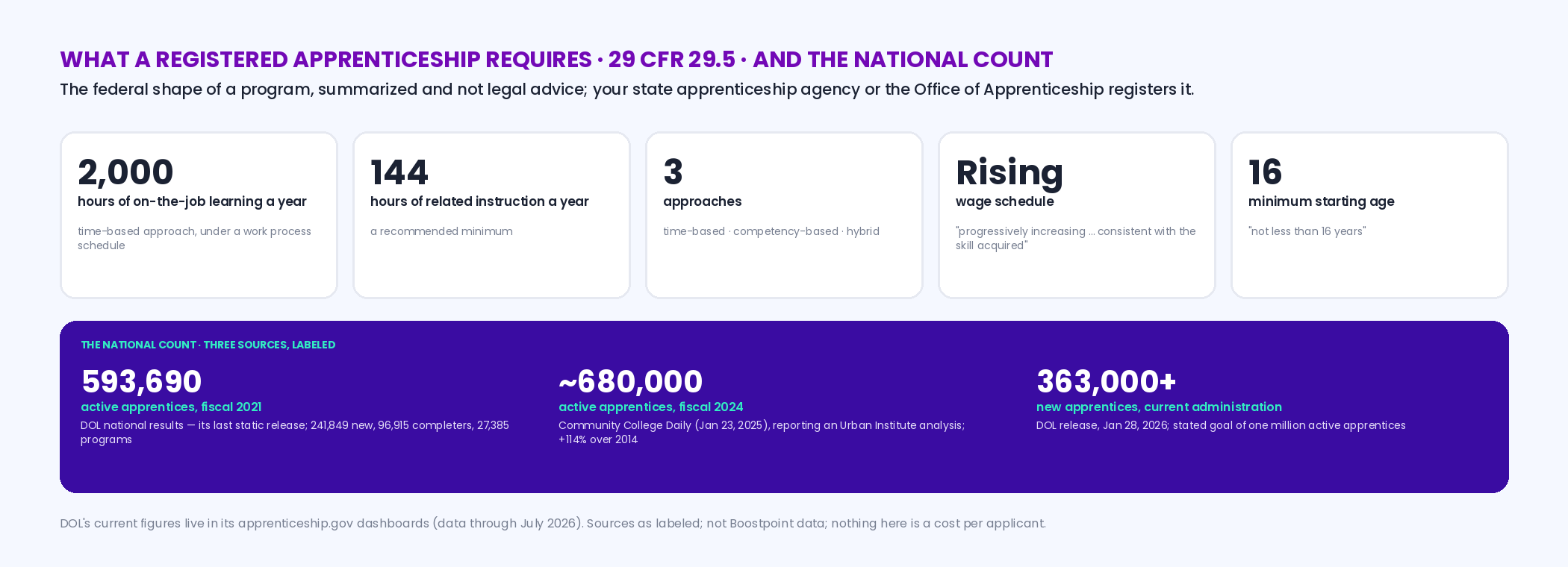
Under 29 CFR 29.5, a registered apprenticeship on the time-based approach includes "at least 2,000 hours of on-the-job learning as described in a work process schedule"; related instruction of "a minimum of 144 hours for each year of apprenticeship is recommended"; the program may instead be competency-based or a hybrid of hours and demonstrated skills; the eligible starting age is "not less than 16 years"; and — the recruiting line — "a progressively increasing schedule of wages to be paid to the apprentice consistent with the skill acquired." BLS describes the result for specific trades: millwrights "complete a 3- or 4-year apprenticeship" with "at least 144 hours of relevant technical instruction" a year; carpenters "typically learn on the job or through apprenticeships." Three of those requirements are ad copy. The wage schedule is the number a helper compares against the warehouse across the street, and it has to appear as a schedule, not a starting rate. The 2,000 hours is "full-time, paid, from day one." And the credential at the end — a nationally recognized completion certificate — is the thing a 24-year-old who has been told for six years to go to college has never been offered in a job ad. For the national picture: DOL's last static national results, fiscal 2021, counted 593,690 active apprentices, 241,849 new apprentices and 96,915 completers across 27,385 active programs; Community College Daily, reporting an Urban Institute analysis in January 2025, put active apprentices at about 680,000 in fiscal 2024, a 114% increase over 2014; and DOL's January 28, 2026 release said "over 363,000 new individuals have started apprenticeships" under the current administration against a stated goal of one million active apprentices. The employer reading those numbers should see one thing: the program count is small relative to the trades, and a registered program with a real ad is a differentiator most competitors don't have.
How you actually register a program, and how long it takes
The section above sets out what a registered apprenticeship has to contain. This one is the part employers ask next and the guidance rarely answers: what you physically do to get one registered, and how long before it exists.
A program is registered with one of two bodies, and which one depends on your state. Under 29 CFR 29.3 a program must be registered either with the U.S. Department of Labor's Office of Apprenticeship or with a State Apprenticeship Agency recognized by the Office of Apprenticeship. Roughly half the states run their own recognized agency; in the rest the Office of Apprenticeship handles it directly. That is the first thing to establish, because it determines who you file with.
Two timing facts are worth planning around. A new program receives provisional approval for a period of one year — so the program starts operating well before it is permanently established, and you are not waiting years to hire your first apprentice. And where a program is later modified, the Registration Agency must “make a determination on whether to approve such submissions within 90 days from the date of receipt”. If a union is involved, the rule provides for receipt of union comments “within 45 days before final action”.
Individual apprentices are then registered either by filing a copy of each apprenticeship agreement, or — the route most multi-apprentice employers use — by submitting “a master copy of such agreement followed by a listing of the name, and other required data, of each individual.” That distinction matters at scale: you are not filing a fresh document for every hire.
What this means for recruiting is simple and slightly counter-intuitive. Because provisional approval runs for a year, the sensible order is to get the program provisionally registered and then advertise the cohort, rather than waiting for a settled program before you go to market. The advert can say “registered apprenticeship” from the point of provisional approval, and that phrase does real work with candidates — it signals a wage ladder and a credential at the end rather than an unpaid trial.
Source: 29 CFR 29.3, read at source 9 September 2026 via the Electronic Code of Federal Regulations. Whether your state has a recognized State Apprenticeship Agency, and what it requires on top of the federal minimum, is a state-by-state question this page does not attempt to answer.
The cohort arithmetic: what the grow track produces, and when
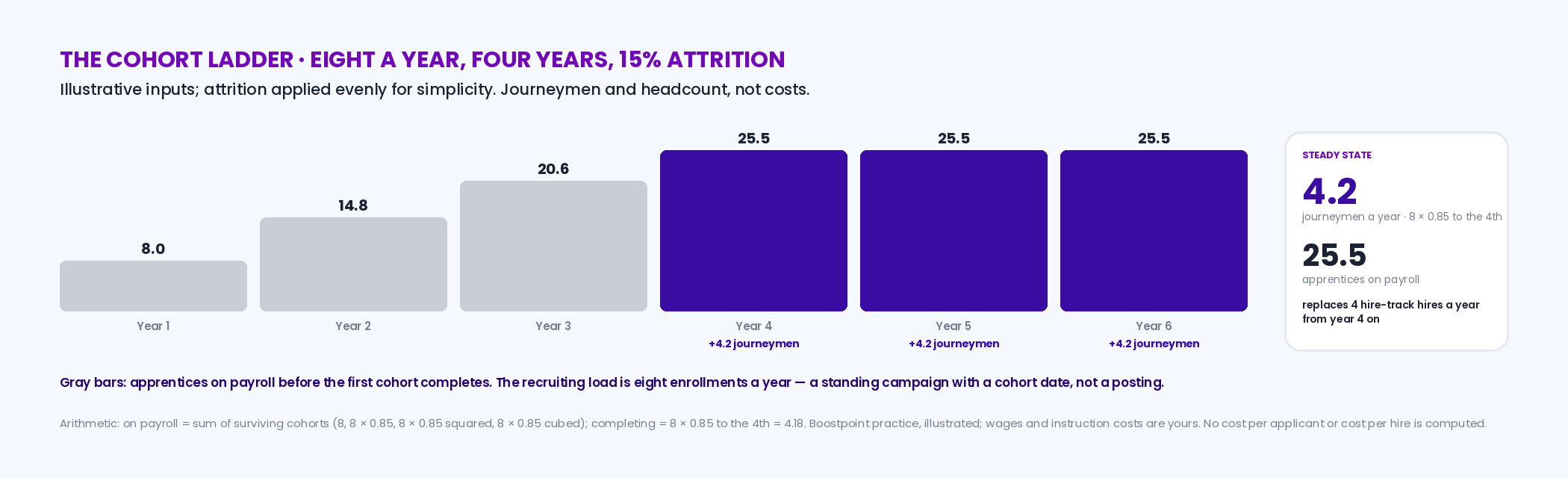
A grow track is a cohort ladder, and its output arrives late and smaller than it started. Enroll eight apprentices a year in a four-year program with attrition of 15% a year and the first journeyman cohort — about four people — arrives in year four; by year five the program is producing four journeymen a year from a standing enrollment of about twenty-five. Those are the two numbers to hold next to the hire track: what a cohort costs in wages and instruction is yours to compute, and the ladder tells you how many market-rate hires it replaces from year four on. It also tells you the recruiting load: eight enrollments a year is a standing campaign, not a posting, and the reason it has to be standing is that 92 percent of construction openings over the next decade are replacements rather than growth, as our construction labor shortage page sets out, and the attrition — which is mostly year one — is a recruiting-quality problem before it is a training one. The planner below runs the ladder on your cohort, program length and attrition.
Interactive
Cohort ladder — what a grow track produces year by year, and how many market-rate hires it replaces
Nothing is stored or sent — this runs in your browser. Enter enrollments a year, program length and annual attrition; the ladder shows apprentices on payroll and journeymen completing each year. No cost is computed.
Arithmetic on your inputs; attrition is applied evenly each year for simplicity, though in practice most of it is year one. Program length is yours; 29 CFR 29.5 sets the time-based minimum at 2,000 on-the-job hours for the term and recommends 144 hours of related instruction. No cost is computed — wages and instruction are yours — and Boostpoint publishes no apprentice cost per applicant. Cost per applicant is not cost per hire.
Who to recruit into it, and what the ad says
Three people are one program away from a journeyman, and none of them reads the "apprentice electrician" posting. The helper already on a crew — BLS's 66,600 electricians' helpers and 25,200 carpenters' helpers — is the best apprentice the program will ever get and is recruited by the foreman with a conversation, not an ad; the ad's job is to make sure he knows the program exists. The trade-school graduate holds a certificate, owes money, and is choosing between three employers who all say "great opportunity"; the one that shows him the wage schedule and the completion certificate wins, and he is found at the school, not on a job board — a standing relationship with the instructor, a dated visit each term, and a start date for the next cohort. The career-changer is in a warehouse or a kitchen, has never been offered a credential, and is reached in the social feed by an ad that says "paid apprenticeship · $[start]/hr rising to $[journeyman]/hr · no experience · cohort starts [date]." On Meta that ad runs in the Special Ad Category — no age, gender or ZIP targeting, rules on Meta Special Ad Category, explained — and one more rule applies with force here: an apprentice ad may not express an age preference. "Recent grads," "young," "entry-level for students" are out under the ADEA and Meta's policy, and they are unnecessary; in our earlier trades analysis the 35–44 band was the cheapest to reach at $8.29 per applicant and 65+ the most expensive at $13.25 with no age targeting used, and the career-changer at 38 is a better apprentice than the ad writer imagines. The form asks two questions — available for the cohort start date, and a driver's license — and the completion rate on trades forms ran from 3.5% to 18.6% across contractors in that analysis, so it asks nothing else. A dated program open house at the shop, with current apprentices present and offers made in the room, is the event-driven structure that ran a median $8.02 per applicant in the benchmark; mechanics on open house hiring events. The trade-specific hire-track pages — electricians, welders, carpenters and concrete crews — each have the journeyman ad that runs beside this one.
If the entry route you are advertising is an internship rather than a registered apprenticeship, the wage rules are different and stricter: see our guide to unpaid internship laws.
Interactive
Wage ladder builder — the progressive schedule 29 CFR 29.5 requires, as the line the ad can quote
Nothing is stored or sent — this runs in your browser. Enter your journeyman rate, the starting share and the program length; the builder writes the schedule in equal steps and the first line of the ad. Your rates, your schedule.
Arithmetic on your inputs: equal steps from the starting rate to the journeyman rate over the program. 29 CFR 29.5 requires "a progressively increasing schedule of wages … consistent with the skill acquired"; your registered standards, your state and any collective agreement set the actual schedule, and where a pay-transparency law applies the ad must show the range you pay. Not legal advice; nothing here is a cost per applicant.
| Who | Where they are | What decides it | First line |
|---|---|---|---|
| The helper on your crew | BLS: 66,600 electricians' helpers, 25,200 carpenters' helpers, median $46,050 for laborers and helpers | The foreman's conversation; the program has to exist and be visible | Internal: "The apprenticeship starts [date]. You're on the list if you want it — here's the wage schedule." |
| The trade-school graduate | At the school — the instructor, the placement office, the term's end | The wage schedule and the completion certificate, shown, not promised | "Registered apprenticeship · $[start]/hr rising to $[journeyman]/hr · 2,000 paid hours a year · certificate at completion · cohort starts [date]" |
| The career-changer | In a warehouse, a kitchen, a delivery van — on a phone in the feed | "No experience" and a number, in that order; no age words | "Paid apprenticeship · no experience needed · $[start]/hr rising to $[journeyman]/hr · [trade] · cohort starts [date] · [City]" |
The hire track buys a credential someone else built. The grow track builds it — and its only hard part is the ad: the wage schedule as a schedule, the hours as paid, the certificate as the point, and a cohort date instead of "apply now."
How to hire apprentices
Hiring an apprentice is a different sale from hiring a qualified tradesperson, and most employers advertise it the same way. A qualified electrician is choosing between wages. An apprentice is choosing between futures, and the things that decide it are the ones a normal job ad leaves out.
Four details do most of the work in an apprentice ad. The wage progression, not the starting wage — "$20 to start, up $1.50 every 1,000 hours" says more than any number on its own. Who pays for schooling, and whether classroom hours are paid. Whether the hours count toward licensure, which is the whole point and is frequently unstated. And what happens at the end: a named journeyman rate beats "opportunities for advancement".
On the advertising itself, skilled trades campaigns in our 2026 benchmark ran a median of $14.14 per completed application with a 15% apply rate — cheap clicks, low completion. That combination means the application form is where apprentice campaigns are won or lost. Requiring a resume from someone whose qualification is that they do not have one yet is the most common self-inflicted wound in this category.
Register the program where the registration is free and the candidates are already looking: your state apprenticeship agency and the state job bank, both at no cost. Then advertise it as a career decision rather than a vacancy.
Related: Electrical Apprentice Job Description, HVAC Apprentice Job Description.
Earn while you learn: how to advertise a paid apprenticeship
“Earn while you learn” works in an ad only when the next line proves it with a number. Every job ad says the job pays. What an apprentice ad can say that no other ad can is that the pay rises on a schedule while the training is free to the candidate, and that there is a credential at the end. Put those three facts in the first two lines.
The regulation gives you the floor. Under 29 CFR 29.5(b)(5) a registered program needs “a progressively increasing schedule of wages to be paid to the apprentice consistent with the skill acquired,” and “the entry wage must not be less than the minimum wage prescribed by the Fair Labor Standards Act, where applicable,” unless other federal or state law or a collective bargaining agreement sets a higher rate. So you already have the schedule the ad needs. Most employers simply leave it out.
- Lead with the ladder, not the starting rate. “Paid apprenticeship · $[start]/hr rising to $[journeyman]/hr” beats “competitive pay.” If your state has a pay transparency law, the range has to be there anyway.
- Say who pays for school and whether classroom hours are paid. This is the question the candidate is really asking when they read “earn while you learn.”
- Name the credential. A nationally recognized completion certificate, or the license the hours count toward, is the part that makes this a career move instead of another hourly job.
- Give a date. “Next cohort starts [date]” turns a vague opportunity into a decision with a deadline.
- Say “no experience needed” and mean it. Then keep the form to the questions that screen out people you legally cannot hire, such as the driver’s license the job needs.
Keep age words out of the copy. “Great for recent grads” or “young and hungry” states an age preference, which the ADEA prohibits in job ads, and Meta’s Special Ad Category for employment ads already removes age, gender and ZIP code targeting and requires at least a 15-mile radius. Describe the program and let the career-changer in their thirties apply alongside the 19-year-old.
On cost, the closest published row is skilled trades in the 2026 Boostpoint benchmark: a median $14.14 per applicant with a 15% apply rate. That is cost per applicant, not cost per hire, and there is no apprentice-specific figure.
Youth apprenticeship programs for employers
A youth apprenticeship is a Registered Apprenticeship built for high school students and young adults. The Department of Labor describes apprenticeship programs for high school students as combining “academic and technical classroom instruction with work experience through a Registered Apprenticeship Program,” and says Registered Apprenticeship is a pathway for “young people ages 16–24.” It reports that in 2025, 415,560 young apprentices were served, concentrated in construction, public administration and educational services (Apprenticeship.gov).
For an employer, a youth program is the grow track started earlier. Three structures are worth knowing:
- Registered youth apprenticeship. The student is a registered apprentice while still in school. The minimum starting age in 29 CFR 29.5 is 16, and the same progressive wage schedule applies.
- Pre-apprenticeship. DOL describes an effective pre-apprenticeship as one that, through partnerships with Registered Apprenticeships, lets completers “enter directly into a Registered Apprenticeship.” It is a feeder, not the apprenticeship itself.
- Cooperative education (student-learner). A school-run work program under a written agreement between the employer and the school.
Child labor rules for apprentices under 18
Federal child labor rules still apply to a 16- or 17-year-old apprentice, and the trades are where they bite. Several hazardous occupations orders include a limited exemption for registered apprentices: power-driven woodworking machines (Order 5), metal forming, punching and shearing machines (Order 8), meat-processing machines (Order 10), balers and compactors (Order 12), circular saws, band saws and similar (Order 14), roofing (Order 16) and excavation (Order 17). Under 29 CFR 570.50(b) the apprentice exemption applies only when the apprentice is in an apprenticeable trade, the hazardous work is “incidental to his training,” it is “intermittent and for short periods of time and is under the direct and close supervision of a journeyman,” and the apprentice is registered with the Office of Apprenticeship or a recognized state agency (or employed under an agreement found to conform substantially). The student-learner exemption in 570.50(c) requires a written agreement signed by the employer and the school. Hazardous work outside those orders stays off-limits under 18, and state law can be stricter; see our child labor laws by state guide. General information, not legal advice.
How to recruit into a youth program
The school is the channel for the student, and the parent is often the decision-maker. Build the relationship with the career and technical education teacher or counselor, show up on a dated schedule, and give families the wage schedule and the credential in writing. When you advertise to the wider community, write for the whole 16–24 range without age words, and keep the form short enough to finish on a phone.
Where to find apprentices
The three pools earlier on this page, helpers, trade-school graduates and career-changers, tell you who makes a good apprentice. This is the practical list of where each of them can be found, with the free public channels first because most employers never use them.
| Channel | Who it reaches | What to do |
|---|---|---|
| Your own crews | Helpers and laborers already on the job | A foreman conversation and a posted cohort date. The best apprentice is usually already on the payroll. |
| Apprenticeship.gov job listings | Career seekers searching the federal Apprenticeship Job Finder | Registered sponsors can list openings through RAPIDS, and non-RAPIDS users have a separate route (List Your Apprenticeship Jobs). Free. |
| Pre-apprenticeship programs | People being prepared to enter a Registered Apprenticeship | DOL describes pre-apprenticeship as a program "designed to prepare individuals to enter and succeed in a Registered Apprenticeship Program" (apprenticeship.gov). Become the program's named destination employer. |
| Trade schools and high school CTE programs | Graduates and students about to qualify | A dated visit each term, current apprentices in the room, and the wage schedule in writing. |
| Veterans | Service members leaving the military and veterans | Apprenticeship.gov suggests getting your registered program approved to accept GI Bill benefits (Hire Veterans). See also hiring veterans. |
| American Job Centers and the state job bank | Local job seekers, including workers in retraining | List the cohort; ask the center's business services staff about referrals. |
| Social job ads | Career-changers in warehouses, kitchens and delivery vans who never search "apprentice" | The paid-apprenticeship ad with the wage ladder and cohort date in the first line, no age words. |
The free channels reach people who already know they want an apprenticeship. The larger group, adults who have never been offered one, is only reached by putting the offer in front of them, which is what the social ad is for. For that ad, the Skilled trades family in Boostpoint's 2026 benchmark is the nearest reference: a $14.14 median cost per applicant with a 15% apply rate (benchmark data). There is no apprentice-specific figure. Trade-specific versions are on how to recruit HVAC apprentices and where to find skilled trades workers.
Frequently asked questions
How do you register an apprenticeship program?
Under 29 CFR 29.3 a program is registered either with the U.S. Department of Labor's Office of Apprenticeship or with a State Apprenticeship Agency recognized by it — which of the two depends on your state. A new program receives provisional approval for a period of one year, so it can begin operating and hiring while permanent approval is settled. Individual apprentices are registered either by filing each apprenticeship agreement, or by submitting a master copy of the agreement with a listing of each individual's name and required data.
How do you recruit apprentices?
From three pools: the helpers already on your crews, through the foreman; trade-school graduates, through a standing relationship with the school and a dated visit each term; and career-changers in warehouses and kitchens, through a social ad that says "paid apprenticeship · no experience · $[start]/hr rising to $[journeyman]/hr · cohort starts [date]." Two form questions, a program open house with current apprentices present, and no age words in any of it.
What does a registered apprenticeship require?
Under 29 CFR 29.5, on the time-based approach, at least 2,000 hours of on-the-job learning over the term under a work process schedule, with a recommended minimum of 144 hours of related instruction per year; competency-based and hybrid approaches are also allowed; a progressively increasing wage schedule consistent with skill acquired; and a starting age of at least 16. Your state apprenticeship agency or the Office of Apprenticeship registers the program. Not legal advice.
How many apprentices are there in the United States?
The Department of Labor's last static national results, fiscal 2021, counted 593,690 active apprentices, 241,849 new apprentices and 96,915 completers across 27,385 programs; Community College Daily, reporting an Urban Institute analysis in January 2025, put active apprentices at about 680,000 in fiscal 2024; DOL's January 2026 release cited over 363,000 new apprentices under the current administration and a goal of one million. DOL's current figures are in its apprenticeship.gov dashboards.
How do you recruit trade school graduates?
At the school, before graduation: a relationship with the instructor, a visit each term with current apprentices, and an offer that shows the wage schedule and the completion certificate rather than promising "growth." The graduate holds a certificate and often a loan, and is choosing between employers who all sound alike; the one with a registered program, a schedule and a cohort date is the one that doesn't.
How long until an apprenticeship program pays off?
The first journeymen complete at the end of the program length — year four for a four-year program — and from then on the program produces a cohort a year, reduced by attrition. Enrolling eight a year at 15% annual attrition yields about four journeymen a year from year four, against the market-rate hires they replace. The cohort ladder on this page runs it on your numbers; wages and instruction costs are yours to add.
What should an apprenticeship ad say?
The wage schedule as a schedule ($[start]/hr rising to $[journeyman]/hr), the hours as paid (full-time, toward at least 2,000 on-the-job hours on the time-based approach), the credential at the end, the trade, the city and the cohort start date — and "no experience needed" for the career-changer pool. Under Meta's Special Ad Category there is no age, gender or ZIP targeting, and under the ADEA no age preference in the words: no "recent grads," no "young," no "students."
Can an apprentice ad say "recent graduates" or "young"?
No. The Age Discrimination in Employment Act makes it unlawful to publish a job ad indicating a preference by age, and Meta's policy rejects it in the Special Ad Category. It is also bad recruiting: in our earlier trades analysis the 35–44 band was the cheapest to reach at $8.29 per applicant and 65+ the most expensive at $13.25, with no age targeting used, and a career-changer in their thirties is a strong apprentice. Describe the program, not the person.
What does it cost to recruit apprentices?
We publish no apprentice-specific figure and no trades role ladder. The nearest rows in our 2026 benchmark are skilled trades at a median $14.14 per applicant (15% apply rate, 35 campaigns) and technician and mechanic at $13.41 (16%, 145); the earlier trades analysis blended $9.28. The grow track's real cost is wages and instruction over the program, which are yours. Cost per applicant is not cost per hire.
How do you hire apprentices?
Advertise the progression rather than the starting wage. The four details that decide an apprentice application are the wage steps and what triggers them, who pays for schooling and whether classroom time is paid, whether the hours count toward licensure, and the named rate at the end of the program. Register with your state apprenticeship agency and state job bank, which cost nothing.
What does it cost to recruit an apprentice?
Skilled trades campaigns in the 2026 benchmark ran a median of $14.14 per completed application at a 15% apply rate, with the middle half between $7.58 and $21.49. Clicks are comparatively cheap in the trades and completion is the constraint, so the application form matters more than the ad. Requiring a resume from an apprentice applicant is the most common avoidable loss.
Do apprentices need experience to apply?
That is the point of an apprenticeship, and saying so plainly in the ad measurably widens the pool. Most programs need a school-leaving qualification, a valid driver’s license where the work involves driving, and the ability to do the physical work. Listing preferences beyond that removes candidates you would have hired and you pay for their click either way.
What does earn while you learn mean in an apprenticeship?
It means the apprentice is a paid employee from the first day while they train. Under 29 CFR 29.5, a registered apprenticeship must pay a progressively increasing wage schedule tied to skills gained, and the entry wage cannot be below the federal minimum wage where the FLSA applies. The related classroom instruction runs alongside the paid on-the-job hours.
What is a youth apprenticeship?
A youth apprenticeship is a Registered Apprenticeship designed for high school students and young adults. The Department of Labor describes it as combining academic and technical classroom instruction with paid work experience, and says Registered Apprenticeship is open to young people ages 16 to 24. The minimum starting age in the federal standards is 16.
Can a 16-year-old apprentice use power tools or work on a roof?
Only within narrow limits. Several federal hazardous occupations orders, including woodworking machines, power saws, roofing and excavation, exempt registered apprentices when the hazardous work is incidental to training, intermittent, brief and under a journeyman's direct and close supervision, per 29 CFR 570.50(b). State law can be stricter. General information, not legal advice.
Where can employers find apprentices?
On their own crews first, among helpers and laborers who already do the work. Then through free public channels: listing openings on Apprenticeship.gov, partnering with pre-apprenticeship programs, trade schools and high school career and technical education programs, getting a registered program approved for GI Bill benefits to reach veterans, and the local American Job Center. Career-changers who have never considered an apprenticeship are reached with a social job ad that shows the wage schedule and the cohort start date.
Run the grow-track ad next to the hire-track ad
We'll write the apprenticeship ad with your wage schedule and cohort date in the first line, the journeyman ad beside it, put a two-question form behind each, run them where helpers, graduates and career-changers scroll, and show you the trades campaigns closest to yours.
Book a DemoBoostpoint figures come from the 2026 Social Job Advertising Benchmark — 891 campaigns and 1,334 campaign-months: skilled trades median cost per applicant $14.14, middle 50% $7.58–$21.49, 15% apply rate, 35 campaigns; technician / mechanic $13.41, 16%, 145; event-driven $8.02, 21%, 78 campaigns. Earlier campaign-level analyses (different methodology): trades blended $9.28, click-to-apply 9.1%, completion 3.5% to 18.6%, age bands 35–44 $8.29 and 65+ $13.25 with no age targeting; manufacturing CNC machinist $4.15, roughly a third of maintenance technicians in the same dataset. No apprentice-specific figure and no role-by-role trades figure is published. Third-party figures — 29 CFR 29.5 as read August 26, 2026; DOL Registered Apprenticeship National Results, fiscal 2021 (DOL's last static release); Community College Daily (January 23, 2025) reporting an Urban Institute analysis; DOL news release, January 28, 2026; BLS Occupational Outlook Handbook (May 2024 wages, 2024–34 projections); ABC (January 15, 2026); Deloitte and The Manufacturing Institute (April 2024); ADEA §4(e) — are theirs and attributed in place; regulatory notes are summaries, not legal advice. No customer is named. The cohort ladder and wage ladder are arithmetic on your inputs, not measured results. Cost per applicant is not cost per hire; we do not track hires and publish no cost-per-hire figure. A sample of Boostpoint campaigns, not an industry-wide study.