
Maintenance Technician Recruiting: The Plant's Hardest Hire Is Scarce, Not Skilled — and the Ad Has to Know the Difference
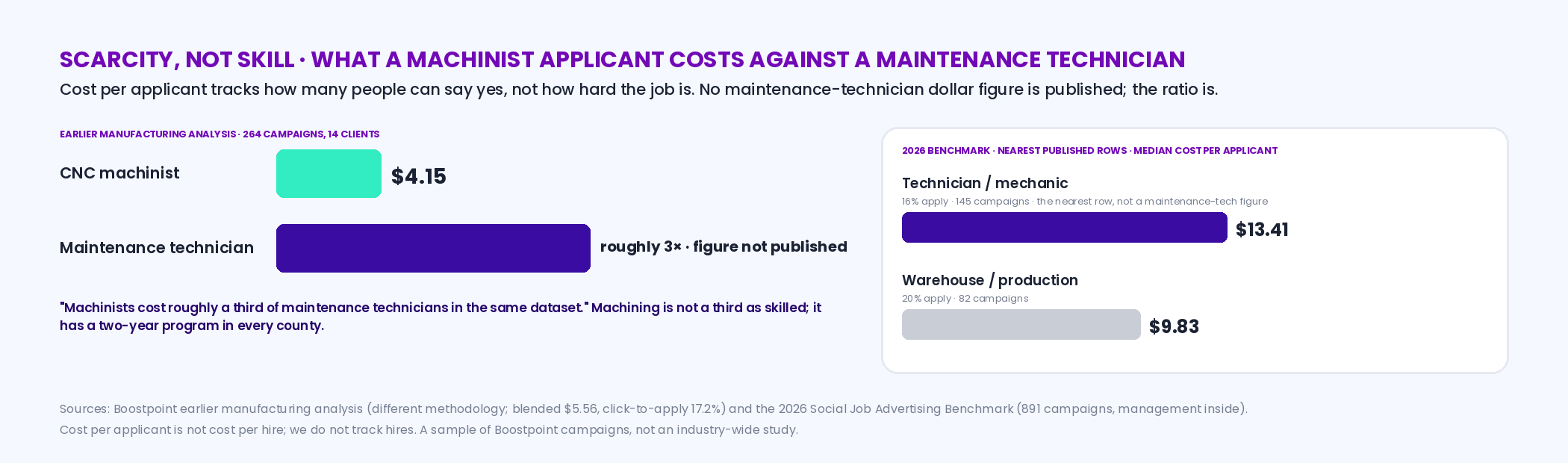
Maintenance technician recruiting is expensive for a reason that has nothing to do with how hard the job is: the pool is small and every plant is bidding for it. In Boostpoint's earlier manufacturing analysis, machinist applicants ran $4.15 — roughly a third of what maintenance technician applicants cost in the same dataset — and machining is not a third as skilled. BLS counts 538,300 industrial machinery mechanics, machinery maintenance workers and millwrights, growing 13% to 2034, with about 54,200 openings a year at a median $30.53 an hour. The recruiting answer is to stop writing an ad for a person who does not exist, price the vacancy in overtime, and reach the technician who is already employed on the phone in his pocket.
Source: Boostpoint 2026 Social Job Advertising Benchmark — 891 Boostpoint-managed campaigns on Meta (1,334 campaign-months), 2026; costs are what advertisers paid for advertising only.
A note on who's writing this
Boostpoint runs social media job ads for manufacturers and the technician roles inside them, so the advertising sections of this page describe what we sell. Our maintenance-technician cost per applicant comes from a small, recent sample and has its own section below; alongside it we show the comparison from our earlier manufacturing analysis — machinists at $4.15, maintenance technicians roughly three times that — and the nearest published row in the 2026 benchmark, technician and mechanic, labeled as the nearest row and not as this one. Customer names are not used on this page because permissions for manufacturing clients were never confirmed. The wage and market figures are BLS's and Deloitte's. Every cost figure of ours is a cost per applicant, never a cost per hire; the vacancy calculator on this page computes a cost of coverage from your own inputs, which is a different thing and is labeled as one.
Scarcity, not skill: the finding that reorganizes the plan
The finding from our earlier manufacturing analysis — 264 campaigns across 14 clients, blended $5.56 per applicant, with the highest click-to-apply of any vertical at 17.2% — is that cost per applicant tracks credential scarcity, not skill level. CNC machinist applicants ran $4.15, among the cheapest role families we measure, and maintenance technician applicants ran roughly three times that in the same dataset; the machinist's job is not easier. The difference is how many people can say yes: a machinist is trained in two years at a community college and there are programs in every county, while a multi-craft maintenance technician — electrical, mechanical, hydraulics, PLCs — is made over a decade on a plant floor and there is no program that produces one. In the 2026 benchmark, the nearest published row, technician and mechanic, ran a median $13.41 per applicant with a 16% apply rate across 145 campaigns, against $9.83 for warehouse and production; the pattern holds across everything we measure. Three recruiting consequences follow. Every maintenance technician you want is employed, usually across town, so the ad is a poaching ad and has to say what the current plant can't. The ad that lists five crafts at journeyman level is describing three people, and the applicant knows it — the builder below measures that. And the vacancy is expensive every week it stays open, which is the number a plant manager should hold next to the ad budget; the case is the same one the CNC operator and machinist page makes from the other side of the ratio.
The market: who a maintenance technician is, by the numbers
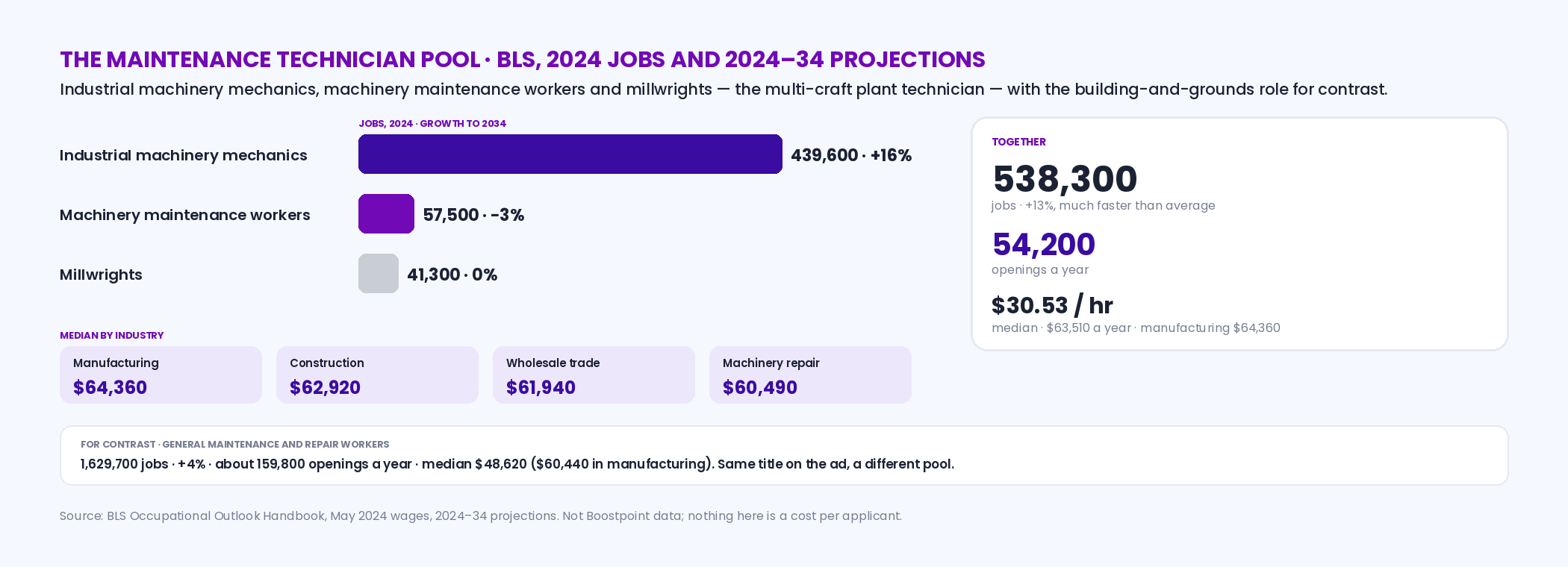
BLS groups the role three ways. Industrial machinery mechanics, 439,600 jobs in 2024 and projected to grow 16% by 2034, are the multi-craft technicians a plant means when it says "maintenance tech"; machinery maintenance workers, 57,500 jobs and declining 3%, do the routine lubrication and adjustment; millwrights, 41,300 jobs and flat, install and move the machines, typically after a three- or four-year apprenticeship with at least 144 hours of technical instruction a year. Together: 538,300 jobs, 13% growth — much faster than average — and about 54,200 openings a year, at a median $63,510 a year or $30.53 an hour (May 2024), with manufacturing paying the most at $64,360, then construction $62,920, wholesale $61,940 and machinery repair shops $60,490. The entry requirement is a high school diploma or equivalent and, for mechanics, typically more than a year of on-the-job training — which is the polite way of saying the credential is time on a floor, and the only place to get it is a job someone else gave them. For contrast, general maintenance and repair workers — the building-and-grounds role, 1,629,700 jobs, 4% growth — earn a median $48,620, or $60,440 in manufacturing; the two roles share a title and not much else, and an ad that doesn't say which one it means gets applicants for the wrong one. Above all of it sits the Deloitte and Manufacturing Institute projection (April 2024) that manufacturing could need as many as 3.8 million new employees by 2033 and that "as many as 5 in 10 of the skilled open positions, 1.9 million jobs could remain unfilled." The maintenance technician is the skilled open position.
| Role | Jobs, 2024 | Growth 2024–34 | Openings a year | Median pay | In manufacturing | How the credential is earned |
|---|---|---|---|---|---|---|
| Industrial machinery mechanics, machinery maintenance workers, millwrights | 538,300 | 13% | 54,200 | $63,510 a year · $30.53 an hour | $64,360 | High school diploma; mechanics typically more than a year of on-the-job training; millwrights a 3- or 4-year apprenticeship |
| General maintenance and repair workers | 1,629,700 | 4% | 159,800 | $48,620 a year · $23.38 an hour | $60,440 | High school diploma; moderate-term on-the-job training |
The ad describes one person, not three
Before rewriting the ad, it is worth widening the pool: military wheeled-vehicle and aviation mechanics arrive with diagnostic experience on heavy equipment, and our hiring veterans page sets out the three federal programs, the thresholds each one asks for, and why the reach has to come from the copy rather than from targeting.
The maintenance technician ad that fails is easy to recognize: "Multi-craft maintenance technician — electrical (480V, 3-phase), PLC troubleshooting (Allen-Bradley), hydraulics and pneumatics, welding, HVAC, CMMS, 5+ years, all shifts." Every line is true of the person the plant wishes it had, and the technician reading it — who is strong in two of those and competent in a third — concludes he isn't qualified and keeps scrolling, while the plant concludes there are no applicants. The ad that works picks the two crafts the plant actually can't run without, says "we'll train the rest," names the shift and the rate range, and states the one thing the plant across town doesn't offer: the newer equipment, the day shift after a year, the tool allowance, the no-mandatory-weekends policy, the pay step for each new craft. On Meta it runs in the Special Ad Category — no age, gender or ZIP targeting, the rules on Meta Special Ad Category, explained — so "PLC" and "480V" in the first line are the targeting. The form asks two questions: which of the listed crafts he'd call himself strong in, and years on a plant floor. The interview is a walk through the plant with the maintenance lead, and the offer is made on the walk, because the technician is employed and the next plant's recruiter calls tomorrow.
Interactive
Craft-mix ad builder — pick what the plant really can't run without, and see whether the ad describes one technician or three
Nothing is stored or sent — this runs in your browser. Check the crafts you'd require at a strong level; the meter reads how many people the ad is describing, and the builder writes the first line and the two form questions.
Boostpoint practice, assembled from your choices; rates are yours and where a pay-transparency law applies must be the range you pay. The "people described" meter is a rule of thumb — two crafts at a strong level describe one technician; three is a stretch; four or more is a wish list — not a measured result. Nothing here is a cost.
What the vacancy costs while the ad runs
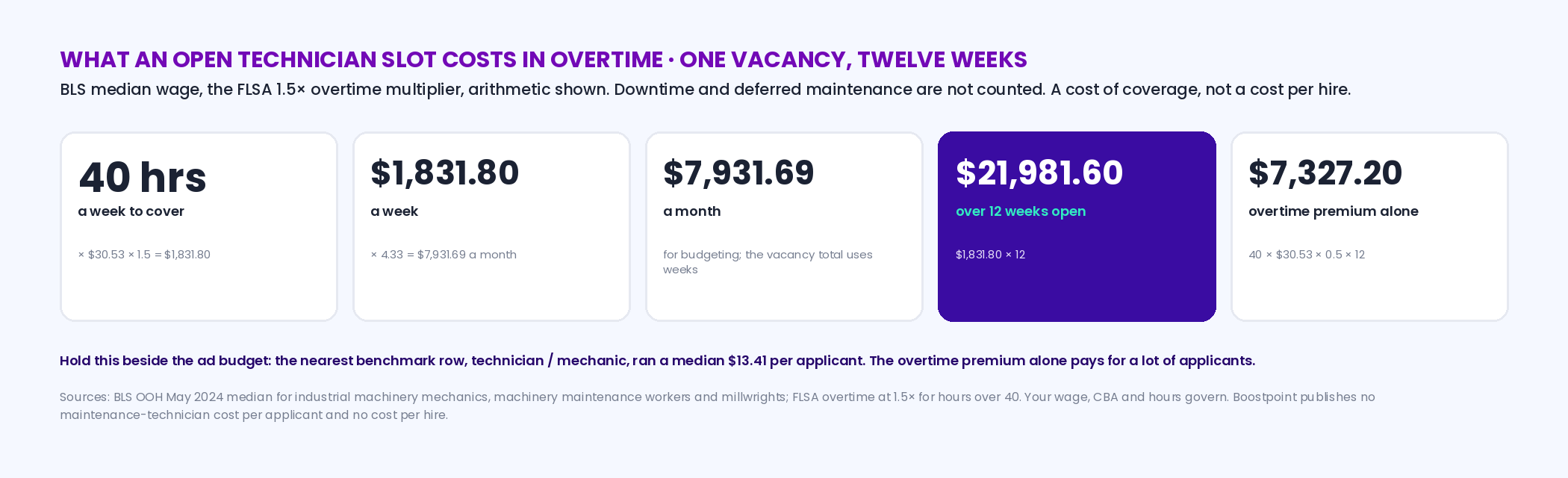
The number to hold next to the ad budget is not a cost per hire — we do not publish one and this page does not compute one — but the cost of covering the empty slot, which any plant can calculate from its own payroll. A vacant technician position on a shift that runs anyway is covered by the remaining technicians on overtime, at time and a half under the Fair Labor Standards Act for hours over forty, and by the maintenance lead doing repairs instead of planning them. Forty hours a week of coverage at the BLS median of $30.53 an hour, paid at 1.5×, is 40 × $30.53 × 1.5 = $1,831.80 a week, or $7,931.69 a month at 4.33 weeks — before the unplanned downtime that a stretched crew doesn't get to, which is the larger number and the one only your plant can put a figure on. Against that, the ad budget for a role whose nearest benchmark row ran $13.41 per applicant is small, and the argument for running it always-on rather than when the slot opens — so that the vacancy is measured in days rather than months — is the arithmetic above. The calculator runs it on your wage, your overtime multiplier and your weeks vacant.
Interactive
Vacancy coverage calculator — what an open technician slot costs in overtime while it stays open
Nothing is stored or sent — this runs in your browser. Your wage, your overtime multiplier, your hours and your weeks; the default wage is BLS's May 2024 median for the group. Cost of coverage, not cost per hire.
Arithmetic on your inputs. It assumes the slot's hours are fully covered by other technicians on overtime and counts nothing for downtime, deferred preventive maintenance, or the lead's time — all of which are larger and yours to estimate. It is a cost of coverage; Boostpoint publishes no cost per hire.
Where the technicians are
On a plant floor across town, and on a phone during break. The maintenance technician is reached in the feed — an ad with "PLC" and "480V" and the rate in the first line, shown to people in the county — and through the two networks he already belongs to: the other technicians at your plant, who know every technician at every plant nearby and will refer them for a bonus paid at ninety days, and the equipment vendors and integrators whose field techs are the next generation of plant maintenance staff. Community college industrial maintenance programs produce the machinery-maintenance-worker tier, not the multi-craft mechanic, and are worth a standing relationship for the pipeline rather than a posting for the vacancy. A dated plant walk-through — the maintenance lead, the newest machine on the floor, a conditional offer on the spot — is the event-driven structure that ran a median $8.02 per applicant in the benchmark; the mechanics are on open house hiring events. Two adjacent roles have their own pages: diesel mechanics and technicians, who share the scarcity and often the applicant, and HVAC technicians, who share one of the crafts; the production floor around the technician is on production recruiting, and the posting itself starts from the machinist job description with the crafts swapped in.
The technician you want is fixing a machine across town right now. Write the ad for two crafts, not five, put the rate and the shift in the first line, and price the empty slot in overtime so the ad budget looks like what it is.
Maintenance technician applicant cost: the latest 12 months
Across 19 Boostpoint-managed Meta campaigns for maintenance technician roles, October 2025–September 2026, the median applicant cost $11.06. The middle half of campaigns paid between $3.74 and $13.92.
| Measure | Figure |
|---|---|
| Median cost per applicant (maintenance technician) | $11.06 |
| Middle half of campaigns (25th–75th percentile) | $3.74–$13.92 |
| Click-through rate | 1.26% |
| Clicks that became applicants | 18.3% |
| Campaigns | 19 |
| Sample | Boostpoint-managed Meta campaigns, October 2025–September 2026 |
| Basis | Cost per applicant: what advertisers paid. Not cost per hire. |
Read it with two cautions. Nineteen campaigns is a small sample, and the spread is wide: a quarter of campaigns came in at $3.74 per applicant or less and a quarter at $13.92 or more. That spread fits the scarcity argument on this page, since the same role costs very different amounts depending on how many technicians work within the draw area and how many plants are bidding for them. In this sample, 18.3% of clicks became applicants.
For reference, the nearest row in Boostpoint's 2026 Social Job Advertising Benchmark, technician and mechanic, is a $13.41 median across 145 campaigns. That is a different sample and a broader role group; the $11.06 figure is the maintenance-technician cut.
How to recruit industrial maintenance mechanics
"Industrial maintenance mechanic" is the title many plants use for the multi-craft technician this page is about, and the one BLS files under industrial machinery mechanics. The newer BLS Employment Projections 2025-35 edition updates the 2024 figures above: 446,900 industrial machinery mechanics in 2025, projected growth of 17.8% by 2035, and about 44,400 openings a year, at a BLS, May 2025 median annual wage of $64,520. Note that this is the mechanics occupation on its own, not the three-occupation group in the table earlier on the page. Either way, the conclusion holds: a growing role, filled almost entirely from people already working on another plant's floor.
Four things change when you recruit for the mechanic title specifically:
- Use the title your market uses. Some mechanics search and scroll for "maintenance technician," others for "industrial maintenance mechanic" or "maintenance mechanic." Put the title your competitors use in the first line, then the two crafts you can't run without, the shift and the rate range. Our industrial maintenance mechanic job description has the full posting.
- Recruit the adjacent trades. Field service technicians for equipment vendors and integrators, diesel and heavy-equipment mechanics, and electricians with plant experience already have part of the skill set. Say which crafts you will train so they know they qualify.
- Grow the next one. Machinery maintenance workers and production operators with a mechanical streak are the plant's own pipeline. A pay step for each new craft learned is both a retention tool and a recruiting line.
- Interview on the floor. A walk to a down machine tells you more than a resume. Our maintenance technician interview questions cover what to ask.
On cost, use the maintenance technician cut above ($11.06 median across 19 campaigns) with its small-sample caution, and the broader Technician / mechanic family in Boostpoint's 2026 Social Job Advertising Benchmark ($13.41 median, $7.40 to $23.58 middle half, 16% apply rate) as the wider reference.
Frequently asked questions
How do you recruit maintenance technicians?
Write the ad for the two crafts the plant can't run without, say "we'll train the rest," and put the rate range, the shift and the one thing the plant across town doesn't offer in the first line. Run it in the feed where employed technicians scroll, pay your technicians to refer technicians, and make the interview a plant walk with an offer on it. Every technician you want already has a job; the ad is a poaching ad.
Why are maintenance technicians so hard to hire?
Scarcity, not skill. In our earlier manufacturing analysis machinist applicants ran $4.15, roughly a third of maintenance technician applicants in the same dataset, and machining is not a third as skilled — there is no program that produces a multi-craft technician, only a decade on a floor. BLS projects 13% growth and about 54,200 openings a year for the group, and Deloitte and the Manufacturing Institute estimate as many as 1.9 million skilled manufacturing jobs could go unfilled by 2033.
What does a maintenance technician earn?
BLS puts the May 2024 median for industrial machinery mechanics, machinery maintenance workers and millwrights at $63,510 a year or $30.53 an hour, with manufacturing paying a median $64,360. General maintenance and repair workers — the building role — earn a median $48,620, or $60,440 in manufacturing. Your market will differ, and the ad has to state the range you pay.
What does it cost to hire a maintenance technician?
For advertising, the latest 12 months of Boostpoint-managed Meta campaigns (October 2025–September 2026, 19 campaigns) put the median maintenance technician applicant at $11.06; we publish no cost per hire. Our earlier manufacturing analysis put maintenance technician applicants at roughly three times machinist applicants ($4.15), and the nearest published row in the 2026 benchmark, technician and mechanic, ran a median $13.41 per applicant with a 16% apply rate across 145 campaigns. The number to hold next to it is the cost of covering the vacancy in overtime, which the calculator on this page runs on your payroll.
What should a maintenance technician job ad say?
The two crafts required at a strong level, "we'll train the rest," the rate range, the shift, the city and one real differentiator — newer equipment, days after a year, a pay step per craft — in the first line. Not five crafts at journeyman level: that describes three people, and the technician strong in two of them decides he isn't qualified. Two form questions — which crafts he'd call himself strong in, and years on a plant floor — and nothing else before the walk-through.
What does an open maintenance technician position cost?
Covering forty hours a week at the BLS median of $30.53 on overtime at 1.5× is $1,831.80 a week, or about $7,931.69 a month — before any downtime a stretched crew doesn't prevent, which is the larger number and yours to estimate. That is a cost of coverage, not a cost per hire, and it is the reason to run the ad always-on rather than when the slot opens.
Is a maintenance technician the same as a maintenance worker?
No, and the ad should say which it means. BLS separates industrial machinery mechanics and millwrights — the multi-craft plant technicians, median $63,510 — from general maintenance and repair workers, the building-and-grounds role, median $48,620. An ad titled "maintenance technician" with no crafts named draws the second pool for the first job.
Where do you find maintenance technicians?
At other plants, through your own technicians' referrals, among equipment vendors' and integrators' field techs, and in community college industrial maintenance programs for the pipeline rather than the vacancy. Reach the employed ones in the social feed with the crafts and the rate in the first line, and with a dated plant walk-through — the event-driven structure ran a median $8.02 per applicant in our benchmark.
How do you recruit industrial maintenance mechanics?
Reach the ones already employed at other plants with a local ad that names the title your market uses, the two crafts you need most (for example PLC troubleshooting and hydraulics), the shift and the rate range, and says you will train the rest. Ask two form questions, call the same day, and invite applicants to walk the floor. Add a referral bonus for your own technicians and recruit from field service, diesel and electrical trades. BLS Employment Projections 2025-35 put industrial machinery mechanics at about 44,400 openings a year.
How do you recruit technicians?
Name the equipment and the crafts in the first line, because technicians move for the work as much as the pay; give the rate and shift; pay for certifications and training rather than requiring every one up front; keep the application to a few questions on a phone; and call the same day. Most technicians you want are employed, so reach them in the feed and through referrals rather than waiting for job board searches. In Boostpoint's 2026 Social Job Advertising Benchmark, the Technician / mechanic family ran a $13.41 median cost per applicant with a 16% apply rate; see also diesel mechanic recruiting.
Write the two-craft ad and run it always-on
We'll write the maintenance technician ad for the crafts you actually need, with your rate and your differentiator in the first line, put a two-question form behind it, run it where employed technicians scroll, and show you the manufacturing campaigns closest to yours.
Book a DemoBoostpoint figures come from the 2026 Social Job Advertising Benchmark — 891 campaigns and 1,334 campaign-months: technician / mechanic median cost per applicant $13.41, middle 50% $7.40–$23.58, 16% apply rate, 145 campaigns (the nearest published row, not a maintenance-technician figure); warehouse / production $9.83, 20%; event-driven $8.02, 21%. Earlier manufacturing analysis (different methodology): 264 campaigns, 14 clients, blended $5.56, click-to-apply 17.2%; CNC machinist applicants $4.15, roughly a third of maintenance technician applicants in the same dataset; that analysis published no maintenance-technician dollar figure. Latest 12 months: Boostpoint-managed Meta campaigns, October 2025–September 2026, maintenance technician median $11.06 per applicant, middle half $3.74–$13.92, 19 campaigns. Third-party figures — BLS Occupational Outlook Handbook (May 2024 wages, 2024–34 projections) for industrial machinery mechanics, machinery maintenance workers and millwrights and for general maintenance and repair workers; Deloitte and The Manufacturing Institute, Taking Charge (April 2024) — are theirs and attributed in place. The vacancy calculator is a cost of coverage from your inputs, with the FLSA 1.5× overtime multiplier as a default; it is not a cost per hire. No customer is named. The builder is Boostpoint's practice, not a measured result. Cost per applicant is not cost per hire; we do not track hires and publish no cost-per-hire figure. A sample of Boostpoint campaigns, not an industry-wide study.