
How to Hire Diesel Mechanics and Technicians When Everyone Says There Aren't Any
The diesel technician shortage is real — the workforce grew about 1.04% a year over five years while replacements outpaced growth 4 to 1 (TechForce Foundation). But every one of the 289,960 working diesel techs on the current BLS edition is employed somewhere, and most are reachable: in Boostpoint's 2026 Social Job Advertising Benchmark, technician and mechanic campaigns ran a $13.41 median cost per applicant — half the $26.86 median for CDL driver applicants in the same benchmark. Hiring diesel mechanics is an offer-and-reach problem, and this page prices both.
A note on who's writing this
Boostpoint runs social recruitment advertising for fleets, dealers, equipment co-ops, and repair shops, so this page favors the channel we sell and shows our own figures — including the comparison that makes our trucking clients wince. Advertising numbers come from the technician/mechanic and CDL role families in our 2026 Social Job Advertising Benchmark; labor-market, wage, and certification facts are from the Bureau of Labor Statistics, O*NET, the TechForce Foundation, and ASE, cited where they appear. The wider context is on our skilled trades recruiting pages; the same argument for a different trade — that credential scarcity, not skill, sets the price — is on hiring CNC operators and machinists. If your fleet's other empty seat is the driver's, our truck driver recruiting pages cover that one.
The shortage, measured instead of asserted
"There aren't any diesel techs" is half true, and the half that's true is about the pipeline, not the openings. BLS counts 319,900 diesel service technicians and mechanics in 2024, projects growth of just 2% through 2034 — about 7,800 jobs — and still expects roughly 26,500 openings a year, almost all from retirements and people leaving the trade. The TechForce Foundation's 2024 Supply & Demand Report puts the structural problem plainly: diesel is "an area of critical concern, with growth averaging just 1.04% annually over the past five years," and across diesel, automotive, and collision, "replacement needs outpace workforce growth at a rate of more than 4-to-1." Program completions are small against that churn — about 11,310 diesel students finished programs in 2023, per the report as covered by Fleet Maintenance.
Here is the part that matters for a hiring manager: measured as openings against the employed base, diesel techs are not unusually scarce. The strip below uses the same BLS Employment Projections figures for four roles our clients hire.
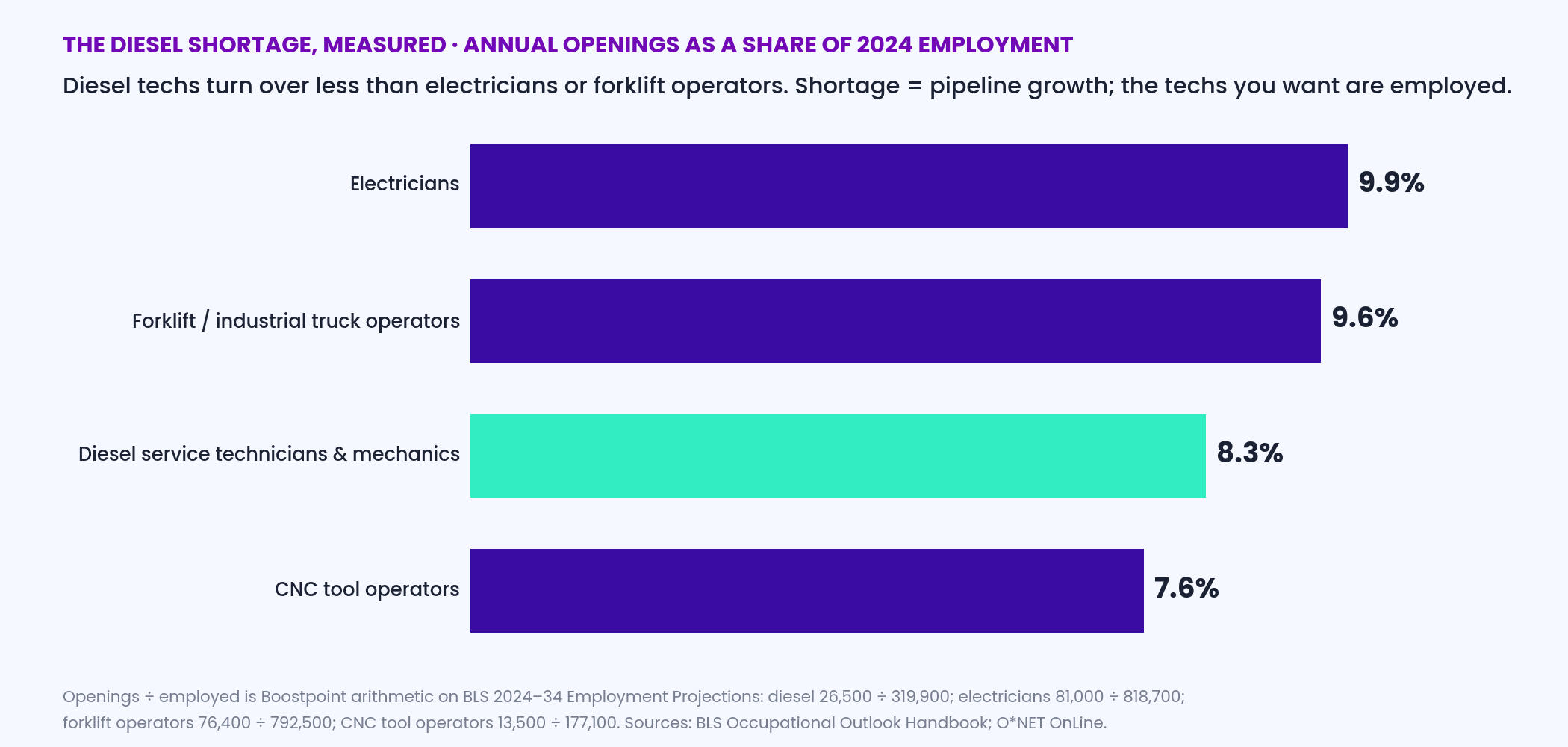
That reframes the task. You are not fishing in an empty pond; you are trying to move an employed technician from one bay to yours. That is a reach problem (are they seeing you?) and an offer problem (is it worth the move?). Both are measurable, and neither is fixed by adding "must have 5+ years and own tools" to a job board post.
Where diesel technicians actually work — and what each pool pays
BLS breaks the occupation down by employer type, and the medians tell you who you are bidding against. In May 2024 the median annual wage was $60,640 ($29.15 an hour); the lowest 10% earned under $41,670 and the highest 10% over $85,980. O*NET's 2025 figure is $29.70 an hour, $61,770 a year. By industry:
| Where they work | Median annual wage | What it means for your ad | Source |
|---|---|---|---|
| Local government (transit, DPW, school fleets) | $67,710 | The best-paid pool: pensions, days, benefits. You will rarely out-pay it; compete on overtime, tooling, and speed of hire. | BLS OOH |
| Wholesale trade (truck & equipment dealers) | $62,370 | Dealer techs have OEM training and factory tools. Say which brands you run; reach them with the equipment in the ad. | BLS OOH |
| Automotive repair and maintenance | $60,350 | Independent shops; often flat-rate. A guaranteed hourly rate is a genuine draw here. | BLS OOH |
| Rental and leasing services | $58,600 | High-volume PM work. Techs here move for variety and diagnostic work. | BLS OOH |
| Truck transportation (private fleets) | $57,360 | The lowest median of the five — and the pool most fleets are trying to hire from. Your ad has to lead with something other than "competitive pay." | BLS OOH |
Two things follow. First, if you are a private fleet, the technician you want is probably earning more at the dealer or the county garage than your posting offers, so the ad has to name a number that clears their current one — or name the things that money doesn't buy them where they are: day shift, a tool allowance, paid ASE tests, a diagnostic laptop that isn't shared. Second, the truck transportation median is the one most of our fleet clients benchmark against, and it is the floor of the market, not the middle.
The case for a staffing agency, made fairly
Heavy-equipment and diesel staffing agencies earn their fee in three situations. When a shop is down two techs and trucks are missing dispatch, the agency's bench is the only same-week answer, and a temp markup is cheaper than out-of-service days. When you are opening a location in a market you don't know, a direct-hire firm's local candidate file is worth a 15–30% fee of first-year salary (the direct-hire range published by Instawork, Davis Companies, ExpectLLC, BDA, and Frontline Source Group) — on the O*NET median of $61,770 that is $9,265.50 to $18,531.00 for one tech. And a good technical recruiter can screen for diagnostic skill in a way a form never will. For a single urgent, hard-to-judge hire, that is real value.
The case weakens for the ongoing seat. A fleet that replaces a tech or two every year — which, at an 8.3% annual openings rate, is what a shop of 12 to 24 techs should expect — is not buying one shortlist; it is renting a pipeline at placement-fee prices, and everything the agency learns about your local market stays with the agency. The comparison with worked math is on our staffing agency vs direct hiring for trades page; the rest of this page is the owned-pipeline version.
What diesel technician applicants cost on social — and the comparison fleets don't like
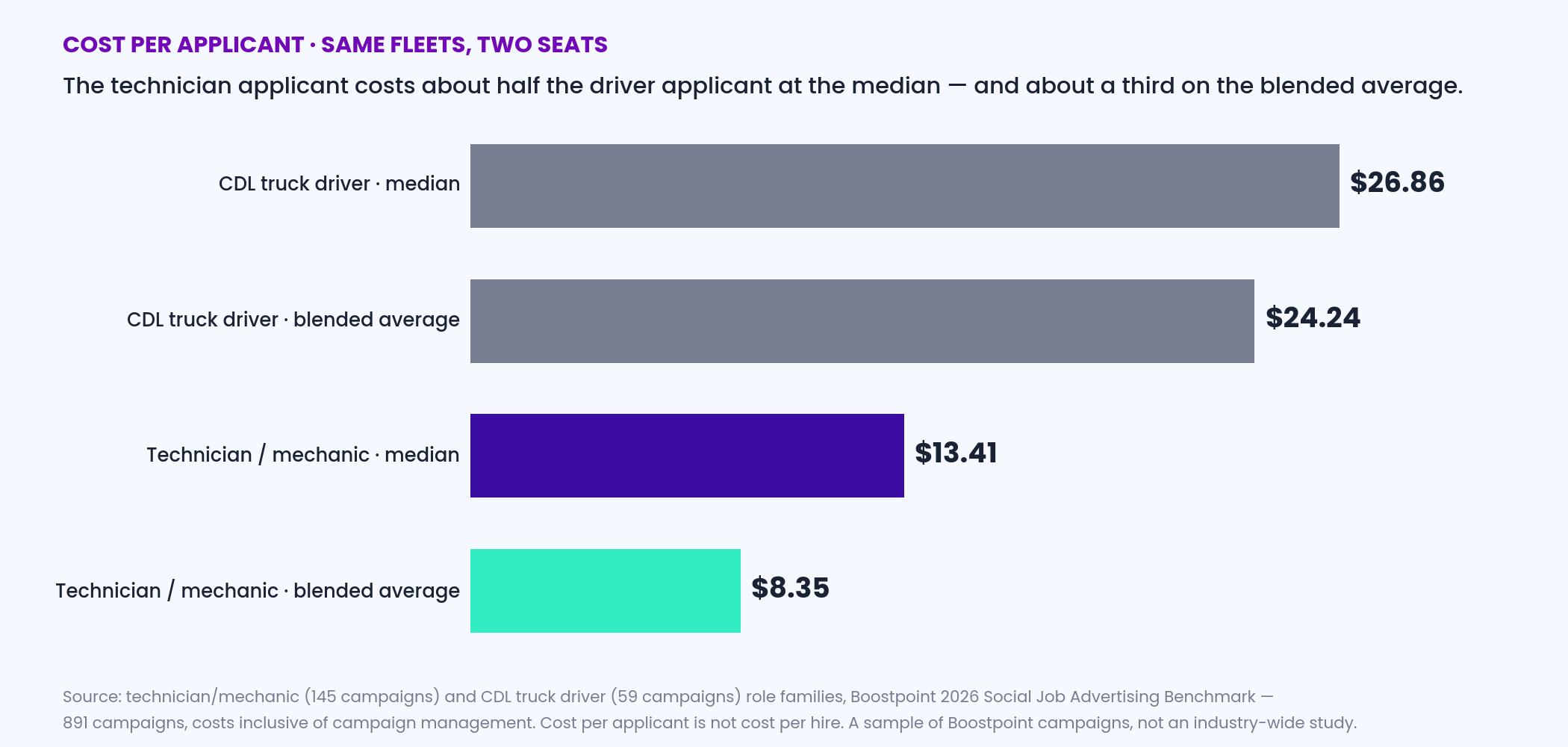
Diesel techs fall into the technician/mechanic role family in our 2026 benchmark: across 145 campaigns, the median cost per applicant was $13.41, the middle half of campaigns ran $7.40–$23.58. Now the comparison. CDL driver campaigns in the same benchmark ran a $26.86 median and a $17.00–$42.31 middle range. A diesel technician applicant costs about half what a driver applicant costs — and yet in our experience the driver seat gets the always-on budget and the shop gets a job board post and a sign on the fence.
| Metric | Technician / mechanic | CDL truck driver | All 891 campaigns |
|---|---|---|---|
| Median cost per applicant | $13.41 | $26.86 | $13.88 |
| Middle 50% of campaigns | $7.40 – $23.58 | $17.00 – $42.31 | $6.48 – $29.74 |
| Campaigns in sample | 145 | 59 | 891 |
What we will not give you is a diesel-only number. The light-vehicle side of the same family, including the federal replacement and training-pipeline data, is on our auto technician shortage page. The posting for that light-vehicle technician is our mechanic job description. Our technician family spans diesel, fleet, agricultural equipment, HVAC, and industrial maintenance techs, and most of those campaigns advertise several roles at once, so a "diesel mechanic cost per applicant" would be a guess with a decimal point. The closest family we do publish is skilled trades, at a $14.14 median and a $7.58–$21.49 middle half across 35 campaigns; agricultural co-ops' mechanic and service-tech hiring is covered on our agriculture pillar. Treat $7.40 to $23.58 as the honest range and plan at the median.
The offer position check
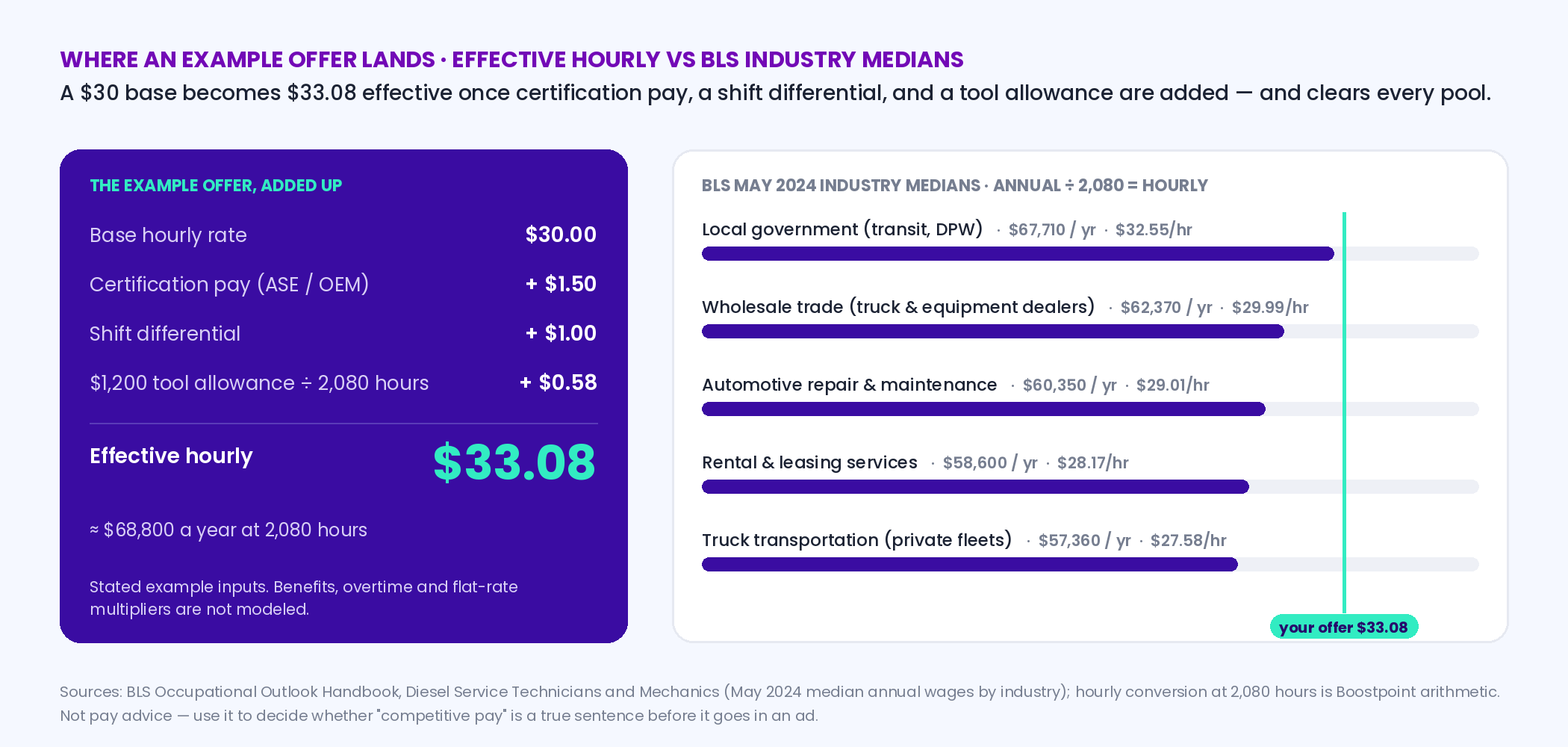
Before you spend a dollar reaching diesel techs, find out what your offer looks like next to the pools above. Enter the parts of your offer; the check adds them into an effective hourly figure and places it against the five BLS industry medians, converted to hourly at 2,080 hours a year. It is arithmetic on public data, not advice on what to pay — but it tells you whether "competitive pay" is a true sentence before you put it in an ad.
Nothing is stored or sent — this runs in your browser. Effective hourly = base + certification pay + shift differential + (annual tool allowance ÷ 2,080).
Industry medians are BLS May 2024 annual figures divided by 2,080 hours — a stated conversion, not a BLS hourly statistic. Benefits, overtime, flat-rate multipliers, and local cost of living are not modeled. Use it to write an honest first line, not to set pay policy.
The playbook, in order of impact
- 1. Price the seat against the pools, then put the number in the first line. "Diesel technicians · $30–$36/hr + $1.50 ASE pay · days, M–F · $1,200 tool allowance" is a complete first line. Fleets that hide the rate pay for clicks from techs who leave when they learn it.
- 2. Say what they'd be working on. Techs move for the equipment: the makes, the model years, the diagnostics you run, whether it's PMs all day or real troubleshooting. A phone photo of the shop floor does more than a benefits graphic.
- 3. Pay for the certifications instead of requiring them. ASE credentials require hands-on experience plus a test and renew every five years; OEM training comes from the dealer. Techs who have them are the ones you're poaching; techs who want them are the ones you can grow. "We pay for ASE tests and OEM training" widens the pool in both directions.
- 4. Cut the form to four questions, in-platform. Name and mobile, years on diesel (multiple choice), the equipment they've worked on (multiple choice), and shift availability. A tech applying from the bay on a break will not stop to upload a résumé, so don't ask for one.
- 5. Run the tech seat always-on at a base budget. At an 8.3% openings rate you will hire techs every year; a pipeline that never stops beats a panic post every time a bay goes dark. Treat the tech campaign like the driver campaign — at half the price per applicant, that isn't a hard budget conversation.
- 6. Call the same day, offer a shop visit, not an interview. Working techs apply from the bay on a break. The first fleet that says "come see the shop Thursday after your shift" wins, and it is rarely the highest bidder.
- 7. Feed a program in parallel. Roughly 11,310 diesel students finished programs in 2023 against 26,500 openings a year; the ones near you are spoken for by graduation. Sponsor a tool scholarship, host clinicals, and hire apprentices you can afford to train — the four-year answer alongside the four-week one.
The math for a fleet that needs three techs
Say you need 3 diesel technicians this quarter and plan on 12 applicants per hire — a stated planning assumption for credentialed roles; use your own ATS ratio — so 36 applicants. At the technician-family median, 36 × $13.41 = $482.76. At the upper quartile, 36 × $23.58 = $848.88. At the lower quartile, 36 × $7.40 = $266.40. For scale, the same 36 applicants at the CDL driver median would cost 36 × $26.86 = $966.96 — a budget many fleets already approve for the cab. And one agency direct-hire placement on the $61,770 median salary runs $9,265.50 to $18,531.00 — for one tech. The ad spend for all three hires, at the expensive end of our range, is under a tenth of one placement fee at the cheap end of theirs.
The diesel shortage is real and it is not why your bay is empty. Every tech you want is employed, reachable at half the cost of a driver applicant, and waiting for an offer that names a number and the equipment. Price the seat, put it in the first line, and run it always-on.
Frequently asked questions
Demand for diesel mechanics: the 2025–35 figures, which supersede the ones above
The shortage section on this page was built on the BLS 2024 estimates and the 2024–34 projection decade. Both have since been replaced. Here are the current figures, so that the arithmetic is on one edition:
| Previous edition (2024 / 2024–34) | Current edition (May 2025 / 2025–35) | |
|---|---|---|
| Diesel technicians employed | 319,900 | 289,960 |
| Projected growth | 2% through 2034 | 3.6% through 2035 |
| Openings a year | ~26,500 | ~24,400 |
| Openings ÷ employed | 8.3% | 8.4% |
| Median pay | $29.15/hr, $60,640/yr | $29.70/hr, $61,770/yr |
The conclusion does not change, and that is the point worth making. Demand for diesel mechanics is steady, not explosive: growth is low single digits, and the openings figure is almost entirely replacement — retirements and people leaving the trade. The turnover rate is essentially identical across the two editions at a little over eight percent, which means the planning implication is unchanged whichever edition you were working from.
One caution on the employment line, because it is tempting to read it as a story. The published count fell by about 30,000 between the two editions. Some of that may be a real contraction and some of it is how the survey re-estimates an occupation from one year to the next; a single year-over-year change in an occupational employment estimate is not a reliable measure of whether a trade is shrinking. Do not build a recruiting argument on it. The figure that is stable across both editions — the openings rate, a little over eight percent either way — is the one to plan with. Pay did move, and upward: the $29.70 an hour that earlier sections of this page attribute to O*NET's 2025 estimate is now also the BLS median, against $29.15 in the previous edition.
What that means for a fleet: you will be replacing roughly one technician in twelve every year as a matter of course, forever, and none of the people who can fill that seat are unemployed. So the demand question is not “is there a shortage” but “what does it cost to be in front of an employed technician in the month he decides to move.” That is an advertising question with a known price, and it is answered further up this page.
How do you hire diesel mechanics?
Treat it as an offer-and-reach problem, not a sourcing problem. Price the seat against the BLS industry medians (local government $67,710, dealers $62,370, repair shops $60,350, rental $58,600, private fleets $57,360 in May 2024), put the hourly rate, shift, equipment, and certification pay in the ad's first line, reach employed techs in social feeds rather than waiting for job-board searches, keep the application to four in-platform questions, and call the same day with a shop-visit time. In our 2026 benchmark, technician and mechanic campaigns ran a $13.41 median cost per applicant.
Is there really a diesel technician shortage?
Yes, as a pipeline problem: the TechForce Foundation reports diesel workforce growth averaging just 1.04% a year over five years, with replacement needs outpacing growth more than 4-to-1, and roughly 11,310 diesel program completions in 2023 against BLS's projected 26,500 openings a year. But measured as openings against the 319,900 employed, diesel techs turn over at 8.3% a year — lower than electricians (9.9%) or forklift operators (9.6%). The techs exist; they are employed, and the question is whether your offer and your reach can move one.
Where do you find diesel mechanics?
Mostly at other employers. BLS's largest pools are local government fleets, truck and equipment dealers (wholesale trade), independent repair shops, rental and leasing companies, and private trucking fleets, and nearly all techs in them are employed and not searching job boards. The channels that reach them are social feed advertising, referrals from your own techs, dealer and OEM networks, and local diesel programs for apprentices — about 11,310 students completed diesel programs in 2023, and most are placed before graduation. Staffing agencies rent you their bench at a temp markup or a 15–30% direct-hire fee.
What does it cost to recruit a diesel technician?
We publish the technician/mechanic family figures rather than a diesel-only number, because most of our technician campaigns advertise several roles at once. In the 2026 benchmark that family ran a $13.41 median cost per applicant and a $7.40–$23.58 middle range across 145 campaigns — about half the $26.86 median for CDL driver applicants. Cost per applicant is not cost per hire; at a stated planning ratio of 12 applicants per hire, that is roughly $89 to $283 in ad spend per hire at the middle of our range, against a $9,265.50 to $18,531.00 agency placement fee on the median salary.
Should I require ASE certification for diesel technicians?
Pay for it rather than require it. ASE credentials require a combination of hands-on work experience and a passing test, and renew every five years; a technician who holds them is exactly the person other employers are also trying to keep, and one who wants them is a person you can develop. An ad that says "we pay for ASE tests and OEM training" reaches both, while "ASE required" removes the second group and rarely changes who applies from the first. Use certification pay per hour to reward the credential without gating on it.
How much should I pay a diesel mechanic?
Enough to clear the pool you are hiring from. BLS's May 2024 median was $60,640 a year ($29.15 an hour), with the lowest 10% under $41,670 and the highest 10% over $85,980; O*NET's 2025 median is $29.70 an hour ($61,770). By employer type, medians ran from $57,360 at private trucking fleets to $67,710 in local government. If you are a private fleet trying to hire a dealer or municipal tech, your effective offer — base plus certification pay, shift differential, and tool allowance — needs to clear their current median or lead with what they can't get where they are, such as day shift, their own diagnostic laptop, or paid certifications.
Should I use a staffing agency to hire diesel technicians?
For same-week coverage when trucks are missing dispatch, for one hard-to-judge hire in a market you don't know, or when you want a technical recruiter to screen diagnostic skill, yes — that is what a temp markup or a 15–30% direct-hire fee ($9,265.50 to $18,531.00 on the $61,770 median) buys. For the recurring seat it weakens: at an 8.3% annual openings rate a dozen-tech shop hires every year, an agency keeps what it learns about your market, and the fee compounds. Most fleets that stay staffed run an always-on direct pipeline and use agencies only for emergencies.
What should a diesel mechanic job ad say?
The decision facts in the first line: hourly rate or range, certification pay, shift and schedule, the equipment (makes, model years, what diagnostics you run), the tool allowance, and whether you pay for ASE and OEM training. "Diesel technicians · $30–$36/hr + $1.50 ASE pay · days, M–F · Freightliner and Kenworth, 2019+ · $1,200 tool allowance · we pay for ASE tests" is a complete ad. Add a real photo of the shop and skip the mission paragraph — techs move for the equipment and the number, in that order.
What is the demand for diesel mechanics?
Steady rather than explosive. On the current BLS edition the occupation employs about 289,960 people, is projected to grow 3.6% from 2025 to 2035, and produces roughly 24,400 openings a year — an openings-to-employment rate of about 8.4%, almost all of it replacement from retirements and people leaving the trade. The rate is essentially unchanged from the previous edition, so the planning implication is the same: continuous replacement hiring rather than a growth surge.
Is there a diesel mechanic shortage?
There is a pipeline problem rather than an unusual scarcity. The openings-to-employment ratio of about 8.4% a year is normal churn for a skilled trade, not evidence of a shortage; what makes the seat hard to fill is that essentially every qualified technician already has a job, and few new entrants are coming into the trade. That makes it a competitive recruiting problem, not a supply crisis.
Has the number of diesel mechanics fallen?
The published employment count fell from 319,900 to 289,960 between the two most recent BLS editions, but that should be treated cautiously. Some of a year-over-year change in an occupational employment estimate reflects how the survey re-estimates the occupation rather than a real contraction, and one year's movement is not a trend. The pay and the openings rate held steady across both editions and are the safer figures to plan against.
What works for diesel technician recruiting?
An always-on direct pipeline, with agencies kept for emergencies. Lead the ad with the hourly rate, shift, equipment and certification pay; keep the application to four in-platform questions; and call the same day with a shop-visit time. Add a referral bonus paid once the new tech stays, and a standing relationship with your local diesel program for apprentices. In Boostpoint's 2026 Social Job Advertising Benchmark, technician and mechanic campaigns ran a median $13.41 per applicant, with the middle half of campaigns between $7.40 and $23.58.
How do I hire a diesel mechanic fast?
Cut the days between the application and the shop visit. Text the applicant within minutes, call the same day, and offer a time to see the bays and the equipment that week, because an employed tech is comparing you with the shop they already know. A dated open house with trucks in the bay gives an employed tech a specific time to come and look. For same-week coverage while you hire, a staffing agency is the faster, more expensive option.
Is demand for diesel mechanics growing faster than demand for truck drivers?
About the same, and both are mostly replacement hiring. BLS Employment Projections 2025-35 project 3.6% growth for the BLS occupation that covers diesel mechanics (SOC 49-3031, which also includes bus and truck mechanics), with about 24,400 openings a year, and 3.8% growth for heavy and tractor-trailer truck drivers, with about 214,500 openings a year. For a fleet that means the shop seat and the cab seat both reopen every year. In Boostpoint's 2026 Social Job Advertising Benchmark, the Technician / mechanic family ran a $13.41 median cost per applicant against $26.86 for CDL truck drivers; our CDL recruiting playbook covers the driver side.
See what technician applicants cost fleets like yours
We'll show you the technician and mechanic campaigns closest to yours across 891 real campaigns — and the offer-and-form mechanics that put the shop seat on the same footing as the driver seat.
Book a DemoAdvertising figures come from the technician/mechanic and CDL truck driver role families, plus the skilled trades family, in the 2026 Social Job Advertising Benchmark — 891 campaigns and 1,334 campaign-months overall: technician/mechanic $13.41 median cost per applicant, $7.40–$23.58 middle 50%, 145 campaigns; CDL truck driver $26.86 median, $17.00–$42.31 middle 50%, 59 campaigns; skilled trades $14.14 median, $7.58–$21.49 middle 50%, 35 campaigns; benchmark-wide $13.88 median, $6.48–$29.74 middle 50%. No diesel-only cost figure is published because technician campaigns advertise several roles at once. The three-hire example uses a stated 12-applicants-per-hire planning assumption to be replaced with your own ATS ratio ($482.76, $848.88, $266.40, and $966.96 resolve exactly from 36 applicants at $13.41, $23.58, $7.40, and $26.86; $9,265.50 and $18,531.00 are 15% and 30% of $61,770). The offer position check adds your inputs and converts BLS annual industry medians to hourly at 2,080 hours ($32.55, $29.99, $29.01, $28.17, $27.58); the $33.08 example is $30 + $1.50 + $1 + $1,200 ÷ 2,080. Cost per applicant is not cost per hire; we do not track hires and publish no cost-per-hire figure. Third-party figures: employment (319,900), growth (2%, +7,800), openings (26,500 a year), wages ($60,640 / $29.15 median; under $41,670 and over $85,980 at the 10th and 90th percentiles) and industry medians from the BLS Occupational Outlook Handbook, Diesel Service Technicians and Mechanics (May 2024 wages); electrician, forklift, and CNC employment and openings from the BLS OOH and O*NET OnLine (2024–34 projections); the $29.70 / $61,770 2025 median from O*NET OnLine (49-3031.00); the 1.04% annual growth and 4-to-1 replacement figures from the TechForce Foundation's 2024 Transportation Technician Supply & Demand Report news release, and the 11,310 diesel program completions (2023) from that report as covered by Fleet Maintenance; ASE certification requirements and the five-year renewal from ASE (About ASE); direct-hire fee ranges (15–30%) from Instawork, Davis Companies, ExpectLLC, BDA, and Frontline Source Group as cited on our skilled trades recruiting cost page. This is a sample of Boostpoint campaigns, not an industry-wide study.