
Employer guideRead at source, 3 September 2026
Auto Technician Shortage 2026: Replacement Demand, Pay, and What Dealers and Shops Pay per Applicant
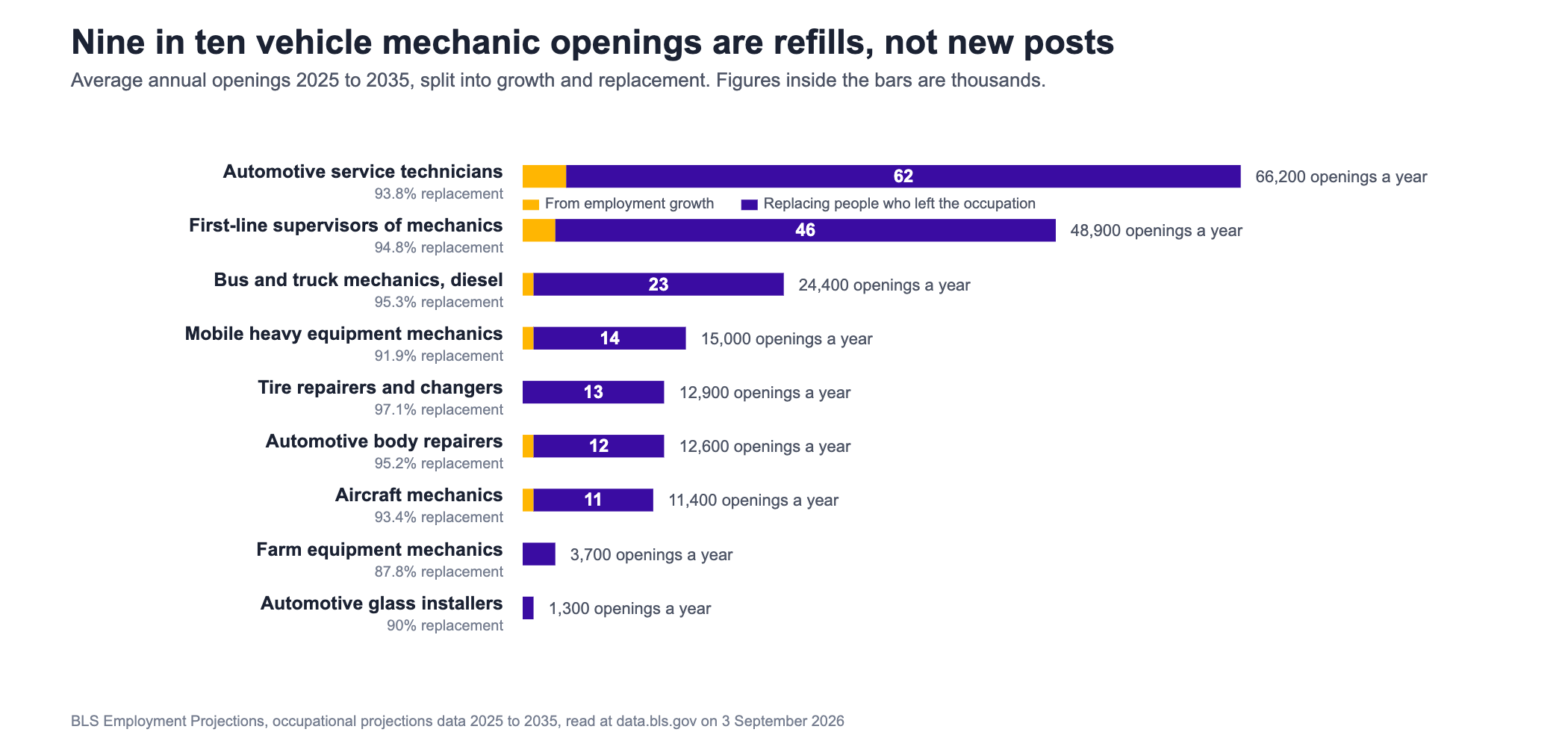
The federal projections put 66,200 job openings a year for automotive service technicians between 2025 and 2035. Only 4,090 of those exist because the occupation is growing. The other 62,110, or 93.8 percent, are replacements for people leaving. Meanwhile the training pipeline everyone says is failing is at a six-year high: 41,700 automotive awards were conferred in 2023 to 2024, up 44.6 percent from the 2020 to 2021 trough and 16.4 percent above the pre-pandemic level. And the occupation sits at the bottom of its own pay ladder, at a $50,620 median against $61,770 for diesel and $65,510 for heavy equipment — while being one of only two mechanic occupations the Bureau of Labor Statistics says needs a postsecondary award before you are hired. All of it read at the Bureau of Labor Statistics and the Department of Education on 3 September 2026.
Ninety-four percent of the openings are replacements
Take the Employment Projections table for automotive service technicians and mechanics. Employment of 825,800 in 2025 is projected to reach 866,700 by 2035: a rise of 40,900, or 5.0 percent. Spread over ten years that is about 4,090 additional posts a year. The same table shows 66,200 annual average openings. Subtract the growth and 62,110 openings a year are people being replaced.
The whole mechanic family behaves this way, and the pattern is tighter here than in most trades: every occupation in the table below runs between 88 and 97 percent replacement. What that means practically is that hiring is not a project with an end. If you filled every open bay in the country tomorrow, the occupation would need roughly sixty-two thousand more people twelve months later, and the number would be almost entirely unaffected by whether the industry grew.
| Occupation | Employed 2025 | Openings a year | Replacement share | Median wage | Entry education |
|---|---|---|---|---|---|
| Automotive service technicians | 825,800 | 66,200 | 93.8% | $50,620 | Postsecondary award |
| First-line supervisors of mechanics | 629,000 | 48,900 | 94.8% | $79,860 | High school |
| Bus and truck mechanics, diesel | 316,000 | 24,400 | 95.3% | $61,770 | High school |
| Mobile heavy equipment mechanics | 180,300 | 15,000 | 91.9% | $65,510 | High school |
| Tire repairers and changers | 112,200 | 12,900 | 97.1% | $37,710 | High school |
| Automotive body repairers | 163,200 | 12,600 | 95.2% | $54,890 | High school |
| Aircraft mechanics | 140,000 | 11,400 | 93.4% | $79,870 | Postsecondary award |
| Farm equipment mechanics | 41,900 | 3,700 | 87.8% | $56,550 | High school |
| Recreational vehicle technicians | 17,500 | 2,200 | — | $52,000 | High school |
| Automotive glass installers | 22,600 | 1,300 | 90.0% | $47,630 | High school |
Read the last two columns together
The automotive service technician is the lowest-paid mechanic occupation on this list except tire fitting, at $50,620. It is also one of only two the Bureau of Labor Statistics classes as requiring a postsecondary nondegree award to enter, alongside aircraft mechanics, who earn $29,250 more. And the training column goes the other way too: BLS records short-term on-the-job training for automotive service technicians and long-term on-the-job training for diesel. The auto side asks the candidate to arrive already trained, trains them least once they do, and pays $11,150 less than the diesel bay next door.
The pipeline is at a six-year high, and it still does not close the gap
No published federal table breaks out automotive training programs: the Digest of Education Statistics folds them into a combined engineering technologies line that also contains construction trades. So we tabulated the underlying files ourselves — the IPEDS Completions component, Fall 2024 collection, filtered to CIP 47.0604, automobile and automotive mechanics technology, first majors, all award levels below the bachelor degree.
41,700 automotive awards were conferred in 2023 to 2024. The wider vehicle repair series, CIP 47.06, which also covers diesel, collision, aircraft, marine and motorcycle, produced 74,361. Both figures cover every Title IV institution, which matters here because proprietary automotive schools are a large share of this pipeline; on the narrower convention the Digest uses, degree-granting institutions in the fifty states and the District of Columbia only, the automotive figure is 34,683.
| Award level | Automotive awards, 2023–24 | Share of the pipeline | Since the 2020–21 trough |
|---|---|---|---|
| Certificates under one year | 18,116 | 43.4% | Up 62% |
| Certificates of one to two years | 10,429 | 25.0% | Not published separately here |
| Associate degrees | 10,325 | 24.8% | Up 45% |
| Certificates of two to four years | 2,830 | 6.8% | The one level that fell in 2023–24 |
| All sub-baccalaureate | 41,700 | 100% | Up 44.6% |
Note where the growth sits. Forty-three percent of the automotive pipeline is now a certificate of under a year, and that level has grown fastest. Whatever a shop believes about what a graduate arrives knowing, the modal automotive credential in the United States is a short certificate, and the share of them is rising.
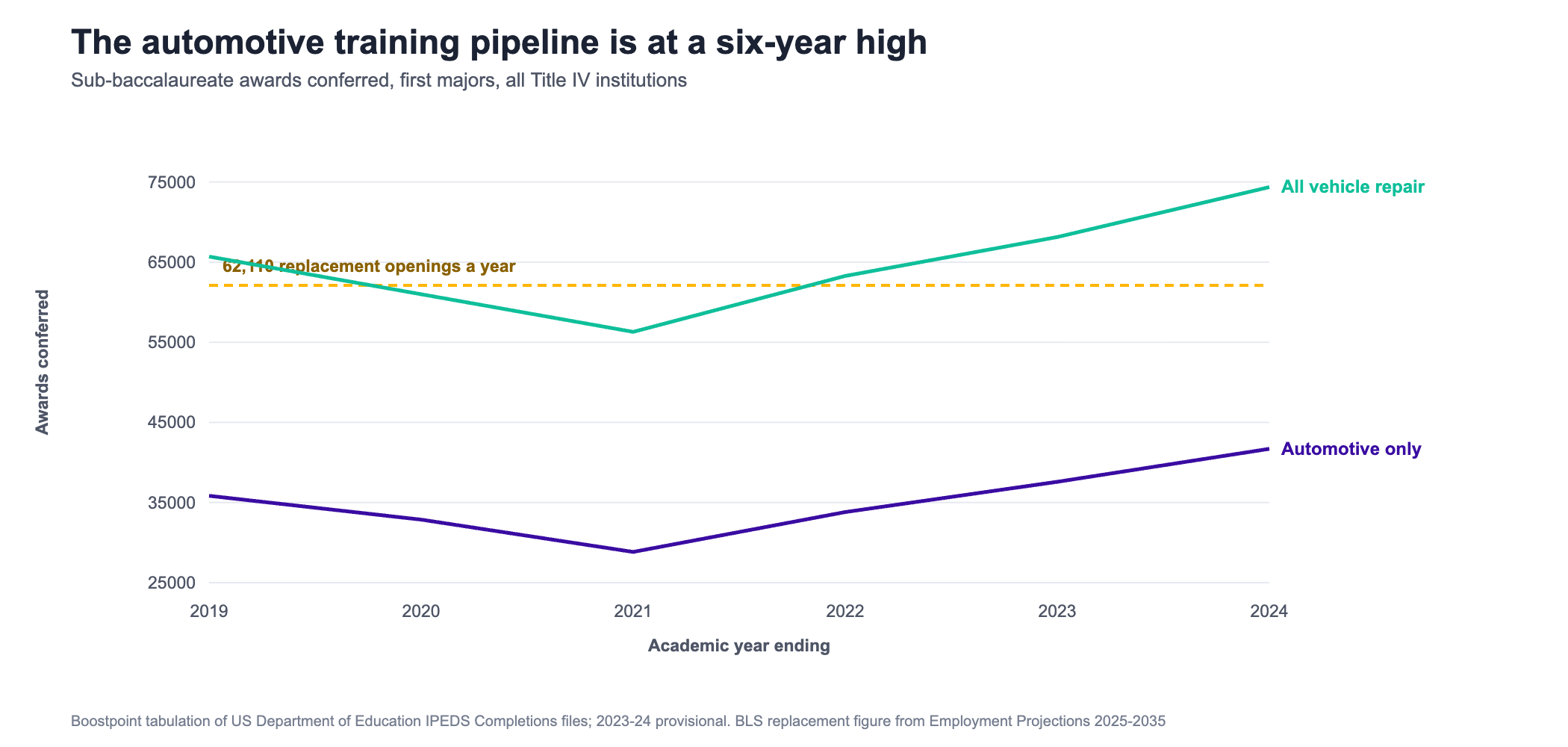
The shape matters more than the level. The pipeline bottomed in the pandemic year and has grown every year since, up 44.6 percent from the 2020 to 2021 trough and 16.4 percent above 2018 to 2019. Short certificates are up 62 percent since the trough and associate degrees 45 percent. Whatever the industry has been saying about enrollment for the last four years, the schools have been producing more automotive graduates each year, and the shortage language has not changed at all. That is the signature of an exit-rate problem rather than an intake problem.
The pipeline grew 44.6 percent in three years and the shortage did not move, because 93.8 percent of openings are people leaving. You cannot enroll your way out of an exit rate.
Growth against replacement, by occupation
The pay ladder, and where your technicians go when they leave
If 93.8 percent of your openings are people leaving, the useful question is where they go. The projections table answers most of it. Two doors are open to a working automotive technician and both pay more. Sideways: diesel at $61,770, mobile heavy equipment at $65,510, farm equipment at $56,550 — between $5,930 and $14,890 above the automotive median, and none of the three requires the postsecondary award the automotive role does. Upward: first-line supervisor of mechanics at $79,860, which is $29,240 more and has 48,900 openings a year of its own.
Neither move requires retraining from scratch, and both are advertised to your technicians constantly by employers in adjacent sectors. That is the competitive set. A shop benchmarking its pay against the shop across town is looking at the wrong list; the fleet yard, the equipment dealer and its own service-manager vacancy are all bidding for the same person, and two of the three do not care whether he holds a certificate.
The number everyone quotes, and the year it was forecasting
Search this subject and one figure dominates: a projection, published by a foundation funded by the transportation and automotive sector, of how many technicians the industry would be short by a target year. It is still being quoted in pages written in 2025 and 2026. The target year it forecasts has already passed. A forecast whose horizon is behind us is not evidence about 2026, whoever commissioned it, and it is not comparable with the projections table above, which is a decadal model of employment and separations published by a statistical agency with no stake in the answer.
The same care applies to graduate counts. A trade body puts annual service technician graduates at around thirty-nine thousand, which is close to what we get from the federal files and we have no quarrel with it. What that figure alone cannot tell you is the direction, because it is published as a level rather than a series. The federal data is a series, and the series is rising. Anyone using a graduate count to argue that enrollment is collapsing is using a number that says the opposite when you plot six years of it.
What an empty bay costs, and what filling it costs
Here is our own data, labeled as ours. Automotive technicians fall inside the technician and mechanic role family in our 2026 benchmark: across 145 campaigns the median cost per applicant was $13.41, the middle half ran $7.40 to $23.58, the volume-weighted average was $8.35, and 16 percent of people who clicked finished the application. We do not publish an automotive-only figure, because the family spans diesel, fleet, agricultural and industrial maintenance work and most of those campaigns advertise several roles at once. A number labeled auto technician cost per applicant would be a guess with a decimal point on it.
Set that against the other side of the ledger. A bay with no technician in it bills nothing, and the arithmetic runs away from the advertising cost almost immediately. The tool below uses your own labor rate and your own billable hours, because we have no business telling you what your door rate is.
Price an idle bay against the cost of refilling it
Two adjacent pages carry what this one does not repeat. The posting itself is on the mechanic job description page, the fleet side and the full technician cost tables are on diesel mechanic recruiting, the same replacement arithmetic runs across the building trades on the construction labor shortage, and if you are paying for training yourself, some of it is fundable: see workforce development grants.
The mechanical trades run the same arithmetic with one difference worth knowing: HVAC is the only one of them BLS projects to grow much faster than average, so a smaller share of its openings are refills. We take that apart in the HVAC technician shortage.
Filling the seat: technician and mechanic applicants cost $13.41 at the median across 145 campaigns in our 2026 benchmark.
See live technician ads“Mechanic shortage”, “auto technician shortage” or “shortage of automotive technicians”? The answer depends on which bay
All three phrasings describe the same gap, and which one you use tends to follow where you work: independent shops say mechanic, dealer groups and manufacturers say automotive technician, and the trade and government data series mostly say automotive service technicians and mechanics. The wording matters in one practical place — the job ad — because the title is the single biggest driver of who sees it. Use the phrase your applicants call themselves, not the one your organization uses internally.
The two phrases get used as if they were the same thing. They are not. “Mechanic” spans four separately projected occupations, and they behave differently enough that a shop and a plant reading the same headline are reading about different problems.
| Occupation | Employed 2025 | Openings a year | Replacement share |
|---|---|---|---|
| Automotive service technicians and mechanics | 825,800 | 66,200 | 94% |
| Industrial machinery mechanics, maintenance workers and millwrights | 547,300 | 51,900 | 85% |
| Bus and truck mechanics and diesel engine specialists | 316,000 | 24,400 | 95% |
| Heavy vehicle and mobile equipment service technicians | 242,400 | 20,300 | 92% |
| All four | 1,931,500 | 162,800 | 91% |
Source: BLS Occupational Outlook Handbook, 2025–35 projections. Replacement share calculated by Boostpoint as annual openings minus one tenth of the projected ten-year employment change, divided by annual openings.
Put together, the mechanic trades hold 1,931,500 jobs and turn over 162,800 of them a year. That is 8.4 percent of the entire mechanic workforce refilled every twelve months, and 91 percent of it is replacement rather than growth — jobs that already existed, held by someone who left.
The exception is the one worth knowing. Industrial machinery mechanics and millwrights are projected to grow 14 percent to 2035, so roughly 15 percent of that occupation’s openings are genuinely new positions. For automotive it is 6 percent, for diesel 5 percent, for heavy equipment 8 percent. A plant hiring a millwright is often adding a head. A shop hiring an automotive technician almost never is.
That distinction decides where the person comes from. If 94 percent of your openings are replacement, the technician you need is not entering the trade this year — he is currently employed, in one of the other three columns of that table, at a median that is higher than yours. The pay ladder above is the recruiting problem; the ad is downstream of it.
It also explains why “is there a mechanic shortage” gets contradictory answers. Measured as unfilled growth, no: the four occupations add about 14,800 net jobs a year between them. Measured as seats a service manager has to refill, yes, and permanently: 162,800 a year, every year, with the whole pool bidding against itself for the same experienced people.
What actually moves the exit rate
If nine in ten of your openings are refills, the cheapest hire available is the one you do not lose. Three things in the data above are worth acting on, and none of them is an enrollment program.
- Price against the right list. Your competitive set is not the shop across town. It is the fleet yard at $61,770, the equipment dealer at $65,510 and your own service-manager vacancy at $79,860. A technician comparing offers is comparing those, and two of the three do not ask for the credential the automotive role expects.
- Stop charging the candidate for the credential and then not training them. Automotive is one of two mechanic occupations recorded as needing a postsecondary award, and the one recorded with the shortest on-the-job training after hire. Diesel does the reverse and pays more. An employer that will train a high-school hire competes for a pool roughly ten times the size of the certificate-holding one, and the neighboring trades have been doing exactly that for years.
- Name the ladder in the advertisement. There are 48,900 first-line supervisor openings a year at $79,860. If the route from your bay to that job is real, it belongs in the first three lines of the ad, with the timescale on it. If it is not real, the technician will find the ladder somewhere else, and the federal separations data suggests a great many of them do.
What it costs to put one technician application in your inbox, and how that compares with the other frontline role families, is in the 2026 benchmark: the technician and mechanic family ran a $13.41 median with a 16% apply rate across 145 campaign-months.
Hiring through the shortage of automotive technicians: where the next technician comes from
The numbers above say the automotive technician shortage is a refill problem: 62,110 of the 66,200 openings a year replace people who leave. That changes where a shop or dealer should look. The next technician is rarely a new graduate arriving unprompted, and rarely someone scrolling a job board. He is in one of three places, and each needs a different message.
1. Employed technicians at other shops
Most qualified automotive technicians have a job. They are reachable in a Facebook or Instagram feed within commuting distance of your service drive, and they decide on four facts: the flat-rate or hourly number, how hours are guaranteed, the tool situation, and the schedule. Put those in the first line. Meta runs job ads in the Employment special ad category, so you cannot target by age or ZIP code and the radius must be at least 15 miles; the copy does the qualifying (see Meta's special ad category, explained).
2. Your own lower bays
BLS Employment Projections 2025-35 count 112,200 tire repairers and changers, with about 12,900 openings a year and a May 2025 median of $37,710, and 102,400 automotive and watercraft service attendants, with about 12,900 openings a year and a $35,670 median. Those are the people already in your building, or the building next door, who know the service lane and earn well below the $50,620 technician median. A written path from those roles to a technician bay, with the pay steps and the training you will pay for, is a recruiting message in its own right.
3. Career-changers you train
The pipeline section above shows short certificates growing fastest. A shop that pays for training and says so in the ad competes for a far larger pool than one that asks for the credential first. If you formalize it, a registered program gives the ad a wage schedule to quote; apprenticeship recruiting covers how to advertise one.
Whichever pool you are fishing in, the cost of reaching it has a reference point: the Technician / mechanic family in Boostpoint's 2026 benchmark ran a $13.41 median cost per applicant with a 16% apply rate (benchmark data). Dealer groups hiring across several rooftops at once will find the multi-store version in auto dealership recruiting.
How to hire automotive technicians: the process from ad to first day
The sections above say where the next technician is. This is the order of work once you know. Automotive technicians are a large occupation, 825,800 employed in 2025 with 66,200 openings a year projected for 2025 to 2035 and a May 2025 median of $50,620 (BLS Employment Projections 2025-35), and almost all of the people you want already have a bay somewhere else. Every step below is built for a candidate who is employed, busy and comparing you with the shop down the road.
1. Decide the four facts before you write anything
Pay plan (flat-rate with the rate and any guaranteed hours, or hourly), tools (what you provide, any tool allowance), schedule (days, hours, Saturdays), and the work mix (maintenance, drivability, electrical, which makes). If these are not settled, the ad will be vague and the interview will be spent settling them.
2. Write the ad for someone who is not looking
Lead with the pay plan and hours guarantee, then the schedule, then what the bays and equipment are like. Leave the long duty list for the mechanic job description on your careers page. On Facebook and Instagram the ad runs in Meta's Employment special ad category, so the copy does the qualifying rather than the targeting.
3. Screen for what the job legally or genuinely needs
- A/C work. If the role services motor vehicle air conditioning, the EPA says "any person who repairs or services a motor vehicle air conditioning system for consideration" must be trained and certified under section 609 of the Clean Air Act. That is a fair knockout, or an offer to pay for the certification before the tech touches a system.
- ASE certifications. Industry credentials issued by ASE, not a state license. ASE requires passing a test plus hands-on work experience (or training combined with experience), and certifications are valid for five years. Ask which areas someone holds; do not make it a knockout unless the pay plan rewards it.
- Driver's license if the job includes road tests or moving customer vehicles.
Keep the mobile application to name, phone, years in a bay, and two or three of those questions. Everything else belongs in the interview; our mechanic interview questions cover what to ask.
4. Call back the same day and offer a shop visit
An employed technician applies on a lunch break and takes the first serious call. Text within minutes to set a time, meet in the shop rather than an office, and have the service manager there to talk pay plan and workload honestly.
5. Know what an applicant costs before you set a budget
In Boostpoint's 2026 Social Job Advertising Benchmark, the Technician / mechanic family ran a $13.41 median cost per applicant, a middle 50% of $7.40 to $23.58, and a 16% apply rate. That family covers several technician types, not automotive alone, and cost per applicant is not cost per hire. Dealers with an XML job feed can run one ad per opening through Boostpoint Programmatic 2.0; multi-rooftop groups should also read auto dealership recruiting.
Frequently asked questions
Is there really an auto technician shortage?
There is a large and permanent hiring requirement, but it is not caused by growth. The federal projections show 66,200 annual openings for automotive service technicians between 2025 and 2035, of which only about 4,090 a year come from the occupation getting bigger. The other 62,110, or 93.8 percent, are replacements for people leaving. The training pipeline has meanwhile grown every year since 2021.
How big is the automotive technician shortage?
Measured as seats that have to be refilled, about 66,200 a year. The federal projections put automotive service technician and mechanic employment at 825,800 in 2025 and 866,700 in 2035, a rise of 40,900, or roughly 4,090 new posts a year. The other 62,110 openings a year, 93.8 percent, replace technicians who leave the occupation. As unfilled growth the gap is small; as the refill load a service manager carries, it is large and it does not end.
How many auto technicians graduate each year?
Our tabulation of the Department of Education IPEDS Completions files puts automotive awards at 41,700 in the 2023 to 2024 academic year, across certificates and associate degrees at every Title IV institution. On the narrower convention used in the Digest of Education Statistics, degree granting institutions only, the figure is 34,683. No published federal table breaks the automotive program out, which is why we tabulated the source files.
Is the training pipeline shrinking?
No. It fell through the pandemic, bottoming at 28,836 automotive awards in 2020 to 2021, and has risen every year since to 41,700 in 2023 to 2024. That is 44.6 percent above the trough and 16.4 percent above the 2018 to 2019 level. Short certificates are up 62 percent since the trough and associate degrees 45 percent. The one category that fell in the latest year is the two to four year certificate.
How much do auto technicians make?
The 2025 median annual wage for automotive service technicians and mechanics is 50,620 dollars. That is the lowest of the vehicle mechanic occupations except tire fitting. Diesel technicians are at 61,770 dollars, mobile heavy equipment mechanics at 65,510, automotive body repairers at 54,890 and aircraft mechanics at 79,870. First line supervisors of mechanics are at 79,860.
Why do auto technicians leave the trade?
We cannot tell you why any individual leaves, and we will not invent a reason. What the federal data does show is that two well populated occupations next door pay between 5,930 and 14,890 dollars more, do not require the postsecondary award that automotive entry does, and have thousands of openings a year of their own. Supervision pays 29,240 dollars more. Those are the exits the numbers describe.
Do you need a certificate to be an auto technician?
The Bureau of Labor Statistics records the typical entry level education for automotive service technicians as a postsecondary nondegree award, and records short term on the job training once hired. Diesel, body, farm equipment and heavy equipment mechanics are all recorded as high school entry with moderate or long term on the job training. Whether your own shop should require the credential is a hiring decision, not a legal one.
What does it cost to recruit an auto technician?
In our 2026 benchmark the technician and mechanic role family ran a median of 13 dollars 41 an applicant across 145 campaigns, with the middle half between 7 dollars 40 and 23 dollars 58 and a volume weighted average of 8 dollars 35. Sixteen percent of clicks became completed applications. We publish no automotive only figure because the family spans several technician types and most campaigns advertise more than one.
What does an empty bay cost?
It depends entirely on your labor rate and how many hours that bay would have billed, which is why the calculator above asks for both rather than assuming them. The general shape holds across every input we have tried: the billed labor a bay loses in its first two weeks empty exceeds the entire advertising cost of filling the seat, usually by two orders of magnitude.
Is there a mechanic shortage in 2026?
Not in the sense of unfilled growth. Across the four mechanic occupations — automotive, industrial machinery and millwrights, bus and truck diesel, and heavy vehicle and mobile equipment — the projections add about 14,800 net jobs a year against 1,931,500 existing ones. The shortage employers actually feel is replacement: 162,800 openings a year, 91 percent of which are seats that already existed and have to be refilled from a pool that is already employed.
How many auto mechanics are needed each year?
About 66,200 openings a year for automotive service technicians and mechanics, against 825,800 people employed in the occupation in 2025. Only about 4,090 of those openings a year come from growth; the other 62,110, roughly 94 percent, are replacements for people who left the occupation or the workforce.
Is there really a shortage of auto technicians?
The shortage is mostly replacement rather than growth: the great majority of openings each year come from technicians leaving the trade or retiring, not from new positions. That matters because it changes the fix from recruiting harder to losing fewer.
Is there a shortage of auto body technicians?
The hiring need is real, and it is mostly replacement. BLS projects employment of automotive body and related repairers to grow from 163,200 in 2025 to 169,300 in 2035, or 3.7%, while the occupation generates about 12,600 openings a year, so roughly 95% of openings replace people who leave. The May 2025 median wage was $54,890. In Boostpoint’s 2026 benchmark, the closest role family, technicians and mechanics, ran a median $13.41 per applicant. For the posting, see our auto body technician job description.
What can a shop do about the shortage of automotive technicians?
Treat it as a refill problem rather than a pipeline problem, because about 94 percent of openings replace people who leave. Keep the technicians you have by pricing against diesel, heavy equipment and supervisor pay, build a written path from tire, lube and service-lane roles into a bay, pay for training rather than requiring the credential up front, and advertise to employed technicians with the pay, hours guarantee and tools policy in the first line.
Where do auto shops find technicians during the shortage?
In three places: employed technicians at other shops, reached through social job ads within commuting distance; the tire, lube and service-lane workers already in the building, promoted through a written training path; and career-changers the shop trains itself, often through a registered apprenticeship. Job boards reach only the small share of technicians actively searching in a given week.
How do you hire automotive technicians?
Settle the pay plan, tools, schedule and work mix first; put pay and guaranteed hours in the first line of the ad; keep the mobile application to a few questions such as years in a bay and section 609 certification if the role services A/C; call back the same day; and interview in the shop with the service manager present. Most qualified technicians are employed, so the ad has to reach people who are not job hunting.
Do automotive technicians need EPA 609 certification?
Only for air conditioning work. The EPA states that any person who repairs or services a motor vehicle air conditioning system for payment or barter must be trained and certified under section 609 of the Clean Air Act by an EPA-approved program. A technician who never touches A/C systems does not need it for other work.
Is there a shortage of mechanics?
For automotive mechanics, the shortage is a refill problem. Federal projections show 66,200 openings a year for automotive service technicians and mechanics from 2025 to 2035, and 62,110 of them, or 93.8 percent, replace people who leave rather than new posts. The training pipeline is not the main constraint: automotive awards reached 41,700 in 2023 to 2024, a six-year high. Meanwhile better-paid diesel, heavy equipment and supervisor jobs compete for the same technicians.
Are auto mechanics in demand?
Yes, steadily. Employment of automotive service technicians and mechanics is projected to rise from 825,800 in 2025 to 866,700 in 2035, about 5.0 percent, with 66,200 openings a year once replacements are counted. The 2025 median wage was $50,620, below diesel at $61,770 and heavy equipment at $65,510, so the technicians a shop trains have better-paid options close by.
What is the demand for diesel mechanics?
About 24,400 openings a year for bus and truck mechanics and diesel engine specialists, against 316,000 people employed in 2025, under the federal 2025 to 2035 projections. About 95 percent of those openings replace people who leave. The 2025 median wage was $61,770, and BLS records high school as the typical entry education, with long-term on-the-job training, so fleets and dealers often hire and train rather than wait for graduates.
Technician seat empty?
Working technicians are employed, not searching, and they are on their phones between jobs. We put the offer in front of them where they actually are, keep the form short enough to finish standing up, and tell you what each applicant cost.
Book a Demo




For the collision side of the shop, our free auto body technician job description template covers duties, flat-rate pay and the federal spray certification requirement most ads leave out.