
Employer guideRead at source, 3 September 2026
Workforce Development Grants for Employers: WIOA, State Training Funds and Apprenticeship Money (2026)
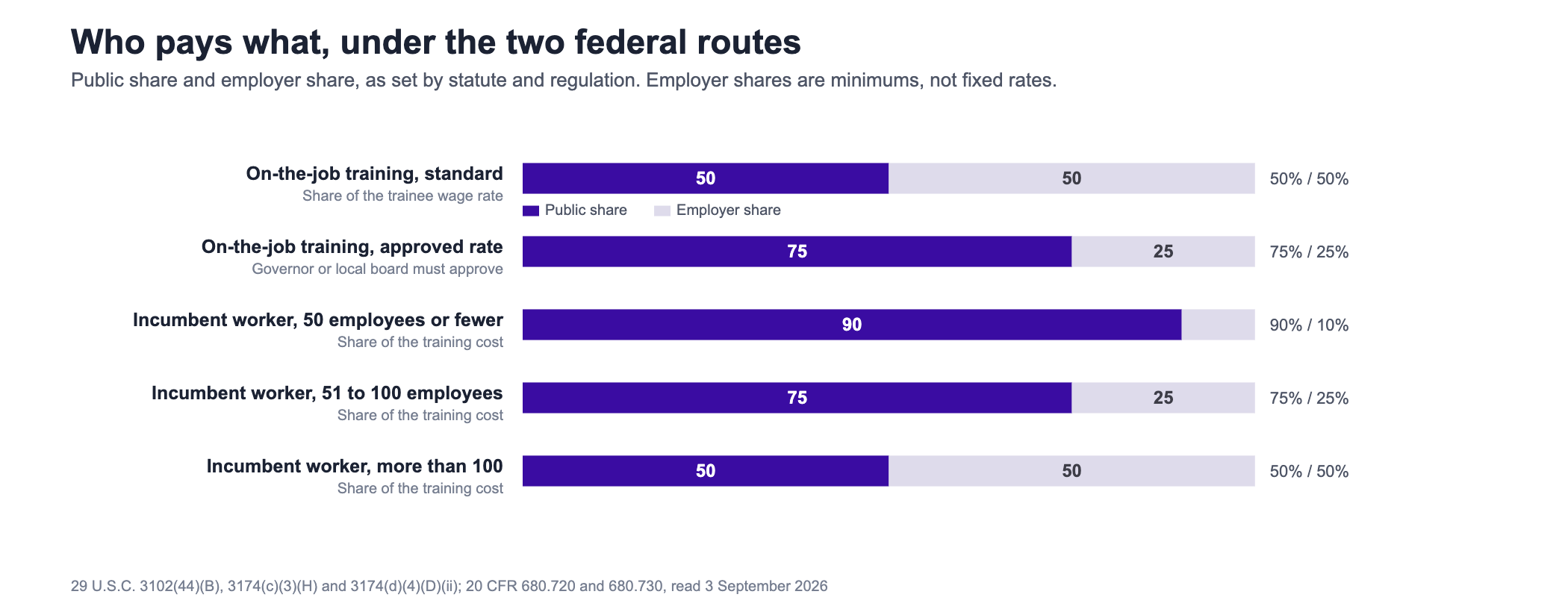
Three separate pots of money, and most pages blur them. Federally, on-the-job training under WIOA reimburses an employer up to 50 percent of a new hire’s wage during training, and up to 75 percent where the Governor or local board approves — and the regulation says plainly that employers are not required to document those costs. Separately, incumbent worker training asks for an employer match that scales with headcount: 10 percent under 50 employees, 25 percent from 51 to 100, and 50 percent above that, with the wages you already pay during training counting toward it. Then twenty states run their own funds, ranging from $1,000 a credential in Ohio to $250,000 an employer in Michigan and New Jersey. And the fourth thing people reach for, the federal hiring tax credit, is currently lapsed. Everything below was read in the statute, the regulation, or on the state agency page on 3 September 2026.
The federal money, and the sentence in the regulation that changes the arithmetic
On-the-job training is the one worth understanding properly. Under 29 U.S.C. 3102(44)(B), an OJT program reimburses the employer up to 50 percent of the wage rate of the participant for the extraordinary costs of providing the training and the additional supervision it requires. 20 CFR 680.720(b) repeats it and adds the ceiling: up to 75 percent under the criteria at 680.730. The increase is not automatic. Under 29 U.S.C. 3174(c)(3)(H) the Governor approves it for state-reserved funds and the local board for locally allocated funds, weighing four factors: the characteristics of the participants, the size of the employer, with an emphasis on small businesses, the quality of the training and advancement on offer, and anything else the board thinks relevant.
You do not have to prove the cost
20 CFR 680.720(a) says OJT payments are deemed to be compensation for the extraordinary costs of training and for the lower productivity of a trainee. And then 680.720(c): employers are not required to document such extraordinary costs. That single sentence is the difference between a grant and a receipts-based reimbursement. You are not assembling an invoice file. You are agreeing on a wage-rate percentage for a training period with the board, and being paid it.
| Federal route | What it pays | Who applies, and where | Authority |
|---|---|---|---|
| On-the-job training | Up to 50% of the new hire wage rate during training; up to 75% if the Governor or local board approves | The employer, through the local workforce board, under an OJT contract agreed before the hire starts | 29 U.S.C. 3102(44)(B); 3174(c)(3)(H); 20 CFR 680.700–680.730 |
| Incumbent worker training | Training cost less the employer match: minimum 10%, 25% or 50% by headcount | The employer, through the local board, for staff with six months or more of service | 29 U.S.C. 3174(d)(4); 20 CFR 680.780–680.820 |
| Apprenticeship, through OJT | The OJT percentages above, applied to the on-the-job portion of a registered apprenticeship | The employer or the program sponsor, contracting with the local board | 20 CFR 680.740(a); 20 CFR 680.750 |
| Individual training accounts | Classroom or provider training, paid to the provider rather than to you | The worker, through the board; can be combined with OJT for the same apprentice | 20 CFR 680.750 |
| Federal apprenticeship grants | Nothing directly. They fund states, intermediaries and community bodies | Not the employer. Registration under 29 CFR part 29 is eligibility, not cash | 29 CFR 29.1(b), 29.2; 29 U.S.C. 2503(a) |
| Federal hiring tax credit | Currently nothing for a 2026 hire | Lapsed. See the note further down | IRC 51 |
Incumbent worker training: the match is smaller than it looks
A local board may reserve up to 20 percent of its combined adult and dislocated worker allocation for incumbent worker training under 29 U.S.C. 3174(d)(4)(A)(i), and the Governor can add statewide funds from a reserve capped at 15 percent of the allotment. The match floors sit at 3174(d)(4)(D)(ii): not less than 10 percent for 50 employees or fewer, 25 percent from 51 to 100, and 50 percent above 100.
Then the part that decides whether this is worth your time. Under (D)(iii) the employer share may include the wages you pay a worker while that worker is attending the training, and may be provided in cash or in kind, fairly evaluated. For most employers that means the match is met by payroll you were already running, not by a check. The eligibility gate is service length: 20 CFR 680.780 requires an established employment history of six months or more, with an exception where a majority of a training cohort meets it.
Find the programs for your state and situation
State training funds, read at the state agency page
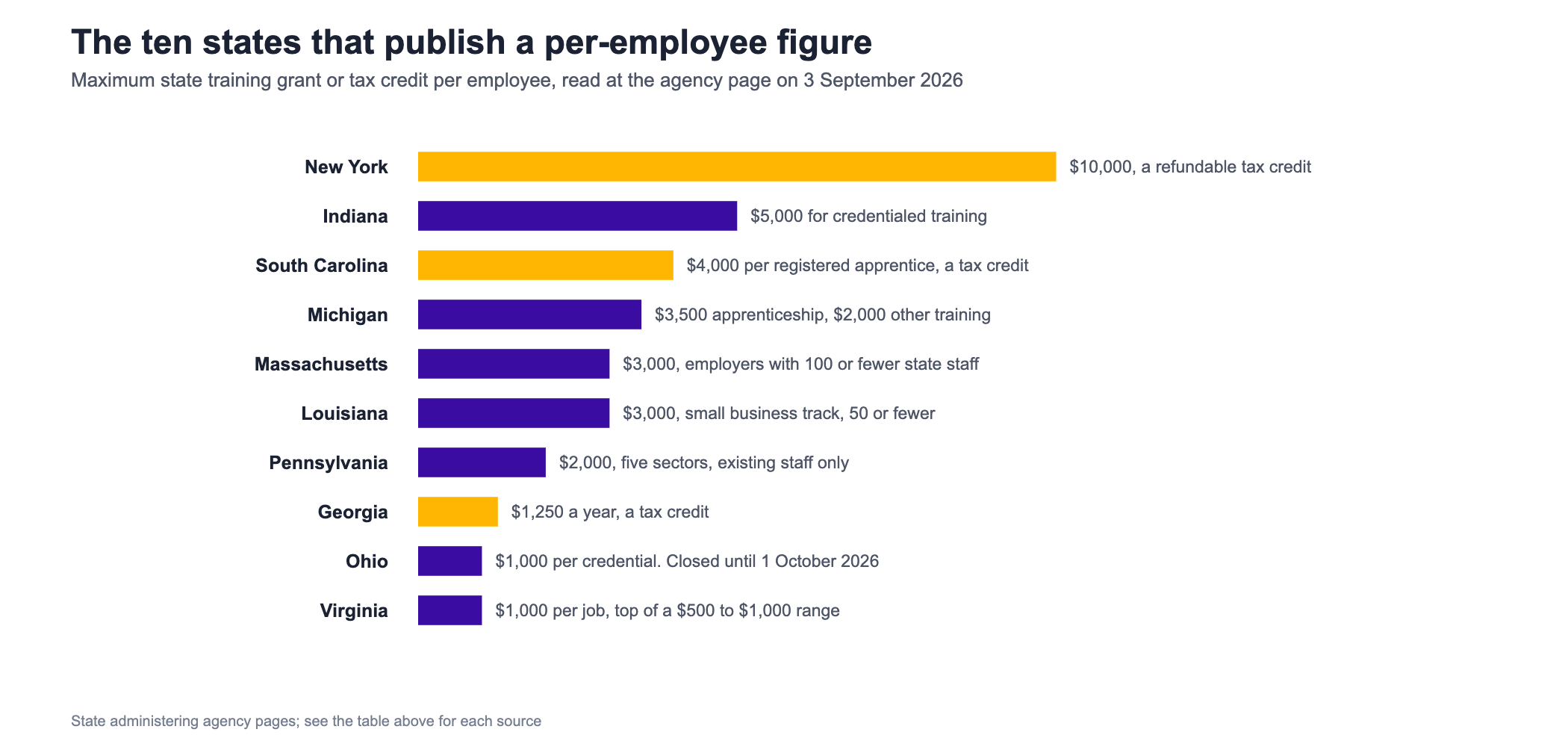
State money is where the larger numbers are, and where published figures go stale fastest. All twenty below were read at the administering agency page on 3 September 2026. Two things before the table. Several of the best-known programs are not reimbursements at all: Alabama, South Carolina, North Carolina and Georgia Quick Start deliver training as a free service. And several are closed right now, which aggregator pages rarely mention.
| State | Program | What it pays | Cap | Status on 3 Sept 2026 |
|---|---|---|---|---|
| California | Employment Training Panel | Fixed hourly reimbursement, $24 standard, $28 small business and new hire | $650,000 per employer | Open, FY26/27 from 1 May 2026 |
| Michigan | Going PRO Talent Fund | $2,000 a person, $3,500 for registered apprenticeship | $250,000 per site a year | Cycle 2 closed; collaboratives rolling |
| New Jersey | UPSKILL incumbent worker grant | 50% reimbursement, existing staff only, six months service | $250,000 per applicant | Open, letter of intent 23 Sept, application 28 Oct |
| Wisconsin | Fast Forward standard grant | Training cost with a 50% cash or in-kind match | $5,000 to $400,000 | Open then; applications closed October 5, 2026 |
| Illinois | Employer Training Investment Program | Up to 50% with a 50% match; requires an active state agreement | $150,000 to $10m | Rolling until funds exhausted |
| Minnesota | Job Training Incentive Program | Direct training cost including trainee wages during OJT | $200,000 per business | Rolling; Greater Minnesota, new jobs only |
| Florida | Incumbent Worker Training | 50% of direct cost, 75% at 25 employees or fewer or in a rural or distressed area | $100,000 per employer | Open; figures still show FY25/26 |
| Pennsylvania | WEDnetPA | $2,000 an employee, five sectors only, existing staff, $17.31/hr wage floor | $50,000 per company a year | Opened 1 August 2026 |
| Indiana | Employer Training Grant | $5,000 an employee for credentialed training, $1,000 company-specific | $50,000 per employer a year | FY26 figures; FY27 round not posted |
| Ohio | TechCred | $1,000 an employee per credential earned | $30,000 per employer per round | Closed then. Round open October 1 to 30, 2026 |
| Massachusetts | Workforce Training Fund, Express | Up to 100%, $3,000 an employee per course, 100 or fewer state employees | $15,000 per company a year | Open, expanded 1 April 2026 |
| New York | Employee Training Incentive Program | A refundable tax credit, 50% of eligible cost; capital investment required | $10,000 an employee | Rolling. The labor department grant tracks are closed |
| Louisiana | Incumbent Worker Training, small business track | Tuition and required texts; 50 employees or fewer, three years in business | $3,000 a trainee a year | Rolling |
| Virginia | Virginia Jobs Investment Program | Training and recruiting costs, thresholds on jobs and investment | $500 to $1,000 per job | Ongoing |
| South Carolina | readySC and the apprentice credit | Training delivered at minimal or no cost; credit for registered apprentices | $4,000 an apprentice, $6,000 youth | Ongoing; $5m statewide credit cap |
| Georgia | Retraining tax credit (Quick Start is free delivery) | 50% of direct retraining cost, $500 an employee per approved program | $1,250 an employee a year | Ongoing |
| Kansas | Kansas Industrial Training and Retraining | Instructor pay, curriculum, materials and travel; $500 application fee | No published rate or cap | Year round |
| Texas | Skills Development Fund | Grant goes to the partner community college, not to you | No statutory per-trainee cap | Ongoing |
| North Carolina | NCEdge, formerly Customized Training | Customized and pre-employment training at no additional cost | No published cap | Ongoing |
| Alabama | AIDT | Recruitment, screening, pre-employment and on-the-job training at no cost | No published cap | Ongoing, case by case |
Grants against tax credits, and why one of the two is currently shut
A grant reduces what the training costs you. A tax credit reduces what you owe after the year is over, and only if you owe something. The two are not interchangeable and the timing is completely different. The federal hiring credit is the one most employers know, and as things stand it lapsed on 31 December 2025 and has not been reauthorized, so a 2026 hire generates nothing from it today. There is a filing deadline that keeps running during the lapse regardless, and getting that wrong is the expensive part; we set the whole position out separately on the work opportunity tax credit page rather than repeat it here.
Two state programs in the table are credits rather than grants and behave the same way: New York Employee Training Incentive Program and the Georgia retraining credit both arrive at tax time and are worth nothing without liability. The South Carolina apprentice credit is the same shape. If cash flow is the constraint, a reimbursement beats a credit of the same face value.
What none of this will pay for
Almost universally these programs fund training, not finding people. Advertising and sourcing sit outside the eligible cost list nearly everywhere, and where a state does allow recruiting costs it is unusual enough to name: Virginia Jobs Investment Program is the example in the table above. Alabama and South Carolina fold recruitment and screening into their free service model, which comes to the same thing by another route. Everywhere else the money starts once the person is hired.
The two costs are not the same size. Advertising a skilled trades role runs a median $14.14 an applicant in the Boostpoint 2026 Social Job Advertising Benchmark (middle 50% $7.58 to $21.49, 35 campaigns), and at an assumed 8 percent applicant-to-hire rate that is about $177 of advertising per hire, which no grant will touch. The training that follows can be 50 to 75 percent funded. The tool below puts the two side by side.
Recruiting cost against training reimbursement
How to actually reach the people who hold the money
All the federal money and much of the state money is administered locally by a workforce development board, and there is no national application form. The Department of Labor runs a locator for American Job Centers at careeronestop.org, and the legacy shortcut servicelocator.org redirects into the same tool; the department also publishes a help line on 1-877-US-2JOBS. Call before you hire, not after. An OJT contract must be agreed with the board before the participant starts, which is a common way employers disqualify themselves from money they would have had. The related pages here are apprenticeship recruiting for the grow-track side of this, and the construction labor shortage for why replacement hiring, not growth, is what you are actually funding.
Frequently asked questions
What is WIOA on the job training?
It is an arrangement under the Workforce Innovation and Opportunity Act in which an employer hires a participant and is reimbursed a share of that person’s wage during the training period. Under 29 U.S.C. 3102(44)(B) the reimbursement is up to 50 percent of the wage rate, and 20 CFR 680.720 allows up to 75 percent under the criteria at 680.730. It is arranged through the local workforce board before the person starts.
Do I have to prove what the training cost me?
For on the job training, no. 20 CFR 680.720(a) says the payments are deemed to be compensation for the extraordinary costs of training and for the lower productivity of a trainee, and 680.720(c) states that employers are not required to document such extraordinary costs. Incumbent worker training is different: there you are matching a real training cost, though the match can be met with wages you already pay.
Can a small employer apply?
Yes, and the rules favor smaller employers in two specific places. The employer match for incumbent worker training is a minimum of 10 percent at 50 employees or fewer, against 50 percent above 100 employees. And when a board decides whether to raise on the job training reimbursement from 50 to 75 percent, 20 CFR 680.730 directs it to weigh the size of the employer with an emphasis on small businesses.
What is the difference between a grant and a tax credit?
A grant or reimbursement reduces the cash the training costs you, usually within the program year. A credit reduces tax owed after the year closes and is worth nothing to an employer with no liability. In the table above, New York and Georgia are credits and the rest are grants or free service delivery. If cash flow is your constraint, a reimbursement beats a credit of the same face value.
Is there federal money for running an apprenticeship?
Not directly to the employer. 29 CFR part 29 sets registration and labor standards and contains no funding mechanism; registration is what makes you eligible for other federal purposes rather than a payment in itself. Most federal apprenticeship money goes to states, intermediaries and community organizations. The route that reaches an employer is an on the job training contract with the local board, which 20 CFR 680.740 expressly permits for the on the job portion of a registered apprenticeship.
How long does approval take?
It varies by board and program and no national figure exists, so we will not invent one. What we can tell you is the shape of the calendar. State programs run in rounds with hard dates: Ohio TechCred runs from October 1 to 30, 2026, New Jersey UPSKILL closes on October 28, 2026, and the latest Wisconsin Fast Forward round closed on October 5, 2026. Federal on the job training runs on your timetable rather than a round, but the contract must be in place before the participant starts work.
Will a grant cover my recruiting or advertising costs?
Usually not. These programs fund training rather than sourcing, and advertising is outside the eligible cost list in almost every one. The Virginia Jobs Investment Program is the notable exception in the table above, reimbursing recruiting alongside training. Alabama and South Carolina achieve something similar by delivering recruitment and screening as a free service rather than reimbursing you for it.
Where do I apply?
Federal money goes through your local workforce development board, which you can find with the Department of Labor’s American Job Center locator at careeronestop.org or by calling 1-877-US-2JOBS. State programs are applied for at the administering state agency, and in Michigan through a local Michigan Works agency rather than the state directly. There is no single national application, and no fee to apply for the federal programs.
The grant pays for the training. We handle the part before it.
Workforce money starts once somebody is hired. Getting them to apply is the bit you fund yourself, and it is the bit we do: the ad, the audience, and a form short enough to finish on a phone.
Book a Demo