
Employer guideUpdated September 2026
WOTC Tax Credit: It Lapsed on December 31, 2025, and You Should Still Screen
The Work Opportunity Tax Credit expired on December 31, 2025 and has not been reauthorized. Read at source today, the Department of Labor page that administers it and the IRS page that explains it both still say the credit is authorized only until that date. An employer who hired somebody in 2026 cannot claim it right now. The reason to keep screening anyway is the deadline: Form 8850 must reach the state workforce agency within 28 calendar days of the start date, and if Congress revives the credit retroactively, as it has done after previous lapses, that window will already have closed on every hire you did not screen.
What the government pages actually say today
Two federal pages carry the operative statements, and they agree with each other.
| Source | What it says | Read |
|---|---|---|
| U.S. Department of Labor, Employment and Training Administration | “WOTC is authorized until December 31, 2025 (Section 113 of Division EE of P.L. 116-260 — Consolidated Appropriations Act, 2021).” | September 2, 2026 |
| Internal Revenue Service | “The Consolidated Appropriations Act, 2021 … authorized the extension of the WOTC until December 31, 2025.” Page last reviewed or updated July 20, 2026. | September 2, 2026 |
That is 271 days of lapse as of September 29, 2026, and it is the single most important thing about the credit right now. Every article telling you how to claim WOTC on a 2026 hire is describing something you cannot currently do, though the training-side money is unaffected: our workforce development grants page covers WIOA on-the-job training, which reimburses up to 75 percent of a new hire wage.
What still works
Wages paid during 2026 to somebody hired on or before December 31, 2025 can still generate credit, because eligibility attaches to the hire date rather than the wage date. If you certified people in 2025 and they are still on the payroll, that part of the credit is unaffected by the lapse.
What the WOTC is, for anyone arriving cold
The Work Opportunity Tax Credit is a federal income tax credit for employers who hire people from ten groups that have historically had a hard time getting hired. It is claimed against the employer's tax, not the employee's; it is worth a percentage of first-year wages up to a cap that varies by group; and it depends entirely on a certification the employer requests from a state workforce agency within 28 calendar days of the person's start date. Everything else about it — the amounts, the hours thresholds, the paperwork — hangs off that certification.
The ten target groups, as the IRS names them
- Qualified IV-A recipient — someone in a family receiving Temporary Assistance for Needy Families
- Qualified veteran
- Qualified ex-felon
- Designated community resident — an 18-to-39-year-old living in an empowerment zone or rural renewal county
- Vocational rehabilitation referral
- Qualified summer youth employee
- Qualified SNAP benefits recipient
- Qualified Supplemental Security Income recipient
- Long-term family assistance recipient
- Qualified long-term unemployment recipient
Several of these describe a large share of a frontline applicant pool, which is why the credit matters more to a senior living operator or a warehouse than it does to an office employer — and why the screening habit is worth keeping even while the credit is lapsed.
The forms, in the order they happen
- IRS Form 8850, the Pre-Screening Notice and Certification Request, signed by the applicant on or before the day a job offer is made and filed with the state workforce agency within 28 calendar days of the start date.
- ETA Form 9061, the Individual Characteristics Form, filed alongside it — or ETA Form 9062 where the applicant already holds a conditional certification.
- IRS Form 5884 and Form 3800 with the business tax return, once the certification comes back. Tax-exempt employers hiring qualified veterans use Form 5884-C instead.
A qualified veteran is the group with the largest ceiling: up to $24,000 in wages can be taken into account for certain veterans, against $6,000 for most other groups. The section below sets out what that is worth once the hours thresholds are applied.
The 28-day trap
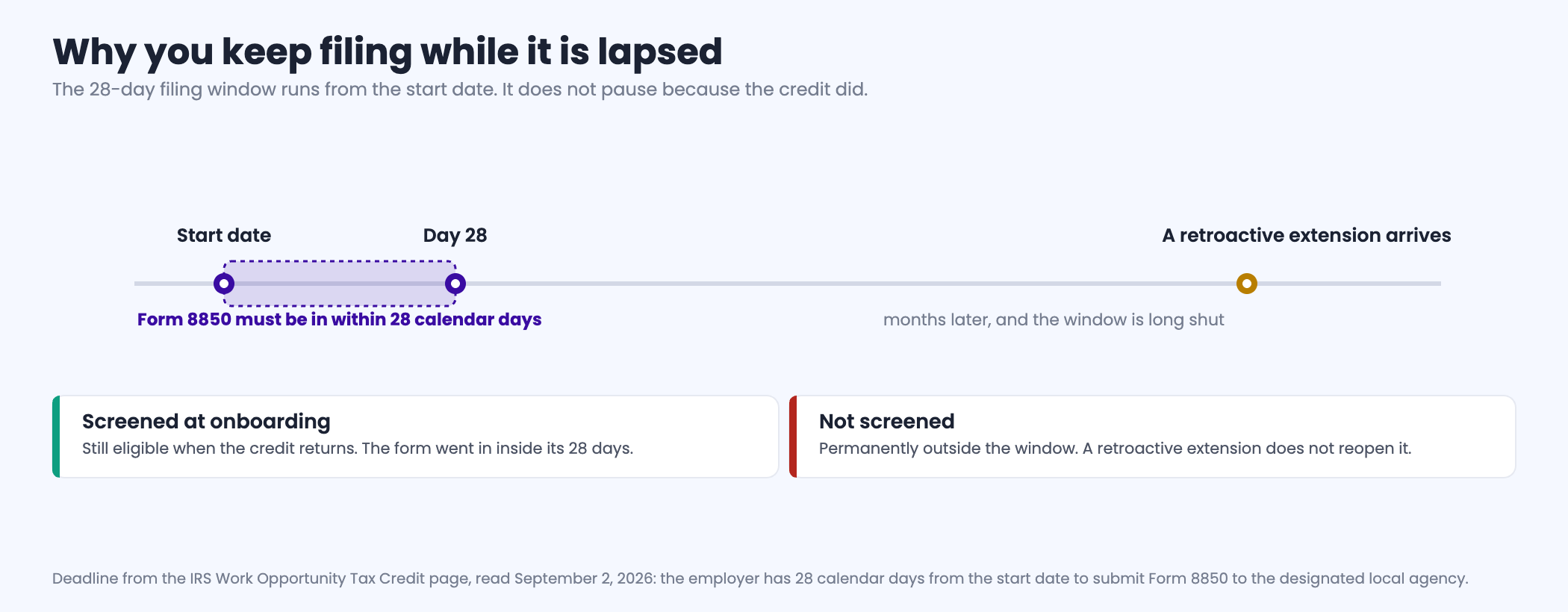
This is the part that decides whether a lapse costs you anything. Certification is not something you can do later. The employer has 28 calendar days from the new employee’s start date to submit Form 8850 to the designated local agency. That clock runs on its own schedule and takes no notice of whether the credit is currently authorized.
So consider what happens if Congress revives the credit retroactively, which is what has happened after previous lapses. On the day the extension passes, every 2026 hire you screened is still eligible, because the form went in inside its 28 days. Every 2026 hire you did not screen is gone, permanently, because you cannot go back and file inside a window that closed months ago. The employer who stopped screening in January did not save anything; they wrote off a credit that had not been decided yet.
Work out which windows are still open
What it is worth when it comes back
Worth knowing, because it is the number that decides whether screening is worth the friction it adds to onboarding.
| Hours worked | Rate | Wages counted | Maximum credit |
|---|---|---|---|
| Fewer than 120 | — | — | Nothing |
| At least 120, fewer than 400 | 25% | Up to $6,000 of first-year wages | $1,500 |
| 400 or more | 40% | Up to $6,000 of first-year wages | $2,400 |
| 400 or more, certain qualified veterans | 40% | Up to $24,000 of first-year wages | $9,600 |
The ten targeted groups, named as the IRS names them, are the qualified IV-A recipient, qualified veteran, qualified ex-felon, designated community resident, vocational rehabilitation referral, qualified summer youth employee, qualified SNAP benefits recipient, qualified SSI recipient, long-term family assistance recipient, and qualified long-term unemployment recipient. Certification of group membership has to come from the state workforce agency before anything is claimed.
The 400-hour line is where frontline employers lose most of it
Look again at the hours column, because it is doing more work than the group list. Four hundred hours is ten weeks of full-time work, or sixteen weeks for somebody on twenty-five hours. One hundred and twenty hours is three weeks full-time. Between those two lines sits a $900 difference per person, and below the lower one the credit is zero.
The credit is not the only federal instrument attached to a hire from a targeted group. The Federal Bonding Program covers a different risk — employee theft, for six months, at no cost — and the two stack rather than compete.
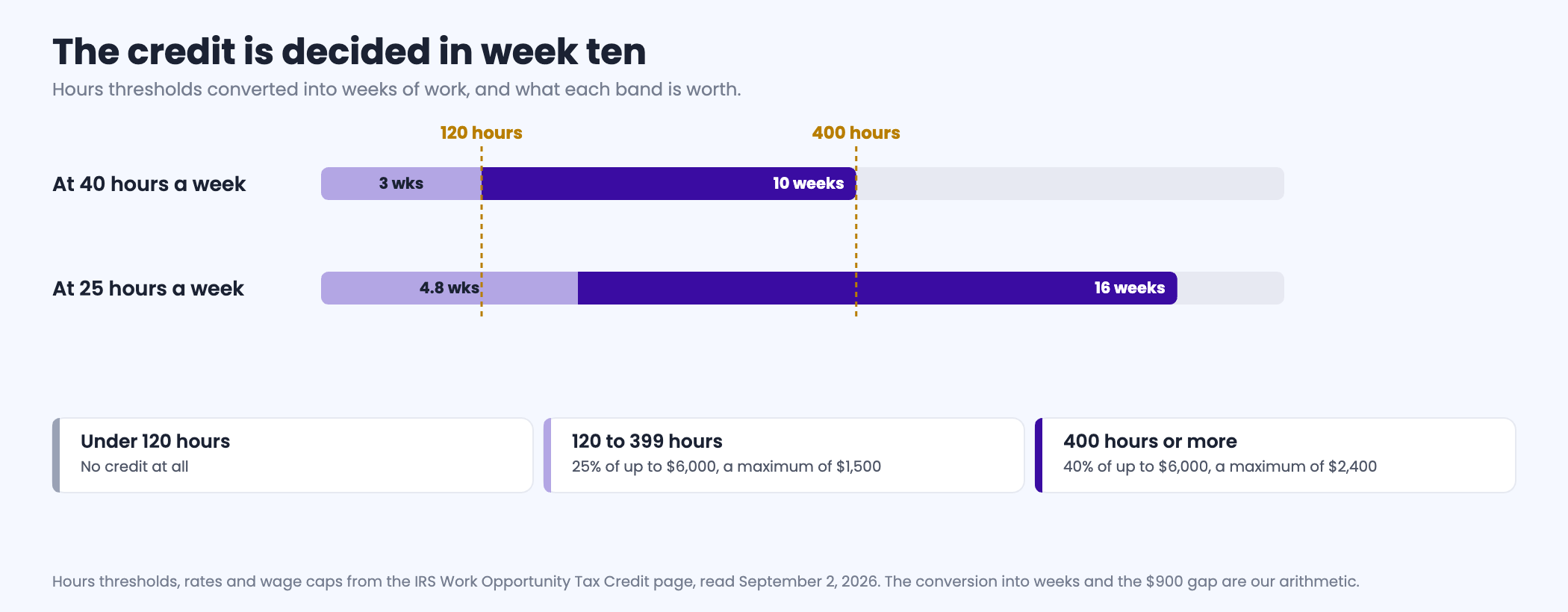
That makes the credit, for a high-turnover operation, less a hiring incentive than a retention one. Screening costs you a form at onboarding. Reaching hour 400 costs you a person who is still there in week ten. If your ninety-day attrition is heavy, a meaningful share of the people you certify will land in the 25% band or below it, and the difference between the number on the spreadsheet and the number on the return will be entirely explained by who stayed.
What is actually at stake across a hiring year
Tax credit for hiring felons: the WOTC ex-felon group
The federal tax credit for hiring felons is not a separate program. It is one of the ten WOTC target groups, the qualified ex-felon, and it rises and falls with the rest of the credit. That means it lapsed on December 31, 2025 along with everything else on this page, and as of September 23, 2026 the Department of Labor and IRS pages still carry that date and neither announces an extension. Bills introduced in this Congress to extend and change the credit, among them H.R. 6231 and S. 3265, were still in committee at their last recorded action.
When it is authorized, the rules for this group are narrow in one way that matters more than the dollar figure:
- Who qualifies. Someone convicted of a felony under any federal or state statute and hired not more than one year after the conviction or after release from prison for that felony. A person whose conviction or release was longer ago than that is not in the group, however hard they are finding it to get hired.
- What it is worth. The standard rate: 40% of up to $6,000 of first-year wages at 400 hours or more, a maximum of $2,400, or 25% at 120 to 399 hours.
- The paperwork. Form 8850 completed no later than the day the job offer is made, and filed with the state workforce agency within 28 calendar days of the start date. The state agency certifies group membership; the employer cannot.
So the one-year window does the filtering. Screening for it is the same Form 8850 every other group uses, which is why the advice below applies unchanged: keep screening, because a retroactive revival would reward only the hires whose forms went in on time. States vary in how they are treating those forms now; South Dakota, for example, is accepting new applications with 2026 hire dates but says final certifications or denials cannot be issued until the program is reauthorized.
The other federal instrument for this hire is still running. The Federal Bonding Program issues a free bond, with a $5,000 limit, covering the first six months of employment, and it does not depend on the WOTC. Before you screen for either, check your state and city rules on when you may ask about a conviction at all: our guide to ban the box laws by state covers that.
What to do while it is lapsed
| Do | Because |
|---|---|
| Keep running Form 8850 at onboarding for every new hire | The 28-day window is the only irreversible part. Screening preserves the option; not screening closes it. |
| Ask your state workforce agency how it is handling submissions during the lapse | Practice differs. Some accept and hold, some decline to certify until the credit returns, and you want to know which before you rely on a filed form. |
| Keep 2025 certifications and wage records | Wages paid in 2026 to somebody hired on or before December 31, 2025 still count. That part is live. |
| Do not budget 2026 hires as credit-bearing | There is no credit to claim for them under current law, and forecasting one is how a finance team ends up with a hole. |
| Do not pay anybody a percentage of a credit that does not exist | Contingency-fee WOTC processing is priced on captured credit. During a lapse there is nothing to capture, and the screening itself is a form. |
Other tax credits and hiring incentives for employers
With the WOTC lapsed, the hiring incentives that are still live are mostly not tax credits. Three are worth knowing about, and none of them depends on Congress reviving anything.
- WIOA on-the-job training reimbursement. Under 20 CFR 680.720, “employers may be reimbursed up to 50 percent of the wage rate of an OJT participant” to cover the extra cost of training and supervision, and up to 75 percent where the local workforce board applies the criteria in the next section of the regulation. It is arranged through your local workforce board or American Job Center before the hire, not claimed afterwards. Our workforce development grants page covers how to apply.
- The Federal Bonding Program. A free fidelity bond, $5,000 with no deductible, covering the first six months of employment for applicants whose background is a barrier to being hired, including justice-involved people, people in recovery from substance use disorders and people with poor credit records, per the program’s administrator working under contract with the Department of Labor. It protects against theft and dishonesty, and it stacks with the WOTC if the credit returns. Detail on our Federal Bonding Program page.
- State hiring credits. Many states run their own credits for hiring in particular areas or from particular groups. They are separate statutes from the WOTC and do not lapse with it, but the terms, caps and pre-hire paperwork differ state by state. Ask your state revenue or economic development agency before you rely on one.
For skilled trades, registered apprenticeship is often the route those programs fund; see apprenticeship recruiting. For veterans, the WOTC group with the largest wage ceiling, hiring veterans covers the programs that exist outside the credit.
Where our own numbers stop
We can tell you what it costs to put an ad in front of the people this credit exists to reach. Across the 891 campaigns in our 2026 social job advertising benchmark the median campaign delivered an applicant for $13.88, with caregiver and home care roles at $3.76 and warehouse and production at $9.83. Set the $2,400 maximum credit against a cost per applicant in that range and the arithmetic is obviously favorable — which is exactly why it is worth being precise that there is currently no credit, rather than quietly assuming there will be.
What we have no data on at all is certification rates, how many of our customers’ hires fall into a targeted group, or how many reach four hundred hours. We are not going to estimate any of those. The retention half of the question is the one we have written about honestly elsewhere, in first 90 days turnover and the turnover cost calculator, and it is the half that decides how much of this credit an employer actually collects when it returns.
For the eligibility side in detail — the ten targeted groups, the per-category wage limits, and what each hire is actually worth — see our guide to WOTC eligibility.
Frequently asked questions
What is the WOTC?
The Work Opportunity Tax Credit, a federal income tax credit for employers who hire someone from one of ten target groups that face barriers to employment. It is claimed by the employer against its own tax liability, is worth a percentage of the person's first-year wages up to a group-specific cap, and requires a certification requested from a state workforce agency within 28 calendar days of the start date.
What is WOTC screening?
Asking a new hire the questions on IRS Form 8850 so you can tell whether they fall into a target group, and getting their signature on or before the day the job offer is made. It is a compliance step with a deadline rather than an interview stage, and it is the step that is lost first when the credit lapses.
Which forms do you file for the WOTC?
IRS Form 8850 goes to the state workforce agency within 28 calendar days of the start date, accompanied by ETA Form 9061, or ETA Form 9062 if the applicant already holds a conditional certification. Once the certification is issued, taxable employers claim the credit on IRS Form 5884 and Form 3800 with the business return; tax-exempt employers hiring qualified veterans use Form 5884-C.
Is the WOTC tax credit still available in 2026?
Not for new hires. The Work Opportunity Tax Credit was authorized only until December 31, 2025, and as of September 29, 2026 it has not been reauthorized. The Department of Labor page that administers the program and the IRS page that explains it both still carry the 2025 date, and the IRS page was last reviewed on July 20, 2026. Wages paid in 2026 to someone hired on or before December 31, 2025 can still generate credit.
Should I keep filing Form 8850 during the lapse?
Yes, and this is the practical point of the whole situation. The employer has 28 calendar days from an employee start date to submit Form 8850 to the designated local agency, and that window is not suspended because the credit is. If Congress revives the credit retroactively, hires you screened remain eligible and hires you did not are permanently outside the window. Ask your state workforce agency whether it is accepting and holding submissions or declining to certify until reauthorization.
How much is the WOTC worth per employee?
For the standard targeted groups, 40% of up to $6,000 of qualified first-year wages, a maximum of $2,400, where the employee works at least 400 hours. Where the employee works at least 120 but fewer than 400 hours the rate drops to 25%, a maximum of $1,500. Up to $24,000 of wages may be counted for certain qualified veterans, which at 40% works out to $9,600. Below 120 hours there is no credit.
How many hours does an employee need to work?
At least 120 for any credit at all, and 400 for the full rate. Four hundred hours is ten weeks of full-time work, or sixteen weeks for someone on twenty-five hours a week. The gap between the two bands is $900 per person for the standard groups, and for a high-turnover operation it is decided almost entirely by how many new hires are still there in week ten rather than by anything about the screening.
Who counts as a targeted group?
The IRS names ten: qualified IV-A recipient, qualified veteran, qualified ex-felon, designated community resident, vocational rehabilitation referral, qualified summer youth employee, qualified SNAP benefits recipient, qualified SSI recipient, long-term family assistance recipient, and qualified long-term unemployment recipient. Membership has to be certified by the state workforce agency before an employer claims anything; the employer cannot self-certify.
What happens to hires I already screened in 2026?
Their paperwork is in on time, which is the part you cannot fix later. Whether the certification is issued depends on how your state workforce agency is handling submissions during the lapse: some accept and hold them, others decline to certify until the credit is reauthorized. If a retroactive extension passes, those hires are the ones that can be claimed, because the 28-day filing requirement was met when it mattered.
Can I still claim WOTC for someone hired in 2025?
Yes, subject to the ordinary rules, because eligibility attaches to the hire date rather than the date wages are paid. Someone hired on or before December 31, 2025 and certified through the usual process can generate credit on qualified first-year wages, including wages paid during 2026. Keep the certifications and the wage records for those employees separate from your 2026 hiring, which is in a different position entirely.
Should I budget 2026 hires as credit-bearing?
No. Under current law there is no credit to claim for a 2026 hire, and building one into a hiring budget creates a hole if reauthorization does not arrive or arrives without retroactive effect. Treat any future extension as upside rather than as plan. The cost of preserving that upside is a form at onboarding, which is small enough that it does not need to appear in the budget at all.
Do companies get tax breaks for hiring felons?
Federally, only through the Work Opportunity Tax Credit, and that credit lapsed on December 31, 2025 and has not been reauthorized as of September 2026. When it is live, an employer can claim up to $2,400 for hiring a qualified ex-felon, meaning someone hired within one year of a felony conviction or of release from prison for it, who works at least 400 hours. The Form 8850 still has to be filed within 28 calendar days of the start date, so employers who want the credit if Congress revives it retroactively should keep screening. The Federal Bonding Program, which is not a tax break, remains available.
What tax credits are there for hiring employees?
At the federal level, the main one is the Work Opportunity Tax Credit, and it lapsed on December 31, 2025; the DOL page still says it “is authorized until December 31, 2025” as of September 24, 2026. Keep filing Form 8850 within 28 days of each start date in case it returns retroactively. Meanwhile the live federal incentives are not tax credits: WIOA on-the-job training reimbursement of up to 50 percent of wages (up to 75 percent in some cases) and the free Federal Bonding Program. Many states also offer their own hiring credits.
Has WOTC been extended for 2026?
Not as of September 28, 2026. The statute still ends the credit for new hires: 26 U.S.C. 51(c)(4), in the official U.S. Code text current through Public Law 119-111, excludes wages paid to anyone who begins work after December 31, 2025, and the IRS WOTC page still limits the credit to individuals who begin work on or before that date. Extension bills such as H.R. 6231 and S. 3265 were still in committee. Wages paid to people hired before 2026 still count; for 2026 hires, keep filing Form 8850 within 28 days in case an extension is retroactive.
The credit is uncertain. The cost per applicant is not.
Bring the roles you are filling and the markets you are filling them in. We will show you what applicant flow actually costs there, so the hiring plan stands up whether or not the credit comes back.
Book a Demo




Two neighboring rules worth knowing before you budget a role: our guide to on-call pay laws explains when on-call hours count as hours worked for minimum wage and overtime, and our guide to pre-screening questions covers what you may and may not ask before a conditional offer.