
Hiring Veterans: The Federal Programs, What Each Requires, and What Ads Can't Do
There are three federal mechanisms worth an employer's time — the HIRE Vets Medallion Award, DoD SkillBridge and the Work Opportunity Tax Credit — and they work in completely different ways: one is recognition you earn, one is a pipeline you host, one is a credit you claim per hire. One of them may not currently be authorized. And none of them solves reach, because employment advertising cannot be targeted by veteran status at all.
A note on who's writing this
Boostpoint runs recruitment advertising, and the honest position on this topic is that advertising is the smaller half of veteran hiring. Every program fact below comes from the agency that administers it — hirevets.gov, skillbridge.osd.mil, dol.gov and irs.gov — read on 28 August 2026 and quoted rather than summarized where the wording carries weight. Where a site does not publish something, this page says so instead of filling the gap. This is not legal or tax advice, and one point below in particular needs your accountant rather than us.
The population you are actually hiring from
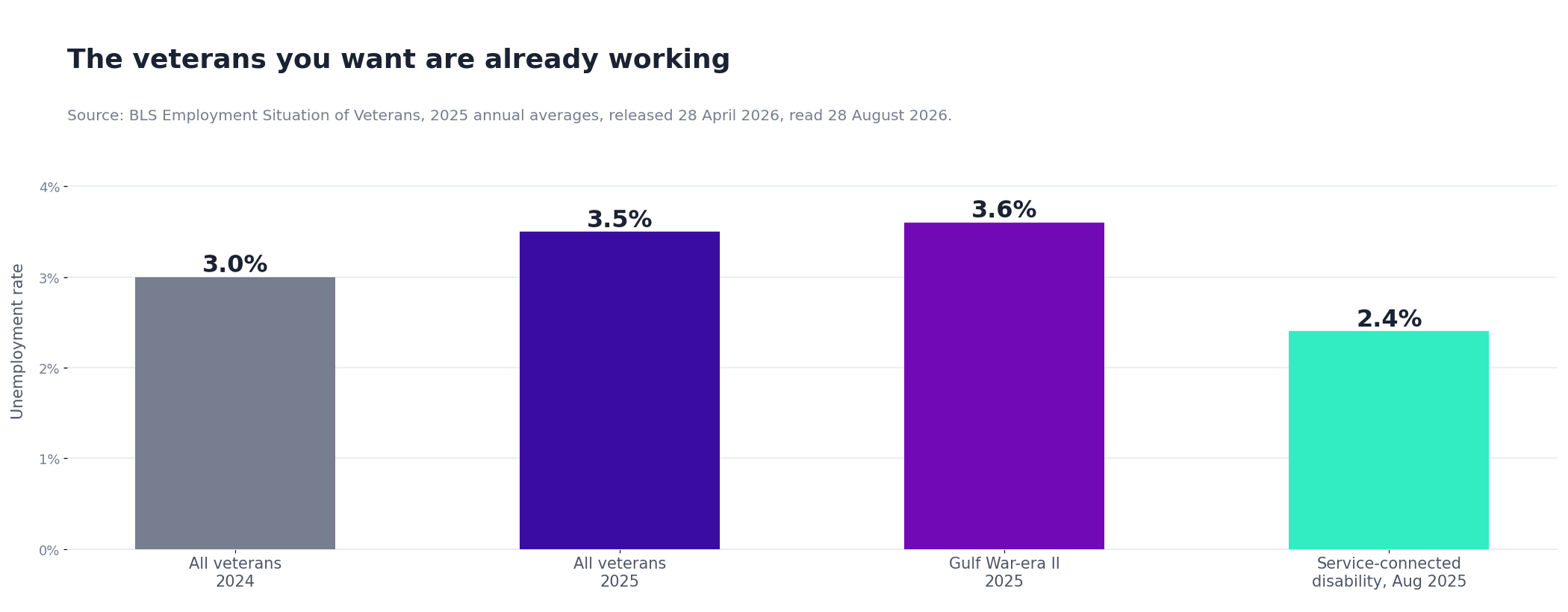
The Bureau of Labor Statistics counted 17.3 million veterans in 2025, about 7% of the civilian noninstitutional population aged 18 and over. Their unemployment rate rose over the year from 3.0% to 3.5%. Veterans who served since September 2001 — the Gulf War-era II cohort, the one most employers mean — were at 3.6%, little changed. Veterans with a service-connected disability were at 2.4% as of August 2025, down 1.7 percentage points over the year.
Read those numbers before designing a program. A 3.5% unemployment rate means the veterans you want are overwhelmingly already working. This is not an underemployed pool waiting to be discovered; it is a competitive one, and your offer has to beat the job they already have rather than an absence of options.
The three programs, and how differently they work
| Program | What it actually is | What it asks of you |
|---|---|---|
| HIRE Vets Medallion Award | Recognition, not money. The Department of Labor calls it "the only federal-level veterans' employment award that recognizes a company or organization's commitment to veteran hiring, retention, and professional development", established under the HIRE Vets Act of 2017. | Hitting published thresholds on veteran hiring share and retention, plus integration-assistance programs, then applying and paying a fee. |
| DoD SkillBridge | A pipeline. Service members with "180 days or fewer of service remaining prior to their date of military discharge" do civilian work experience with a participating employer. | A memorandum of understanding with DoD and the administrative lead time to get through a structured application enrollment period. No hiring percentage, no size gate. |
| Work Opportunity Tax Credit | Money, claimed per qualifying hire against your federal tax. Five veteran categories qualify. | Certification before you can claim, and IRS Form 8850 filed within 28 calendar days of the employee's start date. See the authorization warning below. |
HIRE Vets Medallion: the thresholds, stated plainly
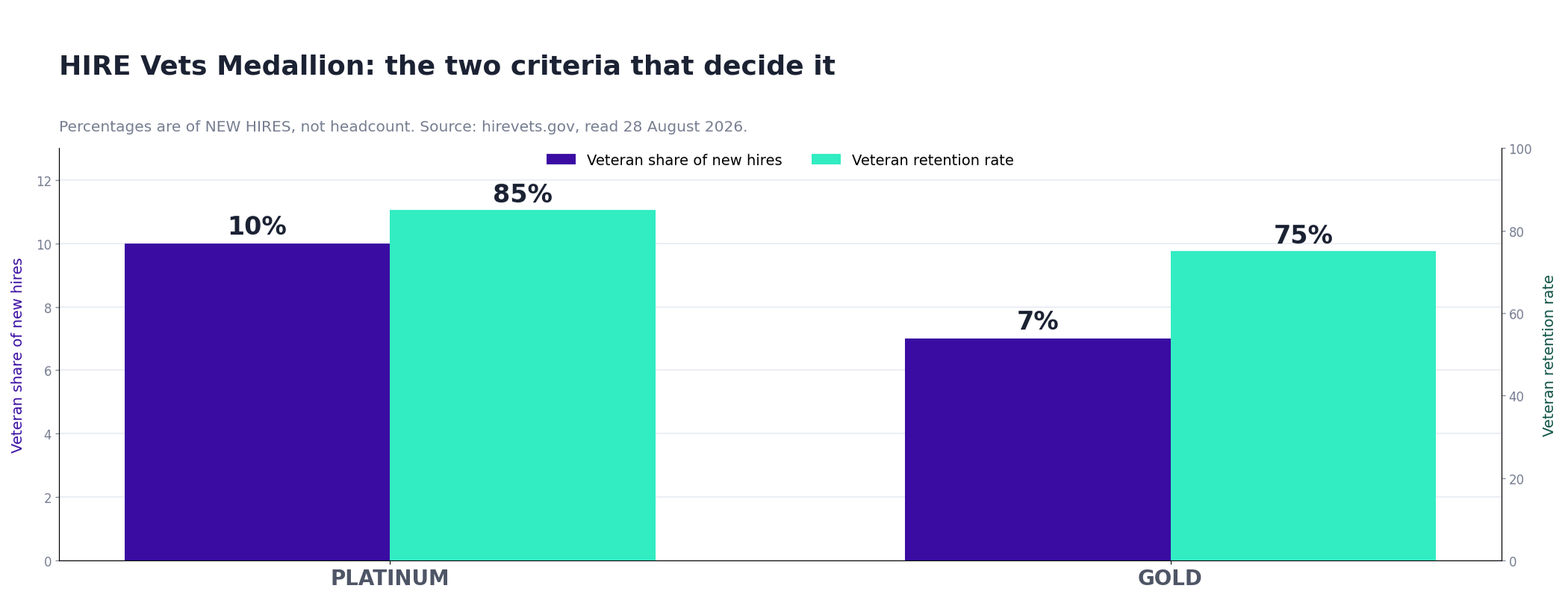
The award has two levels across three employer size bands — small (1–50 employees), medium (51–499) and large (500+). The criteria that decide it are a veteran share of new hires and a veteran retention rate: Platinum asks for 10% veteran new hires and 85% retention; Gold asks for 7% and 75%, alongside integration-assistance requirements that vary by size band. Application fees run from $120 for small employers to $640 for large ones.
Two practical notes. First, the percentages are of new hires, not of headcount, which makes the award far more reachable for a high-turnover frontline employer than for a stable one — if you hire 200 people a year, Gold is 14 veteran hires. Second, when we read hirevets.gov on 28 August 2026 the application-window text still referred to the 2025 award cycle, so confirm the current cycle's dates before you build a plan around them.
Work out where you stand
Enter your own numbers. The planner does the threshold arithmetic against the published federal criteria and tells you the gap in hires rather than in percentage points, which is the number you can actually act on.
Sets your HIRE Vets size band
All new hires, not headcount
How many of those were veterans
The Work Opportunity Tax Credit — and the thing to check first
Five veteran categories qualify, and the IRS defines them precisely: veterans in families receiving SNAP benefits for at least three months in the fifteen months before hire; veterans unemployed for at least four weeks but less than six months in the year before hire; veterans unemployed at least six months in that year; veterans entitled to compensation for a service-connected disability hired within a year of discharge; and veterans entitled to that compensation who were unemployed at least six months in the year before hire.
The general credit is 40% of up to $6,000 of first-year wages, a maximum of roughly $2,400 per qualifying hire, with a reduced 25% rate for employees who work at least 120 but fewer than 400 hours. For certain qualified veterans, up to $24,000 of wages may be taken into account. You must obtain certification that the hire belongs to a targeted group before claiming, and Form 8850 goes in within 28 calendar days of the start date — a deadline that catches more employers than any other part of the program.
Check this before you plan around it. Both the Department of Labor's WOTC page and the IRS page, read on 28 August 2026, still state that the credit is authorized through 31 December 2025. We are not in a position to tell you whether it has since been extended, and neither is any evergreen blog post that quotes the credit as current. Ask your tax adviser what the authorization status is before you build a hiring plan on it. This is not tax advice.

One thing has changed since the section above was written: the credit itself lapsed on December 31, 2025 and has not been reauthorized. Our page on the WOTC tax credit sets out where that leaves a 2026 hire, and why Form 8850 is still worth filing.
Military spouse hiring: the programs and the tax credit
Military spouse hiring is its own problem, and none of the three veteran programs above covers it. The Department of Defense's 2024 Survey of Active Duty Spouses counts 561,008 active duty spouses and puts the civilian spouse unemployment rate at 20%, on the survey's own measure. The same survey found that a permanent change of station (PCS) move in the past 12 months more than doubled the odds that a civilian spouse was unemployed, and that 28% of spouses had to acquire a new professional license or credential to work after their last move.
| Mechanism | What it is | What it means for you |
|---|---|---|
| Military Spouse Employer Partnership (MSEP) | Part of the SpouseWorks program (formerly SECO) on Military OneSource. It connects spouses to "more than 1,000 employer partners" who have committed to "recruiting, hiring, promoting and retaining military spouses." | A job board and partner network, not money. The public pages we read do not publish partnership criteria, so ask the program directly before planning around it. |
| License portability, 50 U.S.C. 4025a | A spouse whose license is in good standing and who relocates because of military orders can have it treated as valid in the new state after applying with the orders, a marriage certificate and a notarized affidavit. If the board cannot act within 30 days, it may issue a temporary license. | For nursing and other licensed roles, a spouse arriving from another state may be hireable sooner than your usual transfer timeline. Licenses held under an interstate compact follow the compact instead. Confirm with your state board. |
| Work Opportunity Tax Credit | Military spouses are not a WOTC targeted group, and the IRS page (last reviewed July 20, 2026) says the credit is available for individuals who begin work on or before December 31, 2025. | There is no federal tax credit for hiring a military spouse today. The Military Spouse Hiring Act (S. 1027 and H.R. 2033), which would add "a qualified military spouse" to the credit, was introduced in March 2025 and referred to committee, with no further action recorded. |
The advertising limit is the same as for veterans: you cannot target spouses on Meta. What works is saying the things a spouse is scanning for. State that you hire people mid-move and will work around a PCS date, that you accept an out-of-state license under the portability law where your board allows it, and which shifts are fixed. Place campaigns within reach of the installation, and list your openings with MSEP if you become a partner. This is general information, not legal or tax advice.
Where veterans actually cluster, and why it matters to frontline employers
The transferable-skills argument gets made badly. What matters is not that veterans are disciplined; it is that specific military occupational specialties map onto specific civilian roles with almost no retraining. Motor transport operators hold or can convert to commercial driving credentials. Wheeled-vehicle and aviation mechanics arrive with diagnostic experience on heavy equipment. Logistics and supply specialists have run warehouses at scale. Combat medics and corpsmen hold clinical experience that maps toward EMT and patient-care roles, though state licensure remains its own gate.
That maps directly onto the categories where hiring is hardest. If you hire CDL drivers, maintenance technicians or warehouse crews, a veteran-hiring program is not a corporate-responsibility line item — it is a supply strategy for exactly the roles where our own data shows applicants cost the most. In the 2026 benchmark, CDL driver campaigns ran at a $26.86 median cost per applicant with only 8% of clickers completing an application, against $3.76 and 31% for caregivers. Credential-gated roles are expensive because the qualified pool is small; a pipeline that produces credentialed people is worth more than a cheaper ad.
The thing advertising cannot do
This is the part most pages on this subject leave out. Employment advertising on Meta runs under the Special Ad Category, which removes targeting by age, gender and detailed demographic attributes and widens the minimum radius. You cannot target an ad at veterans. There is no audience to buy, and any vendor who implies otherwise is describing something that does not exist. The mechanics are on our Special Ad Category page.
What actually works is unglamorous. The creative does the self-selection — naming the military occupational specialties you can hire directly, saying "we translate your MOS, you don't have to" and stating that you accept military experience in place of civilian years. Placement near installations does geographic work that demographic targeting cannot. And partnerships do the rest: state veteran employment representatives, the transition assistance offices on nearby bases, and SkillBridge itself, which is the only one of the three programs that puts an actual person in your building before they separate. The wider channel logic for roles where the qualified people are not searching is on the best way to recruit.
You cannot buy a veteran audience. You can write an ad only a veteran would answer — and put it where they already are.
A realistic order of operations
- Start with the job description, not the program. Say which military experience substitutes for which civilian requirement, in writing. Our job description templates show where that line belongs, and the generator keeps required and preferred separate — which is where most veteran applicants get screened out.
- Fix the credential-substitution rule before advertising. If your posting says "5 years commercial experience" and your recruiter cannot count eight years of military logistics toward it, no amount of reach helps.
- Pursue SkillBridge if you can host. It is the only mechanism that produces a person rather than a percentage, and it has no size gate — but it needs a memorandum of understanding and an enrollment period, so it is a quarter of lead time, not a week.
- Track veteran hires and retention from day one. Both HIRE Vets levels are measured on data you have to be keeping already. Employers usually discover they qualified two years late.
- Ask your accountant about WOTC status before assuming the credit exists in the current tax year.
Frequently asked questions
What tax credit do you get for hiring a veteran?
The Work Opportunity Tax Credit, where the general rate is 40% of up to $6,000 of first-year wages — roughly $2,400 per qualifying hire — with up to $24,000 of wages counted for certain qualified veterans. Both the DOL and IRS pages we read on 28 August 2026 state the credit is authorized through 31 December 2025, so confirm the current status with your tax adviser. This is not tax advice.
Which veterans qualify for the WOTC?
Five categories, per the IRS: veterans in families receiving SNAP for at least three months in the fifteen months before hire; veterans unemployed at least four weeks but under six months in the prior year; veterans unemployed at least six months in that year; veterans entitled to compensation for a service-connected disability hired within a year of discharge; and those same disabled veterans unemployed at least six months in the prior year.
What is the HIRE Vets Medallion Award?
A Department of Labor recognition established under the HIRE Vets Act of 2017 — described by DOL as the only federal-level veterans' employment award. It has Platinum and Gold levels across small, medium and large employer bands, judged on the veteran share of new hires, veteran retention and integration-assistance programs. Fees run from $120 for small employers to $640 for large ones.
What percentage of hires must be veterans to win it?
Ten percent of new hires for Platinum and seven percent for Gold, alongside retention thresholds of 85% and 75% respectively and integration-assistance requirements that vary by employer size. Because the percentages are of new hires rather than headcount, a high-turnover frontline employer reaches them on far fewer veteran hires than a stable one.
How does DoD SkillBridge work for employers?
Service members with 180 days or fewer remaining before discharge do civilian work experience with a participating employer. There is no company-size requirement and no hiring percentage; the constraint is administrative — a memorandum of understanding with DoD and a structured application enrollment period. The public site does not publish placement duration, who pays the service member, or whether you must hire, so confirm those directly.
Can you target veterans in job ads on Facebook?
No. Employment advertising runs under Meta's Special Ad Category, which removes demographic targeting and widens the minimum radius, and there is no veteran audience to buy. Reach comes from the copy — naming the military specialties you hire directly and the credentials you will substitute — from placing campaigns near installations, and from partnerships with transition assistance offices.
Is there really a benefit to hiring veterans, or is it goodwill?
For frontline employers it is a supply argument. Military occupational specialties in transport, vehicle maintenance and logistics map onto exactly the civilian roles where the qualified pool is smallest and applicants cost the most — CDL driver campaigns in our 2026 benchmark ran at a $26.86 median cost per applicant against $3.76 for caregivers. A pipeline of credentialed people beats a cheaper advertisement.
What is the single biggest mistake employers make here?
Writing a requirements block that military experience cannot satisfy, then advertising harder. If the posting asks for civilian years of experience and nobody is authorized to count service equivalents, veteran applicants are screened out before a human sees them. Fix the substitution rule in the job description first; it costs nothing and it is upstream of every program on this page.
Is there a tax credit for hiring military spouses?
No, not today. Military spouses are not one of the Work Opportunity Tax Credit targeted groups, and the IRS says the credit covers people who begin work on or before December 31, 2025. The Military Spouse Hiring Act (S. 1027 and H.R. 2033) would add military spouses, but as of September 24, 2026 it had only been referred to committee. This is not tax advice.
How do you recruit veterans?
Start with the job, then the channels. Write into the posting which military occupational specialties and experience you accept in place of civilian requirements, and make sure recruiters will actually count it. Then use the free federal routes the Department of Labor lists on its Hire a Veteran page: Regional Veterans' Employment Coordinators, who connect employers with resources; American Job Centers; posting openings on the National Labor Exchange; and DoD SkillBridge if you can host service members before they separate. Add transition assistance offices at nearby installations, and run local job ads near those installations whose copy names the specialties you hire, since you cannot target an ad by veteran status.
Hiring for the roles veterans are qualified for?
We write the ad, build the form and run it where the people you need are already scrolling — then report what each applicant cost.
Methodology and sources, all read 28 August 2026. Veteran population and unemployment: U.S. Bureau of Labor Statistics, Employment Situation of Veterans — 2025 annual averages, released 28 April 2026: 17.3 million veterans and about 7% of the civilian noninstitutional population aged 18 and over; all-veteran unemployment up from 3.0% to 3.5%; Gulf War-era II 3.6%; service-connected disability 2.4% in August 2025, down 1.7 percentage points. HIRE Vets Medallion Award: hirevets.gov — the HIRE Vets Act of 2017, Platinum and Gold levels, small (1–50) / medium (51–499) / large (500+) bands, 10% veteran new hires and 85% retention for Platinum against 7% and 75% for Gold, application fees from $120 for small to $640 for large; the fee for medium employers was not published in what we read, and the application-window text on the site still referred to the 2025 cycle at the time of reading. DoD SkillBridge: skillbridge.osd.mil — eligibility at 180 days or fewer of remaining service, structured application enrollment periods and memorandum-of-understanding requirements; the site does not publish placement duration, service-member compensation or any employer hiring obligation, and this page does not assert them. Work Opportunity Tax Credit: dol.gov Employment and Training Administration and irs.gov — five qualified-veteran categories, 40% of up to $6,000 of first-year wages for a maximum of about $2,400, a 25% rate for at least 120 but fewer than 400 hours, up to $24,000 of wages for certain qualified veterans, certification required before claiming, Form 8850 within 28 calendar days of the start date, and authorization stated as running through 31 December 2025 on both pages as read. This is not legal or tax advice. Boostpoint figures come from the Boostpoint 2026 Social Job Advertising Benchmark — 891 Boostpoint-managed campaigns on Meta across 1,334 campaign-months, advertising costs only: CDL driver median $26.86 per applicant at an 8% apply rate against caregiver $3.76 at 31%. Cost per applicant is not cost per hire; hires are recorded in your applicant tracking system, not in an ad platform. The military-to-civilian skill mappings are our editorial judgment, not a government classification. See the full benchmark report.