
What It Costs to Recruit Skilled Trades Workers (2026 Data)
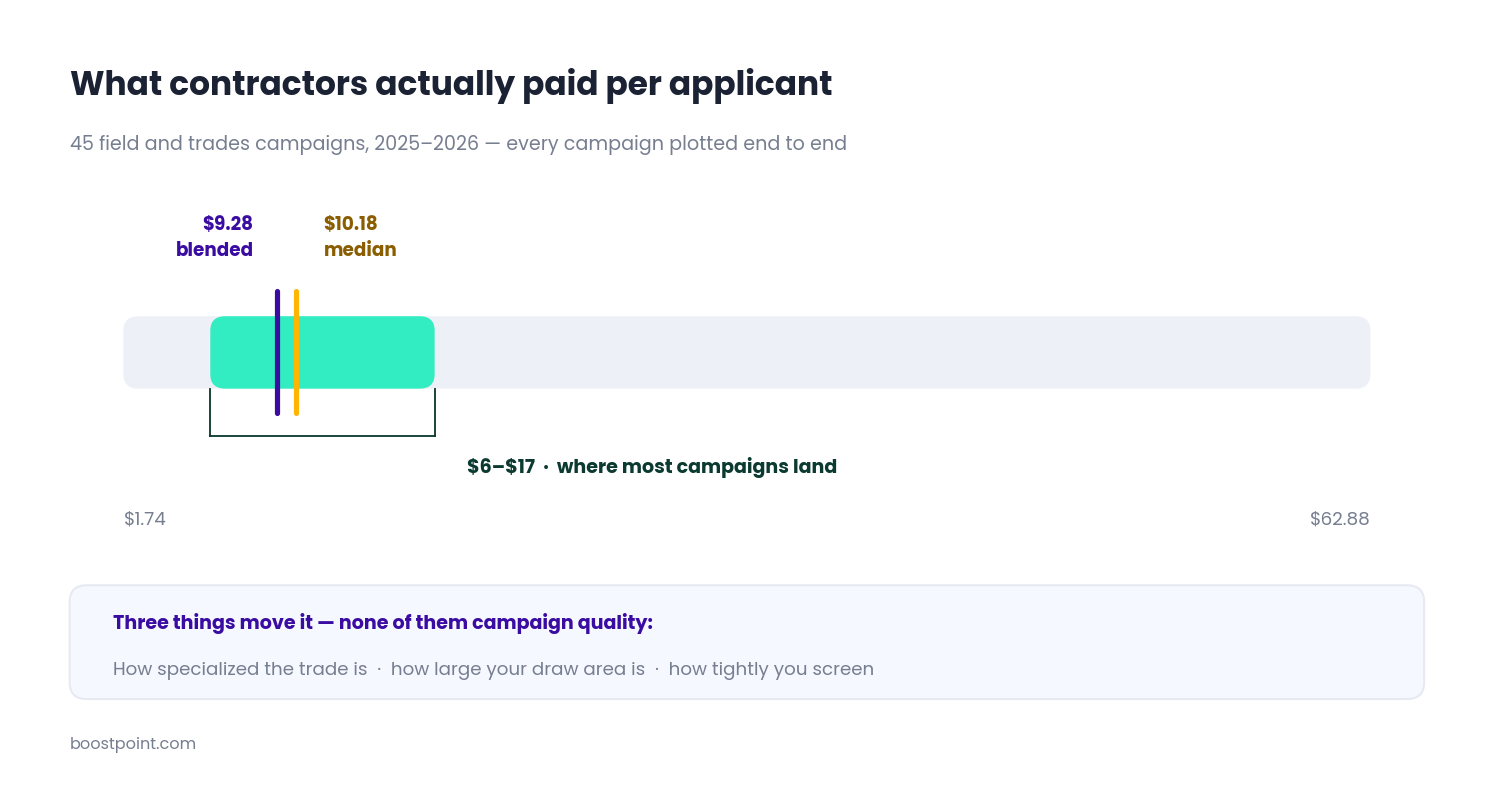
A skilled trades technician applicant costs a median of $17.21 in Boostpoint-managed Meta campaigns, October 2025–September 2026, across 127 HVAC and trades technician campaigns. In an earlier set of 45 Boostpoint-managed field and trades campaigns in 2025 and 2026, which mixed crew and technician roles, a qualified applicant cost $9.28. Most of those campaigns landed between $6 and $17. For comparison, a staffing agency placing one journeyman electrician typically charges 15 to 25 percent of first-year salary — roughly $9,750 to $16,250 for a single hire.
Source: 45 Boostpoint-managed field and trades campaigns across ten contractors and industrial service companies, 2025 through 2026, representing 2,590,544 impressions and 3,703 applications.
Why nobody can tell you what hiring costs
Search for what it costs to hire a tradesperson and you'll find plenty of numbers. The problem is they don't agree with each other. It's the first thing we run into whenever we start on skilled trades recruiting for a new contractor.
| Source | Published cost per hire |
|---|---|
| 2026 recruiting benchmarks | $1,340 median; $1,200 non-executive |
| Construction workforce platform | ~$1,900 average in construction |
| Same platform, different page | $4,000–$10,000; niche trades $15,000+ |
| Skilled trades recruiter | Agency fees 15–25% of first-year salary |
| Construction recruiter | Agency 25–40% of hourly rate; job boards $300–$500 per listing |
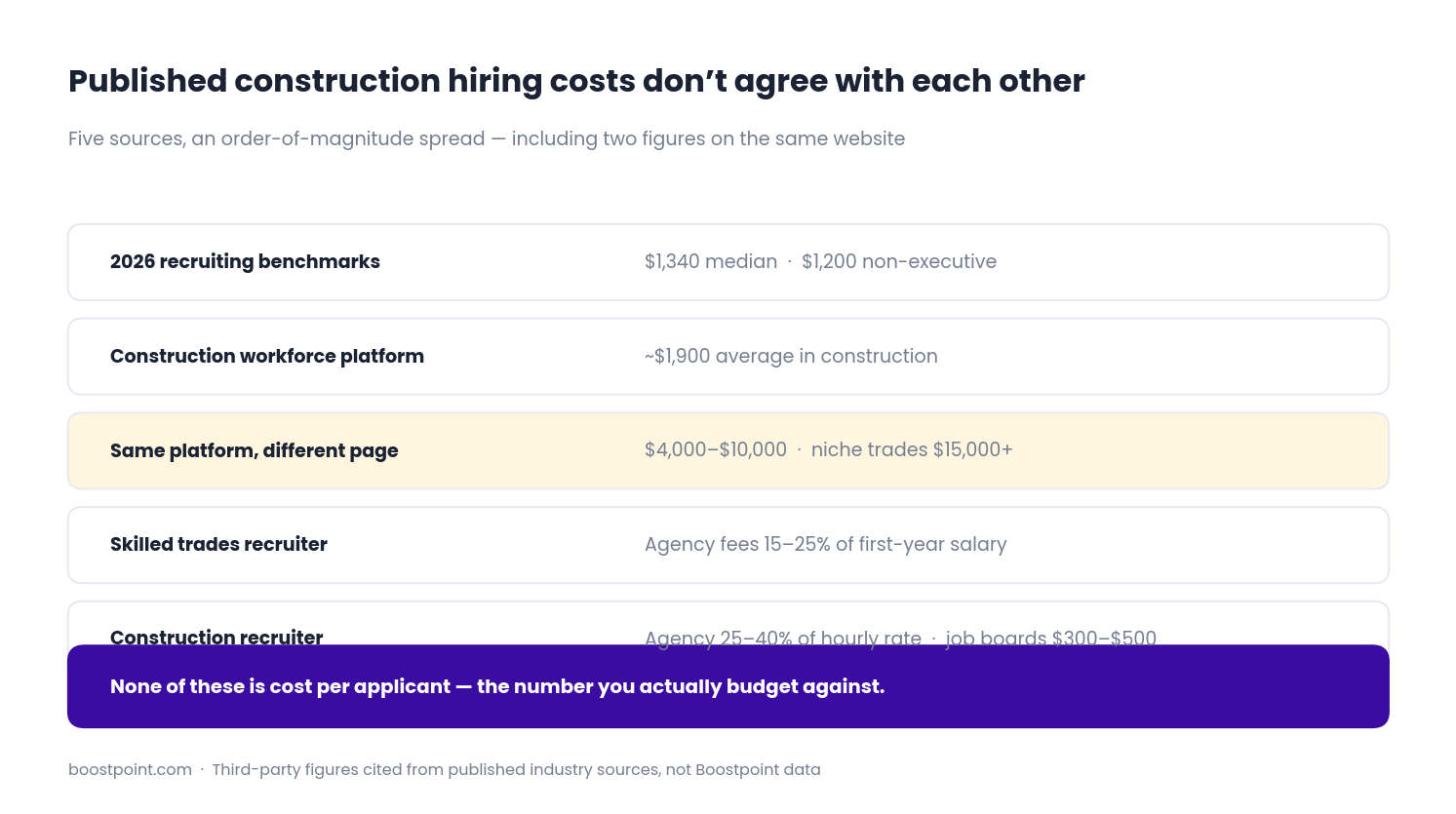
That's an order-of-magnitude spread, including two figures that contradict each other on the same website. A contractor trying to budget from this has nothing usable.
There are two reasons for the mess. First, cost per hire bundles everything — advertising, recruiter time, screening, drug testing, onboarding, and sometimes the cost of the vacancy itself. Different sources include different things. Second, most of these numbers come from staffing firms quoting their own placement fees, which is a price, not a cost.
The number missing from all of it is cost per applicant — what it takes to get one qualified person in front of your foreman. That's the figure you actually budget against, and here's ours.
What we see across 45 trades campaigns
From field and trades campaigns run for ten contractors and industrial service companies between 2025 and 2026 — 2.6 million ad impressions and 3,703 applications:
| Metric | Field & trades campaigns, 2025–26 |
|---|---|
| Cost per applicant (blended) | $9.28 |
| Median campaign | $10.18 |
| Typical range (25th–75th percentile) | $6–$17 |
| Full observed range | $1.74–$62.88 |
| Cost per click | $0.84 |
| Click-through rate | 1.57% |
| Application completion rate | 9.1% |
Source: 45 Boostpoint-managed field and trades campaigns across ten contractors and industrial service companies, 2025 through 2026, representing 2,590,544 impressions and 3,703 applications.
These are what advertisers paid. They cover advertising only — not foreman time, screening, drug testing or onboarding.
Put that next to a placement fee
This is the comparison that reframes the budget conversation, and it's the one the published cost-per-hire figures obscure.
A staffing agency placing a journeyman electrician earning $65,000 charges somewhere between 15 and 25 percent of first-year salary. That's $9,750 to $16,250 for one hire.
At $9.28 per applicant, the same money buys somewhere between 1,000 and 1,750 applications.
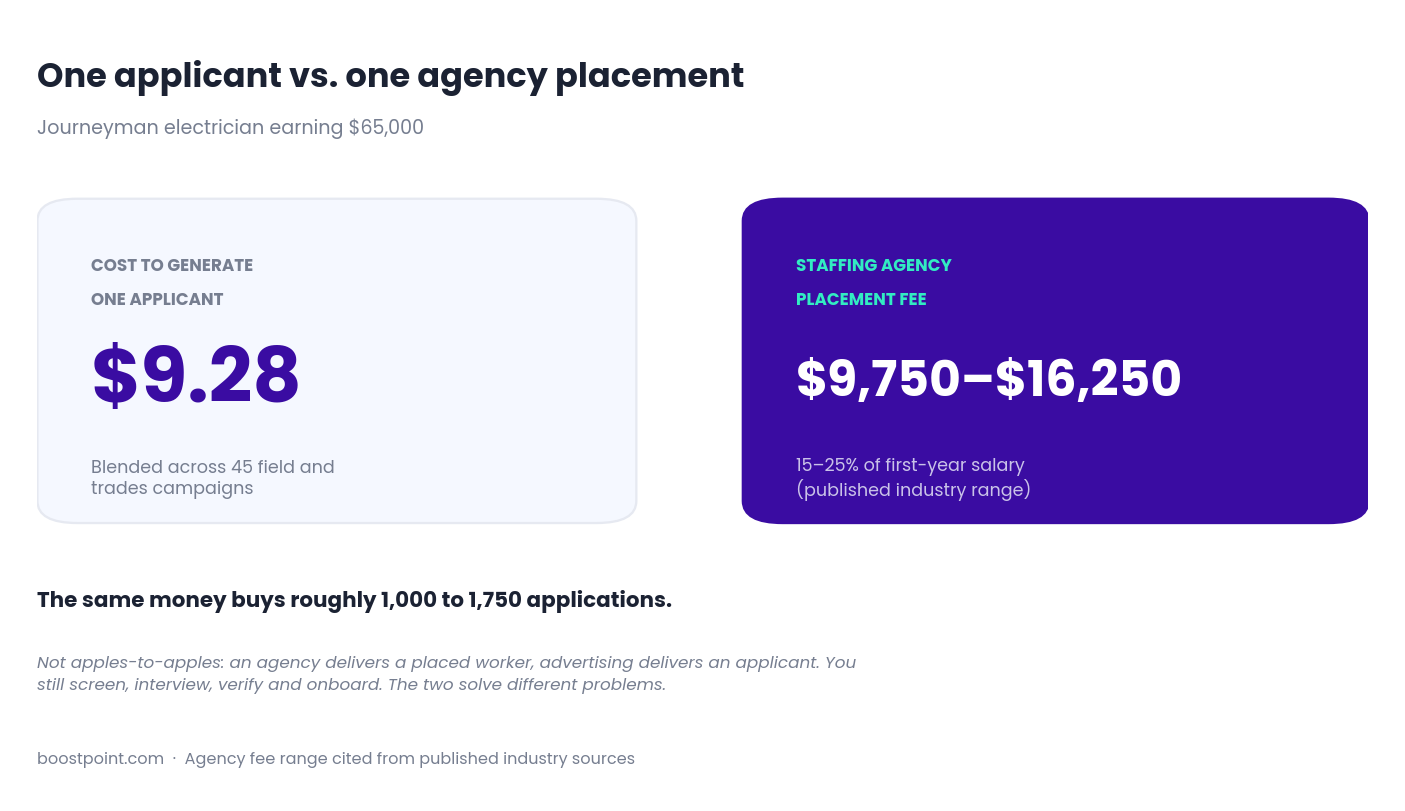
That comparison is deliberately unfair in one direction and worth being honest about: an agency delivers a placed worker, and advertising delivers an applicant. You still have to screen, interview, verify and onboard. Your foreman still spends time on it. Some of those thousand applicants won't answer the phone.
But run it at any realistic conversion rate and the arithmetic still isn't close. If one in fifty qualified applicants becomes a hire — a conservative assumption for trades — you're at roughly $460 in advertising per hire against a $9,750 minimum placement fee.
Which is why the honest framing isn't "advertising is cheaper than agencies." It's that they solve different problems. Agencies solve a capacity problem — you have no recruiter and no time. Advertising solves a reach problem — you have someone to work the calls but not enough people to call.
Why the range runs from $1.74 to $62.88
The spread is real, and none of it is a difference in how well the campaigns were run. The same spread across every role family, and what it means for the metrics worth tracking, is on hiring metrics benchmarks. Three things move it.
1. How specialized the trade is
General labor and crew positions draw from a large local pool. A specialized technician role — one requiring a specific certification, a specific piece of equipment, or a license — draws from a small one. The narrower the requirement, the fewer people in your radius qualify, and the more you pay to find each one. That is why a posting should list only the certifications the job needs; our mechanic job description separates the ones that matter, such as EPA Section 609 for A/C work, from the ones that empty the pool.
In our data the specialist technician campaigns ran several times the cost of general crew campaigns. That's not a channel problem. It's how many people exist within driving distance.
2. How large your draw area is
A contractor pulling from a metro area is advertising into hundreds of thousands of working-age people. A contractor pulling from three rural counties is advertising into a few thousand, most of whom already have a job.
Thin markets cost more per applicant. They're also where job boards produce almost nothing, because a job board needs someone to actively search — and in a thin market, there may be nobody searching that week. A $25 applicant who exists beats a $0 applicant who doesn't.
3. How tightly you screen
Every knockout question filters more people out before submission. Requiring five years verifiable, a specific certification, and willingness to travel will produce fewer, better applications at a higher unit cost.
Neither setting is automatically right. A contractor with one person answering the phone and twelve open spots should screen harder. A contractor with a training program can cast wider. The point is that it's a dial you control, and most contractors don't realize they're holding it.
The line item most contractors miss
Cost per applicant is only half the equation, and it's the half that gets attention because it appears on an invoice.
The other half is the completion rate — the share of people who tap your ad, start the application and actually finish it. Across trades campaigns that runs 9.1%, the lowest of any industry we advertise for. Manufacturing runs 17.2%. We dig into why only 9.1% of people who click finish the form separately, because it's the single largest lever available to most contractors.
Cost per applicant is cost per click divided by completion rate. At our observed trades click cost of $0.84, that arithmetic is unforgiving:
| Application completion rate | Cost per applicant |
|---|---|
| 9.1% (current trades average) | $9.28 |
| 12% | $7.04 |
| 15% | $5.63 |
| 17.2% (manufacturing average) | $4.91 |
Source: 45 Boostpoint-managed field and trades campaigns across ten contractors and industrial service companies, 2025 through 2026, representing 2,590,544 impressions and 3,703 applications.
Clicks in the trades are the cheapest of any industry we run — $0.84. Reaching tradespeople is not expensive. Nearly everything you pay per applicant is created by what happens after the click, and that's the part you control for free.
What this doesn't tell you
Being straight about the limits, because a number you can't defend is worse than no number.
- This is cost per applicant, not per hire. Your conversion from applicant to hire depends on your screening, your offer and how fast you call. We don't have hire attribution across this sample.
- Our trades dataset is smaller than our other verticals. 3,703 applications across ten employers, against 24,712 in healthcare. Treat $9.28 as a well-supported estimate rather than a precise industry benchmark. Our wider frontline hiring benchmarks put it in context across every vertical we run.
- We can't publish reliable cost by trade. Most trades campaigns advertise several roles at once, which means we can't cleanly attribute applications to specific trades. Anyone publishing a confident cost-per-electrician figure is probably doing arithmetic we'd be uncomfortable with.
Trades technician applicant cost: the latest 12 months
Boostpoint's newest cut looks at technician roles on their own, HVAC and similar trades technician campaigns, rather than mixing them with crew hiring. Across 127 Boostpoint-managed Meta campaigns, October 2025–September 2026, the median technician applicant cost $17.21, and the middle half of campaigns paid between $9.98 and $31.17.
| Measure | Figure |
|---|---|
| Median cost per applicant (HVAC / trades technician) | $17.21 |
| Middle half of campaigns (25th–75th percentile) | $9.98–$31.17 |
| Click-through rate | 0.94% |
| Clicks that became applicants | 11.3% |
| Campaigns | 127 |
| Sample | Boostpoint-managed Meta campaigns, October 2025–September 2026 |
| Basis | Cost per applicant: what advertisers paid. Not cost per hire. |
Why it sits above the earlier figures on this page ($9.28 blended, $10.18 median campaign): that set of 45 campaigns mixed general crew roles with technician roles, and as described above, specialist technician campaigns ran several times the cost of crew campaigns because fewer people in any radius hold the certification. The two sets also cover different windows, so the gap is not a price trend. The completion lever still applies: 11.3% of technician clicks became applicants, so a shorter form is the cheapest improvement available here too.
This is a role grouping, not a per-trade figure, so the caveat above about cost by specific trade still stands. For HVAC specifically, including click costs and what the ad should say, see HVAC technician recruiting.
Frequently asked questions
How much does it cost to recruit a skilled tradesperson?
Across our 2025–2026 campaigns, field and trades applicants cost $9.28 on average, with most campaigns falling between $6 and $17. That's cost per applicant, not cost per hire — it covers advertising only, not screening, onboarding or foreman time.
How does that compare to a staffing agency?
Staffing agencies typically charge 15–25% of first-year salary for skilled trades placements — roughly $9,750 to $16,250 for a journeyman electrician earning $65,000. But they deliver a placed worker while advertising delivers an applicant. The channels solve different problems: agencies solve a capacity problem, advertising solves a reach problem.
Why do published construction hiring costs vary so much?
Because cost per hire bundles different things depending on who's calculating it, and because many published figures are staffing placement fees rather than costs. We've seen $1,340, $1,900, $4,000–$10,000 and $15,000+ all published as construction hiring costs, including two contradictory figures on the same website.
What makes one campaign cost $2 per applicant and another cost $60?
Three things: how specialized the trade is, how large your draw area is, and how tightly you screen. Specialist certifications, thin rural markets and strict knockout questions all raise cost per applicant — the first two because the qualified pool is smaller, the third because you're deliberately filtering.
Is it cheaper to advertise in a metro or a rural area?
Cost per applicant is generally lower in denser markets because more eligible people live there. But job boards produce very little in thin markets, since they depend on someone actively searching. In a rural draw area a more expensive applicant who exists is a better outcome than no applicant at all.
What's the fastest way to lower our cost per applicant?
Shorten your application. Trades clicks cost $0.84 — the cheapest of any industry we run — but only 9.1% of people who click finish the form. Raising that to 17% would take cost per applicant from $9.28 to about $4.91 with no change in ad spend.
Do you have cost data by specific trade?
Not reliably, and we won't publish one. Most trades campaigns advertise several roles at once, which makes it impossible to cleanly attribute applications to a specific trade. We'd rather say that than publish a number we can't stand behind.
Does this replace job boards?
Most of our trades clients run both. Job boards capture people already searching; social advertising reaches the much larger group who aren't looking. Where advertising tends to displace spend is staffing agency fees, which cost multiples of either.
What does it cost to recruit skilled trades workers?
For advertising, the latest figure is a median of $17.21 per applicant for HVAC and other trades technician roles, across 127 Boostpoint-managed Meta campaigns from October 2025 to September 2026. The middle half of those campaigns paid $9.98 to $31.17. Crew and general labor roles usually cost less because the local pool is larger. That is cost per applicant, not cost per hire, which also includes screening, onboarding and foreman time.
See what it costs to fill your crews
Book a 30-minute call and we'll walk through cost per applicant for the trades, markets and shifts you're hiring for.
Book a Free DemoFigures come from 45 Boostpoint-managed field and trades campaigns across ten contractors and industrial service companies, 2025 through 2026, representing 2,590,544 impressions and 3,703 applications. Costs are what advertisers paid for advertising only. Third-party cost-per-hire and staffing fee figures are cited from published industry sources and are not Boostpoint data. This is a sample of Boostpoint campaigns, not an industry-wide study.
Related: Skilled Trades Recruiting · Why 91% of Trades Applicants Never Finish Your Application · Frontline Hiring Benchmarks