
Production Recruiting: Filling Plant Floor Roles Without Job Boards
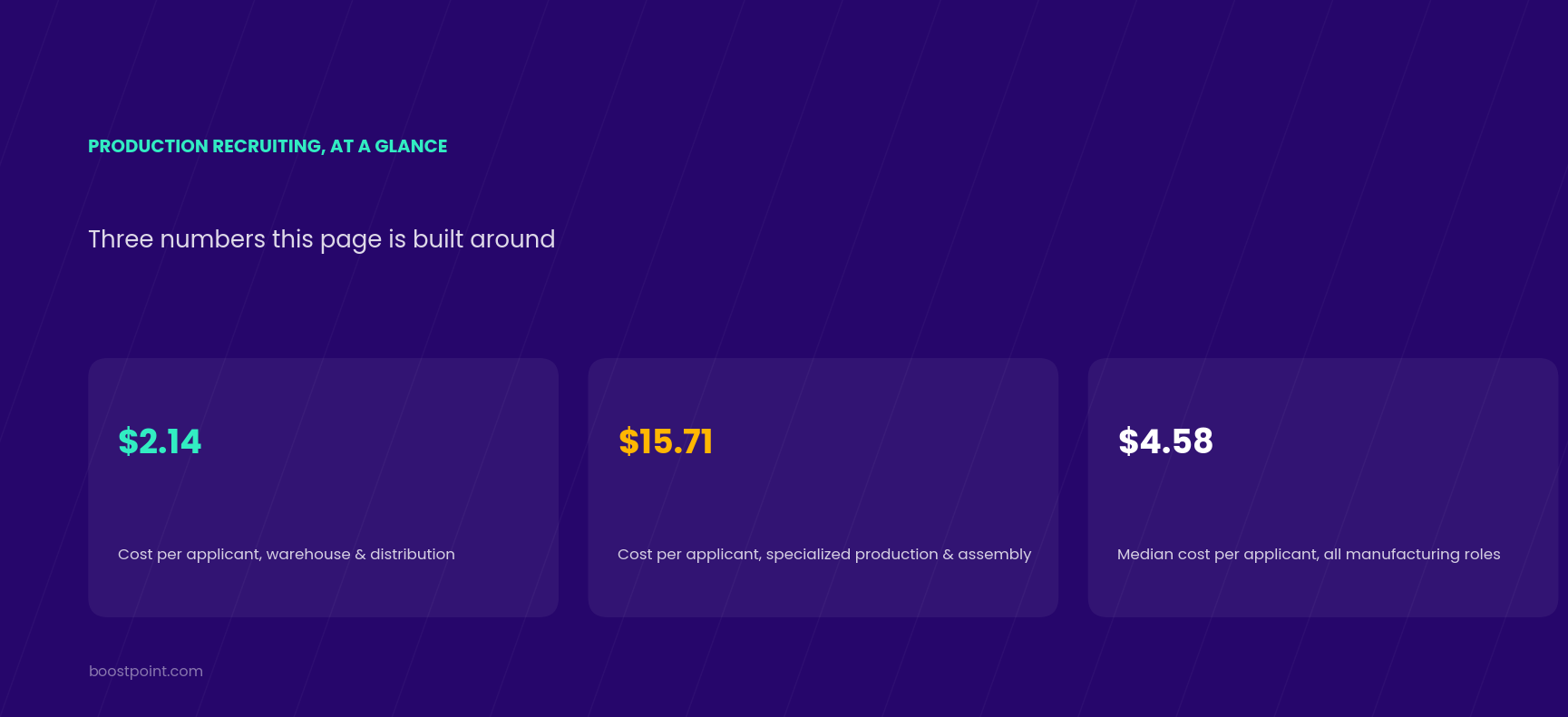
Production recruiting works best when targeting passive candidates on social media rather than relying on active job boards. In 2026, Boostpoint-managed social recruitment campaigns generated production and assembly applicants for an average of $15.71, while general warehouse and distribution candidates cost $2.14. Across all manufacturing roles, the blended median cost per applicant is just $4.58. Using targeted advertising allows plant managers to reach skilled workers during off-hours and screen for required shift availability and equipment experience.
Source: Boostpoint campaign data — 110 managed manufacturing recruitment campaigns conducted in 2025–2026 across industrial facilities nationwide.
A note on who's writing this
Most guides on production recruiting are written by staffing agencies or job board platforms. Their advice naturally leads you back to their own services — either paying high hourly markups for contingent labor or buying expensive promoted listings in a crowded search feed.
Boostpoint is not a staffing agency or a traditional job board. We build recruitment advertising software that helps plant managers and industrial HR teams build their own direct pipelines of production workers through targeted social media campaigns.
We aren't here to give you generic advice on writing a better job description. We are providing the exact financial data and sourcing mechanics required to get qualified production workers through your front doors, backed by real 2026 campaign data from manufacturing facilities nationwide.
The demographic reality of production recruiting
If you are struggling to hire production workers, it is not just a localized issue with your pay rate. You are competing against macroeconomic forces.
The U.S. Bureau of Labor Statistics reported roughly 439,000 open manufacturing positions in early 2026, against a stable workforce of 12.6 million. The July 2026 rates behind that, and why they describe a filling problem rather than a quitting one, are on the manufacturing labor shortage. Quits consistently sit high, and openings remain elevated even without massive sector growth.
More pressingly, the demographic pressure is compounding. An estimated 2.8 million manufacturing workers are expected to retire by 2030, with industry projections showing 3.8 million new manufacturing employees will be needed by 2033.
You are not competing for general headcount. You are competing for a shrinking pool of specific skills: machine operation, assembly, quality control, and uptime maintenance.
Why traditional job boards underperform for plant floor roles
For years, production recruiting meant posting a requisition on Indeed and waiting. Today, that strategy yields diminishing returns. Here is why:
- The skilled talent isn't actively searching. Great machine operators and production assemblers are currently employed. They are not scrolling job boards on their lunch break.
- High competition for active searchers. When a candidate does search for "production jobs near me," they are met with hundreds of listings from every warehouse, plant, and fulfillment center in a 30-mile radius. You are competing entirely on brand recognition and top-line pay rate.
- Unqualified applicant spam. Job boards make applying too easy for unqualified candidates. You receive dozens of applications, but learn nothing about what equipment they have run, whether they can read a print, or if they will accept a second or third shift.
The solution: shift from active sourcing (job boards) to passive sourcing (social media advertising). Production workers spend hours a day on platforms like Facebook, Instagram, and TikTok. Targeted ads put your job opportunity directly in their feed, qualifying them immediately through mobile-friendly screening questions.
What it actually costs to recruit production workers directly
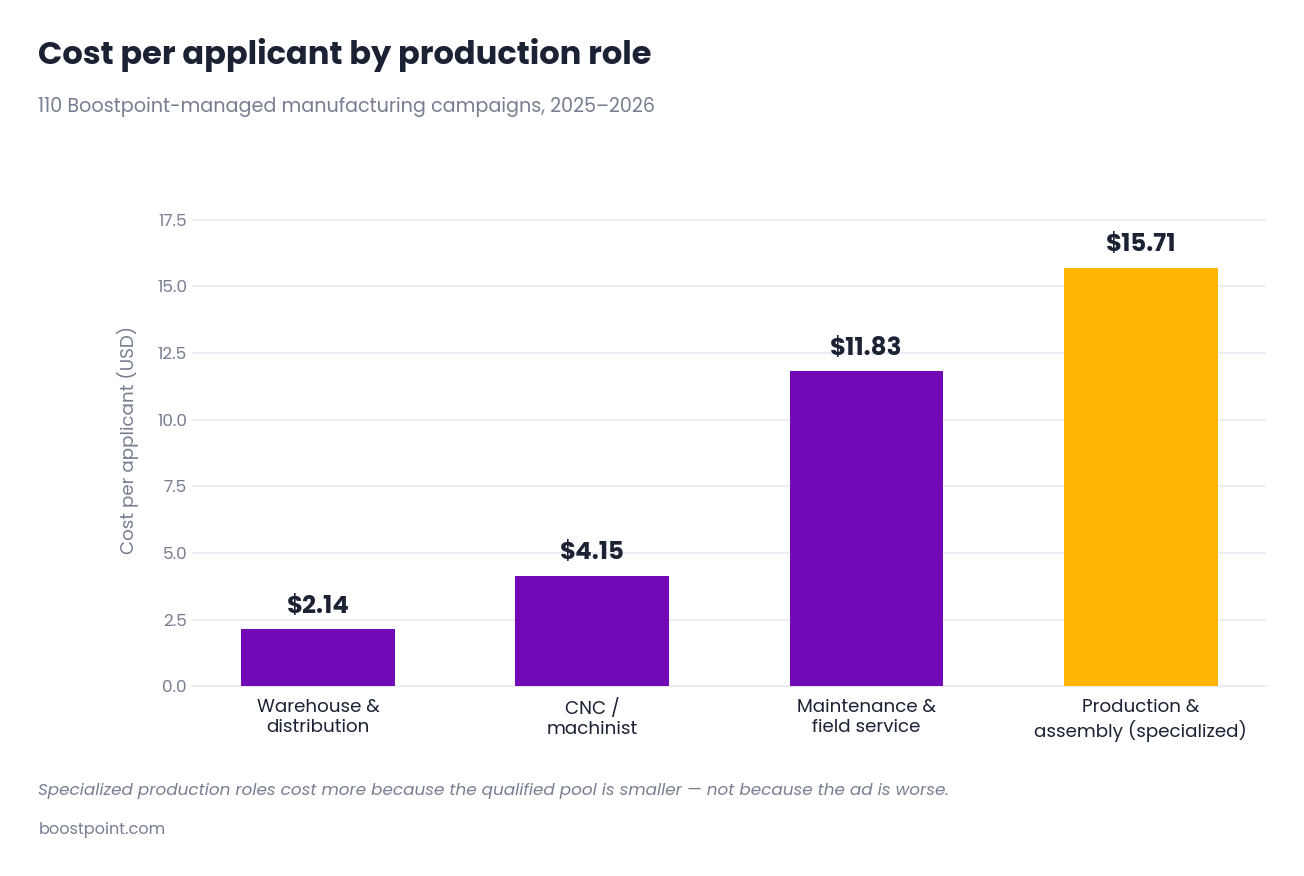
To evaluate your production recruiting strategy, you need real benchmarks. Across Boostpoint-managed manufacturing campaigns in 2025–2026, targeted social recruitment yielded significantly lower acquisition costs than traditional channels — the wider pattern across every industry we track is in our published 2026 Social Job Advertising Benchmark data.
| Production role category | Cost per applicant (CPA) |
|---|---|
| Warehouse & Distribution | $2.14 |
| CNC / Machinist | $4.15 |
| Maintenance & Field Service | $11.83 |
| Production & Assembly (Specialized) | $15.71 |
| Blended Average (All Manufacturing Roles) | $5.56 |
Source: Boostpoint campaign data — 110 managed manufacturing recruitment campaigns conducted in 2025–2026 across industrial facilities nationwide.
Data based on 110 distinct manufacturing campaigns across local markets. Median campaign CPA across all roles sits at $4.58.
Who actually applies on social media?
A common misconception is that social media only reaches entry-level, younger demographics. However, our 2026 data shows that experienced workers convert incredibly well:
- 35–44 year-olds accounted for 25.6% of applications at $5.52 per applicant.
- 45–54 year-olds accounted for 23.4% of applications at $5.28 per applicant.
- 55–64 year-olds produced 23.4% of applications while only accounting for 18.0% of ad impressions — converting well above their exposure.
Calculating direct cost per hire across screening ratios
Advertising budget produces applicants, not finished hires on the plant floor. Depending on your facility's drug testing, background checks, and specific equipment experience vetting, conversion rates vary significantly.
Here is what direct ad cost per hire looks like across three candidate screening scenarios based on Boostpoint data:
| Production role | Cost per applicant (CPA) | 1 in 10 hire rate (10% — high touch) | 1 in 50 hire rate (2% — realistic standard) | 1 in 100 hire rate (1% — strict vetting) |
|---|---|---|---|---|
| Warehouse & Distribution | $2.14 | $21.40 | $107.00 | $214.00 |
| CNC / Machinist | $4.15 | $41.50 | $207.50 | $415.00 |
| Maintenance Tech | $11.83 | $118.30 | $591.50 | $1,183.00 |
| Specialized Production / Assembly | $15.71 | $157.10 | $785.50 | $1,571.00 |
Even at a strict 1-out-of-50 screening ratio for specialized production roles, spending $785.50 to acquire a permanent hire is drastically cheaper than paying $16,000+ in annual staffing agency markups for the same seat — the full breakdown of what those markups look like is in manufacturing staffing agency markups, and the same pipeline math applies directly.
Best practices for modern production recruiting
To build a reliable talent pipeline and reduce reliance on staffing agencies, update your recruiting mechanics:
- Advertise the shifts, not just the role. If you are hiring for a weekend night shift, state it clearly in the ad creative. Disqualifying candidates upfront is cheaper than interviewing them only to find out their availability doesn't match.
- Use short-form video. Show the actual plant floor. A 15-second mobile video showing a clean, safe, well-lit production environment outperforms a bulleted list of responsibilities every time.
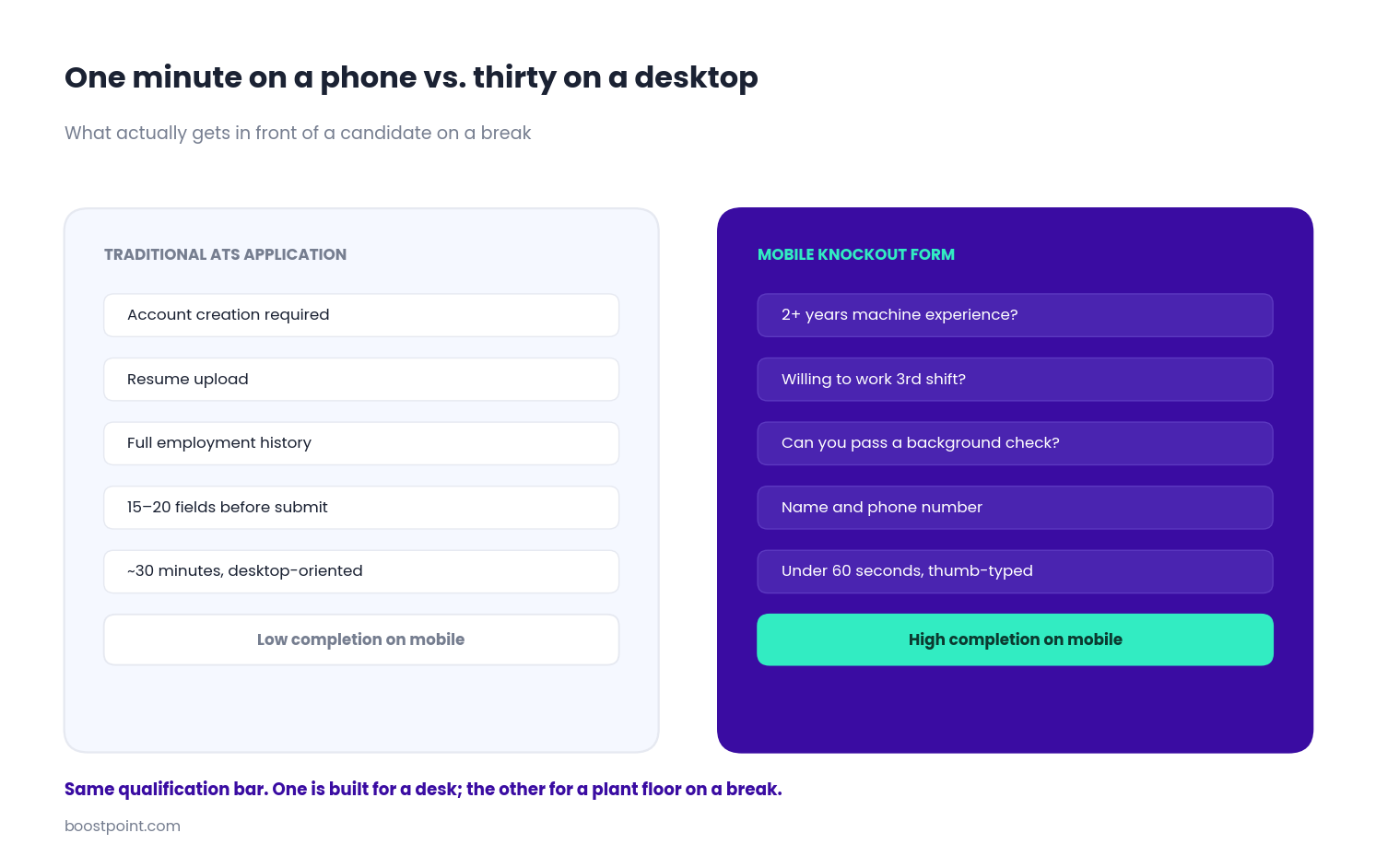
- Deploy "knockout" screening questions. Replace the 30-minute ATS application with a 1-minute mobile form. Ask 3-4 critical questions: do you have 2+ years of machine operation experience? Are you willing to work 3rd shift? Can you pass a background check?
- Call applicants within minutes, not days. Top production talent gets scooped up quickly. If an applicant submits a form at 10:00 AM, your internal recruiting team should call them by 10:15 AM, supported by an automated SMS confirmation.
The honest summary
Job boards catch active job seekers. Targeted advertising captures the passive workforce.
If you are trying to fill entry-level general labor positions, job boards still produce volume. But if you need reliable production operators, machinists, and maintenance techs, traditional active channels fall short. By pivoting your recruitment marketing budget toward targeted social media campaigns, you reach experienced workers directly, pre-screen them for equipment knowledge, and reduce your cost-per-hire to under $500.
The calculation worth running this quarter
Manufacturing HR leaders should evaluate these metrics when refining their production recruiting strategy:
- Audit your applicant source quality. Look at the last 30 production hires you made. How many came from job boards versus referrals or targeted advertising? Compare 90-day retention rates across those sources.
- Calculate your true cost per hire. Take your total monthly job board spend and divide it by the actual hires made from those platforms. Compare that to the direct advertising benchmarks ($100–$800 depending on the role).
- Assess time-to-contact. Submit a test application through your own career portal. How long does it take for a recruiter to text or call you? If it is longer than 24 hours, you are losing candidates.
How to recruit production operators
A production operator runs a process rather than a single station: sets up or tends a machine, watches the gauges, keeps the line fed, checks quality and logs it. The title covers packaging and filling machine operators (the BLS counts 377,700 in 2025, with about 41,400 openings a year and a median of $43,220, May 2025), mixing, molding and extrusion operators, and the catch-all "production workers, all other" (275,700 jobs, median $40,110). Most need a high school diploma or equivalent and moderate on-the-job training, which makes the operator the rung between a line worker and a technician.
That position decides where to recruit. The best candidates are one step below: your own line workers and packers who have shown up for a year, and the same people at the plant down the road. Run the operator ad as a promotion as much as a job: a headline with the title, the hourly rate, the shift, "we train on the line" and the town, then the machine or process named in plain words and the pay step after training. Ask three questions: the shift, experience on any production machine (yes or no, not a knockout if you train), and the start date. Post the same role internally first, since an operator promoted from your own floor is a hire with no ramp, and backfill the line job it opens. Operators who already run the same equipment read for the rate, the shift pattern and the state of the machines, so name them. The role is described on our production operator job description, and the forklift and machine operator version is on hiring forklift and machine operators.
How to recruit line workers
Line workers are the volume hire: hand packers, line assemblers, sorters and inspectors who need no credential and learn the job in days or weeks. The BLS counts 555,500 hand packers and packagers (2025) at a median $36,280 (May 2025), with about 61,800 openings a year even as the occupation shrinks, and 1,403,500 miscellaneous assemblers and fabricators. Nobody in this pool is scarce; the competition is every warehouse, distribution center and temp agency in the county, so the recruiting is won on the first line and the speed.
Put the rate, the shift with its hours, "no experience needed" and the start date in the first sentence. Say what the floor is like (climate-controlled or not, standing all shift, what the line makes). Keep the form to two questions, available for the shift and able to start on the date, and call the same day; a line worker who applied to three plants on a Sunday night takes the first interview offered. For a line start or a shift add, a dated walk-in day with offers in the room fills faster than a posting. The nearest benchmark row is the Warehouse / production family in Boostpoint's 2026 Social Job Advertising Benchmark, which ran a median $9.83 per applicant at a 20% apply rate; it is Boostpoint's canonical campaign-month measure and uses a different method from the earlier campaign figures above. The working-back-from-the-start-date plan is on assembly and packaging line recruiting, and the posting is on our line worker job description.
Frequently asked questions
How can I improve my production recruiting strategy?
Shift away from relying solely on active job boards. Utilize social media recruitment advertising to reach passive candidates, incorporate video tours of your plant floor in your ads, and streamline your application process to mobile-friendly, 1-minute knockout forms.
What is the average cost to recruit a production worker?
Based on 2026 benchmarks across 110 campaigns, the median cost per applicant for manufacturing roles is $4.58. Specialized production and assembly roles average $15.71 per applicant, while warehouse roles sit around $2.14.
Why are job boards ineffective for hiring machine operators?
Skilled machine operators are typically employed and not actively searching resume databases. Furthermore, standard job board applications do not effectively screen for the specific equipment experience, certifications, and shift availability required for production roles.
How do I recruit for hard-to-fill manufacturing shifts?
Be upfront in your advertising. Clearly promote the shift differential and exact hours in your ad creative. Use mobile-friendly targeted ads to reach local workers, and immediately filter out unqualified applicants using shift-specific knockout questions.
What is a realistic applicant-to-hire ratio for production jobs?
Depending on your vetting requirements (background checks, drug screening, technical testing), manufacturing facilities typically hire 1 out of every 20 to 50 applicants generated through direct recruitment marketing.
How do you recruit production operators?
Start one step below: promote reliable line workers and packers from your own floor, and recruit the same people from nearby plants with an ad that names the machine or process, the rate, the shift and the pay step after training. Ask three questions (shift, any production machine experience, start date), call the same day and backfill the line job each promotion opens. The BLS counts 377,700 packaging and filling machine operators alone, at a median $43,220 a year (May 2025).
How do you recruit line workers?
Win on the first line and on speed: the rate, the shift and its hours, "no experience needed" and the start date in the first sentence, a two-question form, and a call the same day. For a line start, hold a dated walk-in day and make offers in the room. In Boostpoint's 2026 benchmark, the Warehouse / production family ran a median $9.83 per applicant at a 20% apply rate. Cost per applicant is not cost per hire.
How do factories recruit production workers?
Most plants run several channels at once: employee referrals and promotion from their own floor, social job ads that reach people working at other plants and warehouses within commuting distance, walk-in hiring days for a new line or shift, staffing agencies for temp-to-hire and surges, job boards for active searchers, and local technical schools and workforce boards for trained entrants. The ones that fill fastest put the hourly rate, the shift and its hours, and the start date in the first line, keep the application to a few knockout questions on a phone, and call the same day. In Boostpoint's 2026 Social Job Advertising Benchmark, the Warehouse / production family ran a median of $9.83 per applicant at a 20% apply rate; cost per applicant is not cost per hire. See the benchmark and our walk-in interview guide.
See what it costs to fill your plant floor directly
Book a 30-minute strategy call with our industrial recruiting team. We'll analyze your local labor market, review cost-per-applicant benchmarks for your specific production roles, and show you how to build a direct hiring pipeline.
Book a Demo →Boostpoint figures are derived from 110 managed manufacturing recruitment campaigns conducted in 2025–2026 across industrial facilities nationwide. Cost-per-applicant metrics reflect what advertisers paid for advertising. Labor statistics and demographic projections are sourced from the U.S. Bureau of Labor Statistics (BLS) and Deloitte's manufacturing industry projections.