
Assembly and Packaging Line Recruiting: Filling Entry-Level Line Roles Before the Line Starts
Assembly and packaging line recruiting is a volume problem with a date on it: a line starts on a Monday and needs every station staffed, from a pool — BLS counts 1,885,400 assemblers and fabricators and 591,800 hand packers — that needs no credential, learns the job in weeks, and is also being recruited by every warehouse and temp agency in the county. The plan is arithmetic worked backward from the start date: stations to hires, hires to offers, offers to applicants, applicants to the week the ad has to go up. The nearest published figure in Boostpoint's 2026 Social Job Advertising Benchmark is the uncredentialed warehouse and production row at a median $9.83 per applicant and a 20% apply rate; the ad that gets there says the rate, the shift and "no experience needed" in the first line.
Source: Boostpoint 2026 Social Job Advertising Benchmark — 891 Boostpoint-managed campaigns on Meta (1,334 campaign-months), 2026; costs are what advertisers paid for advertising only.
A note on who's writing this
Boostpoint runs social media job ads for manufacturers, and line-level roles — assemblers, packers, operators, laborers — are a large share of what those campaigns fill, so the advertising sections of this page describe what we sell. We publish no assembler- or packaging-specific cost per applicant; the figures here are the warehouse and production row of our benchmark and an earlier manufacturing analysis, both labeled as the nearest published evidence rather than as this role's number. The broader plant-floor picture, including the demographics and the job-board argument, is on production recruiting; this page is narrower — the entry-level line, and the ramp to a start date. No customer is named. Every figure of ours is a cost per applicant, never a cost per hire.
The pool: who works a line, by the numbers
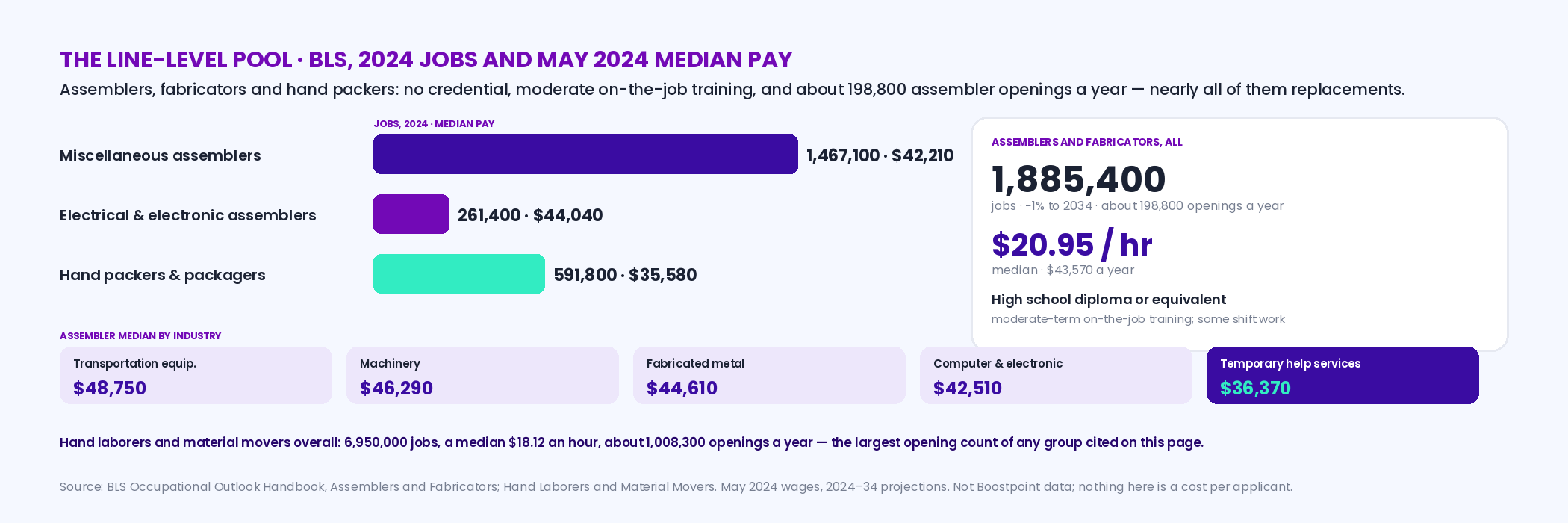
BLS counts 1,885,400 assemblers and fabricators (2024) — 1,467,100 of them "miscellaneous assemblers," the team-assembly line role — at a median $43,570 a year or $20.95 an hour (May 2024), with about 198,800 openings a year despite a projected 1% decline to 2034, because the openings are replacements. Pay runs with the product: transportation equipment $48,750, machinery $46,290, fabricated metal $44,610, computer and electronic products $42,510, and — the line that matters most to this page — temporary help services $36,370. Hand packers and packagers are a separate BLS occupation: 591,800 jobs at a median $35,580, inside a hand-laborer group of 6,950,000 jobs, a median $18.12 an hour and about 1,008,300 openings a year, the largest opening count of any group we cite. The requirement is a high school diploma or equivalent and moderate-term on-the-job training; BLS notes that some assemblers work shifts "which may require evening, weekend, and night work," which is the line's defining fact for recruiting. Nobody in this pool is scarce; everybody in it has three other places to go this week, and the ad, the offer and the first shift are the whole competition.
The wage gap nobody puts in the ad
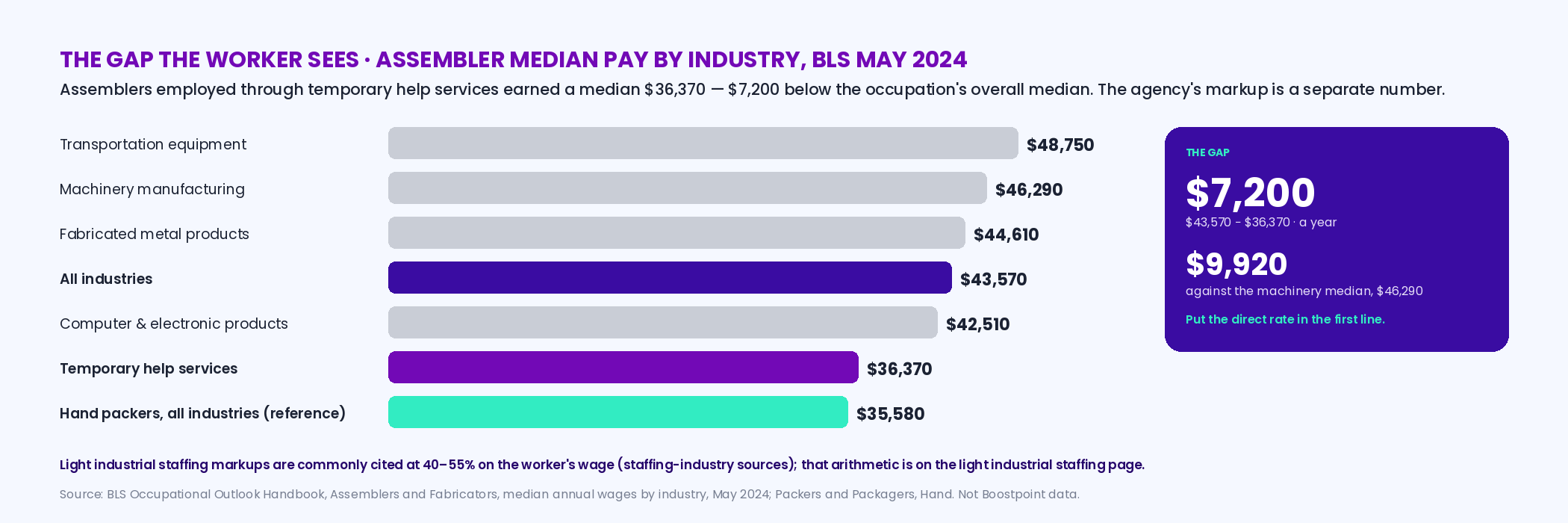
BLS's industry breakdown carries the argument for direct hiring in one row: assemblers employed through temporary help services earned a median $36,370 against $43,570 for the occupation overall and $46,290 in machinery manufacturing — a gap of $7,200 a year against the overall median, or $9,920 against the machinery figure. That gap is not the agency's margin; it is what the worker sees, and the agency's markup on top of the worker's wage — commonly cited at 40–55% for light industrial staffing, per staffing-industry sources — is what the plant sees. The recruiting consequence is the differentiator most plants forget they have: a direct assembler ad can state a rate the temp agency's ad can't match for the same station, and the person choosing between the two on a phone compares the number. The full markup arithmetic, and the case for and against temp-to-hire, is on light industrial staffing; the calculator below runs the worker's side of it against BLS's medians.
Interactive
The worker's side of the temp gap — your direct rate against what BLS says assemblers earn through temp agencies and in your industry
Nothing is stored or sent — this runs in your browser. Enter the rate you'd pay direct; the comparisons are BLS May 2024 annual medians at 2,080 hours, national, and your market will differ.
BLS Occupational Outlook Handbook, May 2024 annual medians: assemblers and fabricators $43,570 overall; by industry transportation equipment $48,750, machinery $46,290, fabricated metal $44,610, computer and electronic $42,510, temporary help services $36,370; packers and packagers, hand $35,580. Annualized at 2,080 hours. The agency's markup on the worker's wage — commonly cited at 40–55% for light industrial staffing — is a separate number and is on the light industrial staffing page. Nothing here is a cost per applicant.
The ramp: working back from the start date
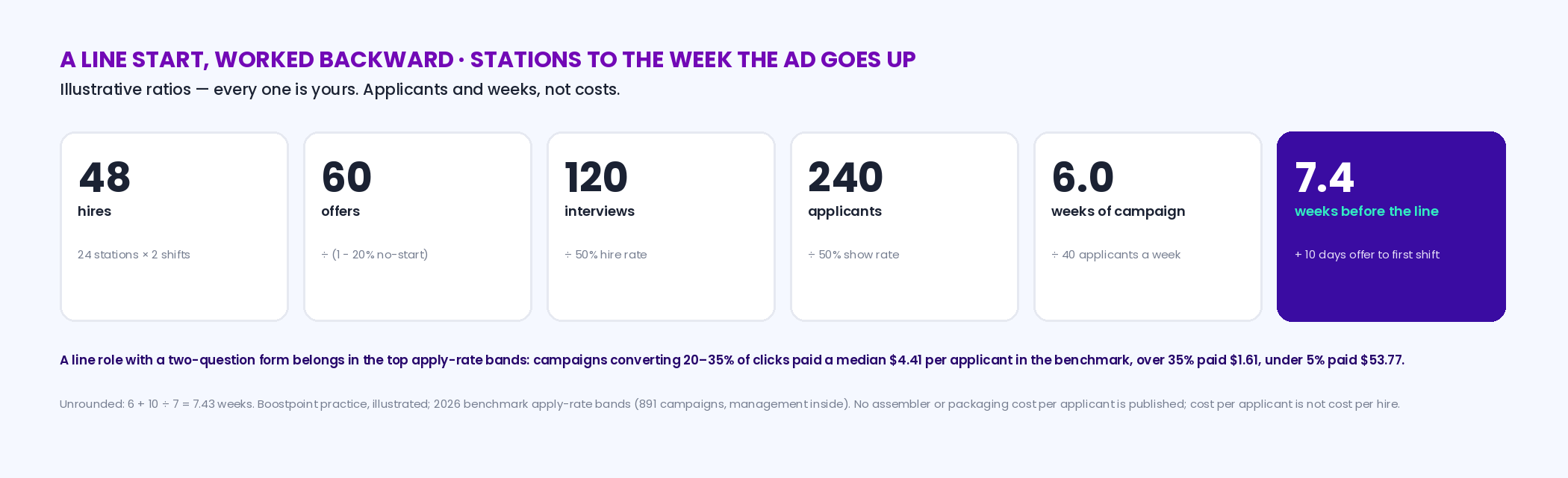
A line start is the one recruiting problem with a hard deadline, and most plants meet it by calling an agency three weeks out. The alternative is to work the arithmetic backward. Stations times shifts is the headcount; the headcount plus the buffer for the people who accept and never show is the offers; offers divided by the share of interviewed applicants you'd hire is the interviews; interviews divided by the share of applicants who show up to interview is the applicants; and applicants divided by the weekly rate a campaign produces is the number of weeks before the start date the ad has to be running — plus the days between offer and first shift for drug screens and onboarding. Every one of those ratios is yours, and none of them is a cost. What our data adds is the apply rate: the warehouse and production row converted 20% of clicks to applicants across 82 campaigns, and the benchmark's apply-rate bands show why the form matters — campaigns converting 20–35% of clicks paid a median $4.41 per applicant and campaigns over 35% paid $1.61, against $53.77 under 5%. A line role with a two-question form belongs in the top bands; a line role behind an assessment and a résumé upload does not. The planner below runs the ramp on your ratios.
Interactive
Line-start ramp planner — from stations to the week the ad has to go up
Nothing is stored or sent — this runs in your browser. Enter the line and your own funnel ratios; the planner works backward to applicants needed and weeks of lead time. No cost is computed.
Arithmetic on your inputs. Every ratio is yours; the planner assumes nothing about them and computes no cost. Boostpoint publishes no assembler or packaging cost per applicant; the nearest benchmark row is warehouse / production at $9.83 median and a 20% apply rate, and cost per applicant is not cost per hire.
The ad, the form and the first shift
A line ad competes with a warehouse ad and a temp agency ad for the same thumb, and it wins on three words and a number. On Meta it runs in the Special Ad Category — no age, gender or ZIP targeting, the rules on Meta Special Ad Category, explained — so the first line does the selecting: "Assembler · $[low]–$[high]/hr · 2nd shift, 3 p.m.–11 p.m. · no experience needed · [City] · start [date]." The rate is the number the temp agency can't match; "no experience needed" is the three words that double the pool; the shift and the start date are what the applicant is actually deciding about. Then the specifics a line worker compares: the pay step at 90 days, the schedule pattern (four 10s or five 8s), whether it's climate-controlled, and what the line makes. The form asks two questions — available for the stated shift starting the stated date, and legally able to work in the US — and nothing else before the offer; the earlier manufacturing analysis put click-to-apply at 17.2%, the highest of any vertical we measured, on campaigns whose forms looked like that. The first shift is part of the recruiting: a plant that texts the day before, has a name on a locker and a buddy on the station, and pays the first week on time keeps the person it spent the ad money on. For a line start, the structure that beats a posting is a dated walk-in day with offers made in the room — the event-driven structure ran a median $8.02 per applicant in the benchmark; mechanics on on-the-spot hiring and walk-in interviews and, for a plant opening, mass hiring. Forklift and machine operator roles that sit beside the line are on hiring forklift and machine operators; the warehouse playbook the ad borrows from is on warehouse recruiting.
| Role | BLS jobs, 2024 | BLS median pay | Requirement | First line of the ad | Nearest Boostpoint row |
|---|---|---|---|---|---|
| Assembler (team / line) | 1,467,100 miscellaneous assemblers | $42,210 a year | High school diploma or equivalent; moderate on-the-job training | "Assembler · $[low]–$[high]/hr · [shift] · no experience needed · [City] · start [date]" | Warehouse / production $9.83 median, $4.44 blended, 20% apply, 82 campaigns |
| Hand packer / packaging line | 591,800 | $35,580 a year | None federal; food-safety training where the product requires it | "Packer · $[low]–$[high]/hr · [shift] · climate-controlled · [City] · start [date]" | Same row; earlier manufacturing analysis warehouse $2.14 |
| Electrical / electronic assembler | 261,400 | $44,040 a year | High school; soldering or IPC training a plus, often taught | "Electronics assembler · $[low]–$[high]/hr · days · we train to IPC · [City]" | Same row; no specialty figure published |
| Line laborer / material handler | 2,988,900 laborers and material movers | $38,940 a year | None; forklift certification if the job includes it | "Material handler · $[low]–$[high]/hr · [shift] · forklift training paid · [City]" | Warehouse / production row; forklift page for the certified role |
Nobody on a packaging line is scarce, and everybody on it has somewhere else to be next week. Put the rate, the shift and "no experience needed" in the first line, and start the ad the number of weeks before the line that the arithmetic says — not the number the agency's lead time forces on you.
How to hire assemblers: three kinds of assembler, three different ads
"Assembler" covers three jobs that read different ads, and hiring gets easier the moment the ad says which one it is. The newer BLS edition (Employment Projections 2025-35, May 2025 wages) keeps the same shape as the May 2024 figures above: miscellaneous assemblers and fabricators, the team and line role, are 1,403,500 jobs at a median $44,650 a year with about 138,700 openings a year; electrical, electronic and electromechanical assemblers are 246,300 jobs at $45,850 with about 25,900 openings; and engine and other machine assemblers are 33,500 jobs at $53,710, projected to shrink 17.0% by 2035.
- Line or team assembler. The volume hire. The person is choosing between you, a warehouse and a temp agency this week, so the rate, the shift and "no experience needed" go in the first line, and the form asks only about the shift and the start date. Recruit from warehouse, retail and food service workers who want a fixed schedule and a raise.
- Electronics assembler. Bench work: small parts, soldering, work instructions and inspection. Say whether you train to a soldering standard or need it on day one, name the product, and say it is a seated, climate-controlled bench if it is. Hobbyists, repair techs and people with steady hands from other bench jobs answer this ad.
- Mechanical or machine assembler. Hand and power tools, torque specs, reading drawings, sometimes a crane or hoist. Ask about tools and prints in the form, and recruit from maintenance helpers, auto and small-engine repair, and experienced line assemblers ready for the next rate.
Whichever one you are hiring, keep the hire itself short: a call the same day, a floor walk as the interview, and an offer with a start date before the person leaves the building. The nearest benchmark row is the Warehouse / production family in Boostpoint's 2026 Social Job Advertising Benchmark, cited above, not an assembler figure. The duties and requirements for the posting itself are on our assembler job description.
Frequently asked questions
How do you recruit assemblers and packaging line workers?
Work backward from the start date: stations times shifts is the headcount, then offers, interviews and applicants through your own ratios, and applicants divided by what a campaign produces a week is the lead time. Run the ad with the rate, the shift and "no experience needed" in the first line, a two-question form behind it, and a dated walk-in day with offers made in the room for a line start.
What do assemblers and packers earn?
BLS puts the May 2024 median for assemblers and fabricators at $43,570 a year ($20.95 an hour) — $42,210 for miscellaneous assemblers, $44,040 for electrical and electronic assemblers — and hand packers and packagers at $35,580. By industry, assemblers earned a median $48,750 in transportation equipment, $46,290 in machinery and $36,370 through temporary help services.
Why hire assemblers directly instead of through a temp agency?
Because the worker sees the gap: BLS's median for assemblers employed through temporary help services was $36,370 against $43,570 overall — $7,200 a year — and the plant pays the agency's markup on top, commonly cited at 40–55% for light industrial staffing. A direct ad can state a rate the agency's can't. When an agency still makes sense — a two-week surge, a plant with no recruiter — is on the light industrial staffing page.
How far ahead of a line start should recruiting begin?
Applicants needed divided by the applicants a campaign produces a week, plus the days from offer to first shift. For 48 hires with 20% of accepted offers never starting, a 50% hire rate at interview and a 50% show rate, that is 240 applicants; at 40 a week, six weeks of campaign plus a ten-day lag — about seven and a half weeks. The planner on this page runs it on your ratios.
What does it cost to recruit assemblers?
We publish no assembler or packaging figure. The nearest row in our 2026 benchmark, warehouse and production, ran a median $9.83 per applicant (blended $4.44, 20% apply rate, 82 campaigns), campaign, and warehouse campaigns in an earlier manufacturing analysis ran $2.14. Applicants per hire are yours; cost per applicant is not cost per hire.
What should a production line job ad say?
The rate range, the shift with its hours, "no experience needed," the city and the start date, in the first line; then the 90-day pay step, the schedule pattern, whether the floor is climate-controlled and what the line makes. Under Meta's Special Ad Category there is no age, gender or ZIP targeting, so the first line is the targeting. Two form questions, nothing else before the offer.
How do you reduce no-shows on a line start?
Shorten the gap between offer and first shift, text the day before from a person with a name, and make the first shift feel expected — a locker with a name on it, a buddy on the station, the first week paid on time. Then measure the no-start rate and put it in the planner as a buffer rather than a surprise; a 20% no-start rate means 60 offers for 48 hires.
Is a hiring event worth it for a packaging line?
For a line start or a shift add, usually: a dated walk-in day with the line visible, a two-minute application and offers made in the room converts the people who won't fill out anything. The event-driven structure ran a median $8.02 per applicant across 78 campaigns in our benchmark, with a 21% apply rate. Cost per applicant is not cost per hire.
How do you hire assemblers?
Decide which assembler you need first: a line or team assembler (the volume hire, sold on rate, shift and "no experience needed"), an electronics assembler (bench work and soldering, sold on the product and the bench), or a mechanical assembler (tools, torque and drawings). Write one ad per kind with the rate and shift in the first line, ask two or three questions that match it, call the same day and make the offer on the floor walk. The newer BLS edition counts 1,403,500 miscellaneous assemblers at a median $44,650 a year (May 2025).
Where do you find assemblers to hire?
Mostly in other hourly jobs nearby: warehouses, retail, food service and temp assignments, where people want a fixed shift and a better rate. Referrals from your own line are the cheapest source, a social job ad reaches the employed majority who are not searching, and a dated walk-in day works for a line start. For electronics and mechanical assembly, look at repair shops, maintenance helpers and experienced line assemblers ready for the next step.
Start the ad the week the arithmetic says
We'll write the line ad with your rate, your shift and your start date in the first line, put a two-question form behind it, run it the number of weeks before the line that your ramp needs, and show you the manufacturing campaigns closest to yours.
Book a DemoBoostpoint figures come from the 2026 Social Job Advertising Benchmark — 891 campaigns and 1,334 campaign-months — and are the NEAREST published rows to this page's roles, labeled as such: warehouse / production median cost per applicant $9.83, middle 50% $3.15–$18.72, blended $4.44, 20% apply rate, 82 campaigns; apply-rate bands under 5% $53.77, 20–35% $4.41, over 35% $1.61; event-driven $8.02, 21%, 78 campaigns. Earlier manufacturing analysis (different methodology): 264 campaigns, 14 clients, blended $5.56, click-to-apply 17.2%, warehouse $2.14. No assembler, packaging or line-specific figure is published. Third-party figures — BLS Occupational Outlook Handbook (May 2024 wages, 2024–34 projections) for assemblers and fabricators and for hand laborers and material movers; light industrial staffing markups of 40–55% as cited by staffing-industry sources — are theirs and attributed in place. No customer is named. The planner and wage comparison are arithmetic on your inputs and BLS medians, not measured results. Cost per applicant is not cost per hire; we do not track hires and publish no cost-per-hire figure. A sample of Boostpoint campaigns, not an industry-wide study.