
How to Hire Forklift Operators and Machine Operators in 2026
The best way to hire forklift operators is to certify them yourself instead of requiring it: OSHA forklift certification is employer-specific, never transfers, and takes days — so "certified only" ads screen out most of the pool for a credential you must re-issue anyway. Screen for shift, reliability, and 18+; train the equipment. In Boostpoint's 2026 Social Job Advertising Benchmark, warehouse and production campaigns ran a $9.83 median cost per applicant and a $4.44 blended average.
A note on who's writing this
Boostpoint sells social recruitment advertising to manufacturers, distribution centers, and food plants, so this page has a bias toward the channel we run — and it shows our own cost figures, including the ones that make the median campaign look ordinary. The advertising numbers come from the warehouse and production roles in our 2026 Social Job Advertising Benchmark; the wage, employment, and training facts are from the Bureau of Labor Statistics, O*NET, OSHA, and the Department of Labor, each cited where it appears. The wider context for production-floor roles lives on our manufacturing recruiting pages. If you want a job-seeker-facing posting rather than a hiring plan, our forklift operator job description is the template; this page is about filling the seat.
For the posting itself, our machine operator job description template covers the six BLS occupations the title spans and what each pays.
The certification trap: why "certified forklift operators only" is the most expensive line in your ad
Most forklift ads open with a requirement that quietly shrinks the applicant pool to a fraction of what it could be. The requirement sounds reasonable — "must be forklift certified" — but it rests on a misunderstanding of what OSHA certification is. Under 29 CFR 1910.178(l), it is the employer who "shall ensure that each powered industrial truck operator is competent to operate a powered industrial truck safely," through training that combines formal instruction, practical exercises, and "an evaluation of the operator's performance in the workplace." The certification record OSHA requires is a four-item document — operator name, training date, evaluation date, and the name of the person who did the training and evaluation — created by you, for your trucks, in your building. There is no government-issued forklift license. A card from a previous employer or a training vendor is evidence of prior instruction; it is not a credential you can hire against and skip the process.
OSHA does let prior training count for something. Paragraph (l)(5) says an operator who has already been trained on a topic, and is evaluated and found competent, does not need to repeat that topic. In practice that shortens the classroom portion; the workplace evaluation on your specific equipment still happens, and refresher training is triggered any time an operator is "assigned to drive a different type of truck" — which, given OSHA's seven truck classes (electric rider, electric narrow-aisle, electric hand/rider, IC cushion-tire, IC pneumatic-tire, tractors, and rough-terrain), is most job changes. The same logic reaches temp workers: OSHA's Temporary Worker Initiative Bulletin No. 7 says a host employer "must still verify that training and provide site-specific information and training on the particular types of powered industrial trucks and working conditions present at the worksite," and must conduct its own workplace evaluation of each operator the agency supplies.
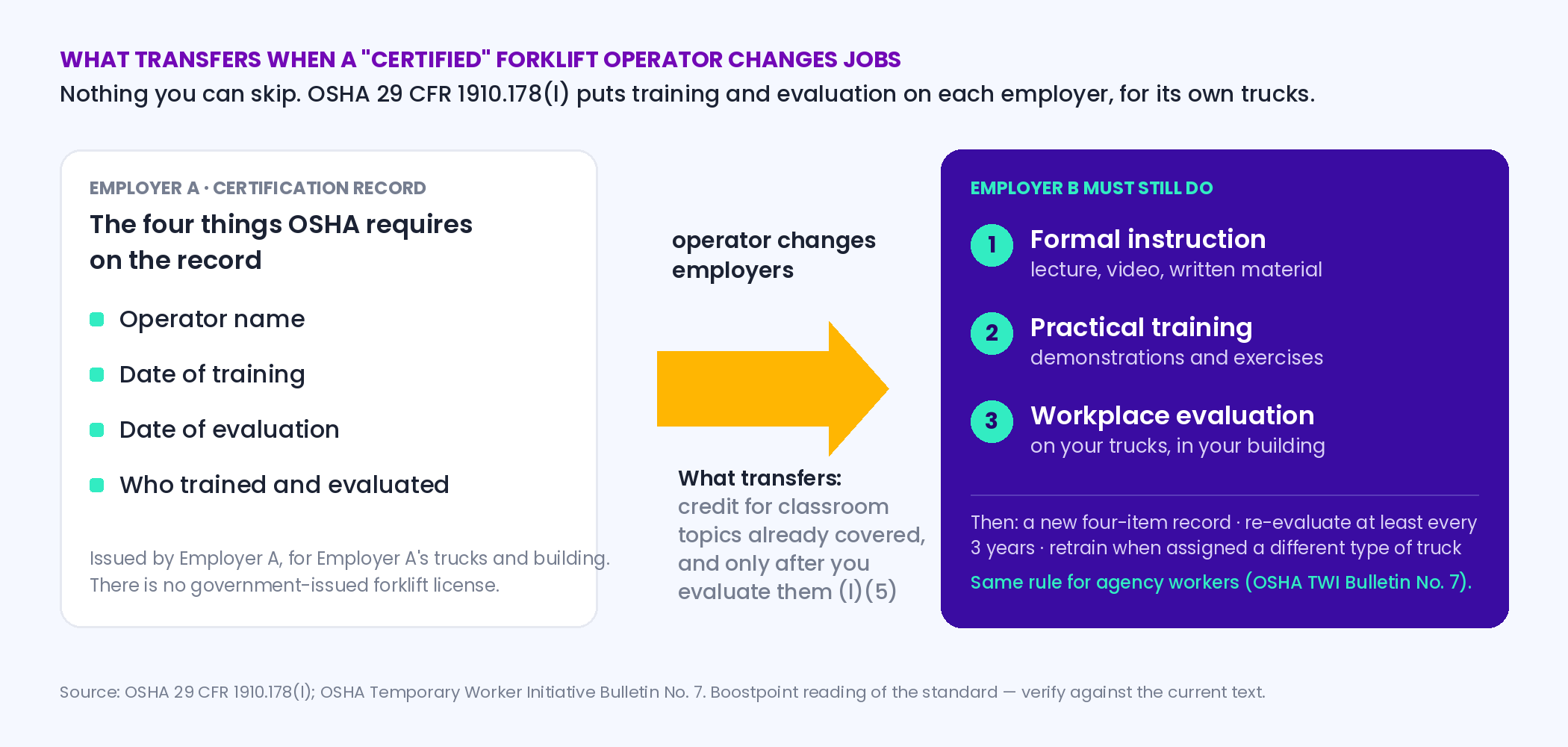
The practical conclusion: requiring certification buys you a smaller pool, not a shorter onboarding. The two things you genuinely cannot train — age and availability — are the things to screen for. Federal law (Hazardous Occupations Order No. 7) bars anyone under 18 from operating a forklift in non-agricultural work, so "18 or older" is a real knockout. Shift availability is the other.
Hire for the seat, train for the machine: the time-to-competency split
"Machine operator" covers a wide range of ramp times, and the ramp time is what should decide whether you require experience. BLS's Occupational Outlook Handbook is blunt about the forklift end of the range: industrial truck and tractor operators "may take only a few days to learn how to operate," and the occupation typically needs less than a month of on-the-job training. For metal and plastic machine workers, the same handbook says "some operators and tenders are trained on basic machine operations and functions in a few months," while CNC tool operators "may need training for up to 1 year." That spread is the hiring decision in one sentence: the shorter the ramp, the more you should hire on reliability and train the skill; the longer the ramp, the more prior experience is worth paying for.
Bar lengths are illustrative of the ranges BLS describes, not measured averages. The right-hand column is our reading of those ranges. For the top of the ladder — machinists and CNC operators — the scarcity math is different enough that we gave it its own page: hiring CNC operators and machinists. This page is about the bottom three rows, where the pool is large and the constraint is your process.
What forklift and machine operators earn — and why the temp gap matters
Pay is the first thing an operator checks, so it belongs in the ad's first line. These are the 2025 national medians O*NET reports from BLS data; your local market will sit above or below them, and night, cold-storage, and reach-truck roles usually pay a premium.
| Role (SOC code) | Median hourly, 2025 | Median annual, 2025 | Employment, 2024 | Projected openings per year, 2024–34 | Source |
|---|---|---|---|---|---|
| Industrial truck & tractor operators — forklift (53-7051) | $22.32 | $46,420 | 792,500 | 76,400 | O*NET / BLS |
| Packaging & filling machine operators (51-9111) | $20.78 | $43,220 | 381,200 | 45,300 | O*NET / BLS |
| Cutting, punching & press machine setters/operators (51-4031) | $22.27 | $46,330 | 174,700 | 14,400 | O*NET / BLS |
| CNC tool operators (51-9161) | $24.37 | $50,690 | 177,100 | 13,500 | O*NET / BLS |
| Production workers, all other (51-9199) | $19.29 | $40,110 | 292,800 | 31,600 | O*NET / BLS |
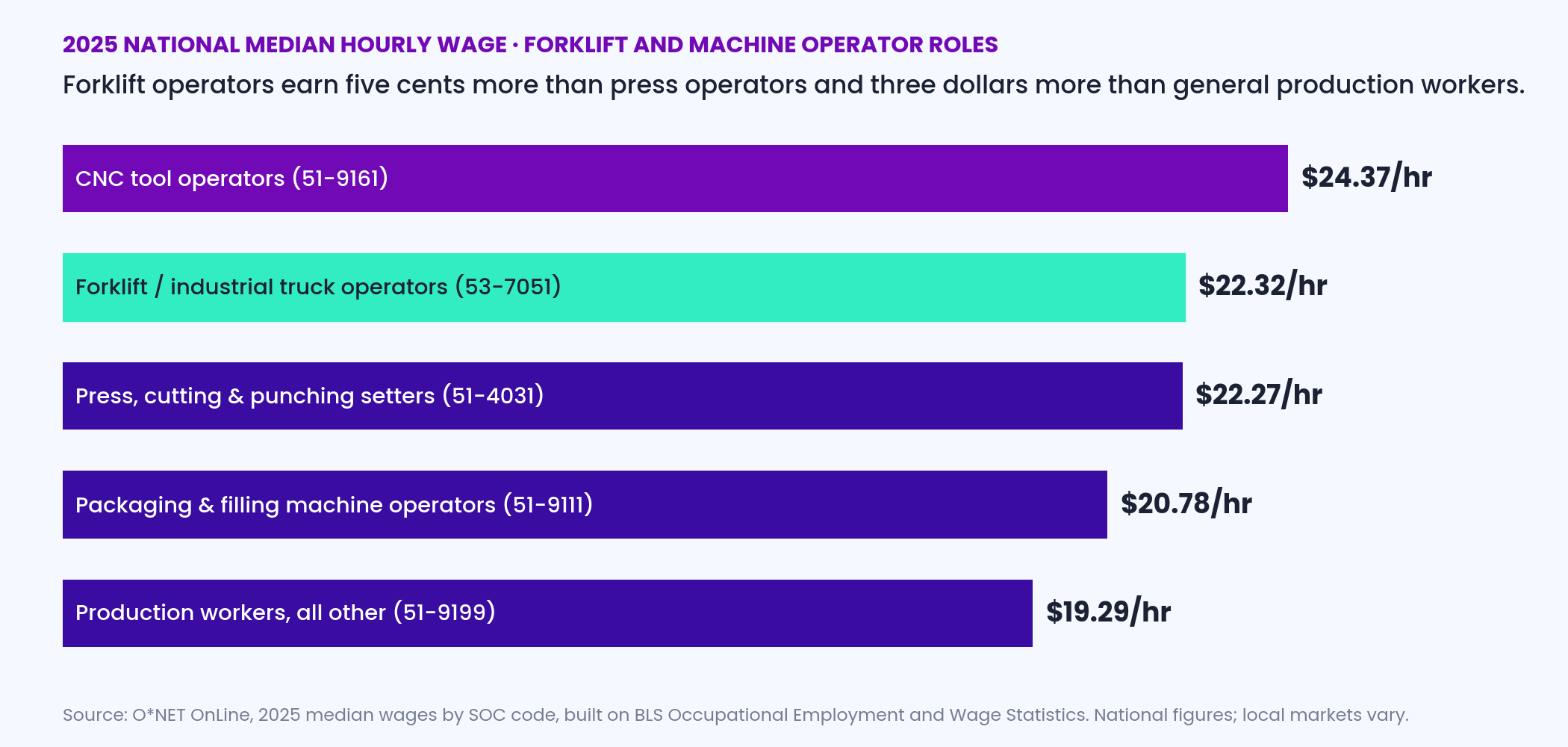
One BLS number deserves its own paragraph. In May 2024, material moving machine operators employed in warehousing and storage earned a median of $47,880 a year; the same occupation in temporary help services earned a median of $37,910 — a gap of $9,970. That gap is the reason temp-to-hire operators leave the moment a direct employer posts a rate, and it is the reason a direct ad with a real number in it out-pulls an agency posting for the same seat. Openings, meanwhile, come almost entirely from turnover: BLS projects 1% growth for material moving machine operators through 2034 yet about 83,200 openings a year, "most of those… from the need to replace workers who transfer to different occupations or exit the labor force."
The case for a staffing agency, made fairly
Light-industrial agencies exist because they solve three problems well, and honesty requires saying so before we make our own case. First, speed with no pipeline: if you need six operators on the floor Monday and have no applicants, an agency's bench is the only same-week answer. Second, volume that genuinely swings: a peak build or a seasonal line that runs twelve weeks is a reasonable thing to staff with people you never intended to keep. Third, administrative offloading: payroll, workers' comp, and the first pass of screening are real work, and some plants would rather pay a markup than build that function. Light-industrial markups run roughly 40–55% on top of the wage (LG Resources, The Resource Company, getproductiv, cited on our warehouse staffing agency cost page), and for a short, sharp surge that can be money well spent.
Where the case weakens is the year-round seat. The OSHA point above means an agency operator still costs you the site-specific training and evaluation. The wage gap above means the agency worker is the most likely person in the building to leave for a direct job. And a markup that made sense for twelve weeks compounds badly over fifty-two. For the steady-state hiring a warehouse or plant does all year, the arithmetic favors owning the pipeline — which is what the rest of this page is about.
What forklift and machine-operator applicants cost on social
Forklift and machine-operator roles fall into the warehouse and production family in our 2026 benchmark. Across 82 campaigns, the median cost per applicant was $9.83, the middle half of campaigns ran $3.15–$18.72, and the blended (volume-weighted) average was $4.44 — less than half the median, because the large, continuously tuned campaigns that dominate volume run much cheaper than the typical one. 20% of people who clicked completed an application, and the click-through rate was 1.67%.
| Metric | Warehouse / production | All 891 campaigns |
|---|---|---|
| Median cost per applicant | $9.83 | $13.88 |
| Middle 50% of campaigns | $3.15 – $18.72 | $6.48 – $29.74 |
| Blended (volume-weighted) average | $4.44 | $8.02 |
| Apply rate (click to completed application) | 20% | — |
| Click-through rate | 1.67% | — |
| Campaigns in sample | 82 | 891 |
Two earlier findings from our manufacturing campaign analysis (a campaign-level cut with a different date range — where it conflicts with the benchmark, the benchmark wins) are worth knowing because they speak to this role directly. Manufacturing applicants completed applications at 17.2% click-to-apply, the highest of any vertical we run, which is why in-platform forms matter so much here: the pool is willing to finish if you let it. And one multi-market client ran 110 campaigns at roughly $4.11 per applicant across dozens of markets — the same ad, the same one-minute form, the same knockouts, repeated market after market. That is the strongest evidence we have that these costs are a process outcome, not a lucky geography.
The playbook, in order of impact
- 1. Write "we certify you" instead of "must be certified." It is both the legally accurate statement and the biggest pool-expander available to you. Keep "18 or older" and "available for [shift]" as the hard requirements; those are the ones you cannot train.
- 2. Put the rate, shift, equipment, and start date in the first line. "$22/hr · 2nd shift · reach truck & sit-down · starts Monday · we certify" answers every question an employed operator has before deciding whether to tap. Hiding the rate does not protect it; it pays for clicks from people who leave when they learn it.
- 3. Screen with three or four knockouts, not a résumé. Age, shift availability, equipment experience as a multiple-choice question (so "none" is an acceptable answer for forklift, and a disqualifier only where the ramp justifies it), and a lifting or standing requirement if the job has one. The builder below writes this for you.
- 4. Keep the application in-platform and under a minute. Benchmark-wide, what happens after the click explains 70% of cost variation. With a pool that converts at 17–20%, every added field throws away applicants you already paid for.
- 5. Ask equipment questions as data, not as gates. Which truck classes have you run — counterbalance, stand-up reach, order picker, walkie? Use the answers to route candidates to the right line and to set training scope, not to reject.
- 6. Contact the same day, with an interview time in the first message. Operators apply in batches; the first employer with a slot on the calendar wins. If you hire in cohorts — a new shift, a peak build — an event-driven campaign ("open interviews Thursday 2–6 p.m., offers on the spot") ran a $8.02 median in our benchmark, the cheapest structure we track. The mechanics are on our walk-in interview page.
- 7. Certify in week one and put the date in the record. Formal instruction, practical exercises, workplace evaluation, four-item certification record, re-evaluation within three years. Onboarding that includes certification is a retention feature — say so in the ad.
Build the first line and the screener
Pick the role and the facts. The builder writes the ad's first line and the knockout questions from them — everything else in the ad is optional. Copy it, edit the numbers, and skip the mission paragraph.
Nothing is stored or sent — this runs in your browser.
What it costs to hire a forklift operator: the honest version
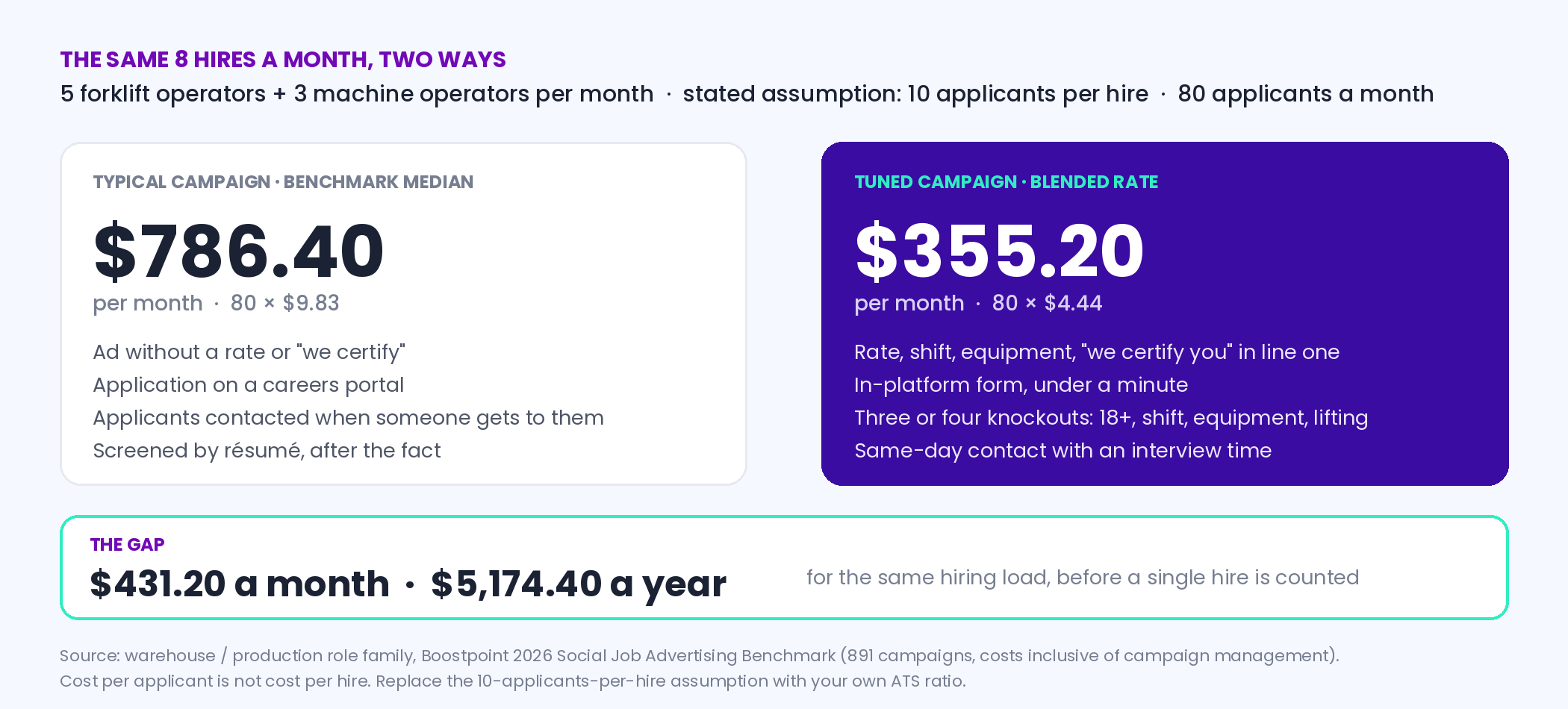
Search for "cost to hire a forklift operator" and you will find confident single numbers. We will not give you one, because cost per hire depends on three things only you know: your applicants-per-hire ratio, what your certification training costs in trainer time, and what an empty seat costs your line. What we can give you exactly is the advertising piece. Say a plant hires 5 forklift operators and 3 machine operators a month — 8 hires — and its ATS shows about 10 applicants per hire with knockouts in place (a common planning ratio; use yours). That is 80 applicants a month. At the benchmark median, 80 × $9.83 = $786.40 a month. At the blended rate the tuned campaigns run, 80 × $4.44 = $355.20 a month. The difference — $431.20 a month, $5,174.40 a year — is what the process in the playbook above is worth on this hiring load, before a single hire is counted. Then add your training time and your vacancy cost, and you have a cost per hire you can defend. What you will not get from us is a cost per hire computed from ad data; we do not track hires, and any vendor number that claims to has skipped a step.
If you are weighing that against a temp-to-hire arrangement on the same seats, the markup math is worked through on our warehouse staffing agency cost page, and the broader mechanics of keeping a warehouse pipeline full — always-on budgets, one campaign per shift, no-show prevention — are in our warehouse recruiting playbook.
Forklift and machine-operator hiring is won by removing a requirement, not adding one: certify instead of requiring, screen for 18+ and shift, put the rate in the first line, and train the machine in week one. The pool is large; the constraint was your ad.
Experienced operators still need your own workplace evaluation and certification; see OSHA forklift training requirements.
Where to find forklift operators and machine operators
Because forklift certification is yours to issue and most machine-tending roles train in weeks, the question is not where to find certified operators. It is where to find reliable adults who will work your shift, and a smaller number with experience on the machines that take months to learn. They are in six places, roughly in order of how quickly each produces a start.
| Source | Who you reach | Best for |
|---|---|---|
| Your own floor | Pickers, packers, material handlers and line workers already on your payroll | Forklift seats and machine tending. Certify them in week one and backfill the entry-level role, which is easier to fill. |
| Social job ads around the plant | Operators employed at other warehouses and plants within commuting distance, who never open a job board | Volume and experienced operators. Rate, shift, equipment and "we certify" in the first line. |
| Past applicants | People who applied in the last year and were never reached, or turned down a shift that has since changed | Same-week starts, for the cost of a text. See re-engaging past applicants. |
| Employee referrals | Friends and family of operators who already work your shift | Retention, when the bonus is paid at 90 days. |
| Walk-in or open interview days | Local job seekers who respond to a date and a place | Cohorts for a new shift or a peak build. The mechanics are in walk-in interviews. |
| Community colleges and workforce boards | Students in manufacturing and logistics programs, and job seekers in retraining at the local American Job Center | Setup, press and CNC roles where training takes months; a standing relationship, not a one-off posting. |
One channel is missing from that list on purpose. Temp operators already on your floor are an obvious source, but check the conversion terms in the staffing agreement before you make an offer; the warehouse staffing agency cost page covers how those fees work.
What each channel costs to reach differs more than what the people cost to train. For the social ad, the Warehouse / production family in Boostpoint's 2026 benchmark ran a $9.83 median cost per applicant with a 20% apply rate; the other five are mostly staff time.
Frequently asked questions
How do you hire forklift operators?
Drop the certification requirement and certify in-house (OSHA 1910.178(l) makes the employer responsible for training and evaluation on its own equipment regardless of prior cards), put the rate, shift, equipment, and start date in the ad's first line, screen with three or four knockouts — 18 or older, shift availability, equipment experience as a routing question, any lifting requirement — keep the application in-platform and under a minute, and contact applicants the same day with an interview time. In our 2026 benchmark, warehouse and production campaigns ran a $9.83 median and $4.44 blended cost per applicant.
Do forklift operators need to be certified before you hire them?
No. OSHA requires that operators be trained and evaluated before they operate a powered industrial truck, but the employer provides and certifies that training — there is no government-issued forklift license. Prior training can shorten the classroom portion under paragraph (l)(5) if you evaluate the operator and find them competent, but the workplace evaluation on your equipment still happens. Hiring for reliability and certifying in week one is both legal and the larger applicant pool.
Does forklift certification transfer between employers?
Not in a way you can rely on. The OSHA certification record belongs to the employer who issued it and names the trainer, the training date, and the evaluation date for that workplace and its trucks. A new employer must ensure competence on its own equipment, and refresher training is required whenever an operator is assigned to a different type of truck. OSHA's Temporary Worker Initiative Bulletin No. 7 applies the same rule to agency workers: the host employer must verify training, provide site-specific training, and conduct its own evaluation.
How much does it cost to hire a forklift operator?
The advertising portion is measurable: in our 2026 benchmark, warehouse and production campaigns ran a $9.83 median cost per applicant with a $4.44 blended average, so at a planning ratio of 10 applicants per hire the ad spend is roughly $44 to $98 per hire. Cost per hire also includes your certification training time and the cost of the empty seat, which only you can measure — we do not track hires and will not compute a cost per hire from ad data. Staffing agencies add roughly 40–55% to the wage for light-industrial placements, which is a different cost model entirely.
How do you hire machine operators with no experience?
Match the requirement to the ramp time. BLS says some machine operators and tenders learn basic operation in a few months, while CNC tool operators can need up to a year; forklift operation may take only days. For packaging, line, and forklift roles, hire on reliability, shift fit, and mechanical aptitude, use the equipment question to set training scope rather than to reject, and pair the hire with a structured first-week training plan. Reserve "experience required" for press, setup, and CNC roles where the ramp is months.
What should a forklift operator job ad say?
The first line should carry the decision facts: hourly rate, shift and any differential, the equipment (sit-down, reach, order picker), whether you certify, the start date, and one differentiator such as weekly pay. "Forklift operators · $22/hr + $1.50 differential · 2nd shift · reach truck & sit-down · we certify you · start this week · apply in 60 seconds" is a complete ad. Skip the mission paragraph and the résumé requirement; use three or four knockout questions instead.
Should I use a staffing agency for forklift and machine operators?
For same-week coverage with no pipeline, or a surge that genuinely ends in a few months, yes — that is what a 40–55% light-industrial markup buys. For year-round seats the case weakens: you still owe the site-specific OSHA training and evaluation for agency operators, BLS data shows material moving machine operators in temporary help services earned a median of $37,910 in May 2024 versus $47,880 in warehousing and storage, which drives turnover, and the markup compounds over fifty-two weeks. Most plants that stay staffed run an always-on direct pipeline and use agencies only for spikes.
How old do you have to be to operate a forklift?
Eighteen, in non-agricultural work. The Department of Labor's Hazardous Occupations Order No. 7 bans workers under 18 from operating, riding on, or assisting in the operation of most power-driven hoisting apparatus, and names forklifts specifically. That makes "18 or older" a legitimate knockout question in a forklift ad; it is one of the two things you cannot train, along with shift availability.
Where can I find forklift operators?
Mostly on your own floor and at the warehouses around you. Promote pickers, packers and material handlers and certify them yourself, since OSHA makes the employer responsible for training and evaluating operators on its own trucks. Reach operators employed elsewhere with a social job ad that states the rate, shift, equipment and "we certify you", text past applicants, pay referral bonuses at 90 days, and run walk-in interview days for a new shift.
Where can I find machine operators?
For packaging, line and machine-tending roles that train in weeks, the same places as forklift operators: your own entry-level workers, social job ads around the plant, past applicants and referrals. For press, setup and CNC roles where training takes months, add a standing relationship with the manufacturing programs at the local community college and the business services team at the American Job Center.
How do you hire machine operators?
Decide first whether the machine takes days, weeks or months to learn, because that decides whether to require experience. Then put the rate, shift, machine type and start date in the first line of the ad, ask three or four knockout questions (18 or older, shift availability, machine experience as a multiple-choice routing question, any lifting requirement), contact applicants the same day with an interview time, and start training in week one.
Is there a forklift driver shortage?
Not in the sense of too few people for too many new jobs. In the newer BLS Employment Projections for 2025 to 2035, industrial truck and tractor operators, the occupation that includes forklift drivers, held 765,200 jobs in 2025 and are projected to grow just 1.5% by 2035, yet about 64,700 openings are projected each year, almost all of them replacing operators who move on, at a median wage of $46,420 in May 2025. (The wage table above uses the earlier 2024-34 projections, so its counts differ.) What feels like a shortage is turnover plus competition from every warehouse nearby. Because BLS says forklift operation can be learned in days, the fix is usually to hire for reliability and certify on your own trucks, as the employer training rules require, rather than wait for certified operators.
See what forklift and machine-operator applicants cost in your market
We'll show you the warehouse and production campaigns closest to yours across 891 real campaigns — and the ad and form mechanics that put you on the $4.44 side of the gap.
Book a DemoAdvertising figures come from the warehouse and production role family in the 2026 Social Job Advertising Benchmark — 891 campaigns and 1,334 campaign-months overall: $9.83 median cost per applicant, $3.15–$18.72 middle 50%, $4.44 blended (volume-weighted) average, 20% apply rate, 1.67% click-through rate, 82 campaigns; benchmark-wide $13.88 median, $6.48–$29.74 middle 50%, $8.02 blended, $8.02 event-driven median, and post-click conversion explaining 70% of cost variation. The 17.2% click-to-apply figure and the 110-campaign multi-market client at roughly $4.11 per applicant come from an earlier campaign-level manufacturing analysis with a different date range; where they conflict, the benchmark is canonical. The 8-hires-per-month example uses a stated 10-applicants-per-hire planning assumption meant to be replaced with your own ATS ratio ($786.40 and $355.20 resolve exactly from the stated inputs; $431.20 monthly and $5,174.40 annual are their differences). Cost per applicant is not cost per hire; we do not track hires and publish no cost-per-hire figure. Third-party figures: wages, employment, and openings from O*NET OnLine (2025 medians, 2024 employment, 2024–34 projected annual openings, SOC 53-7051, 51-9111, 51-4031, 51-9161, 51-9199) built on BLS OEWS and Employment Projections data; training duration, industry wages ($47,880 warehousing and storage vs $37,910 temporary help services, May 2024), 1% growth and 83,200 annual openings from the BLS Occupational Outlook Handbook, Material Moving Machine Operators and Metal and Plastic Machine Workers; training and certification rules from OSHA 29 CFR 1910.178(l), the seven truck classes from OSHA's Powered Industrial Trucks eTool, temporary-worker responsibilities from OSHA TWI Bulletin No. 7, and the under-18 prohibition from U.S. Department of Labor Fact Sheet #43 (Hazardous Occupations Order No. 7); light-industrial markup ranges (40–55%) from LG Resources, The Resource Company, and getproductiv as cited on our warehouse staffing agency cost page. Verify legal requirements against the current standard and your state's rules. This is a sample of Boostpoint campaigns, not an industry-wide study.