
How to Hire Carpenters and Concrete Crews: Recruit the Lead, Build the Crew Around Him, and Fix the Form
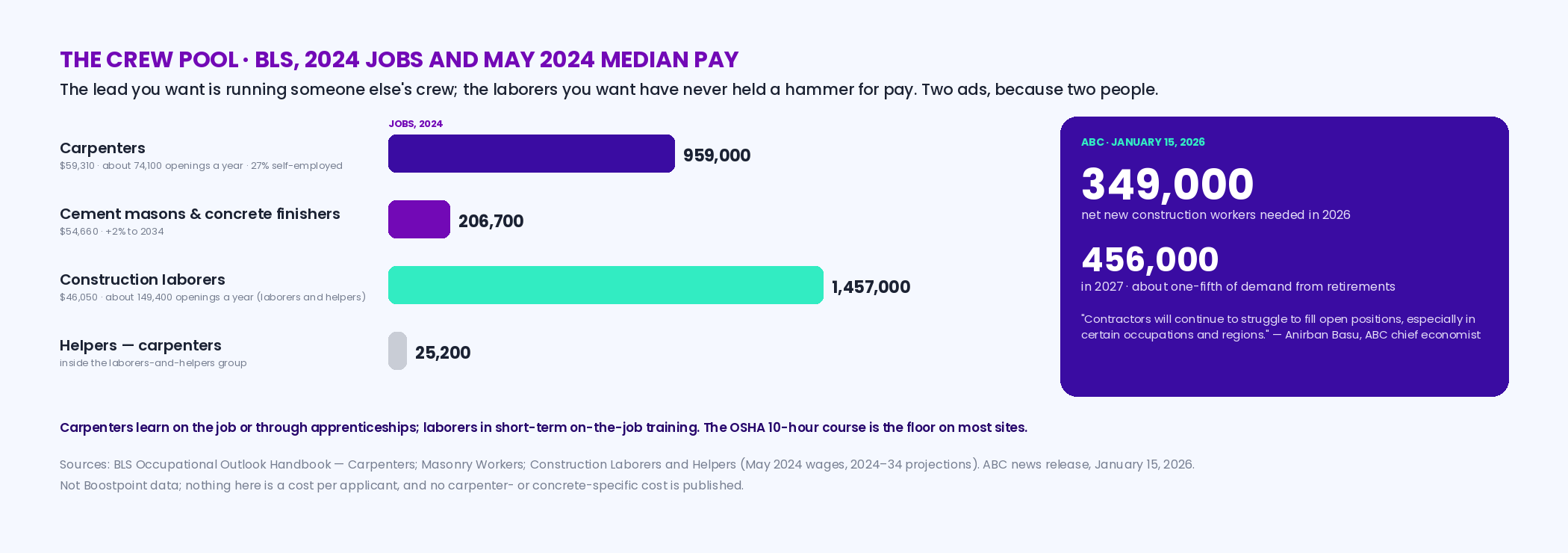
Carpenters and concrete finishers don't work alone, and they aren't hired alone either: a framing or flatwork crew is a lead who brings two or three people with him, and the rest is filled around him. So the plan has two ads — one for the lead, written for a person who is running someone else's crew today, and one for the laborers and helpers, written for a person with no experience and a truck. BLS counts 959,000 carpenters, 206,700 cement masons and concrete finishers and 1,457,000 construction laborers, and ABC says the industry needs 349,000 new workers in 2026. In Boostpoint's earlier trades analysis the form, not the trade, decided the outcome: application completion ran from 3.5% to 18.6% across contractors on the same channel.
Source: Boostpoint 2026 Social Job Advertising Benchmark — 891 Boostpoint-managed campaigns on Meta (1,334 campaign-months), 2026; costs are what advertisers paid for advertising only.
A note on who's writing this
Boostpoint runs social media job ads for contractors, so the sections of this page about the ad describe what we sell. We do not publish a carpenter-specific or concrete-specific cost per applicant, and we won't estimate one: 69% of the applications in our trades data sit in campaigns whose names don't identify the role, so any role-by-role ladder would be invented. The figures here are the skilled trades row of our 2026 benchmark and an earlier trades analysis, both labeled, plus BLS and ABC. No contractor is named, because we never confirmed permission. Whether a crew comes on as employees or as a subcontractor is a worker-classification question with legal consequences, and this page does not answer it — get that right before the ad runs. Every figure of ours is a cost per applicant, never a cost per hire.
The pool, and the number that says why it's hard
BLS counts 959,000 carpenters (2024), 27% of them self-employed, at a median $59,310 a year or $28.51 an hour (May 2024), with about 74,100 openings a year and pay that runs from $63,330 in nonresidential building to $58,090 with foundation, structure and exterior contractors; carpenters learn on the job or through apprenticeships, and the OSHA 10-hour course is the floor on most sites. Cement masons and concrete finishers are 206,700 jobs at a median $54,660, growing 2% with about 20,700 openings a year across all masonry trades. Underneath both sit the laborers and helpers — 1,457,000 construction laborers and 25,200 carpenters' helpers, median $46,050, growing 7% with about 149,400 openings a year, learned in short-term on-the-job training — which is the pool a crew is actually built from. ABC's January 2026 estimate is that the industry must attract 349,000 net new workers in 2026 and 456,000 in 2027, with about one-fifth of the demand coming from retirements; in Anirban Basu's words, "contractors will continue to struggle to fill open positions, especially in certain occupations and regions." For a contractor the arithmetic is simple: the lead carpenter you want is running a crew for someone else, and the laborers you want have never held a hammer for pay. The two ads are different because the two people are. And if the crew is going onto public work, the rate in the ad is set for you by a wage determination rather than by the market; see prevailing wage by state.
Hire the crew, not the carpenter
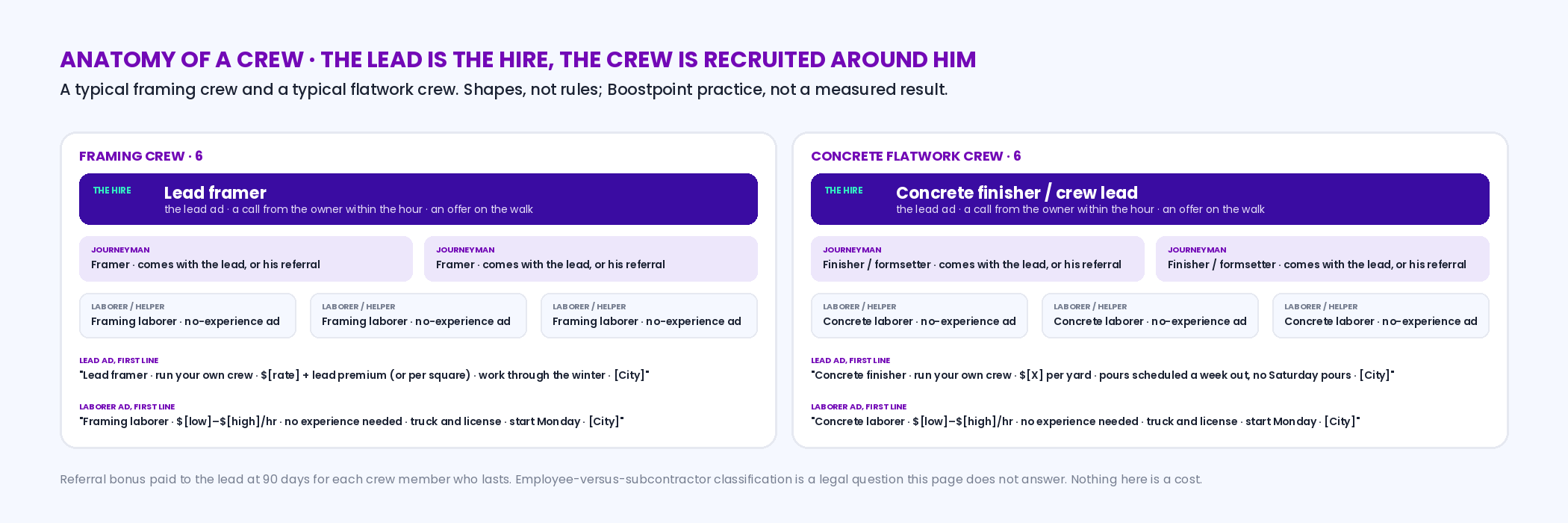
A framing crew is a lead and three to five people; a flatwork crew is a finisher who runs the pour and the laborers who place, screed and strip. The lead sets the pace, reads the plans, talks to the super and decides who shows up on Monday — and in residential work he often brings the crew with him when he moves, because the crew follows the lead, not the company. That changes the recruiting in three ways. First, the lead is the hire: one ad, written for a person who is running a crew today and is tired of the contractor he runs it for, that names the thing he can't get where he is — steady work through the winter, a truck, a rate per square or per yard he sets, the super's name. Second, the crew is recruited around him, and the lead does most of it: a referral bonus paid to the lead for each crew member who lasts ninety days costs nothing until it works, and a lead who brought three people with him has already done the screening. Third, the laborer ad is a separate ad for a separate person — no experience, a truck and a driver's license, a start date, the rate and the pay step at 90 days — because the laborer who wants to become a carpenter is the pipeline, and he does not read an ad headed "lead framer." The mechanics of the crew form, the walk-through and the callback are the same as on how to recruit construction workers; this page is the crew version of it.
Interactive
Crew builder — pick the crew, and get the lead ad, the laborer ad and the order to hire in
Nothing is stored or sent — this runs in your browser. Choose the crew type and size and the lead's pay structure; the builder lays out the crew, writes both first lines and the knockout questions, and puts the hires in order.
Boostpoint practice, assembled from your choices; rates are placeholders and, where a pay-transparency law applies, must be the range you pay. Crew composition is a typical shape, not a rule. Employee-versus-subcontractor classification is a legal question this tool does not answer. Nothing here is a cost.
What our trades data says — and what it refuses to say
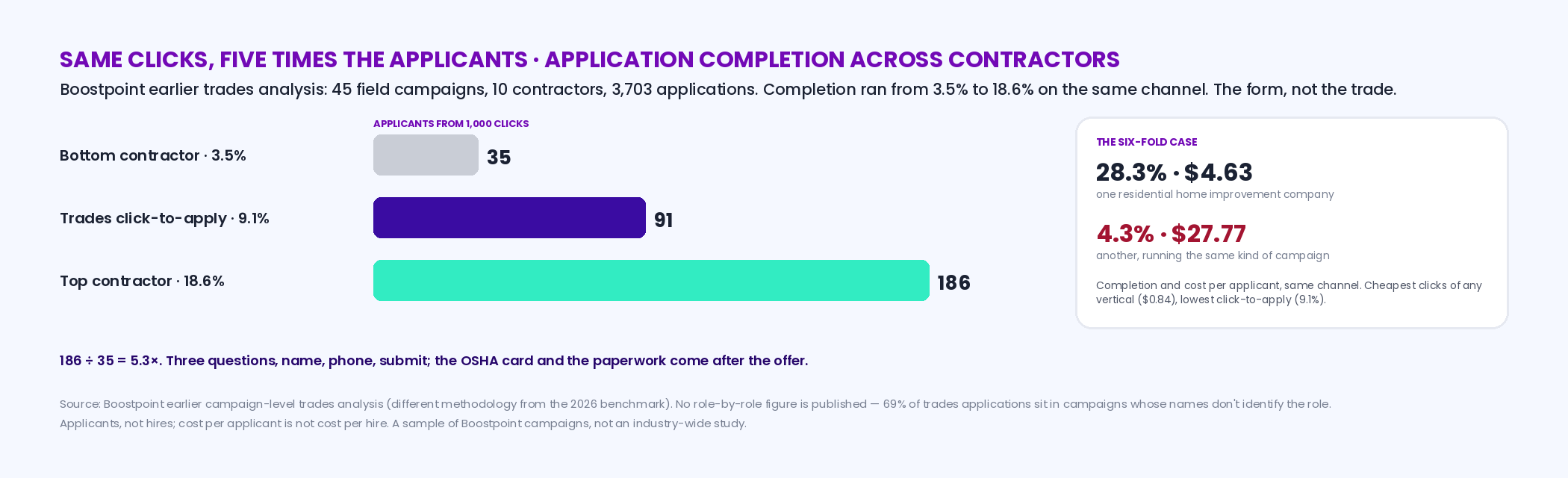
In the 2026 benchmark, skilled trades campaigns ran a median $14.14 per applicant (middle 50% $7.58–$21.49, 15% apply rate, 35 campaigns), inside a Skilled Trades & Field Service sector at $11.89 across 335 campaigns; the full picture is on what it costs to recruit skilled trades workers. The earlier campaign-level trades analysis — 45 field campaigns, 10 contractors, 3,703 applications, blended $9.28 — found the cheapest clicks of any vertical at $0.84 and the lowest click-to-apply at 9.1%, which is the whole story of trades recruiting in two numbers: the audience is cheap to reach and hard to get through a form. Application completion ran from 3.5% to 18.6% across contractors on the same channel, and in residential home improvement two companies running the same kind of campaign differed six-fold — 28.3% completion at $4.63 against 4.3% at $27.77. That is the form, not the trade. What the data will not say is what a carpenter costs against a concrete finisher: 69% of the applications came through campaigns whose names don't identify the role, so there is no honest role ladder, and this page doesn't print one. One more finding worth knowing before you write the ad: trades is the only vertical where older applicants cost more — 35–44 was the cheapest band at $8.29 and 65+ the most expensive at $13.25 — with no age targeting possible or used; the lead ad reaches the experienced crew runner through what it says, not who it's shown to.
Interactive
The completion gap — what the same clicks turn into at the bottom and top of the contractors we measured, and at your rate
Nothing is stored or sent — this runs in your browser. Enter a month's clicks and your own completion rate; the bars show applicants at 3.5%, at your rate and at 18.6%. Applicants, not costs.
3.5% and 18.6% are the lowest and highest application-completion rates across contractors in Boostpoint's earlier trades analysis (45 field campaigns, 10 clients, different methodology from the 2026 benchmark); 9.1% is that analysis's click-to-apply figure, prefilled as a placeholder for your rate. Arithmetic on your inputs; no cost is computed, and cost per applicant is not cost per hire.
The form that loses crews
A lead carpenter applies from the cab of his truck at 4:30 with a phone he can barely see, and a laborer applies from a phone that isn't his. Both stop at the same things: a résumé upload, a "create an account" screen, a work-history form with ten boxes, a question about certifications he has never heard of. The form that holds completion at the top of the range asks three things. For the lead: how many people are on the crew you run today, what do you frame (or pour) most, and when could you start. For the laborer: do you have a truck and a valid license, and are you available Monday. Name, phone, submit; the OSHA card, the I-9 and the classification paperwork come after the offer, on site, with the super. Then the callback: the lead gets a call from the owner within the hour, because he is deciding between two contractors this week and the one who calls first has him; the laborer gets a text with the address and a start time. On Meta the ads run in the Special Ad Category with no age, gender or ZIP targeting — the rules are on Meta Special Ad Category, explained — so "lead framer" and "no experience" in the first lines are the targeting. A dated crew hiring day at the yard, with the super present and offers made in the lot, is the event-driven structure that ran a median $8.02 per applicant in the benchmark; the mechanics are on open house hiring events. When a contractor should pay a construction staffing agency's 25–100% markup instead of running the two ads — a two-week pour, a crew in a market with no bench — is on construction staffing agency cost; the residential six-fold case is on residential home improvement hiring, and the finish side of the trade shares a pool with painters.
| The lead (carpenter / finisher running a crew) | The laborer / helper | |
|---|---|---|
| Who he is | Running someone else's crew today; BLS carpenters median $59,310, cement masons and concrete finishers $54,660 | No experience, a truck and a license; BLS construction laborers median $46,050, 149,400 openings a year |
| First line | "Lead framer · run your own crew · $[rate] + lead premium (or per square) · work through the winter · [City]" | "Construction laborer · $[low]–$[high]/hr · no experience needed · truck and license · start Monday · [City]" |
| Three questions | Crew size you run today · what you frame or pour most · start date | Truck and valid license? · available Monday? · (name and phone) |
| What happens next | Owner calls within the hour; walk the current job; the crew comes with him or is recruited around him with a referral bonus at 90 days | Text with the address and start time; OSHA 10 and paperwork on site after the offer |
| Where the data points | Completion 3.5%–18.6% across contractors — the form decides; trades click-to-apply 9.1%, CPC $0.84 (earlier analysis) | Same; event-driven structure $8.02 median per applicant, 21% apply (2026 benchmark) |
The crew follows the lead. Write the lead's ad for the man running someone else's crew, the laborer's ad for the one who's never held a hammer for pay, and ask each of them three questions — not ten.
Frequently asked questions
How do you hire carpenters?
By hiring the lead first: one ad written for a carpenter running someone else's crew that names what he can't get where he is — winter work, a truck, a rate he sets, the super's name — with a three-question form and a call from the owner within the hour. The crew is then recruited around him, mostly by him, with a referral bonus paid at 90 days, and a separate no-experience ad fills the laborer and helper slots.
How do you hire a concrete crew?
The same way, with a finisher in the lead slot: the person who runs the pour and reads the mix is the hire, the laborers who place, screed and strip are recruited around him. The finisher ad leads with the yards or squares, the pay structure and the schedule; the laborer ad leads with the rate, "no experience needed," a truck and a license, and a start date. BLS counts 206,700 cement masons and concrete finishers at a median $54,660.
What do carpenters and concrete finishers earn?
BLS puts the May 2024 median for carpenters at $59,310 a year ($28.51 an hour), from $58,090 with foundation, structure and exterior contractors to $63,330 in nonresidential building, and cement masons and concrete finishers at $54,660. Construction laborers earned a median $46,050. Your market and your pay structure — hourly, piece rate, salary and truck — decide the number in the ad, and it has to be the number you pay.
What does it cost to recruit carpenters?
We publish no carpenter- or concrete-specific figure, and won't estimate one: 69% of applications in our trades data sit in campaigns whose names don't identify the role. The skilled trades row of our 2026 benchmark ran a median $14.14 per applicant (15% apply rate, 35 campaigns), and the earlier trades analysis blended $9.28 with a typical range of $6–$17. Cost per applicant is not cost per hire.
Why do trades job ads get clicks but no applications?
Because the form is built for an office applicant. Trades had the cheapest clicks of any vertical in our earlier analysis ($0.84) and the lowest click-to-apply (9.1%), and completion ran from 3.5% to 18.6% across contractors on the same channel — a five-fold range that tracks the form, not the trade. Three questions, name, phone, submit; the OSHA card and the paperwork come after the offer.
Is there a construction labor shortage in 2026?
ABC's January 2026 estimate is that the industry must attract 349,000 net new workers in 2026 and 456,000 in 2027, with about one-fifth of the demand coming from retirements. BLS projects about 74,100 carpenter openings and 149,400 construction laborer openings a year through 2034. For a contractor the practical version is that the lead you want is employed and the laborers you want are inexperienced, which is why the two ads differ.
Should a crew be hired as employees or as a subcontractor?
That is a worker-classification question with legal and tax consequences under federal and state law, and it depends on how the work is controlled and paid; this page does not answer it, and the ad should not run until you have. What the recruiting plan needs either way is the same: the lead first, the crew around him, and two forms that ask three questions each.
Where do you find carpenters and concrete workers?
The leads are on other contractors' crews and on their phones at 4:30; the laborers are in warehouses, restaurants and high-school shop programs. Both are reached in the social feed with the right first line, through the lead's own referrals, and at a dated crew hiring day at the yard with the super present and offers made in the lot — the event-driven structure ran a median $8.02 per applicant in our benchmark.
If what you need first is the posting rather than the hiring plan, our carpenter job description template has the responsibilities, requirements and pay data ready to copy.
Run the lead ad and the laborer ad together
We'll write both first lines for your crew and your pay structure, put a three-question form behind each, run them where crew runners and laborers scroll, and show you the contractor campaigns closest to yours.
Book a DemoBoostpoint figures come from the 2026 Social Job Advertising Benchmark — 891 campaigns and 1,334 campaign-months: skilled trades median cost per applicant $14.14, middle 50% $7.58–$21.49, 15% apply rate, 35 campaigns; Skilled Trades & Field Service sector $11.89, 335 campaigns; event-driven $8.02, 21%, 78 campaigns. Earlier campaign-level trades analysis (different methodology): 45 field campaigns, 10 clients, 3,703 applications, blended $9.28, typical range $6–$17, CPC $0.84, click-to-apply 9.1%, application completion 3.5% to 18.6% across contractors, age bands 35–44 $8.29 and 65+ $13.25 with no age targeting; residential home improvement 28.3% / $4.63 against 4.3% / $27.77. No carpenter-, concrete- or role-specific figure is published, because 69% of trades applications are in campaigns whose names don't identify the role; no seasonality claim is made. Third-party figures — BLS Occupational Outlook Handbook (May 2024 wages, 2024–34 projections) for carpenters, masonry workers, and construction laborers and helpers; ABC (January 15, 2026); construction staffing markups of 25–100% as cited by staffing-industry sources — are theirs and attributed in place. No customer is named. Worker classification is a legal matter this page does not advise on. The builder and calculator are Boostpoint practice and arithmetic on your inputs, not measured results. Cost per applicant is not cost per hire; we do not track hires and publish no cost-per-hire figure. A sample of Boostpoint campaigns, not an industry-wide study.