
Hiring for Residential Home Improvement: Roofing, Siding and Exteriors
Residential contractors hire two workforces at once — crews who do the work and the sales side that sells it. Across 10,627 applications from home improvement companies, the biggest cost variable turned out not to be which of the two you're hiring. Two companies running the same kind of campaign differed six-fold, and the reason had nothing to do with the role.
The two-workforce problem
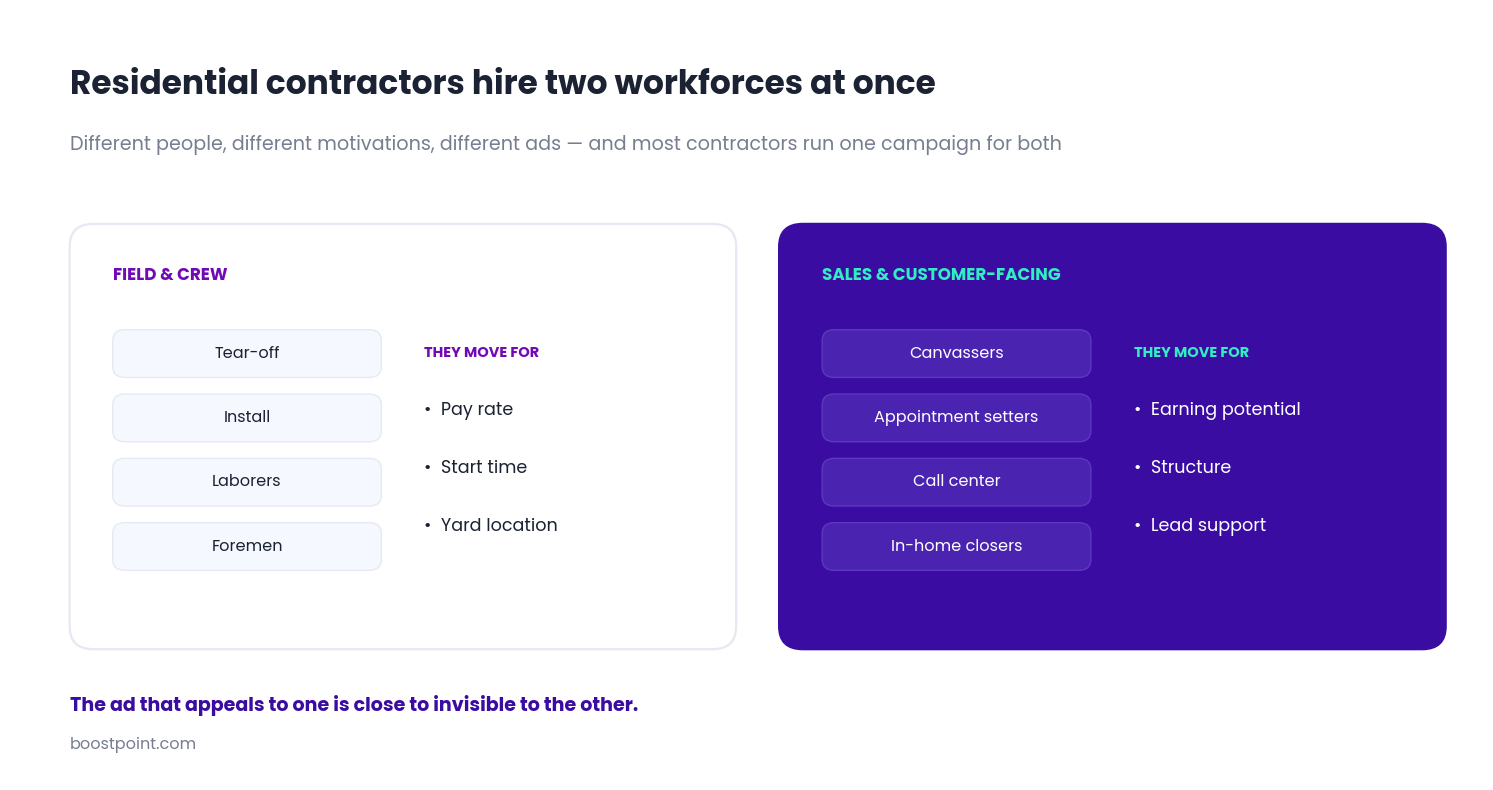
A roofing, siding or exteriors company hires people most contractors don't. Alongside crew — tear-off, install, laborers, foremen — you're hiring canvassers, appointment setters, call center staff and in-home closers. It's a wrinkle that doesn't show up anywhere else in skilled trades recruiting.
Those are genuinely different hires. They respond to different things, they're found in different places, and the ad that appeals to one is close to invisible to the other.
Across residential home improvement campaigns we ran in 2025 and 2026 — five companies, 10,627 applications:
| Metric | Field & crew roles | Sales & customer-facing |
|---|---|---|
| Applications | 1,153 | 9,474 |
| Cost per click | $0.55 | $1.26 |
| Application completion | 4.2% | 24.0% |
| Cost per applicant | $12.97 | $5.24 |
Source: Boostpoint-managed campaigns for five residential home improvement companies — spanning roofing, siding, exteriors, masonry and window replacement — run between 2025 and 2026, representing 10,627 applications on Meta platforms.
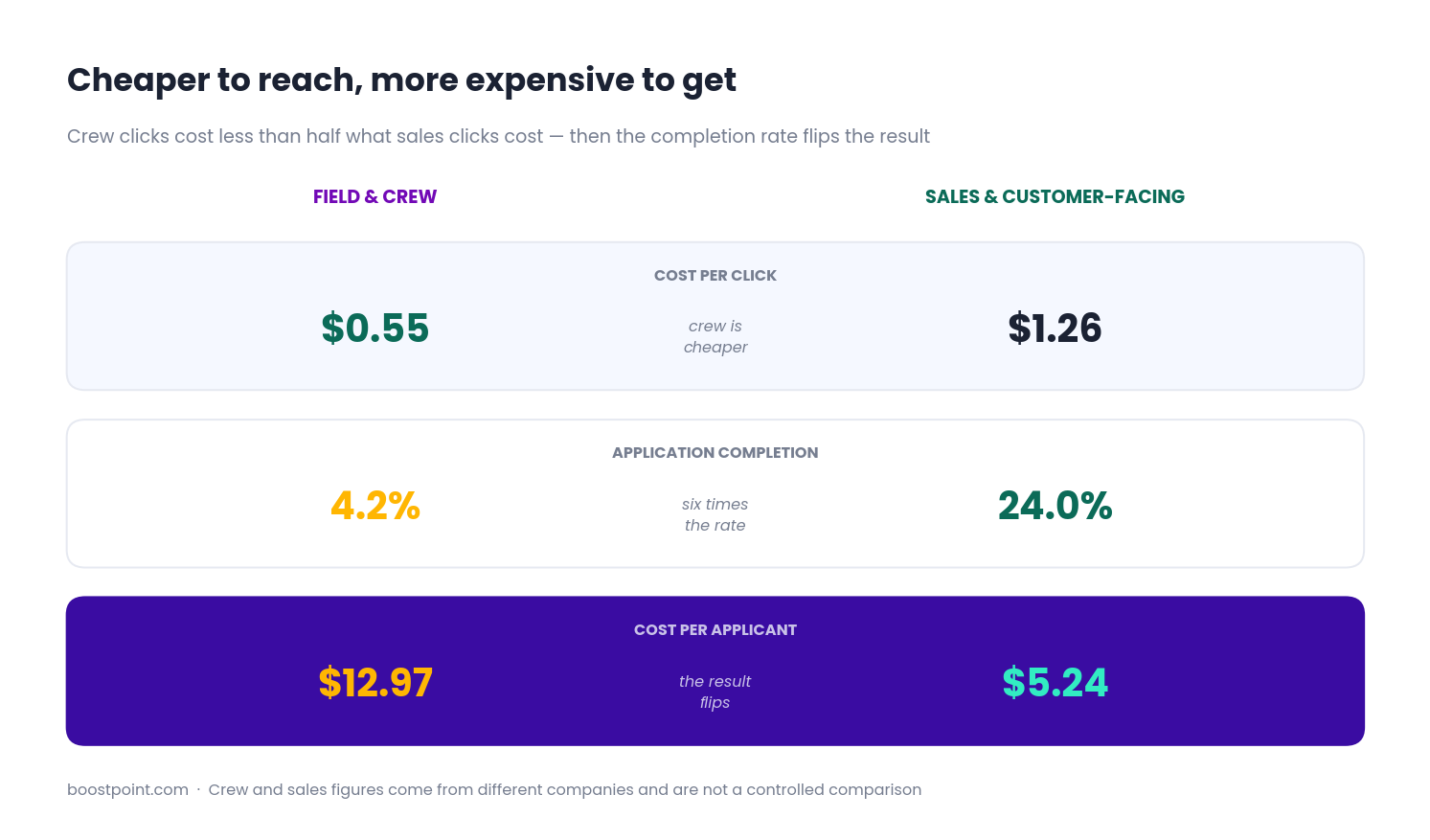
Read the middle two rows together, because they're the interesting part. Reaching crew is less than half the cost of reaching sales candidates — $0.55 a click against $1.26. Crew ads are cheap to run. The wider cost picture is in what trades recruiting costs.
Then crew applications complete at 4.2% and sales applications at 24.0%, and the cost per applicant flips entirely. You pay less to reach crew and more to get one.
That flip is the single most useful thing on this page, and it points somewhere most contractors don't look.
The variable that matters more than the role
It would be easy to conclude that crew roles are simply harder to hire for than sales roles. The data inside our own book says otherwise.
Two residential home improvement companies in this dataset both ran sales and canvassing campaigns — same role type, same segment, same channel, same year:
| Metric | Company A | Company B |
|---|---|---|
| Role type | Sales & canvassing | Sales & canvassing |
| Application completion | 28.3% | 4.3% |
| Cost per applicant | $4.63 | $27.77 |
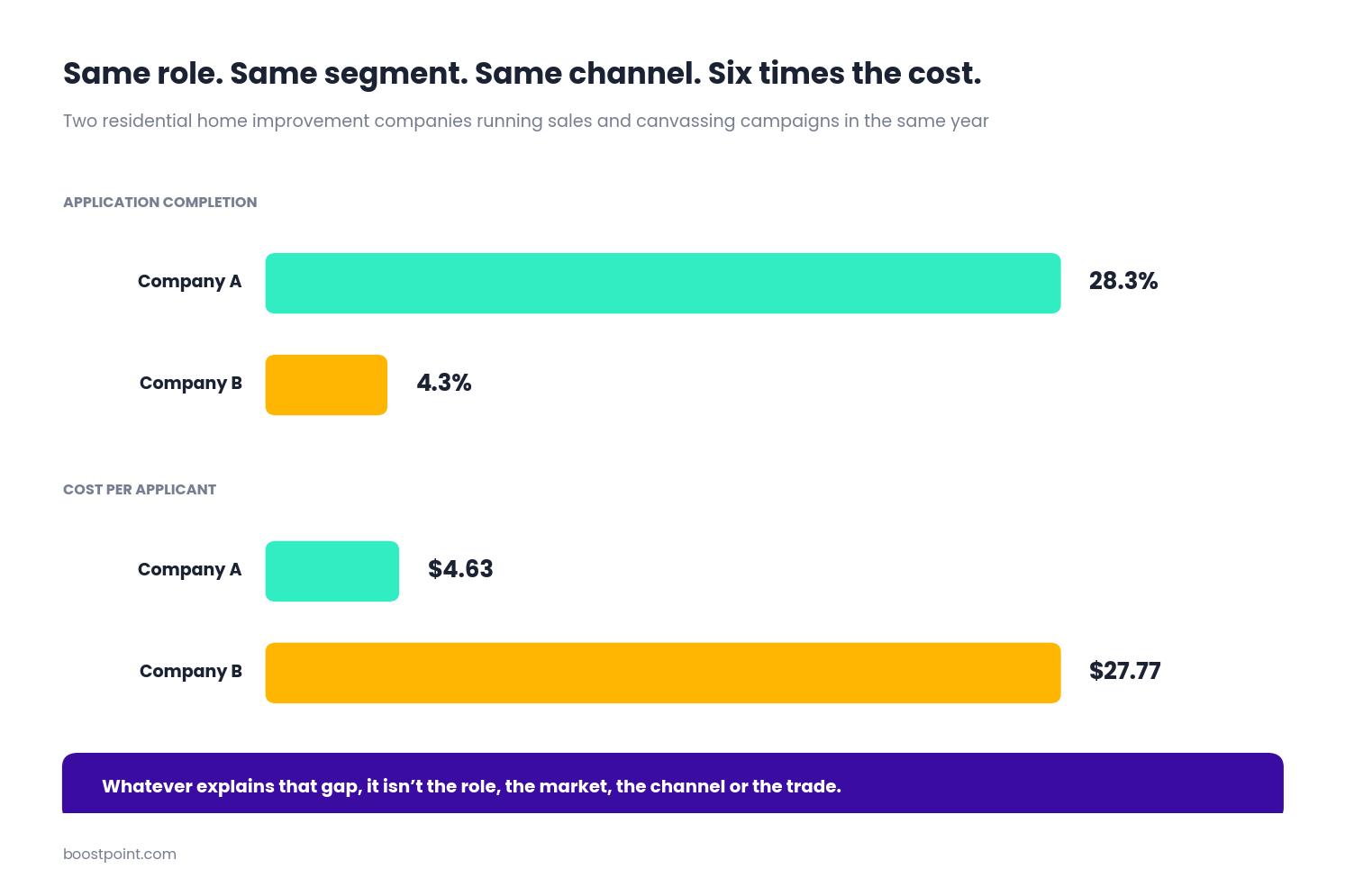
A six-fold difference in completion, and a six-fold difference in cost — for the same kind of role in the same industry.
Whatever explains that gap, it isn't the role, the market, the channel or the trade. Company B is paying six times more per applicant than Company A to hire the same kind of person.
In our experience the application is almost always the answer: how many questions it asks, whether it requires leaving the platform, and whether it can be completed one-handed on a phone in under ninety seconds.
Which reframes the whole crew-versus-sales question. The gap between a good form and a bad one is larger than the gap between your two workforces. A contractor with a well-built crew application will beat a contractor with a bad sales application, even though sales is supposedly the easier hire.
Why crew applications lose people
Crew campaigns in this segment complete at 4.2% — meaning about 96 of every 100 people who tap the ad and start applying don't finish.
Consider where they are. On a roof. Mid-afternoon. One hand free, two bars of signal, ninety seconds before someone needs them. Now the form asks for:
- A resume upload — which he doesn't have on his phone, and may not have at all
- Full employment history, hand-keyed, three employers deep
- Certification numbers and issue dates, from memory
- An account on an external careers site before the first real question
A canvasser applying from a couch at 8pm can push through all of that. A roofer on a job site cannot.
That's why the same form produces wildly different results for your two workforces, and why copying your sales application over to your crew postings doesn't work.
Run two campaigns, not one
The practical recommendation follows from the above, and it's the one most residential contractors get wrong.
A single campaign covering "roofing crew and sales reps — now hiring" has to speak generically enough to cover both, which means it speaks specifically to neither. And whichever role draws more volume will dominate the applications, leaving the other position open.
Separate campaigns let each ad do its actual job:
Crew ads
- Lead with pay rate, start time and yard location. These are the three things a working tradesperson compares against the job he already has.
- Use real footage of the crew and the equipment. Phone video is fine and outperforms stock.
- Keep the application to three or four questions. What he can run, years in the trade, transportation and start-time availability, any required certification as a yes/no.
- State the hard parts — 6am starts, heights, travel between sites. Losing someone at the ad stage is far cheaper than losing him on day three.
Sales ads
- Lead with earning potential and structure. Commission, base plus commission, realistic first-year range.
- Address the objection directly. Most people assume door-to-door means cold-calling strangers with no support. If you provide leads, appointments or training, that belongs in the first two lines.
- Sales applications can be slightly longer, because the audience is applying from a laptop or a couch — but 24% completion is still not 50%, and shorter still wins.
What this segment doesn't tell you
Being straight about the limits.
- We don't have roofing-specific cost data. The figures here are drawn from residential home improvement companies broadly — roofing, siding, exteriors, masonry and window replacement. Anyone publishing a confident cost-per-roofer figure is doing arithmetic we'd be uncomfortable with.
- The sales figures are concentrated. One company accounts for the large majority of the 9,474 sales applications, which is why we've shown the two-company comparison separately rather than leaning on the segment average.
- This is cost per applicant, not per hire. Your conversion from applicant to hire depends on your screening, your offer and how fast you call.
- Crew and sales figures come from different companies. They aren't a controlled comparison of the same contractor hiring both, and shouldn't be read as one.
Frequently asked questions
How much does it cost to hire a roofing crew member?
Across residential home improvement field and crew campaigns, applicants cost $12.97 on average. We don't publish roofing-specific figures — our data covers residential contractors broadly, including siding, exteriors, masonry and window replacement, and we can't cleanly separate roofing from the rest.
Why do crew applicants cost more than sales applicants?
Not because they're harder to reach — crew clicks cost $0.55 against $1.26 for sales. The difference is application completion: 4.2% for crew against 24.0% for sales. Crew members apply from job sites with poor signal and limited time, and long forms lose them.
Should we run one campaign for crew and sales roles?
No. They respond to different things — crew to pay rate, hours and location; sales to earning potential and lead support. A blended ad speaks specifically to neither, and whichever role draws more volume will crowd out the other.
What's the biggest factor in our cost per applicant?
The application form, more than the role. Two residential home improvement companies in our data ran the same kind of sales campaign and differed six-fold in both completion rate and cost per applicant. That gap is larger than the gap between crew and sales roles.
How short should a crew application be?
Three or four questions: what equipment or work they've done, years in the trade, transportation and start-time availability, and any legally required certification as a yes/no. Resume, references and employment history belong on the phone call.
Does social media advertising reach experienced crew or just young workers?
Experienced crew. Across our trades campaigns, applicants aged 35 to 44 were the largest group and the cheapest to reach, with about half of all applicants between 35 and 54. Under-25s were 5.4% of applications.
What should a canvassing or sales ad say?
Earning potential and structure up front, and an immediate answer to the assumption that door-to-door means cold-calling with no support. If you supply leads, set appointments or provide training, say so in the first two lines.
How fast do we need to follow up?
Same day for both workforces, and same hour for crew. Tradespeople apply to several contractors in one sitting and go cold within hours. If nobody can work applications same-day, fix that before spending on advertising.
See what it costs to fill your crews
Book a 30-minute call and we'll walk through cost per applicant for both sides of your hiring — crew and sales — in the markets you work in.
Book a Free DemoFigures come from Boostpoint-managed campaigns for five residential home improvement companies — spanning roofing, siding, exteriors, masonry and window replacement — run between 2025 and 2026, representing 10,627 applications on Meta platforms. Sales and customer-facing figures are concentrated among a small number of advertisers and the two-company comparison is shown separately for that reason. Crew and sales figures are drawn from different companies and are not a controlled comparison of one contractor hiring both. Costs are what advertisers paid for advertising only. This is a sample of Boostpoint campaigns, not an industry-wide study.
Related: Skilled Trades Recruiting · What It Costs to Recruit Skilled Trades Workers · Social Media Recruiting for Contractors