
How to Hire Painters: Where They Are, What the Ad Has to Name, and the Form That Loses Them
To hire painters, recruit from the two places painters actually are — 42% work for painting and wall covering contractors and 31% are self-employed (BLS, 2025) — with an ad that names the work (repaint or new construction, brush-and-roll or spray), prints the pay as a weekly number, states whether tools and transport are provided, and asks about EPA RRP certification before the interview. Then keep the application under a minute: in Boostpoint's trades campaigns, application completion ranged from 3.5% to 18.6% across contractors running the same kind of ads, and that range, not the labor market, decided what each one paid.
Source: BLS Occupational Outlook Handbook for the employer split; Boostpoint's earlier campaign-level trades analysis (45 field campaigns) for application completion, a different methodology from the 2026 Social Job Advertising Benchmark of 891 Boostpoint-managed campaigns on Meta.
A note on who's writing this
Boostpoint runs social media job ads for painting contractors and other trades employers, so this page is a vendor's page, and the part of it that recommends advertising is the part we sell. The labor-market facts are BLS's, from the Occupational Outlook Handbook, and the lead-paint rule is the EPA's; both are quoted and dated. Our own figures come from the 2026 Social Job Advertising Benchmark and an earlier campaign-level analysis of trades campaigns, labeled where used, with the methodology at the bottom. One thing you won't find here is a painter-specific cost per applicant: 69% of the applications in our trades campaigns came from campaigns whose names don't identify the role, so we can't separate painters from the rest honestly, and we won't pretend to. Siding and exterior crews have their own page on residential home improvement hiring; this one is painters only.
Where painters are, according to the people who count them
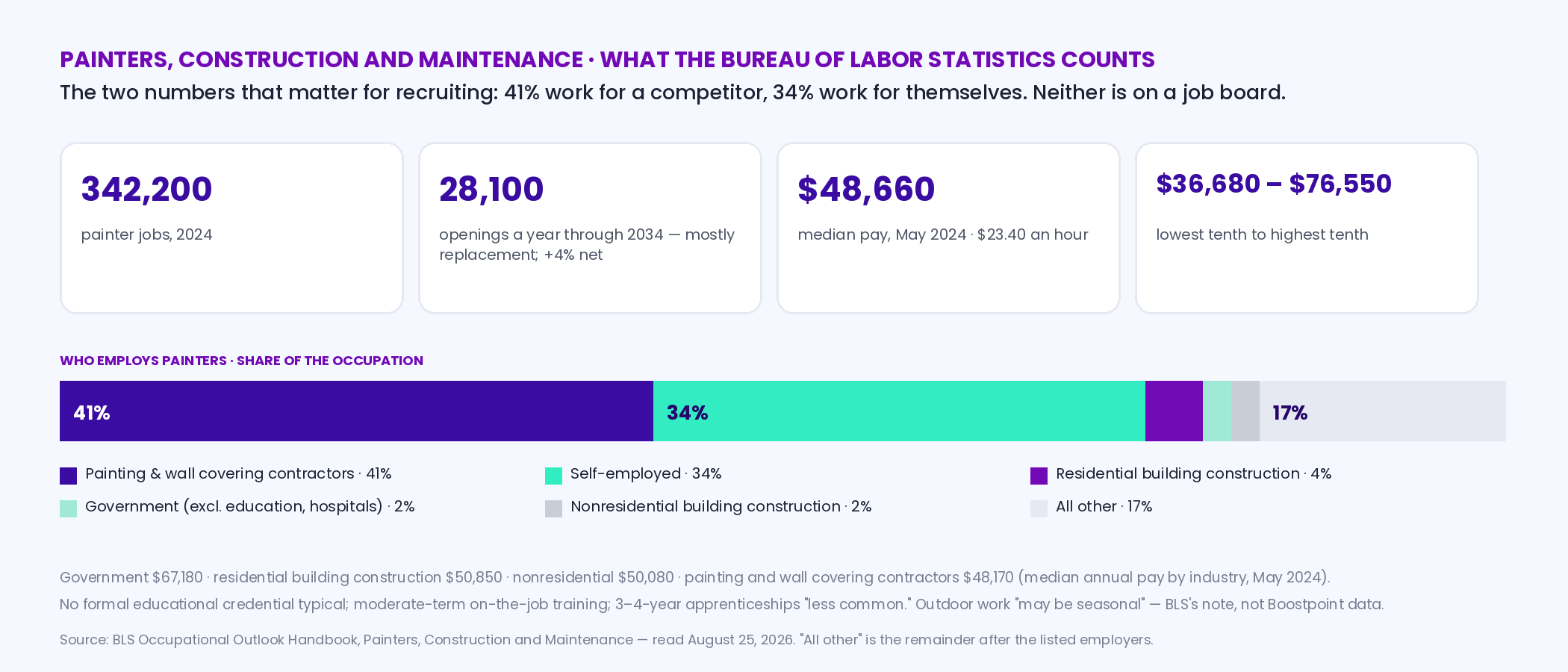
The Bureau of Labor Statistics counted 326,900 painter jobs in 2025 and projects about 24,900 openings a year through 2035 — most of them, in BLS's words, "to replace workers who transfer to different occupations or exit the labor force, such as to retire," with net growth of 3%, about average. Median pay was $49,400 a year, $23.75 an hour in May 2025, with the lowest tenth under $37,440 and the highest tenth above $78,810; painters at painting and wall covering contractors had a median of $48,830, residential building construction $52,000, and government $69,660. No formal educational credential is typical; training is moderate-term on the job, and BLS notes that 3-to-4-year apprenticeships exist but are "less common."
The employer split is the recruiting fact. 42% of painters work for painting and wall covering contractors — your competitors — and 31% are self-employed. That second group is the one most employers never advertise to: the one-truck painter who bids their own jobs, carries their own insurance, and would take a W-2 position for steady hours, a crew, and a paycheck that doesn't depend on collecting. They are not on job boards. They are on Facebook, in the paint-store parking lot at 6:45 a.m., and in the referral networks of your current crew. The pool is real; the channels that reach it are not the ones most contractors use.
What a painter reads first in a job ad
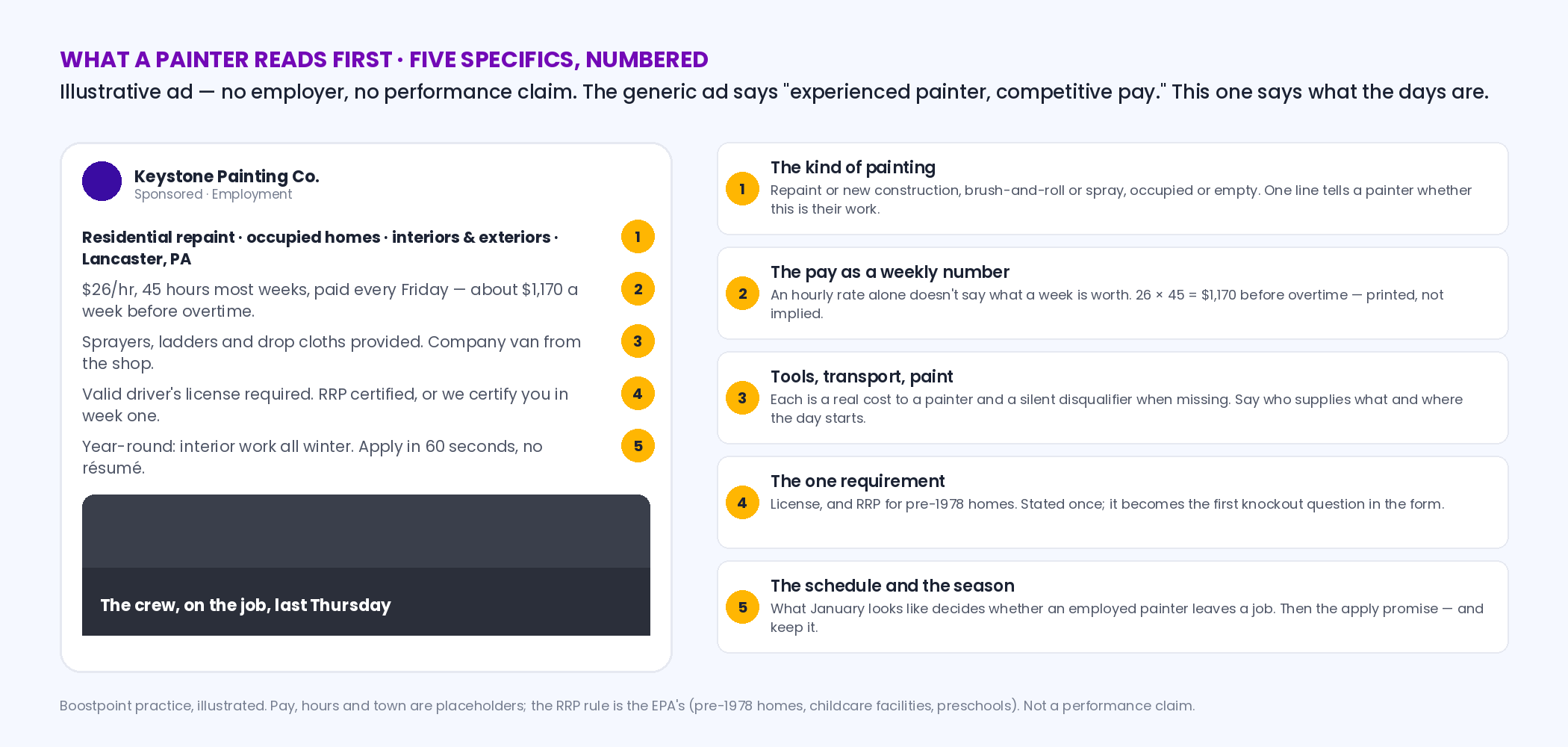
Painters screen an ad the way they walk a job before quoting it: for specifics that tell them what the days will be like. The generic ad — "experienced painter wanted, competitive pay, great team" — tells them nothing and reads as a company hiding the rate. The ad that gets answered names five things, in this order.
- The kind of painting. Residential repaint, new-construction production, commercial interiors, industrial coatings, and cabinet finishing are different jobs with different people. "Residential repaint, occupied homes, interiors and exteriors" or "New-construction production, spray, tract homes" tells a painter in one line whether this is their work.
- The pay, as a weekly number. Painters are paid hourly, by the day, or by the piece depending on the shop, and an hourly rate alone doesn't tell them what the week is worth. "$26/hr, 45 hours most weeks, paid every Friday — about $1,170 a week before overtime" is the line; the translator below builds it.
- Tools, transport, and who buys the paint. Do you provide sprayers, ladders, and drop cloths, or are they bringing their own? Is there a company truck or a mileage rate? Do they meet at the shop or at the job? Each of these is a real cost to a painter and a silent disqualifier when it's missing.
- The one requirement. A valid driver's license and reliable transportation are the usual ones; for pre-1978 residential work, RRP certification or the willingness to get it in the first week. State it once, plainly, and make it the first knockout question.
- The schedule and the season. Whether it's year-round interior work or exterior work that BLS notes "may be seasonal," say so. A painter deciding whether to leave a job wants to know what January looks like.
Name the crew you're hiring for
Pick the kind of shop you run and the panel shows what to name in the ad and what to ask in the form. The ad line at the bottom of each is a starting point, not a template to paste; put your own rate and town in it.
Residential repaint — occupied homes, interiors and exteriors
Name in the ad
- Brush-and-roll finish quality; cut-in skill matters more than speed
- Occupied homes: customer-facing, clean-site expectations
- Whether winter is interior work (year-round) or a layoff
- Company van or mileage; tools and drop cloths provided
Ask in the form
- Valid driver's license and reliable transportation?
- RRP certified, or willing to certify in the first week? (pre-1978 homes)
- Two years of residential repaint experience?
New-construction production — tract homes, spray
Name in the ad
- Spray work: airless experience, back-rolling, production pace
- Piece or day rate vs hourly — say which, and what a typical week pays
- Start time at the site, and whether the crew travels between subdivisions
- Who supplies sprayers, tips, and hoses
Ask in the form
- Airless spray experience — yes / no?
- Own transportation to job sites?
- Available to start at 6:30 a.m.?
Commercial interiors — tenant fit-outs, night and weekend work
Name in the ad
- Night or weekend hours and the differential for them
- Lift work: scissor or boom lift certification, fall protection
- Drywall finishing or wallcovering as part of the job, or not
- Prevailing-wage or union status if it applies
Ask in the form
- Available for night shifts?
- Lift certified (scissor / boom)?
- Commercial or fit-out experience?
Industrial coatings — plants, tanks, bridges, blasting
Name in the ad
- Abrasive blasting, epoxy and urethane systems, confined space
- Travel and per diem — how much of the year is away
- Respirator fit testing and the physical that goes with it
- Certifications you value (name them) and which you'll pay for
Ask in the form
- Willing to travel with per diem?
- Blasting or coatings experience?
- Able to pass a respirator fit test and physical?
Turn the rate into a paycheck
A painter comparing your ad with the job they have does the same arithmetic every time: what is a week actually worth, after the hours are real and before overtime. Hourly shops and piece-rate shops make that comparison hard by printing different units. Do the arithmetic in the ad so they don't have to.
Nothing is stored or sent — this runs in your browser. Enter your rates; the ad line at the bottom updates. Illustrative arithmetic, not a wage recommendation.
Hourly shop
Piece-rate shop
Overtime is calculated at 1.5× the hourly rate for hours past the threshold you enter; check your state's rules. Piece-rate pay must still meet minimum-wage and overtime law for the hours worked — that is the employer's responsibility, not this tool's. Figures are whatever you type; Boostpoint publishes no painter wage recommendation.
The RRP question, before the interview
If you paint occupied homes, you already know the EPA's Lead Renovation, Repair and Painting Rule: anyone paid to perform work that disturbs painted surfaces in homes, childcare facilities, and preschools built before 1978 must work for a certified firm and be trained as a certified renovator or on the job by one. Fourteen states and one tribe run their own programs in place of the EPA's. What most painting contractors don't do is use the rule as a screening question. "Are you RRP certified, or willing to complete the course in your first week?" in the application form does three things: it sorts out the applicant who won't, it reassures the experienced painter that you run a legal shop, and it lets you print "we pay for the RRP course" in the ad — a real benefit that costs a day and a course fee. Whether you require certification at hire or provide it is your call; asking the question is not.
Where to find painters: the channels, honestly ranked
| Channel | Who it reaches | What it costs you | The honest note |
|---|---|---|---|
| Your crew's referrals | Painters your painters have worked beside, including the self-employed ones between jobs | A bonus, paid in installments at 30 and 90 days | Often the fastest hire, and the one most likely to stay. Ask for one name each, every quarter, not once. |
| Social feed ads (Facebook, Instagram) | Employed and self-employed painters who aren't searching — 73% of the trade, by BLS's employer split | A monthly ad budget (minimum $750/month) plus a separate Boostpoint subscription; the 2026 benchmark's skilled trades row shows a $14.14 median cost per applicant (middle 50% $7.58–$21.49, 35 campaigns), not a painter-specific figure | What we sell. Works when the ad names the work and the form takes a minute; expensive when it sends people to a long application. |
| The paint store | Pros at the contractor desk at 6:45 a.m., and the store staff who know who's between jobs | A flyer with the weekly pay on it, and your time | Old-fashioned and still real. Say the rate on the flyer; the pros compare it to what they bill. |
| Job boards | The minority actively searching this week — mostly less experienced, or the same people every contractor in town sees | Per post or per click, depending on the board | Fine for entry-level; rarely where an experienced painter is. In our earlier trades analysis, click-to-apply was 9.1% — the form loses them. |
| Staffing agencies | Temp painters at a markup, for a job you can't staff this week | A percentage on top of the wage; see the trades cost page | Right for a surge on one commercial job. Wrong as a way of staffing a crew for a season. |
| Apprenticeship and trade programs | Entry-level painters with some training; BLS calls formal painting apprenticeships "less common" | Your time, and a pay scale that steps up | Slow, and worth it for a shop that plans to be here in five years. |
The form is where painters are lost
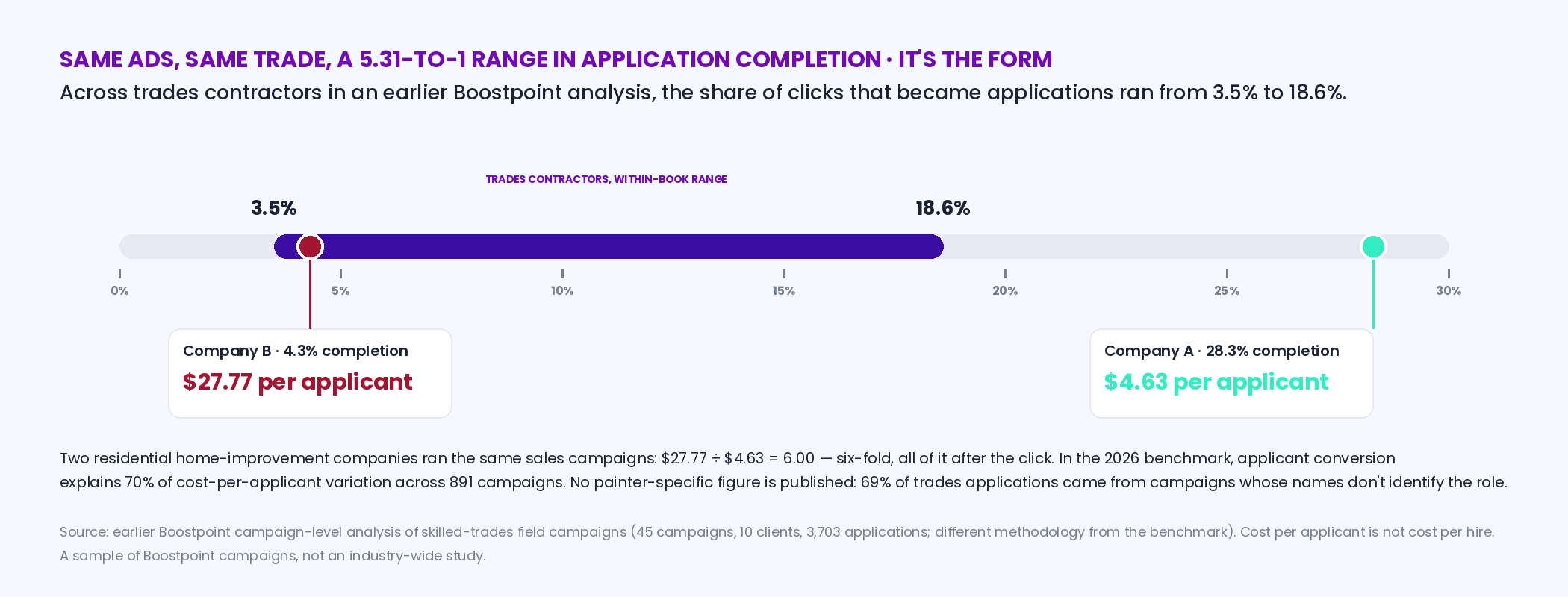
Across the trades campaigns in our earlier analysis, the share of clickers who completed an application ranged from 3.5% to 18.6% across contractors — a 5.31-to-1 range, running the same kind of ads to the same kind of people. The clearest case was two residential home-improvement companies running the same sales campaigns: one completed 28.3% of clicks at $4.63 per applicant, the other 4.3% at $27.77. Same offer, six-fold difference, all of it in the application. Cost per applicant is the ad spend divided by the people who finish the application, so every painter who taps and then abandons a long form raises it. For a painter on a phone at the end of a ten-hour day, a one-minute form with three questions — license, RRP, experience — gets completed; an application that asks for a résumé, references, and a login does not, and the ad gets blamed. Our what makes a good job ad page has the anatomy; the trades cost page has the sector figures.
Painter recruiting, start to finish, in one week
- Monday: write the ad with the five specifics above and the weekly pay line from the translator. Build the form: license, RRP, experience. Shoot a fifteen-second phone video of the crew on a job.
- Tuesday: launch the social campaign around the towns your jobs are in. Ask each painter on the crew for one name, with the bonus in writing. Drop a flyer at the paint store with the weekly number on it.
- Wednesday to Friday: text every applicant within the hour, call the same day, interview on the job site within 48 hours — a painter would rather see the work than an office — and offer on the spot with a start date.
- The following week: RRP course for anyone who needs it, paid. Keep the campaign on: 24,900 openings a year nationally means the next vacancy is coming, and a list beats a scramble.
Painters are not hard to find. Nearly three in four work for a competitor or for themselves, and neither is on a job board. Name the work, print the week, ask the RRP question, and keep the form to a minute.
Frequently asked questions
How do I hire painters?
Recruit where painters are — 42% work for painting and wall covering contractors and 31% are self-employed, per BLS — with a job ad that names the kind of painting, prints the pay as a weekly number, states whether tools and transport are provided, gives the one requirement, and says what the schedule is year-round. Run it where employed painters actually look (social feeds, referrals, the paint store), not only on job boards, and keep the application to one minute with three knockout questions: license, RRP certification, experience.
Where can I find painters to hire?
Your current crew's referrals first — painters know painters, including the self-employed ones between jobs. Social feed advertising reaches the nearly three in four painters who are employed or self-employed and not searching. The contractor desk at the paint store at opening time is a real channel; so is a flyer there with the weekly pay on it. Job boards reach the minority actively searching; staffing agencies supply temps at a markup for a job you can't staff this week. Apprenticeships and trade programs supply entry-level painters slowly.
How much do painters make?
Per the BLS Occupational Outlook Handbook, the median for painters, construction and maintenance was $49,400 a year or $23.75 an hour in May 2025; the lowest tenth earned under $37,440 and the highest tenth over $78,810. By industry: painting and wall covering contractors $48,830, residential building construction $52,000, nonresidential $49,980, government $69,660. Your local market will differ; print your rate and the weekly hours in the ad rather than "competitive pay."
Is there a shortage of painters?
BLS projects about 24,900 openings a year through 2035, most of them replacement rather than growth (net growth of 3%, about average). That is a steady churn, not a collapse. Most contractors who say they can't find painters are advertising to the searching minority on job boards while 73% of the trade is employed elsewhere or self-employed and never looks there. The fix is the channel and the ad, not the labor market.
What should a painter job ad include?
Five things, in order: the kind of painting (residential repaint, new-construction spray, commercial interiors, industrial coatings); the pay as a weekly number with the hours behind it; tools, transport, and who supplies the paint; the one hard requirement (license, RRP for pre-1978 homes); and the schedule, including what winter looks like. Then an apply promise you keep: one minute, no résumé, a call the same day. Leave out "competitive pay," "fast-paced," and "like a family."
Do painters need RRP certification?
Under the EPA's Lead Renovation, Repair and Painting Rule, anyone paid to disturb painted surfaces in homes, childcare facilities, and preschools built before 1978 must work for a certified firm and be trained as a certified renovator or on the job by one; fifteen states and one tribal entity run their own programs. For a residential repaint shop that means the firm must be certified and the crew trained. Ask about it in the application, and consider paying for the course — it is a cheap, real benefit to advertise.
Should I pay painters hourly or by the piece?
That is a business decision this page doesn't make for you, and either has to meet minimum-wage and overtime law for the hours actually worked. What we can say is that whichever you pay, print the week: a painter comparing your ad to their current job wants to know what a typical week is worth before overtime, and an hourly rate or a per-house rate alone doesn't tell them. The translator on this page turns either format into the same weekly number for the ad.
What does it cost to recruit a painter with advertising?
We don't publish a painter-specific figure, because 69% of applications in our trades campaigns came from campaigns whose names don't identify the role and we won't guess. What we publish: the 2026 benchmark's skilled-trades row shows a $14.14 median cost per applicant, with the middle 50% of campaigns between $7.58 and $21.49, across 35 campaigns. The spread inside that range is the form — completion ranged from 3.5% to 18.6% across contractors. Cost per applicant is not cost per hire.
Put your crew's ad in front of the painters who aren't looking
We'll write the ad with the weekly number in it, build the three-question form, and show you the trades campaigns closest to yours from our benchmark — costs, no painter figure we can't back.
Book a DemoBoostpoint figures come from the 2026 Social Job Advertising Benchmark — 891 campaigns and 1,334 campaign-months: skilled trades median cost per applicant $14.14, middle 50% $7.58–$21.49, 35 campaigns. Earlier campaign-level analysis of skilled-trades field campaigns (different methodology): 45 campaigns, 10 clients, 3,703 applications, click-to-apply 9.1%, application completion 3.5%–18.6% across contractors, and two residential home-improvement companies running the same sales campaigns at 28.3% completion / $4.63 vs 4.3% / $27.77; 69% of trades applications came from campaigns whose names do not identify the role, so no painter-specific cost per applicant is published. Cost per applicant is not cost per hire; we do not track hires and publish no cost-per-hire figure. Channel rankings, the five ad specifics, the one-week plan, and the pay-format translator are Boostpoint's practice and arithmetic, not measured results. Third-party: BLS Occupational Outlook Handbook, Painters, Construction and Maintenance (May 2025 wages; 2025 employment; 2025–35 projections; employer shares; training), read October 8, 2026; EPA Lead Renovation, Repair and Painting Program, read October 8, 2026. Verify pay, licensing, and lead-safe rules for your state before hiring. This is a sample of Boostpoint campaigns, not an industry-wide study.