
Welder Recruiting and the Welder Shortage: How to Hire Without Agency Markups
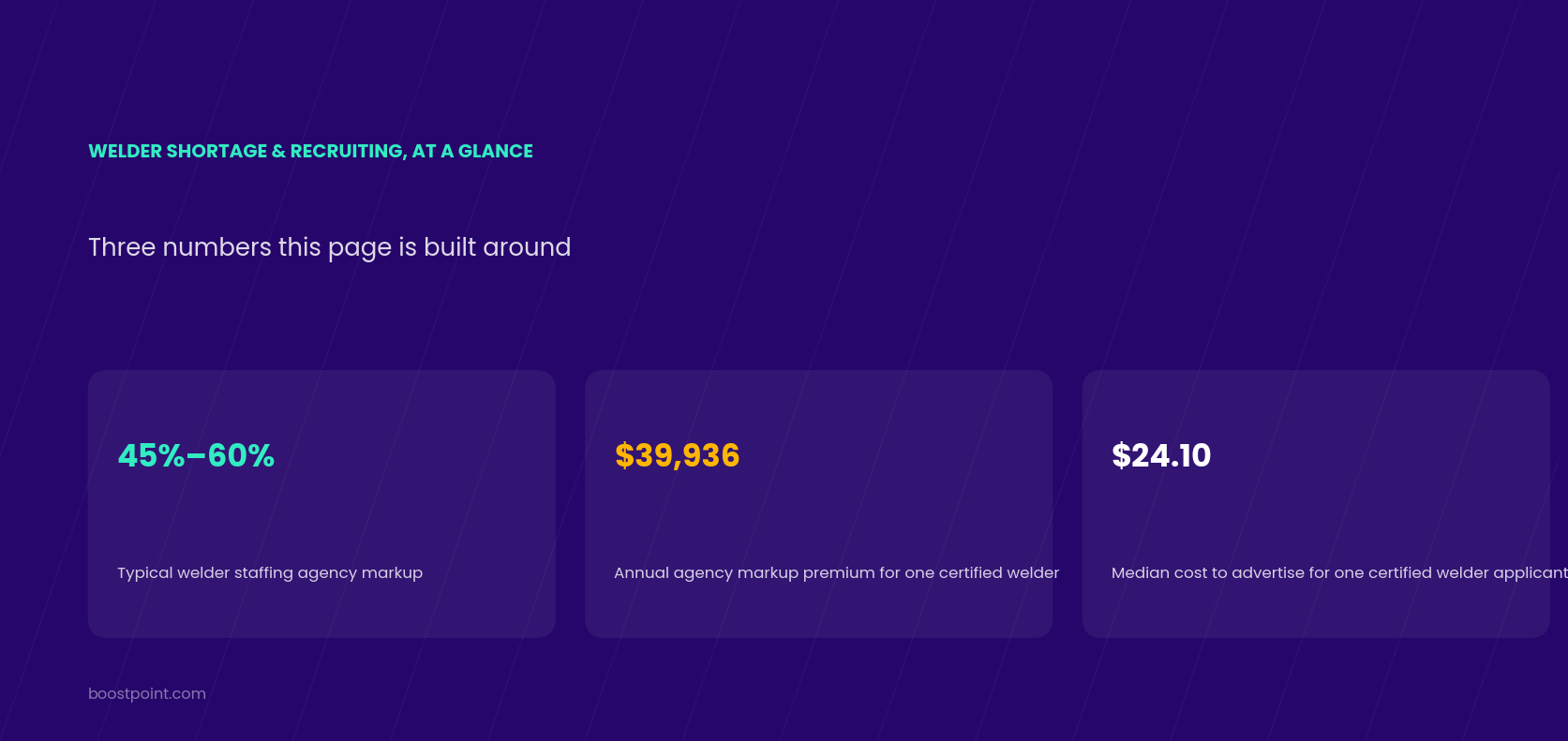
To combat the national welder shortage, many manufacturers and contractors rely on specialized welder staffing agencies that typically charge a 45% to 60% markup on hourly wages. For a certified welder earning $32.00/hour, the agency bills up to $51.20 per hour — adding $39,900+ in annual markup costs per worker. Alternatively, Boostpoint-managed social media recruitment campaigns generate certified welder applicants for an average cost of $24.10 each, allowing employers to build a direct hiring pipeline for a fraction of the cost.
Source: Boostpoint campaign data — managed construction, skilled trades, and manufacturing recruitment campaigns conducted in 2025–2026 across contractors and fabrication shops nationwide.
A note on who's writing this
Most articles about the welder shortage and how to hire welders are written by industrial staffing agencies. Their content naturally frames the talent shortage as an impossible hurdle for in-house HR, steering you toward their contingent labor services and high hourly markups.
Boostpoint is not a staffing agency. We build recruitment advertising software that helps commercial contractors, manufacturers, and fabrication shops generate their own direct applicants through targeted social media campaigns.
We recognize that for short-term, 14-day plant shutdowns or disaster recovery, specialized welder staffing agencies are invaluable. But for maintaining baseline production capacity, relying on agency labor is financially devastating. We are providing the exact 2026 financial benchmarks that agencies leave out, showing you what it actually costs to recruit certified welders directly.
The demographic reality of the welder shortage
The welder shortage is not a myth, nor is it merely a local problem for your fabrication shop. It is driven by systemic macroeconomic and demographic trends.
Industry reports consistently show that the manufacturing and industrial construction sectors are losing older, highly skilled tradespeople faster than trade schools can replace them. The American Welding Society estimates a deficit of hundreds of thousands of welders through the end of the decade.
For hiring managers of commercial contractors, manufacturers, and fabrication shops, the implication is simple: you are not recruiting from a pool of unemployed welders. The skilled welders you need are currently employed, working on a plant floor or job site right now. If your recruitment strategy relies solely on capturing active job seekers, your pipeline will remain empty.
The true cost of using a welder staffing agency
When job boards fail to produce applicants, operations default to welder staffing agencies. These agencies supply the talent, carry the workers' compensation liability, and bill your company a steep hourly premium.
Because welding involves high-hazard environments, specialized certifications (AWS, ASME), and intense physical labor, the markups are among the highest in the skilled trades sector.
| Agency service type | Typical agency markup range |
|---|---|
| MIG / TIG Production Welders | 45% – 55% |
| Certified Pipefitters & Structural Welders | 50% – 60% |
| Short-Term Turnaround / Shutdown Crews | 60% – 75%+ |
What that markup means per hour and per worker
Consider a standard full-time schedule (2,080 hours per year) for a certified welder:
| Welder role | Base wage | 50% markup bill rate | 60% markup bill rate | Annual agency markup premium per seat |
|---|---|---|---|---|
| Production Welder | $25.00/hr | $37.50/hr | $40.00/hr | $26,000 – $31,200 |
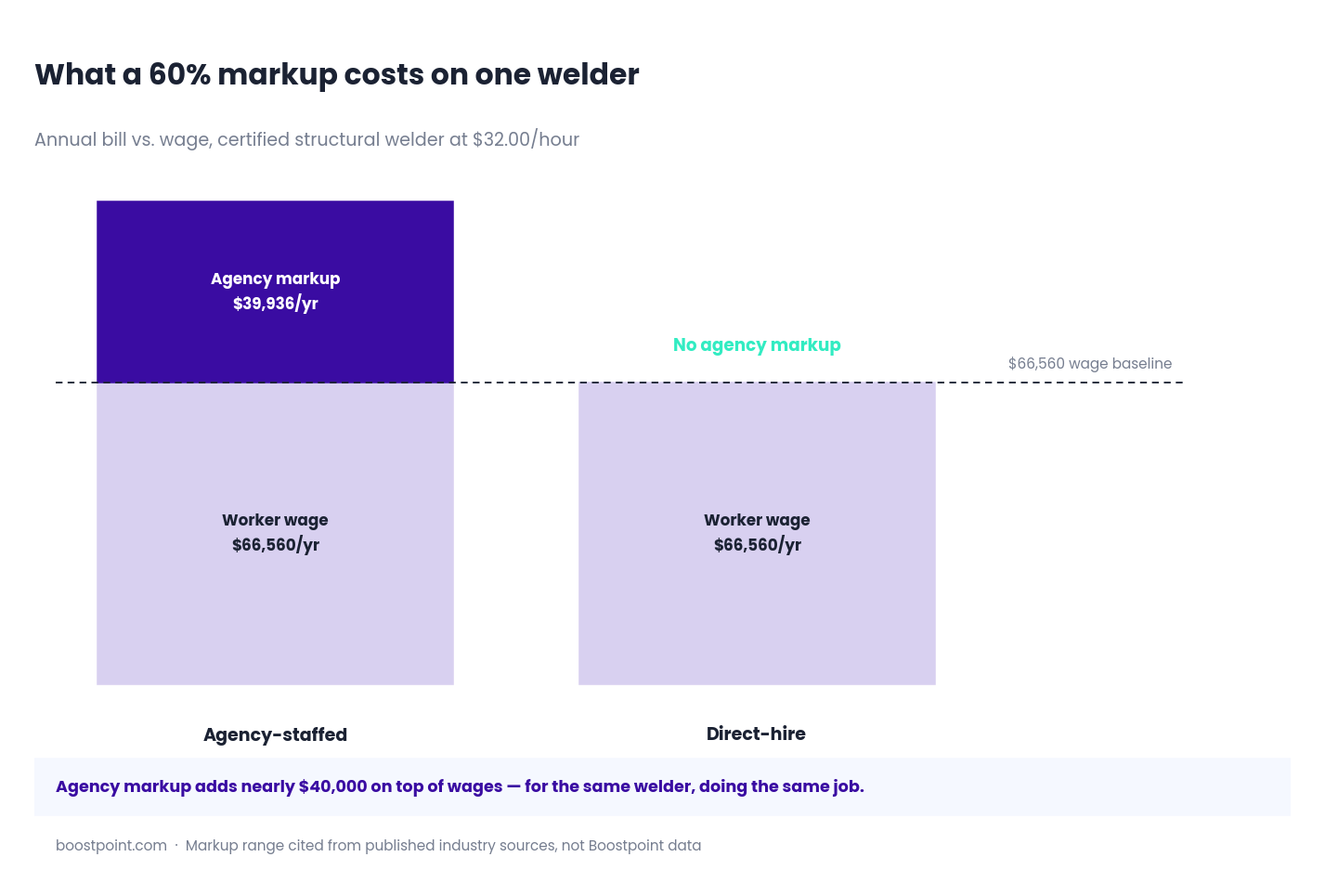
| Certified Structural Welder | $32.00/hr | $48.00/hr | $51.20/hr | $33,280 – $39,936 |
| Specialized Pipe Welder | $40.00/hr | $60.00/hr | $64.00/hr | $41,600 – $49,920 |
If your fabrication shop relies on five agency welders year-round, you are paying upwards of $150,000 to $200,000 annually in pure agency markup. That premium erodes project margins and restricts your ability to offer competitive direct-hire wages.
Why traditional job boards fail for welder recruiting
If you are paying to post jobs on Indeed and getting zero qualified applicants, the issue is your sourcing channel.
- Active search intent is non-existent. A highly skilled welder is already working 40 to 60 hours a week. They do not spend their off-duty time scrolling job boards.
- Heavy local competition. When a welder does search "welding jobs near me," they see identical listings from every manufacturer and contractor in a 50-mile radius. You are instantly commoditized.
- Application friction. Traditional job boards often route candidates to an Applicant Tracking System (ATS) requiring a formatted resume upload. Deskless tradespeople apply from their smartphones, and a long application form kills candidate conversion immediately.
The passive sourcing alternative (and what it costs)
To solve the welder shortage locally, you must shift to passive sourcing. By placing engaging, short-form video ads in the social media feeds of working tradespeople (Facebook, Instagram, TikTok), you capture their attention while they are relaxing at home.
Across Boostpoint-managed skilled trades and manufacturing campaigns in 2026, targeted social recruitment yielded the following applicant acquisition costs — the full breakdown across every trade we track is in our published 2026 Frontline Benchmark Report:
| Skilled trade category | Median cost per applicant (CPA) |
|---|---|
| General Skilled Labor | $9.40 |
| Carpentry & Framing | $14.20 |
| Certified Welders & Pipefitters | $24.10 |
Source: Boostpoint campaign data — managed construction, skilled trades, and manufacturing recruitment campaigns conducted in 2025–2026 across contractors and fabrication shops nationwide.
Data based on the 2026 Boostpoint Frontline Benchmark Report.
The demographic advantage of social media for trades
A unique advantage of social media for physically demanding trades is the demographic reach. Our 2026 data shows that for skilled trades, the 35–44 age bracket is the largest single group of applicants (27%) and the most cost-effective to acquire. Mid-career workers — those who are experienced, still "on the tools," and likely to stay for a decade — are precisely who these campaigns engage most efficiently.
From applicants to hires
Advertising buys applicants, not finished hires. Because welding requires strict vetting — weld tests, certification verification, background checks — the number of applicants it takes to make one welder hire is set inside your own process, and it varies enormously between shops. Our campaign data measures advertising, not hiring outcomes, so we don't publish a cost per hire, and any figure that multiplies a cost per applicant by an assumed ratio is an assumption, not a benchmark. Take the cost per applicant above, apply the applicant-to-hire ratio you measure over a few months (the planner further down turns that ratio into test plates and test days), and set the result against what an agency's annual markup premium costs on the same seat. Cost per applicant is not cost per hire.
4 best practices for recruiting welders directly
To build a reliable talent pipeline and reduce reliance on staffing agencies, optimize your recruitment process for the tradesperson:
- Knockout questions replace the resume. Do not ask for a resume. Use a 1-minute mobile application with 3 to 4 knockout questions: Do you have 3+ years of MIG/TIG experience? Are you AWS certified? Can you pass a 3G weld test?
- Put the pay and shift in the ad. The two things passive welders care about most are the pay rate and the hours. Put them in the first two lines of your ad copy to pre-qualify candidates before they even click.
- Show the shop floor. Run a 15-second video shot on a smartphone showing your facility, the ventilation, and the equipment. Tradespeople can spot stock photography immediately; showing the actual working environment builds instant credibility.
- Call them in minutes. When a qualified welder submits an application, automate an SMS text message to them immediately. Have a hiring manager follow up with a phone call the exact same day.
How to hire welders: the sequence, step by step
Everything above is about what the wrong channel costs. This is how to hire welders when you have decided to do it yourself, in the order the steps actually happen. The Bureau of Labor Statistics counts 457,300 welders, cutters, solderers and brazers at a median $51,000 a year, with about 45,600 openings a year projected through 2034 (Occupational Outlook Handbook, May 2024 wages, read August 2026). The American Welding Society's workforce data puts the wider welding workforce at 771,000, says more than 157,000 of them are nearing retirement, and projects 320,500 new welders needed by 2029 (AWS Welding Digest, October 2025). Almost none of those 457,300 are on a job board this week. The sequence below is built for the ones who aren't.
- Write down the process and the position before you write the ad. "Welder" is not a job; MIG on 3/16" plate in a fab shop, TIG on stainless sanitary pipe, stick 6G on carbon pipe and flux-core structural are four different people. Name the process, the positions (1G flat through 6G pipe), the material and the code your customers hold you to (AWS D1.1 structural, ASME Section IX pipe). That sentence becomes the first line of the ad and the first knockout question. Our welder job description has the full posting.
- Decide what the test plate is, and who reads it. The interview for a welder is a coupon, not a conversation. Decide the joint, the position and the acceptance criteria now, and whether you need an AWS Certified Welding Inspector to read it. If a customer spec requires AWS Certified Welder status, know that the AWS program has no educational or experience prerequisites, is a performance test at an AWS Accredited Test Facility, and has to be maintained with paperwork every six months confirming the welder is still using the process (AWS Certified Welder Program page, read August 2026). A welder who lets that lapse is not uncertified; he is a retest away.
- Source from the passive pool first: your own crew, the welding school, the gas and consumables counter. Every welder knows the welders at three other shops. A referral bonus paid at ninety days, said out loud in the shop meeting, is the cheapest sourcing you will run. The welding program's instructor knows which students can already pass your plate. The counter where every shop in the county buys wire and gas sees them all weekly. The full map, trade by trade, is on where to find skilled trades workers.
- Then the feed, with the process, the rate and the shift in the first sentence. Under Meta's Special Ad Category there is no age, gender or ZIP targeting for job ads (the rules), so the copy does the selecting: "TIG welder, stainless sanitary pipe, $X/hr, days, 4×10s" finds the right welder and repels the wrong one. In our earlier trades analysis (45 field campaigns, 10 contractors, a different methodology from the benchmark), a click on a trades ad cost $0.84, the cheapest of any vertical, and 9.1% of clicks became an application, the lowest. The reach is cheap; the form is where it leaks.
- A form of three questions, and a call the same day. Which processes and positions have you welded in the last year? Can you pass a [joint, position] test plate? What is the earliest you could test? Name and phone. Nothing else. A call from a person with a name the same day is Boostpoint practice, not a measured statistic; it is also the step most shops skip.
- Test within 48 hours, in the shop, on your metal. Book the plate on the first call. A welder who is working will come at 6 a.m. or on Saturday; make both available. Read the coupon while he waits, and tell him the result before he leaves. Where you need the passive pool in a room at once, a dated test day is the event-driven structure that ran a median $8.02 per applicant across 78 campaigns in our 2026 benchmark, 21% apply rate; the mechanics are on open house hiring events.
- Offer at the plate, checks in parallel, start at the end of his notice. The welder who passed your test has a job to give notice at. Make the offer in writing the same day, order the drug screen and references that afternoon rather than in sequence, and set the start date at the end of his notice. The days you can't compress are the notice period; every other day is yours. The full 72-hour version is on how to hire skilled trades fast.
How to hire welders fast: what actually compresses
Fast is not a different sequence; it is the same sequence with the waiting removed. Three things compress: the gap between application and first call (same day, not next week), the gap between the call and the test plate (48 hours, with a 6 a.m. and a Saturday slot), and the gap between the plate and the written offer (the same afternoon). Two things do not: the welder's notice period at the shop he is leaving, and the drug screen's turnaround, which you can only start earlier, not shorten. A shop that tests on Tuesday for a Monday application and makes the offer in the lot is hiring in three days plus notice; a shop that schedules interviews for next week is hiring in three weeks plus notice from the same applicant. The planner below turns the ratios you actually run into the number of test plates and test days a hiring target needs.
Interactive
Test-plate planner — how many applicants, plates and test days a welder hiring target takes at your ratios
Nothing is stored or sent — this runs in your browser. Every ratio is yours; Boostpoint publishes no applicant-to-hire ratio and no cost per hire.
The honest summary
Agencies manage short-term turnarounds. Direct advertising builds profitable core teams.
If your facility is facing a massive, unexpected 14-day plant shutdown and you need 20 extra welders, a staffing agency is your best operational tool. But if you rely on agencies to staff your baseline, year-round fabrication needs because job boards aren't working, you are paying emergency surge pricing for a fixable pipeline problem.
By shifting budget to targeted social media recruitment, manufacturers and contractors can bypass active job boards, engage experienced, passive welders directly, and pay per applicant instead of per agency seat. What that comes to per hire depends on the applicant-to-hire ratio you measure, which we don't publish.
The calculation worth running this quarter
HR leaders and Plant Managers should calculate these metrics together:
- Calculate total annual agency markup spend. Take total agency invoicing for welders over the past 12 months and subtract direct wages paid. That difference represents your preventable markup premium.
- Measure your ATS drop-off rate. If your click-to-application completion rate on mobile is under 10%, your application is too long and is driving away candidates.
- Compare direct acquisition against agency premium. Track what you actually spend on advertising per welder hired over a full quarter — your cost per applicant times your own measured applicant-to-hire ratio — and compare it against your projected agency markup on the same seats.
What it costs to hire a welder
The cost to hire a welder directly has five parts, and only the first is advertising. Add them up per hire and you have a welder cost per hire you can set against the agency markup table above. Nobody can hand you the total, because three of the five lines come from your own shop.
| Cost line | What sets it | Where your number comes from |
|---|---|---|
| Advertising per applicant | The ad, the radius and above all the application form | Your campaign reports; the benchmark below for scale |
| Applicants per hire | Your knockout questions, how fast you call, how many show up to test, and your plate pass rate | Your own last quarter; the test-plate planner above turns it into plates and test days |
| Testing | Coupon material, shop time, and an inspector's time where a customer code requires one | Your shop |
| Pre-employment checks | Drug screen, background check, references | Your vendors' prices |
| People time | Recruiter or office time on calls, and the supervisor's time reading plates | Hours per hire multiplied by the loaded hourly cost |
The formula is simple: advertising cost per hire is cost per applicant multiplied by applicants per hire, and the full cost per hire adds testing, checks and people time for every candidate you test, not only the one you hire. For the first line, the canonical figure is the Skilled trades family in the Boostpoint 2026 Social Job Advertising Benchmark: a median of $14.14 per applicant, with the middle half of campaigns between $7.58 and $21.49 and a 15% apply rate. The $24.10 welder and pipefitter figure earlier on this page comes from an earlier campaign analysis with a different method; where the two differ, the benchmark is the one to plan with. Neither is a cost per hire, and we do not publish one, because our data stops at the application.
Then set the total against the two numbers that make the decision. One is the wage you will pay: welders, cutters, solderers and brazers had a median of $53,750 a year in May 2025, in an occupation of 437,700 jobs with about 40,300 openings a year projected through 2035 (BLS Employment Projections 2025-35, newer than the 2024 edition quoted in the hiring sequence above). The other is the agency markup on the same seat, from the table above, which is charged every hour the seat is filled rather than once. Our cost per hire calculator runs the arithmetic, and the posting itself is on our welder job description.
Frequently asked questions
How to hire welders during a labor shortage?
To overcome the welder shortage, employers must stop relying solely on active job boards. The most effective strategy is running targeted social media advertising on platforms like Facebook and Instagram to reach passive, currently employed welders, followed by a fast, mobile-friendly application process.
How much does a welder staffing agency charge?
Welder staffing agencies typically charge a 45% to 60% markup over the worker's base hourly wage. For a certified welder earning $32.00/hour, the agency bill rate ranges from $46.40 to $51.20 per hour, costing the employer over $30,000 in annual markup premiums per worker.
What is the average cost to recruit a certified welder directly?
Based on Boostpoint 2026 benchmark data, targeted social media recruitment campaigns generate certified welder and pipefitter applicants for an average of $24.10 each.
Why are job boards ineffective for welder recruiting?
Job boards rely heavily on active search intent. Because highly skilled welders are already employed, they rarely browse job boards. Additionally, traditional job boards often force mobile users through long applicant tracking systems (ATS) that require formatted resumes, causing deskless tradespeople to abandon the application.
Does social media recruiting work for older, experienced welders?
Yes. Boostpoint 2026 demographic data shows that for physically demanding trades, the 35–44 age bracket provides the largest volume of applicants and is the most cost-effective demographic to acquire. Social media algorithms naturally target experienced, mid-career tradespeople.
How do you hire welders fast?
Remove the waiting, not the steps: a call the same day the application lands, a test plate within 48 hours with a 6 a.m. and a Saturday slot, a written offer the same afternoon the plate passes, and the drug screen and references ordered that day in parallel. What you cannot compress is the welder's notice period at the shop he is leaving. Three days plus notice is possible; three weeks plus notice is what scheduling interviews for next week costs from the same applicant.
How do you test a welder before hiring?
With a coupon, not a conversation. Decide the joint, the position (1G flat through 6G pipe), the material and the acceptance criteria before the ad runs, test in your shop on your metal, and have a qualified person, an AWS Certified Welding Inspector where a customer code requires it, read the plate while the welder waits. If the job requires AWS Certified Welder status, the AWS program is a performance test at an Accredited Test Facility with no educational or experience prerequisites, maintained with paperwork every six months; a lapsed certification is a retest, not a disqualification.
Where do you find welders who are already working?
Where they already are: your own crew's phones (a referral bonus paid at ninety days), the welding program's instructor, the gas and consumables counter every shop in the county uses, the social feed at lunch with the process and the rate in the first line, and a dated test day at the shop. BLS counts 457,300 welders and the few percent searching this week are the only ones a job board reaches. The trade-by-trade map is on our where-to-find-skilled-trades-workers page.
How do you calculate cost per hire for a welder?
Multiply your cost per applicant by the number of applicants it takes to make one hire in your shop, then add the testing, pre-employment checks and staff time spent on every candidate you tested. Use your own applicant-to-hire ratio from the last few months; it depends on your screening, show rate and plate pass rate, and no published figure can stand in for it. For the advertising line, the Skilled trades family in Boostpoint's 2026 benchmark ran a median of $14.14 per applicant, which is a cost per applicant, not a cost per hire.
See what it costs to build your own welder pipeline
Book a 30-minute strategy call with our industrial recruiting team. We'll analyze your local trade market, review cost-per-applicant benchmarks for your region, and demonstrate how to build a direct hiring pipeline using automated social ads.
Book a Demo →Boostpoint figures are derived from managed construction, skilled trades, and manufacturing recruitment campaigns conducted in 2025–2026 across contractors and fabrication shops nationwide. Cost-per-applicant metrics reflect what advertisers paid for advertising. Staffing agency markups are compiled from published industry financial audits and third-party staffing benchmarks.