
How to Hire Welders, Electricians and Technicians Fast: The 72-Hour Sequence, and the Days You Can't Compress
"Fast" in the trades has a ceiling: the welder or electrician you want is employed and licensed, owes his current shop two weeks, and will not fill out a ten-field form from a truck. What can be compressed is everything between the tap and the offer — three questions instead of ten, a call within the hour, a walk-through with a test or a license check on it, an offer on the walk — which Boostpoint's campaign data says is where the days actually go: trades application completion ran from 3.5% to 18.6% across contractors on the same channel, and click-to-apply was the lowest of any vertical at 9.1%. What can't be compressed is the license lookup, the drug screen and the notice period, and pretending otherwise is how a "fast" hire becomes a bad one.
Source: Boostpoint's earlier campaign-level trades analysis (45 field campaigns), a different methodology from the 2026 Social Job Advertising Benchmark of 891 Boostpoint-managed campaigns on Meta.
A note on who's writing this
Boostpoint runs social media job ads for contractors and manufacturers, so the parts of this page about the ad describe what we sell; the parts about the form, the callback and the walk-through cost nothing and are where most of the speed is. This is the trades version of a more general page — how to fill open positions fast triages any role into this-week, this-month and permanent fixes — and doesn't repeat it; here the role is licensed, employed and scarce, which changes what "fast" can mean. "Same-day contact" and the 72-hour sequence are Boostpoint's practice, not a measured result; we publish no time-to-hire figure, no cost per hire, and no trades role-by-role cost. Every figure of ours is a cost per applicant.
Why "fast" means something different for a licensed trade
BLS counts 821,000 electricians at a median $63,190 with about 72,700 openings a year, and "most states require electricians to pass a test and be licensed"; 437,700 welders at a median $53,750 with about 40,300 openings, where "some employers require general or specific certification for particular jobs"; and 547,300 industrial machinery mechanics and millwrights at a median $64,100 with about 51,900 openings. ABC's January 2026 estimate is that construction alone needs 349,000 new workers this year. Read for speed, those numbers say the person you want exists, is employed, and is licensed by someone other than you — so the fast path is not finding him, it is getting from his thumb on an ad to an offer in his hand before the other three shops that saw the same applicant do. Our trades data puts the bottleneck exactly there: clicks were the cheapest of any vertical in the earlier analysis at $0.84, click-to-apply the lowest at 9.1%, and completion ranged five-fold across contractors on the same channel. A trades employer that "needs to hire fast" almost never has a reach problem; it has a form that takes eleven minutes and a callback that takes three days.
The 72-hour sequence
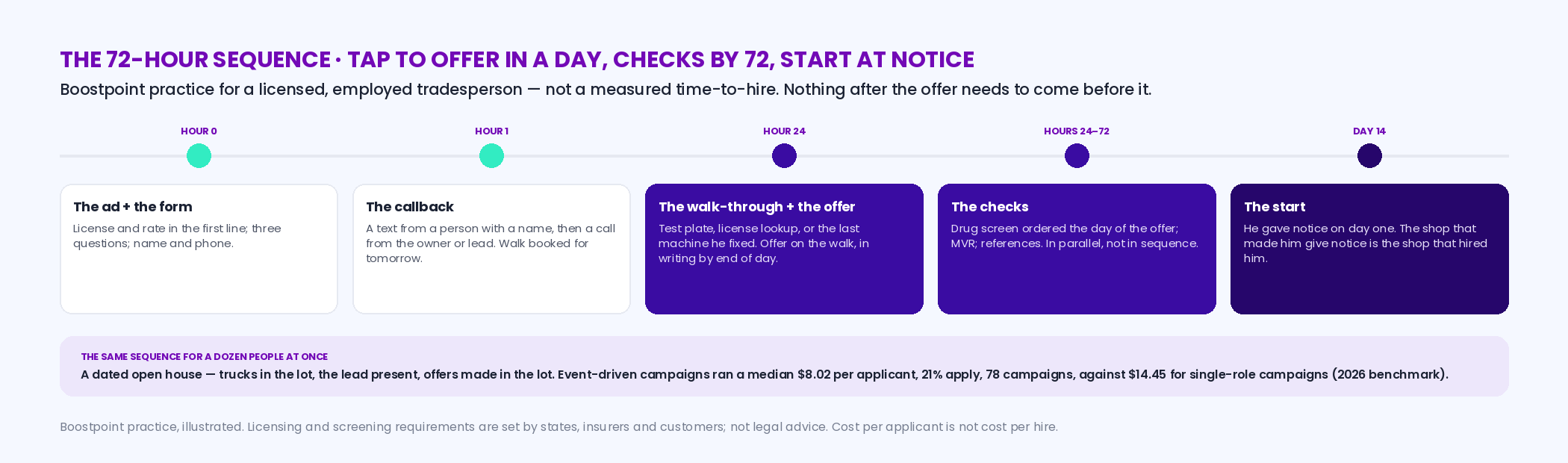
Hour 0 — the ad. It runs in Meta's Special Ad Category with no age, gender or ZIP targeting (rules on Meta Special Ad Category, explained), so the first line is the targeting: "Journeyman electrician · [state] license · $[low]–$[high]/hr · van, no weekends · start in two weeks · [City]." Hour 0 — the form. Three questions: license or certification held, years on the trade, and start availability; name and phone; submit. Nothing else before the call — no résumé, no work history, no assessment. Hour 1 — the callback. A text from a person with a name, then a call; the owner or the lead, not a recruiter reading a script. Confirm the three answers, state the rate and the schedule, book the walk-through for tomorrow. Hour 24 — the walk-through. The candidate walks the job or the shop with the person he'd work for; the welder takes a test plate, the electrician's license is looked up on the state board's site while he's there, the technician talks through the last machine he fixed. Hour 24 — the offer. On the walk, in writing by the end of the day, conditional on the checks. Hours 24–72 — the checks. Drug screen ordered the same day, MVR if he drives a company vehicle, references if you take them; none of these needs to precede the offer, all of them precede the start. Day 14 — the start, because he gave notice on day one, and the shop that made him give notice on day one is the shop that hired him. A dated open house — trucks in the lot, the lead present, offers made in the lot — runs the same sequence for a dozen people at once, and gives every employed tradesperson who saw the ad one specific time to come and look; mechanics on open house hiring events and on-the-spot hiring.
Where the days actually go
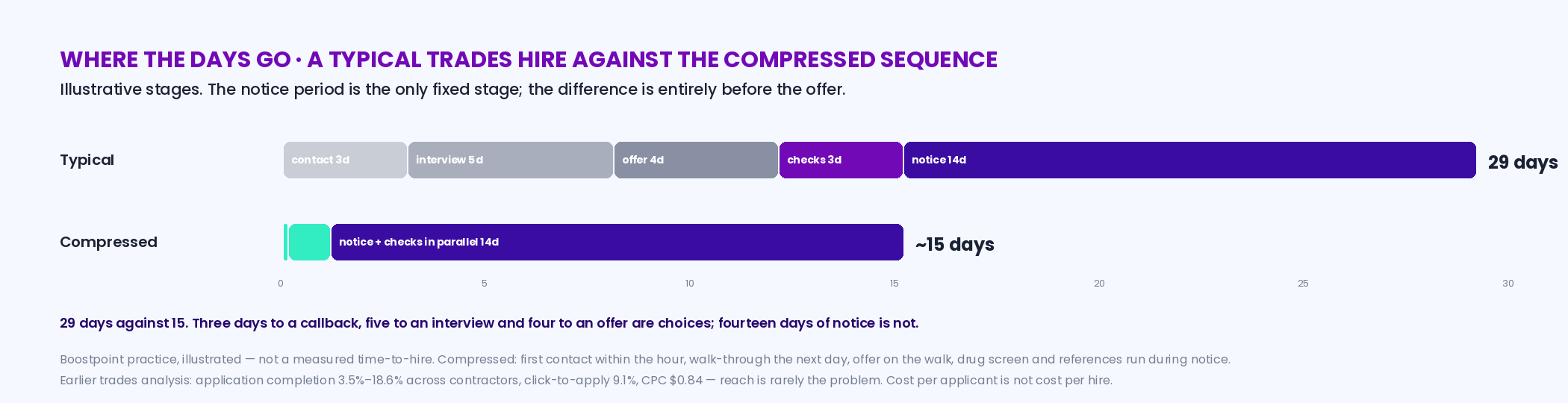
Ask a shop that "can't hire fast" to time its own process and the days are rarely where it thinks. The ad ran for a week before anyone looked at the applicants; the form asked for a résumé, which a welder doesn't have, so he closed it; the applicants who finished got an email three days later asking for availability; the interview was set for the following week because the estimator was busy; the offer waited on the drug screen; the drug screen waited on the offer letter. Two to three weeks pass between tap and offer, during which the candidate was hired by whoever called first. The audit below adds up your own days from the tap to the first shift, shows which stage is the biggest, and shows the same sequence compressed. The only stages with a real floor are the ones after the offer.
Interactive
Speed audit — where your days go between the tap and the first shift, and what the same hire looks like compressed
Nothing is stored or sent — this runs in your browser. Enter your current stages in days; the audit totals them, names the biggest, and shows the compressed sequence beside it.
Arithmetic on your inputs. The compressed sequence is Boostpoint's practice — first contact within the hour (0.04 days), the walk-through the next day, the offer on the walk, checks run in parallel with notice — not a measured time-to-hire. Form fields are scored against our earlier trades analysis' completion range (3.5% to 18.6% across contractors) as a direction, not a prediction. No cost is computed; cost per applicant is not cost per hire.
What can't be compressed — and how to run it in parallel
Three things have a floor, and the fast shops know exactly what it is. The license or certification check is nearly instant where the state board publishes a lookup — most do for electricians, and "most states require electricians to pass a test and be licensed" — and for welders it is a test plate on the walk-through, since BLS notes that "some employers require general or specific certification for particular jobs" and the fastest certification is the one you witness. The drug screen takes a day to three and is ordered the same day as the offer, not after the offer letter is countersigned. The notice period is two weeks of the candidate's honor and cannot be shortened by you; it can only be started earlier, which is the whole argument for an offer on the walk. Everything else — references, the MVR, the I-9, the OSHA card — runs in parallel with notice. The sequencer below sorts the checks for each trade into "on the walk," "after the offer, before the start" and "not before the call," which is the order that keeps the sequence at 72 hours. When the floor is still too slow — a two-week shutdown with no bench — the question becomes an agency's 25–100% construction markup, and that arithmetic is on staffing agency vs direct hiring for the trades.
Interactive
Verification sequencer — for each trade, what happens on the walk, what happens after the offer, and what never comes before the call
Nothing is stored or sent — this runs in your browser. Pick the trade; the columns are the order that keeps the sequence at 72 hours. Your state, insurer and customer contracts may add steps.
Boostpoint practice, not legal or compliance advice. Licensing and certification requirements are set by states, localities, customers and insurers and vary; BLS notes most states license electricians and some employers require welding certification for particular jobs. Federal rules for drivers of commercial vehicles are on the CDL and delivery-driver pages. Nothing here is a cost.
The three levers the data supports
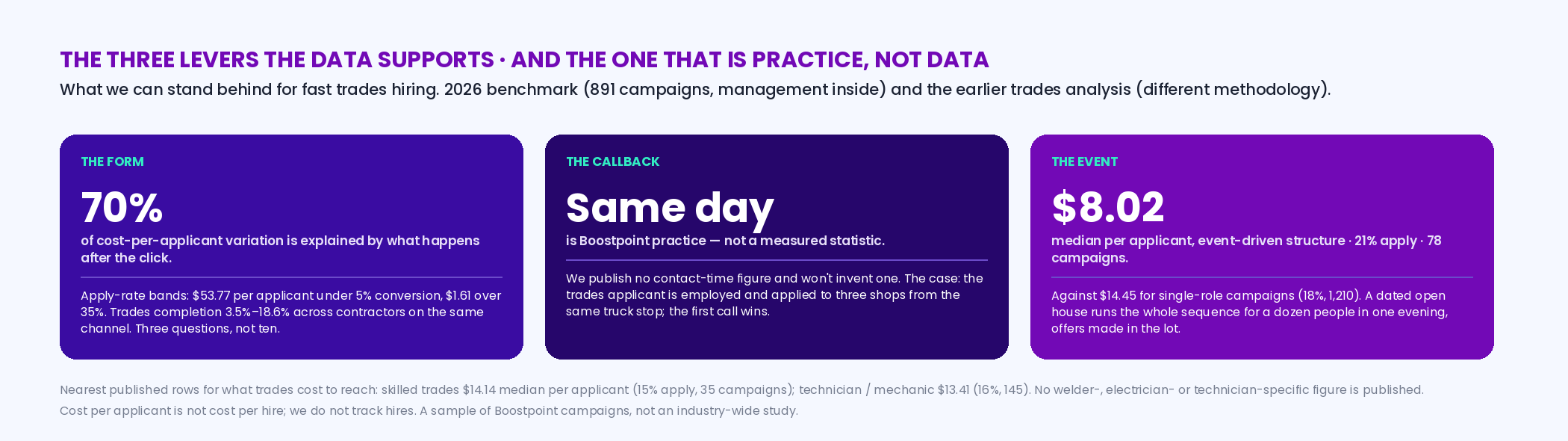
Strip the sequence to what our data can actually stand behind and three levers remain. The form. Cost per applicant is the ad spend divided by the people who finish the application, so every tradesperson who taps and then abandons a long form raises it, and the trades-specific completion range of 3.5% to 18.6% says a three-question form is the difference between a week of silence and a shortlist by lunch. The callback. We don't publish a measured contact-time statistic and won't invent one; same-day contact is our practice, and the case for it is that the trades applicant is employed and applied to three shops from the same truck stop. The event. The event-driven campaign structure — a dated open house or walk-in day with offers made on site — puts the lead, the walk-through and the offer in one place on one date, and it compresses the sequence for everyone who walks in. What the skilled trades cost to reach at all is on the benchmark: a median $14.14 per applicant for skilled trades (middle 50% $7.58–$21.49, 35 campaigns) and $13.41 for technicians and mechanics ($7.40–$23.58, 145 campaigns); no welder-, electrician- or technician-specific figure is published, because 69% of trades applications sit in campaigns whose names don't identify the role. The trade-specific ads live on their own pages — welders, electricians, diesel mechanics and technicians — and the texting side of the hour-one callback is on text recruiting software.
| Trade | BLS pool and median | First line names | On the walk | The floor |
|---|---|---|---|---|
| Welder | 437,700 jobs · $53,750 · about 40,300 openings a year | Process (MIG/TIG/stick), material, position, rate, shift | A test plate in your process and position; the coupon decides | Drug screen; notice; certification test if a customer spec requires it |
| Electrician | 821,000 jobs · $63,190 · about 72,700 openings a year | License class and state, commercial or residential, rate, van, weekends | State board license lookup while he's there; a walk of the current job | Drug screen; MVR for the van; notice |
| Industrial / maintenance technician | 547,300 jobs · $64,100 · about 51,900 openings a year | Two crafts at a strong level, rate, shift, equipment | The newest machine on the floor and the last one he fixed | Drug screen; notice; any customer-site clearance |
| Diesel / equipment technician | See the diesel mechanic page | Equipment, rate, tool allowance, shift | A diagnostic on a unit in the bay; ASE or OEM certificates in hand | Drug screen; MVR; notice |
You can't shorten a license or a notice period. You can shorten everything between the tap and the offer to a day — three questions, a call within the hour, an offer on the walk — and let the floor run in parallel.
Moving fast only helps if the interview is any good. Our electrician interview questions page covers eight questions worth the time and the difference between a state license and being a qualified person under OSHA.
Frequently asked questions
How do you hire welders fast?
Name the process, material, position, rate and shift in the first line; ask three questions on the form — certification or process experience, years, start availability; call within the hour; and put a test plate in the candidate's hands on a walk-through the next day, with an offer on the walk. Order the drug screen the same day and let it run in parallel with notice. BLS counts 437,700 welders with about 40,300 openings a year.
How do you hire electricians fast?
Put the license class, the state, commercial or residential, the rate and the van in the first line; ask license, years and availability on the form; call within the hour; look the license up on the state board's site during the walk-through and make the offer on the walk. Most states require electricians to be licensed, so the check is instant where the board publishes a lookup; the notice period is the only fixed stage.
How fast can you realistically hire a skilled tradesperson?
Tap to offer in about 24 hours, checks by 72, start at the end of notice — roughly two weeks from the tap, if the candidate is employed and gives notice the day he accepts. We publish no measured time-to-hire; the sequence is our practice. What makes it two weeks instead of five is everything before the offer: the form, the callback and the walk-through, none of which has a floor.
What slows down trades hiring the most?
The form and the callback. In our earlier trades analysis application completion ran from 3.5% to 18.6% across contractors on the same channel, click-to-apply was the lowest of any vertical at 9.1%, and clicks were the cheapest at $0.84 — reach is rarely the problem. A ten-field form with a résumé upload and a three-day reply loses the employed tradesperson to whichever shop called first.
Should I skip the drug screen or the license check to hire faster?
No — move them. The license check is nearly instant on a state board lookup and belongs on the walk-through; the drug screen is ordered the day of the offer and runs in parallel with the notice period; references and the MVR run the same way. Nothing after the offer needs to come before it, and nothing before the start should be skipped. Your state, insurer and customer contracts govern what's required.
Is a hiring event faster than posting a job?
For a bench or a shutdown, yes — it runs the whole sequence for a dozen people in one evening, with the lead present and offers made in the lot. A posting runs the same sequence one applicant at a time, so each one waits on a callback and a walk-through slot.
What does it cost to recruit welders or electricians fast?
We publish no welder-, electrician- or technician-specific figure and no time-to-hire premium. The nearest rows in our 2026 benchmark are skilled trades at a median $14.14 per applicant (middle 50% $7.58–$21.49, 35 campaigns) and technician and mechanic at $13.41 ($7.40–$23.58, 145 campaigns). Speed comes from the form and the callback, which cost nothing. Cost per applicant is not cost per hire.
When does a staffing agency make sense for a fast trades hire?
When the floor is still too slow — a two-week shutdown with no bench, a crew in a market where you have no name — and you are paying for someone else's bench rather than building your own. Construction staffing markups are commonly cited at 25–100% on the worker's wage. The comparison, and when direct is the better answer, is on the staffing agency vs direct hiring page.
Run the 72-hour sequence with us on the ad
We'll write the first line for the trade and the license, put a three-question form behind it, route applicants to a phone within the hour, and show you the contractor and manufacturer campaigns closest to yours.
Book a DemoBoostpoint figures come from the 2026 Social Job Advertising Benchmark — 891 campaigns and 1,334 campaign-months: skilled trades median cost per applicant $14.14, middle 50% $7.58–$21.49, 35 campaigns; technician / mechanic $13.41, middle 50% $7.40–$23.58, 145 campaigns (the nearest rows, not trade-specific figures). Earlier campaign-level trades analysis (different methodology): 45 field campaigns, CPC $0.84, click-to-apply 9.1%, application completion 3.5% to 18.6% across contractors. No welder, electrician or technician figure and no time-to-hire statistic is published; "same-day contact" and the 72-hour sequence are Boostpoint's practice. Third-party figures — BLS Occupational Outlook Handbook (May 2025 wages, 2025–35 projections) for electricians; welders, cutters, solderers and brazers; industrial machinery mechanics, machinery maintenance workers and millwrights; ABC (January 15, 2026); construction staffing markups of 25–100% as cited by staffing-industry sources — are theirs and attributed in place; licensing and screening requirements are set by states, insurers and customers and this page is not legal advice. No customer is named. The audit and sequencer are arithmetic and practice on your inputs, not measured results. Cost per applicant is not cost per hire; we do not track hires and publish no cost-per-hire figure. A sample of Boostpoint campaigns, not an industry-wide study.
Our free pest control technician job description template covers duties, pay, and the federal rules that let you hire a technician before they are certified — which is how most firms in the trade actually staff.