
How to Fill Open Positions Fast: What Works This Week, This Month, and Permanently
How to hire quickly: re-contact recent applicants today, put a date on the job, answer every applicant the same day, and run a dated hiring-event campaign — in Boostpoint's 891-campaign 2026 Social Job Advertising Benchmark, event-driven ads cost $8.02 per applicant at a 21% apply rate against $14.45 for a standard single-role ad. Then triage by how many days you have. This week: re-contact every applicant from the last 90 days, put a date on the job with walk-in interviews, and buy coverage from an agency if the shift can't wait. This month: run the dated campaign and cut the application to one minute. Permanently: keep an always-on pipeline so the next opening is filled from a list, not a scramble. The fastest lever at every tier is the same: answer applicants the same day.
Source: Boostpoint 2026 Social Job Advertising Benchmark — 891 Boostpoint-managed campaigns on Meta (1,334 campaign-months), 2026; costs are what advertisers paid for advertising only.
A note on who's writing this
Boostpoint sells social media job advertising to frontline, healthcare, trades, and driving employers, and one of the three tiers below is the thing we sell, so read this as a vendor's page. The other two tiers include things we don't sell — staffing agencies, referral bonuses, walk-in interviews — and where they are the faster answer, this page says so. Every Boostpoint figure comes from the 2026 Social Job Advertising Benchmark, with the methodology at the bottom; where we state a practice, such as calling every applicant the same day, it is what we do and not a measured result. Nothing here is a cost per hire.
How to hire quickly: the first 72 hours
If you need to hire fast, the order of the steps matters more than the channel. This is the sequence we recommend for the first three days after a position opens. It is Boostpoint's practice rather than a measured result, and it assumes the pay is already at the local rate; if it is not, fix that first.
- Hours 0–2: the people who already exist. Text every applicant for that title from the last 90 days, ask each crew member for one name, and write the four lines every ad needs: pay, shift, location and the one hard requirement.
- Hours 2–4: give the job a date. Announce a walk-in or open-house interview day and launch a dated campaign with a one-minute, three-question application inside the app. In Boostpoint's 2026 benchmark, dated event campaigns cost $8.02 per applicant at a 21% apply rate.
- Hours 4–24: answer every applicant the same day. Text within the hour with two call times, hold a ten-minute call, and book the interview before you hang up.
- Hours 24–72: interview and offer. Fifteen-minute structured interviews within 48 hours, a verbal offer on the day, the rate and start date by text within the hour, and background checks ordered the same day.
If the shift cannot wait even 72 hours, cover it with agency or per diem staff while this runs. The sections below take the same steps through the week, the month and the permanent fix.
First, decide which problem you have
"Fill this position fast" is three different problems depending on the calendar. If the shift is uncovered this week, no recruiting channel is fast enough; you need people who already exist and are already screened, and the question is where to find them at the least cost. If you have two to four weeks, you have enough time for a campaign to produce applicants and for you to interview them, and the question is how to compress the days between application and start. If this position keeps opening, you don't have a speed problem; you have a pipeline problem, and the fix is permanent. Most employers reach for the month-tier tools when they are in the week-tier situation, or keep paying week-tier prices for a permanent-tier problem. Set the number of days and the tool below sorts you.
Nothing is stored or sent — this runs in your browser. Drag the days; pick the role type; the tier and the three moves update.
Tiers and moves are Boostpoint's recommendation. Figures: campaign-structure cut of the 2026 benchmark (event-driven $8.02 median cost per applicant, 21% apply rate, 78 campaigns; single-role $14.45, 18%, 1,210 campaigns). Agency markups are third-party ranges on our staffing agency markup page. Cost per applicant is not cost per hire.
This week: the moves that produce a person by Friday
Nothing you launch on Monday produces a stranger who is screened, interviewed, and working by Friday. What does exist by Friday is the people you already have. Start with the applicant list: every person who applied in the last 90 days and did not get an offer is a warm contact, most of them are still employed somewhere they'd leave, and the ones who never heard back are the most receptive because a call from you is a surprise. Text first — "still hiring, three openings, can you talk today?" — and call the ones who reply; our text recruiting page has the templates. Second, put a date on the job. "Walk-in interviews Thursday, 8 to 4, offers on the spot" converts the employed-but-open person who will never fill out an application on a Tuesday night; the open house page covers how to staff the day. Third, ask the crew: one name each, a referral bonus paid in installments at 30 and 90 days, and the promise that their friend gets a call the same day. And if the shift is uncovered and none of that is enough, buy coverage — a staffing agency or per diem roster is the right tool for a week, and the wrong one for a quarter; the markup math tells you where the line is.
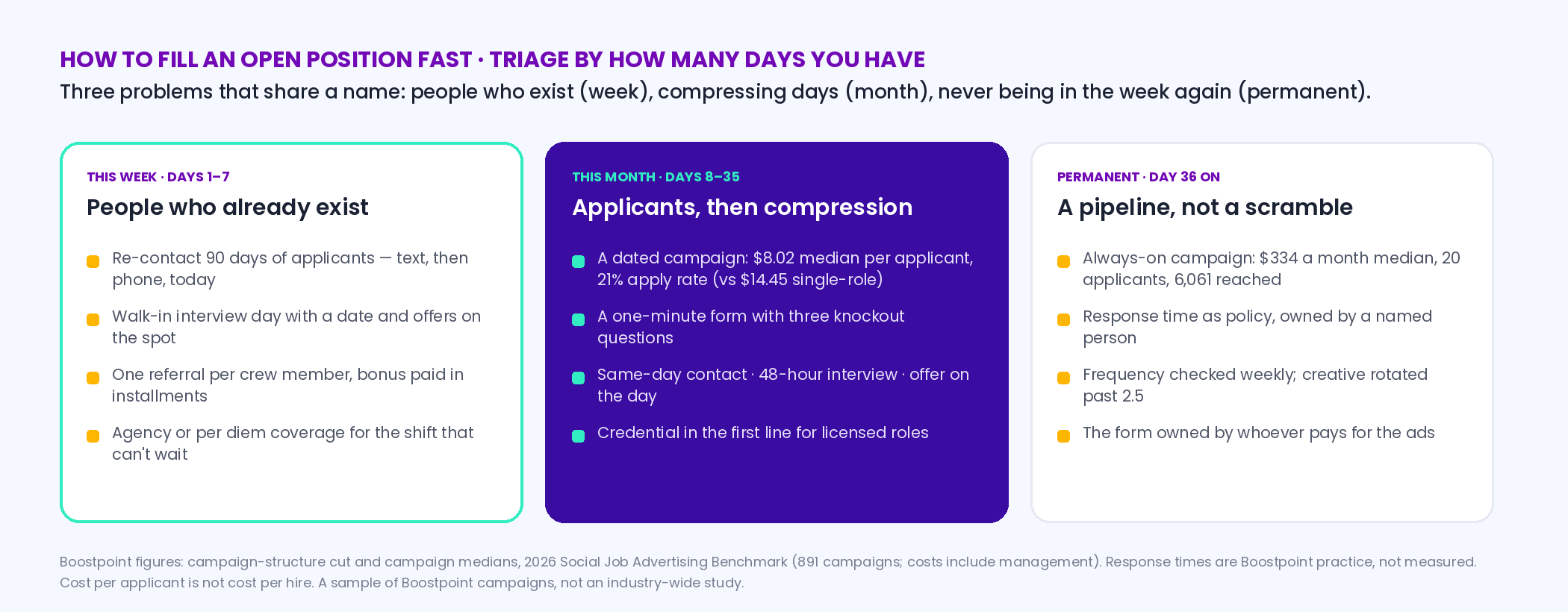
This week · people who already exist
Days 1–7
- Re-contact 90 days of applicants by text, then phone, today.
- Walk-in interview day with a date, hours, and offers on the spot.
- One referral per crew member, bonus in installments.
- Agency or per diem coverage for the shift that can't wait — priced by the hour, no conversion fee.
This month · applicants, then compression
Days 8–35
- A dated campaign — open house or virtual event: $8.02 median per applicant, 21% apply rate.
- A one-minute form with three knockout questions.
- Same-day contact, 48-hour interview, offer on the day — the calendar you keep after the ad.
- Credential in the first line for licensed roles.
Permanent · a pipeline, not a scramble
Day 36 onward
- Always-on campaign for roles that always reopen: $334 a month median, 20 applicants.
- Response time as policy, owned by a named person.
- Frequency checked weekly; creative rotated past 2.5.
- The form owned by whoever pays for the ads, because that is where the cost is decided.
This month: put a date on it, then compress the days after the click
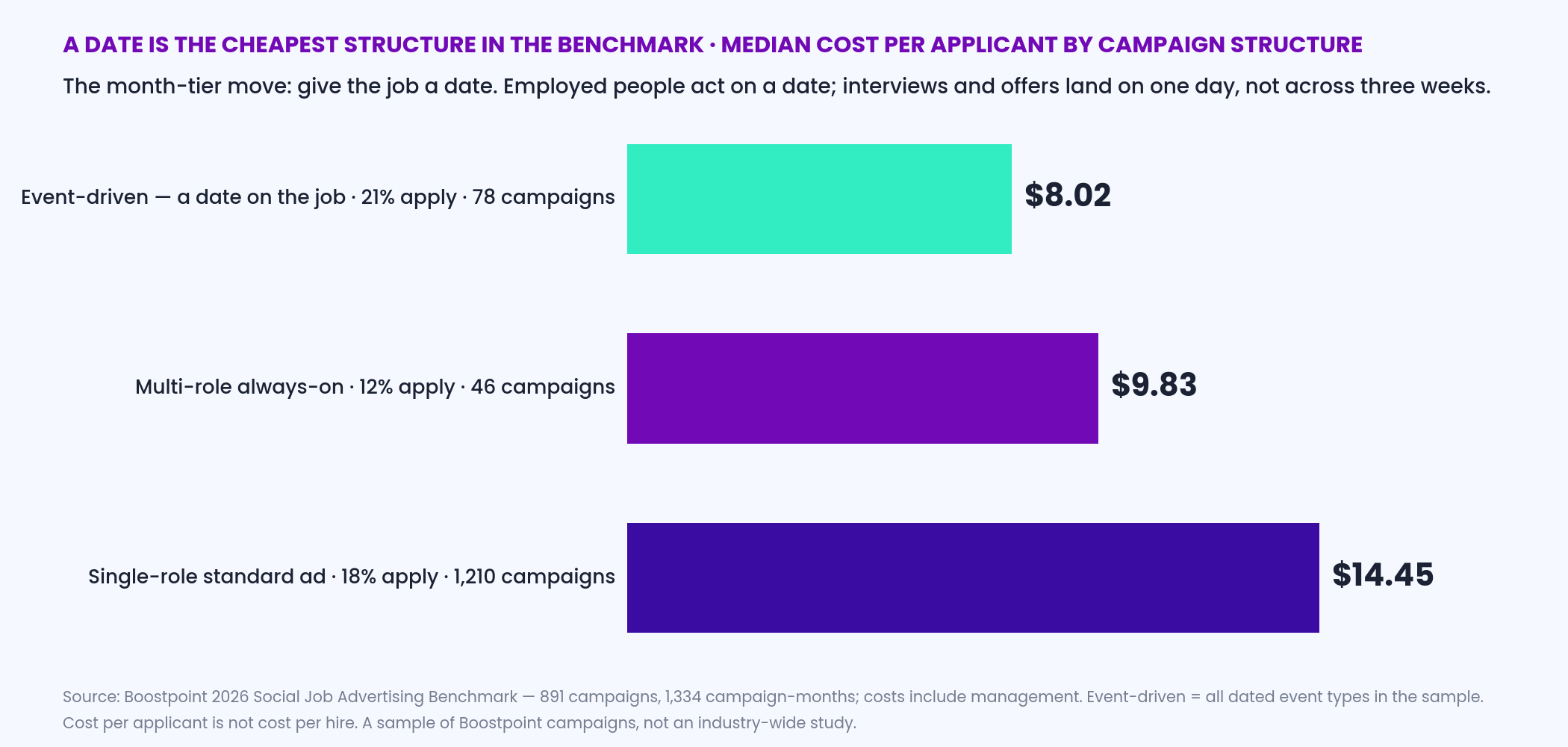
With two to four weeks you can generate applicants, and the cheapest way we know to do it is to give the job a date. Across the 891 campaigns in our benchmark, campaigns built around a dated event — an open house, a walk-in day, a virtual hiring event — ran at a median cost per applicant of $8.02 with a 21% apply rate, against $14.45 and 18% for a standard single-role ad and $9.83 at 12% for an always-on multi-role campaign. The date does two things at once: it gives an employed person a reason to act now instead of "sometime," and it gives you a day on which interviews and offers happen in one place instead of trickling across three weeks. Our virtual hiring event and open house pages cover the two formats; the mass hiring playbook covers running several at once.
The applicants arrive in days. What happens next is where most employers lose the month. Two things decide it. The first is the form: applicant conversion explains 70% of the variation in cost per applicant in our data, and campaigns converting under 5% of clicks paid $53.77 per applicant against $1.61 above 35%; a twenty-minute application does not just cost more, it takes longer, because the qualified people leave and you keep paying for the ones who didn't. Our shorten your application process post walks through the cuts. The second is your calendar. An applicant who hears nothing for two days is, in our experience, gone — they applied to three other places the same night. Same-day contact, an interview inside 48 hours, and an offer on the day of the interview are not customer-service niceties; they are the mechanism by which a campaign that produces applicants in a week produces starts in two.
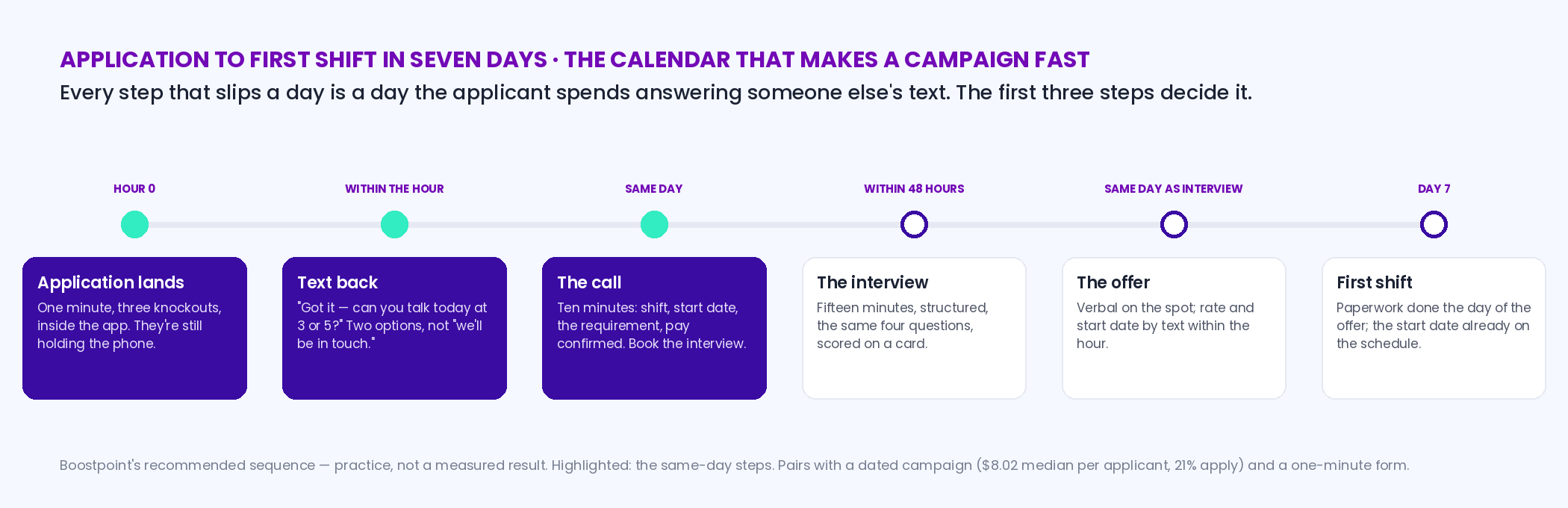
Hour 0
Application lands
One minute, three knockouts, inside the app. The applicant is still holding the phone.
Within the hour
Text back
"Got it — can you talk today at 3 or 5?" Two options, not "we'll be in touch."
Same day
The call
Ten minutes: shift, start date, the one requirement, the pay confirmed. Book the interview before hanging up.
Within 48 hours
The interview
Fifteen minutes, structured, the same four questions for everyone, scored on a card.
Same day as interview
The offer
Verbal on the spot, rate and start date by text within the hour. "Next week" loses people.
Day 7
First shift
Paperwork started at a laptop the day of the offer; the start date already on the schedule.
The seven-day path from application to first shift, as Boostpoint recommends running it. Response times are our practice, not a measured result; the first three steps are where the day is won or lost.
Permanently: stop having this problem
If the same position reopens every quarter, the speed problem is a symptom. The fix is a pipeline that exists before the vacancy does, and in our data it is not expensive: the median campaign in the benchmark runs on $334 a month, produces a median of 20 applicants, and reaches about 6,061 people — a small, continuous presence in the feed of every person within driving distance who does that job for someone else. The always-on campaign is not the whole answer; three operating rules keep it cheap. Own the form: whoever pays for the ads decides how long the application is, because that is where the cost is set. Make response time a policy with a name on it: same-day contact and a 48-hour interview as standing rules, not a hiring-emergency behavior. And check frequency weekly — the median cost per applicant rose from $13.39 at a frequency of 2.0–2.5 to $18.76 at 3.0–4.0 in our data, so a campaign left alone gets slowly more expensive until someone swaps the creative. The what makes a good job ad page covers the ad; the nine ways to find employees post covers the channels around it.
What "fast" actually is, and why the week tier is rarely the cheap one
A reference point from one sector: hospitals in NSI's 2026 survey reported an average registered-nurse time-to-fill of 78 days, ranging from 56 to 102 by specialty. That is what "normal" looks like when the pipeline starts at zero on the day the vacancy opens, and it is why the week tier exists at all — the shift has to be covered while the 78 days run. Coverage is bought by the hour at a markup, and it is worth every dollar for a week. The mistake is renting the week tier for a quarter: the same markup that is cheap for five shifts is the most expensive way to staff a position for ninety days, and the vacancy is still open at the end. The honest way to read the three tiers is as a sequence, not a menu. Buy the week. Use the month to fill the position. Spend the permanent tier making sure the next vacancy is a list, not a scramble.
The fastest lever at every tier is the same one. Answer the applicant today. A date gets them to apply; a one-minute form gets them through; a same-day call is what makes it fast.
Frequently asked questions
How do you fill an open position fast?
Triage by days. Inside a week: re-contact every applicant from the last 90 days by text and phone, hold a walk-in interview day with offers on the spot, ask each crew member for one referral with a bonus in installments, and buy agency or per diem coverage for a shift that can't wait. Inside a month: run a dated hiring-event campaign — $8.02 median per applicant and a 21% apply rate in our 891-campaign benchmark, against $14.45 for a standard single-role ad — cut the application to one minute, and keep a same-day-contact, 48-hour-interview calendar. Permanently: an always-on campaign so the next opening is filled from a list.
What is the fastest way to hire employees?
For this week, the people who already exist: past applicants, referrals, and a staffing roster. For this month, a campaign with a date on it and a form that takes a minute, followed by same-day contact and an offer on the day of the interview — in our recommended sequence that puts an applicant on their first shift in seven days. No channel produces a screened stranger working by Friday from a Monday start; speed inside a month comes from compressing the days after the application, not from the ad.
How quickly can I hire someone?
For a frontline hourly role, about a week from application to first shift, if the application takes a minute and you answer the same day: text within the hour, interview within 48 hours, offer on the day of the interview. That seven-day path is Boostpoint's recommended practice, not a measured average. Finding applicants is rarely the slow part; in Boostpoint's 2026 Social Job Advertising Benchmark, dated hiring-event campaigns had a median cost of $8.02 per applicant. The days are lost in the form and the calendar.
How do I hire fast when I need someone this week?
Use people who already exist rather than strangers. Text every applicant from the last 90 days, ask each crew member for one referral, and hold a walk-in interview day with offers on the spot. If the shift cannot wait, cover it with agency or per diem staff priced by the hour, and check the contract for a conversion fee. No advertising channel produces a screened stranger working by Friday from a Monday start; a campaign fills the month, not the week.
How long does it normally take to fill a position?
It depends on the role and on whether a pipeline existed before the vacancy. One published reference point: hospitals in NSI Nursing Solutions' 2026 survey reported an average registered-nurse time-to-fill of 78 days, from 56 to 102 by specialty. Frontline hourly roles with a one-minute application and a same-day response can move from application to first shift in about a week in our practice; the delay is almost always in the form and the calendar, not in finding people.
Should I use a staffing agency to fill a position quickly?
For a week, yes — a roster of screened people who can start tomorrow is the only thing that covers a shift this week, and the markup buys real work. For a quarter, usually no: the same markup priced by the hour becomes the most expensive way to staff the position, and the vacancy is still open at the end. Read the ranges on our staffing agency markup page, make sure the contract has no conversion fee if you keep the person, and use the agency weeks to run the month-tier plan.
Why do hiring events fill positions faster?
Two reasons. A date gives an employed person a reason to act now instead of "sometime," which is why event-driven campaigns in our benchmark ran at $8.02 median per applicant and a 21% apply rate against $14.45 and 18% for a standard ad. And a date concentrates interviews and offers into one place on one day, so the three weeks of scheduling that usually follow a campaign happen in four hours. Open house for one site and same-week starts; virtual for multi-site or licensed roles.
How fast should we respond to applicants?
Same day, and in our practice within the hour by text: "Got it — can you talk today at 3 or 5?" Then a ten-minute call the same day, a fifteen-minute structured interview within 48 hours, and a verbal offer on the day of the interview with the rate and start date texted within the hour. This is our recommended sequence, not a measured statistic, but it is the mechanism that turns applicants in a week into starts in two; an applicant who waits two days has applied to three other places in the meantime.
Why does the same position keep reopening?
Because it is being filled from zero each time. The permanent fix is a pipeline that exists before the vacancy: an always-on campaign — median in our benchmark $334 a month, 20 applicants, 6,061 people reached — a one-minute form owned by whoever pays for the ads, response time as a standing policy, and creative rotated when frequency passes 2.5 (cost per applicant rose from $13.39 at 2.0–2.5 to $18.76 at 3.0–4.0). Retention is the other half; if people leave in the first 90 days, no recruiting speed keeps up.
What if we have no budget and need to fill the role this week?
Re-contact your own applicants — it costs a phone and an afternoon — and ask your crew for one name each. Put a walk-in interview date on your Facebook page and the sign out front. Call the people who declined your last offer; circumstances change. These are the week-tier moves that need no media budget, and they work because they reach people who already know your building. The month-tier campaign that keeps this from happening again starts at a median of $334 a month.
What is recruiting speed, and what controls it?
Recruiting speed is the time from a position opening to the new hire's first shift. It is the sum of stages you can measure separately: time to the first qualified applicant, application to first contact, first contact to interview, interview to offer, and offer to start, including any background check or license verification. For frontline hourly roles the slow stages are usually inside the employer rather than in the market: an application too long to finish on a phone, first contact measured in days, interviews booked one at a time, and offers waiting on a second approval. Pull the timestamps for each stage from your ATS and fix the longest one first. A pipeline that exists before the vacancy removes the first stage entirely, which is the point of the permanent tier on this page.
If speed is the whole problem, the fastest format is to stop scheduling interviews one at a time. Our guide to open interviews and on-the-spot hiring covers how to run a walk-in day that ends with offers rather than callbacks.
Fill this one, then stop filling it from zero
We'll show you the dated and always-on campaigns closest to your roles from 891 real ones — and no cost-per-hire claim we can't back.
Book a DemoBoostpoint figures come from the 2026 Social Job Advertising Benchmark — 891 campaigns and 1,334 campaign-months: $13.88 median cost per applicant, $8.02 volume-weighted average; campaign-structure cut (event-driven $8.02 median, 21% apply rate, 78 campaigns; multi-role always-on $9.83, 12%, 46 campaigns; single-role $14.45, 18%, 1,210 campaigns — event-driven covers all dated event types in the sample); median monthly campaign budget $334, median 20 applicants and 6,061 people reached per campaign-month; applicant conversion explaining 70% of cost variation; cost per applicant $53.77 under a 5% apply rate and $1.61 above 35%; median cost per applicant by frequency $13.39 at 2.0–2.5 and $18.76 at 3.0–4.0; CDL 8% and registered nurse 11% apply rates. Same-day contact, the 48-hour interview, offers on the day, the seven-day path to first shift, referral bonuses in installments, and the three-tier triage are Boostpoint's recommendations and practice, not measured results. Cost per applicant is not cost per hire; we do not track hires and publish no cost-per-hire figure. Third-party: NSI Nursing Solutions, 2026 National Health Care Retention & RN Staffing Report (527 hospitals) — average RN time-to-fill 78 days, 56 to 102 by specialty; staffing-agency markup ranges as cited on our staffing agency markup page. This is a sample of Boostpoint campaigns, not an industry-wide study.