
Plumber Recruiting: Apprentice, Journeyman, Master, and Service Tech Are Four Different Hires
Plumber recruiting fails most often because the ad doesn't say which plumber it wants. An apprentice, a journey-level plumber (typically 2 to 5 years of experience and a state exam, per BLS), a master (another exam after several more years), and a service tech on a van read completely different first lines. Two-thirds of the trade — 66% — work for plumbing, heating, and air-conditioning contractors, so you are recruiting from a competitor, and the honest lines about on-call weeks, the van, and the license tier are what move them. Then keep the application to a minute: across Boostpoint's trades campaigns, completion ranged from 3.5% to 18.6%, and that range set the cost.
Source: Boostpoint 2026 Social Job Advertising Benchmark — 891 Boostpoint-managed campaigns on Meta (1,334 campaign-months), 2026; costs are what advertisers paid for advertising only.
A note on who's writing this
Boostpoint runs social media job ads for plumbing contractors and other trades employers; the section of this page about advertising describes what we sell, and you should read it that way. The labor facts are the Bureau of Labor Statistics', quoted from the Occupational Outlook Handbook and dated; the license structure is BLS's summary and varies by state, so check yours. Our own figures come from the 2026 Social Job Advertising Benchmark and an earlier campaign-level analysis of trades campaigns, labeled where used, with the methodology at the bottom. We don't publish a plumber-specific cost per applicant — 69% of the applications in our trades campaigns came from campaigns whose names don't identify the role, and a number we can't separate honestly is a number we don't print. The electrician page covers the form in depth and the HVAC page covers the agency comparison; this one is about which plumber you're actually hiring.
The plumber labor market, in BLS's numbers
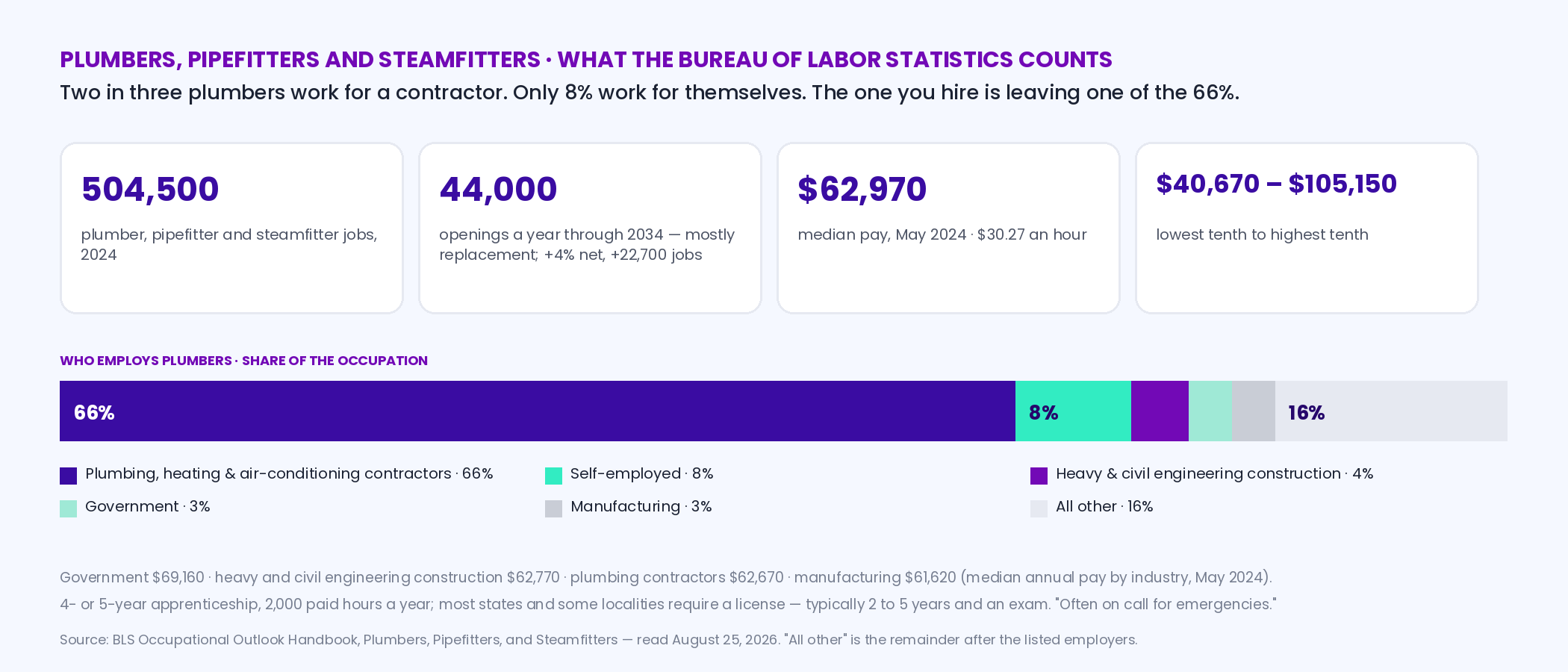
BLS counted 504,500 plumber, pipefitter, and steamfitter jobs in 2024 and projects about 44,000 openings a year through 2034 — mostly, in its words, "to replace workers who transfer to different occupations or exit the labor force, such as to retire" — on top of 4% net growth. Median pay was $62,970 a year, $30.27 an hour in May 2024, with the lowest tenth under $40,670 and the highest tenth above $105,150; plumbing contractors had a median of $62,670, government $69,160. Entry is a high school diploma and a 4- or 5-year apprenticeship with 2,000 hours of paid on-the-job training plus technical instruction each year, sponsored by unions, trade associations, and businesses; "most states and some localities require plumbers to be licensed," typically after 2 to 5 years of experience and an exam. Most plumbers "work full time, including nights and weekends," and are "often on call for emergencies."
The recruiting fact is the employer split: 66% of plumbers work for plumbing, heating, and air-conditioning contractors, 8% are self-employed, and the rest are spread across heavy and civil construction, government, and manufacturing. Unlike painters, where a third of the trade works alone, plumbers mostly work for someone — which means the plumber you hire is almost always leaving a competitor, and the ad's job is to give a licensed, employed, on-call-tired person a specific reason to switch.
The license ladder is the recruiting plan
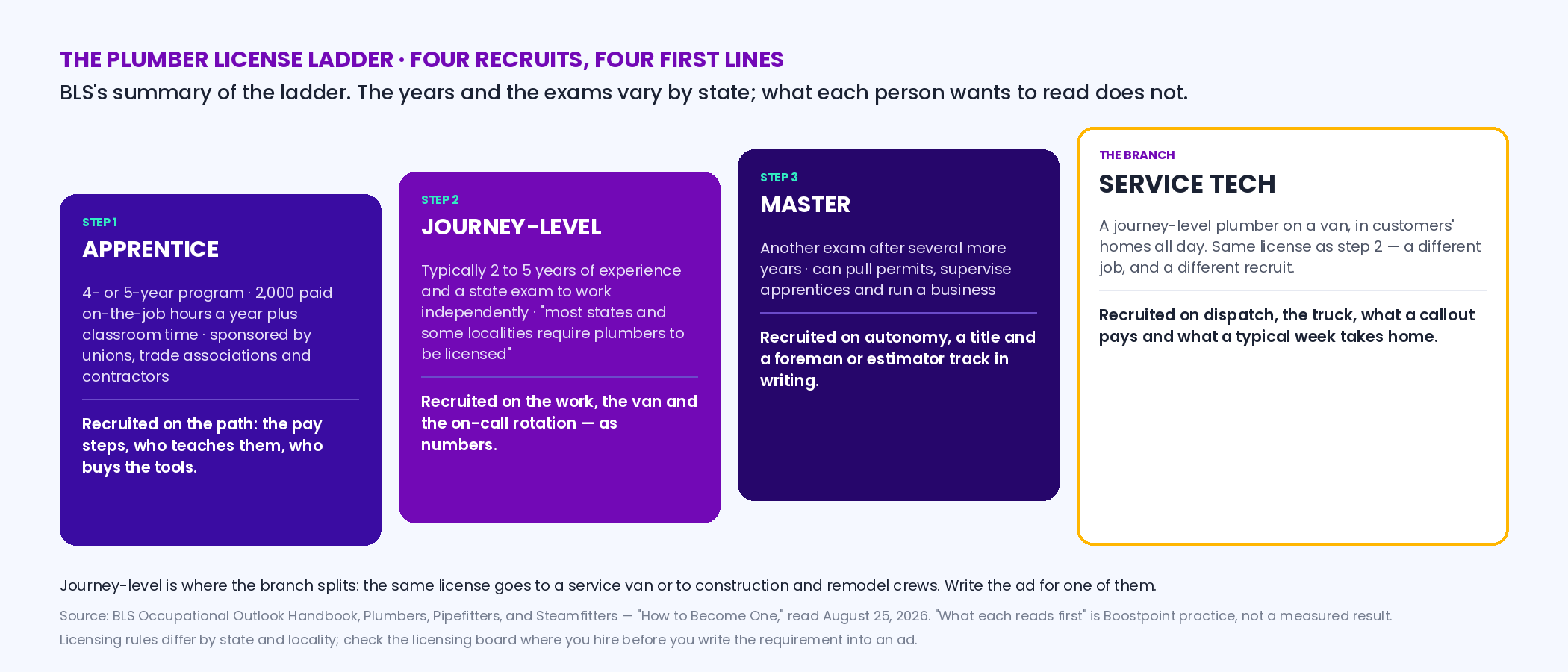
Every state draws the lines a little differently, but BLS's summary of the ladder is the one to recruit against. An apprentice is in a 4- or 5-year program and is paid to learn; they are recruited on the path — who sponsors the program, what the pay steps are, whether the classroom hours are on your time. A journey-level plumber has finished the apprenticeship, has the state's 2 to 5 years of experience, and has passed the exam that lets them work independently; they are recruited on the work, the van, and the on-call rotation. A master plumber has passed another exam after several more years and can, in most states, pull permits and run a shop; they are recruited on autonomy, a foreman or estimator track, and what the license is worth to you in writing. And a service technician — usually a journey-level plumber who does residential calls from a van — is a fourth animal: recruited on the truck, the dispatch, the commission or spiff structure if you have one, and how many nights a month they'll be on call. An ad that says "plumber wanted" is addressed to none of them.
Build the first line for the plumber you actually want
Pick the tier and the panel shows who you're competing with for that person, what to name in the ad, the three knockout questions for the form, and a starting first line. Replace the bracketed rate and town with yours; the tool prints nothing you didn't type.
Nothing is stored or sent — this runs in your browser. Tiers follow BLS's summary; check your state's license names and requirements.
Who you're competing with
Name in the ad
Three knockout questions
What they'll leave a competitor for
Boostpoint's practice, not a template to paste. Knockout questions must be real requirements of the job; nothing about age, sex, or origin. Wages, hours, and towns are placeholders — Boostpoint publishes no plumber wage recommendation. See what makes a good job ad for the rest of the anatomy.
The on-call line: the silent disqualifier, and the honest advantage
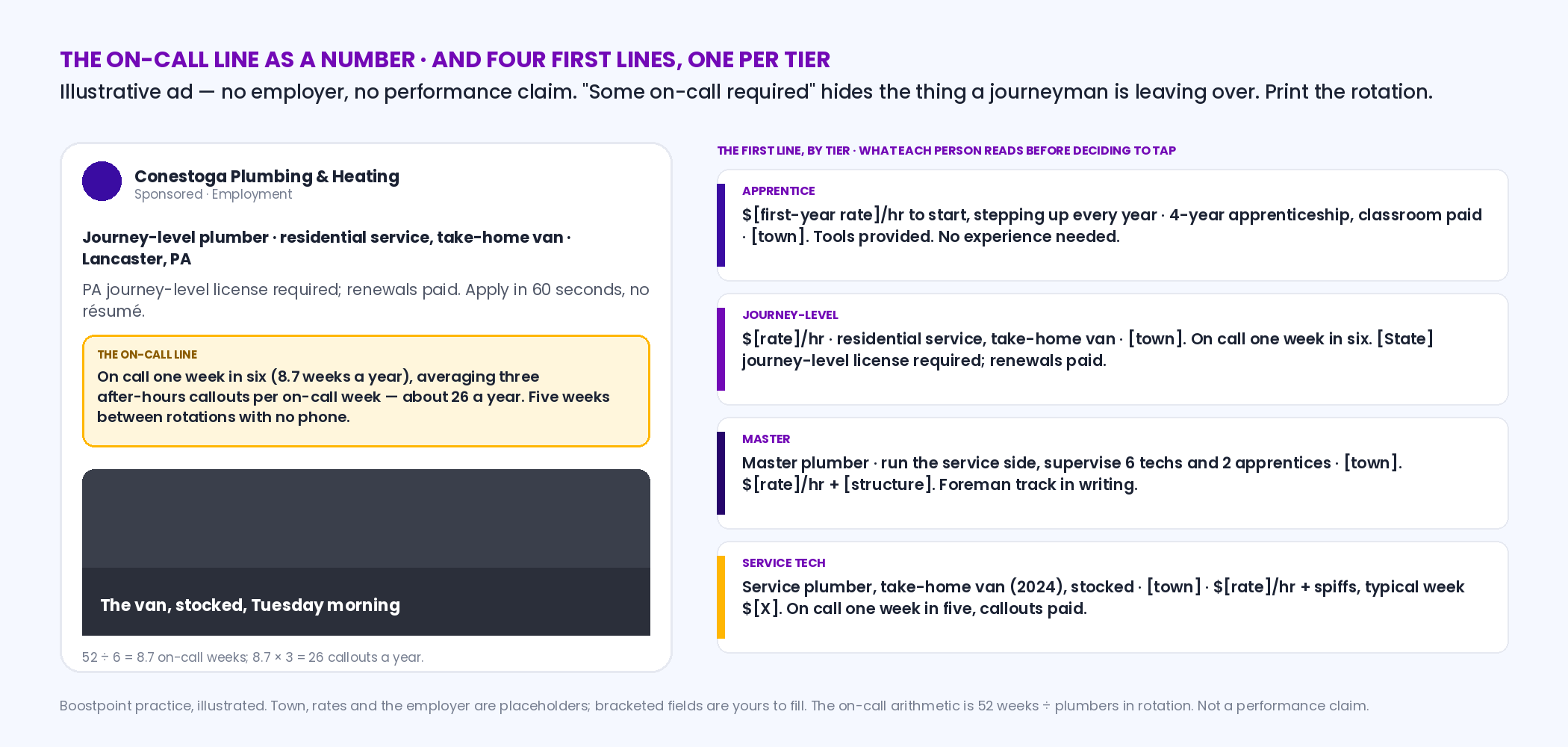
BLS puts it plainly: plumbers "are often on call for emergencies, so evening and weekend work is common." Every employed plumber knows their current rotation to the week, and it is the first thing they want to know about yours — and the thing most ads leave out, either because the employer thinks it scares people off or because nobody has counted it. Count it. If your rotation is genuinely lighter than the shop down the road, it is the best line in the ad. If it isn't, saying so filters out the person who would have quit in month two, before you've paid for their application. Enter your rotation and the tool turns it into a sentence.
Nothing is stored or sent — this runs in your browser. Use your real numbers; the sentence goes in the ad and the form.
Arithmetic on your inputs: 52 weeks ÷ plumbers in rotation, rounded to one decimal; callouts a year = on-call weeks × callouts per week. Overtime and callout pay must follow federal and state wage law. Boostpoint publishes no on-call benchmark; this is a wording tool.
Where to find plumbers who aren't looking
Because two in three plumbers are employed by a contractor and most of the rest are self-employed, the searching minority on job boards is a small, over-fished pool — and, in our trades campaigns, the one that converts worst: click-to-apply ran at 9.1%, the lowest of any vertical we track, because the form loses them. The employed majority is reached three ways. Referrals from your own plumbers, with a bonus paid in installments at 30 and 90 days, produce the hires that stay, because the referrer has already explained the rotation. The supply house at opening time is where every plumber in the county stands in line; a flyer with the on-call line and the van on it does more there than a job board post. And social feed advertising — what we sell — reaches the journeyman on his phone at the end of a callout, with the ad's first line doing the selecting and a one-minute form doing the screening. Union halls and the apprenticeship programs BLS describes are the channel for apprentices and, in union markets, for journey-level plumbers too. Staffing agencies supply a licensed plumber for a job you can't cover this month; the trades agency comparison has the markup math.
What advertising for plumbers costs — and the number we won't print
In an earlier campaign-level analysis of 45 skilled-trades field campaigns across 10 clients and 3,703 applications, the blended cost per applicant was $9.28, with a typical range of $6 to $17 and a click cost of $0.84, the cheapest of any vertical — and a click-to-apply rate of 9.1%, the lowest. The 2026 benchmark's skilled-trades row shows a $14.14 median and a 15% apply rate across 35 campaigns. What we can't tell you is what a plumber applicant costs, because 69% of the applications in those trades campaigns came from campaigns whose names don't identify the role, and splitting plumbers out would be a guess. What we can tell you is what decides the number: application completion ranged from 3.5% to 18.6% across trades contractors running the same kind of ads, and across the whole benchmark, conversion after the click explains 70% of the variation in cost per applicant. A journeyman on a phone after a callout will answer three questions; he will not upload a résumé. Cost per applicant is not cost per hire, and this page makes no claim about the latter.
The plumber job description, and why the ad isn't one
Once the ad has done its job, the applicant lands on the description — duties, requirements, conditions — and ours for the trade is on the plumber job description page, with a template you can copy. Keep the two documents separate. The description is for the person who has decided to apply; the ad is the six seconds before that decision, read by a licensed plumber who is employed and not searching. The ad says the tier, the work, the van, the rotation, and the rate. The description says everything else.
"Plumber wanted" is addressed to nobody. Name the tier, print the rotation, describe the van, and give a licensed, employed person one specific reason to answer the phone.
Frequently asked questions
How do you recruit plumbers?
Decide which plumber first — apprentice, journey-level, master, or service tech — because each reads a different first line. Then write the ad around that tier: the work (service, new construction, commercial), the van, the on-call rotation as a number, the license you require by name, and the rate. Reach the employed majority through your own plumbers' referrals, the supply house, and social feed ads with a one-minute form; use job boards for the searching minority and union or apprenticeship programs for entry-level and, in union markets, journey-level hires.
Where can I find plumbers to hire?
Two in three plumbers work for plumbing, heating, and air-conditioning contractors and 8% are self-employed, per BLS, so most of the trade is employed and not searching. They are reachable through referrals from your current plumbers, at the supply house at opening time, in social feeds on their phones, and — for apprentices and union markets — through the apprenticeship programs BLS describes as sponsored by unions, trade associations, and businesses. Job boards reach the minority actively looking; staffing agencies supply licensed plumbers at a markup for jobs you can't cover this month.
How much do plumbers make?
Per the BLS Occupational Outlook Handbook, the median for plumbers, pipefitters, and steamfitters was $62,970 a year or $30.27 an hour in May 2024, with the lowest tenth under $40,670 and the highest tenth above $105,150. By industry: government $69,160, heavy and civil engineering construction $62,770, plumbing contractors $62,670, manufacturing $61,620. Local markets and license tiers differ widely; print your rate and a typical week in the ad rather than "competitive pay."
Is there a plumber shortage?
BLS projects about 44,000 openings a year through 2034, most of them replacement of plumbers who leave the occupation or retire, plus 4% net growth on 504,500 jobs. That is steady churn, and the ladder makes it feel worse than it is: a journey-level license takes a 4- or 5-year apprenticeship plus, typically, 2 to 5 years of experience and an exam, so the licensed pool grows slowly. The contractors who fill positions are the ones recruiting from the employed 66%, not the ones waiting for job-board applicants.
What should a plumber job ad say?
Which tier (apprentice, journey-level, master, service tech); the work (residential service, new construction, commercial, remodel); the van — take-home, stocked, who fuels it; the on-call rotation as a number ("one week in six, about three callouts"); the license you require by name and whether you reimburse renewals; the rate and a typical week; and an apply promise you keep — sixty seconds, three questions, a call the same day. Leave the duties list for the job description page.
What is the difference between a journeyman and a master plumber?
In BLS's summary, a journey-level plumber has completed a 4- or 5-year apprenticeship and, typically, 2 to 5 years of experience plus a state exam, and is qualified to work independently. A master plumber has several more years of experience and has passed another exam; in most states a master can pull permits, supervise apprentices, and run a plumbing business. Names, years, and exams vary by state and sometimes by locality — check yours before writing "master required" into an ad.
Should I hire an apprentice or a licensed plumber?
Both, on different timelines. A licensed journey-level plumber produces billable work this month and is recruited away from a competitor on the van, the rotation, and the kind of work; an apprentice produces a licensed plumber in four or five years and is recruited on the path — sponsor, pay steps, paid classroom time, a named mentor. A shop with only one of the two either can't grow or can't replace; BLS's 44,000 openings a year are mostly replacement, and the apprentice you hire now is the journeyman you won't have to recruit in 2031.
What does it cost to recruit plumbers with advertising?
We don't publish a plumber-specific figure, because 69% of the applications in our trades campaigns came from campaigns whose names don't identify the role. What we publish: a blended $9.28 per applicant across 45 trades field campaigns in an earlier analysis (typical range $6–$17), and a $14.14 median with a 15% apply rate in the 2026 benchmark's skilled-trades row (35 campaigns). The spread inside those numbers is the form — application completion ran from 3.5% to 18.6% across contractors. Cost per applicant is not cost per hire.
Write the ad for the plumber you actually want
We'll build the tier-specific ad and the three-question form, run it where employed plumbers are, and show you the trades campaigns closest to yours — costs, no plumber figure we can't back.
Book a DemoGetting licensed plumbers to apply is the hard half; the other half is what you ask when they arrive. See plumber interview questions.
Boostpoint figures come from the 2026 Social Job Advertising Benchmark — 891 campaigns and 1,334 campaign-months: skilled trades median cost per applicant $14.14, middle 50% $7.58–$21.49, 15% apply rate, 35 campaigns; applicant conversion explaining 70% of cost variation. Earlier campaign-level analysis of skilled-trades field campaigns (different methodology): 45 campaigns, 10 clients, 3,703 applications, blended $9.28 per applicant, typical range $6–$17, cost per click $0.84, click-to-apply 9.1%, application completion 3.5%–18.6% across contractors; 69% of trades applications came from campaigns whose names do not identify the role, so no plumber-specific cost per applicant is published. Cost per applicant is not cost per hire; we do not track hires and publish no cost-per-hire figure. The tier profiles, knockout questions, first lines, channel ranking, and on-call wording are Boostpoint's practice, not measured results; the on-call calculator performs arithmetic on the user's inputs only. Third-party: BLS Occupational Outlook Handbook, Plumbers, Pipefitters, and Steamfitters (May 2024 wages; 2024 employment; 2024–34 projections; employer shares; apprenticeship and licensing summary; work schedule), read August 25, 2026. License names, years, and exams vary by state and locality; verify yours. This is a sample of Boostpoint campaigns, not an industry-wide study.