
Landscaping and Grounds Crew Recruiting: Rebuilding the Crew Every Spring Without Starting From Zero
Landscaping recruiting is the same problem every March: the crews that left in November have to exist again by the first mow, from a pool — BLS counts 1,192,500 landscaping and groundskeeping workers at a median $18.31 an hour, with about 171,600 openings a year across grounds maintenance — that needs no credential and is also being recruited by every warehouse and construction site in the county. The plan is arithmetic: how many of last year's crew come back, how many the returning leads bring, and how many the ad has to produce, started early enough that it isn't competing with everyone else's spring ad. Our adjacent evidence for "early enough" is agriculture, not landscaping: across four co-ops' campaigns, May cost 2.8× August per applicant.
A note on who's writing this
Boostpoint runs social media job ads for contractors and for agribusinesses that staff up every spring, so the sections of this page about the ad describe what we sell. We publish no landscaping-specific cost per applicant and won't estimate one — 69% of applications in our trades data sit in campaigns whose names don't identify the role — and we have no landscaping seasonality data. Where this page talks about timing, the evidence is our agriculture analysis, four co-ops across one season, which is adjacent to landscaping and labeled as such every time it appears. The federal H-2B facts are summarized from the February 2026 rule and are not immigration advice. No contractor is named. Every figure of ours is a cost per applicant, never a cost per hire.
The pool, and the two things about it that set the plan
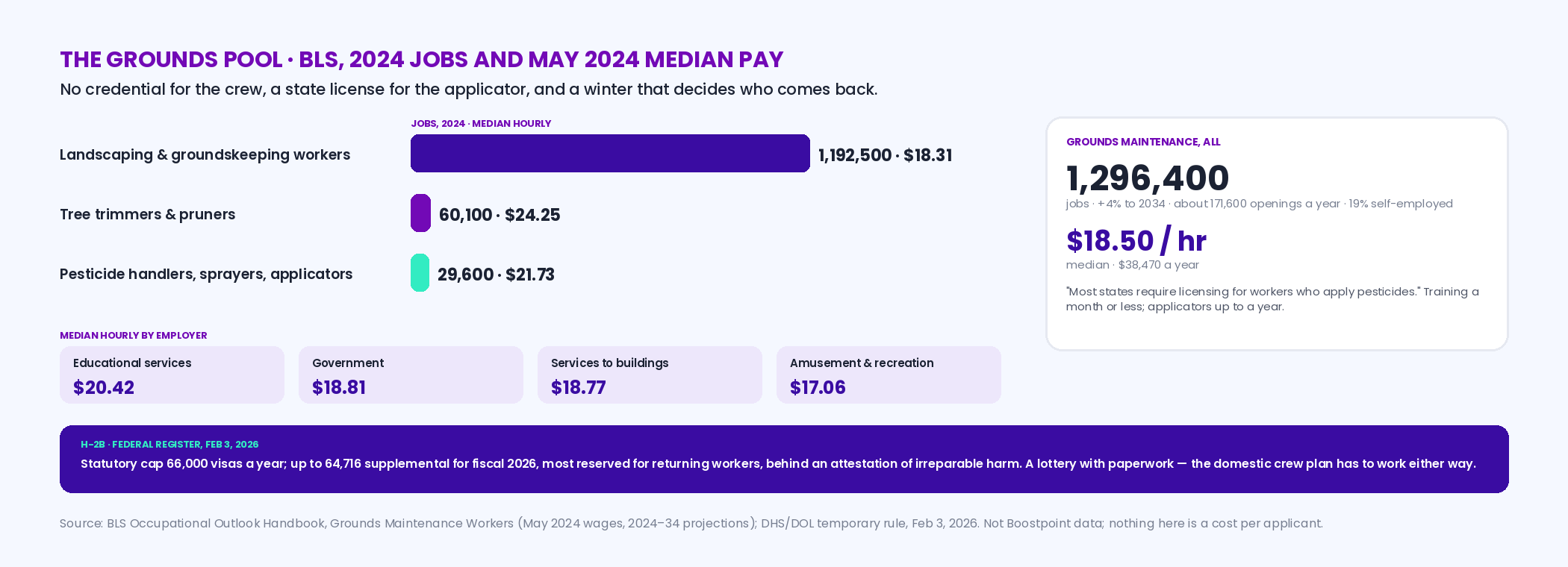
BLS counts 1,296,400 grounds maintenance workers (2024) — 1,192,500 landscaping and groundskeeping workers at a median $18.31 an hour, 60,100 tree trimmers and pruners at $24.25, and 29,600 pesticide handlers, sprayers and applicators at $21.73 — growing 4% to 2034 with about 171,600 openings a year, 19% of them self-employed. Pay by employer runs from $20.42 an hour in educational services to $18.77 with services-to-buildings contractors and $17.06 in amusement and recreation. Two facts about the pool decide the recruiting. First, there is no credential for the crew — BLS puts training at a month or less — but "most states require licensing for workers who apply pesticides," which makes the licensed applicator the one hire on the crew that is scarce, and the one to recruit first and keep through the winter. Second, in BLS's words, "some jobs are seasonal. However, grounds maintenance workers sometimes provide other services during the winter months, such as snow removal" — which is the retention lever: a crew member with winter hours in December is a crew member you don't recruit in March. The third fact sits outside BLS: the federal H-2B program, whose statutory cap is 66,000 visas a year with up to 64,716 supplemental visas made available for fiscal 2026 by a February 3, 2026 rule, most of them reserved for workers who held H-2B status in the prior three years, and all of them behind an employer attestation of irreparable harm. Administrative and landscaping services was among the six sectors that requested about 95% of fiscal 2025's H-2B applications. For a contractor the practical meaning is that the H-2B crew is a lottery with a paperwork trail, and the domestic crew is the plan that has to work whether or not the lottery does. If you are running the visa track as well, H-2B visa for employers has the cap position, the 75 to 90 day filing window and the domestic recruitment DOL requires before it will certify.
How much should I pay landscaping and lawn care employees?
Pay a new crew member without experience about $17.40 an hour, a competent crew member about $18.82, an experienced worker who runs equipment or irrigation $22.52 to $27.28, and a crew lead about $28.09. Those are the national 25th percentile, median, 75th to 90th percentile for landscaping and groundskeeping workers, and the median for first-line supervisors of landscaping crews, in BLS's May 2025 Occupational Employment and Wage Statistics, newer than the May 2024 figures quoted elsewhere on this page. Local pay can sit several dollars either side, so check your metro area in the same table before you post a rate, and never post below your state or local minimum wage.
| Rung | Who it is | National hourly (May 2025) | BLS basis |
|---|---|---|---|
| Helper / new hire | No experience; mows, trims, loads; needs training on equipment | $14.98–$17.40 | 10th–25th percentile, landscaping and groundskeeping workers (37-3011) |
| Crew member | A season or more; works unsupervised on a route | $18.82 | Median, 37-3011 |
| Experienced | Runs equipment, irrigation, hardscape or planting; drives the truck | $22.52–$27.28 | 75th–90th percentile, 37-3011 |
| Crew lead / foreman | Runs the crew and the route; talks to the customer | $22.79–$34.90 (median $28.09) | 25th–75th percentile, first-line supervisors of landscaping, lawn service and groundskeeping workers (37-1012) |
Source: U.S. Bureau of Labor Statistics, Occupational Employment and Wage Statistics, May 2025 national estimates, read September 24, 2026. Tree trimmers and pruners and pesticide applicators are separate occupations with their own, higher medians; the licensed applicator rate is in the table further down this page.
The wage is not the cost. Add 7.65% for Social Security and Medicare on every dollar, federal unemployment of up to $42 a year and state unemployment on your state's wage base, and a workers' compensation premium that for landscape work is usually well above what an office pays. Read your rate off your declarations page. On a seasonal crew member working 1,200 hours at the $18.82 median, payroll taxes and Pennsylvania's newly liable unemployment rate alone take the hour to about $20.61 before workers' compensation or any benefit, and because unemployment taxes stop at the wage base, they weigh more on seasonal hires than on year-round ones. The employee cost calculator runs the full stack on your own numbers.
What a higher rate does to applicants. A rate at or above the local median, in the first line of the ad, removes a common reason a qualified person scrolls past; a rate below it still draws applicants, but fewer, and the ad has to say what the trade is, such as winter hours or a four-day week. We publish no landscaping-specific figure, but the nearest row in our 2026 benchmark, skilled trades, ran a median $14.14 per applicant at a 15% apply rate. Just as much depends on whether the application takes under a minute and someone calls the same day: in the same benchmark, what happens after the click explained 70% of the difference in cost per applicant between campaigns. For pay-setting across other hourly roles, see how much to pay employees.
The spring crew, worked as arithmetic
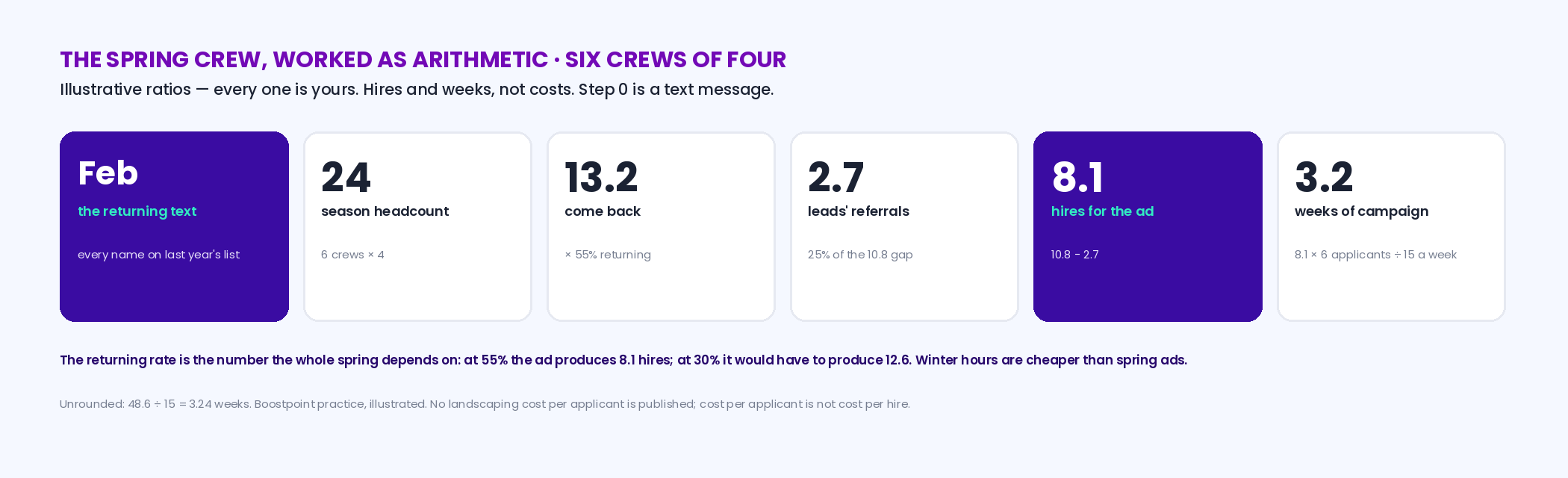
A landscaping company with six crews of four needs 24 people on the first mow. Some of last year's 24 come back — the share is the number that matters most in this business and the one most companies don't track; the crew leads who come back bring people with them; the licensed applicator, if kept on through the winter, is already there; and the remainder is what the ad has to produce, through a funnel whose ratios are the company's own. That remainder decides how early the ad goes up. Run it backward the way the carpenter and concrete crew page runs a crew: the lead first, the crew around him, the laborer ad for the rest. Then add the landscaping-specific step — the returning-worker text in February, before the ad, to every name on last year's list, with the start date and the rate. A company that texts 24 people in February and hears back from 14 has cut its spring recruiting by more than half before spending a dollar.
Interactive
Spring crew planner — how many of the season's crew the ad actually has to produce, and when it has to start
Nothing is stored or sent — this runs in your browser. Enter the crews, your returning rate and your funnel; the planner works back to applicants and the week the ad goes up. No cost is computed.
Arithmetic on your inputs; every ratio is yours. The planner computes no cost and assumes no seasonality — Boostpoint publishes no landscaping figure and has no landscaping seasonality data. Cost per applicant is not cost per hire.
When to start: the adjacent evidence, labeled
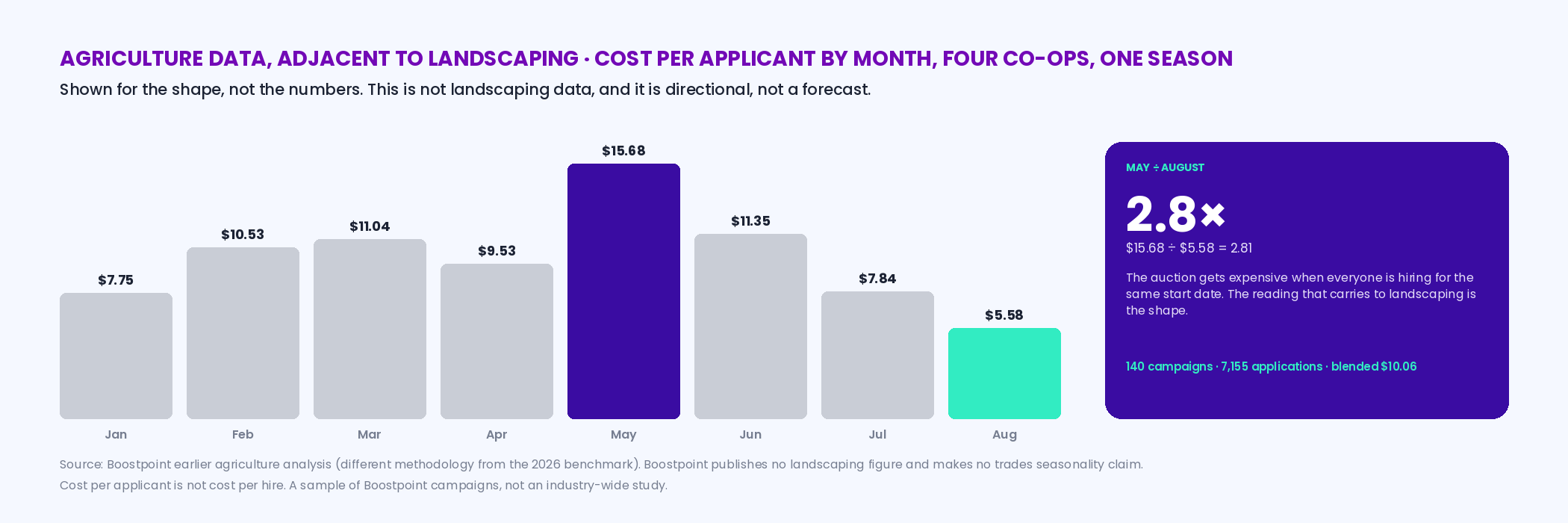
We have no landscaping seasonality data and won't pretend to. What we have is agriculture — 140 campaigns across four co-ops in one season, 7,155 applications, blended $10.06 per applicant — where the cost per applicant by month ran January $7.75, February $10.53, March $11.04, April $9.53, May $15.68, June $11.35, July $7.84 and August $5.58: May cost 2.8 times August. The co-ops were recruiting seasonal applicators, CDL drivers and plant workers into the same spring that landscapers recruit into, from overlapping rural and exurban pools, against the same competing employers, which is why we show it; it is a single season and four clients, directional and not a forecast, and it is not landscaping. The reading that carries over is the shape, not the numbers: the auction gets expensive when everyone is hiring for the same start date, and the company whose ad ran in February for a March start paid a different price from the one whose ad ran in May. The full curve, with the roles and the co-op detail, is on agricultural recruiting costs: the seasonal curve.
Interactive · agriculture data, adjacent
The spring curve we can show — cost per applicant by month across four agricultural co-ops, one season
Nothing is stored or sent — this runs in your browser. Pick a month to see that month's figure against the cheapest and the most expensive. This is agriculture, not landscaping: shown for the shape, labeled so nobody mistakes it.
Boostpoint earlier agriculture analysis (different methodology from the 2026 benchmark): 140 campaigns, four co-ops, 7,155 applications, blended $10.06 per applicant, one season — directional, not a forecast, and not landscaping data. Boostpoint publishes no landscaping figure and makes no trades seasonality claim. Cost per applicant is not cost per hire.
The ad, the form, the winter
The landscaping ad competes with a warehouse ad at the same rate and a construction laborer ad at a higher one, and it wins on being outside, being done by four, and starting Monday. On Meta it runs in the Special Ad Category — no age, gender or ZIP targeting, the rules on Meta Special Ad Category, explained — so the first line does the selecting: "Landscape crew · $[low]–$[high]/hr · outside, Monday to Friday, done by 4 · no experience needed · start [date] · [City]." The crew lead ad is a different ad for a different person: the route, the truck, the crew he runs, the winter hours; the applicator ad names the license and the rate for holding it. The form asks two questions — a valid driver's license, and available for the start date — and nothing else before the offer; in our earlier trades analysis, application completion ran from 3.5% to 18.6% across contractors on the same channel, and click-to-apply was the lowest of any vertical at 9.1%, so the form is where a landscaping ad is won. Then the winter: snow, holiday lighting, hardscape, equipment maintenance — whatever keeps the lead and the applicator on payroll through February is cheaper than recruiting both in March, and BLS's own note about winter services is the industry saying so. For a spring start, a dated yard hiring day — trucks in the lot, the crew leads present, offers made on the spot — is the event-driven structure that ran a median $8.02 per applicant in the benchmark; the mechanics are on open house hiring events. The adjacent pools share pages: housekeepers and janitorial staff for the grounds-and-buildings crew, and painters, which draws from the same exterior-work applicant. What a landscaping applicant costs we don't publish; the skilled trades row of the 2026 benchmark ran a median $14.14 per applicant with a 15% apply rate across 35 campaigns, and the earlier trades analysis blended $9.28 with a typical range of $6–$17 — the nearest rows, not a landscaping number.
| Hire | BLS jobs and median pay | Credential | When to recruit | First line of the ad |
|---|---|---|---|---|
| Licensed applicator | 29,600 pesticide handlers, sprayers and applicators · $21.73/hr | State pesticide applicator license in most states; up to a year of training | Keep through the winter; if recruiting, first, in January | "Licensed applicator · $[rate]/hr + license premium · year-round · [City]" |
| Crew lead | Within 1,192,500 landscaping and groundskeeping workers · $18.31/hr median for the group | Driver's license; the route and the crew | February: the returning text, then the lead ad | "Crew lead · run your own route · $[rate]/hr · truck, winter hours · [City]" |
| Crew member | Same group · $18.31/hr median; a month or less of training | Driver's license preferred; none required | The ad, started the weeks before the first mow that the planner says | "Landscape crew · $[low]–$[high]/hr · outside, done by 4 · no experience needed · start [date] · [City]" |
The spring crew isn't recruited in March; it's kept in December and texted in February. Count who comes back, let the leads bring the rest, and start the ad for the remainder before everyone else's — the only seasonality claim we can make is the shape of somebody else's curve.
How to recruit groundskeepers: the year-round job at a campus, a course or a property
A groundskeeper and a landscape crew member sit in the same BLS occupation, but they are recruited differently because the employer is different. The groundskeeper works for the place itself: a school district or university, a hospital campus, a golf course, a cemetery, an apartment or HOA portfolio, a park. The work is the same property every day, often year-round, and often with benefits a contractor cannot match. The BLS counts 1,188,600 landscaping and groundskeeping workers (2025), with about 149,500 openings a year through 2035 and a median of $39,150 a year (May 2025); the pay-by-employer figures earlier on this page show educational services paying above contractors.
That changes the ad. A contractor sells "outside, done by 4, start Monday"; a groundskeeper ad sells stability: the title, the name of the campus or property, "year-round, Monday to Friday," the hourly rate and the benefits, all in the first line. Name the property, because people like working on a place they know, and name the winter work (snow removal, equipment maintenance, setup for events) so nobody assumes the job ends in November. Ask about a driver's license if the job drives a vehicle, any license the role genuinely needs (BLS notes that most states require licensing for workers who apply pesticides), and availability for weather call-outs. Recruit from contractor crews whose members want benefits and a single site, from your own facilities and custodial staff, and with a social job ad in the commute area around the property. Golf courses and seasonal parks recruit on the spring calendar like a contractor does. The posting itself is on our groundskeeper job description.
How to recruit landscape laborers: the first rung of the crew
The landscape laborer is the crew's entry hire and the one most companies recruit hardest every spring. The person is choosing between your crew, a warehouse and a construction site, often for similar money, so the ad wins on the things only outdoor work offers and on removing the reasons people say no. Say where the day starts ("meet at the yard at 7, ride in the truck"), because a laborer without a reliable car can still take a job that starts at the yard. Say what the work is (mowing, mulch, planting, hardscape) and what it is not. Say whether hours continue into winter. And say "no experience needed, we train on the equipment" if that is true.
Recruit from the people already doing physical work nearby: warehouse and delivery workers who want to be outside, construction laborers between jobs, agricultural workers, and students and seasonal workers for summer help. Your crew leads' referrals are the cheapest source, and a text to last year's laborers in February comes before any ad. Keep the form to two questions (the start date, and the days available), call the same day, and let the first day in the truck be the interview. Pay the first week on time and put the laborer beside a lead who explains the equipment, because a laborer who quits in week one is usually one nobody talked to. The nearest benchmark row is the Skilled trades family cited above, not a laborer figure. Duties and requirements for the posting are on our landscape laborer job description, and the interview is on landscaper interview questions.
Is there a landscaper shortage?
Not of people who could do the work. The newer BLS Employment Projections for 2025 to 2035 count 1,188,600 landscaping and groundskeeping workers in 2025, projected to grow 4.7% to 1,244,200 by 2035, with about 149,500 openings a year and a median wage of $39,150 in May 2025. (Figures earlier on this page come from the previous 2024-34 edition, and their openings count covers all grounds maintenance occupations together, so they differ.) Growth accounts for about 5,560 of those openings a year, which means roughly 96% of them are replacements: workers who moved to a different occupation or left the labor force.
So the landscaper shortage most contractors feel is a spring refill problem layered on a low-credential pool that every warehouse and construction site is also hiring from. Three things make it feel worse than the national numbers suggest.
- Everyone hires in the same weeks. The crew that left in November is being rebuilt by every contractor in the county at once, which is why the timing section above argues for starting before the season.
- The scarce hires are specific. Crew leads and licensed applicators are the tight part of the pool. First-line supervisors of landscaping, lawn service and groundskeeping workers number 243,300, with about 23,900 openings a year and a $58,430 median; pesticide handlers, sprayers and applicators for vegetation number just 25,700, with about 3,300 openings a year and a $46,340 median (BLS Employment Projections 2025-35). Recruit and keep those first.
- The visa route is capped. Contractors who rely on H-2B workers are competing in a capped program; the cap position and the rule are set out in the pool section and the FAQ below, and in H-2B visa for employers.
The answer to a replacement shortage is the plan this page already lays out: text last year's crew in February, pay returning leads to bring people, run the ad before the first mow, and give the people you want back some winter hours. The posting for the entry role is on our landscape laborer job description.
Frequently asked questions
What is the best way to recruit landscapers?
Count who comes back first — text last year's list in February with the start date and the rate — then let returning crew leads fill part of the gap by referral, keep the licensed applicator on through the winter, and run the ad for the remainder early enough that it isn't competing with every other spring ad. The ad says the rate, "outside, done by 4," "no experience needed" and the start date in the first line, and the form asks two questions.
How many landscapers do I need to recruit each spring?
Crews times crew size, minus the share of last year's crew who come back, minus the share of the gap that returning leads fill by referral. Six crews of four with 55% returning and referrals covering a quarter of the gap leaves about 8 hires for the ad; at 6 applicants per hire that is about 49 applicants. The planner on this page runs it on your numbers.
What do landscaping workers earn?
BLS puts the May 2024 median for landscaping and groundskeeping workers at $18.31 an hour, tree trimmers and pruners at $24.25 and pesticide handlers and applicators at $21.73; grounds maintenance workers overall earned a median $38,470 a year. By employer, educational services paid $20.42 an hour, government $18.81, services-to-buildings contractors $18.77 and amusement and recreation $17.06.
How much should I pay my landscaping employees?
Nationally, about $17.40 an hour for a new hire without experience, $18.82 for a competent crew member, $22.52 to $27.28 for an experienced worker who runs equipment or irrigation, and $28.09 for a crew lead. Those are BLS's May 2025 25th percentile, median, 75th to 90th percentile and supervisor median. Check your metro area's figure and your state minimum wage, and post the rate in the first line of the ad.
How much should I pay lawn care workers?
Lawn care crews fall under the same BLS occupation as landscapers: a national median of $18.82 an hour in May 2025, with $17.40 at the 25th percentile for new mowers and trimmers and $22.52 at the 75th for experienced operators. Budget for the full cost, not the wage: payroll taxes, unemployment tax on the first slice of wages and a landscaping workers' compensation rate add several dollars an hour, proportionally more for seasonal staff.
How much should a landscaping crew leader make?
BLS puts first-line supervisors of landscaping, lawn service and groundskeeping workers at a national median of $28.09 an hour in May 2025, with $22.79 at the 25th percentile and $34.90 at the 75th. A lead who runs a route and a truck and deals with customers is usually paid toward the middle of that range; one who runs several crews or holds a pesticide license toward the top.
When should I start recruiting for the spring landscaping season?
Before everyone else does, by the number of weeks the planner gives you for your funnel. We have no landscaping seasonality data; the adjacent evidence is our agriculture analysis, where across four co-ops in one season May cost 2.8 times August per applicant — a shape, not a forecast, and not landscaping. The returning-worker text goes out in February regardless.
Do landscaping workers need a license?
Not for the crew — BLS puts entry training at a month or less — but "most states require licensing for workers who apply pesticides," and a driver's license is the practical requirement for anyone who runs a route. The licensed applicator is the one scarce hire on the crew; recruit that person first and keep them through the winter.
How does H-2B affect landscaping recruiting?
The statutory cap is 66,000 visas a year; a February 3, 2026 DHS/DOL rule made up to 64,716 supplemental visas available for fiscal 2026, most reserved for workers who held H-2B status in fiscal 2023–2025, behind an employer attestation of irreparable harm. Administrative and landscaping services was among six sectors requesting about 95% of fiscal 2025 applications. It is a lottery with paperwork; the domestic crew plan has to work either way. Not immigration advice.
What does it cost to recruit landscaping crews?
We publish no landscaping figure and won't estimate one — 69% of applications in our trades data sit in campaigns whose names don't identify the role. The nearest rows are the 2026 benchmark's skilled trades median of $14.14 per applicant (15% apply rate, 35 campaigns) and the earlier trades analysis at a blended $9.28 with a typical range of $6–$17. Cost per applicant is not cost per hire.
How do you keep a landscaping crew from year to year?
Winter hours. BLS notes that grounds maintenance workers "sometimes provide other services during the winter months, such as snow removal"; snow, holiday lighting, hardscape and equipment maintenance keep the lead and the applicator on payroll, and a crew member with December hours is one you don't recruit in March. Track the returning rate every year — it is the number the whole spring plan depends on.
Where can I find landscapers to hire?
Most experienced landscapers are already working for another crew, which rules out job boards as a primary channel — they reach the small slice currently between jobs. What works: referrals from your existing crew paid as a written bonus, social job ads that reach people in a feed rather than on a search, signage on your trucks and at active job sites, and supply houses and equipment dealers where crews stop weekly. Trade programs and high schools build a bench for future seasons rather than filling this week.
How do you hire landscapers quickly for the season?
Advertise before the season rather than during it — by the time the work arrives, the available crews have already been taken. Put the hourly rate, the start date and whether the work is seasonal or year-round in the first line, make applying take under two minutes without a resume, and call the same day. Crews that hire in February fill from a pool; crews that hire in April fill from whoever is left.
When you have people to talk to, the matching interview is on our page of landscaper interview questions — including the two questions that predict whether a spring hire is still on the crew in September.
How do you recruit groundskeepers?
Sell the stability that a contractor cannot: one property, year-round hours and benefits, named in the first line with the rate. Mention the winter work so the job does not read as seasonal, ask only for the licenses the role genuinely needs, and recruit from contractor crews who want a single site, from your own facilities staff, and with a social job ad around the property. The BLS counts 1,188,600 landscaping and groundskeeping workers at a median $39,150 a year (May 2025).
How do you recruit landscape laborers?
Text last year's laborers in February, ask your crew leads for referrals, then run an ad before the spring rush that says the rate, where the day starts (the yard, the truck), what the work is, whether hours continue in winter and "no experience needed" if true. Aim it at people doing physical work nearby, such as warehouse, delivery and construction workers. Two form questions, a same-day call, and the first day in the truck as the interview.
Run the spring ad before the spring
We'll write the crew, lead and applicator ads with your rate and your start date in the first line, put a two-question form behind each, run them the weeks before the first mow that your planner says, and show you the seasonal campaigns closest to yours.
Book a DemoBoostpoint figures come from the 2026 Social Job Advertising Benchmark — 891 campaigns and 1,334 campaign-months: skilled trades median cost per applicant $14.14, middle 50% $7.58–$21.49, 15% apply rate, 35 campaigns (the nearest row, not a landscaping figure); event-driven $8.02, 21%, 78 campaigns. Earlier campaign-level analyzes (different methodology): trades blended $9.28, typical range $6–$17, click-to-apply 9.1%, completion 3.5% to 18.6%; agriculture 140 campaigns, four co-ops, 7,155 applications, blended $10.06, cost per applicant by month January $7.75 through August $5.58 with May $15.68 at 2.8× August — one season, directional, not a forecast, and cited here as adjacent to landscaping, not as landscaping data. No landscaping figure is published and no trades seasonality claim is made. Third-party figures — BLS Occupational Outlook Handbook, Grounds Maintenance Workers (May 2024 wages, 2024–34 projections); Federal Register, February 3, 2026, DHS/DOL temporary rule on the FY 2026 H-2B numerical limitation — are theirs and attributed in place; the H-2B summary is not immigration advice. No customer is named. The planner is arithmetic on your inputs, not a measured result. Cost per applicant is not cost per hire; we do not track hires and publish no cost-per-hire figure. A sample of Boostpoint campaigns, not an industry-wide study.