
Agricultural Recruiting: What It Costs to Staff a Co-op, Month by Month
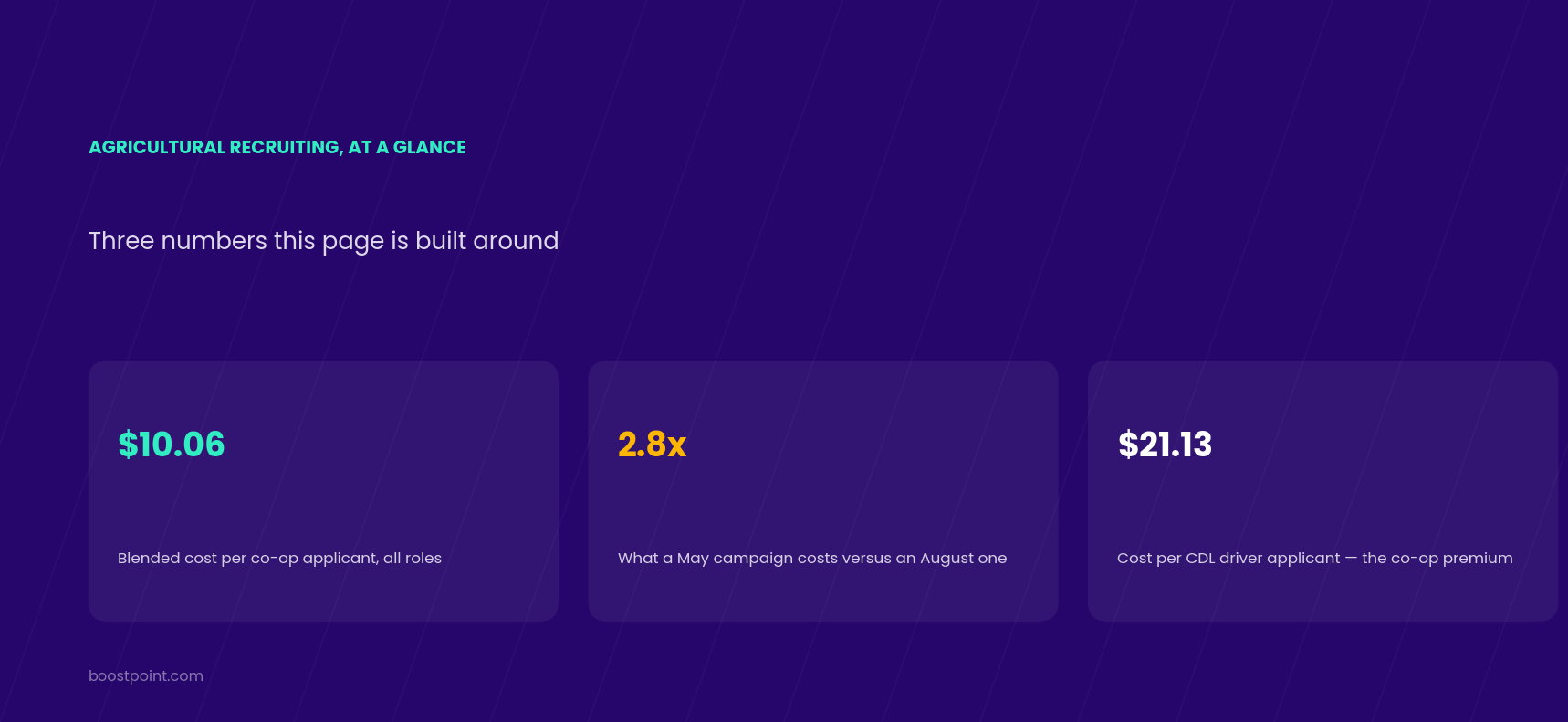
In Boostpoint's 2025–2026 agricultural campaign data, agricultural recruiting costs $10.06 per applicant on average, but that number moves more with the calendar than with anything else you control. A campaign launched in May cost $15.68 per applicant. The same campaign launched in August cost $5.58 — nearly three times less, for the same roles in the same markets.
Source: 140 Boostpoint-managed agricultural campaigns across four cooperatives, late 2025 through mid-2026, representing 5,498,069 impressions and 7,155 applications.
The problem is a calendar problem
Agricultural labor gets discussed as a shortage. A survey of agribusinesses across eight Midwest states found 75% identified a shortage of skilled workers as the primary barrier to expanding employment, with farm labor and truck drivers named the hardest entry-level roles to fill. CoBank has warned the available worker pool will shrink further, with the effect concentrated in the Upper Midwest, Corn Belt and Central Plains — which is to say, exactly where co-ops operate.
All true. But it misses the thing that costs co-ops the most money, and it's not scarcity.
Every co-op in a region needs applicators, seasonal drivers and plant help in the same eight-week window. The wider supply picture behind that crunch, including H-2A certifications and the 2026 wage rules, is on our farm labor shortage page. When you all compete for the same rural labor pool at the same time, the price of reaching a candidate moves sharply. That's not a shortage — it's an auction, and it's predictable enough to plan around. The non agricultural roles at a co-op, plant help and seasonal retail among them, fall under H-2B rather than H-2A if you go the visa route: see H-2B visa for employers.
We can show you the curve.
The seasonal cost curve
This is the most actionable data on this page. Cost per applicant, by the month the campaign launched, across a full season:
| Month launched | Cost per applicant | Applications |
|---|---|---|
| January | $7.75 | 646 |
| February | $10.53 | 1,295 |
| March | $11.04 | 1,670 |
| April | $9.53 | 1,326 |
| May | $15.68 | 578 |
| June | $11.35 | 514 |
| July | $7.84 | 686 |
| August | $5.58 | 165 |
Source: 140 Boostpoint-managed agricultural campaigns across four cooperatives, late 2025 through mid-2026, representing 5,498,069 impressions and 7,155 applications.
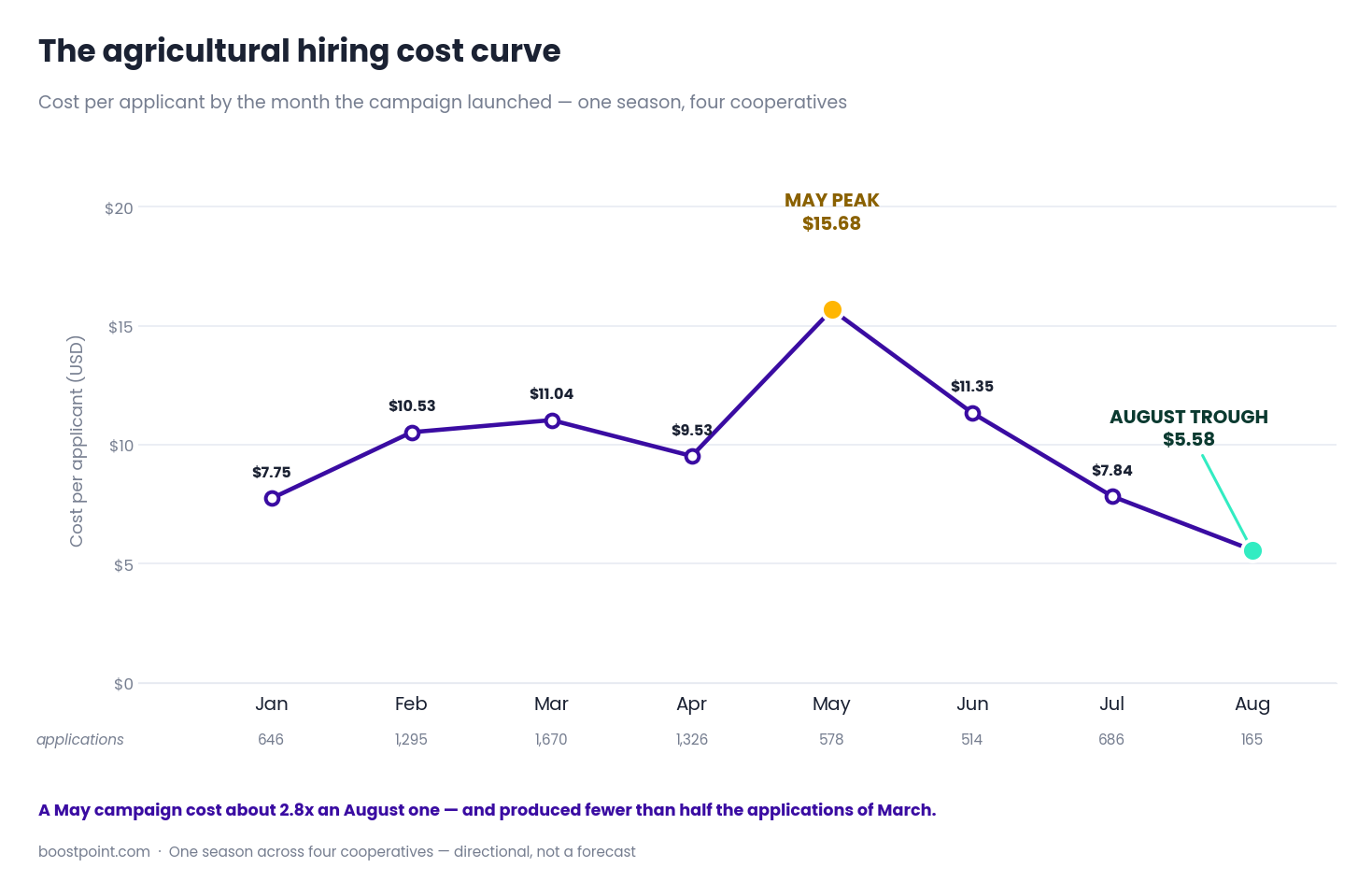
A campaign launched in May cost roughly 2.8 times as much per applicant as one launched in August, and about twice as much as one launched in January.
Look at the applications column alongside the cost. May was the most expensive month and produced fewer than half the applications of March. You pay more and get less, because by May everyone who was going to move has already moved.
What this means for how you plan
- Recruit in the trough, not the crunch. Applicators and seasonal drivers hired in January cost meaningfully less than the same roles hired in May.
- Start six to eight weeks before you need people on the ground, not when the season starts. Campaigns take days to produce applicants and weeks to produce hires.
- Use the summer and early fall window for hard-to-fill permanent roles — mechanics, facility operators. Late-season applicants were the cheapest in our data by a wide margin.
- If you must hire in May, budget for it. The cost is predictable, which makes it plannable. Being surprised by it is the avoidable part.
One caveat, stated plainly: this is one season's data from four cooperatives. The pattern is strong and it matches what any co-op manager would tell you intuitively, but treat the exact multiples as directional rather than a forecast.
What each role costs
Across 140 campaigns run for four agricultural cooperatives, representing 5.5 million impressions and 7,155 applications:
| Role | Cost per applicant | Applications |
|---|---|---|
| Sales and account roles | $2.16 | 63 |
| Energy and propane | $2.28 | 100 |
| Plant and grain operations | $5.56 | 951 |
| Seasonal roles | $5.93 | 1,066 |
| Mechanic / service technician | $9.19 | 386 |
| Applicator / agronomy | $10.83 | 869 |
| CDL driver | $21.13 | 1,585 |
Source: 140 Boostpoint-managed agricultural campaigns across four cooperatives, late 2025 through mid-2026, representing 5,498,069 impressions and 7,155 applications.
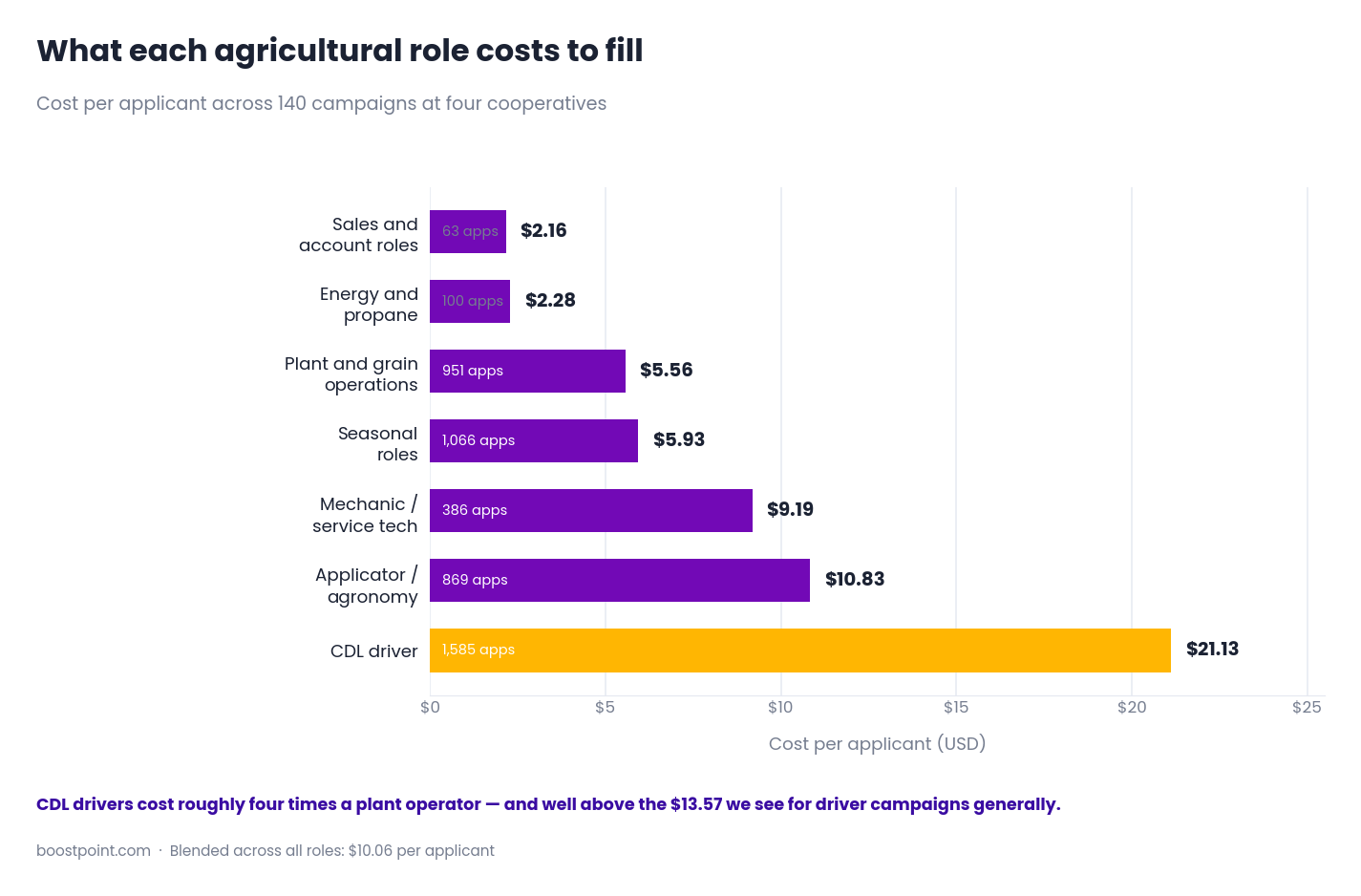
Blended across everything: $10.06 per applicant. Most campaigns landed between $5 and $16.
Costs are what advertisers paid. An applicant is a completed application, not a click.
The driver premium
CDL drivers cost $21.13 per applicant at co-ops — roughly four times a plant operator, and well above the $13.57 blended figure we see for driver campaigns across our whole client base.
That gap isn't a campaign problem. Co-ops recruit drivers in the thinnest rural labor markets in the country, competing against carriers, construction firms and every other employer within a hundred miles. The Midwest agribusiness survey found truck drivers among the hardest entry-level positions to fill, second only to general farm labor. Our cost data puts a number on that — and for the wider picture on what carriers and agencies pay, see truck driver recruiting agency costs.
The practical implication: budget driver recruiting separately. Blending it into a single per-hire assumption will consistently underfund the role that shuts your operation down when it goes unfilled.
Why job boards produce so little in rural trade areas
Job boards run on search intent. Someone decides they want a job, opens Indeed, and types a title. In a county of 12,000 people, the number doing that this week is very close to zero.
That's the difference between a thin market and a competitive one. In a metro, a posting produces some applicants at some price. In a rural trade area, a posting can sit for six weeks and produce nothing — not because there aren't qualified people within thirty miles, but because none of them sat down to search.
The people you want already have a job, and often it's farming. An experienced applicator or grain facility operator isn't unemployed. He's working for the co-op one county over, or farming his own ground and looking for winter work. He might move for better hours, better pay, or less time away in season. He'll never see your posting, because he isn't looking for it.
Social advertising doesn't require search intent, which is why the gap between the two channels is widest in exactly the markets co-ops operate in. Our agricultural campaigns averaged a $13.09 CPM — well below what dense markets cost — and reach frequency runs high enough that you can put a role in front of most of the eligible population in a trade area, repeatedly, for a modest budget.
Who actually applies
A common assumption is that social advertising reaches people with no connection to agriculture. The response profile suggests otherwise:
| Age | Share of applicants | Cost per applicant |
|---|---|---|
| 18–24 | 6.6% | $9.64 |
| 25–34 | 16.2% | $9.06 |
| 35–44 | 22.5% | $8.96 |
| 45–54 | 23.4% | $9.76 |
| 55–64 | 20.6% | $10.72 |
| 65+ | 10.6% | $13.55 |
Source: 140 Boostpoint-managed agricultural campaigns across four cooperatives, late 2025 through mid-2026, representing 5,498,069 impressions and 7,155 applications.
Nearly 46% of applicants were aged 35 to 54 — experienced workers in their prime earning years — and cost per applicant was lowest in the 25–44 brackets.
That last point is worth sitting with. The Midwest survey found 57% of agribusinesses believe the physical demands of the work discourage younger applicants. Our data suggests younger workers are not only reachable but the least expensive to reach. The barrier appears to be awareness and framing rather than willingness.
We didn't select for any of this. Employment ads in the US run under Meta's Special Ad Category, which removes age targeting entirely — this is organic response.
On gender: 77.4% of applicants were men, and women cost meaningfully less per applicant ($7.96 against $10.66). For co-ops working to broaden their applicant base, that difference arrives without any targeting effort.
What works in practice
Lead with pay, in-season hours, and which location. Those are the three things applicants screen on before reading anything about the co-op. Licensing and duties come after.
Show the actual work. The plant, the equipment, a tender truck — yours, not stock imagery. People who grew up around agriculture can tell in two seconds whether you know the work.
Screen at the application, not the audience. Special Ad Category removes detailed targeting for employment ads, so qualification happens in the form: CDL class and endorsements, applicator licensing or willingness to obtain it, equipment operated, availability for in-season hours, which locations they'd travel to. Applicants who don't meet your minimums screen themselves out before reaching a manager — which matters most in April, when nobody has time for phone screens.
Scope campaigns to trade areas, and run them in parallel. Because reach doesn't depend on local search volume, adding a location is a campaign setting rather than a supply question.
Follow up the same day. Applicants apply to several employers in one sitting. The co-op that responds in five minutes beats the one that calls back in two days — and in season, that's the constraint your managers are least able to protect.
Harvest season hiring: the crew, the window, and the ad
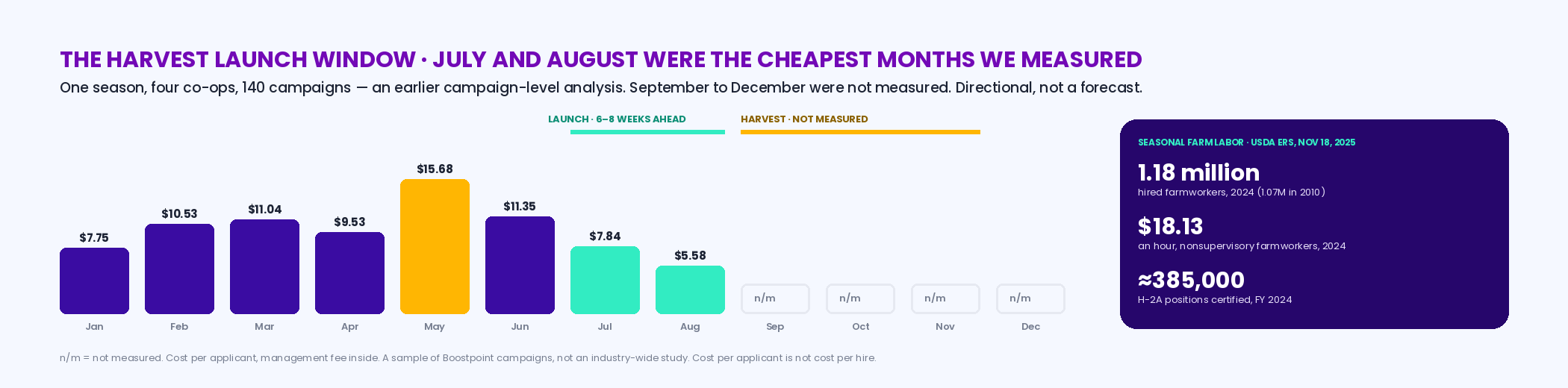
Everything above is about the spring: applicators, tenders and drivers hired into the most expensive weeks on the curve. Harvest is the other peak, and it's a different hiring problem in three ways. The roles are broader and less licensed — seasonal elevator hands, scale and probe operators, dryer and pit crews, truck drivers with and without a CDL, and the extra hands every grain location adds for eight to twelve weeks. The window is later, which means the launch window falls in the cheapest months we measured. And the crew is closer to the ground: harvest help is rehired from last year, referred by members, or found in the county, and a farm's alternative for field labor is a federal visa program a co-op's elevator doesn't use. The rest of this section takes those three in turn. One caveat first: our measured curve runs January through August. We did not measure September through December, so no cost figure is claimed for harvest months themselves; what we can say is what the launch months cost.
Seasonal farm labor: the size of the pool, and the three places a harvest crew comes from
The USDA's Economic Research Service puts hired farmworker employment at 1.18 million in 2024, up from 1.07 million in 2010 — a 10% gain — with nonsupervisory farmworkers averaging $18.13 an hour in 2024, about 60% of the nonfarm wage. Eighty-three percent of hired crop farmworkers are not migrant workers; they're settled where they work. The H-2A temporary agricultural program, the visa route for seasonal farm labor, had around 385,000 positions certified in fiscal 2024 and around 315,500 visas issued (ERS, page updated November 18, 2025). Those numbers set the shape of harvest crew recruiting. A farm with a fixed field-labor need and months of lead time can use H-2A; it's a legal process with its own wage rules and deadlines, and nothing on this page is legal advice about it. A co-op elevator, a seed plant or a grain terminal can't, and hires its harvest help from three places, in this order. Last year's crew, by text, in July — the cheapest hire there is and the one most co-ops forget until September. Members and their families, through the newsletter and the counter — the referral network is the county. The county itself, through the feed: the employed majority who'd take eight weeks of harvest hours for the pay, if the ad names the pay, the dates and the location, and who don't open a job board. The BLS counted 23.45 employed people for every unemployed one nationally in July 2026; in a rural county the ratio is the whole story, and the rural version of the arithmetic is on the rural hiring page.
The harvest launch window falls in the cheapest months we measured
On the curve above, campaigns launched in July cost $7.84 per applicant and August $5.58 — the two cheapest months in the season, against May's $15.68. That's the harvest window. If the crew is coming through the agricultural visa program instead, the wage floor, the housing and the three-quarters guarantee are set out on our H-2A program page, and the fifty percent rule keeps this domestic recruitment live to the midpoint of the season. A crew needed on site in mid-September is recruited in July and August, when the spring rush is over, the auction is quiet, and last year's crew is reachable before they've committed to someone else's harvest. Launch in September and you're recruiting against every elevator in the region for the same people in the same week, and the applicants you do get arrive after the first trucks; we didn't measure September's cost, but the spring shows what a crowded month does to it. Six to eight weeks ahead is the rule for harvest as it is for spring, and for harvest the calendar makes it cheap to follow. The planner below turns a harvest window into a crew size, an applicant count, a media estimate at the August figure, and a launch date.
Interactive
Harvest crew planner — the window, the hours the site runs, people per hour and what each seasonal hire can give; get the crew, the applicants, the media at the August figure, and the launch date
Nothing is stored or sent — this runs in your browser. Every input is yours; the only Boostpoint figure is the August cost per applicant from one measured season, used as an illustration of the launch window's cost, not a forecast.
days × hours × people per hour
hours ÷ hours per hire, plus attrition, rounded up
crew × your ratio
applicants × $5.58, one season, illustrative
Harvest crew recruiting: what the ad has to say
A harvest ad is a short ad about a short job, and it fails when it's written like a career posting. Five things in the first lines, in this order. The dates: "September 15 to about November 1" — a seasonal applicant is deciding whether the window fits around a school schedule, another job or a family's own harvest, and an ad without dates is an ad about a job they can't evaluate. The hours, honestly: harvest runs long, nights and Saturdays when the trucks are lined up; say the typical day and the long day, and say what you pay for the hours past 40 — overtime rules for agricultural work differ from other industries and vary by state, so state your own practice plainly rather than a rule. The pay, as a number: hourly and any season-completion bonus, which is the cheapest attrition tool there is and belongs in the ad, not the handbook. The location, by name, because a county has six elevators and the applicant is choosing the one on the way home. The work, in a sentence: pit, scale, dryer, trucks, and whether a CDL is needed for the truck role or a farm-plate exemption applies — a question for your own counsel, not a claim on this page. Then the three-question form (name, phone, which location and dates you can work), a text within minutes, and a manager who calls the same day, because the applicant applied to two other elevators in the same sitting. Show the actual pit at dusk with the trucks lined up, not stock photography: people who grew up around it can tell in two seconds.
When this isn't the right approach
- A single agronomy or management hire. A certified crop adviser with regional experience is a search problem, not a reach problem. Use your network and industry associations.
- Very small co-ops with one or two hires a year. The economics work best with multiple locations or recurring seasonal need.
- When pay or in-season hours are the real issue. If your package is below what the co-op two counties over offers, advertising surfaces that faster and more expensively.
- If nobody can follow up during season. Applications arrive in volume and go cold within hours. If your managers are in the field, someone else has to work the list.
What to measure
- Cost per qualified applicant, by role. Drivers and plant operators differ four-fold. A blended number hides that.
- Cost per applicant by month. Build your own seasonal curve. It's the single most useful planning number a co-op can produce.
- Time to first contact, in minutes. Hardest to protect in season, and the biggest lever.
- Applicant cost by location. Thin trade areas cost more. That's a staffing and pay-band signal, not just a recruiting one.
Frequently asked questions
How much does agricultural recruiting cost?
Across our 2025–2026 co-op campaigns, applicants cost $10.06 on average, with most campaigns between $5 and $16. Cost varies enormously by role — plant and grain operations ran $5.56 per applicant while CDL drivers ran $21.13.
When is the cheapest time to recruit for the season?
Our data shows a clear curve. Campaigns launched in January cost $7.75 per applicant; May campaigns cost $15.68 — roughly double. Late summer was cheapest at $5.58. Recruiting six to eight weeks ahead of when you need people, rather than when the season starts, is the single largest cost lever available.
Why do CDL drivers cost so much more at a co-op?
Because co-ops recruit drivers in the thinnest rural labor markets in the country, competing against carriers, construction firms and every other employer in the area. Our data puts driver applicants at $21.13 — roughly four times a plant operator and above what we see for driver campaigns generally.
Does social media advertising work in small rural communities?
Yes, and it's often where the gap versus job boards is widest. Job boards depend on people actively searching, and in a thin rural trade area there may be almost none. Social reaches people regardless of whether they're looking, and rural media costs are low enough — our campaigns averaged a $13.09 CPM — that you can reach most of the eligible population repeatedly.
Will younger workers apply for physically demanding agricultural roles?
In our data, yes, and they were among the least expensive applicants to reach. That's notable given 57% of Midwest agribusinesses report that physical demands discourage younger applicants. The constraint appears to be awareness and how the role is presented rather than willingness.
When should we start hiring for harvest?
In July and August, six to eight weeks before the first trucks. Those were the two cheapest months on our measured curve — $7.84 per applicant in July and $5.58 in August against $15.68 in May — and they're when last year's crew is still reachable by text. We did not measure September through December, so we claim no harvest-month cost; the spring shows what launching into a crowded month does. The harvest crew planner on this page turns a window into a crew size, an applicant count and a launch date.
How do we screen for applicator licensing and CDL endorsements?
In the application, not the ad targeting. Employment ads can't use detailed audience targeting under Meta's Special Ad Category rules, so qualification happens through knockout questions — CDL class, endorsements, licensing status, equipment operated, in-season availability and travel radius.
How long before we see applicants?
Usually within days, though the first two weeks are a learning period while the platform calibrates. In season, that ramp is a reason to start early rather than a reason to wait.
See what it costs to staff your locations
Book a 30-minute call and we'll walk through cost per applicant for the roles, trade areas and seasons you're staffing for.
Book a Demo →Figures come from 140 Boostpoint-managed agricultural campaigns across four cooperatives, late 2025 through mid-2026, representing 5,498,069 impressions and 7,155 applications. Costs are what advertisers paid for advertising only. Seasonal figures reflect a single season and should be read as directional rather than as a forecast. Workforce survey findings and labor pool projections are cited from published third-party sources and are not Boostpoint data. Harvest section (added August 27, 2026): USDA Economic Research Service, Farm Labor (page updated November 18, 2025) — hired farmworker employment 1.18 million in 2024, up from 1.07 million in 2010; nonsupervisory farmworkers averaging $18.13 an hour in 2024, about 60% of the nonfarm wage; 83% of hired crop farmworkers not migrant; around 385,000 H-2A positions certified and around 315,500 visas issued in fiscal 2024. BLS Employment Situation, July 2026. The harvest crew planner computes on the reader's inputs; the August $5.58 is one season's figure, illustrative. September–December were not measured. Nothing on this page is legal advice about H-2A, overtime or CDL rules. Cost per applicant is not cost per hire; we do not track hires and publish no cost-per-hire figure.