Employer guideRead at source, 4 September 2026
The H-2A Program: Wage Rates by State, Housing, Transport and the Three-Quarters Guarantee (2026)
H-2A has no annual cap, which is the single largest difference between it and every other temporary work visa, and in FY2025 it certified 398,258 positions. What it has instead of a cap is a set of obligations that make the hourly rate the smallest part of the cost: free housing, inbound and outbound transport with subsistence, daily transport to the field, and a guarantee of work for three-quarters of the contract hours whether or not there is work to do. And the wage itself is currently unsettled in a way no summary reflects. On 26 August 2026 a federal court held the methodology behind the current Adverse Effect Wage Rates unlawful but did not vacate it, so the published rates stand until the Department writes a new methodology. Two days before this page was built, the Department gave public notice that employers may be required to make wage adjustment payments for a backpay period beginning 2 September 2026. Every figure below was read at the Federal Register, the eCFR or the Office of Foreign Labor Certification on 4 September 2026.
The wage: two skill levels, a housing deduction, and a court order
The Adverse Effect Wage Rate is the floor an H-2A employer must pay, and it is the highest of the AEWR, the prevailing wage, the agreed collective rate, or the federal or state minimum. Until 2025 it came from the USDA Farm Labor Survey. USDA discontinued that survey effective 31 August 2025, and the Department moved the AEWR onto the Bureau of Labor Statistics occupational survey by interim final rule at 90 FR 47914, effective 2 October 2025. The current rates, at 91 FR 48946, took effect 3 August 2026, or 17 August 2026 for employers covered by the Georgia injunction described below.
That rule changed the shape of the number, not just its source. There are now two skill levels per state: Level I is the mean of the bottom third of the wage distribution, Level II the mean of the whole distribution. On top of that sits a downward housing compensation adjustment that applies only to the H-2A worker, not to a US worker doing the same job in corresponding employment. In Florida the entry rate is $13.17, and the same job filled by an H-2A worker given employer housing pays $10.87. The adjustment is largest in Hawaii at $3.20 an hour and smallest in Mississippi and West Virginia at $1.11.
Unlawful, not vacated, and a backpay window that is already open
In United Farm Workers v. Department of Labor, the Eastern District of California held on 26 August 2026 that the methodology producing these rates is unlawful. It did not vacate the rule and left the published rates in place, directing the Department to produce a new methodology promptly. On 2 September 2026 the Department published notice that employers may owe wage adjustment payments to H-2A workers and to US workers in corresponding employment, for a period running from that date until new rates issue. The Department states that no employer is under an obligation to pay back wages at this time and is considering an appeal.
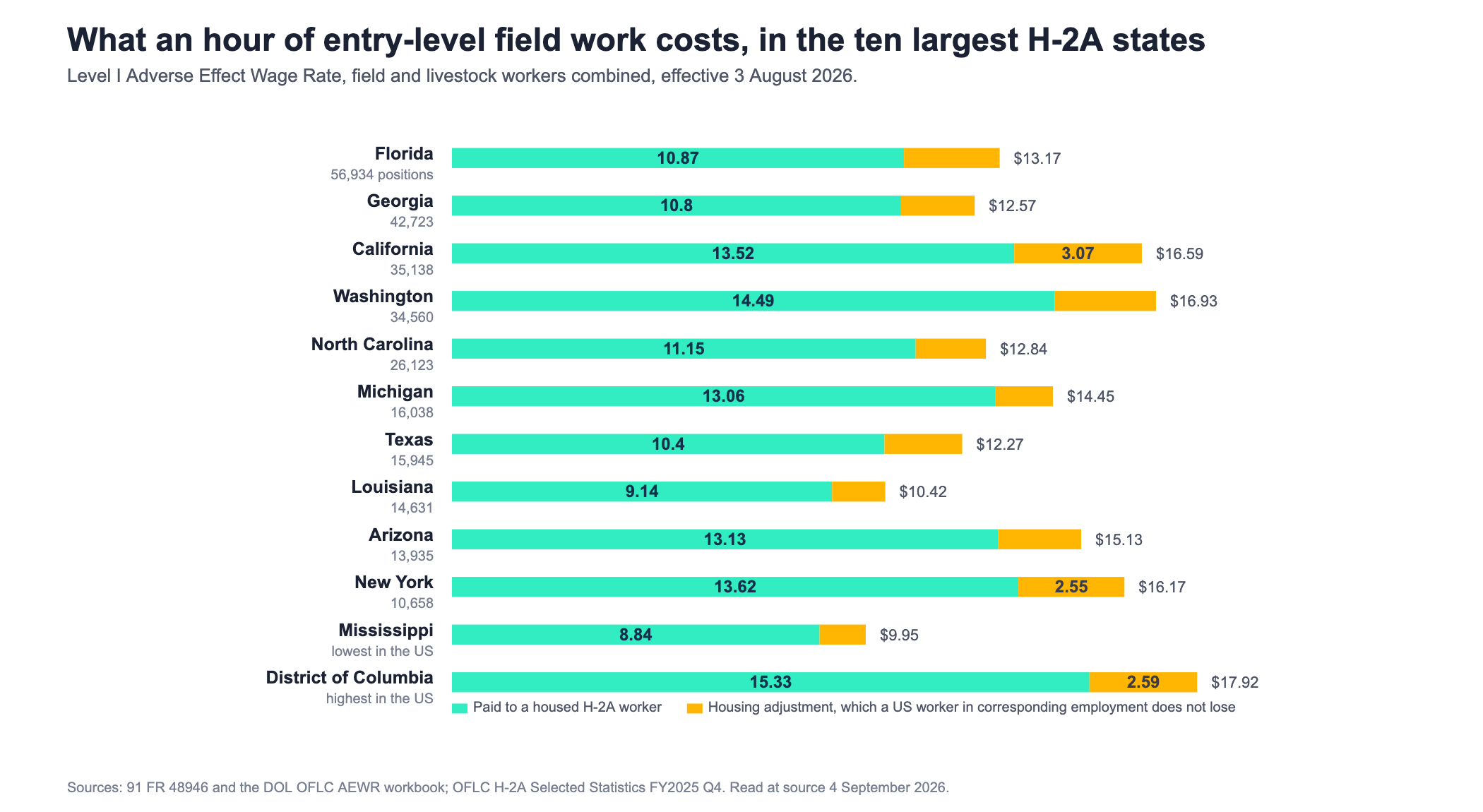
Adverse Effect Wage Rates by state, field and livestock work
These are the rates for the five occupational codes the rule groups as field and livestock workers combined, which covers 82 percent of all H-2A positions certified. Every other occupation, including farm supervisors, construction laborers and tractor-trailer drivers, has its own two-level rate in the same workbook, and those are materially higher: in Florida a first-line agricultural supervisor is $18.92 at Level I against $13.17 for a field worker. The four columns below are the rate for a US worker in corresponding employment, and the reduced rate payable to an H-2A worker who is given free housing.
| Jurisdiction | Level I | Level II | H-2A Level I | H-2A Level II | Housing adjustment |
|---|---|---|---|---|---|
| Alabama | $11.85 | $16.04 | $10.61 | $14.80 | -$1.24 |
| Alaska | $14.80 | $20.83 | $12.83 | $18.86 | -$1.97 |
| Arizona | $15.13 | $17.75 | $13.13 | $15.75 | -$2.00 |
| Arkansas | $13.95 | $16.80 | $12.71 | $15.56 | -$1.24 |
| California | $16.59 | $18.60 | $13.52 | $15.53 | -$3.07 |
| Colorado | $16.68 | $20.28 | $14.51 | $18.11 | -$2.17 |
| Connecticut | $16.43 | $18.57 | $14.18 | $16.32 | -$2.25 |
| Delaware | $16.16 | $19.33 | $14.32 | $17.49 | -$1.84 |
| District of Columbia | $17.92 | $24.49 | $15.33 | $21.90 | -$2.59 |
| Florida | $13.17 | $15.71 | $10.87 | $13.41 | -$2.30 |
| Georgia | $12.57 | $16.49 | $10.80 | $14.72 | -$1.77 |
| Hawaii | $14.53 | $18.75 | $11.33 | $15.55 | -$3.20 |
| Idaho | $13.34 | $17.42 | $11.60 | $15.68 | -$1.74 |
| Illinois | $15.81 | $18.75 | $14.01 | $16.95 | -$1.80 |
| Indiana | $14.91 | $19.13 | $13.52 | $17.74 | -$1.39 |
| Iowa | $14.96 | $19.52 | $13.72 | $18.28 | -$1.24 |
| Kansas | $15.18 | $19.71 | $13.86 | $18.39 | -$1.32 |
| Kentucky | $14.33 | $18.68 | $13.07 | $17.42 | -$1.26 |
| Louisiana | $10.42 | $15.81 | $9.14 | $14.53 | -$1.28 |
| Maine | $14.95 | $18.67 | $13.13 | $16.85 | -$1.82 |
| Maryland | $15.70 | $18.98 | $13.48 | $16.76 | -$2.22 |
| Massachusetts | $15.26 | $17.66 | $12.70 | $15.10 | -$2.56 |
| Michigan | $14.45 | $17.64 | $13.06 | $16.25 | -$1.39 |
| Minnesota | $15.63 | $20.45 | $13.91 | $18.73 | -$1.72 |
| Mississippi | $9.95 | $15.04 | $8.84 | $13.93 | -$1.11 |
| Missouri | $14.74 | $18.71 | $13.42 | $17.39 | -$1.32 |
| Montana | $13.46 | $18.62 | $11.60 | $16.76 | -$1.86 |
| Nebraska | $16.25 | $20.56 | $14.91 | $19.22 | -$1.34 |
| Nevada | $14.73 | $18.25 | $12.59 | $16.11 | -$2.14 |
| New Hampshire | $13.87 | $16.22 | $11.69 | $14.04 | -$2.18 |
| New Jersey | $16.57 | $20.05 | $14.10 | $17.58 | -$2.47 |
| New Mexico | $12.35 | $15.96 | $10.78 | $14.39 | -$1.57 |
| New York | $16.17 | $19.25 | $13.62 | $16.70 | -$2.55 |
| North Carolina | $12.84 | $16.82 | $11.15 | $15.13 | -$1.69 |
| North Dakota | $14.29 | $19.99 | $12.94 | $18.64 | -$1.35 |
| Ohio | $14.42 | $18.20 | $13.11 | $16.89 | -$1.31 |
| Oklahoma | $11.88 | $16.66 | $10.59 | $15.37 | -$1.29 |
| Oregon | $15.13 | $17.65 | $13.00 | $15.52 | -$2.13 |
| Pennsylvania | $14.40 | $18.45 | $12.83 | $16.88 | -$1.57 |
| Rhode Island | $15.13 | $18.77 | $13.14 | $16.78 | -$1.99 |
| South Carolina | $12.56 | $16.37 | $11.02 | $14.83 | -$1.54 |
| South Dakota | $13.19 | $17.92 | $11.86 | $16.59 | -$1.33 |
| Tennessee | $13.15 | $17.34 | $11.59 | $15.78 | -$1.56 |
| Texas | $12.27 | $16.24 | $10.40 | $14.37 | -$1.87 |
| Utah | $12.63 | $17.15 | $10.71 | $15.23 | -$1.92 |
| Vermont | $16.15 | $19.55 | $14.42 | $17.82 | -$1.73 |
| Virginia | $13.82 | $17.90 | $11.76 | $15.84 | -$2.06 |
| Washington | $16.93 | $19.62 | $14.49 | $17.18 | -$2.44 |
| West Virginia | $11.87 | $15.68 | $10.76 | $14.57 | -$1.11 |
| Wisconsin | $13.57 | $18.09 | $12.21 | $16.73 | -$1.36 |
| Wyoming | $12.16 | $17.59 | $10.81 | $16.24 | -$1.35 |
| Guam | $9.85 | $10.74 | $7.93 | $8.82 | -$1.92 |
| Puerto Rico | $10.50 | $11.62 | $9.79 | $10.91 | -$0.71 |
| US Virgin Islands | $10.58 | $12.51 | $9.16 | $11.09 | -$1.42 |
The spread is the thing to notice. Entry-level field work runs from $9.95 in Mississippi to $17.92 in the District of Columbia, and at the experienced level from $15.04 to $24.49. That is not a cost-of-living gradient; it is a wage-survey gradient, and it means the same crew moving between two states on consecutive contracts is owed materially different money for the same work. There are no multi-state groupings any more. The old Delta Region grouping ended with the Farm Labor Survey it depended on.
Two cautions before anybody budgets from this table. The first is the court order: these rates stand, but the methodology behind them has been held unlawful and the Department has been told to replace it, so the number you plan a season around may be superseded and may carry a retrospective adjustment. The second is that the 2023 methodology is gone. It was vacated on 25 August 2025 in Teche Vermilion Sugar Cane Growers Association v. Su, so any summary still describing separate occupational AEWRs created by that rule is describing a rule that no longer exists. Separate occupational rates do exist today, but they come from the 2025 interim rule and are built differently.
When the 2027 rates arrive, and what they do to a contract already running
No 2027 rates have been announced as of 24 September 2026. The regulation requires the Office of Foreign Labor Certification to publish a Federal Register notice setting the AEWRs “at least once in each calendar year” (20 CFR 655.120(b)(4)). The 2026 rates in the table above were built from the May 2025 OEWS estimates, which BLS released on 15 May 2026, and took effect on 3 August 2026 (91 FR 48946). The court order changes the timetable: the Department’s 2 September 2026 notice says the backpay period runs until new AEWRs are published under a revised methodology, so the next set may come off-cycle and may be built differently.
Two rules decide what a new rate does mid-season. If the updated AEWR is higher than the rate you guaranteed, you must pay it from its effective date (655.120(b)(5)). If it is lower, you keep paying the rate in your job order (655.120(b)(6)). Budget a multi-month contract on the assumption that the rate can rise during it, and keep hours and earnings records for H-2A workers and US workers in corresponding employment, as the Department’s notice asks.
What the program actually obliges an employer to do
The hourly rate is where the attention goes and it is not where the money is. An H-2A employer takes on a set of obligations that run for the whole contract whether or not the crop cooperates, and several of them attach to US workers in corresponding employment as well.
| Obligation | What it requires | Authority |
|---|---|---|
| Housing | Free, and it must meet the OSHA temporary labor camp standards or the equivalent ETA standards. Rental housing is paid by the employer direct to the landlord. No deposit for bedding. Family housing where that is the local practice. | 20 CFR 655.122(d); 29 CFR 1910.142 |
| Inbound transport and subsistence | Reimbursed once the worker completes 50 percent of the contract, at the most economical common carrier rate, from the place the worker came from, whether in the US or abroad. | 20 CFR 655.122(h)(1) |
| Outbound transport | Paid by the employer if the worker completes the contract or is terminated without cause and has no subsequent H-2A job. | 20 CFR 655.122(h)(2) |
| Daily transport | Between employer housing and the worksite, at no cost to the worker, with seat belts where the vehicle was built with them. | 20 CFR 655.122(h)(3), (h)(4) |
| Meal charge cap | The employer may charge no more than $16.78 a day for meals. | 91 FR 17664, effective 7 April 2026 |
| Travel subsistence with receipts | Up to $68.00 a day for meals and incidentals and $110.00 a day for lodging, at the standard federal rates. | 91 FR 17664 |
| Three-quarters guarantee | Work must be offered for at least three-quarters of the contract hours, or the shortfall paid anyway. | 20 CFR 655.122(i) |
| The 50 percent rule | Any qualified US worker who applies must be hired until half the contract has elapsed, unless the employer is under 500 man-days and unassociated. | 20 CFR 655.135(d) |
| Corresponding employment | US workers doing substantially the same work get the same wage and benefits, but not the housing adjustment. | 20 CFR 655.103(b) |
| Range work | Herding and open-range livestock is a national monthly rate of $2,132.41, not an hourly AEWR. | 91 FR 2373, effective 3 February 2026 |
The three-quarters guarantee is the one that surprises people, and it is worth reading precisely because it is an hours guarantee, not a days guarantee. The regulation carries its own worked example: a ten-week contract at six days a week and eight hours a day is 480 hours, so the guarantee is 360 hours. If a federal holiday falls inside the period, its eight hours come out before the multiplication, giving 354. Offering work on three-quarters of the days does not satisfy it if those days were short. Hours offered and refused do count. And the housing and meal obligations run for every day of the contract regardless of the guarantee, until the worker departs, abandons the job or is terminated for cause.
The 50 percent rule is the one that most directly touches recruitment. From the moment the foreign workers depart for the worksite until half the contract has elapsed, any qualified US worker who applies must be given the job. That is a live obligation running into the season, not a box ticked before it, and the employer is not relieved of its return-transport liability to an H-2A worker displaced by it. The exception is narrow: fewer than 500 man-days of agricultural labor in every calendar quarter of the preceding year, no association membership, and no joint petitioning.
The 2024 rule is printed in the CFR and unenforceable in twenty-one states
This is the part that makes reading the regulations misleading on their own. The 2024 Farmworker Protection Rule, at 89 FR 33898 and effective 28 June 2024, is what the current CFR prints. It is also enjoined across most of the country where the program is actually used.
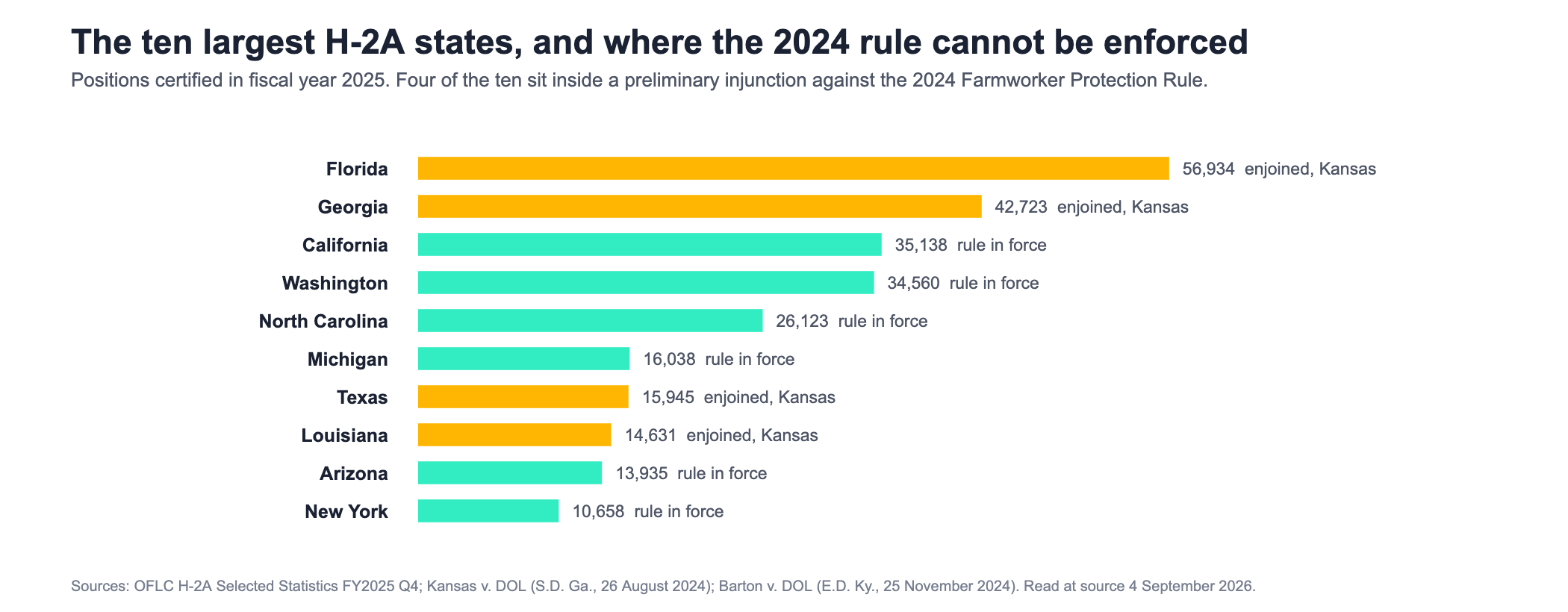
In Kansas v. Department of Labor, the Southern District of Georgia enjoined enforcement on 26 August 2024 in seventeen states: Arkansas, Florida, Georgia, Idaho, Indiana, Iowa, Kansas, Louisiana, Missouri, Montana, Nebraska, North Dakota, Oklahoma, South Carolina, Tennessee, Texas and Virginia, on the ground that the worker voice provisions conflict with the National Labor Relations Act. In Barton v. Department of Labor, the Eastern District of Kentucky enjoined specified provisions on 25 November 2024 in four more: Alabama, Kentucky, Ohio and West Virginia. On the same day, in International Fresh Produce Association v. Department of Labor, the Southern District of Mississippi stayed 20 CFR 655.135(h)(2) and (m) nationwide. A fourth court, the Eastern District of North Carolina, upheld the rule in May 2025.
Two of the five largest H-2A states, Florida and Georgia, are inside the Georgia injunction, and four of the ten largest. A rescission was proposed at 90 FR 28919 on 2 July 2025 and has not been finalized, so on the build date the position is genuinely a patchwork: the CFR text, minus two paragraphs stayed everywhere, minus a longer list of provisions unenforceable in twenty-one states and against certain named grower associations, with a rescission pending. Anyone quoting the regulation without saying where it applies is quoting something that may not govern their farm.
How big the program is, and where it is
In FY2025 the Office of Foreign Labor Certification certified 398,258 positions across 23,424 applications, up 3.5 percent on FY2024, when it certified 384,900. Through the third quarter of FY2026 it had certified 349,867, with applications received down 3.3 percent year on year, the first softening in a long time. The full-year figure is not published yet and we will not estimate it.
The five largest states in FY2025 were Florida at 56,934 positions, Georgia at 42,723, California at 35,138, Washington at 34,560 and North Carolina at 26,123, which is 49 percent of the program in five states. Through FY2026 Q3 Georgia has moved ahead of Florida. One thing you will see quoted that we cannot verify: there is no published crop breakdown. The disclosure data classifies jobs by occupational code, not by crop, so any list of top H-2A crops has been inferred from job titles rather than published, and this page does not carry one.
Most growers fill part of the crew domestically. Seasonal applicants ran $5.93 at the median in our agricultural campaigns.
See crew ads for my areaCheck a state rate
Pick a state for the current field and livestock rate at both skill levels, the reduced rate for a housed H-2A worker, and whether the 2024 rule can be enforced there.
Work out the three-quarters guarantee
Enter the contract as it appears in the job order. The calculator applies 20 CFR 655.122(i) the way the regulation own example does, deducting federal holidays before taking three-quarters.
Where this sits next to the domestic side
Two things follow for an employer weighing the program. The guarantee and the housing turn a seasonal crew into a fixed cost that starts before the first day of need and does not stop if the weather does, which is a different risk profile from advertising for local labor. And the 50 percent rule means the domestic recruitment does not end when the visas are approved: a qualified applicant halfway through the season has to be hired. The wider picture on domestic supply is on the farm labor shortage, and the non-agricultural sibling program, with its 66,000 cap and its two half-year allocations, is on H-2B for employers. Anyone under 18 on the crew is governed separately, by child labor laws by state.
Frequently asked questions
Is there a cap on H-2A visas?
No. The numerical limits at 8 U.S.C. 1184(g)(1) reach only H-1B and H-2B, and no limit appears anywhere in 8 U.S.C. 1188, the H-2A statute. H-2B by contrast is capped at 66,000 a year, split into two allocations of 33,000. H-2A certified 398,258 positions in FY2025.
What is the AEWR for 2026?
There is no single figure. Each state has two, a Level I and a Level II rate, published under 91 FR 48946 and effective 3 August 2026. The average across both levels is $15.96. Entry-level field work runs from $9.95 in Mississippi to $17.92 in the District of Columbia.
Does the employer have to provide housing?
Yes, free of charge, under 20 CFR 655.122(d), and it extends to US workers in corresponding employment who cannot get home the same day. Employer housing must meet the OSHA temporary labor camp standards. Rental housing is paid by the employer direct to the owner.
What is the three-quarters guarantee?
Under 20 CFR 655.122(i) the employer must offer work for at least three-quarters of the contract hours, and pay the shortfall if it does not. It is measured in hours, not days, so offering work on enough days but running them short does not comply. Federal holidays come out first.
What does the H-2A program cost an employer?
Start with the filing fees. Under 8 CFR 106.2 the Form I-129 H-2A petition is $1,090 for 1 to 25 named workers or $530 for unnamed workers only, and $545 or $460 for an employer with 25 or fewer full-time equivalent employees or a nonprofit. Each petition also carries the Asylum Program Fee: $600, or $300 for a small employer and nothing for a nonprofit. The Department of Labor bills $100 plus $10 per worker certified, capped at $1,000, under 20 CFR 655.163. The consular visa fee is $205 per worker. The larger costs are the obligations in the table above: free housing, transport in both directions and daily to the field, meals or kitchen facilities, and the three-quarters guarantee. None of your attorney, application or recruitment fees may be passed to the worker, under 20 CFR 655.135(j).
Who pays for the worker travel?
The employer, at both ends. Inbound transport and daily subsistence become reimbursable once the worker completes half the contract, under 20 CFR 655.122(h)(1). Outbound is paid if the worker finishes the contract or is let go without cause. Daily travel from housing to the field is free to the worker.
Must I still hire US workers after the visas are approved?
Yes. The 50 percent rule at 20 CFR 655.135(d) requires the employer to hire any qualified US worker who applies until half the contract period has elapsed. The only exception is a small employer under 500 man-days a quarter that is not part of an association or a joint petition.
Why is the H-2A rate lower than the rate for a US worker?
Because the 2025 methodology applies a downward housing compensation adjustment, capped at 30 percent of the rate, only to H-2A workers who are given employer housing. It ranges from $1.11 an hour in Mississippi and West Virginia to $3.20 in Hawaii. A US worker in corresponding employment gets the unadjusted rate.
Is the current wage rate settled?
No. On 26 August 2026 the Eastern District of California held the methodology unlawful without vacating it, so the published rates stand until new ones issue. On 2 September 2026 the Department gave notice that wage adjustment payments may be owed for a period beginning that date. It says no back wages are owed at present.
What are H-2A wages in 2026 by state?
H-2A wages are the Adverse Effect Wage Rates in the state table on this page. Each state has two rates, Level I and Level II, published under 91 FR 48946 and effective August 3, 2026. Entry-level field work runs from $9.95 in Mississippi to $17.92 in the District of Columbia, and other occupations such as supervisors and truck drivers have their own, higher rates. H-2A workers given employer housing receive a lower rate after the housing adjustment shown in the table.
Do H-2A wage rates change in the middle of a contract?
They can. When a new AEWR takes effect during a work contract and it is higher than the rate you guaranteed, you must pay the new rate from its effective date; when it is lower, you keep paying the job-order rate (20 CFR 655.120(b)(5) and (b)(6)). The current rates took effect on 3 August 2026, and the Department has said new ones will follow a revised methodology after the United Farm Workers ruling, with no date given yet.
The visa side is not the whole crew.
The 50 percent rule keeps domestic recruitment live all the way to the midpoint of the season. Bring the roles and the counties you are staffing, and we will show what a local applicant has actually cost there.
Book a Demo