
Employer guideRead at source, 3 September 2026
H-2B Visa for Employers: Cap, Wages, Timeline and Costs of Hiring Seasonal Foreign Workers
The H-2B cap is 66,000 a year, split into 33,000 for start dates in the first half of the fiscal year and 33,000 for the second. As of the USCIS count dated 25 August 2026, the first half of FY 2027 already held 30,125 beneficiaries against 33,000 — 22,257 approved and 7,868 pending — leaving fewer than three thousand for start dates between 1 October 2026 and 31 March 2027. Separately, the FY 2026 supplemental allocation of 64,716 extra visas stops accepting petitions on 15 September 2026. Both clocks are running as this page is published. Below: the timeline, the recruitment you owe US workers first, the full cost stack, and the one obligation H-2B does not impose that almost everybody assumes it does.
The cap, and the two clocks running right now
The statutory limit is set by INA section 214(g): 66,000 H-2B visas a fiscal year, 33,000 for workers who begin employment between 1 October and 31 March and 33,000 for those who begin between 1 April and 30 September. Unused numbers from the first half roll into the second half. Unused numbers do not roll into the next fiscal year.
That is the part everyone knows. What decides whether your season happens is where the count stands the week you file. The USCIS count dated 25 August 2026 put the first half of FY 2027 at 22,257 approved and 7,868 pending, 30,125 against a 33,000 limit — fewer than three thousand numbers left for every employer in the country with an October-to-March start date, and the second half not yet open. With a winter start date the question is not whether you qualify. It is whether a number is left when your certification clears.
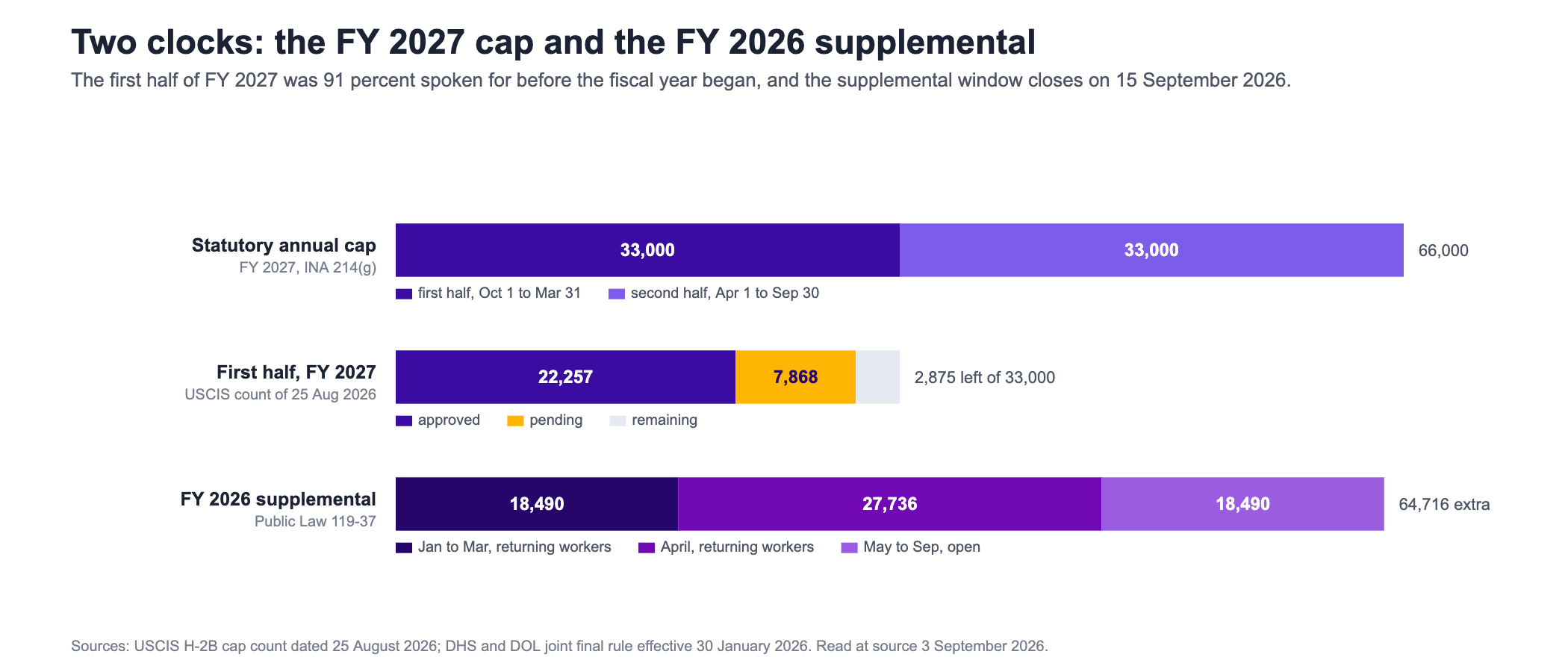
The relief valve is a supplemental allocation, and Congress has to authorize one each year. For FY 2026 it did: under Public Law 119-37, DHS and DOL issued a joint final rule effective 30 January 2026 releasing up to 64,716 additional visas in three tranches by start date — 18,490 for returning workers starting 1 January to 31 March 2026, 27,736 for returning workers starting in April, and 18,490 for start dates from 1 May to 30 September with the returning-worker requirement lifted. All three require the employer to attest to impending irreparable harm: permanent and severe financial loss without the workers. The rule is explicit about its own end. DHS will accept no supplemental petitions after 15 September 2026 and approve none after 30 September.
Cap exempt, and often missed
Workers already in H-2B status who extend, change employers or change the terms of employment are not counted again. Neither are workers already counted against the cap in the same fiscal year, provided the petition names them and says so. Nor are H-4 spouses and children. Two odder exemptions sit in the statute: fish roe processors, fish roe technicians and supervisors of fish roe processing, and workers performing labor in Guam or the Northern Mariana Islands until 31 December 2029.
The timeline: what is due 90, 75, 60 and 21 days out
H-2B runs backwards from your date of need, and the sequence is fixed by regulation. You cannot file the job order before you hold a prevailing wage determination, and you cannot petition USCIS before DOL certifies, so missing the front of the chain does not compress the back of it.
| When | Step | Form or filing | Rule |
|---|---|---|---|
| At least 60 days before it is needed | Request a prevailing wage determination from the National Prevailing Wage Center | ETA-9141, through the FLAG system | 20 CFR 655.10 |
| Before the job order | Hold the PWD; it must be valid on the date the job order is posted | — | 20 CFR 655.10(c) |
| 75 to 90 days before the date of need | File the job order with the State Workforce Agency and the application with the OFLC National Processing Center, at the same time | SWA job order plus ETA-9142B and appendices | 20 CFR 655 subpart A |
| Within 6 business days | SWA reviews the job order and reports deficiencies to the NPC | — | 20 CFR 655.16, 655.18 |
| Within 7 business days of receipt | The Certifying Officer issues a Notice of Acceptance or a Notice of Deficiency | — | 20 CFR 655 subpart A |
| On the Notice of Acceptance | Recruitment begins: former US workers contacted, notice posted to current employees, any additional recruitment the CO directs | Employer recruitment | Notice of Acceptance |
| 15 consecutive business days | Notice of the job posted in at least two conspicuous places at the worksite, or given to the bargaining representative | — | Notice of Acceptance |
| By the date on the notice | Initial recruitment report to the NPC; updated reports retained, not filed | Recruitment report | 20 CFR 655 subpart A |
| Until 21 days before the date of need | Keep accepting referrals of US applicants | — | Notice of Acceptance |
| After certification | Petition USCIS, then consular processing abroad | Form I-129 | 8 CFR 214.2(h) |
| Three years | Retain records from the date of certification, denial or withdrawal | — | 20 CFR 655 subpart A |
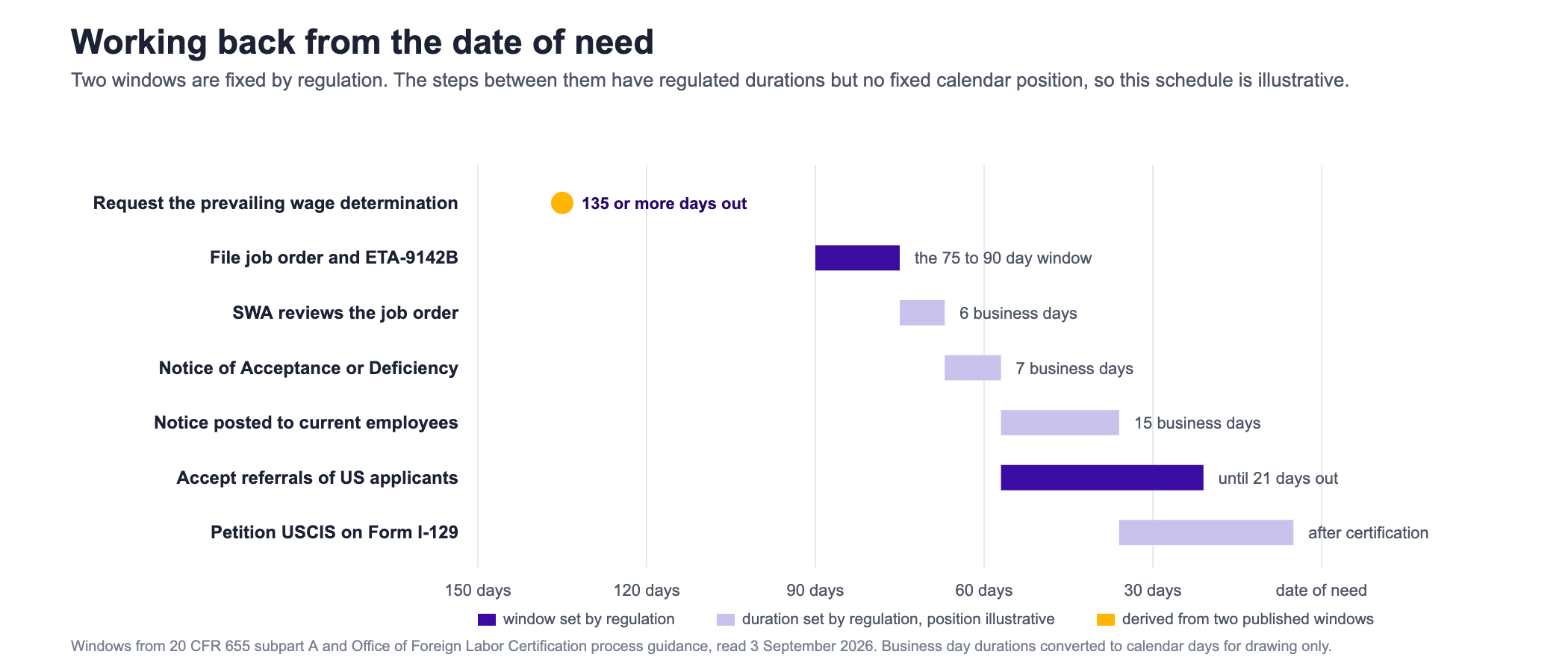
Work back from your date of need
The recruitment you owe US workers first
H-2B is a labor certification program: the visa is the last step and the recruitment is the first. Before DOL will certify, you have to test the domestic market and document that you did. That test is a real advertising campaign with a legal record attached, and it is the step our product touches.
The obligations are specific. You must contact former US workers who did similar work. You must post notice of the job to your current employees in at least two conspicuous places for 15 consecutive business days, or hand it to the bargaining representative where there is one. DOL itself posts the job to SeasonalJobs.dol.gov. You must run whatever additional recruitment the Certifying Officer directs. And you must keep accepting referrals of US applicants until 21 days before your date of need, which is the part that surprises employers, because the domestic pipeline stays open long after you have mentally moved on to the visa.
Then you write it up. An initial recruitment report goes to the National Processing Center by the date on your Notice of Acceptance, naming each US applicant, what became of the application, and the lawful job-related reason for any rejection. Updates as applicants arrive are not filed, but must sit in your retention file for three years and be produced on audit.
The wage goes in the advertisement
20 CFR 655.10(a) requires the employer to advertise the position to all potential workers at a wage at least equal to the prevailing wage from the National Prevailing Wage Center, or the federal, state or local minimum, whichever is highest. Under 655.10(b) that prevailing wage is the arithmetic mean of wages for the occupation in the area from the BLS Occupational Employment Statistics survey, unless a collective bargaining agreement governs or you supply a survey OFLC accepts. The number in your recruitment ad is not a marketing decision. It is a determination you already hold in writing, and it is usually above what you were paying.
One consequence deserves naming. Employers often run the domestic test as a formality and are then annoyed when it produces applicants. If the recruitment is genuine and the determined wage is above your old rate, it will produce applicants, and some will be hireable. Whether that beats the visa route is arithmetic, and the numbers are in our 2026 social job advertising benchmark: the median campaign delivered an applicant for $13.88, volume-weighted $8.02, tenth percentile $2.91. Against a per-worker H-2B stack in the thousands, a domestic hire that sticks is not a close call.
What it costs, and the obligation H-2B does not impose
The wage is the floor, not the total. 20 CFR 655.20(a) requires the offered wage to equal or exceed the highest of the prevailing wage, the federal, state or local minimum, paid free and clear, and it may not be based on commissions or bonuses. On top sit four costs easily left out of a bid.
The three-fourths guarantee at 655.20(f) is the one that bites hardest in a bad season. You must offer employment for at least three-quarters of the workdays in each 12-week period, or each 6-week period where the job order runs under 120 days. The regulation works the example itself: a job order specifying five days a week at seven hours is 420 hours a period, so you owe 315 hours whether or not the work exists. Weather, a canceled contract, a slow spring — the guarantee does not care.
Transportation and subsistence run both ways under 655.20(j): inbound travel and daily subsistence, reimbursed once the worker completes half the period of employment, and return travel at the end or on dismissal before it where the worker has no immediate subsequent H-2B job. The amount need be no more than the most economical common carrier cost.
Then the filings. The Asylum Program Fee is $600 for employers with more than 25 full-time equivalent staff, $300 for 25 or fewer and $0 for nonprofits, verified on the USCIS fee page on 3 September 2026. The Form I-129 fee and the fraud prevention and detection fee are set in 8 CFR 106.2 and quoted in the cost section below; the estimator takes your total filing and agent fees as an input, because attorney and agent fees vary.
And here is what almost everyone gets wrong. H-2B does not require you to provide housing. There is no housing paragraph in 20 CFR 655.20 at all; the word does not appear in the section. H-2A, the agricultural program, does require it, and the two get conflated constantly. If you have budgeted employer-provided housing for an H-2B season because you were told it was mandatory, that is a cost you may not owe.
| Obligation | H-2B (non-agricultural) | H-2A (agricultural) |
|---|---|---|
| Annual cap | 66,000, split 33,000 each half year | No numerical cap |
| Housing | Not required | Required, at no cost to the worker |
| Wage standard | Highest of the OES arithmetic mean, or federal, state or local minimum | Adverse Effect Wage Rate, set by state |
| Hours guarantee | Three-fourths of workdays per 12-week period | Three-fourths of the contract period |
| Inbound transport | Reimbursed at 50 percent completion | Reimbursed at 50 percent completion |
| Nature of need | Temporary: one-time, seasonal, peakload or intermittent | Seasonal or temporary agricultural |
| Typical users | Landscaping, hospitality, seafood, amusement, construction | Farms, orchards, ranches, packing |
| Certifying agency | DOL OFLC, then USCIS on Form I-129 | DOL OFLC, then USCIS on Form I-129 |
What an H-2B visa costs the employer
The government fees are the smallest part of the bill, but they are fixed and almost all of them are yours. Every USCIS amount below was read in the fee regulations themselves, 8 CFR 106.2 and 106.4, in the eCFR text current on 23 September 2026. The Form I-129 amounts were the same on 1 January 2026, so they apply to every petition filed this year.
| Fee | Standard | 25 or fewer full-time equivalent employees, or nonprofit | Who bears it |
|---|---|---|---|
| Form I-129 petition, 1 to 25 named workers | $1,080 | $540 (half, under 106.2(a)(3)(ix)) | Employer |
| Form I-129 petition, unnamed workers only | $580 | $460 | Employer |
| Asylum Program Fee, per petition | $600 | $300 small employer; $0 nonprofit | Employer |
| Fraud prevention and detection fee, per H-2B petition | $150 | $150 | Employer |
| Premium processing, optional | $1,780 | $1,780 | Employer |
| DOL labor certification, ETA Form 9142B | No fee | No fee | |
| Consular visa application fee, per worker | $205 | $205 | Worker pays at the consulate; you reimburse it in the first workweek |
| Attorney, agent and recruiter fees | What you contract | What you contract | Employer only. None of it may be recovered from the worker |
Worked through for a petition with unnamed workers, that is $1,330 payable to USCIS for an employer with more than 25 full-time equivalent employees ($580 + $600 + $150), or $910 for a small employer ($460 + $300 + $150), before premium processing. The petition fees are per petition, not per worker. The $205 visa fee is per worker, and 20 CFR 655.20(j)(2) makes it yours in week one: you must pay or reimburse all visa, visa processing, border crossing and related government fees, though not passport costs. Paragraph (o) of the same section bars you, your attorney and your agents from taking any payment from the worker for the labor certification, the petition, recruitment or your own agent fees, including through wage deductions.
The Department of Labor charges nothing to file the H-2B labor certification; subpart A of 20 CFR 655 contains no filing or certification fee. That is a difference from H-2A, where the certification is billed. Put your filing and agent total into the estimator below, alongside the travel and the hours guarantee.
Price the stack against a domestic hire
Neighboring pages carry the rest. Prevailing wage by state covers the other determination a seasonal contractor meets, on public works. Agricultural recruiting costs and the seasonal curve has our own data on what seasonal domestic recruiting costs by month. And once workers arrive, Form I-9 requirements and E-Verify requirements by state apply to them as to everyone else.
J-1 vs H-2B for seasonal staff
Employers who search for J-1 visa employers are usually looking at the same summer gap H-2B fills: a resort, an amusement park, a beach restaurant, a hotel. The J-1 program that fits is Summer Work Travel, and it works differently from H-2B at almost every step. The biggest difference is who sponsors. Under H-2B you are the petitioner. Under J-1 you cannot sponsor anyone yourself: a sponsor is a legal entity designated by the Secretary of State to run an exchange program, and you take part as a host employer that the sponsor vets and places students with.
| Question | J-1 Summer Work Travel | H-2B |
|---|---|---|
| Who sponsors | A State Department-designated sponsor; the employer is a host employer | The employer petitions USCIS, after DOL labor certification |
| Who the worker is | A full-time student at a post-secondary institution outside the US who has completed at least one semester | A foreign worker for temporary nonagricultural work, no student requirement |
| How long | Up to four months during the long break between academic years; no extensions | The period on the approved petition, extendable for qualifying temporary work up to three years total |
| Numbers | No numerical limit is set in the Summer Work Travel rule, 22 CFR 62.32 | 66,000 a fiscal year, split between the two halves |
| Jobs allowed | Seasonal or temporary jobs with minimal training and regular contact with Americans; bars include overnight shifts, warehousing and distribution centers, and goods-producing sectors such as construction and manufacturing | Temporary nonagricultural work where your need is a one-time occurrence or seasonal, peakload or intermittent |
| Pay | The higher of the applicable federal, state or local minimum wage, or pay and benefits commensurate with similarly situated US workers, with overtime where eligible | The highest of the DOL prevailing wage and the federal, state and local minimums |
| US worker protection | The sponsor confirms you will not displace US workers, have had no layoffs in the past 120 days and have no workers on strike or lockout | You must recruit US workers first and file a recruitment report |
| Government filing fees to the employer | None; you do not file a petition | USCIS fees per petition, set out in the cost section above |
Read across the table and the choice mostly makes itself. J-1 fits guest-facing summer work that ends when university terms start abroad, and it cannot fill a construction job, a manufacturing or warehouse line or a night shift. H-2B fits a longer season, a crew that comes back year after year, and the goods-producing work J-1 excludes, at the price of the cap, the fees and the domestic recruitment test. The one thing neither changes is the domestic hiring you still need for the rest of the roster, and that is the part we run.
Frequently asked questions
What is the H-2B cap and when does it reset?
Congress sets it at 66,000 a fiscal year under INA section 214(g): 33,000 for workers beginning employment between 1 October and 31 March, and 33,000 for those beginning between 1 April and 30 September. Unused numbers roll from the first half into the second, but never into the next fiscal year. On the USCIS count dated 25 August 2026 the first half of FY 2027 already held 30,125 beneficiaries against the 33,000 limit.
Can I file for the second half of the fiscal year?
Yes, and for many seasonal employers it is the easier half, because the first half absorbs winter and holiday demand. Petitions may generally be filed up to 90 days before the start date. The practical constraint is not the filing window but the labor certification behind it, which begins with a prevailing wage determination request at least 60 days before you need the determination.
What prevailing wage do I have to pay?
The highest of the prevailing wage from the National Prevailing Wage Center, the federal minimum, the state minimum or the local minimum, paid free and clear, and not based on commissions or bonuses. Under 20 CFR 655.10 the prevailing wage is the arithmetic mean of wages for that occupation in that area from the BLS Occupational Employment Statistics survey, unless a collective bargaining agreement governs the job or you supply a survey the Office of Foreign Labor Certification accepts. You must advertise at that wage, not merely pay it.
Do I have to provide housing for H-2B workers?
No. There is no housing obligation anywhere in 20 CFR 655.20, the section that lists the assurances and obligations of an H-2B employer. The word housing does not appear in it. This is the single most common confusion in the program, because H-2A, the agricultural visa, does require employer provided housing at no cost to the worker. If somebody has told you H-2B housing is mandatory, they were describing a different visa.
How long can an H-2B worker stay?
Status is limited to the period on the approved petition, plus up to 10 days before it starts for travel to the worksite and up to 30 days after it ends for departure or to seek an extension. Extensions are possible for further qualifying temporary work, but total time in H-2A or H-2B status is capped at three years. After three years the worker cannot be granted H-2B status again until they have been outside the United States for an uninterrupted period of at least 60 days. Note that 60 days is current; a great deal of published guidance still says three months.
What counts as temporary need?
Under 20 CFR 655.6 the need must be temporary regardless of whether the underlying job is permanent, and it must fit one of four shapes: a one time occurrence, a seasonal need, a peakload need, or an intermittent need. Except for a one time occurrence, the Certifying Officer will deny an application where the need lasts more than nine months. A job contractor may only apply on the basis of its own temporary need, and only for a seasonal need or a one time occurrence.
What happens once the cap is reached?
USCIS may then accept only petitions for workers exempt or not subject to the cap: workers already in H-2B status who extend, change employers or change the terms of employment; workers already counted in the same fiscal year and named as such; H-4 spouses and children; fish roe processors and technicians and their supervisors; and workers in Guam or the Northern Mariana Islands until 31 December 2029. Beyond that the only route is a supplemental allocation, which Congress must authorize each year.
What is a recruitment report and who sees it?
It is the written record of your domestic recruitment: each US applicant, what happened to the application, and the lawful job related reason for any rejection. An initial report goes to the National Processing Center by the date on your Notice of Acceptance. You keep updating it until 21 days before your date of need, and those updates are not filed. They stay in your retention file for three years and are produced on audit.
How do you hire seasonal workers?
For seasonal work you have two routes, and the choice is made months before the season. Domestically, the constraint is that the people who can do the work are usually already doing something else by the time you need them, so recruiting has to start in the off-season rather than in the week the season opens. Through H-2B, the constraint is the calendar and the cap set out above: the filing windows, the domestic recruitment you must run first, and the semi-annual cap that decides whether your petition lands at all. Most employers who use H-2B still recruit domestically in parallel, because the regulations require the attempt and because a domestic hire who returns each season costs nothing to petition for.
How much does an H-2B visa cost?
For an employer with more than 25 full-time equivalent employees, USCIS fees on one H-2B petition for unnamed workers total $1,330: the $580 Form I-129 fee, the $600 Asylum Program Fee and the $150 fraud prevention and detection fee. Naming 1 to 25 workers raises the I-129 fee to $1,080. Small employers pay $460 unnamed or $540 named, and a $300 Asylum Program Fee. DOL charges nothing for the labor certification. Per worker, you also reimburse the $205 visa fee and travel, and pay the prevailing wage.
Can an employer sponsor a J-1 visa for seasonal workers?
Not directly. J-1 sponsors are organizations designated by the Secretary of State. A seasonal employer takes part in the Summer Work Travel program as a host employer: the sponsor vets the business and places university students from outside the US for up to four months during their break. Placements must be seasonal or temporary, and the rules exclude overnight shifts, warehousing and goods-producing sectors such as construction and manufacturing.
Who pays the cost of an H-2B visa, the employer or the worker?
The employer, for almost all of it. The Form I-129 fee, the Asylum Program Fee, the $150 fraud prevention and detection fee and any premium processing, $1,780 for H-2B, are the employer’s, and 20 CFR 655.20(o) bars you, your attorney and your agents from recovering them, recruitment costs or agent fees from the worker, including through wage deductions. The worker pays the consular visa fee, but under 655.20(j)(2) you must pay or reimburse visa, visa processing and border crossing fees in the first workweek. Passport costs stay with the worker.
What are the H-2B visa fees in 2026?
Four government fees are set by regulation. Form I-129 for an H-2B petition is $1,080 with 1 to 25 named workers or $580 with only unnamed workers ($460 unnamed for small employers and nonprofits), under 8 CFR 106.2. The Asylum Program Fee is $600 per petition, $300 for small employers and nothing for nonprofits. The fraud prevention and detection fee is $150 per H-2B petition. Premium processing, if you choose it, is $1,780 under 8 CFR 106.4. The consular visa application fee for petition-based visas is $205 per worker (State Department fee schedule), which the employer must pay or reimburse in the first workweek. DOL charges no fee for the H-2B labor certification.
What does an H-2B visa cost per worker, beyond the filing fees?
The petition fees are per petition, so they shrink per worker as the crew grows. What scales with each worker is the $205 visa fee you reimburse, inbound travel and daily subsistence reimbursed once the worker completes half the period of employment, return travel at the end, and the wage itself at the highest of the prevailing wage and the federal, state or local minimum, with the three-fourths hours guarantee behind it. Attorney and agent fees are yours alone and may not be recovered from the worker. The estimator on this page adds those lines for your own season.
The domestic test is an advertising campaign. Run it like one.
The recruitment DOL requires before it will certify is the same job, in the same market, that we advertise every day. Bring the roles and the counties, and we will show you what a qualified applicant has actually cost there.
Book a Demo